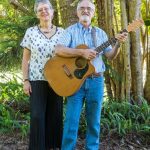
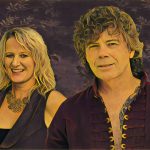
Quite a few of the guests appearing at the Maleny Music Festival this weekend have also played in our loungeroom over the last year or two. Cloudstreet, Fred Smith, Sadie & Jay, Tin Star, Karen Law Band and Steve Tyson (who brought along some of his comrades from Rough Red) are among those on the festival bill. We also welcome back Jenny Fitzgibbon from her world travels and, not to forget, we are doing a gig too.
The Goodwills with guest musician Helen Rowe play the Tibrogargan Stage on Saturday at 1.10pm. Laurel and I are also taking part in the Concert for Refugees on Saturday night in the same venue. The festival starts at the Maleny Showgrounds on Friday evening with a Welcome to Country and continues until Sunday afternoon, with a finale concert at 3.45pm with Zumpa. This is our third festival and we feel privileged to vie for the title of elder statespeople of folk!
Australia Post celebrates Winx’s record-breaking 26th consecutive win with a commemorative stamp
You’d have to say Australia Post had a bit riding on the champion mare Winx winning her 26th consecutive race at Warwick Farm last Saturday. Let’s say at the outset that this is about stamp collecting, not horse racing (surveys show the latter subject turns FOMM readers off – or politics – that was a three horse race…Ed.)
Whether you like horse racing or not, the existence of Winx the super horse must have filtered through, as it is many a moon since any horse won this many races on the trot, which is racing parlance for an unbroken winning streak.
Celebrating the mare’s place in equine history, Australia Post released a commemorative stamp, pictured here by courtesy of AP and ‘with perforations’ as requested. Journalists received the press release from Australia Post about a minute after the race was run and won.
“We plan ahead for important activities, achievements, and national events in the calendar, and had extra resources on standby to assist in producing the special stamps,” an Australia Post spokesperson said, in response to our obvious question.
So all ended well. If you are a stamp collector or philatelist as it is known in the trade, you will already have ordered your first day covers, special 26-stamp packs, a set of maxi cards and a medallion cover.
Horse stamps are not that unusual – examples include Black Caviar in 2013 and a set of four stamps issued in 1978. They featured Phar Lap, Bernborough, Peter Pan and Tulloch. The collection is notable for fine art work by Brisbane artist Brian Clinton.
Like Dusty Springfield, I was wishin’ and hopin’ and thinkin’ and prayin’ that either Malcom Turnbull or his nemesis were philatelists so I could make this politically relevant. But it seems only one (former) Federal politician, Philip Ruddock, collects stamps. This seemingly innocuous hobby at times embroiled the then Immigration Minister in controversy.
Ruddock, now Mayor of Hornsby Shire, was a member of Amnesty International. Critics found his membership of the organisation was at odds with his government’s hard-line immigration policies. In 2000, Amnesty asked Mr Ruddock not to wear his lapel badge when performing ministerial duties and not to refer to his membership when promoting policies opposed by Amnesty. AM 18/3/2000
In a profile for The Good Weekend in 2002, writer Richard Guilliatt was given a look at Ruddock’s collection, which spans three generations. Guilliatt, perhaps innocently, suggested that the high dramas of the job had spurred the stamp collecting hobby on.
“…every month letters pour into Ruddock’s Parliament House office in Canberra, imploring him to liberate the men, women and children detained behind razor wire in Australia’s desert camps for Third World asylum seekers,” he wrote. “Those letters come affixed with all manner of exotic stamps, which Ruddock gets his secretary to tear off so he can take them home to his house in the leafy northern hills of Sydney, to be packed away for sorting.
“That’s one of the good things about getting a lot of letters from Amnesty International,” Ruddock told Guilliatt.
If few politicians collect stamps, at least a dozen former Prime Ministers featured on Australian stamps in the 1950s and 1960s. It’s important to note that all received the honour after their deaths.
“Until the introduction of the Australia Post Australian Legends Awards in 1997, the only living person allowed on a stamp was the reigning monarch”, the spokeperson told FOMM.
Nevertheless, the PM’s head on a postage stamp seems clearly out of fashion now, in this era when one is never quite sure if the PM will last his or her term. But there have been enough sporting celebrities, athletes, actors, singers, writers and decorated soldiers to compensate.
In an aside for crime fiction aficionadas, the most infamous stamp collector award must surely go to Lawrence Block’s fictional hit man, Keller. John Keller is the protagonist in Block’s crime series which began with Hit Man in 1998. Keller collects pre-1940 stamps and uses down-time between ‘jobs’ to visit stamp shops and exhibitions. It’s a kind of cover for his apparent lack of legitimate income, not unlike Block’s gentleman burglar and antique bookstore owner, Bernie Rhodenbarr.
Many famous people are listed in various publications and websites as stamp collectors. The collection does not have to be distinguished to command a price. Former Beatle John Lennon’s collection of 550 stamps from his childhood was bought by the Smithsonian Institute’s National Postal Museum in 2005 for about $A74, 000.
Which brings me to the best-selling commemorative stamp of all time – the Elvis stamp released in 1993, Perhaps the delay since the rock singer’s death in 1977 was due to persistent ‘sightings’ of the late Mr Presley. Even today you will find folk who will tell you he is still alive and living under an alias, like someone in witness protection. Elvis would be 83 if still alive today.
The US Postal Service printed 500 million commemorative stamps – three times the usual print run. It was the most highly publicised stamp issue in the USPS history. The people were asked to choose between two designs (1.2 million votes), the majority preferring the stylised image of the young rocker, microphone in hand.
Stamps can be highly controversial items. For instance, the first secular Christmas stamp in the US, with its pair of white candles and a wreath with a red bow, was released in 1962.
Critics said it crossed the line between church and state. The public was also unenthused about a 1963 design – an illuminated Christmas tree in front of the White House.
Public takes dim view of Surfing Santa
The most controversial Australian stamp was also a Christmas release. The 1977 stamp featured a humorous depiction by Adelaide artist Roger Roberts of Santa Claus riding a surfboard. Some members of the public were affronted, saying the postal service was not taking Christmas seriously. Until 1975, all Christmas stamps featured religious themes, often based on the traditional nativity story. There was no such fuss about the mix of secular and Christian stamps released in 1976.
If you thought the popularity of email would adversely affect stamp collecting, the market is as robust and profitable as ever. As an extreme example, the One-Cent Magenta from British Guiana, issued in 1856 and thought to be unique, sold at a New York auction in 2014 for a record $9.5 million.
In 2007, the Australian collection of Arthur Gray was sold through Shreves auction house in New York for more than $7 million. Among the spectacular results was the $265,000 paid for a block of four 1919 £1 brown and blue Kangaroos.
So did you collect stamps as a child? Did you, as I discovered, learn at some point in your cash-strapped adulthood that the collection was worthless?
We had a family friend who spent most of her younger years travelling to exotic climes and would write, with bundles of stamps included ‘for wee Bobby’.
I gave away stamp collecting and its fussy handling (gloves and tweezers and corners to mount the stamps rather than pasting them in the album), around about the time I realised girls were interesting.
I still have those two old albums tucked away somewhere – among Father’s Letters, I’m thinking.
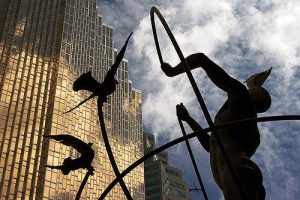
Monument to Multiculturalism in Toronto, a sculpture by Francesco Perilli. Photo by Shaun Merritt https://flic.kr/p/5d7sTp
My plan to write something cuddly and wholesome about Multiculturalism Month in Queensland was derailed somewhat by the egregious maiden speech of crossbench Senator Fraser Anning.
One of our newest politicians, he chose his maiden speech to call for a return to the White Australia policy, suggesting that a plebiscite be held to ask Australians if they want ‘wholesale non-English speaking immigrants from the Third World and, in particular, whether they want any Muslims’.
Politicians who make incendiary speeches are often misquoted, so this is exactly what Senator Anning had to say about Muslims.
“A majority of Muslims in Australia of working age do not work and live on welfare. Muslims in New South Wales and Victoria are three times more likely than other groups to be convicted of crimes. We have black African Muslim gangs terrorising Melbourne. We have ISIS-sympathising Muslims trying to go overseas to fight for ISIS and, while all Muslims are not terrorists, certainly all terrorists these days are Muslims. So why would anyone want to bring more of them here?”
He said a lot of other things too; about countering the growing threat of China both outside and within Australia; about building coal-fired power stations to return us to the cheapest power in the world, and about (ahem) restoring personal freedoms and free speech.
The thing that outraged many, however, was his use of the words, ‘the final solution’, made infamous by the Nazis in WWII. Senator Anning seems unrepentant, amid claims the speech was deliberately structured to be controversial and raise his profile. He claims the use of the term “final solution” (the Nazi regime’s euphemism for exterminating Jewish people), was “inadvertent”. But he has not backed down, saying the outrage is coming solely from political opponents.
The counterpoint to Senator Anning’s divisive speech was a plea for consensus by the Member for Chifley, Hon Ed Husic. His response in Parliament described the experiences of his Bosnian parents, who came to Australia in the 1960s.
“My old man worked on the Snowy Mountains scheme. Dad worked with his hands and Mum stayed home to make sure we had a family that could take advantage of all the great things in this country.
“Like many kids of migrants, I carry a debt – a debt of gratitude to this country that we were able to achieve this. I went to university. I could count on one hand the numbers of folks in my family or from my Dad’s generation that got to do that. Now I get to serve in this place (Parliament) and regardless of my faith, my commitment to the community is what I’m judged on.”
Opposition leader Bill Shorten weighed in, saying “…As leaders, as representatives of the Australian people, as servants of diverse communities in a great multicultural nation, we cannot stay silent in the face of racism.”
Even former MP John Howard condemned the tone of Anning’s speech, which is a bit rich coming from the bloke who introduced the One Australia policy in 1988, which called for an end to multiculturalism (and opposed a treaty with Aboriginal Australians).
Anning might not have read the spray in the Tweed Daily News from Australian-born journalist Charis Chong, who said that although she drinks all kinds of Australian beer and has a Weber in her backyard, “I’ll never be Australian enough”.
She talks of her negative experiences as an Asian Australia, but also her true friendships with people who don’t talk about assimilation – “they are just nice, decent people who appreciate each individual person for who they are.
“The problem with Senator Anning’s comments is that they seek to exclude people from ever being good enough to be ‘Australian’ simply because they don’t look ‘white’ or want to practice a certain religion.”
Katharine Murphy writing for The Guardian warned that the Anning speech was a sign that Australia was being caught up in global nationalist debates.
“What we are witnessing in national politics is the latest manifestation of Australia’s cultural cringe. Far right political operatives, and the media voices prepared to give them succour, are importing the nationalist debates that have sprung up in the shadow of the global financial crisis.”
Murphy is correct in saying that debates about race, multiculturalism, sovereignty and immigration have flared up elsewhere because of deep resentments felt by the losers of globalisation. While Australia was not as deeply affected by the GFC, the ‘outrage consciousness’ that exists elsewhere is being imported, validated and projected here, she said.
The 2016 Census revealed a lot about the ethnic makeup of Australia. Nearly half (49%) of Australians had either been born overseas (first generation Australian) or one or both of their parents had been born overseas (second generation Australians). Of the 6.16 million overseas-born persons, nearly one in five (18%) had arrived since the start of 2012. While England and New Zealand were still the next most common countries of birth, the proportion of those born overseas who were born in China and India has increased to 8.3% and 7.4% respectively. Malaysia now appears in the top 10 countries of birth (replacing Scotland) and represents 0.6% of the Australian population. While 52.1% of Australians identify as Christians, those who listed Islam as their religion numbered 620,200 or 2.6% of the population.
One might imagine that immigrants and refugees settling in regional and rural Australia would receive a chilly reception from the stereotypical ‘rednecks’ of the bush. But Prof. Collins wrote in The Conversation that a research project on immigrants living in regional Australia a decade ago dispelled this myth, with 80% of respondents reporting a warm welcome.
“Our new research confirmed this finding, with 68% of the refugees surveyed in Queensland overall – and 81% in Toowoomba – reporting it was ‘very easy’ or ‘easy’ to make friends in Australia.”
Meanwhile, people who believe in embracing multiculturalism continue to celebrate its existence, which in Queensland is the month of August.
If you live in regional Queensland and support cultural diversity, you could look out for BEMAC’s Culture Train. (BEMAC is Queensland’s leading multicultural arts producer, presenter and artistic development organisation).The train will be making 15 whistle stops on a tour that starts today. A group of five culturally diverse musicians will present free concerts and workshops starting at Dunwich (Stradbroke Island), then on to Dalby, Chinchilla, Roma, Charleville, Longreach, Barcaldine, Emerald, Rockhampton, Gladstone, Childers, Cherbourg, Toowoomba, Ipswich and finishing at the Brisbane Multicultural Centre on August 31. The Culture Train 2018 ensemble is: Sarah Calderwood: Celtic singer-songwriter, flute & whistle player, Chong Ali: Vietnamese rapper and emcee, Marcelo Rosciano: Brazilian percussionist, Ben Kashi: Persian dulcimer and percussionist and Gertrude Benjamin: Torres-Strait Islander folk and soul singer.
Sarah, who is also musical director, said the group would be performing shows which combine songs from the group’s vastly different cultures backgrounds, with individuals performing solo work as well.
“The five of us are thrilled to not only celebrate this diversity through music and storytelling,” she told FOMM, “but to promote inclusion and bring communities together to collectively celebrate multiculturalism in regional, rural and remote communities.”
Renewable energy – solar lights at Charters Towers-
For some time I’d been harbouring a suspicion that Queensland was a laggard when it came to renewable energy. That may have been the case in the past – wind and solar generation increased only 3% between 2006 and 2016. But a recent national survey by the Clean Energy Council found that eight of the country’s top 10 domestic solar panel users are in Queensland. Bundaberg, which has some 11,060 households with solar panel installations, tops the list.
The Clean Energy Australia report (2018) said that in 2017, more than 1100 MW of rooftop solar power capacity was installed Australia-wide. This has happened despite the winding back of once-attractive subsidies to install solar, as well as a reduction in the amounts paid for selling energy back to the grid.
At the end of 2017, more than 50 large-scale wind and solar projects were under construction or scheduled to start in the near future. This represents more than 5,300 MW of new generating capacity, $10 billion in investment and 5,750 new direct jobs. Queensland’s share of this new infrastructure will generate 2121 MW, a $4 billion investment creating 3,196 jobs. If all of the proposed projects come to pass, they will generate more than 15% of Queensland’s present day electricity needs.
While some regional Queensland towns (Emerald, Charters Towers, Hughenden), are building solar farms, my observations are that the domestic and business use of solar is hit and miss. We visited shopping centres in regional towns that have gone to the trouble of providing shaded car parks for their customers. These shelters usually comprised heavy duty shade cloth over steel frames. If they’d spent more money, they could have their very own solar farm, protecting shoppers from the punishing summer sun and generating their own electricity.
The lights upon the hill
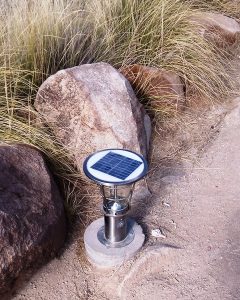
While it may seem relatively inconsequential, outback Councils and mining companies have adopted outdoor solar lighting, the latter to light pathways within mining villages. Charters Towers Council has spent a lot of money dressing up the town’s main attraction (Tower Hill), with picnic tables and a walkway made from recycled plastic leading to the 29 concrete bunkers which were used to store ammunition during WWII. At night, LED solar lights positioned every 20m or so light the steep path to the summit for the nightly amphitheatre show, Ghosts after Dark, a documentary about the town’s history and legends.
Renewable energy’s been on my mind since returning from 39 nights staying in caravan parks, recreation grounds, farm stays and free camps. The latter attract grey nomads and their generators. We were camped somewhere off grid for a few days, so I put our 120W portable solar panel out in the sun, as you do, while my neighbour primed his generator. It wasn’t that intrusive and he did shut it off at dusk, but when there are 90 vans on one large site…
Meanwhile, after three days off grid, our 12-volt lights and marine fan were still working; we charged our phones and my trusty laptop and all I had to do was to keep moving the panel as the sun passed over.
Until recently, we also had a portable solar light, a simple gooseneck lamp, very handy as an extra light when cooking. It has/had a pop-out panel you can hold in the palm of your hand. Alas, I left it sitting on a tree branch (charging), at the last or second-last camp site. We spent a fruitless hour or so traversing Townsville in search of an Ikea (from whence the light was purchased, moons ago). Alas, lackaday, it turns out there is no Ikea in Townsville. The GPS navigated us to the outer industrial suburbs to a warehouse which acts as a distribution depot for online orders (from outlets which so far have no real estate in Townsville).
Just because you have switched to renewable energy, that’s no reason to forget about maintenance. We have eight panels on the roof and a solar hot water system which pre-dates the panels. When the technician came to give the system its 10-year check-up, the part of the system which converts the sun into energy had given up the ghost some indeterminate time before. Which meant our hot water was being delivered via a 240v booster switch. This partially explained why (a) the water was sometimes not so hot and (b) the disparity in our power bill. So this week we hired a plumber who installed two new solar panels to service the hot water system. This cost a bit, but we are confident of once more returning to the world of smaller power bills.
Which brings us to the Australian Competition and Consumer Commission’s recommendation to wind down the Small-scale Renewable Energy Scheme by 2021.There are varying opinions as to whether that is a good or bad thing.
Lucy Percival of the Grattan Institute says the ACCC concluded that offering subsidies for household solar was a well-intentioned but ultimately misguided policy.
“Solar schemes were too generous, unfairly disadvantaged lower-income households,and failed to adjust to the changing economics of household solar.”
The SRES subsidy did not reduce as the cost of solar installation fell. So a larger proportion of solar installation was paid for by the scheme, as prices fell (from around $18,000 for a 1.5kW system in 2007 to around $5,000 for a 3kW system today).
In addition, premium feed-in tariffs were well above what generators were paid for their electricity production. Historically, solar feed-in tariffs paid households between 16c and 60c per kilowatt-hour, while wholesale prices were less than 5c per kWh.
Not everyone agrees that the ACCC got this right. Joseph Scales, national director of Solar Citizens said that while much of the ACCC’s report was ‘spot on’, the suggestion to slash the small-scale (subsidy) made zero sense.
“Solar is the best way to guarantee energy bill savings. Our governments should be helping more people to take the power back from the big power companies by installing cost-cutting solar.”
By way of example, New South Wales solar owners saved all of the state’s energy consumers $2.2 billion in just one year.
Meanwhile, the Council of Australian Governments (COAG) will meet today to decide whether to support the Federal Government’s controversial National Energy Guarantee.
Solar Citizens and other pro-renewable lobby groups have three main objections to what they see as flawed, old-school energy policy:
The NEG will allow energy retailers to continue to benefit from energy fed back into the grid from customers’ rooftop solar systems (given that many consumers are paid around 11c per Kw, while retailers charge upwards of 32c per Kw) ;
The NEG does not provide incentives for renewable energy but instead props up ageing and inefficient coal plants;
The renewable energy target for 2030 is now so low it will be covered by schemes already planned or under construction.
It’s hard to see the NEG fixing the number one issue – the rising cost of electricity. Meanwhile, some three million Australian households have taken the matter into their own hands, installing solar panels. Now we just have to convert the two thirds of households who don’t have solar that it is the right way to go.
The derogatory label ‘tree hugger’ is worn with pride by environmental guerrillas, the ones who chain themselves to trees in a bid to prevent them being chopped down.
The Merriam Webster Dictionary defines tree hugger as ‘someone who is regarded as foolish or annoying because of being too concerned about protecting trees, animals, and other parts of the natural world from pollution and other threats’. Yes, well, that’s objective.
Although chaining yourself to a tree as a form of conservation protest is more often associated with North America, you’ll find many such tree hugger examples in Australia. In Tasmania’s Tarkine forest, conservationists protested logging by direct action. Suburban tree hugger types arc up when councils decide to fell established trees for public liability or other specious reasons.
Trees, as the occasional crossword question will remind us, are the largest plants in the world. They not only provide animals and humans with shade and shelter, they pump out oxygen, suck up carbon, stabilise the soil and provide homes for native birds and animals. Trees are great for children to climb and big ones often support tree houses and swings. And as anyone who lives in a timber house could attest, once removed from the landscape, trees make permanent shelters for humans. Moreover, generations of young lovers have carved their initials in tree trunks. The latter is not world’s best practice, though, as damaging a tree’s skin (bark) can start a deterioration of the plant’s health.
Tree hugger paradise – ancient Ooline forest
On our six-week outback trip last month we visited one of the few remaining stands of Ooline forest in Tregole National Park, which only achieved that status in 1995. Tregole’s Ooline forest survives in semi-arid, south-western Queensland, between two of the State’s natural regions, the Brigalow belt and the Mulga lands. As the National Parks website tells us, “the park protects a small but pure stand of ooline Cadellia pentastylis, an attractive dry rainforest tree dating back to the Ice Age”.
Ooline has been extensively cleared and is now uncommon and considered vulnerable to extinction.
In Queensland, a very large northern state of Australia, trees have been under siege and remain endangered by forestry activities and by clearing for agriculture or mining. Only 9% of Queensland is forested, compared to 16% of Australia overall.
The ABC did a fact checking exercise during the last state election, to verify the claim that Queensland was clearing more timber than Brazil.
Some 395,000 hectares of regrowth and old growth vegetation was cleared in 2015-16, a 33% increase over the previous year. Queensland accounts for more than half of Australia’s total losses of native forests. This dire statistic generated critical editorials in international media.
The ABC fact checkers vindicated the claim by the Queensland Greens that more than one million hectares of native bush and forest was cleared in Queensland over four years.
“Land clearing in Queensland is now on par with Brazil,” the Greens said.
Unhappily, the rate of land clearing tends to increase under the management of conservative governments (voted in primarily by farmers, miners and the businesses that profit from agricultural and mining commerce). One of the infamous innovations of land clearing was the ‘ball and chain’ method, involving two bulldozers, a giant steel ball and a ship’s anchor chain. The chain was secured between two bulldozers (with a third bulldozer often following on behind to add weight to dislodge larger trees).
The felled trees were swept up into a giant pile and left to dry for up to a year before being torched (in itself an ecological disaster).
Although the use of a five-tonne steel ball has largely been discontinued, many landowners still engage contractors to use the dozer and chain method to clear light scrub and forest. A good contractor can clear 40 hectares a day.
Fortunately, Labor governments tend to block or reverse the worst of the land clearing excesses. Queensland’s Palaszczuk government passed new legislation in May limiting broad scale land clearing. Farmers demonstrated outside Queensland parliament as the bill was being debated.
Meanwhile, the deforestation of Indonesia, South America and other continents and countries continues unabated. The World Resources Institute says that more than 80% of the Earth’s natural forests already have been destroyed, with clearing continuing at the rate of 20,000 hectares per day.
Tane Mahuta and the risk of dieback
If you have visited New Zealand and saw the country’s oldest and largest Kauri, Tane Mahuta, you were indeed fortunate. Two thousand year old Tane Mahuta, held sacred by the Maori, is at risk of infection from Kauri dieback, a disease which has already picked off many old Kauris in the surrounding forest in Northland and elsewhere in NZ.
New Zealand’s once massive Kauri forests were plundered over the centuries for ships’ masts, houses and other buildings and simply to clear the land for agriculture. In the 1700s, Kauri covered 1.2 billion hectares. Today the coverage is less than 4,000 hectares.
Meanwhile in Maleny, Australia, we ‘small c’ conservationists nurture the native trees on our half acre block, which remains well wooded. We rid the bottom of the block of every bad weed known to man or woman, circa 2002, planted several natives and allowed the area to regenerate as native forest.
The downside is a straggly line of giant camphor laurel trees which straddle the boundary between our block and a neighbour. We felled the biggest and oldest camphor as it was too close to the house, its root system undermining the driveway, massive limbs swaying about during storms. We felt bad about hiring someone to remove that huge old weed tree, imagining its psychic pain as chainsaws did their fatal work.
Did you know the term ‘tree hugger’ can also mean someone who physically hugs a tree to become more at one with nature?
“Good morning, tree.”
“Morning, Elspeth, coffee smells good. Ahem, I don’t suppose I could have a glass of water?”
BBC culture writer Lindsay Baker found that the recent emergence of ‘tree literature’ is no new thing, quoting the likes of William Wordsworth (It Was An April Morn), John Clare (The Fallen Elm) and German poet and philosopher Herman Hesse (Trees: Reflections and Poems).
“Trees are sanctuaries,” wrote Hesse. “When we have learned to listen to trees… that is home.”
New age and literary tree-isms aside, ‘small c’ conservationists can do their bit to save trees without necessarily chaining themselves to bulldozers or a Wollemi Pine (critically endangered, according to the Canberra Arboretum, which hosts 31 endangered species).
In 2014, we set ourselves a carbon-neutral cap after towing a caravan 15,000 kms around Australia. Our carbon footprint for this epic journey was 4.77 tonnes of CO2, based on driving 15,000 kms at an average 14.5 litres per 100 kilometres. This translated to $24.15 per tonne or $115.95. We donated this amount to Barung Landcare, where we often purchase trees, plants and ferns from their native nursery.
Our 2018 outback trip (6,000 kms), which ended on Monday, should cost us around $50 as our version of the ‘carbon tax’. Or we could just wander around the block, hugging trees (hose in hand).
Recommended reading: The Bush – Don Watson, Barkskins – Annie Proulx, The Hidden Life of Trees – Peter Wohlleben.
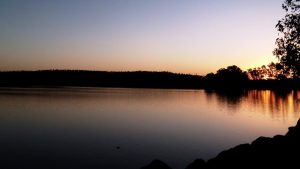
Theresa Creek Dam at sunset. Caravan maintenance and the art of journaling.
As we start out on the last six days of a six-week caravan adventure, now is the time to dig into my journal for publishable insights and ironies. We found quite by accident an oasis in the outback called Theresa Creek Dam, 22km south west of Clermont. The dam was built here in 1985 by Blair Athol Coal to supply Clermont with drinking water.
It’s a tranquil lake spanning some 8,100 acres with abundant birdlife and a special kind of light. The dam is also an angler’s paradise, stocked quite recently (2015-16) with 14,200 barramundi and 34,147 golden perch. There’s also jewfish, saratoga and red claw. All kinds of boating is allowed, but you must have a licence to go fishing.
So after some hard driving across the flatlands of central Queensland, known for beef cattle and abundant reserves of coal, we took time to sit by the cool waters and reflect on the journey. We also did some running repairs on car and caravan. I say ‘we’ advisedly, as I am the sort of impractical bloke who will try three ways of doing something before the fourth and correct way.
This trip has not been without its mishaps, starting with the realisation, three days out, that the three-way caravan fridge wasn’t working. It cost $230 for a fridge mechanic in Charleville to tell us the bad news, that the fridge, given its age and resale value (nil), was not worth fixing.
So it’s had a good innings, this fridge, which the mechanic said was still working on gas, or at least it was until we took the van on dirt roads. She Who Plans Ahead Even When Being In The Moment reckoned it would cost $500 just to get the old fridge removed and a new three-way fridge (about $1200) installed.
The alternative, we figure, is an upright 12-volt fridge which will also cost about $1,100 but the installation will be a piece of cake. It can then run off the car battery when driving, the van battery when camped and the solar panel can keep the latter topped up. (Meanwhile, we pretend we’re in the 1920’s and use the fridge as an icebox, replenishing ice every couple of days. Ed)
In other on-road adventures, we bought a new car battery in Clermont. The old on failed once at Mt Surprise for no real reason other than to suspect the original Ford battery (four years old) was about to cark it. We got a ‘low battery’ warning a few days ago when starting the car, so got it tested in Clermont by the local RACQ approved repairer.
Handy Mandy and the art of caravan maintenance
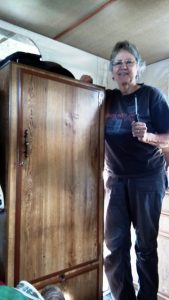
The other challenge was the caravan wardrobe door, which fell off while we were bouncing our way across the dirt road shortcut between Hughenden and The Lynd. Fortunately, the mirror on the inside of the door remained intact. Not so the hinges, which apart from matching all other hinges in the van, proved a curse to replace. Uncle John, who is possibly more handy than She Who Screws With her Left Hand (make of that what you will), tried three different hardware stores on the Atherton Tablelands and came up empty. He suggested a hardware store in Cairns which (a) was hard to find) and (b) couldn’t help us anyway. Persistent as always, SWSWHLH found a set of offset hinges in a caravan supplies shop in Townsville. But there were only two to (the only) packet. Not to be deterred, SWSWHLH took a hinge off a back cupboard, replacing it with the damaged one off the wardrobe, figuring that it ‘would do’ as it is not load bearing. So yesterday, with my assistance, She hung the wardrobe door and what do you know, it closes and locks. Yay. Estimated cost $4.86.
Anais Nin and my 40-year journaling habit
All of these little challenges are detailed in my journal, a long-running series of notebooks which contain not only factual observations, but also fiction and my interpretations of life as it progresses. It’s hardly the erotic adventures of Anais Nin, but as any good psychologist could tell you, it can be cathartic and even helpful to pour one’s feelings out in a journal that will hopefully never be read by anyone else. My executors have their instructions.
My journal contains sentiments which could be misinterpreted in the context of a loving relationship spanning many years. For example, Ms Acronym is apt to interrupt my sudden brilliant flashes of creativity, encouraging me to go birding, walking, do the laundry, work out what we’re doing tomorrow etc just when the small kernel of a new song has started rattling around in my head.
And as she no doubt caustically observes when scribbling in her own book, when travelling I tend to get dazed and confused in the late afternoon, readily confusing left and right and north and south. I grant that one’s spouse could find that exasperating, as I so often insist my way is the right way (when it is abundantly clear it is not).
She Who Keeps A Journal While Travelling has another writing exercise where she is supposed to spend 10 minutes writing down her feelings and then burn the paper. I apparently blundered into this exercise, rummaging around in the fridge (kept cool with ice boxes), saying “Honey, where are the carrots?” (My riposte was milder than you might suspect. Ed.)
Other minor mishaps on this escapade were usually due to somehow getting lost, which we either found amusing (or not). On leaving Glenmorgan for Surat (we’d been at Myall Park, a fascinating botanic garden in the bush), our GPS told us to turn left and continue down a corrugated dirt road which, half an hour later, had not yet met a bend. As my journal now tells me, some weeks after we stopped being annoyed about it, if we had not taken this road less travelled we would not have seen a mob of wallabies, a Bustard, a feral cat, four dead dingos hanging from a tree and a drover on a horse, durrie hanging from the corner of his mouth, who gave us a puzzled look and a laconic wave as if to say ‘are youse lost or something’. Later we deduced we had taken a local access road through various pastoral properties, emerging some 120 kms later at Surat.
We share equal blame for mishaps and forgetfulness. Someone left the van step on the footpath in Augathella while we went to take photos of murals. “Maybe someone nicked it,” I said, in an attempt to be charitable.
We drove on to Morven, planning to have a leisurely meal at the pub then watch State of Origin II. Alas, the pub burned down two years earlier so we ate canned stew and watched the game on the Ipad. I believe it is called finding strength in adversity.
My best act of dazed and confused was going into the ladies loo at Morven Recreation Ground. I came out of the shower wearing only a towel to find a woman about my own age looking less than excited to find a paunchy, near-naked old man in the ladies’ loo. “I think you’re in the wrong place, mate,” she said, in that charming understated outback way, adding “Ewes means girls, mate.”
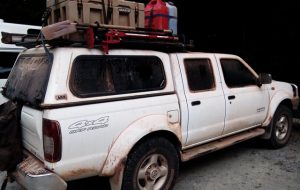
On the last day of Queensland’s school holidays, a steady line of dusty 4WD’s returning from Cape York are queuing up for the Daintree River ferry crossing. Many of these road-beaten vehicles are rentals from Cairns. You can tell the real deal 4WD by the snorkel (a vertical exhaust above the cabin – designed for crossing creek and rivers without killing the engine).
Kids or even adults have written epitaphs on the dusty windows including “Cape York or bust” “Been there done that” and “still driving”.
(And my very favourite one-“Capey McCapeface”.Ed)
The bitumen road peters out just past Cape Tribulation in the Daintree rainforest. Intrepid travellers with appropriate vehicles can take the scenic Bloomfield track to Cooktown then loop back along a sealed road to Lakeland, where the 582 kms journey to Weipa begins. After Weipa, the route becomes a 4WD dirt road with a few sealed sections, all up 908.4 kms, a 28 hour drive to the northernmost tip of Australia. Last time a survey was done, between 60,000 and 70,000 people had made the arduous trek every year. Those are small numbers compared to the volume of tourists visiting Uluru or Kakadu National Park, but in the context of a wild, undeveloped frontier, it’s a lot of traffic.
Some take organised 4WD tours, some fly/drive; others take a boat to Cape York and come back by road. If you do decide to drive from Lakeland, you have an estimated 15 and a half hour journey to Weipa (averaging 37 kmh). By contrast, the bitumen road from Cairns to Lakeland is a three hour drive (250 kms).
You might know that our outback travelling is constrained by the limitations of a six-cylinder rear-wheel drive vehicle and a 30 year old caravan. It’s a high-set van, but as recent journeys on unsealed roads have shown, the suspension is not built for corrugations. We call the 271 kms short cut from Hughenden to The Lynd, which has sealed sections and some rough stretches, ‘The Road that Broke the Wardrobe Door’.
So our adventures north of Cairns were limited to a day trip from Newell Beach to Cape Tribulation and back, via a cruise on the Daintree River, two hikes in the rainforest and the extreme disappointment that arose from listening to the Broncos getting thrashed by the Warriors (well may you scoff and say, ‘what’s that about being in the moment’?).
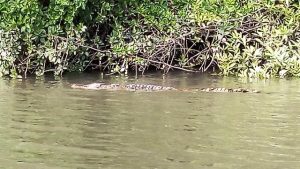
Daintree River croc – Cape York or Bust
Despite the high tide, we saw three crocodiles on the (highly recommended) one-hour Solar Whisper cruise, including a 3m croc known as Scooter who decided to swim along the mangrove-lined bank a few metres from the boat. John the skipper pointed out a few birds including an Azure Kingfisher, a Papuan Frogmouth, a Rufous Night Heron and Radjah Shelducks. (There are photos on my camera, but the downloading process is rather primitive. Ed)
As for Cape York or bust, I can only repeat what authorities will tell you: take extra fuel, water, tyres, vehicle spares, a jack or two and a shovel. Always give way to wildlife. Note to those who are tempted: there is no mobile reception in much of the Cape region and satellite phones do not always work.
Nevertheless, Cape York or bust is a major bucket list item for the intrepid traveller; some ride trail bikes, others mountain bikes and more than a few walk the track, carrying their food and shelter on their backs.
Tourism is just one part of the Cape York story, a tussle between pro-development lobbyists (remember the Spaceport?), the mining industry, pastoralists, the traditional owners and increasing awareness that this pristine wilderness has to be protected for all time.
Even on the relatively tame Mossman to Daintree road there are decisions for the risk-averse. We don’t often take guided tours, but when it comes to croc-spotting (that’s Scooter on the left) on the Daintree River, go with an expert. I told our skipper about Paddy McHugh’s chilling song, Dan O’Halloran. He’d not heard of it, but I said he should look it up but maybe not share with his passengers. Not to spoil a good story song, I’ll just give you the chorus line: “Nobody knows what happened to Dan O’Halloran except me, and it makes me shiver”.
As we drove back along the narrow, winding but sealed road from Cape Tribulation, I wondered if (in the future) I had a Cape York or bust trip in me, and, when I did, would it be a sealed highway by then.
Successive governments have made efforts to upgrade the road from Lakeland to Weipa, which in 2014 still had 380 kms of dirt road, impassable after rain.
The Federal and State governments co-funded work to seal sections of road between Lakeland and Weipa, on the Cape’s west coast. Weipa is the site of a major mining operation and a deep water port. So there are commercial imperatives involved with sealing that road.
But it is a slow process, at about 30 kms per year on average between 2014 and 2018. The slow pace of the project was used as an election issue in 2017.
The numbers of tourists visiting the region fluctuate according to economic conditions and extreme weather events. Studies have concluded that the majority of Cape York adventurers are self-contained, so their contribution to the local economy is negligible.
As the Federal Government’s Wild Rivers report observed, Cape York is large and underdeveloped and only accessible for eight or nine months of the year. The region comprises 15% of Queensland in area, but accounts for only 0.3% of the State’s population. Cape York’s residents are amongst the most disadvantaged in Queensland. More than half (54%) of Cape York people aged 15 years and over have a gross weekly income of less than $400 per week.
While sealing Cape York’s main road and also minor roads to Aboriginal communities might be a good thing for locals (less wear and tear on their vehicles and all-weather access), one ought not to make the trek too easy. Cape York has been nominated as a UNESCO World Heritage site (near neighbours, the Great Barrier Reef and the Queensland Wet Tropics, are already listed). But as the University of Melbourne’s Jo Caust recently wrote in The Conversation, some World Heritage listed sites are being loved to death and authorities need to exert some control over visitor numbers.
When you read about the impact of mass tourism on Cambodia’s Angkor Wat and Vietnam’s Hoi An, a coastal town that escaped the ravages of war, perhaps it’s a good thing that mass tourism is unlikely in Queensland’s rugged and remote top end.
Cobbold Gorge, north Queensland, one of Australia’s special gorges.
Although I clearly remember rubbishing the concept of a “bucket list”, it appears we may have had one all along, namely a list of famous Australian gorges.
This week’s visit to much-lauded Cobbold Gorge, south-east of Georgetown in Savannah country, turns out to be the 10th gorge we have visited from a debatable list of 14 “must-do” destinations. Despite its remoteness, privately-owned Cobbold Gorge attracted 11,500 visitors last year and judging by our two days staying in the bush caravan park, they’re on track for another good year.
Most Australian gorges of any merit are enshrined within national parks, with Cobbold Gorge the exception, through an agreement with the Queensland Government where a tourism venture is allowed to exist within a pastoral lease. The Terry family own the 330,000ha Robin Hood station, with 4,720ha set aside as a nature reserve. The family run 4,000 head of Brahman cattle on the property, which they have owned since 1964. They are the second European owners, after the Clark family who owned it since 1900 and the Ewamian, the traditional owners.
Robin Hood station, even today, is accessible only by a partially sealed road from Georgetown to Forsayth and then 41 kms of dirt road. The land in this region is cut off in the wet season (December to March). It’s not difficult to imagine the hard life out here before electricity, before a proper road was formed from an existing bullock track.
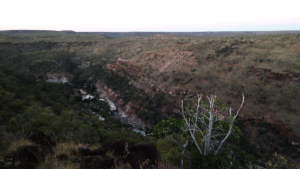
Like most gorges, Cobbold was formed millions of years by water scouring out a channel through a basalt cap then down into the sandstone and gravel escarpment. This is a narrow gorge, 2m wide in some places, which gives rise to the theory that it is relatively young.
Porcupine Gorge, one of Australia’s must-see gorges
Last week, we spent a couple of days at Porcupine Gorge, a National Park between Hughenden and The Lynd. Porcupine Gorge is sometimes referred to as Australia’s ‘mini Grand Canyon’ as its canyon walls are wide apart, eroded over millions of years by Porcupine Creek, a tributary of the Flinders River. We took the walk down into the gorge, a mere 1.2 kilometres, except for the 1,800-step uphill return walk. It cost about $25 to stay here two nights – stunning location but a bit short on facilities (hybrid dunnies). You have to come prepared, carrying your own water, food and power source.
By contrast, Cobbold Gorge tours have to be booked and paid for ahead of time and there is no alternative to a guided tour. Now that I’ve seen the infrastructure the Terry family have built there and taken the tour, I have no argument at all with the $92 fee (and $41 a night for a powered site). The facilities (the village also has motel units) and amenities are first-class.
Most of the information here was gleaned from a bit of note-taking and chatting to the guide, Graham, after the tour. The owners invested a lot of money to set up this eco-tour without any security of tenure. It was only recently that the Queensland government came to an agreement that the family would be compensated if at some future point the gorge becomes a National Park. As it stands, the nature reserve, a tract of old growth bush, can also be used for grazing and water can be taken from the Robinson River. No felling is allowed though, so the bush is allowed to regenerate.
We put this landmark on our list when last in the Savannah country circa 2007. We’d bumped into old newspaper contacts at Undara Lava Tubes. They told us they’d just come from Cobbold Gorge and said it was a special place and a must-do experience. It seems this natural gorge became a tourist attraction largely by word of mouth. The first white people to see the gorge were the Terry family’s teenage children who apparently drove a truck far enough in to carry a dinghy to the gorge and go exploring. It wasn’t long before friends and family started asking if they could visit and that led to the establishment of the tourism enterprise in 1994 (200 people visited in the first year).
The tour involves a short journey by four wheel drive bus, a walk up the sandstone escarpment to see the gorge from above then a ride on a flat bottomed boat (powered by whisper-quiet electric motor).
The walls rise up to 30m and at times the gorge is so narrow you can almost touch both sides. Spiders sit patiently waiting by their intricately spun webs. There’s Jurassic vibe about this gorge, silent and still except for a freshwater crocodile which retreated beneath a rock ledge as we approached.
Last year, Etheridge Shire Council proposed making an application to have 49,000ha of the shire listed by UNESCO as a Geopark. The ABC reported that local graziers were worried what impact this could have on pastoral activities. The proposal caused deep divisions in the shire, but at this stage the plan has not been progressed.
One could see why Etheridge Shire would want the region to become ever-more attractive to international eco-tourists. The famous Undara Lava Tubes are also within Etheridge Shire, which encompasses an area two-thirds the size of Tasmania. For all its size, the shire has only 1,500 ratepayers and has to rely on grants from State and Federal governments.
Our previous visits to well-known gorges like Carnarvon (Qld), Nitmiluk (Katherine Gorge, NT), Wattarka (Kings Canyon, NT) and Karajini and Widjana (both in WA), have mostly involved independent exploration. Hiking in outback gorge country is not without its risks. You can get lost, run out of water, have a fall or be bitten by a venomous snake.
No wonder Cobbold Gorge asks hikers to sign in and out when exploring the bush tracks. They also have a ‘no-selfie’ rule when standing atop the escarpment! It makes you think how the early explorers got by on horseback carrying water in canvas dilly bags, living off damper and bully beef, perpetually in a quest for the next waterhole.
I expect this won’t be the last of our gorges visits on our six-week adventure. There’s Barron and Mossman further north and Cania Gorge on the way back home.
When you visit one of Australia’s remote National Parks, with or without gorges, it is hard not to soak up the timeless influence of the First Nations people. Cobbold Gorge was named after the famous Australian pastoralist Francis Cobbold. The Ewamian tribe were the original inhabitants of this land and there is a section on the gorge tour where guides tell visitors the Ewamian have asked them not to interpret the site or allow people to enter and take photographs.
A few months back, Aboriginal journalist Jack Latimore wrote an opinion piece in the Guardian Weekly, noting that two mountains in central Queensland were to revert to their Aboriginal names.
Jack thinks all Australian landmarks and monuments should revert to their first nation names, but he doesn’t stop there. Boring names like Brisbane, Sydney, Melbourne and Adelaide (all named after British Lords and Sirs), should also be given their native monikers. How about Mianjin instead of Brisbane?
Brisbane based duo Sadie & Jay are our house concert guests on Sunday 5th August after recently returning from their second successful tour in the UK. The duo is a creative combination of a deeply traditional folk musician (Jay), with a jazz, blues and roots singer (Sadie). Their songs feature the duo’s vocal harmonies, Jay’s intricate finger style guitar, bouzouki and banjo and Sadie’s double bass. They are influenced by the storytelling nature of the Anglo-Celtic traditions and contemporary folk, blues and roots music which reflects in their collaborative songwriting.
Sadie & Jay recently spent six weeks performing and promoting their second album ‘Rogue Folk’ at folk clubs, house concerts and festivals in the UK. They were thrilled to be guests performers at Upton upon Severn and The Great North Folk Festivals. They won The Great North’s ‘World Around Us’ song competition with their A Capella piece “Song Already Written.”
The concert on August 5, which starts at 2pm, also features house band The Goodwills with guest musician Helen Rowe. Tickets are $15 at the door and afternoon tea will be available. Bookings are essential.
As we are travelling in July, the best way to book is to send Laurel an email goodwills <at>ozemail.com.au or through our contact page.
NB: Our June house concert guests Tin Star, Sadie & Jay and The Goodwills have all been booked to perform at the Maleny Music Weekend August 31 – September 2. Don’t miss Bob & Laurel’s other musical endeavour, as part of Maleny chamber choir ‘Tapestry’ – performing at this festival on Sunday September 2.
Goodwills house concerts are sponsored by the Queensland Folk Federation
From Hughenden: No 3 in an outback adventure series
So we’re driving into Longreach from Barcaldine, a journey rarely punctuated by a bend in the road, when snippets of a song jump into my head.
“I dunno why they call it Longreach, it doesn’t seem that far to me,” goes the line from one of Mick O’Halloran’s songs. .
Unlike much of the outback, at least you know when you’re coming into Longreach, 1,175 kms north-west of Brisbane, because of the unmistakable landmark which is the Qantas Founders’ Museum. We found our way to the town information centre and paid $6 for the privilege of camping for two nights at Apex Park, 4 kms west. The photo doesn’t quite do justice to the sight of 90 or so caravans, fifth-wheelers, slide-ons, camper trailers, A-vans, converted buses and the occasional tent, squatting in the dust alongside the Thompson River.
There’s a barbecue and covered picnic tables, flushing toilets and it’s only five minutes from town. But we were all a bit too close together for comfort and there were irritants like drifting smoke from camp fires, the grumble of generators, the untimely crowing of feral roosters and the bloody flies! I’ve been on a quest for a pair of his and hers fly swatters but so far on this trip they’ve been out of stock everywhere we looked.
I could not help noticing how many more vans there were in the morning, implying that some arrived late (or early), as it the habit of the lesser crested grey nomad, nabbing the best sites. I’m not suggesting they do it to avoid paying $3 – nobody’s that much of a tight arse.
Apex Park is reached via the Landsborough Highway west of Longreach across a series of bridges forming a long causeway across the Thompson River flood plain. The Thompson is a 3,500km long inland river that runs across channel country into Lake Eyre. While Longreach, like other western Queensland towns, has relatively low rainfall (average 450mm a year) floods are common because the many tributaries of the Thompson join and spread during heavy rain. The causeway’s 16 interlinked bridges stretch 24 kms across the flood plain, one effort to minimise flooding in the town.
We drove to the other side of Longreach for a late afternoon walk through Iningai Nature Reserve. Named after the traditional owners, this example of Mitchell Grass Downs country along the Thompson River has been allowed to regenerate since goats left it a dusty desert in 1950. There’s a fine example of a Coolibah tree, under which one can pose for the inevitable photo. The reserve is touted as a bird watcher’s paradise but we didn’t see many, maybe because night was gathering fast. Tip for bushwalkers – always carry a torch.
Onwards to the town seeking to claim the crown of South Australia’s Quorn as the country’s best known outdoor sound stage. Major films like Mystery Road and Goldstone were filmed in the Winton district. We were in Winton primarily to enjoy the Outback Film Festival, established in 2013 after the successful premiere of the aforementioned Mystery Road, starring Aaron Pedersen as a surly black cowboy detective. Some 400 people packed in to Winton’s famous open air theatre for the event, which remains the main venue for the film festival. Some films are also shown in a theatre at Winton’s rebuilt Waltzing Matilda Centre.
We saw some great films in the four days we were in Winton including Mystery Road, Sweet Country, Brothers’ Nest (starring Shane and Clayton Nicholson), documentaries (Night Parrot, Black Panther Woman and Backtrack Boys stand out), and a gory sci-fi film, Upgrade, which was a last minute replacement for That’s not my Dog.
If you get bored with the show you just look up, let your eyes adjust and take in nature’s starry, starry night. When Upgrade finished about 10.20 we were heading to bed but noticed that comedian Lawrence Mooney was doing an R18 late show at the North Gregory Hotel. Mooney came out in character as PM Malcolm Turnbull and wasted no time establishing the tone with a few swear words.
“Are there any kids here?” he asked. “If there are, f*** them off because this is an adults-only show.”
Mooney’s sharp satirical sword spared no-one; Millennials and Gen Xers copped it, so too the Greens, Labor and a few Senators singled out for special mention. Two people walked out when he made a joke about farmers and suicide and one heckler in the front row kept up such a running commentary Mooney resorted to telling her to shut the f*** up. You attend late night comedy shows at your own risk.
Grey nomads also copped a spray, although they were so under-represented in the Monday night audience there was little risk someone would take offence at his suggestion that serial killers should stop preying on backpackers and focus on grey nomads instead “because nobody cares”.
The telling part near the end of his show was Mooney asking the audience of 30-40 people how many actually lived in Winton. One woman raised her hand only to say she used to live in Winton but had moved away.
I had vague ambitions about driving out to Middleton, where Mystery Road was shot, until I figured out it was a 360km round-trip. Every place of interest around here is at least two hours’ drive away.
The Outback Film Festival, A Vision Splendid, is a bold project for a small outback community to sustain. It deserves to be supported (and you can still find time to go fossicking or dinosaur spotting).
On Wednesday night we got glammed up and went to the 100th Anniversary celebrations of the Royal Open Air Theatre, which included dinner and a special screening of the silent film classic, The Sentimental Bloke.
It meant skipping the spectacular sunsets you so often see in the flat country spreading west, but there are sure to be more as we head north to Hughenden and the Gulf country.
The alert among you will observe that this was posted on Thursday, as we’re going bush and will be out of WIFI range for a few days. I’m off to buy some block ice as our caravan fridge decided to cark it (Aussie expression meaning it died). After our visits to the Stockman’s Hall of Fame in Longreach and Barcaldine’s Australian Heritage Centre, which tell stories of the hard life of country people in the 1800s, getting by without a fridge for a few weeks is no great hardship (as long as you don’t forget to buy the ice-Ed.)