Odd socks stamp out mental health stigma

mental-health
Odd socks for mental health, photo supplied by www.grow.org.au

My choice to wear a matchless pair of socks today was a deliberate tribute to Mental Health Week. Odd Socks Day is just one of the many events sponsored through October to remind us that one in five Australians suffer a mental health disorder in any 12-month period.

I’d never heard of Odd Socks Day, but spotted a flyer in a café somewhere and tucked it away for future reference. It’s a national anti-stigma mental health campaign now in its fourth year, using odd socks as a metaphor that anyone can have an off day.

Despite the fact that the majority of people visiting GPs are consulting them about mental health or psychological issues, those with physical ailments are not confronted with the same level of discrimination, stigma and social shame.

Young people are particularly vulnerable to stigma. Research in 2016 uncovered some alarming facts about stigma and what an obstacle it is to people trying to recover from a mental illness. Headspace found that 26% of young people aged 12-25 would not tell anyone if they had a mental health problem and 22% would be unlikely/very unlikely to discuss it with their family doctor.

Fifty-two percent of young people (12-25) identified with having a mental health problem would be embarrassed to discuss the problem with anyone and 49% would be afraid of what others think.

The Royal Australian College of General Practitioners recently found that 62% of people (via the traditional 10-minute consultation), were seeking support for mental health disorders.

The most common mental health ailments likely to afflict people are depression, anxiety and substance abuse. Sadly, many people struggling with depression use drugs and/or alcohol to self-medicate, often with negative results.

In my former work life, the notion of taking a ‘mental health day’ was anathema to your average hard-bitten journalist, for whom the deadline reigns supreme. But in recent years the previously taboo subjects of depression and suicide are now being freely publicised and debated. The hidden cost of not properly dealing with workplace mental health problems is now an $11 billion problem for Australian commerce. There is now an argument that $1 spent on mental health services equates to a ROI (return on investment) of $2.30. So why aren’t we spending?

If there is one indicator to show how stigma and mental health ratio is shifting, it is the NRL ‘casualty ward’, which lists rugby league players and their injuries. Through the season I recall at least six players said to be having counselling for ‘psychological’ or ‘personal’ issues, the latter covering a range of non-physical traumas. Dragons half Ben Hunt spoke candidly to the media this year about seeing someone to help overcome a slump in confidence. Armchair critics (virtual bullies) did not help Ben’s situation, with a steady stream of vitriol posted on social media.

Suicide is often the end-game for people fighting ongoing battles with mental health disorders. Australia’s standardised statistics on suicide are not as high as some (11.7 per 100,000 people). Lithuania (28.6) and South Korea (26.3) head the World Health Organisation list, but Australia is nonetheless in the list of 10 countries with a suicide rate in double figures and has been for a decade.

In Australia, men are three times more likely to commit suicide (17.8 deaths per 100,000 people) than women (5.8 deaths per 100,000 people). More than 75% of all severe mental illnesses occur prior to the age of 25, and youth suicide is at its highest level in a decade.

The telling statistics revealed by the Royal Australian College of General Practitioners clearly show that the system is under untenable strain.

Author Jill Stark wrote about it in a Sydney Morning Herald opinion piece – ‘What happens when the answer to R.U.O.K is no and there’s nowhere to go?’

Stark wrote from a first person perspective, after  fronting up to a GP with what she suspected was an acute recurrence of anxiety and depression. She was handed a form to fill in – a routine step in such a consultation, so the GP can make a more objective assessment of the patient’s mental health state. As Stark related, she scored 25 ‘mild to moderately depressed’ and was prescribed medication (after first being asked if she was suicidal).

The answer was no, but on the way home Stark reflected that should she indeed want to kill herself, she’d been prescribed with something well-equipped for the job.

As Stark bluntly pointed out, the time for wristbands and hashtags has passed. Doctors need the financial support Medicare can bring by allowing longer consultations for patients with complex psychological problems.

“As a matter of urgency we must stop rationing psychological services to 10 subsidised sessions per year,” she wrote.

So that was Jill Stark, wearing her odd socks in public. Bravo.

People like Jill who are having an acute mental health crisis need expert support at least once a week for as long as the crisis lasts.

The Black Dog Institute reminds us that 45% of Australians will experience a mental illness in their lifetime. One in five mothers with children younger than two will be diagnosed with depression. At 13%, depression has the third highest burden of all diseases in Australia (burden of diseases refers to financial cost, mortality, morbidity etc).

The World Health Organisation (WHO) estimates that depression will be the number one health concerned in both developed and developing nations by 2030.

That gloomy prediction was no doubt behind the WHO’s decision in 2013 to introduce an eight-year plan to change the direction of mental health in its 194 member states. The plan’s main objectives are to:

  • strengthen effective leadership and governance for mental health;
  • provide comprehensive, integrated and responsive mental health and social care services in community-based settings;
  • implement strategies for promotion and prevention;
  • strengthen information systems, evidence and research.

Global targets and indicators were agreed upon as a way to monitor implementation, progress, and impact. The targets include a 20% increase in service coverage for severe mental disorders and a 10% reduction of the suicide rate in member countries by 2020.

These are noble aims, but as the WHO observes, it requires effective leadership and governance to implement meaningful change.

Odd Socks Day is one of the rare light-hearted efforts to raise awareness of mental health. Grow, the organisation behind the campaign, runs an in-school peer program that helps young people support each other through their issues.

The overall cost of unmanaged or mismanaged mental health in the Australian workplace is approximately $11 billion a year, according to Dr Samuel Harvey. Dr Harvey, a Black Dog Institute consultant, leads the workplace mental health research program at the school of psychiatry for the University of New South Wales. He was the lead author for research published in The Lancet which found that workplaces that reduce job strain could prevent up to 14% of new cases of common mental illness from occurring.

Quite clearly, we all need to pull up our socks, odd or not, and change our attitude. If only 35% of Australians in need are actively using mental health services, we need to do more than ask R.U.O.K.

Resources: Lifeline 13 11 14, beyondblue.org.au

FOMM back pages:


Keeping the Toowoomba carnival afloat

Macca-Toowoomba-carnival
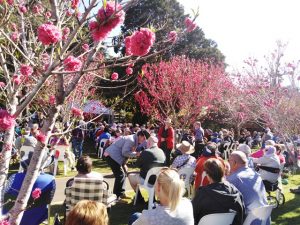
Photo: Macca amongst the people at the Toowoomba carnival of flowers – by Bob Wilson

So there we were at the unaccustomed early hour of 7am in Laurel Bank Park, Toowoomba, trying to catch Macca’s eye to say, “Mate, we’re here.”

Ian McNamara,* the host of Australia all Over, who sometimes plays music by our band, The Goodwills, had invited us to attend his second OB (outside broadcast) of the year.

Laurel Bank Park was pretty as a picture, thanks to a big team of gardeners and a decision by the Toowoomba Regional Council to water the town parks, despite the drought. It makes little sense to have a famous Carnival of Flowers without making some attempt to preserve the gardens.

The Toowoomba Carnival of Flowers has been going for 69 years, attracting ever-larger crowds each year to take tours of the prize-winning gardens, watch the grand parade and dine out in the city’s eclectic ‘Eat Street’. It was sentimentally appropriate that we were in Laurel Bank Park, where rumour has it we (She and Me) once had a re-affirmation of vows ceremony, cunningly disguised as a bush dance. We lived in Toowoomba in the 1980s (and my how this sprawling country town has grown).

Last weekend, we stayed with old friends at Highfields, now a satellite suburb 10 kms north-west. Our friends bought an acre of land and a house there when it was still in the bush. Now there’s a service station on the corner (and traffic lights). We drove into town to watch the Grand Parade on Saturday, parking in a secret place known only to locals. On the way we detoured up Bridge Street, past what used to be the Toowoomba Foundry, now home to the biggest Bunnings store I’ve seen for a long time. The Foundry facade on Ruthven Street has been left standing, along with remnants of the old saw-tooth factory roof, which you don’t see much of in this era of tilt-slab concrete industrial sheds.

Toowoomba has certainly become not only bigger but more multicultural since we lived there. Walking past St James Anglican Church on Russell Street, we saw many Sudanese people gathered outside. They had just returned from the funeral of the Rev James Ajak, a respected priest and community leader among Toowoomba’s large South Sudanese community. A thousand people, some who came from as far away as Western Australia, attended his funeral at the Centenary Heights State High School Assembly Hall.

Multicultural-Toowoomba-carnival
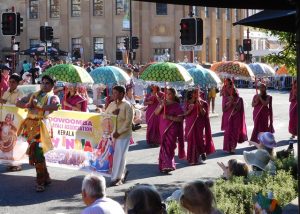
Multicultural Toowoomba carnival

Multicultural groups were well represented in the grand parade of floats, bands, vintage cars and dancing schools. Our host told us an amusing story about a grand parade from years gone by when it rained relentlessly. There were two elephants on a flat-bed truck, he said, and one of them heeded nature’s call, leaving a wet pile of dung for the people following behind to negotiate.

It wasn’t really the right mental picture for a lovely Spring day with a big crowd of good-natured people enjoying the hour-long parade, led by the Toowoomba Caledonian Pipe Band. I was never very good at estimating crowds, even though I was given a few tips by Toowoomba police back in the day when I worked at The Chronicle as a general reporter and columnist.

Thousands, let’s say, drifting down Margaret Street to Queens Park where floats were lined up for inspection (and judging). Our host’s grandkids cunningly detoured Pop to sideshow alley, while we strolled hand in hand through one of our special places. If Queens Park had been watered lately, it was still thirsty, not surprising given the city has had only 70mm of rain in the past six months. Only one of those rainy days amounted to much (20.8mm). As gardeners would know, this is when you have to think about what to water and when.

Nonetheless, Laurel Bank Park, with its topiary, flower beds, scented garden, flowering peach trees and bowling green lawns was at its showcase best. We did catch Macca’s eye, as he roamed among the 600 or so people who showed up to listen to his four and a half hour live Sunday morning broadcast.

We sang a couple of songs and listened with admiration to local duo Kay Sullivan (accordion) & Peter Freeman (double bass) accompany Mimosa, a gypsy jazz duo from Terrigal, with Toowoomba trombone player Ian Craig chiming in as required. Macca sang a couple of songs and the band played along – as if they’d all had rehearsals. It was impressive.

Later I was reminded of the column I once wrote for the Toowoomba Chronicle in the 1980s. It started life prosaically as This Week with Bob Wilson and later became Friday on My Mind. We were reminiscing about the time our local folk club built a scale model of the Glenrowan Pub on the back of a truck and entered it into the grand parade with a bush ranger theme. I satirised this in one of my old columns (September 1984). Such fun to quote yourself:

“The float-building gang were having a right old bludge. There was Bluey swarming all over the back of his smash repair truck pulling ropes and lugging hay bales while the gang of nine procrastinated beneath a tree where someone had thoughtfully erected a makeshift bar, keg and 10 seven ounce glasses. Ted and Hughie arrived with their contribution to the float – a four-metre high model of the Ryebuck Shearer complete with black singlet, hand shears and a big placard which read “One out, all out”. Bluey inspected the newcomer and tapped its 44-gallon drum chest.

“Good welding job. Thing must weigh a ton.”

“He used to shear 100 sheep a day, mate,” said Molly.

Ben turned up in his bright green Ute with two sheep in the back. Hollering things like ‘Bewdy’ and ‘Have a go’, Ben carted the bewildered animals (one under each arm like Colin Meads), and plonked them on the back of the truck.

“I’ll bet we need a permit to transport live sheep on an open truck during a street parade,” said Cautious Col.

By midnight the day before the grand parade, the Ryebuck Shearer had been bolted to the back of the truck cab, a sheep chained to each of his formidable legs.

“You’re not going to leave them sheep here all night are you?” Bluey said. “They could clean up my back yard before tomorrow.

“It is tomorrow,” said Molly, “And I’m going home.”

Later, about noon, the Rybebuck Shearer was disqualified from the parade because stewards ruled that neither he nor his placard could pass safely beneath overhead power lines. Ben’s sheep (Banjo and Henry), were also pulled out of the race. Rain fell on the parade and the bloke who’d lent the hay bales said they weren’t worth a pinch of sheep now and charged them $2 a bale. Bluey’s truck got a flat tyre as he tried to turn it round in the marshalling yards. Molly started crying into her rum and coke and the barmaid from across the road came over and said anyone with pub glasses please take them back or she’d lose her job.

“I told you so,” said Col.

*Rebecca Levingston interviews Ian McNamara on South Bank’s Ferris wheel, August 2017 (log in to Facebook first).

https://www.facebook.com/abcinbrisbane/videos/10155634496309669/

Clarification: Last week I referred to the cost of a visitor visa to Nauru as $800. It is $8,000 for a journalist.


Goodwills live on Australia all Over

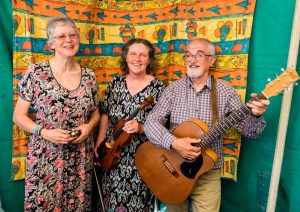
Our friend Paul Brandon took this happy photo of us with guest musician Helen Rowe in the green room at Neurum Creek Festival. Laurel and I will be travelling to our old stamping ground (Toowoomba) today to attend Macca’s outside broadcast (OB) in Laurel Bank Park (tomorrow, Sunday September 23). Australia all Over has been a great supporter of our music over the years so it’s good to give something back when we can. Come over and say g’day.
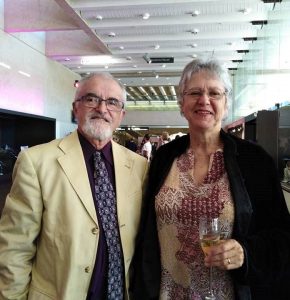
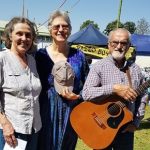
We played back to back festivals in Maleny and at Neurum Creek (near Woodford) over the past month. It’s great to be among musician friends and audiences who actually sit and listen. The trio will be back together on Wednesday November 14 as guests at Red Hill Folk (Red Hill Bowls Club, Fulcher Street for a 7.30 start.

About Nauru your petitioner humbly prays

Nauru-refugee-children
Refugee child ‘Roze’ on Nauru, provided by World Vision Australia

I could count on the toes of my feet the number of petitions I have signed in this life, but I could not refuse the Kids off Nauru campaign. More than 100 human rights groups, churches, charities and organisations, including World Vision, Amnesty International and the Australian Lawyers Alliance are behind Kids off Nauru.

The e-petition to Prime Minister Scott Morrison and Opposition Leader Bill Shorten leaves no room for negotiation. Children in detention on Nauru, about 40 of who were born on the island, have witnessed lip stitching, self-immolation and other suicide attempts. Many have developed traumatic withdrawal syndrome, characterised by resigning from all activities that support a normal life. The Australian Medical Association has called for immediate action to assure the health and wellbeing of those on Nauru.

As one of the NGOs involved in the campaign, Plan International says, “This can’t continue, not on our watch”.

“We’ve seen report after report of children who are in such despair, for whom life in detention is so miserable, that they have withdrawn socially, stopped eating and even attempted suicide,” Plan International said. “In August a 12-year-old girl tried to set herself on fire.”

The petitioners want all 120* children and their families off Nauru by November 20, 2018. The date is not random – it is Universal Children’s Day.

You all know this shameful story, where the Australian Government re-invented an offshore processing solution for people who’d mostly arrived without permission by boat, seeking refuge in the big open country they had heard was egalitarian and tolerant.

Nauru, a small island north-east of PNG and the Solomon Islands, was once known for extracting and selling phosphate for fertiliser. The resource is exhausted, so the Nauruan government could hardly refuse the lucrative offer from the Australian Government.

It’s difficult to get an accurate count* of children on Nauru, quoted variously as between 106 and 126. Meanwhile the official number from the Australian Government is 22. But wait, the fine print refers only to children in the Nauru Regional Processing Centre (Australia’s responsibility). Other refugee children are accommodated in centres run by the Nauruan Government. The latter is not at all transparent about the welfare of refugee children and their parents. A New Zealand TV reporter was detained briefly when reporting from the Pacific Forum because she went ‘off reservation’ to talk to refugees “without going through proper channels”.

I’d go and see for myself but they want $8,000 for a journalist visa.

Anglican Bishop Phillip Huggins wrote to then Home Affairs Minister Peter Dutton seeking clarification of numbers published on the department’s website.

The (eventual) reply from Mr Dutton and Huggins’s interpretation of the answers is worth reading to get a perspective.

Bishop Huggins concluded that the harsh reality is that there were (in August 2018), 120 refugee children in Nauru (some have been resettled in the last month). Some are being assessed for resettlement in America; some may eventually be resettled in New Zealand.

Let’s ask the obvious question: New Zealand PM Jacinda Ardern and her coalition partner Winston Peters have offered to take up to 150 refugees from Nauru. Former Australian PM Malcolm Turnbull rejected the offer to resettle the Nauru refugees, making the woolly argument that this would only make New Zealand attractive to people smugglers. It may surprise readers to know that the New Zealand offer to resettle refugees goes back to the administration of former PM John Key (2008-2016).

The transfer of asylum seekers to offshore processing centres in the Pacific was first introduced by the Howard (Coalition) Government in 2001.Here’s an edited summary of what followed.

Seven months after Kevin Rudd was sworn in as Prime Minister in 2008, the last remaining asylum seekers on Nauru were transferred to Australia, ending the Howard Government’s controversial ‘Pacific Solution’.

In July 2010, then Prime Minister, Julia Gillard revealed that the Government had begun having discussions about establishing a regional processing centre for the purpose of receiving and processing irregular entrants to the region. Importantly, only 25 asylum seekers had travelled by boat to Australia to seek asylum in the 2007–08 financial year. By the time Gillard made her announcement in July 2010, more than 5,000 people had come by boat to Australia to seek asylum.

Gillard acknowledged that the number of asylum seekers arriving by boat to Australia was ‘very, very minor’ but she identified a number of reasons why the processing of asylum seekers in other countries was considered necessary, including:

  • to remove the financial incentive for the people smugglers to send boats to Australia;
  • to ensure that those arriving by boat do not get an unfair advantage over others;
  • to prevent people embarking on a voyage across dangerous seas with the ever present risk of death;
  • to prevent overcrowding in detention facilities in Australia.

Though it took another two years to secure arrangements, people began to be transferred to Nauru and PNG in the last quarter of 2012.

Two months before the 2013 federal election amidst growing support for the Opposition’s tougher border protection policies, newly appointed Prime Minister Kevin Rudd announced that Australia had entered into a Regional Resettlement Arrangement with PNG. Under the arrangement, all (not just some) asylum seekers who arrived by boat would be transferred to PNG for processing and settlement in PNG and in any other participating regional State. Mr Rudd subsequently made a similar arrangement with Nauru.

Mr Rudd now says this was meant to be a temporary arrangement.

So he we are with a humanitarian crisis on our back door and as per usual, those clinging to slender majorities do not want to make brave, decent decisions which might cost them their seat at the next election.

Petitions are a form of protest known to exert moral authority; that is, they have no legal force. But the sheer weight of numbers can force social change. One example was the millions of signatures on a petition calling for the release of Nelson Mandela.

Before e-petitions and ‘clicktivism’ became the norm, government clerks charged with the receipt and storage of paper petitions had a job for life.

The Australian government receives on average 120 petitions a year, a large proportion of which are e-petitions. Activist group, change.org, (https://www.change.org), the biggest generator of e-petitions, has 50 million subscribers world-wide.

Nigel Gladstone, writing in the Sydney Morning Herald, says 32,728 Australian petitions were started on the change.org website since 2014. More than 3.5 million people signed their name to support campaigns such as reduced parking fees at NSW hospitals and marriage equality.

Professor of Political Sociology at the University of Sydney, Ariadne Vromen and Professor Darren Halpin of ANU collected data from change.org to study online petitions over a four-year period.

“This form of political engagement is both mainstream and important,” Professor Vromen told the SMH. “In Australia Get-up were really the pioneers of using online petitions and that was a bit of a shock to the system, but politicians quickly became cynical.

“Change.org is different because citizens can start their own thing, so it is different to an advocacy group starting something.”

So will the advocacy groups behind Kids off Nauru succeed in their mission to force the government to act by November 20? Let’s revisit this in a couple of months’ time.

#kidsoffnauru

More reading:


The ballet dancer and the footie player

ballet-footie
Bob and Laurel at the ballet – photo by Belinda

As we settled into our ballet seats at the Lyric Theatre for Sunday’s matinee of Queensland Ballet’s Cinderella, two kilometres away another group of elite athletes were preparing for their own performance.

It wasn’t much of a decision, whether to take up our pre-booked $100 matinee seats or go to the last-minute NRL home game between the Brisbane Broncos and St George Illawarra Dragons.

At least nobody spills beer on you at the ballet,” I jested, as She Who Also Goes to The Ballet ironed my suit. I’d have done it myself but she’d already hogged the ironing board.

The performance – the timeless story of Cinderella, a fable of class warfare and how goodness and generosity should always prevail, did not disappoint. It was another flawless piece of work from the Queensland Ballet company and the Queensland Festival Philharmonic orchestra. The audience was dominated by children and parents/grandparents and the usual gang of gangly girls whose curious splay-footed stance gives them away as ballet students.

The choreographer (Ben Stephenson) played it for laughs, casting Vito Bernasconi and Camilo Ramos as the ugly sisters. Tradition requires that the ugly sisters be played by men. Bernasconi and Ramos tried their best to look ungainly and uncoordinated, somehow falling on their faces without injuring themselves. Stephenson laid on the magic tricks, with the old woman transformed, with a minor explosion and cloud of smoke, into a svelte fairy godmother. Later SWAGTTB nudged me: “Did I miss the part when she changed the pumpkin into a coach?” Feed two old people lunch outdoors in the Queensland sun and then put them in a stuffy dark room for a few hours – someone’s bound to nod off.

During one of two intervals, SWAGTTB demonstrated her classical education by recounting the gruesome Brothers Grimm version of Cinderella, where the ugly sisters, in failed bids to fit into the glass slipper (and thereby become an idle rich Queen), mutilate their own feet.

I mentioned a favourite radio comedy skit from my childhood where the fairy story is told in spoonerisms – Rindercella and the Pransome Hince. It has an opaque provenance, this sketch, with some attributing it to Ronnie Barker. The latter may have performed it, but this much-recycled skit dates back to the 1930s. I’m sure Barker didn’t write it, as he was much funnier than Rindercella, which quickly becomes tedious and predictable. Eight year old boys find it hysterical, though.

Later, driving home and resisting the urge to listen to the rugby league ‘sudden death’ semi-final, we marvelled that QB could finance lavish productions like this, with top-level dancers and an orchestra. We’ve been subscribers for a long time and have seen this world-class company grow and prosper. QB’s annual report shows it made a net operating profit of $1.64 million in 2017. They did this with the help of some $5.38 million in ticket sales and $7.25 million from sponsors and State Government grants.

Not for nothing do I make comparisons between Queensland Ballet’s company of dancers and the injury-depleted Brisbane Broncos squad. Those of you familiar with arts productions will know about ‘notes’ – the after-performance meeting when the producer/director goes through the things that worked and the things that could have been better. I can’t imagine QB”s ballet master having too much to say except maybe chide someone for raising the curtain a few seconds before everyone was in place for the third curtain-call.

Post the 48-18 drubbing by the Dragons, I imagine Broncos coach Wayne Bennett had a few terse things to say to his squad who, well, just didn’t cut it. In the spirit of Rindercella, the Sisty Uglers (all Dragons forwards) bullied Rindercella (Broncos forwards and halves) into submission. There was no Gairy Fodmother to save the day. The final whistle blew and the Broncos turned into pumpkins and field mice and retreated to the sheds.

As Wayne Bennett said later, the squad was decimated by injuries all year including losing three top players for the season.

Now here’s something: you never hear a ballet company complain about the inevitable stress fractures or knee, ankle and back injuries. While dancers’ rarely suffer the traumatic torque injuries common among rugby players, the cumulative effect of injuries can be serious.

When key footie players are injured, there are constant media updates. For example, when Broncos playmaker Andrew McCullough was taken from the field on a stretcher a few weeks back with serious concussion, the updates and speculation on his welfare were continuous.

Rugby league players can all have a month or two off now before the pre-season training begins in November. All the while they are pulling in salaries which range from the minimum ($80,000) to $1 million a year for top players like Cameron Smith or Johnathan Thurston. The average NRL salary is $371,000.

After Cinderella finishes on September 16, Queensland Ballet dancers will be straight into rehearsals for The Nutcracker, which starts its season on December 8. It’s a big deal, being appointed principal dancer of a ballet company, but it’s not something you’d do for the money. Averages are suspect in such a small field, but it seems principal dancers in Australia can earn around $75k-$85k. The average salary for a company dancer is about $48k.

Budding footie players and ballet dancers start working on their craft at an early age. Their parents foot the bill and the time to take children to dance lessons or footie training. Both disciplines require intense training and perseverance, particularly through injury and rehabilitation.

Then there’s the ongoing expense of buying ballet flats ($25 a pair) or pointe shoes (up to $100 a pair). You could argue that parents of footie-mad kids are up for a new pair of boots every time Junior moves up a size. That’s around $200-$250 a pair for the best, or they can browse Gumtree for second-hand boots.

A hard-working ballet dancer, however, can go through 50 to 80 pairs of pointe shoes ($5,000 – $8,000) a year. Some companies buy dancers’ shoes, others can’t. Professional dancers and aspirants may have to factor it into their personal budgets. If you wondered why pointe shoes wear out so quickly, every time a dancer jumps on pointe, three times her body weight is carried on the tip of her big toe. QB has a donation page where you can help out with this inevitable expense.

In arts as in sport, many have expectations, but only a small percentage make the grade to top billing. The difference in sport – and this is particularly noticeable in soccer and American basketball’s NBL – the top-level salaries can be huge.

Contact sports like rugby union or rugby league attract the support and big dollars from television broadcast rights and sponsorship and, more recently, from betting agencies.

Meanwhile, it is up to supporters of the arts to make sure superb creative companies like Queensland Ballet can cover their costs each and every year. I can’t see anyone promoting a televised State of Origin dance-off between State ballets anytime soon, even though it’s not a bad idea.


Goodwills play Neurum Creek 2018

Fresh from well-received gigs at Maleny Music Festival, The Goodwills and guest Helen Rowe are performing this weekend at Neurum Creek Festival. We always enjoy this camping weekend, whether we’re performing or not, so it is an added pleasure to join the list of talented musicians playing under the big tent.
We’re performing on Saturday morning, after Brisbane folk legend Anne Infante. We’ll have CDs at the shop or come up and say G’day after the gig. Bob has been writing songs again so is likely to perform at least one new song in the set.

Neurum Creek Festival, September 14, 15 and 16.


The Roads More Or Less Travelled

All roads lead to Canberra – at least that’s what most politicians think. This week we’re having a break from politics, the plight of refugees and why Australia’s asylum seeker policies are on the nose. Today guest writer Laurel Wilson (aka She Who Also Writes) looks at the hazards of the highway for travellers. This post contains 21 images. – Ed.

roads-travel
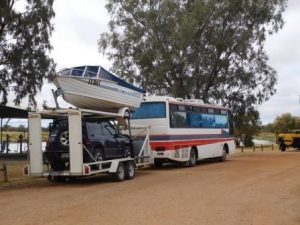
Definitely NOT our next road rig..

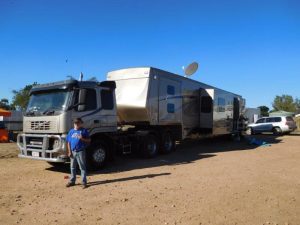
Perhaps somewhat surprisingly, I’m feeling quite refreshed after our 6 week, 6,000 kilometre road trip around Queensland in our trusty 12ft caravan (despite the occasional mishap, chronicled elsewhere).

roads-travel
Not this one, either

One of the positives in travelling is that it can give you the opportunity and inclination to study the ever-changing surroundings. Unlike those who object to outback travel because “you can drive for ages and not see anything”, I’ve always found there’s something new to experience as you drive along. Some of these experiences, such as the pungent stink of Gidgee in humid weather, are perhaps not ‘must does’, but it was a relief to find the source of that odour, when I was beginning to think that we had a leak in the caravan’s gas cylinder or the car had developed some nameless fault.

Having a naturally curious nature (unlike the woman living in Dingo, who neither knew nor cared how that small town got its unique name), I was intrigued by the extent and variety of roads we travelled on during our latest trip.

I began to wonder just how many kilometres of designated roads there are in Queensland. According to a Department of Main Roads factsheet, as of 2013-14 there were over 33,000 kilometres of State controlled roads (which includes over 5,000 kilometres of the National network). In addition, Queensland Local Governments are responsible for almost 155,000 kilometres of roads in their respective areas.

In our latest trip around Queensland, we travelled on all but one of the designated ‘National Highways’, the only exception being the Barkly Highway, which runs westward from Cloncurry. In all of our trip around Queensland, we managed to stay off the highway called ‘Bruce’, except for the 400 or so kilometres from Cairns to Townsville, where we had tickets to watch a North Queensland Cowboys Rugby League game – one of Johnathan Thurston’s last games (I realise that the bulk of readers neither know or care, but I don’t get to write this blog very often, so thought I’d take the opportunity…).

This time, our most westerly destination was Winton, where we spent four fascinating days at ‘The Vision Splendid – Outback Film Festival’.

roads-travel
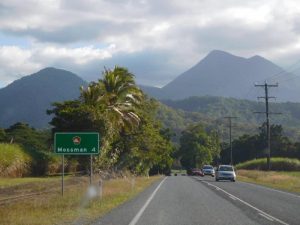
The Not So Mighty Bruce Highway, North Queensland

What constitutes a ‘National Highway’ seems to be open to some interpretation, but I’ve used a list supplied by Wikipedia (I know, I know, not necessarily the best source, but should be adequate for this purpose).

roads-travel
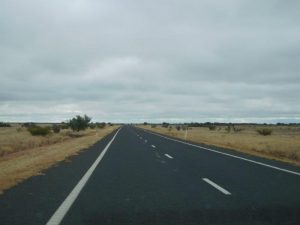
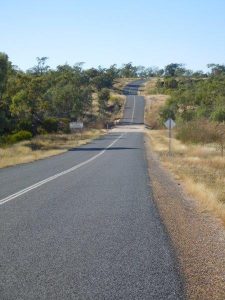
Two lanes and well-maintained –west of Charleville.

Whether the roads we travelled on were ‘National’, ‘State’ or ‘local’ wasn’t always possible to tell. (Apparently the various tiers of government have a similar problem when deciding which tier is responsible for building and maintaining them.) And we really didn’t care who was ‘responsible’; we were more interested in their state of repair (or disrepair). To be fair, of the 6,000 kilometres we travelled, the great majority of the roads were at least two lanes wide, bitumen and either in very good repair or quite adequate.roads-travel

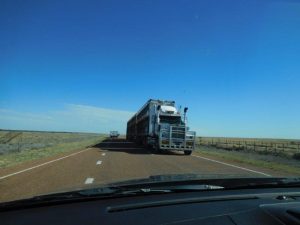
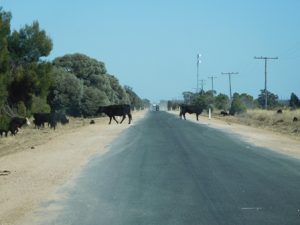
Give the road-trains a wide berth – they ain’t stoppingOnly a couple were gravel or ‘dirt’ and gave us (and the poor old caravan) a rough ride for our money. And one of those we can blame on the GPS, which decided to take us on a trip from Glenmorgan to Surat via the most circuitous route it could find.

roads-travel
Hmm, wish we had a better map
roads-travel
Do you guys know where we are?

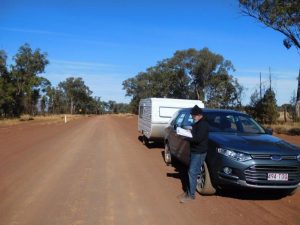
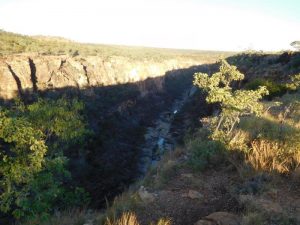
The other was the ‘shortcut’ from Hughenden to ‘The Lynd’, some 250km to the North. We chose this road (The Kennedy Developmental Road) because it went past Porcupine Gorge National Park, which we wanted to visit, and was much shorter than the alternative route to our next destination. And after all, most of the lines on the map were solid red (indicating bitumen) rather than the dotted line for ‘dirt road’.

roads-travel
Porcupine Gorge
roads-travel
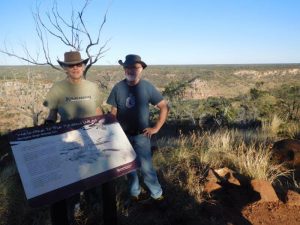
The author and editor (after the 1600 steps down and back)
roads-travel
You can get to Porcupine Gorge on the bitument, a longer way around

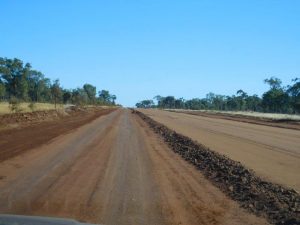
As it turned out, the accent should have been on ‘developmental’, rather than ‘road’. There were frequent patches of the dreaded ‘corrugations’, in which the road surface consists of a series of ruts which run at right angles to the direction of travel. This is a phenomenon common to ‘dirt’ roads and apparently results mainly from the numerous vehicles travelling over the moveable surface of such roads. Regular grading of the road helps smooth out the corrugations, so it’s worthwhile trying to find out whether an unsurfaced road has been recently graded before you travel on it. Being of fairly ‘senior’ years, I’m quite used to travelling ‘off the bitumen’ and have met corrugations before. The general wisdom about negotiating corrugations is to drive at a reasonable speed (not necessarily too slowly, but not highway speeds either) and to drop the tyre pressures a bit if you usually run to higher pressures- though not really worth the hassle unless you’re stuck with a long stretch of ‘corro’.

The Kennedy Developmental Road was the site of one of our minor mishaps this trip. The continual bouncing of travelling across corrugations was eventually too much for the 30year old+ hinges on the wardrobe door, and we arrived at ‘The Lynd’ with the wardrobe door lying on the floor of the van. Interestingly enough, the clothes remained in the wardrobe! (Finding new hinges to fit, putting them on and getting the door to shut properly was a small triumph for ‘Handy Mandy’ and her trusty sidekick.)

roads-travel
Right- No-one’s looking- let’s drive on the smooth side…

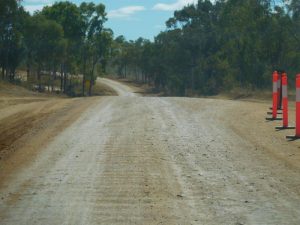
This time next year the road will probably be a much more comfortable drive, as there was plenty of roadwork going on as we drove this stretch.

roads-travel
The dreaded corrugations on the way to The Lynd


We met these International travellers at ‘The Lynd’ – It’s a 1915 Model ‘T’ Ford. They prefer the dirt roads (see below) and avoid highways in their world travels. They have travelled to over 50 countries, raising money for the charity SOS Children’s Villages International.  http://www.tfordworldtour.org/
roads-travel
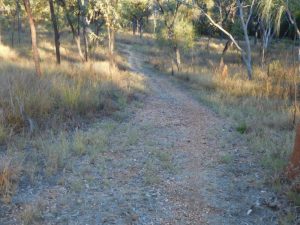
original Queensland outback road

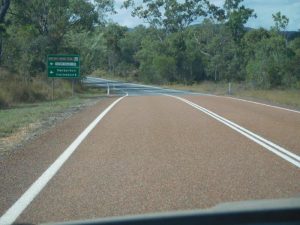
As you would expect, most sealed roads are black or grey, but we do come across some which, to my eye, are a rather fetching shade of pink. Some may see it as ‘tan’, but the idea of pink roads somehow appeals to me. I haven’t been able to find out why they are ‘pink’, but my theory is that it has something to do with the roadbase containing a fair proportion of the red dirt/sand common in many parts of Queensland.

roads-travel
The pink brick road
roads-travel
Pink’, don’t you think?

One of my pastimes while travelling is to take pictures while we are inside the car (and I promise I only do this when I’m the passenger). Most of the photos in this ‘blog’ are of that type. And a few shots of the roads more or less travelled:

roads-travel
The road not travelled – near Winton
roads-travel
On the straight and narrow to Georgetown
roads-travel
The road to Dingo


roads-travel
Sometimes the best road is the one leading home..


Six Prime Ministers and a potato class action

Prime-Ministers
Prime Ministers- ScoMo feeds the fire (meme by twitter.com@GeorgeBludger)

As the dry winter fades away, ushering in a hot and bushfire-prone spring and summer, here’s some sober reflections on ‘Single-use Prime Ministers’.

I borrowed the single-use mention from a clever meme doing the rounds on social media, where, I might say in defence of the humble Kipfler, Sebago and Desiree, potatoes continue to be openly defamed. It might not be long before we see headlines where Tryhard & Associates, no win-no fee, mount a class action on behalf of Mr and Mrs Sebago and 15 other tuber families.

As we now see from former Home Affairs Minister Peter Dutton’s attempted coup, while it worked in principle, the betrayal left Mr Dutton out on a limb, with a centre-right politician seizing the leadership.

At the outset, Australia’s new Prime Minister, Scott Morrison, decided the people needed to know that “we’re on your side”.

“That’s what matters. We are on your side. And we are on your side because we share beliefs and values in common, as you go about everything you do each day.”

Keep playing that one, Scott. Stay away from the line that brings down Westminster democracies; when a leader (be it Whitlam, Hawke, Keating, Howard, Rudd, Gillard, Abbott or Turnbull), have all been caught referring to ‘my government’.

I had a couple of messages from FOMM stalwarts last week in aggregate saying “Get a grip, Bob. The nation’s imploding and you’re talking about stamp collecting?”

I defend last week’s meandering missive as making the case that Australian governments have been lurching hard-right for a very long time now, arguably since John Howard’s 1988 stance on multiculturalism and refusing to make a treaty with the Aborigines. Hence my writing about the stamp-collecting Philip Ruddock, a hard-line Immigration minister in control of our border policies from 1996-2003.

Now here’s the thing – party factions, backroom machinations and political knifings are not what does in a sitting PM – it is narcissism.

As economist and author George Megalogenis wrote in an opinion piece for the New York Times: “The prime minister is not even mentioned in the Australian Constitution, yet the office has evolved into a paradoxical position of supreme authority and permanent vulnerability.”

Megalogenis also wrote: “They have borrowed the worst of United States presidential politics, with its obsessive focus on the leader, and grafted it onto a Westminster system of parliamentary government that was designed for collaboration and compromise.”

Australia has had six Prime Ministers since 2008, the number arguably including a bit of double counting when first Julia Gillard toppled Kevin Rudd, then Rudd came back and promptly lost the next election in a landslide. Then there was Tony Abbott, Malcolm Turnbull and now Scott Morrison. This era was characterised by frantic passing of new legislation in the incumbent’s first year. Fairfax Media research tallied new acts of Parliament passed in the first year for Prime Ministers Kevin Rudd (133), Julia Gillard (132), Tony Abbott (116) and Malcolm Turnbull (104). These are mediocre numbers compared to Paul Keating (212) and Gough Whitlam (161). Surprisingly (well, I was surprised), John Howard’s first year numbers (86), are only marginally better than Ben Chifley (74).

What appears to have brought undone Prime Ministers of the past 10 years is the polarisation caused by climate change policy. It seems nigh on impossible to achieve political consensus on this most serious of issues, even if over 97% of climate scientists active in that field of research say it is a reality, aggravated and accelerated by human activities. (There are, of course, nay-sayers. Just Google ‘what percentage of scientists believe in global warming, if you have a few hours to spare.)

All six of our Prime Ministers thus far have failed or been thwarted in terms of seriously countering climate change. Some even challenging the notion that fossil fuels have had their day. I refer of course to (a) Tony Abbott’s infamous ‘coal is good for humanity’ quote, and incumbent PM Scott Morrison’s stunt, brandishing a lump of coal in Parliament.

But let’s go back 117 years, to an era when coal really did rule – when steam trains, for example, burned through eighty pounds of coal for every mile travelled (a useful factoid from Michael Portillo’s fascinating series, Great British Railway Journeys).

Australia’s leadership changed seven times in the first ten years of Federation (and 11 times between 1901 and 1922). Again, leadership changes involved ambitious men having a second (and even a third) attempt. Andrew Fisher (1909-1909, 1910-1913 and 1914-1915) proved the most persistent, governing during the early years of WWI. Fisher, I’d like to point out, introduced Australia’s first postage stamp. On January 2, 1913, the Fisher-led government issued the Commonwealth penny stamp.

It featured a controversial design – a kangaroo on a white map of Australia. Although later stamps reintroduced the King’s head, the kangaroo design remained in use for some forty years. An example of this rare stamp sold at auction in 2012 for $142,563.

But we were talking about men (and women- Ed.) and their egos and how the Prime Ministership has evolved as the Office of Omniscience. Towards the last days of Kevin Rudd’s Prime Ministership, there were reports of policy on the run, along with statements made with no consultation, and there have been similar reports about other short-term Prime Ministers. To be fair, in the first year of the Whitlam administration, the late Gough Whitlam rammed through a colossal amount of social reform legislation in a fortnight with the help of a two-man Cabinet (the duumvirate) – just Gough and his deputy, Lance Barnard.

Megalogenis observed that post-Rudd, the Labor party has made it harder to remove future Prime Ministers. Changes to internal rules now require the party leader be elected by a combined vote of the parliamentary party and grass-roots members. From this side of the fence, it is hard to see the Liberals coming up with a similar safeguard.

In no time at all, it seems, Australians will be thrust into another Federal election, with a new Prime Minister who will not have had enough time to show his mettle. On the other side, we have Labor leader Bill Shorten, and deputy leader Tanya Plibersek. Mr Shorten’s tactics thus far, apart from keeping his head down and letting the Liberal Party stew in its own juices, has been to divide and conquer, emphasising the class gulf between the left and right.

Tucked away behind the cannot-be-seen hedge, Labor’s Anthony Albanese, passed over for the Opposition leadership in 2013, declared his colours in June, in the Whitlam Oration.

Mr Albanese called upon his party to emulate the Hawke and Keating approach and “collaborate with unions, the business sector and civil society to achieve positive outcomes in the national interest”.

The Labor frontbencher also delivered a warning about the need to find common ground with voters outside the union movement.

“This is not 1950, when most Australians were members of trade unions,” Mr Albanese said. “Indeed many people from working class backgrounds are not members of unions because they were beneficiaries of Gough Whitlam’s education reforms. We cannot afford to ignore this demographic.”

Sigh, it makes my brain burn, like the feeling I got when I saw that clever meme (above) with Scott Morrison feeding a lump of coal into a (red and orange) map of Australia.

Good for humanity my arse.

Goodwills house concert roll call at Maleny Music Festival

The Goodwills

Quite a few of the guests appearing at the Maleny Music Festival this weekend have also played in our loungeroom over the last year or two.  Cloudstreet, Fred Smith, Sadie & Jay, Tin Star, Karen Law Band and Steve Tyson (who brought along some of his comrades from Rough Red) are among those on the festival bill. We also welcome back Jenny Fitzgibbon from her world travels and, not to forget, we are doing a gig too.

The Goodwills with guest musician Helen Rowe play the Tibrogargan Stage on Saturday at 1.10pm. Laurel and I are also taking part in the Concert for Refugees on Saturday night in the same venue.  The festival starts at the Maleny Showgrounds on Friday evening with a Welcome to Country and continues until Sunday afternoon, with a finale concert at 3.45pm with Zumpa. This is our third festival and we feel privileged to vie for the title of elder statespeople of folk!

Stamp of approval a one-horse race

stamp-winx-race
Australia Post celebrates Winx’s record-breaking 26th consecutive win with a commemorative stamp

You’d have to say Australia Post had a bit riding on the champion mare Winx winning her 26th consecutive race at Warwick Farm last Saturday. Let’s say at the outset that this is about stamp collecting, not horse racing (surveys show the latter subject turns FOMM readers off – or politics – that was a three horse race…Ed.)

Whether you like horse racing or not, the existence of Winx the super horse must have filtered through, as it is many a moon since any horse won this many races on the trot, which is racing parlance for an unbroken winning streak.

Celebrating the mare’s place in equine history, Australia Post released a commemorative stamp, pictured here by courtesy of AP and ‘with perforations’ as requested. Journalists received the press release from Australia Post about a minute after the race was run and won.

We plan ahead for important activities, achievements, and national events in the calendar, and had extra resources on standby to assist in producing the special stamps,” an Australia Post spokesperson said, in response to our obvious question.

So all ended well. If you are a stamp collector or philatelist as it is known in the trade, you will already have ordered your first day covers, special 26-stamp packs, a set of maxi cards and a medallion cover.

Horse stamps are not that unusual – examples include Black Caviar in 2013 and a set of four stamps issued in 1978. They featured Phar Lap, Bernborough, Peter Pan and Tulloch. The collection is notable for fine art work by Brisbane artist Brian Clinton.

Like Dusty Springfield, I was wishin’ and hopin’ and thinkin’ and prayin’ that either Malcom Turnbull or his nemesis were philatelists so I could make this politically relevant. But it seems only one (former) Federal politician, Philip Ruddock, collects stamps. This seemingly innocuous hobby at times embroiled the then Immigration Minister in controversy.

Ruddock, now Mayor of Hornsby Shire, was a member of Amnesty International. Critics found his membership of the organisation was at odds with his government’s hard-line immigration policies. In 2000, Amnesty asked Mr Ruddock not to wear his lapel badge when performing ministerial duties and not to refer to his membership when promoting policies opposed by Amnesty. AM 18/3/2000

In a profile for The Good Weekend in 2002, writer Richard Guilliatt was given a look at Ruddock’s collection, which spans three generations. Guilliatt, perhaps innocently, suggested that the high dramas of the job had spurred the stamp collecting hobby on.

“…every month letters pour into Ruddock’s Parliament House office in Canberra, imploring him to liberate the men, women and children detained behind razor wire in Australia’s desert camps for Third World asylum seekers,” he wrote. “Those letters come affixed with all manner of exotic stamps, which Ruddock gets his secretary to tear off so he can take them home to his house in the leafy northern hills of Sydney, to be packed away for sorting.

“That’s one of the good things about getting a lot of letters from Amnesty International,” Ruddock told Guilliatt.

If few politicians collect stamps, at least a dozen former Prime Ministers featured on Australian stamps in the 1950s and 1960s. It’s important to note that all received the honour after their deaths.

“Until the introduction of the Australia Post Australian Legends Awards in 1997, the only living person allowed on a stamp was the reigning monarch”, the spokeperson told FOMM.

Nevertheless, the PM’s head on a postage stamp seems clearly out of fashion now, in this era when one is never quite sure if the PM will last his or her term. But there have been enough sporting celebrities, athletes, actors, singers, writers and decorated soldiers to compensate.

In an aside for crime fiction aficionadas, the most infamous stamp collector award must surely go to Lawrence Block’s fictional hit man, Keller. John Keller is the protagonist in Block’s crime series which began with Hit Man in 1998. Keller collects pre-1940 stamps and uses down-time between ‘jobs’ to visit stamp shops and exhibitions. It’s a kind of cover for his apparent lack of legitimate income, not unlike Block’s gentleman burglar and antique bookstore owner, Bernie Rhodenbarr.

Many famous people are listed in various publications and websites as stamp collectors. The collection does not have to be distinguished to command a price. Former Beatle John Lennon’s collection of 550 stamps from his childhood was bought by the Smithsonian Institute’s National Postal Museum in 2005 for about $A74, 000.

Which brings me to the best-selling commemorative stamp of all time – the Elvis stamp released in 1993, Perhaps the delay since the rock singer’s death in 1977 was due to persistent ‘sightings’ of the late Mr Presley. Even today you will find folk who will tell you he is still alive and living under an alias, like someone in witness protection. Elvis would be 83 if still alive today.

The US Postal Service printed 500 million commemorative stamps – three times the usual print run. It was the most highly publicised stamp issue in the USPS history. The people were asked to choose between two designs (1.2 million votes), the majority preferring the stylised image of the young rocker, microphone in hand.

Stamps can be highly controversial items. For instance, the first secular Christmas stamp in the US, with its pair of white candles and a wreath with a red bow, was released in 1962.

Critics said it crossed the line between church and state. The public was also unenthused about a 1963 design – an illuminated Christmas tree in front of the White House.

Public takes dim view of Surfing Santa

The most controversial Australian stamp was also a Christmas release.  The 1977 stamp featured a humorous depiction by Adelaide artist Roger Roberts of Santa Claus riding a surfboard. Some members of the public were affronted, saying the postal service was not taking Christmas seriously. Until 1975, all Christmas stamps featured religious themes, often based on the traditional nativity story. There was no such fuss about the mix of secular and Christian stamps released in 1976.

If you thought the popularity of email would adversely affect stamp collecting, the market is as robust and profitable as ever. As an extreme example, the One-Cent Magenta from British Guiana, issued in 1856 and thought to be unique, sold at a New York auction in 2014 for a record $9.5 million.

In 2007, the Australian collection of Arthur Gray was sold through Shreves auction house in New York for more than $7 million. Among the spectacular results was the $265,000 paid for a block of four 1919 £1 brown and blue Kangaroos.

So did you collect stamps as a child? Did you, as I discovered, learn at some point in your cash-strapped adulthood that the collection was worthless?

We had a family friend who spent most of her younger years travelling to exotic climes and would write, with bundles of stamps included ‘for wee Bobby’.

I gave away stamp collecting and its fussy handling (gloves and tweezers and corners to mount the stamps rather than pasting them in the album), around about the time I realised girls were interesting.

I still have those two old albums tucked away somewhere – among Father’s Letters, I’m thinking.

Somewhat related reading: