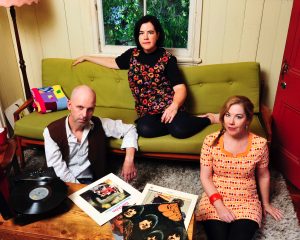
Goodwills performing at Maleny Music Festival

The Goodwills

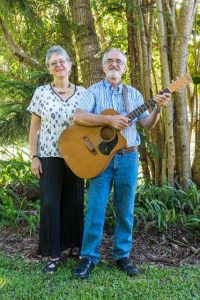
The Goodwills have been booked to perform at this year’s Maleny Music Festival from August 31 – September 2. Programme details will be released soon.  Our musician friend Helen Rowe will be performing with us so expect fine fiddle playing, whistling, three-part harmonies and Bob’s original songs.

Fans of our Maleny house concerts will recognise a few of the bands performing at the seventh Maleny festival. They include the Fred Smith Trio, Cloudstreet, Tin Star and Sadie and Jay (the latter will also be performing at a house concert on August 5). More on that at a later date.

Two fine local choirs will also be performing at the Maleny festival, Sweet Chilli and our own Tapestry, directed by Kim Kirkman. We (Bob & Laurel) have been members of Tapestry, a mixed acapella chamber choir, for a long time.

The Maleny Music Festival will have something for everyone, with artists as diverse as Getano Bann, Estampa, Nicole Brophy, Kevin Bennett, Martin Pearson, the Hillbilly Goats and fine Celtic bands the Barleyshakes and The Jar.

We hope to see you there. Check out the festival; and book tickets here.


Men who don’t cook or do housework

cook-housework
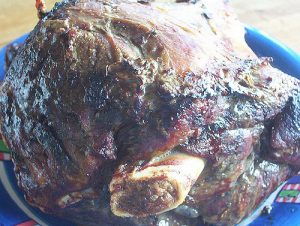
Cook lamb roast photo by Vicki flickr https://flic.kr/p/4u4Dtr

This topic would not have raised an eyelash in my Dad’s era, a generation of men who did not cook or do housework. Many men of my vintage grew up in households where duties were strictly demarcated along gender lines: Dad went to work and paid the bills; Mum stayed home and did all the housework and cooking; knitting, sewing, mending – shall I go on?

We kids had chores to do – washing up, drying, putting away, feeding the chooks, collecting the eggs and so on. Dad would come home on pay day and hand his pay packet to Mum. Later on she’d give Dad an ‘allowance’ for his smokes, haircuts and the like.

Mums from this era did more than cook and keep house; they managed to harvest a lot of the household food, swapping eggs for freshly-caught fish and turning a peach tree harvest into 20 jars of preserves, for example. There were always vegies in the garden (brussel sprouts, yum), and in the pantry multiple jars of homemade marmalade, jams, chutneys, pickled onions and so on. There’s no end to one woman’s ingenuity when making a working man’s pay last a family of five.

When we came home from school there was usually something in the oven – scones, bread, biscuits. The house smelled good and Mum was nearly always there. Dinner times were a bit regimented. Dad would get up about 5 (he worked nights so had an afternoon nap) and sit in his favourite chair reading the newspaper until dinner was served at 6. It wasn’t quite the pipe and slippers routine, but close to it.

Decades later, as a result of living alone or in share houses and with women who had at least read the Female Eunuch, I evolved into what is sometimes called a ‘SNAG’.

There are a lot of us around now – some do all the cooking, bake cakes and make preserves.

If you’ve been paying attention, She Who is Ambidextrous broke her right wrist six weeks ago and although she had the plaster off last week, she’s showing little inclination to oust me from my new-found kingdom.

Like the song says, I can’t do without my Kitchen Man,” she jested, while covertly supervising the preparation of the leg of lamb. (I used a slow cooker, first searing the joint to keep the flavours in, inserting a couple of cloves of garlic and later added potatoes, pumpkin, sweet potato and onion).

This was my second attempt at a lamb roast. The first one was (we both agreed), a little dry. The recipe said cook on low for 10 hours so that’s what I did. I’m only now finding out, after six weeks of being chief cook and rice cooker washer, recipes are only meant to be a guide.

I’ll be the first to admit it takes a bit of gumption to invade the kitchen of a classy cook, although of late SWIA was showing signs of taking a break. I’m sure she did not mean that literally.

My contributions in the kitchen prior to the fracture included sausages and mash, home-made pizzas or pies and vegies for footie nights and the occasional spaghetti bolognaise.

I had precious few disasters during my tour as camp cook and one or two meals (chicken stir fry and a beef curry), drew compliments from the resident chef.

Readers will know I do other chores around the house: vacuuming, laundry, ironing and outside chores like pulling the wheelie bins up a 97m driveway or emptying the Bokashi bucket (don’t ask).

Men who do their share are usually visible (like the young hipster I saw with a baby strapped to his front and a toddler clutching his ankle, navigating a trolley down the organic foods aisle and carefully reading labels).

Such a sight could lull you into thinking 21st century men had moved on and now do their share of unpaid domestic work. Well, not really.

The invisible ones surfaced in 2016 Census data released by the Australian Bureau of Statistics – one in four men who said they did no housework at all. The Census estimated that Australian women spend between five and 14 hours per week doing ‘household work’ while men on average spend five hours. This work is mainly defined as including cooking and housework. Many more hours (up to 30 per week), are spent on unpaid household tasks like laundry, child care and shopping.

Dr Leah Ruppanner, senior lecturer in Sociology at University of Melbourne, suggests women still spend twice as much time on housework as men.

Writing for The Conversation, Dr Ruppanner said Australian Bureau of Statistics data showed Australian working women spend on average 25 hours a week doing housework (in addition to the 36.4 hours spent in full-time employment.

Men working full-time spent 15 hours a week doing housework, on top of their 40 hour week. The data was drawn from a massive but infrequent ABS Time Use Study, last completed in 2006. That data showed women to be doing the greater share of cooking and cleaning up, laundry and clothes care, child care and shopping.

The one area where men prevailed was home maintenance, with time equally divided when it came to household management and grounds and animal care.

Dr Ruppanner said women shoulder the time-intensive and routine tasks such as cooking, laundry and dishes. They are more likely to do the less enjoyable tasks (cleaning toilets and showers). The men are most often found doing periodic tasks like washing the car, mowing the lawns or changing light bulbs.

She said the solution was to bring men into the process as equal housework sharers, not ‘helpers’.

“It also means not penalising men for ‘not doing it right’.

Cleaning the house is a skill men can learn one toilet bowl at a time.”

A 2015 OECD report on unpaid work showed that Australia was relatively high up the list of gender imbalance. The study interpreted unpaid work as including housework, shopping, child and adult care duties, volunteering and other unpaid work.

Australian women completed 5 hours and 11 minutes per day with men lagging behind (just under three hours), which put us in fourth position in a poll where you’d rather be at the bottom.

The pack was clearly led by Mexico, where women spent six hours and 23 minutes a day doing unpaid work. Mexican men put in just two hours and 17 minutes. The gender gap was closest in Sweden, with women and men sharing domestic duties on a more equitable basis (3.26/2.45 hours).

Japanese, Korean and Indian men devoted the least time to domestic work (under 1 hour per day), while at the other end of the scale Danish fellas put in three hours and six minutes.

Meanwhile in Australia, this Aussie househusband is off to make a Shepherd’s Pie from the remains of the lamb and left-over vegies. Sorry, no, you’re not invited.

(Post Shepherd’s pie – and quite satisfactory it was –  SWIA)


The value of inner city car parks

car-parks-value
Image of car parks Palma de Mallorca by Timmy L (flickr) https://flic.kr/p/TR4DFC

As you’d know, one little statistic can send me off on an investigation – like the number tucked away in a Guardian Weekly report that, globally, cars are in car parks 95% of the time.

The statistic emerged in a report about a pilot scheme in Amsterdam to reward residents with a free green space in front of their houses if they give up their parking permits. The car parks pilot scheme being trialled in six streets in an Amsterdam suburb is yet another Dutch idea designed to encourage people to give up cars and switch to carpooling, public transport or bicycles.

Residents’ cars will be stored for free in public car parks and in return something ‘green and pleasant’ can occupy the designated car space. The Guardian reports a fair degree of friction over this idea. Two early adopters (who have been heckled), have already put flower-filled tow carts in front of their houses (a cosy outdoor spot to sit in the sun and have a morning coffee and a plate of warm poffertjes).

This is not the first time Amsterdam’s Stadsbestuurders have tried to rend asunder the city’s love affair with the car. Amsterdam is widely known as the bicycle capital of the world because it is relatively compact and the narrow streets and canal bridges make driving more difficult than in other cities. When I spent time in Amsterdam (wishing I could forget what I can’t remember), the city was then trialling Sundays as a no-car day. I looked that up yesterday and find that it is 45 years since Car Free Sunday was introduced. As this blog explains, something changed in the Dutch mindset when the measure was introduced in 1973 (to dampen oil consumption amid the 1970s Oil Shock).  Since then cycling with or without clogs has clearly become a lifestyle/clean environment movement.

The Netherlands leads other European cities, with 27% of all trips attributed to cyclists, a figure that has been stable for a decade. How could it be anything less when Amsterdammers own 22.5 million bicycles (1.3 per resident). Evidently Mum, Dad and the kids are in on the trend. Denmark is a close second in Europe’s bicycle stakes (0.8 per resident).

Australians are fairly keen on bicycles too, with 3.6 million using one every week, The Australian Cyclists Party says the average Australian household has 1.5 bicycles in working order, although if you wanted to be pendantic, you couldn’t ride half a bike very far. You could of course turn it into a unicycle, learn to juggle, sing and play the ukulele at the same time and apply for a gig at the Woodford Music Festival.

Digressions aside, Australians are as deeply committed to the combustion engine as the global leader (America). The latest Australian Bureau of Statistics motor vehicle census showed there were 18.8 million registered vehicles in Australia as of January 31, 2017, a 2% increase on 2016. The 2016 Australian Census showed there were 2.95 million one-vehicle households, 3.02 million households with two vehicles and another 1.50 million households with three or more. The same Census revealed that only 1.1% of Australians rode their bikes to work. The sole occupant car dominated work trips – from 65.6% in Sydney to 79.9% in Adelaide.

The notion that cars are parked 95% of the time is a figure largely calculated on public car parks which are utilised 85% to 95% of the time. Just dwell on that next time you are doing laps in one of Brisbane’s large shopping malls, waiting for a spot.

Last Saturday we went to a Queensland Ballet double bill (Carmen and The Firebird) which, I must say, we enjoyed more than the reviewer in The Australian did, apparently. There were three curtain calls.

Afterwards, we walked back to the multi-level car park where I realised (despite my disdain for automation), that I had no option but to pre-pay as there were no humans in the parking booths. The machine hungrily gobbled my $20 and dispensed the ticket. You should all know the routine by now – drive to boom gate 1, insert ticket and the boom (should) automatically rise to let you drive out.

Them were the good old days, mate

Not that I want to return to days of yore, but when we first started going to the ballet in 1988, you could quite often score a free car park somewhere in South Brisbane or West End. We’d leave home early and sometimes snag a space in Fish Lane. Ah, those were the days. Now we usually park in the Brisbane Entertainment and Convention Centre car park as it has 1,500 spaces, so is the place least likely to be full around South Brisbane’s entertainment and dining precinct. If I recall, when this complex first opened in 1996, parking 2-4 hours cost $8. That’s inflation for you.

A Colliers International white paper in 2015 predicted city parking would become more expensive in Australia, as no new multi-storey car parks were being approved. Some, in fact, have been demolished to make way for new apartment buildings. The other factor in parking becoming more expensive is that many cities now impose a congestion levy on property owners.

New technology is set to disrupt the parking business model though; one example being Divvy Parking, a digital start-up which hooks up motorists with under-utilised car parks within commercial office buildings. In late 2016, New South Wales car insurance company NRMA took a 40% stake in Divvy Parking.  An NRMA study found that 30% of urban traffic congestion was caused by people driving around looking for a car park. And, according to NRMA, a third of parking spots within centrally-located commercial buildings are under-used. NRMA Group chief executive Rohan Lund told the Australian Financial Review that smart technology would be as crucial to solving Australia’s mobility issues as bricks and mortar infrastructure.

All over the world, cities are introducing measures to thwart or discourage drivers from bringing their vehicles to the inner city. These range from London’s Congestion Charge to Madrid’s blanket ban on non-resident vehicles. Only locals, taxis, buses and zero-emission delivery vehicles are allowed within Madrid. This is not the first time the padres de la ciudad have tried to beat congestion and pollution within Madrid’s city centre. In 2005, a pedestrian-only zone was introduced in a densely-populated inner city neighbourhood.

Interestingly, there are no Australian cities named in Business Insider’s recent article on 13 cities planning to ban cars to one degree or another. Most of the cities are in Europe (Oslo, Berlin, Paris, Hamburg, Copenhagen) but also China, Mexico and South America. Many of the plans are based on making it easier to walk and cycle. Several cities are planning to build bicycle-only super-highways.

Ah well, next time I go to the ballet maybe I’ll take my half a bicycle and wobble on down to the train station. (She Who Broke a Bone Falling on the Stone Steps) “Don’t forget your helmet, dear.” More reading:


Little boxes – the genre-fication of music

music-genre-CD
Old-school CD music collection by Mr Shiraz)

Yes I know it’s my fault, but early in the days of turning my music into online MP3s, I accidently chose Christian Rap as a genre for one of my songs. The song I incorrectly categorised is called 53 & Fragile, about a fellow taking stress leave to ponder his future. I guess you could rap to it, in a God-less sort of way. It only took three years to discover this error.

An enterprising blogger (Glenn McDonald) compiled a list of 1,264 micro-genres; they include goa trance, aggrotech, gabba, yellow mellow, happyhardcore, terrorcore, ghost step and Nordic house.

There are many reasons why the recorded music business is in a state of flux but I continue to believe (and I’m not alone), that the industry’s insistence on streaming music into little boxes called genres has robbed many a musician of potential fans.

As Sydney Morning Herald reviewer Bernard Zuel said of a Luke O’Shea album it is put into a box labelled Country and as a result, a great many people will never open that box. This is likely to be the case, despite someone with Zuel’s acumen identifying all manner of pop, rock and hip hop influences in O’Shea’s music.

When we released our CD, The Last Waterhole, in 2015, it was our first real engagement with online music. After labouring through the online applications (and printing out paper copies), our music was magically turned into MP3s (compressed audio files), and made available for download on CD Baby and subsequently ITunes, Amazon Music, Google Music and more.

We sold the expected number of CDs, but three years later our album has drifted out to sea as thousands of new releases come in with every second wave. Online sales are about as sporadic as our public appearances.

The indie market is cluttered with home-made CDs recorded on a laptop and flogged at markets for $10. Those with loftier ambitions engage a producer and typically spend $6,000 to $10,000, which is all very well if you can sell 500 copies at $20 each. At the high end of the game, production companies spend up to $100,000 on a CD that will jump out of the radio like a rabbit on steroids. But over a long span of time, I suspect, the listening public’s ears are getting tired of it all. There’s way too much of it, no quality control and the harsh, metallic attack of compressed digital music has taken the edge off the listening pleasure.

And, as our producer predicted, the day is coming when people won’t need to own CDs anymore – all they‘ll need is a Bluetooth speaker.

“OK, Google, play The Goodwills.”

“OK, here’s the YouTube channel for the DJ Goodwill.”

The science is imperfect, but it seems to be enough for an alarmingly large group of people, who can buy an OK-quality music-streaming speaker for a few hundred dollars. The latest research estimates the value of the global portable Bluetooth speaker market at over US$4 billion, expected to double by the end of 2025.

A few years back the grand dame of folk and blues Margret RoadKnight posted an article on Facebook from Digital Music News with the droll comment “Why I’m up for House/’Salon’ concerts!!”

The article outlined the industry’s 99 (main) problems, the key one being that musicians and artists are finding it harder to “monetize” what they do, whether performing or selling merchandise.

People have got used to free stuff and now they won’t pay unless they are very drunk and you’re giving away a t-shirt or stubby holder as well.

I asked a 20-something lad why he thought nothing of shelling out $20 for a pizza but he was reluctant to pay $20 for an album.

“Yeh, but I know what a meat lovers’ pizza is like, right? And I get garlic bread.”

“But you only get to eat the pizza once,” I reasoned. “You can play a CD over and over. A pizza won’t make you think about social issues.”

“Meh,” he said.

The Digital Music News article by Paul Resnikoff identifies issues with the method of delivering music. Streaming (subscription services which offer consumers a wide variety of music to listen to in-house but not download), continues to explode, but not enough to compensate for declines in physical CD sales and paid downloads.

We chose not to take up the offer to have our music on Spotify, a subscription streaming service, which in hindsight seems to have been a counter-productive decision. A musician friend Sarah Calderwood recently asked if we were on Spotify as she was compiling a playlist of Australian indie folk music which she planned to put on ‘repeat’.

If you have a Spotify account you can listen to Sarah’s playlist, which includes acts like Gone Molly, The Barleyshakes, Michael Fix, Women in Docs and Mark Cryle.

The independent musician, defined as a musician without financial backing, has to constantly find fresh ways of reaching new ears.

There’s a lot of indie musos around, competing with each other for gigs and CD sales. Increasingly they busk, or play for nothing at ‘walk-up’ venues which ask people to put their name on a blackboard and sing two or three songs. The artist might sell one or two CDs (if he or she is really good at making an impact and the song is up to the task). The alternative is a paid gig playing in a bar or restaurant where people go to eat, drink and talk.

Resnikoff writes that the key issue is that most consumers attribute very little value to the recording itself. They already heard the song on Spotify Soundcloud, Reverbnation, Bandcamp or YouTube.

The fractions of cents paid for streaming plays might add up to dollars eventually, but you need to keep selling ‘merch’ across all platforms.

From a financial point of view, it matters little to me that there are boxes of CDs in the hall cupboard, even if the ego grapples with the notion of relevancy.

It is a different story for people in their 20s and 30s who have decided to make music a full-time career. This involves constant touring, online management of their business and profile and (the thing nobody talks about), singing the same 10 or 12 songs every night, over and over. If you’re going for it, you have to keep churning out new material (thus consigning your older material to the remainder bin).

As one musician told me, “You have to keep putting new stuff out, even when you know it won’t pay for itself, otherwise you get forgotten about.”

House concerts, and we are long-term supporters, are a sure-fire way of giving musicians a listening audience. Even if only 20 people show up, it’s a better result financially and aesthetically than a rowdy Friday night pub gig. Audiences love the intimacy and the musical and lyrical nuances that are often lost in noisy, amplified venues. We’re hosting our 110th house concert on June 10: check it out at

And the homemade afternoon tea on offer is guaranteed to be yummier than a meat lovers’ pizza and garlic bread.

Further reading: How Music Got Free, by Stephen Witt.


An eye for an eye – sports injuries and brawls

eye-sports-injuries
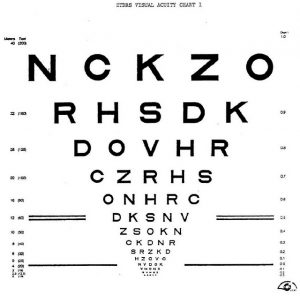
Eye chart image courtesy of Community Eye Health, CC https://flic.kr/p/cenNDu

The news photo of rugby league player Dylan Walker’s fractured eye socket made me feel anxious, like I get when I have an eye infection or it’s time for the annual glaucoma test. If I cover my left eye with my hand, I can navigate my way around the house, but that’s about it. No reading, watching TV or movies; definitely no writing, although I know vision-impaired people who have found ways around reading and writing.

What the auld aunties called a ‘gleyed ee’ or lazy eye was diagnosed in the late 1940s. I don’t remember wearing an eye patch when I was two, but I’ve seen the photos. It didn’t work. I say this only as an explanation if you passed me in the street and I did not say hello, it is possible you passed by on my right side.

Yes, so a serious injury to my left eye would probably see me lining up for the blind pension, although as I understand it, the aged pension replaces the (non-means tested) blind pension when the recipient reaches retirement age. An essay for another day, perhaps.

Last week the Australian Institute of Health and Welfare and Flinders University produced a report on eye injuries in Australia. The report shows 51,778 people were hospitalised due to eye injuries in the five-year period, 1 July 2010 to 30 June 2015. Two thirds of these were males. Falls (35%) and assaults (23%) were the most common causes of eye injuries. The most common type of eye injury was an open wound of the eyelid and periocular area (27%).

However, the report also showed that 86,602 people presented to an emergency department with an eye injury in the two-year period, 1 July 2013 to 30 June 2015. Only 1% of these cases (866) were admitted to hospital.

Sports-related eye injuries were seemingly uncommon by comparison, with just 3,291 males and 595 females reporting that the injury was sustained while participating in a sporting activity. However, information on what activity resulted in the injury was not reported for 69% of cases, so this is likely to be an under-estimation.

Of the known causes, more than one-third (37%) of males were participating in a form of football when they sustained an eye injury. Trail or general horseback riding (12%) was the most common sport-related activity resulting in eye injury reported by females. Over half (55%) of the sports-related cases resulted in an orbital bone fracture.

Such was the case during the Melbourne Storm-Manly rugby league game when a melee turned into a serious scrap between Manly’s Dylan Walker and the Storm’s Curtis Scott, with Scott throwing several punches, one of which broke Walker’s eye socket. Scott was sent off – red-carded as they say in soccer. Walker was given 10 minutes in the sin bin (for throwing a punch) and then had to be assessed for a head injury. Manly player Apisai Koroisau was also sent off for 10 minutes for running in and throwing a punch at Scott.

The National Rugby League (NRL) has been cracking down on such behaviour – Scott was the first person to be sent off for punching since 2015. All rugby league players know if they throw a punch they will at least be sent to the sin bin; angry flare-ups in recent years have tended to be of the push and shove variety.

But whether you follow rugby league or not, it was a bad look, for the sport and for all sports. Imagine the conversations over breakfast.

“Right, that’s it,” says Mum, whose son Billy (8) has been pestering her to play footie. “If you want to play sport you have two choices – soccer or table tennis. Those league blokes are thugs.”

Discussing the Manly/Storm fracas on the Sunday Footie Show, former Jillaroo Allana Ferguson commented: “If they did that in King’s Cross on Saturday at midnight and someone was injured they’d be off to jail.”

She makes a valid point.

A study last year by Dr Alan Pierce from La Trobe University found that repeated concussions in rugby league players have a long-term effect. He compared 25 former league players in their 50s with a control group of a similar age. The men carried out cognitive tests to measure memory and attention spans and dexterity tests to assess motor skills.

“What I’ve found is that the responses of retired rugby league players were significantly different to the healthy controls with no history of head injury,” Dr Pierce told the ABC.

The NRL took steps in 2015 to introduce mandatory head injury assessments (HIA), where players who have suffered a head knock have to leave the field for 15 minutes and be assessed by a doctor. If found to be concussed, they are not allowed to return to the field that match. An NRL injury surveillance report by Dr Donna O’Connor found that head injury assessments increased from 210 in 2015 to 276 in 2016, largely due to strengthened concussion guidelines. Sixty-six per cent of these cases were cleared to continue playing in 2016, compared to 54% in 2015.

If you have seen the excellent Will Smith movie Concussion (about brain injuries in American football), you may well ask why it took the NRL so long to act.

Cheek and eye socket fractures are common injuries in rugby league. They come about through (accidental) contact in tackles, as big bodies collide. Sometimes it happens through ‘friendly fire’ collisions with teammates.

Such was the case with Broncos forward Josh McGuire, whose injury in 2011 required surgery and he is now effectively blind in one eye.

Sports Medicine Australia says the incidence of sports-related eye injuries is low, but severity is usually quite high, as injuries to the eye can result in permanent eye damage and loss of eyesight.

“Research has shown that 30% of sports-related eye injuries in children have the potential for permanent loss of eyesight.

“A blow to the eye from sporting equipment, fingers or balls can lead to injuries ranging from lid haemorrhages or lacerations, corneal abrasions, retinal detachments and hyphaema (bleeding inside the eye) to permanent loss.”

Rugby league is rated a ‘moderate’ risk sport (in relation to sustaining eye injuries) compared to high-risk categories including baseball/softball, basketball, cricket and racquet sports. Any sport that involves small projectiles moving at speed is considered high-risk.

Our family GP once told me most serious eye injuries he had encountered were caused by squash balls and champagne corks.

If you lose an eye, the alternatives are an ocular prosthesis (a glass eye) or an eye patch, the latter having a bad press courtesy of movie bad guys. Think John Wayne’s bullying Rooster Cockburn in True Grit, Adolfo Celi’s menacing Emilio Largo in Thunderball, or John Goodman’s itinerant bible salesman Big Dan Teague (O Brother Where Art Thou).

If it came down to it, I’d opt for a good quality prosthesis, although the price (from $2,500), makes a $10 eye patch look like a bargain.

I’d make it a different colour just because I love that line in the Paul Kelly song about falling for a girl with different coloured eyes.

In the meantime, I will keep wearing Australian Standard safety glasses when I mow the lawns or use the brush cutter. You should too.


Tin Star at Goodwills’ house concert June 10

Tin-Star
Tin Star (l-r) Dan Grant, Penny Boys, Cathy Bell

Brisbane trio Tin Star make their Goodwills’ house concert debut on Sunday June 10. Penny Boys, Cathy Bell and Dan Grant are a Brisbane-based trio who have been performing at folk clubs and festivals since joining forces 18 months ago. Hinterland music fans may have spotted them playing at last year’s Maleny Music Festival and rumour has it they will make a return visit in late August.

In the interim you can enjoy this trio, whose music is a little bit folk and a little bit country but like their idols, Gillian Welsh and David Rawlings, meets somewhere in the middle.

Penny and Cathy were members of the popular Brisbane group The Poachers while Cathy and Dan have been long-time collaborators with Brisbane songwriter Mark Cryle. Cathy plays fiddle and accordion, Dan plays guitar and both provide harmonies for Penny’s distinctive, mellifluous voice.

Tin Star has been working on original songs for a debut album while performing at festivals including Wintermoon (NQ), Turning Wave (Yass), Music by the Sea and the West End Sessions. Last year the trio performed at the Neurum Creek and Maleny music festivals.

Here’s a live sample from the Wintermoon festival

The concert starts at 2pm on Sunday June 10 with a set from your house concert hosts, The Goodwills, often heard on Australia all Over.

Admission is $15 and bookings are essential. Afternoon tea will be available. For bookings contact Laurel goodwills (at) ozemail.com.au.

This concert follow a sold-out show by Cloudstreet on April 22. Our house concerts are popular and we have a limited number of seats so if you would like to book, email Laurel or use the contact page on this website.

We have one more concert scheduled for 2018 with the entertaining folk duo Sadie and Jay, currently touring in the UK.  They will perform on Sunday August 5. Check back later for details.

Whipping up a dust storm in D

dust-storm
Dust storm obscures Sydney Opera House, September 2009. Image by Janet Kavanagh, NSW Maritime, CC

While innocently vacuuming never-ending dust this week, I accidently sucked up the D harmonica which was lying on the coffee table. Said harmonica emitted a plaintive sound, closely resembling the wheezy noise of a piper warming up (think, You’re the Voice, Eric Burden’s Sky Pilot and that AC/DC song about it being a long way to the shop if you want a sausage roll).

Alarmed (these little blues harps cost $45 a piece), I managed to grab one end before it disappeared into the dusty bowels of the 10-year-old Wertheim. After a short struggle and a discordant approximation of the intro to Blowin’ in the Wind, I freed the harmonica and continued on my merry way.

Most household tasks have fallen my way since She Who is Ambidextrous (SWIA) broke a bone in her wrist, although to be serious, using the vacuum cleaner has always been one of my chores. This machine has seen better days, but it still does the job. The broken hose is securely held together with gaffer tape and a pair of chopsticks. A while ago I priced a replacement hose at a vacuum cleaner shop (I could have bought a budget-level machine for the same money). The enterprising young lad managed to side-track me to a really up-market vacuum cleaner which, I discovered after a 20-minute spiel, cost $1,799.

“I could buy a 20-year-old Toyota Corolla for that sort of money,” I said, “Nice try, kid.

I went out of the shop happily humming ‘I love my Toyota Corolla, aha hah,’* having spent no money at all. Instead I went to one of those big red and green barns and bought a roll of gaffer tape.

Maybe 36 years ago (or more), I succumbed to a sales pitch when a colleague sent his uncle around to sell me a vacuum cleaner. I had been telling this colleague how the old machine was seriously incapable of sucking up not only dust but hair and dander from a Golden Retriever.

So Uncle Harry called around, to demonstrate the superior dust sucking power of a top of the line Electrolux, in the days when top quality appliances were manufactured here and sold door-to-door with a five or even 10-year warranty.

I bought the Electrolux on time payment, because that was the only way to finance such an extravagant purchase in those impecunious times.

I’ve earned a few million (sic. Ed.) dollars since then and that old machine refuses to die. It’s now the ‘downstairs’ vacuum cleaner, although I’ve been known to use it upstairs when (as is a common problem), temporarily unable to source the right-size dust bags.

“That old thing still does the job,” said She Who Told Me in Week 3, “I Don’t Vacuum”. (My Dr. said I shouldn’t vacuum- bad for the back. Ed.)

A while back, when the tiler had finished laying tiles in our downstairs rooms I (without thinking), took the Electrolux out and started sucking up tile dust. It was the smell that alerted me – smoke pouring out the top of the machine. The bag was chockers. I let the Electrolux cool down, put in a new bag and what do you know, it continued on untrammelled, a glass half full version of the Millennial expression, “This sucks”.

I’m completely sure no manufacturer today could produce a vacuum cleaner (or any appliance), that would last 36 years and more.

This line of thinking led me to research robotic vacuum cleaners, which can be bought for as little as $129 or as much as a 20-year-old Toyota Corolla. Choice magazine generally gave all models the thumbs down when marking them on the capacity to extract dust from carpet.

The intelligent vacuum cleaner does a pretty good job on hard floors, although why you’d prefer a round model over a square one (to get into those nasty little corners that harbour ancient dust), is a mystery.

The perplexing thing is this: where does dust come from and why does it settle again after one pass with a vacuum cleaner? As Quentin Crisp said in The Naked Civil Servant: “There is no need to do any housework at all.After the first four years the dirt doesn’t get any worse.”

Dust mites and chronic allergies

I will acknowledge to being a little bit fussy about vacuuming, ever since the allergist did the pin prick tests to show I was hyper-allergic to dust mites. On first discovering this in the 1990s, we hired a heavy duty industrial vacuum cleaner and paid an agile friend to clean the crawl space in the attic of our 60-year-old house. After the fourth big black garbage bag was passed down the ladder to the respirator-wearing assistant, our friend declared that was one job he was never doing again.

It’s not too hard to find out the answer to the question, where does dust come from? Science Daily surmises, not so surprisingly, that most house dust comes from outside. The scientists developed a computer model that could track distribution of contaminated soil and airborne particulates into residences. They found that over 60% of house dust originates outdoors. The study by the American Chemical Society found that contaminants like lead and arsenic can find their way into homes via airborne dust.

Researchers David Layton and Paloma Beamer found that household dust included dead skin shed by people, fibres from carpets and upholstered furniture and tracked-in soil and airborne particles blown in from outdoors.

The 2009 report mentioned above came out in the same year a 500 km wide dust storm the colour of Donald Trump’s complexion swept across New South Wales and Queensland. The Australian capital, Canberra, experienced the dust storm on September 22 and a day later it reached Sydney and Brisbane. Thousands of tons of dirt and soil lifted in the dust storm were dumped in Sydney Harbour and the Tasman Sea. Ah yes, you remember that.

Random dust storms aside, the real culprit feared by those suffering from asthma and hay fever is the dust mite. Scientists agree that dust mites thrive among the aforementioned dead skin discarded by humans and pets. The dustier your mattress and pillows are, the worse the problem gets. As this fascinating but skin-crawling article says, there could be between 100,000 and one million dead dust mites (and mite dung) lurking in your bed. Ugh!

What you need to do, every time you change the sheets, is to strip the bed, hang the bedding out in the sun then attach the nifty little mattress cleaner that may or may not have come with your vacuum and give the mattress a good flogging, so to speak.

Or you could buy a robot vacuum cleaner and instruct it to spend all afternoon roaming around on the bed:

As Hal said in 2001 A Space Odyssey: “I’m sorry (Bob), I’m afraid I can’t do that.”

*(a reference to Tiffany Eckhardt’s love song to her Toyota Corolla)  

FOMM back pages/related reading:


Simple as ABC – a public radio/TV licence


ABC-Budget-Cuts
Chart: ABC annual report 2016-2017

At first glance, Treasurer Scott Morrison’s plan to slash $83.7 million from the ABC operating budget seems mean-spirited. At second glance, when he tells reporters ‘everyone has to live within their means’, it still seems mean-spirited.

The Budget proposal comes at a critical time for the ABC, which has been dealing with cumulative cuts of $254 million since 2014.

The Federal Treasurer, having painted the picture large, sent a hospital pass to Finance Minister Mathias Cormann to handle the outrage. Mr Cormann defended the decision to freeze indexation for three years (which amounts to $83.7 million), saying that all taxpayer-funded organisations have to find efficiencies.

The national broadcaster has been tightening its belt so much there is no room left for another notch. Managing director Michelle Guthrie sent an email to all staff saying as much, which she amplified in a press release. Ms Guthrie said the impact of the decision could not be absorbed by efficiency measures alone, as the ABC had already achieved significant productivity gains in response to past budget cuts.

She referred to Budget measures starting in 2014 with a 20% cut to the operating budget. The ABC was told to slash $254 million from its operating budget within five years. The broadcaster began to make cuts which were expected to save $207 million in 2015.

Jobs were lost, through natural attrition or redundancy, and the ABC also started reviewing its property portfolio and transmission network. As I have written previously, there was a general hubbub of protestation about this, circa November 2014.

“Petitioners were petitioning, GetUp was getting up, the ABC Friends group was lobbying and raising funds. They should have seen it coming,” I wrote.

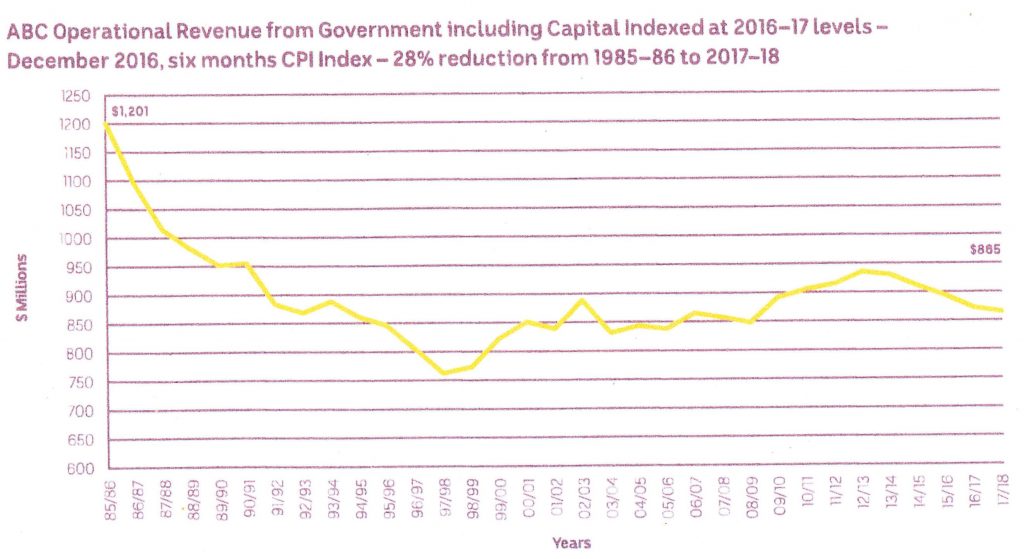
A graph in the ABC’s latest annual report (above) shows how its operational budget has waxed and waned, dropping 28% from 1985-1986 to 2017-2018. As the graph indicates, the ABC has weathered some very lean years, particularly 1997-1998, under John Howard and Peter Costello.

The ABC annual report says 2017–18 was the third year to reflect previously announced Government-funding reductions. As part of the ABC/SBS Additional Efficiency Savings measure, there was a year on year increase of $7.7 million in the cut to the ABC’s base funding, bringing the total decrease in base funding to $55.2 million per annum.

This week Ms Guthrie said the ABC was continuing to implement various savings initiatives to address funding cuts, comprising efficiency savings in support functions and transmission (to cover the previously budgeted reduction of $12.5 million required in 2018–19).

Back to the drawing board, then.

Ms Guthrie said the decision came at a critical time for the ABC, as it starts triennial funding negotiations with the Government.

“The ABC is now more important than ever, given the impact of overseas players in the local media industry and the critical role the ABC plays as Australia’s most trusted source of news, analysis and investigative journalism.”

There is also a risk that the Enhanced Newsgathering initiative will not be renewed (at a cost of $43 million). The ABC acknowledges a decision on this funding is yet to be made by the Government. Considering the hullabaloo that followed economic reporter Emma Alberici’s analysis of the government’s plan to cut corporate tax rates, these financial constraints must be seen as ideological and punitive.

Opposition leader Bill Shorten said the ABC was “one of the pet hates of the Liberal Party”, and it’s hard to disagree.

“Because the ABC occasionally asks questions of the government they’re going to wind back $83 million,” he told the ABC.

But Finance Minister Mathias Cormann says the ABC will still receive $3.2 billion over those three years.

“This is effectively equivalent to the efficiency dividend that applies to nearly all other government taxpayer-funded organisations,” he added.

One of the early victims of successive budget cuts was the ABC Fact Check Unit, which was closed down in May 2016. ABC news director Gaven Morris said at the time “Unfortunately, having a standalone unit is no longer viable in the current climate.”

In March 2017, however, the unit was revived as a joint venture between RMIT University and the ABC. The unit’s brief, as it was before, is to ‘test and adjudicate on the accuracy of claims made by politicians, public figures, advocacy groups and institutions engaged in public debate’.

Which governments taxed us the most?

You may have seen an infographic on social media which the Fact Check Unit verified. It shows which governments taxed us the most, spanning the years between Whitlam and Turnbull. Tax as a percentage of GDP peaked in the Howard years at 23.5%. The Whitlam years averaged 19.4%. The Abbott/Turnbull years thus far average 21.7%. Interestingly, the turbulent years of Rudd/Gillard/Rudd averaged 20.9%.

So isn’t it satisfying to publish information like that and know it has been fact-checked and found to be factual? In this era where fake news and what I’d call ‘sponsored news’ leaves us with a skewed perspective, it is refreshing to see the ABC has found a new way to maintain standards.

There were some moments in the Federal Budget one could choose to laud; tax cuts, better reverse mortgage opportunities for pensioners and more funding for the homeless, albeit dependent on State contributions. But there was no respite for people on NewStart and no real plan to address housing affordability.

And, as the Climate Council pointed out, there was nothing at all in the Budget to address climate change – the words were not even mentioned.

For perspective, take a moment to think about the Federal Treasurer’s $50 million plan to redevelop the Meeting Place Precinct in Botany Bay (including a $3 million statue of Captain James Cook). Yes, it’s in Mr Morrison’s electorate, but surely that’s a side issue, Leigh?

If I may revisit an idea from Simple as ABC in 2014, the budgetary travails of the ABC and the ideology motivating it could simply be avoided. All it would take is an annual public radio/TV licence; $35 per household per year would (now) raise about $300 million. If the government of the day would guarantee indexed funding of $1 billion a year, the ABC could plan, rebuild and restore quality for the long-term.

Let’s be reminded that we all paid a radio licence from 1920 and continued doing so until colour TV was introduced in the early 1970s. Not every household in Australia would be happy about paying this licence fee. Some would see it as subsidising those dangerous lefties and bleeding hearts at the ABC and SBS.

But something radical needs to happen, to arrest the decline in quality (e.g. ABC online), restore transmission to remote areas (try getting an ABC station on your car radio when travelling in country areas-Ed.) and ensure money can be found for important investigations.

Every week since 1961 the award-winning Four Corners has continued to unearth important stories. Investigative journalism is an expensive business which requires reliable funding and a relatively free hand.

If we want more important stories like the live sheep export scandal, the solution is simple as ABC: We need to consistently fund the national broadcaster and guarantee its editorial independence.

Further reading: Mr Denmore thinks the media should boycott the Budget Lockup:

http://bobwords.com.au/simple-abc/

http://bobwords.com.au/simple-abc-part-2/


Falls a risk for over-65s

risk-falls-over-65s
Elderly couple out for a stroll – falls and the over-65s photo courtesy pixabay.com

You may know this statistic about falls among older people, but it is shocking all the same to learn that 74% of people who were hospitalised after a fall had broken their hips. Head injuries were the next most serious (22%) with limb fractures further down the list.

About a third of all Australians in the 65+ age group will have a fall each year, but most are not serious. About 10% of people in this cohort who suffer a fall end up with a serious injury.

An Australian Institute of Health and Welfare (AIHW) reports states that about 100,000 people aged 65 and over were admitted to hospital after falls in 2012-2013. While that is a few years ago, the statistics are part of a 10-year study done at the time, so are representative. Discuss, as people say when posting something contentious on social media.

The falls could be as relatively minor as the tumble I took down our steep terraced acreage recently, which resulted only in bad language and a few minor scrapes. I few years ago I had a rather more serious fall – a broken rib and a bruised thigh – what rugby league commentators scoffingly dismiss as a ‘cork’. I was carrying two folding chairs in each hand while walking down the stairs. Did I mention it was raining and the soles of my shoes were wet? Duh!

Which brings me to She Who Is Ambidextrous (SWIA), who has taken the lead (2-1) in the Domestic Falls Stakes. Excuse me for making light of a poor but not overly serious situation.

SWIA had what’s known in the medical business as a FOOSH (Fall on Outstretched Hand). She sustained the injury as a result of tripping down some stone steps in the front garden.

As a young friend who rather more seriously injured his arm last year said when hearing this news, “At least it wasn’t a PAFO.”  (let me know if you can’t figure it out..)

Yes, it seems we are now in that age group who are more prone to falls, and, having fallen, are more likely to suffer an injury with a longer and sometimes problematic recovery time. Moreover, the fallout from falls can have psychological ramifications, making people less sure of themselves and reluctant to do ‘normal’ things which might result in falls.

It can happen to anyone, anytime.

The AIHW statistics quoted above include the telling observation that 72% of falls occur in the home or residential aged care facilities.

Stay on your feet – join an exercise class

Several Australian states have started a “Stay on Your Feet” campaign, which makes sense when you consider that in Queensland alone, falls cost the state more than $100 million a year.

Most people aged 60 and older are quite aware of the risk involved in taking a tumble and many attend exercise classes designed to shore up core strength and improve balance. So in many ways SWIA’s fall last week is a bit ironic as she is dutiful about attending exercise classes and daily doing what I never do (a morning stretch routine).

One of my regular readers says the thing he likes about the weekly read is that it so often addresses issues affecting ‘our’ age group (he means the over-60s).

So this is for you, mate. Core strength is the overall fitness and flexibility of the core muscles that help us keep our balance, sit down, stand up, lie down, kneel and squat. If your core strength is suspect (like me, down on one knee to get a dish out of the bottom cupboard), you will be found out using your hand/s for support.

Try these tests (and absolve me of all responsibility if you fall in a heap).

Sit on a hard-backed chair for 10 minutes. Now get up without using your arms for leverage. Do the same thing from a sofa, recliner or armchair.

As Billy Connolly says: “Ye know how auld you are by how long it takes to get out of a beanbag.”

The other trick is to stand on one leg for as long as you are able to hold the position, say 30 seconds (no hand support). Now try the other leg. Notice the difference?

The real test is how successful you are at putting on your underpants while standing.

Some people make provisions as they age by retrofitting their homes in some way, for example putting grab bars in the bathroom and toilet. Some even have ramps built to avoid going up and down steps or stairs. People aged 70 and over who live alone are often encouraged to wear a device which they can use to call for help.

Scientists in Australia, the US, UK and Europe are working to develop devices which can prevent falls by predicting the likelihood of a person having a fall. The University of Missouri is collating data from sensors built in to the walls of homes were aged pensioners live. The university’s researchers found that even small changes can predict if an elderly person is about to suffer a dangerous fall.

The risk quadruples if walking speed slows; for example when walking speed decreases by 5.1cm per second, the person has an 86% chance of toppling within three weeks, compared to just a 20% chance with no change. A drop in stride length of 7.6cm predicted a 51% chance of tripping within three weeks. Scientists elsewhere have developed wearable devices which can measure a person’s gait and ability to perform tasks like sitting down and standing up again. These can also reliably predict the likelihood of a pending fall. Scientists are finding these various devices helpful in predicting falls among people who have an illness which affects gait (Parkinson’s Disease, MS, joint pain (arthritis), spinal cord compression injuries and peripheral neuropathy, often associated with diabetes.

If all else fails, there are a range of alert buttons one can wear and press if in need of help. The help buttons trigger a monitoring station which will investigate and, if necessary, dispatch an ambulance.

The main risk of hurting yourself is if you are elderly and live alone, especially in a big, impersonal city. Chances are you could lie on the floor a long time before anyone discovered what had happened to you. I was reminded about this scenario when watching a new TV reality show, Ambulance, which is an inside look at London’s ambulance service. In the first episode, a man in his 90s has fallen to the floor and can’t get up. It’s been three hours and ambulances keep getting diverted to more urgent situations. To add to his woes, an ambulance is about to pull up at his front door when they get sent to help a woman who says she is having a miscarriage. Turns out to be a serial hoaxer

Good thing we live in a small community, where the first responders attending SWIA were prompt, thorough and cheerful. Medical staff at Maleny Soldiers Memorial Hospital were also very thorough, leaving nothing to chance.

Now you’ll have to excuse me, SWIA needs me to tie her shoelaces, take the lid off the pickle jar, and adjust the recliner… (and explain that the title of this article does not, of course, refer to said SWIA. Ed)

Today marks FOMM’s fourth anniversary. Congratulate me, make suggestions, or send gratuities!

Related reading, FOMM back pages

WWI Pacifists, Conchies and Rejects

WWI-Rejects-Conchies
WWI Rejects, Montville Memorial Gates, photo by Bob Wilson

Amidst the salvo of Anzac Day stories, the people least often talked about are those who did not take part in WWI,  either because of a Christian or moral objection, for practical reasons, or because the armed forces rejected them. According to the Australian War Memorial, 33% of men volunteering for the Australian Imperial Forces (AIF) in 1914 were rejected on medical/fitness grounds. Enlistment standards were gradually relaxed in ensuing years, allowing many of the rejected men to enlist. Key among these changes was to reduce the minimum height of a recruit from five foot six to five feet.

The World War I rejects don’t get much press at all: the blokes with poor eyesight, bad teeth, flat feet, hernias or some  other physical ailment or disability which ruled them out for active service. But once rejected, they often had to bear the same stigma as the despised ‘Conchies’ or ‘CO’s’ – our unique slang for conscientious objectors. In Australia, CO numbers were estimated at less than one in 30.

Globally, there were around 16,000 conscientious objectors during World War I and their numbers swelled to 60,000 or more in World War II. During the Vietnam War, hundreds of thousands sought deferment of the call-up or, in the case of American objectors, fled across the border to Canada.

Despite the early fervour to enlist for World War I, the country on the whole rejected the notion of conscription. PM Billy Hughes took the issue to a plebiscite twice during WWI and each time narrowly lost.

Meanwhile in tiny New Zealand (1914 population 1.1 million), the government simply passed a law and conscripted young men for the war effort. And as at least one controversial account claims, they took a very dim view of men who refused to fight on religious or ethical grounds.

Archibald Baxter, father of New Zealand’s late poet laureate James K Baxter, was one such staunch CO – an absolutist to the last.

His autobiography ‘We Will Not Cease’ makes for startling reading as it sets out the cruelty inflicted by his own countrymen on those who refused to fight. Baxter’s son wrote a poem with the searing lines:

When I was only semen in a gland

Or less than that, my father hung

From a torture post at Mud Farm

Because he would not kill.” (Pig Island Letters, Oxford U.P.1966).

Baxter Jnr’s poem, which describes his father’s ‘blackened thumbs’ refers to Field Punishment No 1, also the name of a 2014 New Zealand television movie. CO’s were hung up on poles (on the front line), in faux crucifixion pose, in the hope they would somehow recant.

Baxter never did.

The mistreatment of conscientious objectors in New Zealand has come to public attention in recent years, first through a public exhibit, and later by an opera, ‘War Hero,’ based on Archibald Baxter’s book.

Meanwhile back in Australia, for those who desperately wanted to enlist, particularly for World War 1, being found unfit to serve was a cruel blow that caused many men to become social outcasts. Unless employed in some clearly supportable on-land war effort, when these seemingly able-bodied men of a certain age were seen out and about, they were often subject to much derision.

The nearby hinterland hamlet of Montville holds a unique place in World War I history, as explained in a Canberra Times feature by Chris Sheedy, commissioned by the Canberra campus of UNSW.

The Montville War Memorial lists the local men who served with the AIF, but also the ‘Rejects’, the men who wanted to serve, but were classified as unfit.

Sheedy writes that in the celebrations of the homecomings of soldiers during and after WWI, most communities around Australia ignored those who didn’t serve.

“In fact, many shunned the ‘shirkers’ and were divided into segments of those whose family members had served and those who had not.”

The authorities must have foreseen this by developing badges for those who volunteered but were deemed ineligible to enlist, or honourably discharged because of age, injury or illness.

Sheedy notes that many men chose not to volunteer for practical reasons – they had a family to support or a farm or business to run.

Professor Jeffrey Grey from UNSW Canberra cites Robert Menzies as a prominent person who chose not to volunteer. Menzies had two brothers who went to war but the siblings agreed that Robert (a lawyer), would stay because he was more likely to provide for his parents in their old age.

Australian folk singer John Thompson, who has researched and written songs about WWI, describes it as a time when there was indeed a mood in the country among young, single people to ‘do your bit’. Thompson developed a song about Maud Butler, a teenage girl who so wanted to do her bit she dressed up as a soldier and stowed away on a ship. She got caught, but later made several other attempts to enlist.

As Thompson explains in the introduction to the song, Maud scrounged up the various pieces of an army uniform. “But she couldn’t get the (tan) boots and that’s what eventually led to her being discovered.”

Maud climbed arm over arm up an anchor rope to stow away aboard an Australian troop carrier. Historian Victoria Haskins, who researched the story, recounts how Maud gave interviews a few days after her return to Melbourne on Christmas Day, 1915.

Maud told local media that she “had a terrible desire to help in some way, but I was only a girl… I decided to do something for myself.”

While there may have been an initial wave of patriotism and a naïve yen to support the British Empire, volunteer numbers dropped in the latter years of the war.

The Australian War Museum estimates that 420,000 Australians enlisted in WWI, approximately 38.7% of the male population aged between 18 and 44. So despite the enormous peer pressure on young men to enlist, 61.3% of enlistment-age men did not join the war effort, for whatever reason.

Enlistments peaked at 165,912 in 1915 and declined in the ensuing years to just 45,101 in 1917 and 28,883 in 1918, the year the war ended.

Most of the literature about Australia’s involvement in WWI emphasises the 420,000 who enlisted, rather than the 665,000 or so who did not.

Given that a majority of men aged 18 to 44 either did not volunteer or were rejected by the AIF, it seems absurd to perpetuate the myth of the shirker. Those who stayed behind because of family loyalties, businesses, careers, or simply because they felt it wasn’t their fight, did not deserve to be ignored or worse, handed a white feather in the street or have one left in their mailbox. It is shocking to recall that a formal Order of The White Feather was formed to encourage women to pressure family and friends into enlisting.

As the AWM comments: “Some criticised the practice, arguing that ‘idiotic young women were using white feathers to get rid of boyfriends of whom they were tired.’ ”

It wouldn’t work today.

FOMM back pages