War is Over – Lennon’s plea for peace, 52 years on

plea-for-peace
The dove released – a universal symbol of peace

So goes the simple counter melody to John Lennon and Yoko Ono’s 1971 song, Happy Christmas/War Is Over. The Vietnam war was still raging when Lennon penned this universal message for the album, Imagine.

Fifty-two years later, the 30 children from the Harlem Community Choir who sang on the recording would be in their 50s and 60s now, if still alive. I wonder if any enterprising journalists have tried to find and interview these people.

What in Lennon’s name would they think about the simple call for peace contrasted with what’s going on in December 2023?

As I wrote this, the UN Security Council was trying once more to have its Israel/Gaza ceasefire resolution passed, hopefully without another US veto. Israel insists that a ceasefire will leave it defenceless against Hamas attacks. The inference is that Hamas, as a terrorist group, will pay no heed to a UN resolution.

In case you are confused, the ceasefire resolution passed last week by the UN Assembly is a non-binding agreement. The UN Security Council, however, can force a ceasefire if it gets the resolution passed.

I turned to Al Jazeera for the latest on the Israel/Gaza war, which started on October 7, after Hamas fired missiles on Israel, with 1,200 Israel civilians killed.

The bombing raids and subsequent invasion by Israel has left at least 20,000 Palestinians dead, including large numbers of children.

Which made me wonder when our Prime Minister took the podium at a Lowy Institute function this week and backed Israel’s right to defend itself. Mr Albanese and foreign Minister Penny Wong came out early in the conflict supporting Israel, as did US President Joe Biden

Last week Penny Wong sided with the UN Assembly’s call for a ceasefire, which is a fair U-turn on the original statement. The UN General Assembly resolution was passed 153 votes to 10, with 23 abstentions.

It’s fair to say that any discussion between friends and family over the Israel/Gaza war will inevitably become terse. It usually comes down to one’s heritage and previous experience with sectarian conflicts (Ireland, the former Yugoslavia and Ukraine), which tends to divide families.

My life partner is a Canadian-born Australian who has tracked her Jewish maternal family back to Latvia, where her ancestors fled the pogroms in the late 1800s.

The key difficulty is if you disagree with Israel’s position you are seen as anti-Semitic.

(Ed: I certainly disagree with Israel’s position, and it would seem odd to classify me as ‘Anti-Semitic’- more accurately, anti-uber Zionist).

This a summary of the most recent history from the Council for Foreign Relations: (words in parenthesis are my attempts to clarify)

In 1947, the United Nations adopted Resolution 181, known as the Partition Plan, which sought to divide the British Mandate of Palestine into Arab and Jewish states. (Britain was given the mandate in 1917  by the League of Nations after seizing Jerusalem from the Ottoman Empire).

On May 14, 1948, the State of Israel was created, sparking the first Arab Israeli War. The war ended in 1949 with Israel’s victory, but 750,000 Palestinians were displaced, and the territory was divided into 3 parts: the State of Israel, the West Bank (of the Jordan River), and the Gaza Strip.

Over the following years, tensions rose in the region, particularly between Israel and Egypt, Jordan, and Syria. Following the 1956 Suez Crisis and Israel’s invasion of the Sinai Peninsula, Egypt, Jordan, and Syria signed mutual defence pacts (against Israel). In June 1967, following a series of manoeuvres by Egyptian President Nasser, Israel attacked Egyptian and Syrian air forces, starting the Six-Day War. After the war, Israel gained territorial control over the Sinai Peninsula and Gaza Strip from Egypt; the West Bank and East Jerusalem from Jordan; and the Golan Heights from Syria.

It is demonstrably the case that trouble was expected from the formation of the nation state of Israel. In short, both sides believe they are entitled to occupy the land. These beliefs go back centuries, to biblical times, even. When the British decided to leave Palestine (which they had occupied since the end of WWI), they created a doctrinal vacuum in which Arabs and Jews were supposed to co-exist.

Israel has been accused of genocide (meaning the destruction of a nation or of an ethnic group). Israel in turn says it is focused on rooting out and destroying the terrorist group, Hamas.

Whatever you want to call it, the daily footage of ongoing destruction and killing in Gaza, accompanied by hawkish statements from Benjamin Netanyahu, does not point to the UN successfully  brokering a lengthy ceasefire.

I just happened to be reading The Fog of Peace, a memoir by French diplomat Jean Marie Guéhenno. Early in his tenure with the United Nations, Guéhenno was asked to review UN peacekeeping missions which had been in place for decades.

The brief was to weigh up the importance of the missions against the ongoing costs of maintaining them.

This is how I learned of the existence of UNTSO, an observer mission formed in 1949 to monitor the ceasefire between the newly created state of Israel and its Arab neighbours. This mission, based in Jerusalem, is still in place today.

Guéhenno writes that while closing down the mission made good management sense, maintaining it meant making the political point that the conflict between Israel and its Arab neighbours remains a big issue.

The UN loves acronyms so I should explain that UNTSO is The United Nations Truce Serving Organization. In 2023, the mission has 53 military observers,  81 international civilian personnel and 148 national civilian staff. Some 27 countries including Australia contribute to the ongoing operation of UNTSO. Since we are recording facts, 50 people working for UNTSO have been killed since its establishment 74 years ago.

Meanwhile, our PM and his Foreign Minister remain tied to the US, which is highly unlikely to say Yes to an immediate ceasefire without substantial amendments to the resolution.

Which brings us back to War Is Over, If We Want It.

Lennon is dead, shot by an allegedly disturbed fan in 1980. In the nine years between Lennon’s ultimate call for Peace and his death at an assassin’s hand, 84 wars, civil conflicts, military coups and insurrections went unchecked. Vietnam ended but other wars began.

As Jackson Browne observed in Lives in the Balance:

There’s a shadow on the faces
Of the men who send the guns
To the wars that are fought in places
Where their business interests run
,

In the 43 years since Lennon died, there have been 104 wars in which the US was involved. While the US is not actively involved in the Israel/Gaza war, it provides aid to Israel and its foreign policy dictates what happens from here on. Should Australia be aligning itself so closely to the US, given the divisive signals that sends to the Australian people?

Forty percent of us were born overseas and 213,900 of our citizens were born in one of the 23 Middle Eastern countries.

As Lennon sang in 1971: “And so it is Christmas”.

Yes indeed, but it won’t stop Pro-Palestinian public protests in our capital cities and who are we to say they shouldn’t.

I’d probably recommend banning the above discussion at the Christmas table, even though you are now as up to date as you’d want to be.

Find a soothing playlist which should include Silent Night, O Holy Night, a couple of Australian carols (Carol of the Birds, The Silver Bells), and this one, a version of The First Noel set to Pachelbel’s Canon.

Play Fairytale of New York if you must. We prefer Dirty Old Town.

Bob and Laurel
Stamp of approval a one-horse race

stamp-winx-race
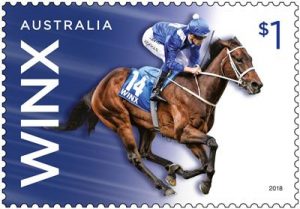
Australia Post celebrates Winx’s record-breaking 26th consecutive win with a commemorative stamp

You’d have to say Australia Post had a bit riding on the champion mare Winx winning her 26th consecutive race at Warwick Farm last Saturday. Let’s say at the outset that this is about stamp collecting, not horse racing (surveys show the latter subject turns FOMM readers off – or politics – that was a three horse race…Ed.)

Whether you like horse racing or not, the existence of Winx the super horse must have filtered through, as it is many a moon since any horse won this many races on the trot, which is racing parlance for an unbroken winning streak.

Celebrating the mare’s place in equine history, Australia Post released a commemorative stamp, pictured here by courtesy of AP and ‘with perforations’ as requested. Journalists received the press release from Australia Post about a minute after the race was run and won.

We plan ahead for important activities, achievements, and national events in the calendar, and had extra resources on standby to assist in producing the special stamps,” an Australia Post spokesperson said, in response to our obvious question.

So all ended well. If you are a stamp collector or philatelist as it is known in the trade, you will already have ordered your first day covers, special 26-stamp packs, a set of maxi cards and a medallion cover.

Horse stamps are not that unusual – examples include Black Caviar in 2013 and a set of four stamps issued in 1978. They featured Phar Lap, Bernborough, Peter Pan and Tulloch. The collection is notable for fine art work by Brisbane artist Brian Clinton.

Like Dusty Springfield, I was wishin’ and hopin’ and thinkin’ and prayin’ that either Malcom Turnbull or his nemesis were philatelists so I could make this politically relevant. But it seems only one (former) Federal politician, Philip Ruddock, collects stamps. This seemingly innocuous hobby at times embroiled the then Immigration Minister in controversy.

Ruddock, now Mayor of Hornsby Shire, was a member of Amnesty International. Critics found his membership of the organisation was at odds with his government’s hard-line immigration policies. In 2000, Amnesty asked Mr Ruddock not to wear his lapel badge when performing ministerial duties and not to refer to his membership when promoting policies opposed by Amnesty. AM 18/3/2000

In a profile for The Good Weekend in 2002, writer Richard Guilliatt was given a look at Ruddock’s collection, which spans three generations. Guilliatt, perhaps innocently, suggested that the high dramas of the job had spurred the stamp collecting hobby on.

“…every month letters pour into Ruddock’s Parliament House office in Canberra, imploring him to liberate the men, women and children detained behind razor wire in Australia’s desert camps for Third World asylum seekers,” he wrote. “Those letters come affixed with all manner of exotic stamps, which Ruddock gets his secretary to tear off so he can take them home to his house in the leafy northern hills of Sydney, to be packed away for sorting.

“That’s one of the good things about getting a lot of letters from Amnesty International,” Ruddock told Guilliatt.

If few politicians collect stamps, at least a dozen former Prime Ministers featured on Australian stamps in the 1950s and 1960s. It’s important to note that all received the honour after their deaths.

“Until the introduction of the Australia Post Australian Legends Awards in 1997, the only living person allowed on a stamp was the reigning monarch”, the spokeperson told FOMM.

Nevertheless, the PM’s head on a postage stamp seems clearly out of fashion now, in this era when one is never quite sure if the PM will last his or her term. But there have been enough sporting celebrities, athletes, actors, singers, writers and decorated soldiers to compensate.

In an aside for crime fiction aficionadas, the most infamous stamp collector award must surely go to Lawrence Block’s fictional hit man, Keller. John Keller is the protagonist in Block’s crime series which began with Hit Man in 1998. Keller collects pre-1940 stamps and uses down-time between ‘jobs’ to visit stamp shops and exhibitions. It’s a kind of cover for his apparent lack of legitimate income, not unlike Block’s gentleman burglar and antique bookstore owner, Bernie Rhodenbarr.

Many famous people are listed in various publications and websites as stamp collectors. The collection does not have to be distinguished to command a price. Former Beatle John Lennon’s collection of 550 stamps from his childhood was bought by the Smithsonian Institute’s National Postal Museum in 2005 for about $A74, 000.

Which brings me to the best-selling commemorative stamp of all time – the Elvis stamp released in 1993, Perhaps the delay since the rock singer’s death in 1977 was due to persistent ‘sightings’ of the late Mr Presley. Even today you will find folk who will tell you he is still alive and living under an alias, like someone in witness protection. Elvis would be 83 if still alive today.

The US Postal Service printed 500 million commemorative stamps – three times the usual print run. It was the most highly publicised stamp issue in the USPS history. The people were asked to choose between two designs (1.2 million votes), the majority preferring the stylised image of the young rocker, microphone in hand.

Stamps can be highly controversial items. For instance, the first secular Christmas stamp in the US, with its pair of white candles and a wreath with a red bow, was released in 1962.

Critics said it crossed the line between church and state. The public was also unenthused about a 1963 design – an illuminated Christmas tree in front of the White House.

Public takes dim view of Surfing Santa

The most controversial Australian stamp was also a Christmas release.  The 1977 stamp featured a humorous depiction by Adelaide artist Roger Roberts of Santa Claus riding a surfboard. Some members of the public were affronted, saying the postal service was not taking Christmas seriously. Until 1975, all Christmas stamps featured religious themes, often based on the traditional nativity story. There was no such fuss about the mix of secular and Christian stamps released in 1976.

If you thought the popularity of email would adversely affect stamp collecting, the market is as robust and profitable as ever. As an extreme example, the One-Cent Magenta from British Guiana, issued in 1856 and thought to be unique, sold at a New York auction in 2014 for a record $9.5 million.

In 2007, the Australian collection of Arthur Gray was sold through Shreves auction house in New York for more than $7 million. Among the spectacular results was the $265,000 paid for a block of four 1919 £1 brown and blue Kangaroos.

So did you collect stamps as a child? Did you, as I discovered, learn at some point in your cash-strapped adulthood that the collection was worthless?

We had a family friend who spent most of her younger years travelling to exotic climes and would write, with bundles of stamps included ‘for wee Bobby’.

I gave away stamp collecting and its fussy handling (gloves and tweezers and corners to mount the stamps rather than pasting them in the album), around about the time I realised girls were interesting.

I still have those two old albums tucked away somewhere – among Father’s Letters, I’m thinking.

Somewhat related reading:

The FOMM alt-Christmas playlist

Alt-Christmas-playlist
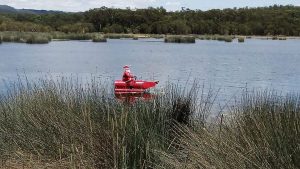
Alt-Christmas playlist Santa escaping shopping centres to go fishing in Ewen Maddock Dam, photo by Bob Wilson

The first thing you’ll notice about my carefully curated alt-Christmas playlist is the absence of Six White Boomers and The 12 Days of Christmas. I’ll walk out of the room if someone starts on that tedious epic. I was intending to write a Grinch-like piece this week, but instead decided to share my eclectic view of the world through an alt-Christmas playlist.

What set me off on this tangent, dear reader, was making visits to three different shopping centres in the past three weeks. It wasn’t so much the crowds, the noise, the proliferation of tattoos or the inappropriate wardrobe choices that got me down. It was being assailed, or should that be wassailed on all sides by different streams of Christmas music. It ranged from Bing and that tired old northern hemisphere trope to Jose Feliciano wishing us a merry one from the heart of his bottom.

For someone whose preferred background music is Bach or Riley Lee playing the shakuhachi, it is an assault on the senses. It seemed to me, though, that most people were oblivious to Rudolph and Frosty the Snowman, as they trudged around shopping centres at Carindale, North Lakes and Morayfield. In fact, as their laden trolleys would indicate, they seemed intent upon spending.

A survey this week by finder.com.au reckons Australian shoppers will spend $492 (each) on Christmas gifts alone. Women will apparently spend $58 more than men. Finder’s Bessie Hassan said the 2017 spending estimate was slightly lower than 2016, when Australians spent on average $539 on Christmas presents.

The shopping swarms were probably to be expected, given the 3.6% rise in the consumer confidence index between November and December. The Westpac Melbourne Institute’s Index is 5% above the average for the September quarter, which saw a ‘disturbing’ slump in consumer spending.

While consumer confidence may have bounced back at a critical time for retailers and their landlords, the keepers of the index are circumspect.

“…with ongoing weak income growth, a low savings rate and high debt levels, we cannot be confident that consumers have the capacity to sharply lift spending, despite higher confidence.”

The irony of my three visits to large shopping centres is, had I planned ahead to buy the small but well-chosen gifts, I could have done it online and saved myself the grief.

So to the FOMM alt-Christmas playlist; they’re not all leftie, anti-Christmas rants and there’s a thread of peace and love running through all of them.

There are a couple of genuine carols, a peace anthem or two, some Australian content and more.

My music correspondent Franky’s Dad offered to create a Spotify alt-Christmas play list for me. Until he did that, I had not subscribed to Spotify. (Hands up who else has no idea what ‘Spotify’ is. Ed.) Unlike many list stories you will find on the Internet, these songs are not in order of preference. I happen to like all of them, but feel free to disagree or tell me which alt-Christmas song I should have included instead.

All of the links here are to YouTube videos. Just dip into them as the spirit moves you. For those who have Spotify, here’s the link:

1/ The Little Drummer Boy, interpreted here by my favourite acapella group, Pentatonix. If you like the group and this genre of music, they do a splendid version of Jolene with songwriter Dolly Parton.

2/ River, by Joni Mitchell. Ah, what a wistful, sad song. They’re cutting down trees and putting up reindeer, singing songs of joy and peace. But Joni just wants a river to skate away on (as you do if you live in Canada).

3/ Fairytale of New York, The Pogues and Kirsty MacColl, a bawdy anti-Christmas ballad of drunkenness and fractious relationships. I like the bit where the boys from the NYPD sing Galway Bay. A classic.

4/ I’m growing a beard downstairs for Christmas, Kate Miller-Heidke and The Beards. This quirky, M-rated Christmas satire won the best Comedy/Novelty song category in the 2015 International Songwriting Competition.

5/ 7 O’Clock News/Silent Night, Simon & Garfunkel, 1966. Half a century later, this timeless carol’s theme of peace and goodwill is still being drowned out by the negativity of global news.

6/ Suddenly it’s Christmas Loudon Wainwright III. Yep, it starts with Halloween (forget about Thanksgiving, that’s just a buffet in between). As Loudo sings – it’s not over till it’s over and they throw away the tree.” The Spotify version is a remix, but the impudent tone is still there.

7/ Happy Xmas (War is Over). One of John Lennon and Yoko Ono’s many pleas for world peace.

8/ Getting Ready for Christmas Day, Paul Simon. From early in November to the last day of December, he’s got money matter weighing him down. Simon cleverly intersperses the lyric with a 1941 sermon, voiced by black American preacher, Rev J.M Gates.

9/ The Silver Stars, Brisbane Birralee Voices. This is an Australian carol by William James which has also been sung by our Maleny chamber choir, Tapestry.

10/ Little Saint Nick, the Beach Boys. I’ve got Macca from Australia all Over to thank for this as he played this merry tune to close out his show last week. It sounds a bit like a rebadged Little Deuce Coupe, but who’s complaining.

11/ How to Make Gravy, Paul Kelly. Where would we be in Australia without the letter to Dan from Joe, who’ll be spending Christmas in jail? Kiss my kids on Christmas Eve and make sure you add a dollop of tomato sauce to the gravy.

The Christians and the Pagans, Dar Williams. The definitive song about disaffected families and how they come together at Christmas and try to find common ground.

(Our friend Rebecca Wright does a cracker version of this one).

Meanwhile, people, there are only 2+ days more shopping days to spend your quota. The Australian Securities and Investment Commission’s Money Smart tells us that the average credit card debt after the holiday season is $1,666.  While 82% of Australians will pay this off in up to 6 months, 11% will take six to 24 months; 4% will take two years or more and 3% believe they will never pay it off.

If you are worried about waking up with a debt hangover, go here, where you’ll find helpful tips, It’s probably too late for this year, but as Loudon Wainwright observes, of all such holidays, ‘it’s not over till it’s over’.

Season’s Greetings and take care on the roads – Bob and Laurel.

Flashback to Christmas 2015