
Although I find the Australian outback fascinating and a little scary, I am unlikely to join the increasing numbers of people whose bucket list item is crossing the Simpson Desert.
It’s not just that we don’t own a 4WD. I/we lack the essential Australian pioneering ability to fix things that break down. Regardless, thousands of people trek across the Simpson Desert each year, from Birdsville in Queensland to Dalhousie Springs in South Australia.
The actual distance travelled between Birdsville and Dalhousie Springs (about 480 kms), seems like a jaunt compared to the 18-hour journey from Brisbane to Birdsville. The conventional first leg, however, is a comparative dawdle, with its largely bitumen and dirt road stretches between Queensland’s capital and the famous outpost which each year draws tourists and adventurers to the annual Birdsville Races and Big Red Bash.
Crossing the Simpson Desert requires thorough preparation and all the skills to navigate a 4WD vehicle across 1,100+ sand dunes. Most guides to the trek recommend an average speed of between 15 and 20 kmh (on tyres deflated to about 20psi), so the crossing can take four or five days.
There are no services between Birdsville and Dalhousie so you need to carry your own food, water and fuel. The key thing to remember is that traversing sand dunes consumes double the amount of fuel you would use on a conventional road. It is recommended to travel in convoy with friends as back-up, in case something goes wrong.
The convoy strategy paid off for Sunshine coast residents Graham Waters and Evelyn Harris, whose planned Simpson Desert crossing went awry on the notoriously corrugated Strzelecki Track.
The party of seven in three vehicles travelled south to Bourke, Cameron Corner and Innamincka, planning to cross the Simpson from west to east.
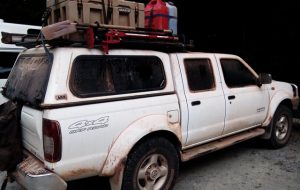
About 100 kms south of Innamincka, Graham heard an ominous rattle in the rear of the vehicle. Thinking he had a flat tyre, he got out to find that five of the six wheel nuts holding the wheel to the rear axle of his Ford 4WD had sheared off.
“If the sixth nut had broken off, anything could have happened, so in that way we were lucky,” Graham said.
 Graham set about ‘borrowing’ wheel nuts from other tyres in the hope they could keep going as far as Moomba. A seasoned four-wheel drive explorer (expeditions include a three-month trip to Cape York), Graham realised he had to find expert help.
“We were there for two nights, off the side of the road. It’s a relatively busy road, so truckies kept stopping to ask if we needed help.
“We tried going back to Innamincka but the wheel started rattling again, “We also tried to drive to Moomba but the replacement nuts wouldn’t hold.”
In the end, a low-loader came out to take the vehicle to the Santos gas plant at Moomba. After a temporary fix at the Moomba workshops, they drove to Port Augusta.
“It ended up being a $5,000 exercise, including the towing, two new axles and the labour.
“But if you did this as an organised tour, it would probably cost that much at least for each person,” Graham added.
Once the vehicle was repaired in Port Augusta, they travelled north via the Flinders Ranges and Lake Eyre before starting the Simpson Desert crossing at Dalhousie Springs.
 “We did talk about packing it in and just going home, but after a night in a B&B in Port Augusta, we got our second wind and decided to keep going.
“We’re really glad we did, because if you slow down and stop frequently, you realise the desert, while it’s stark and windy, is a beautiful place full of wild flowers and birdlife.”
“When you are camped out there at night under the stars all you can hear is the occasional howl from a dingo or a grunt from a feral camel. It’s a magic experience.”
Evelyn knew with one look at the damaged wheel it was a case of “how much is it going to cost to get us out of this situation”.
“Usually Graham can bodgie things up, but this time he couldn’t. It’s all part of the adventure, though. You hope it won’t happen, but if it does you can make the best of it”.
Travelling in convoy also proved crucial for Brisbane couple David Caddie and Margaret Pope while on a Simpson Desert crossing. David was driving his Toyota Prado, customised to include a slide-out camp kitchen, fridge and pantry built in to the back of the vehicle. Unfortunately, at the convoy’s first overnight stop, David found he could not get the rear doors open. They had become jammed with the fine powdery substance known as bull dust.
“Luckily the people we were traveling with love their food so they had plenty”, he said. “At least enough till we got to Alice Springs and a smash repairer used a Spit Water Pressure Cleaner to wash out the dust”.
Peter and Linda Scharf’s 4WD motto is to pack light and don’t be in a hurry. A few years ago, he and Linda took 21 days to traverse the 1,850km Canning Stock Route in Western Australia in a Land Rover with a tent, an HF Flying Doctor radio and basic supplies.
“For us it is all about preparation. You pack light and the things you pack need to have multiple uses. Most people take way more clothes than they actually need.
Peter and Linda did carry tools and spare parts, which came in handy when a shock absorber broke.
“For a long time we travelled without long-range communications. Now we have an HF radio with a range of about 3,000 kilometres.”
But as Peter says, one ought not to rely on technology. “You can only guarantee satellite phone coverage of about 80%. So there are still places, especially in northern Australia, where they won’t work.”
Remote area 4WD traveller John Greig told FOMM the stresses and strains on vehicle chassis/bodies on desert tracks can be enormous.
“These days almost every popular desert crossing, including the Canning Stock Route, is suffering from diagonally opposed holes, opening up in the wheel tracks”.
“This is mainly caused by drivers not dropping their tyre pressures low enough”.
Potential setbacks aside, if you have a hankering to cross the Simpson Desert, the best time is between April and October.
Handy tips abound on the internet, including this one drawn from many sources:
While the Australian desert outback is a beautifully scary and remote place, technology and the capabilities of modern 4WD vehicles have made it far less daunting. Robyn Davidson found fame after her 1977 crossing of the Gibson Desert between Alice Springs and the Indian Ocean. She crossed the 1,700 kilometres on foot, with four camels and a dog.
Her book about one woman’s quest for solitude, Tracks, was subsequently made into a movie starring Mia Wasikowska as Davidson.
In a recent ABC interview, Davidson conceded that doing the same trip in the same way would be impossible today.
“Back then there were no mobile or satellite phones. (You’d) come across a two-way radio every three months – it was how you got messages out of there.”
Davidson, who grew up on a mid-western Queensland cattle station, believes one of the greatest gifts of living in a country like Australia is the physically large open spaces.
She had a fascination with the desert and wonders now if those “those early sensual signals of dry air and the smell of dry grass” of her childhood ran deep.
“Perhaps all Australians have some sense of the desert back there buried in their psyches,” she said.
 “This creed of the desert seemed inexpressible in words and indeed in thought”. T. E. Lawrence
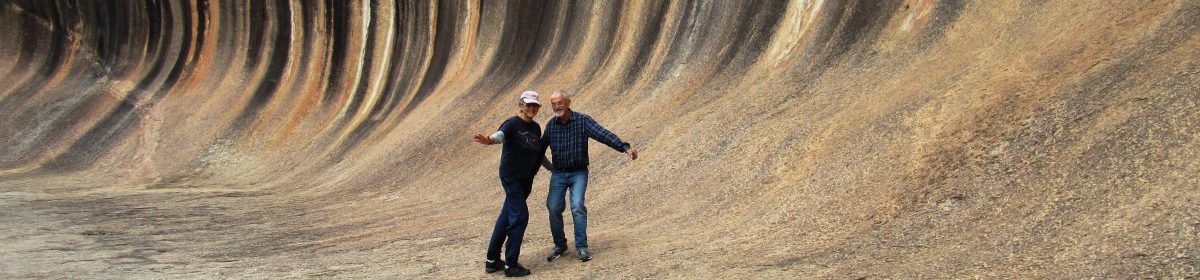
All photos (including drone footage) by Graham Waters.