Concussion and the slow demise of contact sport

contact-sport-concussion
Image: John Hain, www.pixabay.com

As you might know, one of my unlikely ‘hobbies’ is watching rugby league games on television. It’s as exciting as things get around here, especially if your team is winning. Once or twice a year we go to a live game (at least $100 admission for two).

The technology used to televise contact sport has led to a level of live scrutiny the game has never known before. Back in the day you could tackle someone and give him a ‘facial” (mashing your forearm into his face), and if the referee didn’t see it, you got away with an unsporting, illegal ‘dog act’.

The advent of The Bunker (a small team of referees armed with the technology to forensically replay on-field incidents), has changed the game forever. There is only one referee, and he/she can’t be in all places at once. That is why the Bunker alerted the referee to an incident last week where Parramatta Eels forward Reagan Campbell-Gillard slid his knees into the back of Titans hooker Chris Randall (who was already on the ground). It didn’t look good and the player on the ground was in apparent agony.

Campbell-Gillard was sent to the ‘Sin Bin’ and later suspended for four weeks over a grade three dangerous contact charge.

Repeated replays of such incidents prompt mothers (and fathers) around Australia to say, ‘no son of mine is playing that brutal sport.’ Then they sign them up for under-12s soccer, even though 22% of injuries in the round ball game are concussions.

Australia can’t be too far away from a class action brought by former contact sport players for whom repeated head injuries have left a legacy. There have been a few individual cases brought in Australia. Former Newcastle Knights winger James McManus eventually settled out of court after suing the National Rugby League (NRL).

One does wonder how much longer contact sports like rugby league and rugby union can be justified when there is so much evidence to show what repeated head trauma can do to an individual.

Research published in the British Medical Journal canvassed the extent of head injuries/concussions and the risk of under-reporting. The research found that 17.2% of Australian rugby league players suffered a concussion in the previous two years and did not report it to the coaching team or medical staff. About 22% of NRL first grade players admitted to not reporting at least one concussion during the 2018 and 2019 seasons. The most common reason was the player ‘not wanting to be ruled out of the game or training session’ (57.7%) and ‘not wanting to let down the coaches or teammates’ (23.1%).

Rugby league has changed immeasurably since I first started watching the game in the 1980s. Many rule changes occurred, technology worked its way into the game and now, it seems, an entire game is played with player welfare a priority. Back in the day, players commonly used their shoulders to tackle an opponent, usually resulting in the foresaid opponent being concussed and having to leave the field. Players who led with their shoulders inevitably spent time off the field having shoulder reconstructions. Even now, when shoulders are much less utilised than they were, it is not unusual to find a player in his mid-20s who has had two or even three reconstructions.

The shoulder charge is not the only banned ‘tackle’. There is the crusher tackle, the hip drop, third man in and any tackle involving contact with the head. The latter usually ends with a player being sent to the ‘sin bin’. This means the team is a man down for 10 minutes. This commonly leads to the good teams putting on 10 or even 20 points in the period where they have a numerical advantage.

You’d have to ask why rugby league players persist with high contact tackles which sports administrators have agreed are dangerous. At times it seems malicious. True, you might get sent off for 10 minutes, but the bloke you tackled into oblivion is going off for an HIA (head injury assessment) and will not return to the field. The player in the sin bin, perversely, is allowed to return to the field.

Since the tightening of concussion rules in 2016 a few players have retired prematurely because of repeated concussions or ‘head knocks’ as they were once known.

Many instances of high contact are accidental, such as head clashes (at times with your own teammate’s head). Others come from fatigue – the opponent has already beaten you, but you instinctively throw your tired arms up and hit him around the throat, chin, and head.

The NRL, the professional body which administers the game, has in recent years initiated a range of measures designed to protect players from repeated head injuries.

Any contact with the head, be it an accidental head clash, a careless or deliberate high tackle or the unconscious player’s head hitting the ground is reviewed. The Bunker can intervene and order a player off the field to be assessed by an independent doctor.

Typically, the injured player goes off for a mandatory 15-minute HIA. The player may pass the test and return to the match, but more often if it is graded category two or three the game is over for that player. If the contact is deemed serious he may be banned from playing for several weeks.

Some players seem prone to head injuries and in recent years there have been plenty of premature retirements. In the UK, law firms are leading two court challenges, one against World Rugby and another against the promoters of rugby league in England. In all there are some 350 former players involved, all alleging that the sports’ governing bodies failed to protect them from concussion and non-concussion injuries. They allege that these injuries caused various disorders including early onset dementia, chronic traumatic encephalopathy, epilepsy, and Parkinson’s disease.

Despite an older study reporting that 23.2% of parents discouraged their children from playing rugby league, about 480,000 Australian adults, juniors and school children are engaged in the sport.

Speaking of school children (about 30,000 are involved in school programs every year), many will have reached adulthood thinking that sports betting is all part of the game. Sports betting has been legal in Australia since 1983. Lately there is much talk about placing constraints on the industry’s saturation advertising. So far the controversy has led to preposterous warnings after sports betting ads about the dangers of gambling addiction.

Gambling ads are a genuine issue given that NRL games were watched by 119 million viewers cumulatively over the 2022 season, an average of 620,000 viewers per game. The 53% increase in viewers on Channel Nine is reflected in a similar rise on Foxtel, with most games attracting 50,000 to 60,000 viewers.

The choice of betting types is large and varied. Punters can bet on the outcome of league games with novelty bets thrown in: first (and last) try scorer and in big games, man of the match, exact score, and exact winning margin. You cannot yet bet on which player will go off for an HIA, or which player will be sin binned, but never say never.

Australians have bet on stranger things.

More reading https://www.aans.org/Patients/Neurosurgical-Conditions-and-Treatments/Sports-related-Head-Injury

 

War mongers and interjections from ex PMs

war-mongers-ex-PMs
Bushmaster on patrol in Iraq 2008, Australian War Museum CC

Why is the media so enthralled with the utterances of ex-Prime Ministers, namely Paul Keating, John Howard or Kevin Rudd? Keating has been critical in recent months of the current government (his lot, I remind you) about defence issues.

Keating first lashed out at the Albanese Government in March over the nuclear submarine announcement. He described the $368 billion arrangement to buy nuclear submarines through the AUKUS defence pact as “the worst international decision by a Labor government since Billy Hughes tried to introduce conscription.” Strong words.

Keating used the National Press Club in Canberra to criticise Labor for its “incompetence” in backing the decision to sign up to AUKUS while in opposition. At the same time, Keating attacked policy decisions by defence minister Richard Marles and Foreign Affairs minister Penny Wong as “seriously unwise”, accusing them of allowing defence interests to trump diplomacy.

As it turned out, he was baying into an empty chamber, as veteran sleuth Brian Toohey discovered. The US (a key member of the AUKUS triumvirate) has said it cannot now sell three to five used Virginia class nuclear submarines to Australia, as Toohey related in the public policy journal, Pearls and Irritations.

Toohey wrote that the chief of US Naval operations Admiral Michael Gilday was recently reported from Washington as saying the US shipyards are only producing subs at a rate of about 1.2 a year. A minimum of two a year is needed to fill the US Navy’s own requirements. Until then, Gilday said, “We’re not going to be in a position to sell any to the Australians.”

“If Albanese were genuinely a good friend of America,” Toohey wrote, he would say ‘we don’t want to deprive you of any nuclear submarines, so we’ll buy readily available conventional subs that serve our needs’.

Toohey added, “Instead of grabbing this chance to get out of an impossible commitment, he behaves as if everything is still on track.”

The veteran journalist and author (he’s 79) broke numerous stories about national security and politics in his heyday, regularly receiving leaks that enraged and embarrassed politicians.

\The submarine deal is not the most recent example of ex-PM Keating getting stuck into his own party.

As The Guardian’s Paul Karp reported this week, Keating labelled the head of NATO, Jens Stoltenberg, a “supreme fool” for wanting to increase NATO’s ties with Asia. Keating’s comments coincided with Prime Minister Anthony Albanese’s travels to Germany and the NATO leaders’ summit in Lithuania. (NATO stands for the North Atlantic Treaty Organization.)

This state visit produced announcements about Australia’s material support for Ukraine via the donation of 30 Australian-made Bushmasters. Known in military parlance as Protected Mobility Vehicle or Infantry Mobility Vehicle, the Bushmaster is an Australian-built four-wheel drive armoured vehicle. ($2.45 million each).

Mr Albanese also confirmed on Monday that the German Army would buy 100 Australian-built Rheinmetall Boxer armoured vehicles. In case you did not know, this is something the Queensland government should be crowing about as the Boxers will be manufactured at Rheinmetall’s plant in Ipswich, near Brisbane. (The German company owns 64% of this joint venture – just thought you should know that.)

The Prime Minister’s announcements this week are yet another sign he and his executive team are well capable of making big decisions and acting upon them, despite criticism from the left and right. From my perspective, the Labor government seems to be a good deal more ‘hawkish’ than some of its predecessors. Then again, the top echelons of government in Canberra are no doubt privy to daily security briefings which could be prompting the escalating defence strategies.

Not the least there is China’s increasing economic and diplomatic push into the Asia Pacific, namely the Solomon Islands, Sri Lanka and Papua New Guinea.

Keating has been a strident critic of the Albanese government’s apparent strategy to prepare for possible aggression from China. He would prefer, I suppose, closed-door diplomacy.

Paul Keating, I’ll remind you, was infamous in his political career for an ability to deliver invective-laden tirades that inevitably drew headlines.

But who cares what Paul Keating thinks about anything? He had his day at the Despatch Box.

There’s a reason the likes of Rudd, Howard and Keating are ex-Prime Ministers. The people – that’s you and me and Freddie next door, not to mention their own party – got sick of them and voted them out. Brilliant, motivated and influential as they once were, they are not the least bit relevant now.

In tackling this topic, about which I know little, I relied on some expert research from the policy wonks who write for Pearls and Irritations (recommended), the Australian Strategic Policy Institute, and a defence blog which recently took a similar position on interjections by former PMs.

As Stephen Kuper wrote in DefenceConnect,

“Our world has changed significantly since the 1990s — gone are the heady days of elated optimism in the aftermath of the collapse of Lenin and Stalin’s “evil empire”,[ in its place] the global information super highway, a truly global economy responsible for lifting hundreds of millions, if not billions out of abject poverty, yet it seems, someone has forgotten to tell former prime minister Paul Keating.”

It is worth noting (from another source) that Australia’s Defence spending under the Keating government (1991-1996), was slightly above or below 2% of GDP, which is the financial benchmark for ensuring the country can be independently protected from aggression.

Defence spending was between 3% and 4% of GDP during the Vietnam war and has peaked above 2% at various times, including the 1980s when the world was in a relatively benign state.

Marcus Hellyer of the Australian Strategic Policy Institute wrote a two-part report in 2019 about the reasoning behind (and the flaws) of working on 2% of GDP. As he observed, GDP rises and falls, and any number of global crises can interfere with this way of calculating defence budgets. For example, former PM Kevin Rudd’s stimulus-spending during the Global Financial Crisis put a serious kink in the defence spending supply hose.

“As official predictions for GDP growth change, the Defence Department’s future funding changes,” Hellyer wrote. He argued that defence spending based on 2% of GDP was likely to fall short of the fixed-funding line presented in a 2016 defence white paper.

“If a future government sticks to 2% of GDP rather than the white paper line, the Defence Department would take a substantial funding cut.”

The strategic risk arises with what defence calls its ‘future force’, much of which will not be delivered until 2030. It is probably already unaffordable under the white paper’s funding model.

Australian Budget papers reveal a funding shortfall with the 2023-2024 defence budget ($54.9 billion), projected to be $5 billion short.

If I may editorialise now, that’s a serious problem for any Australian politician trying to wear big boots to a global foreign policy conference. While Albanese, Marles and Wong have been shoring up alliances with the US, UK, Japan and now, it seems, Germany, most strategic analysts agree that Australian needs to become more self-reliant (with the added financial burden that implies).

I was digging around looking for a quote about peace to finish this uneasy essay on a positive note and found one from an unlikely source.

Peace is not absence of conflict; it is the ability to handle conflict by peaceful means.” – Ronald Reagan.

Yep, he said it.

The Goodwills and The Jar at The BUg July 25

Fred-Smith-Goodwills-Support
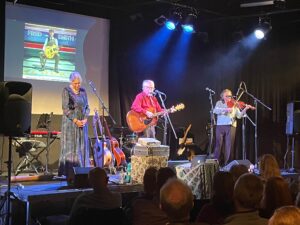
The Goodwills Trio opening show for Fred Smith June 18, Nambour. Photo by Rob Mackay.

We’d no sooner finished our opening set for Fred Smith at Nambour on June 18 when along came an email inviting us to perform at The BUg in July. The Goodwills Trio is the original Goodwills (Bob and Laurel Wilson, original songs, guitar and vocals) plus Helen Rowe on fiddle and vocals.

The New Farm Bowls Club is one of our favourite venues for folk-flavoured music. There’s a good stage, a great sound man, you can order meals and if you want to natter to your mates you can go into the other bar. Perfect arrangement.

The BUg (Brisbane Unplugged Gigs) has been operating under that banner at this venue every Tuesday for many years. All styles of music have had their turn up on that stage, from the full-on Irish song and dance band, Murphy’s Pigs, to solo singer-songwriters.

We (The Goodwills Trio) will perform a set of Bob’s original songs and perhaps a surprise cover (or two). Fiddler and singer Helen Rowe complements and sometimes re-invents our arrangements worked out as a duo over many years. Laurel usually takes lead and if not, then it will be Bob’s ‘wonderful reedy tenor,’ as a reviewer once put it. Bob’s songs such as ‘When Whitlam took his turn at the Wheel’ and the two songs about New Zealand are almost certain to get an airing. Since Giardinetto’s is still down in the Valley, it seems the right place to sing ‘Big Country Town’. And, as Bob rashly promised (on social media), he will be doing a solo spot with his quirky song about a red shirt and a girl in a black dress (‘Dead Man’s Shirt’).

If you are interested, this song was covered by country singer Kalesti Butler on her album Airborne.

The Jar, a high-energy four-piece led by John Logan, will be quite a contrast to our folksy harmonies. As described in the Folk Rag, The Jar play traditional and contemporary Irish, Scottish and Australian music with the occasional pop classic thrown in.

Doors open at 7.00 pm. The music starts with three blackboard acts, followed by The Goodwills (8:15pm), and then The Jar. Admission is $10. New Farm Bowls Club, Brunswick Street opposite New Farm Park.

Time to befriend an indigenous person

NAIDOC-Week-Yes-Nawa
Musician Kevin Bennett

Aboriginal and Torres Strait Islander viewers are advised that this blog may contain references to deceased persons.

Reading an online ABC story about Ash Barty and her newly-born baby, I was struck by two things. The first was that the story had clearly been assembled with no direct input from Barty. Since retiring from championship tennis last year, Ash has made it fairly clear she values her private life. All the same, she’s famous enough that a declaration (to friends) on social media was appropriated by deadline-hungry online media. The story was compiled from what old journalists used to call ‘the cuts’, meaning file stories, social media comment (and responses) and a photo of Ash on her wedding day (supplied).

The second thing about this shallow news story was that nowhere in the text was Ash identified as an indigenous person. You’d think that in NAIDOC week, that would be a given.

NAIDOC stands for National Aboriginals and Islanders Day Observance Committee (originally dubbed National Aborigines Day Observance Committee).

The ABC could at least have tried to contact Ash, perhaps in the guise of preparing a NAIDOC week story. The time-honoured protocols of mainstream journalism should at least contain the disclaimer – the ABC made attempts to contact Ash Barty for comment but was unsuccessful.

The most interesting thing about the newly-born son (Hayden) of Ash Barty and husband Garry Kissick is that he is now part of the Barty extended family.

Through her great-grandmother, Ash Barty is a member of the Ngarigo people, the Aboriginal people of southern New South Wales and north-eastern Victoria. Despite being declared Australia’s Person of the Year in 2022, Ashleigh Barty is entitled to her private life, so I will now move on to NAIDOC.

This is a week of observance during which indigenous people can feel free to celebrate their origins. White fellas can use the time to reflect on their attitudes to indigenous folk, hopefully in a positive way. It is probably fair to say (and feel free to let me know if you think this is a generalisation), most white people who are not in some way inter-married, know few indigenous people and fewer still can actually say they have an Aboriginal friend.

She Who Is Going to Canada Soon has been making attempts to meet First Nations people in our home town, with limited success. Her attempts to make eye contact and say Hi will on occasion elicit a shy smile or a nod. (Of course, it’s just possible we already have Indigenous acquaintances, as not everyone chooses to mention their ethnicity. Ed)

It’s probably no wonder that so many Indigenous people are reluctant to engage with ‘white’ Australians If I was an Aboriginal person living in this country I’d probably not want to make eye contact with white people either.Ed

This is a reference to the shocking periods in this country’s history when European settlers squatted on land once used by Aboriginal tribes for hunting, food-gathering and sacred ceremonies. From this arose seldom-mentioned Frontier Wars and the gradual marginalisation of indigenous Australians

We got chatting to a young person in Brisbane recently who we discovered has Aboriginal ancestry, though it was not obvious to us. We found this out because she was visibly upset by an overtly racist comment made in her workplace by a customer.

The comment was not addressed to the young person, but it was gratuitous enough to make her angry and upset.

The young person revealed that her grandmother was one of the Stolen Generation. This refers to a shameful period in Australia’s history (mid-1800s to 1969), when Aboriginal children were removed from their parents and adopted by (usually) well-intentioned white people. This tawdry period in Australia’s colonial past was best summed up by the late songwriter, Archie Roach:

Taught us to read, to write and pray
Then they took the children away
Took the children away
The children away
Snatched from their mother’s breast
Said this is for the best
Took them away.

Even today, people in their 50s and 60s are discovering or tracing back their ancestry and those who have the opportunity to spread the story do just that. Alt-country songwriter Kevin Bennett not so recently traced his family and now writes songs depicting or satirising that era. Check out his song Spaghetti Western and its reference to a ‘stolen land’. Bennett also referred to intermarriage in Goulburn Valley Woman.

“She said she was a Goulburn Valley woman, she felt connected to the land; Her mother was a flame-haired Irish lass, her father was a Yorta Yorta man.”

The ABC this week interviewed songwriters Paul Kelly and Kev Carmody, who did more to raise awareness than most with their seminal song ‘From Little Things Big Things Grow’. I first met Kev at a folk club in Toowoomba and was also aware that he was (like me) one of the mature age students studying at the university. Kev played guitar in a local bush band and on occasions would sing one of his own songs. I had no idea he was indigenous until the night he sang a song about someone being ‘zipped up in black skin’.

“This is a song about my Uncle,” he said, launching into Jack Deelin. Carmody released his debut album in 1988, the Bicentennial year. Along with indigenous bands Yothu Yindi and compadres including Gurrumul, Tiddas, Kutcha Edwards and others, Kev Carmody was at the forefront of raising awareness of indigenous culture and the injustices of the past.

The injustices and inequalities (which still exist) include a mortality rate 1.6 times greater than non-indigenous, chronic health problems, inadequate housing and over-representation among jail populations.

Over time, this led to the Apology by Prime Minister Kevin Rudd in 2007 and the emergence of some now ubiquitous traditions. One is the warning at the start of this blog. This accords with the Aboriginal custom of not referring to the departed by name, unless special permission has been given. Then there is the acknowledgment of country which has become universal.

My attempts at befriending Aboriginal people stall on innate shyness and I suspect it is a two-way street. A fellow sometimes busks outside the IGA in town. He sings, plays guitar and harmonica and is not half-bad. I was tempted to sidle up and join in on the harmony to “Down on the corner, out on the street, Willie and the Poor boys etc.” Opportunity lost.

I remember visiting Derby in Western Australia and seeing the ancient Boab ‘Prison’ tree and reading the bleak history of the region. While the story of that hollow tree used as a temporary prison is said to be a myth, the Boab was a staging post and Aboriginal prisoners were chained to nearby trees. These are stark images which remind us of how European settlers mistreated the original inhabitants. But as is often the case, the historic records are often disputed, many because they were never written down.

It’s not that much different to the Highland Clearances, where my descendants were pushed off their land so the English aristocracy could run their sheep and lay claim to whisky production. The same applies to other colonial conquests around the world, although the mistreatment of Aborigines and Native Americans stand out as egregious examples.

The way I see it on this particular Friday is that come the referendum, we should all be saying ‘yes’.nawa.


Cashing in on the cashless society

While the world’s media was trying to get a handle on Russia and Ukraine, my counter-cyclical approach was to investigate the move towards a cashless society.

Retailers and banks have been (stealthily), moving away from having their shop assistants and tellers handle cash. Maybe it was already happening, but the Covid-19 pandemic accelerated the push by retailers in particular, to insist on people using a debit card to pay for goods and services. The rational was to slow the spread of germs, although one might be aghast at the results of swabbing an ATM keypad or EFTPOS machine.

A majority of Australians (55%) now has become used to internet banking, electronic bill paying and using debit or credit cards to buy goods and services.

In 2022, the Reserve Bank issued a technical bulletin about the use of and distribution of cash in Australia. The Bank’s Consumer Payments Survey (CPS) showed that the share of total retail payments made in cash fell from 69% in 2007 to 27% in 2019. The results from the 2022 study will be published later this year.

The RBA used multiple surveys to explain the rapidly declining use of cash in Australian society. The Online Banknotes Survey (OBS), commissioned by the RBA, asked individuals about their cash use behaviour. In 2022, cash was used by 25% of respondents in their most recent  transaction. Debit and credit cards remain the most popular payment method, although electronic options such as tapping with smartphones or watches are becoming more prevalent.

“The survey points to a permanent shift in payment behaviour for a significant proportion of the population; 39% of respondents said they have been using cash less often since the pandemic began. Those on lower incomes were more likely to have used cash for transactions and consider themselves high cash users.

On Sunday the host of Australia all Over, Ian McNamara, read out a letter from a listener who had taken a cache of cash to a bank branch. She was told the coins (in bags) could not be accepted as ‘we are a cashless bank’”.

“The world’s going to hell in a hand basket,” Macca opined, citing a phrase originating in mediaeval times.

The cashless bank issue was also canvassed by talkback radio 3AW, after a listener emailed to describe his run-in at a bank branch.

ANZ Victoria and Tasmania general manager Cameron Home confirmed in a statement to the radio station that “a small number” of branches “no longer handle cash at the counter”.

“At these branches cash and cheque deposits and cash withdrawals continue to be possible through a smart ATM and coin deposit machines.”

The ANZ spokesman did not quantity the number of branches refusing to take cash at the counter.

This trend poses a quandary for those of us who traditionally save coins. My pink piggy bank had reached the stage where there was no more room for the coins that accumulate like used tissues in the pockets of jeans and jackets. Many people have a piggy bank, an old cigar tin or biscuit barrel in which they throw their loose change. Nobody wants to keep $20 of loose change in their wallets, purses, handbags or pockets.

So, many of us have this habit, particularly if we are children of depression-era parents, of savings coins then banking them once the amount makes it worth the effort.

She Who Also Hoards Cash routinely throws $1 and $2 coins in a tin. Come Christmas she will count said cash, bank it, then use the $200 or so to buy ‘Christmas plonk’.

This week I laboriously counted and separated the cash into the correct denominations (in plastic bank bags).

All banks have scales and machines which can quickly and accurately confirm that a bag indeed contains $50 in $2 coins (or $7.80 in 20c pieces). Some branches can tip a mixed bag of cash into a machine which will automatically sort and count the cash in a matter of seconds.

I decided to spend an hour or so with a practical demonstration of how one fares trying to deposit $160 in coins at a bank branch. Our family bank (Suncorp) was closed – 9.30 – 2.00pm Monday to Friday). Did you know Suncorp had sold its banking business to ANZ Ltd? (No. Ed)

I then went to the Warwick Credit Union and the teller deposited the coins with no fuss at all. As part of the exercise, I learned that many banks now expect small business customers to deposit cash via a “Smart ATM”. I can only wonder how this will go with people who operate cash-only businesses (markets, busking, CD sales and so on).

The deep flaw in the concept of a cashless society is what happens when the technology (which relies on electricity and technology that works 24/7) fails. Almost on cue, we had an Australian banking example when some Commonwealth Bank customers were unable to log in to their accounts online.

The bank apologised to its customers after a major glitch left them unable to make purchases with their bank cards or access their accounts.

Customers received error messages when trying to use the NetBank online banking service and the CommBank mobile app.

It’s not the first example (for any bank or business for that matter) finding that their ‘smart’ apps can and do fail.

As dedicated readers may recall, we spent a week marooned in a regional town in New Zealand without mobile phones, internet or ATMs. Good thing the hire car had a full tank, eh! The town was cut off from the world in the aftermath of a catastrophic cyclone. A small supermarket near where we were staying had fired up its generator and served customers on the basis of ‘cash is king.’ EFTPOS payments were possible, but only after a long wait in a queue.Despite these occasional ‘hiccups,’ the banking industry seems  determined to introduce labour-saving technology, even if it sends their customers to hell in a hand basket.

A survey by RFI global asked merchants what their future intentions were towards accepting cash. The data suggest that half of merchants that accepted cash in April 2022 planned on actively discouraging cash payments or displaying signage to that effect at some point in the future. Those merchants that plan to move away from accepting cash were more likely to have higher turnover and be in metropolitan areas. The pandemic appears to have influenced some merchants’ plans to dissuade cash use, with hygiene concerns around cash handling as the most prominent reason. The risk of theft and the cost of sourcing cash are other reasons.

Meanwhile, the traditional source of cash for so many Australians (automatic teller machines or ATMS), is in decline. Since 2016, when ATM numbers peaked at 8,000, 25% have closed. Most of these closures have been ATMs owned by authorised deposit-taking institutions. Some of these ADIs, as they are known, will charge you a fee of up to $3.00 to make a withdrawal.

The latter is yet another argument I have against the banking system in general. Banks charge fees for almost every aspect of banking, be it in person or via internet banking. Virtually all merchants charge a fee when you use a credit card to make purchases (e.g, $5.90 added to a return ticket to NZ). Many banks charge a monthly fee for maintaining business and even personal accounts. Moreover, these fees increase over time.

It could be a mistake to ascribe the tap and go trend on Millennials or Generation Z.

I was at a choir reunion last month when an elegant 70-something woman, having ordered a pizza, leaned over towards the EFTPOS machine and waved her smart watch at it. Ka-ching!

More reading: what can go wrong will go wrong


Refugees leave Nauru (at last)

refugees-nauru-global-crisis
Shinkiari refugee camp in Pakistan David Mark www.pixabay.com

One hopes the headline is not a jinx, like headlines pre-empting the Federal Government’s $2 billion investment in social housing. The Government is having trouble getting the legislation through the house and we ought to be asking why.

We should also be asking what is happening with Australia’s human logjam of refugees awaiting decisions on their future. As you probably gathered, it is Refugee Week in Australia. We will be doing our bit on Sunday with a Welcome Walk in Warwick, itself declared a Refugee Welcome Zone a few years ago.

The Guardian published a story late last week that suggested the Federal Government would finally take the remaining 12 refugees held on Nauru Island and re-locate them to the Australian mainland.

Cue a song I wrote in late 2018 when there was a concerted campaign to remove minors and people needing medical assistance from Nauru. The title ‘Get the Kids off Nauru’ may have dated, but the mere fact there are still refugees in offshore detention shows that not much has changed. And this article does not even mention Manus Island.

Even if all refugees are removed from Nauru by June 30, as is widely suspected, the Australian Government will reportedly retain the ‘capacity’ to continue using the remote island for offshore detention.

The Guardian cited intel from the Asylum Seeker Resource Centre (ASRC) and Refugee Action Coalition which has been monitoring the inflow of refugees to Brisbane; most of them moving to hotel detention. Most are expected to be given bridging visas and encouraged to work. That’s a subtle change to common practices since the Howard government saw the opportunity to create offshore processing in 2001, in the wake of the discredited ‘children overboard’ Tampa affair.

Over the ensuing years, the public has mostly been in the dark about what went on in Nauru. In 2014, the Nauruan Government was asking news organisations to pay $8,000 per journalist for a three-month visa. If the application was rejected, the payment was non-refundable.

The newly elected Rudd government stopped offshore processing in 2007, after reports filtered out via humanitarian groups about abuses, overcrowding, and a shortage of potable water. Not that Labor proved to be the panacea, re-introducing offshore processing  in 2012. The right and left of politics have long played ducks and drakes with the lives of people shunted from their homelands by war, famine, religious persecution and/or terrorism.

A week or two away from the 2022 election, the soon-to-be outgoing Coalition Government quickly moved to close a controversial hotel detention centre in downtown Melbourne,. Refugees were the least of former PM Scott Morrison’s problems, but it was an egregious move to deflect attention from other issues.

Offshore processing is one aspect of Australia’s policies about refugees and asylum seekers. Onshore, the prevailing wisdom has been to lock ‘them’ away. As of April 30, 2023, there were 1,128 people in closed detention and another 319 in community detention. Of the people in closed detention, 168 are there because they came to Australia by boat, seeking asylum. On the basis of what it costs to keep one person in jail, closed detention is costing taxpayers at least $45 million a year.*

Conservative governments have been apt to describe boat arrivals as “illegals” when in law the term is “irregular”. Such attempts are often doomed to failure as the boats are intercepted by Australian or Indonesia border forces and turned back. Some sink and people drown – we seldom hear about that. As a ‘champagne socialist’, it pains me to report that the seed of this treatment of refugees was sown by a Labor Government.

In 1992, Paul Keating’s government introduced mandatory detention for any non-citizen who arrived in Australia without an appropriate visa. Keating changed the law from a limit of 273 days to indefinite detention. This meant that non-citizens without a valid visa, suspected of visa violations, illegal entry or unauthorised arrival, could be held in indefinite detention until their case and status was heard and resolved.

The policy (it was meant to be temporary), is regarded as controversial and has been criticised by humanitarian organisations. However, subsequent governments of all creeds have upheld indefinite detention and the High Court decreed that it was constitutional.

The two largest onshore detention centres are Villawood in NSW (441 detainees) and Yongah Hill in WA (248).

The important number in these statistics compiled by the Refugee Council of Australia is the average time spent in closed detention (two years and five days), with another 259 people spending more than two years in community detention.

Australia is also responsible for 1,367 children in the community on bridging visas and 95 children held in community detention.

These numbers are miniscule in the global scheme of things, with 108 million people forcibly displaced as of December 31, 2022. Of these, 28 million were assessed to be refugees by the UNHCR and another 5.4 million judged to be asylum seekers.

As the war in Ukraine continues unabated, as Iran bubbles and boils and people in feudal African countries are hunted like rabbits, we here in Warwick are doing our bit to improve the lot of five people.

Our local refugee support group applied to be part of the Federal Government’s CRISP refugee sponsorship scheme. The latter encourages local community groups to sponsor a family to settle in rural Australia. Thanks to our generous community, we raised more than $10,000 and were gifted a houseful of furniture. So it was that a family of five from Pakistan arrived at Brisbane airport in mid-May. We are responsible for their welfare for the next 12 months. A month later, the family are settling into their new abode; adapting to Warwick’s cold nights after living in a Sri Lankan refugee camp. The daughters are enrolled in local schools and the parents have been getting out and about. It is a challenging but rewarding way to turn abstract concerns into real action.

Having said that, volunteers who get involved with refugee and asylum seeker support groups often suffer from ‘empathy fatigue’. Then there is the perpetual quest for donations to keep much needed support going.

The Asylum Seeker Resource Centre was last year at risk of having to close because of a shortage of funds. The Melbourne-based charity said donations were down 45% since re-opening in mid-2022 after the pandemic. In any given year, more than 7,000 people seeking asylum approach the ASRC for essential services including food, housing, medical care, and legal help. Good to see that the organisation’s annual telethon on World Refugee Day (June 20) raised $1.34 million.

This story is not just about refugees and asylum seekers. The Federal Government has for years struggled with the ongoing problem of non-citizens overstaying their visas. The Canberra Times reported in 2017 that more than 64,000 people were in Australia illegally, after overstaying work and tourist visas. The Federal Government estimated as many as 12,000 have been here for more than 20 years.

For certain the population of refugees in ‘closed detention’ would include overstayers who have been picked up one way or the other. People who come to Australia on a tourist or working visa and overstay by 28 days or more face deportation and a three-year ban on being issued with another Australia visa.

A good start with Nauru, but surely it is time to sort this mess out and restore Australia’s reputation of a fair go for all.

Footnote: These are my personal opinions and not those of the community refugee support group to which I belong

  • based on the estimated annual cost ($40,000) of keeping one person in prison (in Queensland)

In the event of something happening to me

Nothing quite focuses the mind on mortality more than a family bereavement. It’s been a long time between our family’s episodes of sorry business. However, I headed to New Zealand on pure instinct,  arriving in time to support my sister as she said goodbye to her husband of 62 years. They say that 95 is a ‘good innings’, but it is no less hard for the family when the time comes.

The manner in which one can choose to shuffle off has changed appreciably since 1991 when our Dad died. So many people now are eschewing the formal funeral/wake process in favour of simplicity, affordability and privacy.

But first we need to be prepared, and statistics show that only 40% of Australians have a Will.

She Who Has a Plan has been ‘encouraging’ me to make an Advanced Health Care Directive. She has progressed her own, but it is still not completed. Apparently, you (a) need a doctor to sign off that you are  competent and (b) wish to make a compelling argument for not wanting to lie incapacitated in an aged care home for years after a catastrophic stroke.

My next older sister (also a widow) has moved closer to her family as she approaches 80. The recent events led us to talk about not much else than ‘what if’. She has ‘The Folder’ tucked away in a place where her kids can find it. In such a folder – and we all should have one – there’s the Power of Attorney, a copy of the Will and the AHCD (sometimes known as a living will). Some even leave cash for a wake!

As I discovered quite a few months ago now, the age of technology adds more complexity to ‘getting one’s affairs in order’. In our case, SWHAP pays the bills, interacts with Centrelink (sigh. Ed) and plans around things we need to do to the house, car and caravan. I look after our self-managed super fund, the music business (such as it is), technology, lawns, firewood, feeding the dog and cleaning up the kitchen.

I guess at a pinch I could sort out the bills – there is a spreadsheet after all. As for the SMSF, that is a a different challenge. SMSF Trustees deal with a dozen different organisations and the responsibility for stuffing things up falls on them. I also administer two websites and our online music business with its links to streaming services. Not to mention having to report songwriting royalties to Centrelink.

I started work on my (incomplete) Estate document in October 2022. If I were to pop my clogs suddenly, SWHAP would at least have access to all the accounts and websites you need when maintaining a SMSF portfolio (Ed: you changed the bloody passwords again, didn’t you).

As I hinted earlier, we should all have a Will and, even if you do, they probably need to be reviewed. Like, I left everything to my kids and then I met Vera!

Comparison website finder.com.au did a survey last year of 1054 participants, 60% of whom did not have a will. That’s 12 million Australian adults who have no estate plan. Were they to die today, their estate would be locked up interminably, tagged as intestate. If you die without a Will or it is invalid, your next of kin will have to make an application to the Supreme Court.

The law then decides who gets the estate (your assets). This is done with no regard to what you or anyone in your family wanted or thought they were going to get. Vera versus the kids – not a great scenario.

It doesn’t cost much in the scheme of things to have a lawyer draw up a will. Or you can buy a DIY kit from a reputable newsagent.

Even if you have a will, it will not be settled until probate. In the meantime, your spouse’s bank accounts will be frozen.

My point about Wills is that you would not want your loved ones to struggle with your slackness when they are consumed by grief.

At this point, if what I’ve written so far has galvanised you to action, we should all stipulate what is to happen to our mortal remains once we have died. These days almost 75% of us want to be cremated, which is simple enough. You can pay to put the ashes in a memorial wall in the cemetery, take them home in an urn or scatter them at the departed’s favourite fishing spot.

Remember that scene from The Big Lebowski?

What we most commonly call ‘the arrangements’ should be handled by a professional undertaker. There are many options today for a ‘simple’ funeral/cremation and it is likely to cost far less than a traditional funeral service with a burial. More people now are opting for a direct cremation.

A blog by Anton Brown Funerals in Brisbane set down some of the most recent trends in funerals. The big change has been the switch to live streaming of funerals (36%). That is, close family and friends are probably present but the extended family and friends who couldn’t make it can watch live or later. This evolved from the Covid pandemic and subsequent lockdowns, forcing the funeral industry to adapt.

One thing I did not know is that 50% of Australians are likely to be in hospital at the time of their death; 32% are likely to be in an aged care or respite facility and 15% are likely to die at home. Most funerals (85%) are conducted on a spontaneous basis while 15% are pre-planned. I know people in this latter category who have not only pre-planned, but pre-paid. Whether or not the next of kin will be called upon to read Mum or Dad’s self-penned eulogy is a matter of conjecture.

Meanwhile, I have made an appointment for a check up, will look into the living will and finish the Estate document (which should go into The Folder). My sister says The Folder should be bright and visible – tie a bow around it, even.

As a report by Inside Ageing observed, death affects almost all Australians over the age of 35, with 95% of all respondents having attended a funeral, and 60% being involved in a funeral arrangement.

That trend is expected to grow, as the 4.2 million Australians aged 65 and over increases from 16% of our population to between 21% and 23% by 2066.  Increasingly, this cohort are going to be baby boomers with views and attitudes shaped by the Summer of Love. You can read all about it here.

If you’d rather laugh about death, try Billy Connolly’s 2014 series, The Big Sendoff, where he explores death and funerals around the world. The series was made after Connolly discovered he had Parkinson’s. It is a far from morbid, illuminating look at attitudes about death. (Try Apple TV).

The last word goes to Billy, who once said: “I’d hate to have been born and died and nobody noticed.”


Men who cook and do housework LOL

As I have just returned from 10 days in New Zealand on sorry business, today I’m reposting a piece from 2018 when my best half broke her wrist and I became chief cook and bottlewasher. Normal transmission will resume next week.

This topic would not have raised an eyelash in my Dad’s era, a generation of men who did not cook or do housework. Many men of my vintage grew up in households where duties were strictly demarcated along gender lines: Dad went to work and paid the bills; Mum stayed home and did all the housework and cooking; knitting, sewing, mending – shall I go on?

We kids had chores to do – washing up, drying, putting away, feeding the chooks, collecting the eggs and so on. Dad would come home on pay day and hand his pay packet to Mum. Later on she’d give Dad an ‘allowance’ for his smokes, haircuts and the like.

Mums from this era did more than cook and keep house; they managed to harvest a lot of the household food, swapping eggs for freshly-caught fish and turning a peach tree harvest into 20 jars of preserves, for example. There were always vegies in the garden (brussel sprouts, yum), and in the pantry multiple jars of homemade marmalade, jams, chutneys, pickled onions and so on. There’s no end to one woman’s ingenuity when making a working man’s pay last a family of five.

When we came home from school there was usually something in the oven – scones, bread, biscuits. The house smelled good and Mum was nearly always there. Dinner times were a bit regimented. Dad would get up about 5 (he worked nights so had an afternoon nap) and sit in his favourite chair reading the newspaper until dinner was served at 6. It wasn’t quite the pipe and slippers routine, but close to it.

Decades later, as a result of living alone or in share houses and with women who had at least read the Female Eunuch, I evolved into what is sometimes called a ‘SNAG’.

There are a lot of us around now – some do all the cooking, bake cakes and make preserves.

If you’ve been paying attention, She Who is Ambidextrous broke her right wrist six weeks ago and although she had the plaster off last week, she’s showing little inclination to oust me from my new-found kingdom.

Like the song says, I can’t do without my Kitchen Man,” she jested, while covertly supervising the preparation of the leg of lamb. (I used a slow cooker, first searing the joint to keep the flavours in, inserting a couple of cloves of garlic and later added potatoes, pumpkin, sweet potato and onion).

This was my second attempt at a lamb roast. The first one was (we both agreed), a little dry. The recipe said cook on low for 10 hours so that’s what I did. I’m only now finding out, after six weeks of being chief cook and rice cooker washer, recipes are only meant to be a guide.

I’ll be the first to admit it takes a bit of gumption to invade the kitchen of a classy cook, although of late SWIA was showing signs of taking a break. I’m sure she did not mean that literally.

My contributions in the kitchen prior to the fracture included sausages and mash, home-made pizzas or pies and vegies for footie nights and the occasional spaghetti bolognaise.

I had precious few disasters during my tour as camp cook and one or two meals (chicken stir fry and a beef curry), drew compliments from the resident chef.

Readers will know I do other chores around the house: vacuuming, laundry, ironing and outside chores like pulling the wheelie bins up a 97m driveway or emptying the Bokashi bucket (don’t ask).

Men who do their share are usually visible (like the young hipster I saw with a baby strapped to his front and a toddler clutching his ankle, navigating a trolley down the organic foods aisle and carefully reading labels).

Such a sight could lull you into thinking 21st century men had moved on and now do their share of unpaid domestic work. Well, not really.

The invisible ones surfaced in 2016 Census data released by the Australian Bureau of Statistics – one in four men who said they did no housework at all. The Census estimated that Australian women spend between five and 14 hours per week doing ‘household work’ while men on average spend five hours. This work is mainly defined as including cooking and housework. Many more hours (up to 30 per week), are spent on unpaid household tasks like laundry, child care and shopping.

Dr Leah Ruppanner, senior lecturer in Sociology at University of Melbourne, suggests women still spend twice as much time on housework as men.

Writing for The Conversation, Dr Ruppanner said Australian Bureau of Statistics data showed Australian working women spend on average 25 hours a week doing housework (in addition to the 36.4 hours spent in full-time employment.

Men working full-time spent 15 hours a week doing housework, on top of their 40 hour week. The data was drawn from a massive but infrequent ABS Time Use Study, last completed in 2006. That data showed women to be doing the greater share of cooking and cleaning up, laundry and clothes care, child care and shopping.

The one area where men prevailed was home maintenance, with time equally divided when it came to household management and grounds and animal care.

Dr Ruppanner said women shoulder the time-intensive and routine tasks such as cooking, laundry and dishes. They are more likely to do the less enjoyable tasks (cleaning toilets and showers). The men are most often found doing periodic tasks like washing the car, mowing the lawns or changing light bulbs.

She said the solution was to bring men into the process as equal housework sharers, not ‘helpers’.

“It also means not penalising men for ‘not doing it right’.

Cleaning the house is a skill men can learn one toilet bowl at a time.”

A 2015 OECD report on unpaid work showed that Australia was relatively high up the list of gender imbalance. The study interpreted unpaid work as including housework, shopping, child and adult care duties, volunteering and other unpaid work.

Australian women completed 5 hours and 11 minutes per day with men lagging behind (just under three hours), which put us in fourth position in a poll where you’d rather be at the bottom.

The pack was clearly led by Mexico, where women spent six hours and 23 minutes a day doing unpaid work. Mexican men put in just two hours and 17 minutes. The gender gap was closest in Sweden, with women and men sharing domestic duties on a more equitable basis (3.26/2.45 hours).

Japanese, Korean and Indian men devoted the least time to domestic work (under 1 hour per day), while at the other end of the scale Danish fellas put in three hours and six minutes.

Meanwhile in Australia, this Aussie househusband is off to make a Shepherd’s Pie from the remains of the lamb and left-over vegies. Sorry, no, you’re not invited.

(Post Shepherd’s pie – and quite satisfactory it was –  SWIA)


Who’d be a teacher, eh

  1. By Bob Wilson and guest writer Lyn Nuttall

Apart from sharing my life with a teacher in the 1970s and much later spending a couple of years on a high school P&C, teaching is not really on my radar.

Image Gerd Altman www.pixabay.com

But it should be, with the teaching profession in tatters, if you follow the global headlines. First there is the teacher shortage, a situation worsening by the year, as teachers take the flight path and leave the fight to others.

As matters stand in May 2023, teachers are holding rolling strikes in the UK and New Zealand, with sporadic strikes in Australian states. In June last year, NSW state school and private school teachers collectively went on strike, primarily over wages and conditions. That was unprecedented.

The issues are many and varied but focus on unsatisfactory wages, over-work, a dearth of resources and in Australia, the much-hated National Assessment Program – Literacy and Numeracy (NAPLAN). Introduced in 2008 for years 3, 5, 7 and 9, NAPLAN is the only nation-wide assessment of students’ literacy and numeracy skills. The tests, held over nine days, started this year on March 15.

Studies into NAPLAN since its introduction in 2008 have suggested that there is an overall negative impact on curriculum and wellbeing from the testing. Dulfer, Polesel and Rice, (2012) surveyed over 8,000 teachers nationally across primary and secondary contexts. It identified that despite ACARA* suggesting the need only for familiarisation with the test, 30% of the teachers in NAPLAN years reported practising the test three to four times in the two weeks before implementation. This amplified children’s self-doubt and added to the pressures of an already crowded curriculum.

A Senate inquiry was established to assess the effectiveness of NAPLAN. One submission probably sums up the major issues for many teachers.

“NAPLAN is not effective because it only provides teachers, parents and students with a very limited view of a student’s learning and capabilities at school. It breaks the basic rules and concept of valid assessment. The test results do not tell teachers, who do their job, and care about each of the students they teach, anything more than they already know about their students and how they are doing in their learning.”

The submission, from a teacher in Western Australia, observed that test results often cause low self-esteem in very young students. These students do not have the level of maturity to place the assessment in the right perspective, he wrote. This causes stress and anxiety to students who already know that they struggle at school.

NAPLAN and funding shortages in State schools could be identified as some of the reasons for dire forecasts that up to 70% of Australian teachers could quit. Unions, doing what they do best, reduce the issues to numbers, focussing on wages and conditions.

Dr Fiona Longmuir of Monash University says the shortage of teachers in Australia and other countries and education itself was exacerbated during the Covid-19 years.

“Teacher numbers and resourcing, unequal access and outcomes, and widespread student disillusionment, disengagement and mental ill-health aren’t new – but have been blatantly exposed and exacerbated by the pandemic. How we respond now will be crucial for future generations,”

Dr Longmuir, a lecturer in education leadership at Monash, said teacher shortages have reached critical levels in the US, UK, Australia, Europe and Africa.

“The supply and demand of teachers, particularly in  ‘hard-to-staff’  locations, continues to be an issue, and was heightened over the pandemic due to a lack of effective policy solutions.”

Dr Longmuir said the expectations of teachers’ performance had increased over time, as schools increased their reliance on standardised tests.

Joshua Fullard of the University of Warwick (UK) surveyed 300 teachers to assess what would encourage them to stay in the profession.

He asked how likely they might be to leave teaching in a number of different scenarios, such as a salary increase or an increase or decrease in their working hours.

“My findings show that policies related to reducing teacher working hours and improving the quality of school leaders would be effective. I also found that increasing teachers’ salaries would reduce their intentions of leaving. However, only a large pay rise – over 10% – is likely to have a significant effect.”

Professor Fullard’s research showed that school leaders played a particularly important role in teachers’ decision to leave the profession.

“I found that an improvement in senior leadership quality would have a greater impact on teacher intentions than a 5% pay rise.”

The main problem in all countries seemed to be excessive working hours and workloads. Problem students and discipline gets a mention, as does the lack of respect for teachers at all levels. As for over-work, teachers reported working an average of around 52 hours a week during term time. Prof Fullard found that a five-hour-a-week reduction in working hours would have a similar effect on teacher retention as a 10% pay rise. In Australia, primary and secondary teachers work about 45 hours a week, higher than the international average.

What I found interesting, enquiring into the state of the teaching profession, is that little to nothing is said about or on behalf of children.

FOMM reader and sometime contributor Lyn Nuttall was a primary school teacher for 33 1/3 years – “just like the LPs”.

He retired aged 60 and, though disconnected from the classroom since 2010, recently wrote this piece of whimsy which lightens the topic and perhaps reminds us of teachers who made a difference to our lives:

What’s the matter with “kids”?

As the song from Bye Bye Birdie went (1960), without the quotation marks.

I’ve never minded calling children “kids”. It’s a friendly sounding word with no historical baggage as an epithet. To my mind, its connotations are positive.

Over the years I’ve occasionally met someone who objected along the lines of, “They’re not baby goats, they’re children,” but that’s like chiding a French speaker for using the endearment mon chou: “He’s not a green leafy vegetable…” There are many colloquialisms that sprang from figurative speech, and we don’t insist on users being literal.

In many contexts, of course “children” sounds better. “Student” has replaced “pupil” which seems to have gone out of fashion, and it does suggest 1950s officialese. In Queensland, pupil-free days became student-free days at some point.

Teachers have various ways of addressing a class: “people”, “guys”, “folks”. Some of these sound better coming from a teacher seated on a reversed chair. I once heard an able student referred to as a “good little unit” but the small-school principal who said that was a bit unhinged.

I used to slip facetiously into “peanuts”, “bananas”, “ladies and gentlemen”, “ladles and jellybeans”. Context was everything. When I first started teaching you would hear some old-timers using “youse” but that’s rare these days.

Long before gender neutrality became the norm I gave up “girls and boys” and would say, “Good morning everyone,” probably influenced by the broadcaster Karl Haas’s “Hello everyone”. I hated hearing a class chanting “good morning” in reply, so in later years I would dispense with a greeting and say something like, “Okay, let’s get this show on the road,” or just jump in and start talking about whatever needed our attention. The sky didn’t fall in.

One novel variation I heard came from a parent who worked for the RAAF. When he was President of the Parents & Citizens Association, he talked to the school assembly one morning and referred throughout to children as “personnel”. Force of habit.

Thanks, Lyn, for that piece of humorous nostalgia. Ed.

BTW, I used to address my class of ‘B2E2 Industrial Boys’ as ‘Gentlemen’, in the hope that they would respond as such. It actually worked quite well. Ed

* The Australian Curriculum, Assessment and Reporting Authority

The cost of having a say in world politics

cost-global-politics
Sydney Opera House, venue for the cancelled Quad. Image by Patty Jansen www.pixabay.com

On the eve of what was to be Australia’s first time as host of the Quad meeting, let’s reflect on the proposed cost – some $23 million according to Budget papers. It is understood more than 20% of the budget was allocated to the Federal Police, to ensure the security of invited dignitaries.

The planned Quad meeting, with the leaders of Australia, India, Japan and the US to be arriving in Sydney, was scrapped after President Biden  cancelled owing to ongoing debt ceiling negotiations at home.

Nevertheless, Prime Minister Albanese continued with plans to host an official visit by Indian Prime Minister Narendra Modi.

Mr Modi arrived in Australia on Monday, with his arrival in Sydney causing great excitement in the suburb known as ‘Little India”. Coincidence or not, SBS reported this week that after a community appeal, the suburb of Harris Park is to be officially known as Little India.

A high proportion of Sydney’s 188,000-strong Indian population live in or around Harris Park. On Tuesday night, Mr Modi attended a rally of 20,000 at Qudos Bank Arena in western Sydney. Modi is a polarising figure, though, both here and at home. Indian Muslim community groups have already declared they do not welcome the visit, citing human rights violations against minority groups in India.

This is Prime Minister Modi’s first visit to Australia since 2014. His two-day stay will include holding talks with Mr Albanese and Opposition Leader Peter Dutton. I should point out Modi came to Australia via Papua New Guinea, where he met with Pacific Islands leaders.

The Australian Financial Review said Mr Modi and Mr Albanese are expected to build on a communiqué issued after the first annual leaders’ summit in New Delhi in March (which Mr Alabanese attended).

There will be talks on economic co-operation, Australia’s status as a critical minerals supplier, and India’s opportunities for low-cost manufacturing in green technology. Defence co-operation will also be on the agenda, with Australia preparing to host India’s naval war games.

So that’s India covered. What about the other Quad members?

The Quad is a strategic security dialogue amongst Australia, India, Japan and the US, maintained by talks with member countries. One could argue that much of this business could have been done at last week’s G7, the big brother of international talk-fests.

I don’t usually watch the ABC’s Sunday Morning political talk show, ‘Insiders’, but on occasions come in at the end for Mike Bowers’ entertaining ‘Talking Pictures’.

Mike and a guest cartoonist go through their selection of the best political cartoons for the week. Not surprisingly, David Pope’s detailed drawings often feature, as do the works of Cathy Wilcox, Peter Broelman, Jon Kudelka among others.

David Pope’s cheeky depiction of US president Joe Biden swiping a maxxed-out credit card tells the story of President Joe cancelling his proposed attendance of the Quad in Australia.

Biden and Australian Prime Minister Anthony Albanese caught up last week at the G7, another expensive talk fest, both for the host country (Japan) and the countries sending delegations. This year, the G7 was held in Hiroshima, one of two Japanese cities obliterated by a US-delivered atomic bomb in August 1945.

Biden and Albanese reportedly held close talks at the G7 about climate change. Albanese has been quoted as saying that action on climate change was “the entry fee to credibility in the Indo-Pacific”.

The US president said in turn that the two nations were launching a new joint initiative to accelerate the transition to clean energy.

By that, as The Guardian reported, Biden meant building more “resilient critical mineral supply chains”.

Biden said action on climate and clean energy would be another central pillar of the Australia-US alliance. He said he looked forward to hosting Mr Albanese for a State visit in Washington DC later this year.

That’s all very well, but that will also mean another (expensive) international VIP trip for the PM and a team of hand-picked Ministers and advisers.

As we can tell by the tabling of former PM Scott Morrison‘s travel expenses in his first year in office (2019), it’s a costly business.

SBS News did a bit of digging (they submitted Freedom of Information requests), to publish a report in November 2019.

Scott Morrison served as Australian Prime Minister from August 2018 until May 2022. SBS found that Mr Morrison racked up more than $1.3 million in travel costs. He made 12 international trips, visiting 17 nations, in the first 12 months since he had taken office in August 2018.

It is hard to argue that an Australian PM and indeed senior Ministers should not travel to other countries for diplomacy, negotiations and photo opportunities. Our is a vast, isolated continent surrounded by water and many hours’ distance from even our nearest neighbours.

But when you consider the proliferation of international meetings and conventions on climate change, security, the economy, peace and stability, the five-star hotel chains and limo hire companies must be doing OK.

When the G7 was held in Cornwall in 2021, the cost to British taxpayers was put at 70 million pounds ($A131,112m). It’s more difficult to establish what the G7 cost Japan. Al Jazeera reported Japanese Prime Minister Fumio Kishida wants to ‘send a strong message’ about the need for a world without nuclear weapons, hence using Hiroshima as the host city.

It’s interesting to think how much money was saved during the first 18 months of the Covid lockdown. Conferences and meetings were universally held over internet portals such as Zoom, where the biggest expenses were cyber security and bandwidth.

Michelle Grattan had a bit to say about politicians and travel last year. By June 2022, Mr Albanese had visited Indonesia, took part in a Quad meeting in Japan, was about to attend a NATO summit in Madrid, and, despite some internal advice to the contrary, visited war-torn Ukraine. Not to be thwarted, Albanese also visited Paris, at a time when the Australian government was in ‘mauvaise odeur’ over Scott Morrison’s decision to cancel a submarine contract with France.

Grattan defended the right of a PM to visit foreign shores.

“International conferences give an opportunity for the new PM to meet multiple leaders, gather information and signal continuities and change (for example on climate policy) in Australia’s national priorities.

By she added that a newly-elected Prime Minister must be careful in deciding how much foreign travel to undertake. In mid-2022, ordinary Australians were finding the rising cost of living a challenge. The situation has worsened in mid-2023.

“At some point, being away too much stirs criticism,” Grattan wrote.

Despite the cost of staging global conferences, the Group of Seven agreed upon strong moves against Russia, including sanctions and export controls.

Still to come this year, the G20 in New Delhi (September) and the climate change summit, COP28 (Expo City, Dubai) in November. Somewhere in amongstall that, the PM and his troops would do well to stay home and work on the most important (domestic) issue of all – the Voice to Parliament referendum.

As The Conversation observed earlier in May, the latest polls suggest 54% Yes and 46% No. (Come on, Queensland, come on, come on. Ed)

Much work to be done at home.