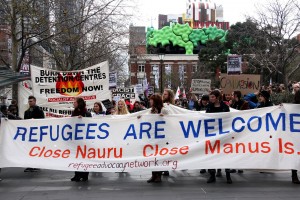
Refugees leave Nauru (at last)

refugees-nauru-global-crisis
Shinkiari refugee camp in Pakistan David Mark www.pixabay.com

One hopes the headline is not a jinx, like headlines pre-empting the Federal Government’s $2 billion investment in social housing. The Government is having trouble getting the legislation through the house and we ought to be asking why.

We should also be asking what is happening with Australia’s human logjam of refugees awaiting decisions on their future. As you probably gathered, it is Refugee Week in Australia. We will be doing our bit on Sunday with a Welcome Walk in Warwick, itself declared a Refugee Welcome Zone a few years ago.

The Guardian published a story late last week that suggested the Federal Government would finally take the remaining 12 refugees held on Nauru Island and re-locate them to the Australian mainland.

Cue a song I wrote in late 2018 when there was a concerted campaign to remove minors and people needing medical assistance from Nauru. The title ‘Get the Kids off Nauru’ may have dated, but the mere fact there are still refugees in offshore detention shows that not much has changed. And this article does not even mention Manus Island.

Even if all refugees are removed from Nauru by June 30, as is widely suspected, the Australian Government will reportedly retain the ‘capacity’ to continue using the remote island for offshore detention.

The Guardian cited intel from the Asylum Seeker Resource Centre (ASRC) and Refugee Action Coalition which has been monitoring the inflow of refugees to Brisbane; most of them moving to hotel detention. Most are expected to be given bridging visas and encouraged to work. That’s a subtle change to common practices since the Howard government saw the opportunity to create offshore processing in 2001, in the wake of the discredited ‘children overboard’ Tampa affair.

Over the ensuing years, the public has mostly been in the dark about what went on in Nauru. In 2014, the Nauruan Government was asking news organisations to pay $8,000 per journalist for a three-month visa. If the application was rejected, the payment was non-refundable.

The newly elected Rudd government stopped offshore processing in 2007, after reports filtered out via humanitarian groups about abuses, overcrowding, and a shortage of potable water. Not that Labor proved to be the panacea, re-introducing offshore processing  in 2012. The right and left of politics have long played ducks and drakes with the lives of people shunted from their homelands by war, famine, religious persecution and/or terrorism.

A week or two away from the 2022 election, the soon-to-be outgoing Coalition Government quickly moved to close a controversial hotel detention centre in downtown Melbourne,. Refugees were the least of former PM Scott Morrison’s problems, but it was an egregious move to deflect attention from other issues.

Offshore processing is one aspect of Australia’s policies about refugees and asylum seekers. Onshore, the prevailing wisdom has been to lock ‘them’ away. As of April 30, 2023, there were 1,128 people in closed detention and another 319 in community detention. Of the people in closed detention, 168 are there because they came to Australia by boat, seeking asylum. On the basis of what it costs to keep one person in jail, closed detention is costing taxpayers at least $45 million a year.*

Conservative governments have been apt to describe boat arrivals as “illegals” when in law the term is “irregular”. Such attempts are often doomed to failure as the boats are intercepted by Australian or Indonesia border forces and turned back. Some sink and people drown – we seldom hear about that. As a ‘champagne socialist’, it pains me to report that the seed of this treatment of refugees was sown by a Labor Government.

In 1992, Paul Keating’s government introduced mandatory detention for any non-citizen who arrived in Australia without an appropriate visa. Keating changed the law from a limit of 273 days to indefinite detention. This meant that non-citizens without a valid visa, suspected of visa violations, illegal entry or unauthorised arrival, could be held in indefinite detention until their case and status was heard and resolved.

The policy (it was meant to be temporary), is regarded as controversial and has been criticised by humanitarian organisations. However, subsequent governments of all creeds have upheld indefinite detention and the High Court decreed that it was constitutional.

The two largest onshore detention centres are Villawood in NSW (441 detainees) and Yongah Hill in WA (248).

The important number in these statistics compiled by the Refugee Council of Australia is the average time spent in closed detention (two years and five days), with another 259 people spending more than two years in community detention.

Australia is also responsible for 1,367 children in the community on bridging visas and 95 children held in community detention.

These numbers are miniscule in the global scheme of things, with 108 million people forcibly displaced as of December 31, 2022. Of these, 28 million were assessed to be refugees by the UNHCR and another 5.4 million judged to be asylum seekers.

As the war in Ukraine continues unabated, as Iran bubbles and boils and people in feudal African countries are hunted like rabbits, we here in Warwick are doing our bit to improve the lot of five people.

Our local refugee support group applied to be part of the Federal Government’s CRISP refugee sponsorship scheme. The latter encourages local community groups to sponsor a family to settle in rural Australia. Thanks to our generous community, we raised more than $10,000 and were gifted a houseful of furniture. So it was that a family of five from Pakistan arrived at Brisbane airport in mid-May. We are responsible for their welfare for the next 12 months. A month later, the family are settling into their new abode; adapting to Warwick’s cold nights after living in a Sri Lankan refugee camp. The daughters are enrolled in local schools and the parents have been getting out and about. It is a challenging but rewarding way to turn abstract concerns into real action.

Having said that, volunteers who get involved with refugee and asylum seeker support groups often suffer from ‘empathy fatigue’. Then there is the perpetual quest for donations to keep much needed support going.

The Asylum Seeker Resource Centre was last year at risk of having to close because of a shortage of funds. The Melbourne-based charity said donations were down 45% since re-opening in mid-2022 after the pandemic. In any given year, more than 7,000 people seeking asylum approach the ASRC for essential services including food, housing, medical care, and legal help. Good to see that the organisation’s annual telethon on World Refugee Day (June 20) raised $1.34 million.

This story is not just about refugees and asylum seekers. The Federal Government has for years struggled with the ongoing problem of non-citizens overstaying their visas. The Canberra Times reported in 2017 that more than 64,000 people were in Australia illegally, after overstaying work and tourist visas. The Federal Government estimated as many as 12,000 have been here for more than 20 years.

For certain the population of refugees in ‘closed detention’ would include overstayers who have been picked up one way or the other. People who come to Australia on a tourist or working visa and overstay by 28 days or more face deportation and a three-year ban on being issued with another Australia visa.

A good start with Nauru, but surely it is time to sort this mess out and restore Australia’s reputation of a fair go for all.

Footnote: These are my personal opinions and not those of the community refugee support group to which I belong

  • based on the estimated annual cost ($40,000) of keeping one person in prison (in Queensland)

Asylum seekers and the seven-year itch

asylum-seekers-seven-years
Asylum seekers and refugee rally – photo by John Englart flickr.com

If Home Affairs minister Peter Dutton ever had a lapse in judgement, it would be thinking that asylum seekers and their supporters have given up. Over a seven-year span, Mr Dutton and his predecessors have exposed asylum seekers to a punitive system (which is outside the UN Convention on Refugees).

As you may hear this weekend, Sunday marks seven years of detention for those who were sent to centres on Manus Island and Nauru. At the time, former Prime Minister Kevin Rudd announced that people arriving by boat to seek asylum would be processed offshore and never be allowed to resettle in Australia. #7yearstoolong

Four administrations later (Gillard, Abbott, Turnbull and Morrison), the unconscionable treatment of people seeking refuge from persecution, torture and ethnic cleansing in their homelands has barely changed.

The now-famous author Behrooz Bouchani chronicled his torturous life on Manus Island in the award-winning book, ‘No friend but the Mountain’. in 2019, Australians became more aware of the effects of despair and mental health issues suffered by asylum seekers in our offshore detention centres. There was a seemingly effective campaign to Get the Kids Off Nauru. All the while, the Australian government continued to be responsible for those much-criticised centres (outsourcing the task to private security firms). Along the way, the government re-opened, closed and then re-opened again the Christmas Island detention centre, Christmas Island being an Australian protectorate.

During the past seven years, the numbers of people who have started or joined an existing asylum seeker support group have grown, to include such organisations as Rural Australians for Refugees.

This national movement started with a campaign by the good folk of Biloela, who took in a Sri Lankan family. You’d know about this saga, where authorities came in the early hours and removed the couple and their two children, taking them into detention. Over time, the family of four ended up being the only detainees in the Christmas Island Detention Centre, at a reported cost to the taxpayer of $27 million a year.

Closer to home, a Kangaroo Point motel has become the focus of the protest movement which wants to see an end to our egregious treatment of people whose only possible mistake was to pay a people smuggler to bring them to Australia – irregular, but not illegal.

Asylum seeker supporters fought long and hard to challenge the government to bring unwell detainees from offshore detention centres. This resulted in a new Act which forced the government’s hand. Even though people needing medical attention were brought to Australia, it seems that few of those brought here under the Medevac Bill have been released from detention. A lot of those people ended up at a motel in the Brisbane inner city suburb of Kangaroo Point.

As Hannah Ryan wrote in The Guardian last month , the Australian government engaged private guards and assigned them to the Kangaroo Point Central Hotel & Apartments, describing it as an “alternative place of detention”. Here, 120 people who had been detained on Manus Island or Nauru and were sent to Australia for medical treatment, are being kept indefinitely. They are not allowed to leave, as Ryan says “not even to visit the KFC across the road.

Since COVID-19 raised its head in March, they are not allowed visitors either. Over the year or so this has been going on, some detainees took to holding up placards from the motel balconies, when allowed out for fresh air. Support networks got wind of this and a series of rallies began, not without some risks. At a rally on June 29, 40 protesters were arrested for staging a sit-in after the two-hour permit had expired.

Public protests aside, Home Affairs minister Peter Dutton is pressing on with a draft Act designed to crack down on drug dealing and the development of terrorist cells. The draft Act would make it illegal for people in detention to have a mobile phone.

Just think about that for a minute, while realising how crucial your mobile phone has been to you through the COVID-19 lockdown.

Australia’s Human Rights Commissioner Edward Santow made a submission to a Parliamentary committee, saying that the bill should not proceed. Writing in the Canberra Times, Santow said:

The Commission recommends that risks be considered on a case-by-case basis. If a particular person in detention has used their phone to commit illegal activity or endanger the security of Australia, this would be a reason to prohibit them from having a phone. But it would not justify a ban that applies to other people who haven’t been shown to be a risk.” 

The government said when introducing this Bill that it did not plan to introduce a blanket ban on mobile phones, rather to address risks to health, safety, and security.

Those protesting on Sunday have made it clear what they want – an end to indefinite detention. As stated in Green Left Weekly (where you will find a list of rallies and gatherings and their locations): “Free the refugees and bring those still on Manus Island and Nauru to Australia now.”

The COVID-19 pandemic and its consequences have pushed this issue onto the media back-burner. The recent closure of some media outlets and the migration of others to online only has further diluted the message.

So emerged the hashtag #7yearstoolong on social media as volunteer groups try to raise awareness of institutionalised inaction.

While the government continues to take a hard line stance, a survey last year showed that attitudes towards refugees are hardening. Part of a global study on attitudes, it shows that 44% of Australians think borders should be closed, up 5% on the 2017 survey.

Globally, 54% of people doubted whether refugees coming into their country were really genuine and not arriving just for economic reasons. Australians’ doubts about people’s motives rated lower, at 49%. About 42% of Australians agree that refugees successfully integrate (a drop of three points since 2017).

Refugee Council of Australia statistics show that at March 31, 2020, there were 1,373 people held in onshore detention centres. Apart from any other consideration, it is costing Australia an estimated $137.34 million a year to keep refugees in domestic detention, based on figures provided by the Kaldor Centre.

And, did you know that 64,000 foreigners have overstayed their Australian work or tourist visas, with up to 12,000 believed to have been here for 20 years or more?

All of the above, I contend, should be seen in the context of Prime Minister Scott Morrison’s plan to allow Hong Kong Chinese safe haven in Australia. (Ed: “Probably because they would be well off financially”

Oh, that’s right, we are still in thrall of the ultimate strong leader (John Howard), who said in 2001 his government had an irrevocable view on border protection: “we will decide who comes to this country and the circumstances in which they come.

Every leader from Kevin Rudd onwards has toed the same Sovereign Borders line. If you are expecting anything different from the Leader of the Opposition, should he ever win an election, do not hold your breath.

Further reading: This Australian Government policy paper sets out the facts and dispels myths about asylum seekers and refugees.

We are travelling in remote western Queensland, so expect one from the archives next Friday.

*Tom Hanks’ companion in Castaway was a volleyball, not a football as I wrote last week (and the Hug Patrol photo was from 2012, not 2019).


Medevac, May Election, 3m missing voters

Parliament-Election-Missing-Voters
Parliament House, Canberra 1979, image by Steve Swayne https://flic.kr/p/q1Jkuq

If one believes that the Australian government will delay holding a Federal election until the last possible date (May 18) that’s just 92 sleeps away. Given the Morrison government’s historic defeat (75/74) when Parliament passed the so-called Medevac Bill, this week, I can’t see ScoMO heading up the hill to the Governor-General’s whare* for an early election. The electorate is clearly polarised and there is a high degree of suspicion about what both major parties say they’ll do and what they actually do when in power.

The problem for political parties running campaigns in such a tense environment, and why they need every one of those 92 days, is to work out how to recapture the estimated 3.14 million Australians who do not participate. That’s right, even though we’ve had compulsory voting since 1924, that’s the estimate of how many people failed to vote in 2016.

The Australian Electoral Commission (AEC) analysis found that turnout at the 2016 House of Representatives was 91%, the lowest recorded since the introduction of compulsory voting ahead of the 1925 Federal election. Turnout at the 2016 Senate elections at 91.9% was also the lowest recorded since the 1925 federal election. The missing include 1.78 million who were enrolled but did not vote, an estimated 816,000 who should be on the roll and aren’t, and 550,000 who cast a ballot paper but either filled it in incorrectly or deliberately defaced it (informal).

We know some scrutineers who, over drinkies after election night, swap notes on the best insults or graffiti on informal votes. Penises are common, so too an added box to tick with a substitute name, e.g. “Duck, D (Animal Welfare Lobby), “Trump, D (Socialist Left) or SCOTLAND!

The informal vote includes ballot papers where voters intended to make their vote count but did not fill it in correctly. Australia’s enormous Senate ballot paper, which can have more than 100 candidates, claims many victims in this way.

Why are these numbers so important, then? In 2016 the not-for-profit Y Vote claimed that people aged 18-24 who were not on the roll, didn’t show up, or voted informally could have swayed the election result one way or the other in 10 marginal seats.

Y Vote calculated wasted votes using AEC data that one quarter of Australians aged 18-24 were not enrolled. The number of wasted votes outnumbered the margins several times over in key Liberal marginal seats.

The founder of Y Vote, Skye Riggs, said young Australians felt their voices were not valued because “they don’t see politicians investing a lot of time in them”.

I’d say the close tussle between the Ayes and Noes on the Medical Evacuation Bill reflects a deeply polarised electorate; polarised and politically volatile. Remember the Wentworth by-election – when former PM Malcolm Turnbull’s solid blue ribbon seat went to cross-bench Independent Senator Kerryn Phelps? There’s no telling what the people will do.

After reading on Monday how Labor intended to insist on amendments to the Medevac Bill, She Who Takes Direct Action rang Bill Shorten’s office. She was assured Labor was not going soft on the Bill but was just ‘having a look at the language’. As it turned out, Labor wanted three amendments (one of which insisted upon a ‘character test’). Labor wanted the Minister rather than doctors to have the final say on who is flown to Australia for treatment. The Greens refused to support the amendments as proposed.

A late amendment to Dr Phelps’s Bill stipulated that the advisory panel picked by the government to oversee decisions, receive no remuneration for their role. This nicely worked around the government’s late-mail advice that the Bill was unconstitutional.

It is important to note, given the government’s steamy rhetoric that it will encourage people smugglers to send more boats, the Medevac Bill applies only to the cohort currently held on Nauru or Manus Island and is (thus far) not extended to new arrivals.

One ought not to forget, as an astute friend reminded me last week, that 80% of Australians voted for either the LNP or Labor at the last Federal election. She reminded me that Labor’s policies on immigration and refugees are not that dissimilar to the current regime. Bill Shorten’s speech to the Labor Party conference last year made that clear enough.

“We cannot and we must not and we will not allow the criminal people smuggling syndicates to get back into business…

…It is not a crime to want to come to this country. But it is a crime to exploit vulnerable people, to put them in dangerous and unsafe vessels, and have them drown at sea.

We cannot, we must not and we will not permit the re-opening of their trade in human desperation and the drownings and the irreplaceable loss of life that it brings.”

To this end Labor would insist upon:

  • Rigorous security, character and health assessments throughout humanitarian and general migration programs
  • pursuing regional resettlement.
  • turning back boats where it is safe to do so.
  • maintaining offshore processing

Those who do not care for selective quoting can look it up (Chapter Nine of Labor’s policy platform).

So while Labor appears to be prepared to give the poor a better deal (e.g. promises to review NewStart and fast-track the NDIS), if you vote Labor you are voting for a continuation of the policy of processing asylum seekers and refugees through offshore detention centres.

Offshore processing is just one of the many important issues one could sift through when deciding who would best represent a voter’s interests. There are other key issues (many now showing up in the ABC’s social media poll), including climate change, the environment, water security, health and education, not to mention whether any government should allow a foreign company to dig up Australian coal and export it.

I was talking to a Labor stalwart who had been door-knocking in one of the Sunshine Coast’s blue-ribbon seats, electorates where you’d need a 11% swing to unseat the incumbent. Our doorknocker persisted, even when faced with less than polite rebuke from Sunshine Coast Tories. What surprised him, though, was the level of ignorance/apathy: “What? Are we having an election? When? Why?”

Some of those people were probably among the 1.78 million who were enrolled but did not turn up in 2016. No doubt some of them received infringement notices and a $125 fine.

The AEC says declining voter turnout observed at Australian federal elections reflects international trends. Voter turnout has been steadily declining in most developed countries over several decades. How do we lift our game, then? And why is it that Malta’s best voter turnout (92%) exceeded Australia’s effort, yet Malta does not have compulsory voting? Perhaps Malta is less exposed to ‘shouty’ commentators?

Defence Minister Christopher Pyne declared on Monday that politics in Australia was “trapped in a self-obsessed and panic-prone spiral that is damaging Parliament’s ability to work for the good of voters.” (Probably the first and last time I’m likely to agree with Christopher Pyne. Ed)

He told the Sydney Morning Herald’s David Wroe the political environment, which had bowed to irrational pressure from “shouty” commentators, was not good for the country and that he can’t see that changing.

Yep, that ought to get the 3.14 million Australian slackers motivated to contribute to the political process. No worries, mate!

*Maori for house

Further reading:

Get the kids off Nauru, maybe

kids-off-nauru
Nauru refugees are welcome – photo by Takver – flickr

We’ve been learning a protest song for our choir’s Christmas concert. Actually it is a plea for peace, the musical equivalent of a street march – “What do we want? Peace! When do we want it? Now.”

John Lennon and Yoko Ono’s Happy Xmas/War is Over starts by asking the universal question so many of us end up asking ourselves: “And so it is Christmas, and what have we done? Another year over, a new one just begun.”

If you can ignore the ‘sounds like’ melody and work through the key changes to the counter-refrain “War is over, if you want it,” this is quite an epic tune. Many critics have pointed out the similarities between Leadbelly’s ‘Stewball’ made popular by Peter Paul and Mary but even then, the tune pre-dates that earnest trio by a few hundred years.

A few people (including me) have written protest songs about Australia’s pitiless refugee policies, particularly its offshore processing strategy. Doctors for Refugees spokesman Paddy McLisky recently told a rally in Brisbane that offshore processing was a ‘health hazard’ Continue reading “Get the kids off Nauru, maybe”

Take me to your leader – the quest continues

leader-politics
(Leader image, old man in park taking time out from politics and spin), Bob Wilson circa 1978

Imagine a flying saucer lands in your back yard and an alien (drooling or not) alights.

“Take me to your leader,” it telepathically commands, as it is from an advanced civilisation, intent upon savings ours.

“Aw yeah, mate.” (pointing). “That’s our leader over there, the one in the striped designer shirt, mingling with the homeless folk.”

If you dig around on the Internet long enough you’ll find lists of world leaders people would rather not introduce to their granny, never mind to an alien. The lists are usually described as ‘the 10 or 20 worst world leaders’ and include despots like North Korea’s Kim Jong-un, Russia’s Vladimir Putin, Syria’s Bashar al-Assad and Sudan’s Omar al-Bashir.

Alas Malcolm Turnbull, PM of Australia; the only list I found him on was the ‘hottest heads of state’ leader ladder, languishing in 12th place behind total spunks like Canada’s Justin Trudeau, New Zealand’s Jacinda Ardern, France’s Emmanuel Macron or Haiti’s Jovenal Moise.

One ought not to touch on politics when striking up conversations at Christmas parties. At one such event, I ventured that the Australian Federal Government was having an ‘Annus Horribilis’ and seemed incapable of making firm and sensible decisions.

I had voiced what I thought was a commonly-held theory, but soon found out what I should have known; on average, at least one-third of people voted for that motley group of indecisive dual citizens who went to work on just 64 days in 2017.

“So what do you think about Turnbull’s piss-weak energy policy?” I began at another Xmas do, when I probably should have said, “Strange weather for this time of year, don’t you think?”

That person moved away, but left me a clean run at the cheese platter.

From my point of view, the LNP in Canberra blundered from one disaster to another in 2017, momentarily making itself look good by introducing marriage equality laws, which in truth should have been enshrined in 1980-something. The poll was estimated to cost the taxpayer $122 million and then we endured weeks of angst while the same-sex marriage law was debated, after 61.6% of the 79.5% of people who voted had told them that’s what they wanted in the first place.

The great shame, or should I say sham, is that the Turnbull government, deliberately or not, distracted the people from more serious issues (climate change, the Adani coal mine, Manus Island), by turning the same-sex marriage debate into an expensive, non-binding referendum-style exercise. They could have used one of those 64 sitting days to have a free vote. We’d have achieved the same result and deployed the $122 million to more laudable outcomes (like finding emergency accommodation for the 6,000 or so Australians who sleep rough each night).

We’ve seen from recent State elections and Federal by-elections that the people are not happy with the mainstream parties. The drift towards the Greens on one side and One Nation on the other mimics the rise of populism the world over.

Political commentator Michelle Grattan, speaking at the launch of The Conversation Yearbook in Brisbane, said so many people in Australia are disgusted with politics they are ‘‘tuning out”

“People think (politicians) are behaving badly, because they are behaving badly. They (politicians) alienate the public – they are aware of it, but it’s beyond them to regain the people’s trust.”

Grattan said focus groups in north Queensland, ahead of the State elections, saw through Malcolm Turnbull’s ploy to cancel a week’s parliamentary sittings. This was ostensibly to allow the House and the Senate to resolve the citizenship issue and to work through the same sex marriage debate.

But here’s the thing: the NQ focus groups didn’t much like Malcolm Turnbull, but neither did they warm to Bill Shorten as an alternative leader.

The Queensland election continued a national, if not international trend: voters are fed up with mainstream parties and are casting their votes elsewhere.

In Queensland, 30.9% of first preference votes went to minority parties, while the informal vote was higher than average, at 4.58%. In the Bennelong Federal by-election, 10 minor parties grabbed 19.15% of the first preference primary vote, although that did not stop the LNP’s John Alexander (45.05%) taking the seat.

So what else happened in 2017?

While it wasn’t a party political issue, the rise of the social media hashtag #MeToo movement had its high point when Time Magazine chose #MeToo as its influential “Person of the Year”.

If you had been living under a rock, #MeToo is a movement where women who have been harassed, assaulted, bullied and otherwise vilified (primarily by men), came out and stood with their sisters.

The movement started with casting-couch revelations about Hollywood movie producer Harvey Weinstein and flushed out similarly bad behaviour all over the world. The Australia media chimed in, outing former TV gardening host Don Burke for a series of alleged indiscretions. Sydney’s Telegraph made an allegation about Australian actor Geoffrey Rush, who responded with a writ for defamation.

On a more positive note, 2017 turned up an unlikely winner of the Nobel Peace Prize. The prize went to the International Campaign to Abolish Nuclear Weapons (ICAN). The organization received the award for drawing attention to the catastrophic humanitarian consequences of any use of nuclear weapons.

There were other examples of positive news in 2017, amid the political scandals, terrorist attacks, humanitarian crises and natural disasters.

A December 19 report by Katrina Sichlau, News Corp Australia Network, found that renewable energy employed 10 million people worldwide.

(Aside – that makes the Queensland Premier’s contested claim that the proposed Adani coal mine would employ 10,000 people look rather sad).

The same article said France and Britain had launched a Clean Air Plan which will make sense to people who have visited either country this year or last. In a year when Queensland’s land-clearing reached Brazil-like proportions, Pakistan planted one billion trees.

If I may add to this optimistic list, New Zealand elected a woman in her 30s as Prime Minister (Jacinda Ardern), largely at the whim of (Queen)-maker Winston Peters, a veteran politician who saw sense in forming an alliance with the savvy young Labour leader.

Probably the less we say about Donald Trump the better, as he seems to thrive on publicity, be it good or bad. Trump continues to use Twitter like a flame-thrower, this year setting diplomatic fires in North Korea, Israel, and Germany and within the US itself.

Trump reportedly plans to go ahead with a visit to the UK in 2018, despite the recent twitter row with UK PM Theresa May. If you’ll recall, Trump retweeted videos posted by radical right group Britain First, inaccurately blaming Muslims in the UK for terrorist attacks.

There has been much misreporting about Trump’s ‘working’ visit to the UK. The White House at one point thanked the Queen for her “gracious invitation” to meet with President Trump at Buckingham Palace. The Guardian Weekly reported on December 15 that a formal state visit was not envisaged. “The Queen is likely to be preoccupied with preparations for a Commonwealth summit.”

As myth-buster Snopes points out, there is a long standing tradition that the Queen does not intervene in political disputes.

We wish you all an ‘annus mirabilis’ in 2018.


A few myths about refugees

Sri Lankan and Tamil refugees
Sri Lankan and Tamil Refugees image by climatalk.in https://flic.kr/p/eEQYBg

My conscience would be burdened if anyone went to the polls on July 2 believing some of the persistent myths and misunderstandings about asylum seekers and refugees. First, let’s set out a few facts in the interests of perspective:

  • Asylum seekers are people seeking international protection but whose claims for refugee status have not yet been determined;
  • Australia is the only nation with a policy of indefinite mandatory detention for people it has identified as illegal or irregular arrivals. This policy was introduced by then Labor Prime Minister Paul Keating in 1992 (it had bipartisan support);
  • Refugees receive the same social security benefits as permanent residents, although they are exempt from the standard social security waiting period that applies to migrants;

These facts sit uneasily amidst the seriously heated debate between refugee advocacy groups and supporters of groups like Rise Up Australia, the Australian Liberty Alliance and Pauline Hanson’s One Nation.

Many Australians believe (and resent) the story perpetuated by hoax emails that refugees receive more Social Security payments than permanent residents. You might also hear that refugees are given (free) houses, cars and big screen TVs, the latter one of the first things spotted on A Current Affair’s expose on Nauru. (Gasp. They have microwaves too).

There is also a persistent myth perpetuated by talkback radio jocks and right-wing commentators that our shoreline (all 25,670 kilometres of it), will be over-run if the current border protection policy does not remain in place.

Over-stayers outnumber boat people

In Australia, visa over-stayers greatly outnumber asylum seekers. According to an Immigration Department report, Migration Trends 2012-2013, 44,800 visitors and 10,720 students overstayed their visit, led by people from China (7,690), Malaysia (6,420), the US (5,220) and the UK (3,780).

The Department of Immigration and Border Protection’s statistical report for April 30, 2016 says there were 1,695 people in immigration detention facilities, including 1,509 in immigration detention on the mainland and 186 in immigration detention on Christmas Island. However, the report also states that there were 469 people, including 56 women and 50 children, at the Nauru Regional Processing Centre and 898 men at the Manus Island RPC. So in sum, the total numbers of people in detention (including on and off shore) at the behest of the Federal Government is 3,062.

Of the 1,695 people in detention on the mainland, 60% (1,025) arrived in Australia lawfully but were subsequently taken into immigration detention either for over staying or breaching their visa conditions. 548, or fewer than 40%, were ‘Irregular Maritime Arrivals’ (some terminology refers to these as ‘Illegals’).

On face value, Labor’s asylum seeker and refugee policies are not that far removed from those of the LNP.  Both remain committed to offshore processing, regional settlement and stopping people smuggling by turning boats away. However, Labor has a plan to provide $450 million over three years to support the UN’s refugee agency. Labor will abolish temporary protection visas, re-instate access to the Refugee Review Tribunal and abolish the Independent Assessment Authority.  Labor states it will also reinstate a statutory requirement for the Department of Immigration and Border Protection to report on how many claims were processed within 90 days of a completed application being received. This ‘90 day rule’ was removed by the Abbott Government last year.

Labor also wants to increase Australia’s annual humanitarian intake from the current 13,750 to 27,000 per annum by 2025. The Australian Greens want to ramp this number up to 50,000, while the LNP aims to increase it to 18,000 ‘within a couple of years’.

In September 2015 the Abbott Government responded to the Middle East humanitarian crisis by announcing that Australia would take an additional 12,000 refugees fleeing Syria and Iraq.

In February this year, the Sydney Morning Herald reported on Canada’s exceptional response to Syrian refugees, resettling 20,490 in just three months. Labor called on Immigration Minister Peter Dutton to explain why, as revealed in a Senate Estimates hearing, that Australia had resettled only 26 Syrian refugees since the emergency intake was announced. A spokesman for Mr Dutton said the government was conducting rigorous security and other checks that could not be rushed.

Social Services Minister Christian Porter has since told the ABC (on April 6), that 187 refugees had now been resettled in Australia and an additional 1,600 visas had been issued overseas. Meanwhile, Canada’s intake of refugees from Syria topped 26,000.

The indefatigable Refugee Action Collective is staging one last peak hour vigil next Thursday outside Immigration Minister Peter Dutton’s office on Gympie Road Strathpine. The aim is to bring the Minister to account and remind people of comments made on Sky News when he criticised Labor and Greens’ proposals to lift the intake to 27,000 or 50,000 respectively.

“For many people, they won’t be numerate or literate in their own language let alone English,” he told Sky News.

“These people would be taking Australian jobs, there’s no question about that.”

Greens lead refugees reform agenda

The Australian Greens is the only political party with a truly reformist answer to the asylum seeker/refugee question. The Greens say it is a better (economic) proposition to allow refugees to live in the community. The Parliamentary Budget Office estimates the average cost of allowing someone to live in the general community at $35,000, compared to $225,000 on Manus Island or Nauru.

The Greens’ plan to close down offshore detention on Manus Island and Nauru and to close ‘the worst’ Australian detention centres on the mainland and on Christmas Island. They would establish 30-day time limits on detention in Australia, with ‘periodic judicial review’ of any detention thereafter.

A few of the minor parties are less forgiving: The Rise Up Party says it would implement legislation that will send all illegal asylum seekers back to where they came from’.

Pauline Hanson’s One Nation has a policy of ‘zero net immigration’. By that is meant, if a migrant goes home, you let another one in. Sustainable Australia also has a ‘low immigration’ policy.

The Australian Liberty Alliance is running candidates in the Upper and Lower houses for the first time on a platform which includes stopping the ‘Islamisation of Australia’. You can read about the ALA here and watch their 15-second advertisement which has been banned from television. *

All you need is love (ra-ta-ta-ta-tah)

Sigh. It’s Refugee Week, did you know? I often wonder how this country lost its multicultural way after we welcomed and resettled 57,700 Vietnamese refugees between 1975 and 1982. Of these, only 2,100 or so were unauthorised arrivals by boat, although many more set out by sea and never made it to shore. The 1971 Census revealed there were just 700 Vietnamese in Australia.

Fifteen years later it was 80,000 and at the 2011 Census, the numbers of Vietnamese-born living in Australia rose to 185,039. Despite language barriers and religious differences (the main religion is Mahayana Buddhism), these new migrants were widely accepted.

Imagine an Australia without Luke Nguyen (chef and TV presenter), Anh Do (comedian), Nam Le (author), Caroline Tran (Triple J announcer), Hieu Van Le, (Lieutenant Governor of South Australia) or Vincent Long Van Nguyen (Parramatta’s Catholic Archbishop).

The Beatles were strongly opposed to the Vietnam War, or rather, western involvement in it. At the peak of the conflict, John Lennon wrote a famous song, which in Vietnam is known as Tất cả những gì bạn cần có là tình yêu.

*policy points drawn from the websites of political parties


Deeper in debt

books-and-window resized
Freeimages.com/Johanna Llungblom

You’d think that after 42 years’ experience handling credit cards Australians would have wised up to over-using their high interest card/s and getting into debt.

Research by comparison website finder.com.au shows that Aussies are up to their eyebrows in credit card debt.

Finder’s analysis of Reserve Bank of Australia data shows that we have $18 billion more credit card debt than we did a decade ago and we have 16.3 million credit card accounts – equivalent to 90% of the adult population.

Bessie Hassan, finder.com.au’s Consumer Advocate, says Australians amassed $32 billion in credit card debt by December 31, 2015. Crikey, that makes my $188 balance payable by March 31 look kind of paltry.

Notwithstanding, one of my better later-life decisions was to keep my credit card with its modest limit, as it allows me to pay for concert tickets, annual subscriptions, overseas airfares and travel and thus defer payments to hopefully co-ordinate with monthly pay days.   But even at that rate, it is alarming how quickly one comes to owe $1,450 and there’s only $1,369 in the bank account.  And as we all know, if you don’t pay the balance off by the due date, you incur interest as high as 23%. I’m aware that folks who are living beyond their means commonly go card-shopping and pay off one balance by incurring a debt on the second card.

Enter Bankcard, 1974

The great expansion in borrowing goes back to 1974 with the introduction of Bankcard; long before many of you who are having panic attacks right now were even born. Bankcard was the first credit card, but within 18 months it was broadly accepted, with 1.054 million users and 49,000 merchants on board.

Of course my parents’ generation were aghast, they of the ‘never a borrower or a lender be’ class. They saved up for stuff, or put it on lay-by. What – you’ve never heard of lay-by? Let’s say you are in (leading department store), when a fabulous crystal chandelier catches your eye.

You go to the lay-by counter and enter into what the ACCC defines as an agreement to pay for the goods in at least two instalments. You do not receive the goods until the full price has been paid.

The beauty of lay-by is that you get a cooling off period, so if you get home and show the wife pictures of the fabulous chandelier on your IPhone and she spits the dummy, you can cancel the lay-by agreement and the business will refund your deposit and all other amounts (except for the termination fee).

The Australian Payments Clearing Association (APCA) has an intriguing timeline which shows the development of finance and credit in this country. Notable is the emergence of international credit cards in the 1980s (visa, MasterCard) which ushered in a new era of competition. Along with nifty initiatives like awarding frequent flyer points on credit card use, rival credit card providers enticed people away with tempting (introductory) low or no-interest periods. In those days hardly anyone charged annual fees, so some people used their cards to buy groceries.

Hassan says the data shows that 90% of people aged 18 and over have one credit card (on average), an increase of 79% from 2004. In warning that the market appears to be reaching saturation level, Hassan says that while a credit card is a convenient, short-term way to borrow money, you can quickly reach dangerous levels of debt.

Someone is spending my share

Total balances on credit cards hit $52 billion at December 31. The total balance per card is currently $3,192, $1,971 of which is accruing interest.”

There are a range of comparison websites like where you can find a snapshot of credit card provider terms. Consider this a moving target, but a quick perusal of Infochoice showed interest charges ranging from 10.99% to 23.50%. Most providers charge an annual fee ranging from $30 to $399. Virtually all offer an interest-free period of 55 days.

Taking the Extreme case, if your $20,000 limit card is ‘maxed out’ and you are paying 15% interest and an annual fee of $165 (due tomorrow), and you’ve just lost your job, it could be time to sit down with your credit card provider and come to an arrangement.

“Look, I can give you $10 a week, every week. Or I can declare myself bankrupt. Your choice.”

There’s a fair chance after a year or so Mr Extreme’s circumstances will have improved and he can afford to pay back the minimum on a debt which over a year has become much larger, but he’s not bankrupt.  He may even have sought advice from a personal finance counsellor.

Bessie Hassan lists a few things credit card users can do if they think their card usage is getting out of control:

  • Don’t get into the trap of using it as a cash advance when income runs low;
  • Don’t accept a higher credit limit just because a lender offers it to you;
  • Clean up your credit card accounts by paying more than the minimum monthly payment, reducing credit limits and practise responsible spending;
  • Transfer all your debt to a new provider (one offering 0% interest for a limited time) and only pay interest on new card purchases.

Changes to consumer credit laws in March 2014 means it does not take much to get a black mark on your credit rating. Before, it would take a string of missed payments before a default notice appeared on your credit report. Now, a payment missed by 14 days can trigger a default. As anyone who’s been oversea on holidays and thought the payment could wait now realises, it can’t wait.

According to the Australian Retail Credit Association, 59% of Australian consumers do not know credit reporting works and are not aware of these changes.

But what about the third-world?

Ah, but this what we middle-class Aussies call a “first-world problem”. Time for a seemingly unrelated segue. You’ll hear a lot this weekend about asylum seekers being detained offshore at the behest of the government we elected (unhappily, a position supported to by the Federal Opposition).

Asylum seeker and refugee advocacy groups will be holding rallies and marches on Palm Sunday, once again trying to make this a major election issue.

So even if your housekeeping has revealed it will take until Easter next year to pay off those three credit cards that seemed so alluring at the time, what’s one more book, bought new and donated to those poor buggers detained without charge on Manus Island, Nauru, Christmas Island or in mainland detention centres?

As Amnesty International found, there is an insatiable appetite for multi-lingual dictionaries in Australia’s detention centres. Donors have so far given Amnesty 4,200 dictionaries in Farsi, Tamil, Vietnamese and other languages. Each dictionary will be hand-delivered or individually mailed to someone who’s asked for one, along with a message from the donor.

However tempting it might be to buy the Arabic translation of Noam Chomsky’s World Orders – Old and New (yes, there is such a thing), a Hindi dictionary or a set of Beatrix Potter books for the little detainees would be a better choice. Get your card out and start looking at ways to help. #LetThemStay.

Darwin Asylum Seeker Support and Advocacy Network, Asylum Seeker Resource Centre; Amnesty International.