The budget that forgot climate change

climate-change-power-station
power station image by Benita Welter from Pixabay

‘The budget that forgot climate change’ may be a slightly misleading headline, even though Greens Leader Richard Di Natale essentially said as much when interviewed on 2GB. He was elaborating on a press release issued on Budget night which castigated the Federal Coalition for virtually ignoring climate change.

“(Treasurer) Josh Frydenberg said in his speech that we owe our children budget discipline,” Di Natale said. We owe our children a plan for their future, and that should mean tackling climate change through a managed transition away from fossil fuels to a clean, green, jobs-rich renewable economy. By any measure this budget fails to do that.”

The Australian Youth Climate Coalition (AYCC) was blunter still, describing it as a “nightmare” budget.

“Scott Morrison’s government has given us budget that sets more money aside for a ring road in Cairns than for dealing with climate change – the biggest social and environmental crisis facing our generation,” the AYCC said.

“The LNP intends to set aside just $189 million over the next four years to deliver their so-called climate action plan – which, by the way, fails to so much as mention a transition away from coal and gas”.

To be fair, climate change did get two mentions in a Budget loaded with tax cuts to woo the nation’s middle-income earners (and an ‘oops we forgot the poor people’ moment, when the energy supplement was later extended to include NewStart recipients).

You know the old adage about shutting the barn door after the horse has bolted? The Coalition’s idea of dealing with climate change is to create a $3.9 billion Emergency Response Fund which will be used to mop up after severe storms, floods, bushfires and cyclones. The fund will grow to $5 billion over the next decade, the Treasurer said.

The Australian Financial Review’s Queensland Bureau chief Mark Ludlow outlined where the government had found the money for the Emergency Response Fund.

The fund, which will need to be passed in legislation, will be created from the leftover allocations from the former Labor government’s Education Investment Fund as well as money that had previously been allocated to the National Disability Insurance Scheme which is no longer needed.”

One ought to mention, as Ludlow did, the government already picks up the tab for post-disaster funding under the existing Natural Disaster Relief and Recovery Arrangements. The NDRRA comes into play once State or Territory funding has been exhausted.

More promisingly, the government announced a $3.9 billion Future Drought Fund, which at least acknowledges that Australia needs to plan on the assumption that drought will continue to plague the outback, if not the entire eastern seaboard.

The Climate Council took to Twitter on Budget night to spell out its disappointment.

“The divide between the parties when it comes to Coalition’s focus on tax and surpluses, and Labor’s focus on climate policy, might come down to this: would you rather leave your children with a smaller federal debt or a worldwide climate crisis.”

The tweet was linked to a University of Melbourne Budget analysis which said Australia was not on track to meet its Paris Climate commitment of a 26% to 28% reduction in emissions off 2005 levels.

“We are projected to achieve a 7% reduction, and the budget on Tuesday night offered little to suggest we can change course.”

The Climate Action Tracker (CAT) rates Australia’s position on climate change as “insufficient”, which is the same rating given in 2011. CAT is an independent scientific analysis produced by three research organisations tracking climate action since 2009. CAT tracks progress towards the globally agreed aim of holding warming well below 2°C, and pursuing efforts to limit warming to 1.5°C.

The Climate Action Tracker’s latest verdict (December 2018) notes that Australia’s climate policy has further deteriorated in the past year, “as it focusses on propping up the coal industry and ditches efforts to reduce emissions”.

“The Federal government is ignoring the record uptake of solar PV and storage and other climate action at State level.

“The Australian government has turned its back on global climate action by dismissing the findings of the IPCC Special Report on Global Warming of 1.5°C and announcing it would no longer provide funds to the Green Climate Fund (GCF).”

The 2019 Budget confirmed that Australia’s contributions to the UN’s major fund would end in December, with a final contribution of $19.2 million. Australia has given $187 million to the fund, which finances developing world projects that cut emissions or promote resilience to climate impacts.

You may recall when John Howard belatedly made a pre-election commitment in 2007 to establishing a national Emissions Trading Scheme, starting no later than 2012.

Dubbed the Climate Change Fund, it promised that revenue from emissions trading was to be re-invested into climate change initiatives.oward made

I mention this only to point out that Tuesday’s announcement was just a rebadged Climate Change Fund – a new name for the same objectives.

The Morrison Government pre-committed $2 billion to the ‘Climate Solutions Fund’, which aims to reduce greenhouse gas emissions across the economy. It does so by (continuing) to purchase low-cost abatement through the existing Emissions Reduction Fund. Already there are claims that the government plans to use ‘Kyoto carryover credits’ to reduce our greenhouse gas pollution, even though comparable countries have ruled out doing this.

Ah well, at least we signed up for the Paris agreement, well after incoming Prime Minister Kevin Rudd honoured a pre-election promise and ratified the Kyoto protocol in 2007.

Some 195 member countries including Australia agreed to the Paris agreement in late 2015. The agreement’s long-term goal is to keep the increase in global average temperature to well below 2 °C above pre-industrial levels, and to limit the increase to 1.5 °C.

So it has been a long journey from the first Australian greenhouse gas emissions reduction proposal 30 years ago. In 1989, Senator Graham Richardson, who must have had an inkling of what lay ahead, made a Cabinet submission for a 20% reduction in 1988 Australian greenhouse gas emissions levels by 2005.

So what does the future hold after the budget that forgot climate change, some six weeks out from a crucial Federal election where the Opposition Labor Party offers a mixed bag of policies, including a big commitment to renewable energy and climate change mitigation?

A book delivered to my mailbox yesterday delivers an unpalatable verdict. Author Anna Skarbik says Australia can be a carbon-neutral country by 2050 – “if we just get on with it”.

Skarbik is a contributor to Advancing Australia – ideas for a better country, just published by The Conversation through Melbourne University Press.

She states that the Federal Coalition’s current emissions reduction target of 26% to 28% by 2030 is not enough to meet the zero target by 2050. Federal Labor will also have to boost its promise of a 45% reduction in carbon emissions to meet this target.

“Australia would need to cut emissions by 55% below 2005 levels by 2030 to get there without undue economic disruption,” Skarbik wrote.

As she observes: “Lack of consensus on climate policy over the last two decades has cost us dearly.”

Recommended viewing:

Y dig up coal? Maleny’s contribution to the Stop Adani campaign:


Media bias and quality news

media-bias-quality-news
Media Bias Chart by Vanessa Otero, Ad Fontes Media

A couple of years ago I wrote an essay called ‘In search of quality news” which many people told me they found educational. The piece was sparked by a media bias infographic invented by US patent attorney Vanessa Otero.

Vanessa supplied an updated media bias chart for today’s main picture. It is self-explanatory in that the quality news outlets are clustered around the middle. The worst of the fake news and extreme right (or left-wing) biased outlets are consigned to the fringes, as they should be. If you want to see who’s who in the (US) online zoo, open this image in a new window and enlarge it.

She is currently working on a project to expand the Media Bias Chart into a dynamic, interactive web version with a lot of additional sources and features. If you are interested, a recent (lengthy) forensic analysis on her blog tackles President Trump‘s frequent claims of media bias.

My February 2016 essay introduced a few readers to an Australian collaboration between academia and journalism. The Conversation, funded by Australian universities, was launched 11 years ago to broaden the depth and variety of informed journalism. Like online news portal The New Daily (2013), The Conversation is free. Moreover whole articles can be reprinted elsewhere, with proper attribution the only proviso. The Conversation now reaches 10.7 million readers a month.

Bloggers need news and research sources like this which allow citation and lengthy extracts via Creative Commons. It’s quite an advance on the ‘Fair Dealing” provisions of the Copyright Act.

What doesn’t work is finding a likely article in The Australian only to be met with a paywall. You can’t blame them for trying, but The Guardian does not do this, nor does the ABC, SBS or Fairfax/Nine papers in general, although I have elsewhere seen ‘you have had your three free stories’ messages.

The latest Deloitte Media and Entertainment Survey (2018) found that the notion of paying for news was met with considerable reluctance. Only 10% of respondents said they would pay for news, consistent with findings over the past four years. Moreover, 22% of those who said they would pay for news would do so only if they could avoid advertising.

Gosh. So who were we selling all those newspapers to in the 1980s? That was possibly the last decade when newspapers owners could rely upon the ‘rivers of gold’ derived from classified advertising, From then, through the 1990s into the new Millennium, portals like realestate.com, domain.com.au, eBay, gumtree, carsales and ubiquitous travel sites like bookings.com or trivago.com ripped much of their traditional revenue away. Traditional media invested in these portals (investors call this hedging) but it is akin to cannibalism.

Nevertheless, news and magazine subscriptions are surviving, owned by 17% and 11% of respondents respectively (in 2017 both were 16%). “As residual hard copy subscriptions endure, there may still be non-digital opportunities for both mediums,” the Deloitte survey found. “This is especially true for magazines where print remains our most popular format.”

So yes, like me, 38% of respondents still prefer to read printed hard copies, with 51% favouring traditional news formats (2017: 55%).

I’m one of the last diehards, waiting for that Friday evening when the print edition of the Guardian Weekly arrives in my letterbox. Never mind that some of the stories in the magazine were published online up to seven to 10 days earlier.

I send links to people I think might have an interest only to be told they ‘read it last week’.

I have serious doubts about the definition of ‘read it’ in this context as a Pew Research Center survey of US online activity estimates the average time people spend ‘reading’ on a news site visit is two minutes 40 seconds. Crikey, it takes me that long to read a recipe for spaghetti bolognaise (and nip over to the neighbour’s place to borrow some parmesan).

In the US, 93% of people get some of their news from online browsing so that two minutes-something statistic is a little worrying.

So if news outlets are not attracting paid subscribers, how do they make money when online users are clearly ad-phobic? Deloitte’s 2017 survey found that one in three respondents employed ad blockers to preserve their online news feed. Almost 80% when perusing short videos skip the introductory ad and 50% abandon the video altogether if they cannot shut down the ‘pre-roll’ ad.

The most telling statistics from the Deloitte surveys (IMHO) are the ones that demonstrate how people have backed away from social media. In 2018, 55% said they use social media on a daily basis, down from 59% in 2017 and 61% the year before. Moreover, 31% say they have either taken a break or disconnected from social media.

There is increased awareness of the perils of fake news with 66% saying they were concerned about it and 77% believing they had been exposed.

As the Federal election is now just a minimum 50 sleeps away, this would be a good time to review where you are getting your news from and who can be trusted. It’s also a good time to look hard at opinion columnists of the right (and left), both in print and on TV/radio programmes.

It doesn’t take too much imagination to place Australian news outlets on Otero’s media bias chart, although be aware of your own biases! For mine, The Australian is becoming increasingly strident, its pet conservatives trotting out predictable rhetoric. Unhappily the takeover of Queensland’s regional newspapers by News Ltd has seen some of those polemical essayists (Paul Murray, Andrew Bolt), airing their views in rural papers.

Fair go! The preoccupying new stories in these country papers ought to be (a) “drought enters third year’ (image of dead sheep in dried up dam), or (b) ‘rain boosts crops’ (farmer in gumboots jumping for joy over muddy puddle).

Further reading (s) means paid subscribers, some free news

The New York Times (now with an Australian section) www.nytimes.com offers some free items and an affordable introductory subscription (s);

Investigative financial journalism www.michaelwest.com.au Michael’s expose of Australia’s top 40 tax cheats is compulsory reading;

www.thenewdaily.com free Australian news portal funded by Australian industry super funds;

www.newmatilda.com left-wing independent Australian website of politics, Aboriginal affairs, environment and media, active since 2004;

The Conversation www.theconversation.com.au as discussed above;

www.crikey.com.au. Launched in 2000, Crikey offers hard-hitting commentary on politics, media, business, culture and technology. Soon to include an investigative unit funded by John B Fairfax. Crikey used to have First Dog on the Moon (s);

The Guardian www.theguardian.com.au the go-to investigative newspaper, favoured by 7 out of 10 retired journalists and fans of FDOTM who defected there in 2014;

www.thesaturdaypaper.com.au notable for being launched in 2014 as a printed newspaper. TSP and The Monthly are paid publications, owned by Schwartz Media (s);

The NYT keeps a good handle on what’s happening in the US, but so too does www.politico.com;

https://bobwords.com.au/further-reading/ My list includes blogs and websites that specialise in long form journalism, interviews, reviews and creative non-fiction.

The changing language of disability

The changing language of disability: I briefly met the deputy editor of The Conversation, Charis Palmer, in December, at the launch of the Yearbook. I handed her my card and told her my weekly blog had been running for three and a half years. I said I often quoted articles from The Conversation as I considered it an accurate and balanced source.

“Well don’t forget you can re-publish any of our articles, anytime,” she said before being descended upon by fans of The Conversation.

In just six years, The Conversation, with its evidence-based stories written by academics and curated by journalists, has gathered an audience of 5.2 million, extrapolated to 35 million via republication in other outlets. The following article by Professor Roly Sussex digs into the background of the language of disability. As he observes at one point, perhaps the pendulum of political correctness has swung too far the other way.

One example of this is the new Mental Health Act in Queensland, where psychiatric wards become ‘mental health units’, patients become ‘consumers’ and family members ‘carers’ or ‘loved ones.’ It has to be said that however stodgy the language sounds, it is an improvement on words like ‘inmates’.

Sad to say people today still use words like ‘moron,’ ‘retard,’ or the less insulting but now redundant deaf, dumb, blind or lame.

I hope you enjoy this erudite piece from Prof Roly Sussex, Queensland’s popular man of letters.

From ‘demented’ to ‘person with dementia’: how and why the language of disability changed

File 20171101 19867 1pqxw8c.jpg?ixlib=rb 1.1
The initial aim of political correctness, to establish non-hateful language was, and still is, admirable.
Nathan Anderson/Unsplash

Roland Sussex, The University of Queensland

In the second half of the 20th century, we came to accept that in certain cases we should avoid deliberately hurtful language. While many deride political correctness for going too far, its initial aim to establish non-hateful language was, and still is, admirable.

In the early 20th century, “moron” was a medical term for someone with a mental age of between eight and 12. “Mongol” was a person with Down syndrome, and also was indirectly a slur on people from Mongolia, some of whose features were supposed to resemble those with Down syndrome. “Retarded” described someone mentally, socially or physically less advanced than their chronological age.

We know these terms now primarily as pejoratives. “Mongol”, following the Australian tendency to form diminutives, has even given us “mong”, meaning someone who is stupid or behaves as such. Yet there is also a consensus such language is unacceptable. How did we get here?

The path to dignified language

In December 1948, the United Nations passed the Universal Declaration of Human Rights. Affirming the dignity of all humans, Article 1 of this landmark document states:

All human beings are born free and equal in dignity and rights. They are endowed with reason and conscience and should act towards one another in a spirit of brotherhood.

Article 2 goes on to specify this should apply

without distinction of any kind, such as race, colour, sex, language, religion, political or other opinion, national or social origin, property, birth or other status.

The declaration, prompted by the dehumanising events of the second world war, soon led to concerted initiatives to avoid hurtful and denigrating language.

Race and ethnicity was the first area to be addressed in Australia, where the philosophy of respect was enshrined in the Racial Discrimination Act of 1975. This included the currently controversial section 18C, which made it an offence to offend, insult, humiliate or intimidate someone else on the basis of race or nationality.


Read more – What is Section 18C and why do some politicians want it changed?


In the 1980s the scope was expanded in Australia to include gender and sexuality, with the legitimisation of terms like “queer”, and an increasing range of different kinds of sexuality now evident in the LGBTQI designations.

Words like ‘deaf’ and ‘blind’ are commonly used in negative ways.
from shutterstock.com

The third big change involved the language for people with disabilities, whether cognitive or physical. Here the English vocabulary was full of terms that mixed description with pejorative overtones.

People first

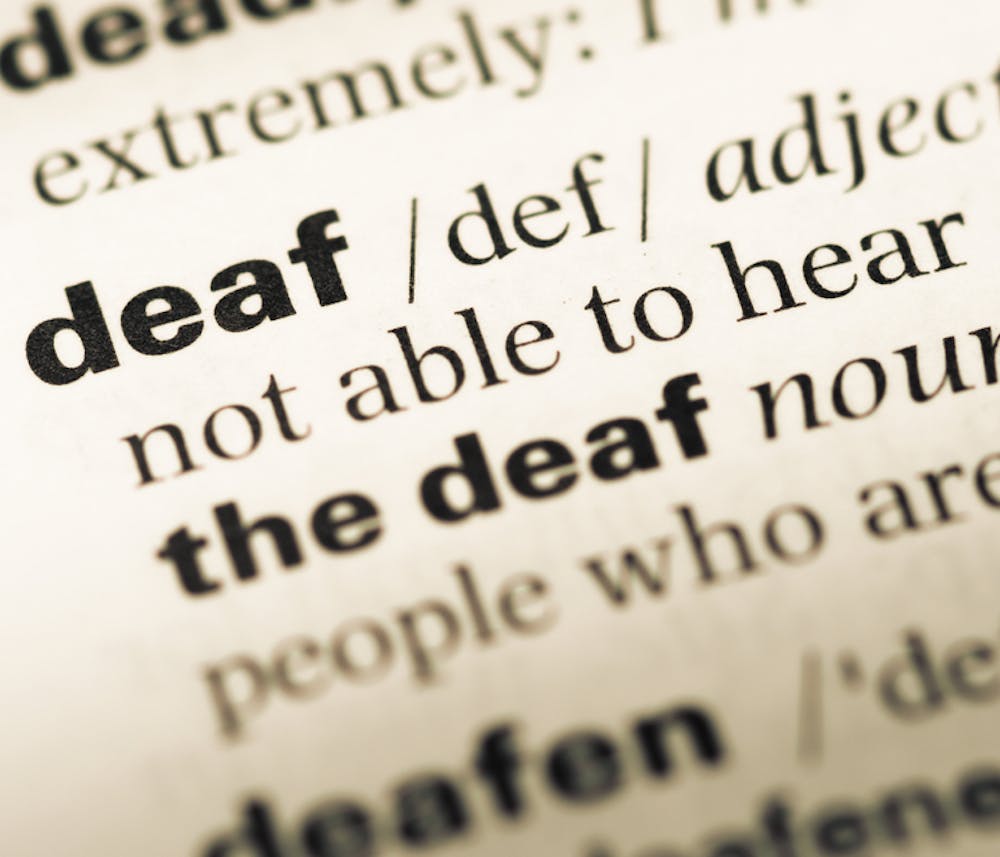
Words like “deaf”, “blind”, “dumb” and “lame” are not only descriptions of physical ability and disability, but are commonly used in negative ways. For instance, “deaf as a post”, “blind Freddie”.

We have now moved away from such language. Especially unacceptable are nouns like “retard” or adjectives like “demented”. In their place we have the principle of people first. The person and the disability are separated.

Instead of a phrase like “demented person” we have “person with dementia” or “person living with dementia”. The New South Wales Department of Ageing, Disability and Home Care has a list of such terms.

We should avoid terms that suggest deficit in a negative way, such as “disabled”, “invalid”, “retarded”, “handicap”, “spastic” and “cripple”. We should also avoid terms that explicitly specify limitation like “confined” (say, to a wheelchair). “Suffering from” is to be eschewed for the same reason, since it suggests the person is passive and incapable.


Read more – Redefining the (able) body: disabled performers make their presence felt at the Fringe


A number of paraphrases allow us to avoid sensitive terms. Instead of “blind” we have “visually impaired”. People are not “disabled” but “differently abled”.

Some of these terms can go too far and are effectively euphemisms because they sound overdone and excessively delicate, like “intellectually challenged”.

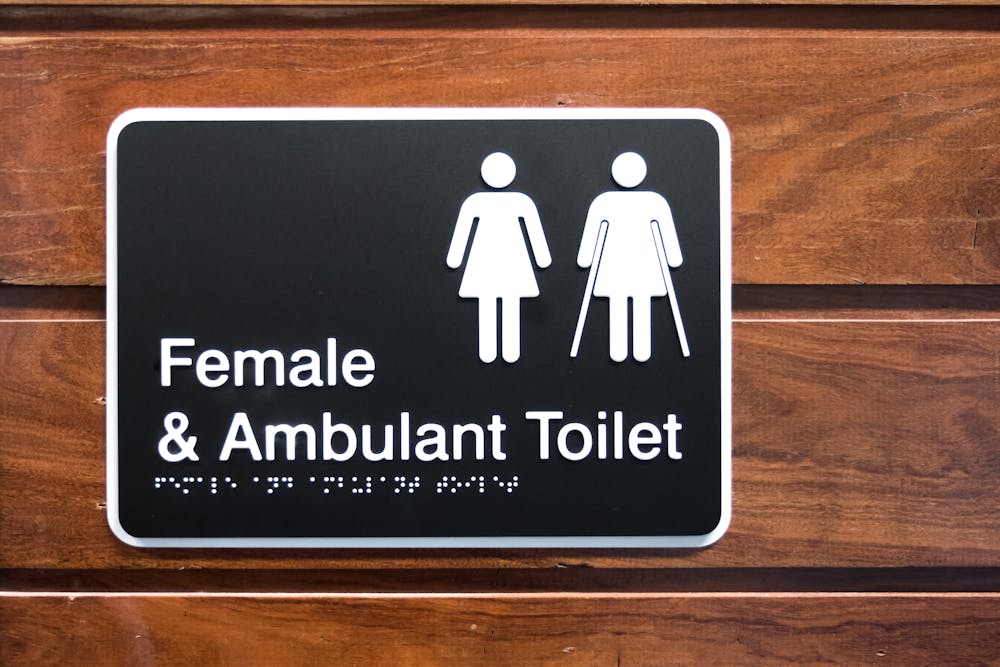
It is preferable to use language that doesn’t exclude people with these conditions from society. A good example of such inclusive language is “ambulant toilet”, often found in airports and public places, which simply indicates the toilet is suitable for anyone able to walk.

The Disability Discrimination Act 1992 consolidated these issues in Australian legislation, which now forms part of an expanding suite of anti-discrimination legislation both here and overseas.

Ambulant toilet is a good use of inclusive language.
shutterstock.com

Talking to someone with a disability

A general guideline for talking to someone with a certain condition is to ask that person how they wish to be described. In some cases, words like “deaf” have been reclaimed by bodies like the National Association of the Deaf in the US. The presence of the capital letter legitimises the term’s use, so long as it is done respectfully. In a similar way, various gender groups have reclaimed the word “queer”, and the fact they use it licenses others to do so too.

The requirement for respectful and considerate speech is not just a matter of good manners; it has teeth. Governments, education systems, companies, societies and other bodies often have guidelines for language use for people with disabilities.


Read more – Political correctness: its origins and the backlash against it


The US National Institutes of Health recommends “intellectually and developmentally disabled” or “IDD” for people with Down syndrome. Bodies like Dementia Australia have language recommendations.

Institutions and governments can apply a variety of sanctions to people who violate this principle in a persistent and hurtful way. These principles are now common in the English-speaking world and countries of the European Union, especially as enshrined in its Charter of Fundamental Rights.

The ConversationIn little more than a generation and half, we have become a more caring and inclusive society, and one much more aware of the importance of avoiding hurtful language. We don’t always get the expression right. But we are getting better at seeing the effect of what we say and write from the point of view of others.
Roland Sussex, Professor Emeritus, The University of Queensland

This article was originally published on The Conversation. Read the original article.

Take me to your leader – the quest continues

leader-politics
(Leader image, old man in park taking time out from politics and spin), Bob Wilson circa 1978

Imagine a flying saucer lands in your back yard and an alien (drooling or not) alights.

“Take me to your leader,” it telepathically commands, as it is from an advanced civilisation, intent upon savings ours.

“Aw yeah, mate.” (pointing). “That’s our leader over there, the one in the striped designer shirt, mingling with the homeless folk.”

If you dig around on the Internet long enough you’ll find lists of world leaders people would rather not introduce to their granny, never mind to an alien. The lists are usually described as ‘the 10 or 20 worst world leaders’ and include despots like North Korea’s Kim Jong-un, Russia’s Vladimir Putin, Syria’s Bashar al-Assad and Sudan’s Omar al-Bashir.

Alas Malcolm Turnbull, PM of Australia; the only list I found him on was the ‘hottest heads of state’ leader ladder, languishing in 12th place behind total spunks like Canada’s Justin Trudeau, New Zealand’s Jacinda Ardern, France’s Emmanuel Macron or Haiti’s Jovenal Moise.

One ought not to touch on politics when striking up conversations at Christmas parties. At one such event, I ventured that the Australian Federal Government was having an ‘Annus Horribilis’ and seemed incapable of making firm and sensible decisions.

I had voiced what I thought was a commonly-held theory, but soon found out what I should have known; on average, at least one-third of people voted for that motley group of indecisive dual citizens who went to work on just 64 days in 2017.

“So what do you think about Turnbull’s piss-weak energy policy?” I began at another Xmas do, when I probably should have said, “Strange weather for this time of year, don’t you think?”

That person moved away, but left me a clean run at the cheese platter.

From my point of view, the LNP in Canberra blundered from one disaster to another in 2017, momentarily making itself look good by introducing marriage equality laws, which in truth should have been enshrined in 1980-something. The poll was estimated to cost the taxpayer $122 million and then we endured weeks of angst while the same-sex marriage law was debated, after 61.6% of the 79.5% of people who voted had told them that’s what they wanted in the first place.

The great shame, or should I say sham, is that the Turnbull government, deliberately or not, distracted the people from more serious issues (climate change, the Adani coal mine, Manus Island), by turning the same-sex marriage debate into an expensive, non-binding referendum-style exercise. They could have used one of those 64 sitting days to have a free vote. We’d have achieved the same result and deployed the $122 million to more laudable outcomes (like finding emergency accommodation for the 6,000 or so Australians who sleep rough each night).

We’ve seen from recent State elections and Federal by-elections that the people are not happy with the mainstream parties. The drift towards the Greens on one side and One Nation on the other mimics the rise of populism the world over.

Political commentator Michelle Grattan, speaking at the launch of The Conversation Yearbook in Brisbane, said so many people in Australia are disgusted with politics they are ‘‘tuning out”

“People think (politicians) are behaving badly, because they are behaving badly. They (politicians) alienate the public – they are aware of it, but it’s beyond them to regain the people’s trust.”

Grattan said focus groups in north Queensland, ahead of the State elections, saw through Malcolm Turnbull’s ploy to cancel a week’s parliamentary sittings. This was ostensibly to allow the House and the Senate to resolve the citizenship issue and to work through the same sex marriage debate.

But here’s the thing: the NQ focus groups didn’t much like Malcolm Turnbull, but neither did they warm to Bill Shorten as an alternative leader.

The Queensland election continued a national, if not international trend: voters are fed up with mainstream parties and are casting their votes elsewhere.

In Queensland, 30.9% of first preference votes went to minority parties, while the informal vote was higher than average, at 4.58%. In the Bennelong Federal by-election, 10 minor parties grabbed 19.15% of the first preference primary vote, although that did not stop the LNP’s John Alexander (45.05%) taking the seat.

So what else happened in 2017?

While it wasn’t a party political issue, the rise of the social media hashtag #MeToo movement had its high point when Time Magazine chose #MeToo as its influential “Person of the Year”.

If you had been living under a rock, #MeToo is a movement where women who have been harassed, assaulted, bullied and otherwise vilified (primarily by men), came out and stood with their sisters.

The movement started with casting-couch revelations about Hollywood movie producer Harvey Weinstein and flushed out similarly bad behaviour all over the world. The Australia media chimed in, outing former TV gardening host Don Burke for a series of alleged indiscretions. Sydney’s Telegraph made an allegation about Australian actor Geoffrey Rush, who responded with a writ for defamation.

On a more positive note, 2017 turned up an unlikely winner of the Nobel Peace Prize. The prize went to the International Campaign to Abolish Nuclear Weapons (ICAN). The organization received the award for drawing attention to the catastrophic humanitarian consequences of any use of nuclear weapons.

There were other examples of positive news in 2017, amid the political scandals, terrorist attacks, humanitarian crises and natural disasters.

A December 19 report by Katrina Sichlau, News Corp Australia Network, found that renewable energy employed 10 million people worldwide.

(Aside – that makes the Queensland Premier’s contested claim that the proposed Adani coal mine would employ 10,000 people look rather sad).

The same article said France and Britain had launched a Clean Air Plan which will make sense to people who have visited either country this year or last. In a year when Queensland’s land-clearing reached Brazil-like proportions, Pakistan planted one billion trees.

If I may add to this optimistic list, New Zealand elected a woman in her 30s as Prime Minister (Jacinda Ardern), largely at the whim of (Queen)-maker Winston Peters, a veteran politician who saw sense in forming an alliance with the savvy young Labour leader.

Probably the less we say about Donald Trump the better, as he seems to thrive on publicity, be it good or bad. Trump continues to use Twitter like a flame-thrower, this year setting diplomatic fires in North Korea, Israel, and Germany and within the US itself.

Trump reportedly plans to go ahead with a visit to the UK in 2018, despite the recent twitter row with UK PM Theresa May. If you’ll recall, Trump retweeted videos posted by radical right group Britain First, inaccurately blaming Muslims in the UK for terrorist attacks.

There has been much misreporting about Trump’s ‘working’ visit to the UK. The White House at one point thanked the Queen for her “gracious invitation” to meet with President Trump at Buckingham Palace. The Guardian Weekly reported on December 15 that a formal state visit was not envisaged. “The Queen is likely to be preoccupied with preparations for a Commonwealth summit.”

As myth-buster Snopes points out, there is a long standing tradition that the Queen does not intervene in political disputes.

We wish you all an ‘annus mirabilis’ in 2018.


Many issues in unwinnable Queensland election

election-special-maleny-police
Election special: Photo of old Maleny police station by Bob Wilson

In the interests of better community policing and the fact she had just called an election, Queensland Premier Anastasia Palaszczuk made an unequivocal promise.

The Premier, who somewhere in the Courier-Mail’s Monday election coverage recalls winning a Grade Nine competition to ‘help police fight crime’, made a commitment to hire an extra 400 police officers over the next four years. Based on a First Year Constable’s salary (including shift allowances) of $70,820, that’s a $28.32 million promise

We back our police with the resources they want, the powers they need and the pay they deserve,” she told the ABC last Sunday.

Crikey, they ought to send a couple up the hill here to Maleny, where the new $2 million police station in Macadamia Drive (staffed by four police officers), has a roaming brief to cover an area from Maleny out to Palmwoods, Beerwah, Conondale and Kenilworth.

Ms Palaszczuk’s election promise to hire more police comes a week before the 1950s-style police station in Maleny’s main street is sold at auction. The 2,344sqm property, which is zoned Community Facilities, includes an office/police station and a residence but excludes a separate lock-up.

On my calculations, this sale alone should provide the Queensland Police Service with enough money to pay the salaries of an extra 21 police officers (over four years).

Against my better judgement, I bought the election special edition of The Courier-Mail on Monday after a three-year hiatus, prompted by a series of inflammatory, misleading and discriminatory front pages. Monday’s page one was no less lurid, presenting unflattering caricatures of the three main party leaders.

I worked there in the broadsheet days, pre-tabloid, pre-redundancies, pre-online editions, four editors ago. No regrets, Coyote, as Joni would say. I entered my 70th year on Monday, BP 120/80, feeling OK and supremely relieved I had no part to play in the CM’s graphics-laden presentation of an unwinnable election.

The first two pages of the CM’s October 30 election special purport to sell us the idea they have the State’s media covered. In what amounts to a two-page ‘house ad’, the CM confirms what we already knew – Rupert Murdoch’s Queensland media empire owns almost all of the print media titles. So yes, they have it covered, but you’d expect the coverage to be suitably mainstream; about 9% of the eleven-page election coverage was set aside for stories about the Greens and how they hope to win three seats, including Deputy Premier Jackie’s Trad’s seat of South Brisbane. It appears (from vox pops interviews), that some people in West End will be voting Green because of over-development (apartments) in the inner city suburb.

The rest of the coverage focuses on the resurgence of One Nation, how Labor will suffer from its seemingly intractable position on the Adani coal mine (no mention that the LNP are all for it too), a token story about the Katter Party and proportional space for (most of) the party leaders to have their say.

So to the unwinnable election

There’s a fair chance no single party will emerge from the November 25 poll with a workable majority, so in this sense it is unwinnable.

Crikey’s Perth-based election analyst, Poll Bludger, quoted ReachTEL polling figures from September showing the LNP with a 52-48 lead on primary votes. One Nation was polling at 19.5% and Greens at 8.1%.

An earlier Newspoll had Labor on 37% and the LNP on 34%. Some of you might take this to mean that the two parties will take 71% of the primary vote. This is roughly in line with election trends around the world where one in three people did not vote for one of the major parties. This leaves the unallocated 29% to be divided up between the Greens, One Nation, Independents, minor parties and the 2% of the electorate who cast informal votes.

The poll numbers, which focus only on primary votes, are not worth much in light of the return to compulsory preferential voting (CPV). To the uninitiated, this means numbering your preferred candidate 1 and then others in order of preference (meaning the party you like the least goes last). So if no single candidate has a clear majority, second preferences of the party that polled the least number of votes are counted until a winner emerges.

Many people do not understand preferential voting, so when handed a how-to-vote-card at the polling booth, they simply fill in the numbers as suggested (or number all candidates 1 to 6 consecutively, which is known as the “Donkey Vote.”)

An Australian Institute poll last year found that only 29% of respondents knew how to correctly fill in the (preferential) Senate ballot paper. So that is not a good sign for the re-introduction of compulsory preferential voting at this election. As Griffith University’s Paul Williams pointed out (in the CM), the Australian Electoral Commission is yet to conduct an information campaign to ensure CPV is clearly understood.

University of Melbourne honorary associate Adrian Beaumont has more to say about polling and CPV in The Conversation.

The Sydney Morning Herald suggested on Monday that the return of full preferential voting and new electoral boundaries could hand One Nation a balance of power role.

Enter stage right, former Senator Malcolm Roberts, booted out after a High Court decision found he had not renounced his British citizenship.

By challenging the seat of Ipswich for One Nation, Mr Roberts, best known for his climate change conspiracy theories, could attract enough LNP second preferences to win the seat, the article suggests. (I would go ‘aarrgghh’ at this stage but that would be editorialising).

ABC election analyst Antony Green told the SMH Roberts faced an uphill battle.

“It would be highly surprising if One Nation won there on first preferences, which would mean they would have to come from behind on LNP preferences,” he said.

Ipswich West was more likely to fall to One Nation, he said, adding that One Nation also had a good chance of winning the neighbouring seat of Lockyer.

Ipswich was where Pauline Hanson originally built her One Nation party in the 1990s. Should Roberts prevail, he is being tipped to lead One Nation in Queensland. What was that about the Lord Mayor’s show and the dust cart?

On latest polling, One Nation at 19.5% would seem to be in a strong position to win seats in Queensland and maybe also control the balance of power. A scary notion for some, but you have to give credit where it is due: Pauline Hanson has found the ear of disgruntled voters, much as Donald Trump wooed that endangered species US filmmaker Michael Moore called ‘angry white men’.

In Queensland, the angry, the poor and those who feel forgotten are listening and Hanson tells them what they want to hear.

There is only one certainty about the Queensland election, whoever cobbles together a coalition from this mess will have a mandated four years in which to rule – that’s 208 ‘Fridays on our minds’…#aarrgghh

Homeless for a rainy night

homeless-for-night
The Hope Centre for the homeless, Logan. Photo used by permission

For some, today is a reminder that anyone can become homeless, with various agencies (and reality TV) bringing this urgent issue to light. It also marks the end of the financial year, a kind of witching hour for those engaged in financial markets, investing in rental housing, or running Australia’s businesses, large and small.

For seventy-nine intrepid souls, our charity sleep-out on Maroochydore beach was thwarted by early morning drizzle turning into heavier rain.

Some abandoned their posts, leaving sheets of cardboard for others to make shelters with. Others took up the scarce positions under the eaves of the Maroochy Surf Club.

I took refuge in a nearby toilet block, mopping my wet hair with a sweatshirt. I decided I’d done enough, including raising $700+ and headed home in the wee hours. I briefly imagined a truly homeless mother in a similar situation. The two-year-old wants to be carried and the seven-year-old is saying “This is dumb, I wanna sleep.” So they walk 300m in the rain to the 1997 Ford wagon and do as best they can.

The St Vincent De Paul Society homelessness sleep-out raised more money this year ($125,577) with fewer people sleeping out. That’s an impressive result from a regional population of 300,000, (1,500 of whom are homeless).

The 2016 Census homeless tally (105,000 in 2011), won’t be known until 2018. But a 2014 Australian Bureau of Statistics survey found that 351,000 Australians had experienced homelessness in the previous 12 months.

There were a few speeches last night before we headed out to a balmy 17 degree Maroochydore evening. Mix FM’s Todd Widdicombe threw gentle barbs at local politicians and did a good job of generating competitive bidding for the charity auction (including a pillow sold to local politician Steve Dickson for $320).

St Vincent De Paul Society tells us most social housing on the Sunshine Coast was built more than 30 years ago. The Coast’s private rental vacancy rate is less than 2% and one-bedroom units are hard to find. A chart of social housing demand shows that 64% of people are looking for accommodation for one person. Developers on the coast tend to build three and four-bedroom homes and two or three-bedroom units. Many units are rented to holiday-makers.

Older people facing a tougher future

This is not a problem unique to the Coast. Pensioners and working parents have been priced out of the rental market in all metropolitan areas across Australia, according to National Shelter’s Rental Affordability Index (RAI), released on May 17.

Chief Executive of COTA Australia (Council on the Ageing) Ian Yate told a conference this week that older Australians were the forgotten faces of the housing crisis. He cited as examples the 70 year old divorcee facing homelessness, the 80 year old with a knee replacement who can’t find appropriate or affordable accommodation, the 68 year old couple retiring, still with a significant mortgage.

“Older Australians are increasingly falling through the cracks in the growing housing affordability and supply challenge,” he said. “A growing number of older Australians need to rent, rather than owning a home outright.

“We are already starting to see rates of home ownership by older Australians decline, and this is forecast to drop even further in the next 10-15 years.”

Anglicare’s annual report into housing affordability shows that welfare recipients and single-person households are the least likely to find appropriate accommodation. Queensland’s stock of social housing is just 3.6%, compared with a national average of 4.5%.


Rents are generally lower on the Sunshine Coast and the weather markedly warmer than the Southern States, even in winter. Little doubt this is why young people take their battered old wagons, surfboards and sleeping bags to the beach.

While many people in crisis use their cars as a refuge between one home and the next, others have developed an on-the-road lifestyle.

I once met a woman in her 50s whose camper van is her home and always on the road, unless she’s visiting family in one state or the other. Recently we met a couple who have a permanent caravan moored in a small town van park. They also have a bigger van for their grey nomad adventures. Safe to say most of their capital is tied up in these depreciating assets

For those who’d rather have a fixed abode, the Queensland Government recently made a ‘better-than-nowt’ commitment to provide 5,500 new social and affordable housing units over the next 10 years. Last year, the Government launched a Better Neighbourhoods initiative in fast-growing Logan City, with an affordable housing target of 3,000 by 2030.

Hoping for Hope Centre II

Family and Kids-Care Foundation established the Hope Centre in 2009, a complex of 19 self-contained units, designed for individuals and small family groups in crisis.

President Tass Augustakis told FOMM the charity is currently considering participating in the Better Neighbourhoods Logan initiative, seeking funding for a second Hope Centre which can accommodate larger family groups.

“The thing that got me going to start the Hope Centre was seeing women sleeping in cars with their kids. It just shouldn’t be happening, but it still is.”

Family and Kids-Care donated the land for the first Hope Centre and raised funding from the Federal Government to build it.

“After reading about the State Government’s affordable housing strategy, I’m organising a meeting to discuss Hope Centre II,” he said.

“We can provide the land, but we need the Government to contribute between $10 million and $12 million to build a four or five-level unit building.”

Cameron Parsell, a researcher with the University of Queensland, last year revealed that it costs governments more to provide services to the homeless than it costs to provide standard accommodation.

He produced ‘compelling and robust’ data in The Conversation which showed that chronically homeless people used state government funded services that cost approximately $48,217 each over a 12-month period. He compared this with another 12-month period in which the chronically homeless were tenants of permanent supportive housing.

“The same people used state government services that cost approximately $35,117 – $13,100 less when securely housed, compared to the services they used when they were chronically homeless.”


Urban studies researcher Emma Power, also writing in The Conversation, says single, older women are among the fastest-growing groups of homeless people in Australia. Yet most are unable to apply for community housing because the sole eligibility criterion is their low-income status.

Sadly, women who are not leaving a violent situation or who do not have a recognised disability will risk homelessness before they qualify for community housing.

The answer is for governments to provide more secure, low-cost social housing and/or increase rent-assistance payments across the board.

But as Power points out, the latter is not ideal. Although it assists renters in the short-term, it effectively subsidises private landlords.

This has been going on for a long time and it is getting worse, despite a lot of work by charitable organisations like St Vinnies. I tucked myself into my cosy bed (early) last night, feeling OK about raising the equivalent of a fortnight’s rent for someone.

But it is a band-aid at best.

Further reading:

http://www.huffingtonpost.com.au/2017/06/27/australias-homelessness-crisis-summed-up-in-four-news-events_a_23005274/

Everyone should have a home


Great wall of Mexico

great-wall-mexico
South Australia dog fence Photo by Bob Wilson

There are precedents for President Donald Trump’s plan to build, or complete a 3,208 kilometre wall between Mexico and the US. The Australian outback features not one but two barrier fences, sprawling the length and breadth of the country.

A tour guide took us on a sunset tour out to the ‘dog fence’ near Coober Pedy in 2014. The South Australian section of the 5,531km fence which runs from the SA border to Queensland is 2,250 kms long.  Built in the 1880s, it’s the longest fence in the world and keeps wild dogs out (or in).

In Western Australia there’s also the 3,256 kms long Rabbit Proof Fence. Possibly because there’s a movie by that name, it is now known as the State Barrier Fence of Western Australia. Having done our share of outback travel, we can tell you that rabbits are still breeding away and undermining parts of Australia, despite myxomatosis, 1080 poison and vermin proof fences. Western Australia’s fence was completed in three stages in the early 1900s as an attempt to isolate the west from the national rabbit plague.

Just so you all know, dingoes and rabbits were not asked to pay for the construction of these fences.

Yes, it makes you think.

There’s no doubt that well-built vermin fences, extending a long way into the ground, have been successful at keeping rabbits and other pests from undermining Australia and also prevent dingoes from savaging livestock. So the cost is defendable, as is the ongoing expense of sending out boundary riders on weekly repair patrols. Feral camels do the most damage, so not surprisingly; there are plans for a taller (electrified) fence.

So what about President Trump’s wall between Mexico and the US? Despite the fact that a 1000 kilometre stretch was completed by George W Bush’s government, this is still going to be a $20 billion exercise. Crikey, that’s about 30% of the US education budget, right there.

And speaking of education, a Pew Research survey found that 61% of Americans think a wall between the US and Mexico is a dumb idea.

Our Albuquerque correspondent, despite living 693 kilometres from the New Mexico border at Juarez, thinks the wall is ‘insulting, a blight and really bad foreign policy.”

Thanks to Bloomberg and heavyweight sources like the Department of Homeland Security, here’s what we know about the challenges facing President Trump’s wall. The notoriously porous border between the US and Mexico is almost 3,208 kilometres long, two-thirds of it tracking the Rio Grande River. The border passes through cities including San Ysidro (California) and El Paso (Texas), rural farmland, desert, mountains and wildlife reserves. The border features 30+ patrol stations and 25 ports of entry.

Barriers already extend along a third of the border, giving President Trump’s contractors something of a head-start. Most of the California, Arizona and New Mexico borders have existing barriers. These range from 5.5m high iron and corrugated metal fences to what our Albuquerque correspondent calls “pedestrian fencing.’

Bloomberg reports that in 2015, the Customs and Border Patrol claimed an 81% strike rate for apprehending and turning back Mexicans attempting to cross illegally (or should that be irregularly).

No-one really knows how many undocumented Mexicans are living in the US but informed estimates figure around 11 million. There have been amnesties in the past, but that does not appear to be an option under a Trump administration.

A Pew Research Centre survey conducted in 2015 found that 72% of Americans (including 80% of Democrats, 76% of independents and 56% of Republicans), thought undocumented immigrants should be allowed to stay “if they meet certain requirements.

Most of the existing border fence was built after 2006, when President George W. Bush signed the Secure Fences Act. I hate to be pedantic, but the act specifically says “Fences” not walls. When President Trump talks about his vision, most of us imagine a Great Wall of China or the 8m high sections of the West Bank edifice.

Al Jazeera reports that the West Bank security fence is the largest infrastructure project in Israel’s history. Nearly 15 years old, the 706km long fence costs Israel $260 million a year to maintain.

The ‘separation barrier” as it is coyly known, comprises mostly 2m high, electrified barbed-wire fences with vehicle-barrier trenches and a 60m exclusion zone on the Palestinian side. But in densely populated urban areas with space limitations, the Israelis built an 8m concrete wall.

Walls built between countries or within countries are always controversial, and, well, brutally divisive.

There’s no space at this time to delve into the tragedies of the Berlin Wall, which divided East and West Berlin for 27 years, for reasons which now seem specious. History shows that barrier walls built for whatever reason are destined to become decaying tourist attractions,

Visitors to Britain often schedule a visit to Hadrian’s Wall, a fascinating relic of 122AD when the emperor Hadrian demanded a wall be built east from Wallsend on the River Tyne to Bowness-on-Solway in the west. Hadrian’s Wall was the north-west frontier of the Roman Empire for nearly 300 years, built by the Roman army (to separate the barbarians from the Romans). Hadrian’s Wall was made a World Heritage Site in 1987.

In 2010 English folksingers Julie Matthews and Chris While joined a group of songwriters to write songs inspired by Hadrian’s Wall. Their song which emerged from the All Along the Wall project, Rock of Gelt, imagines a bored centurion who has been dragooned, if that is the appropriate word, into “building the Empire’s last frontier.”

There are only a handful of inscriptions to be found along the remains of the stone wall, including a piece of graffiti found in the Gelt Valley. It translates to: “Daminius didn’t want to do it,” which becomes the repeated refrain at the end of the song.

So will Donald Trump persist with a plan to build/complete a wall that 61% of Americans do not want? No doubt the 39% who want it would argue it will employ large numbers of people, through the building phase, then on maintenance and security.

Maintenance of walls and fences is an ongoing issue – just ask a fencing contractor called in to repair or replace fences wrecked or washed away in floods. The annual maintenance bill to keep the Dingo Fence in sound repair is around $10 million, according to an article in The Conversation. The authors argue for a re-think of the country’s vermin fence policies, including a plan to move a section of the fence to test whether the now endangered dingo can help restore degraded rangelands.

The humanitarian question is, if you must build a barrier wall or fence, surely you should have to justify the exclusion of a species?

As poet Elvis McGonnagal wrote, inspired by the Along the Wall project:

“Walls entomb, walls divide

Walls barricade the unknown

Berlin, Belfast, Gaza

Walls set difference in stone

 But the same sun that sets on the west bank

Rises up on the eastern wall

A man’s a man in Mesapotamia

A man’s a man in Gaul.”

*thanks to Julie Matthews for the insights

Elephant captured on Nullarbor Plain

elephant-nullarbor-plain
Photo by Mario Micklisch https://flic.kr/p/peLSQA

An African elephant dubbed ‘Ferd’ by social media followers has been cornered in an industrial shed near a roadhouse on the Nullarbor Plain. Ferd escaped from the Perth Zoo three months ago and has been spotted variously in WA and the Northern Territory. Facebook posts claimed sightings on Groote Eylandt.

Shed owner Tony is making a bit of cash on the side charging travellers $10 to pose for an elephant selfie. The Grey Nomad website www.welikefreestuff.dot described this as “exploitation” and lamented the lack of a seniors’ discount.

“It’s weird,” said Tony. “Everybody takes selfies to post on Facebook but nobody actually wants to talk about the elephant in the room.”

At which point you can see this  story about Ferd the elephant is not unlike the proliferating fake news stories on social media which commonly use a  headline and intro like this to suck you in. The more insidious fake news items, however, are portrayed as legitimate news stories and are often picked up and shared.

Satire is not fake news and vice versa

Some of the fake news websites which churn out stories cast themselves as satirists, but it is a loose label, apt to blow off in the wind. A yarn about an elephant wandering the Australian desert is probably satire.

It is satire when someone suggests the Pope is marrying (famous female pop singer) and running for the White House. Fake news is a story about the Pope endorsing Donald Trump (quickly debunked by hoax tracking website www.snopes.com.

WTOE 5 News, which broke the story, claimed that news outlets around the world were reporting on the Pope’s unprecedented endorsement. But Snopes found that no reputable news publications confirmed it, because WTOE 5 News, masquerading as a local television news outlet, does not publish factual stories.

But social media is not so discriminating. As Harvard University’s Nieman Journalism Lab pointed out, this fake yarn, which appeared in July, was shared almost 1 million times, versus 36,000 shares for the story debunking it.

One such story prior to the US election suggested the Amish had committed their vote to Donald Trump. Only 10% of Amish vote at all.

Another story suggested Barack Obama was abolishing the oath of allegiance in US schools. Sounds believable but simply not true.

Before people caught on to the idea of making money by spreading fake news on social media, the so-called supermarket tabloids cornered the market.

Here you will see obviously misleading headlines like “Diana is still alive” or “Hillary Gay Crisis” or “Aliens settle in San Francisco”.

By contrast, fake news stories circulated on social media prior to the election were entirely plausible – until you read to the end or read the website’s disclaimer.

But who has the time to (a) read the whole article before (b) sharing it or (c) checking out the veracity via factcheck.com or snopes.com?

Fake news here to stay

David Glance, writing in The Conversation, says fake news is driven by advertising and is here to stay. Glance, Director of Centre for Software Practice, University of Western Australia, says a great deal of the recent fake news targeted at Trump supporters appears to have originated in the Macedonian town of Veles. Websites with legitimate-sounding names fed pro-Trump fake news, which in turn generated large revenues from traffic generated through Facebook shares.

Glance says it may be tempting to think that news from reputable media organisations is more reliable, but they too are still influenced by partisan opinion and the pressures to advertise and generate traffic and sales.

“Ultimately, there is no protection from fake news other than to adopt a sceptical view of all news and take the truth of it on balance of likelihood and confirmation from multiple reputable sources.”

Facebook and parent company Google say they are going to crack down on fake news sites. The New York Times reported last week that Google would ban websites that peddle fake news from using its online advertising service. Facebook updated its policy, which already says it will not display ads on sites that show misleading or illegal content, to include fake news sites.

Paul Who?

So who are the people who spend their days (and nights) churning out fake news? Some publications have identified Paul Horner, described by Wikipedia as an internet news satirist and writer. Horner confesses to being as described and highlights a few of the stories he has written that have been picked up and shared by internet news sites. The Amish was his, so too Obama banning the oath of allegiance and Horner has recently told the Washington Post that he helped get Donald Trump elected.

Horner’s various websites pose as legitimate websites, but if you jump to the disclaimer, the author leaves himself an out by clearly stating that “…all news articles contained within are fiction, and presumably fake news.”

As David Glance observed, mainstream media is not immune to fakery, or at least allowing embellished news to be published. The blame is placed upon gutted newsrooms, where veterans with 20 years’ or more experience are replaced by school leavers and interns. The Guardian quoted an (un-named) journalist who described the pressure to perform online:

“So much news that is reported online happens online. There is no need to get out and doorstep someone. You just sit at your desk and do it and, because it is so immediate, you are going to take that risk. Editors will say, ‘The BBC got that six seconds before we did.’”

Some editors defend the bull at a gate approach as online news can be instantly updated (or taken down), when errors become obvious. FOMM can confirm this strategy as we have occasionally corrected minor errors on our website (it’s Hillary with two l’s, Bob).

Fake news is nothing new. As David Glance says, quoting French philosopher Michel de Montaigne (re the turmoil and divisions of 16th century France):

“Is it not better to remain in suspense than to entangle yourself in the many errors that the human fancy has produced? Is it not better to suspend your convictions than to get mixed up in these seditious and quarrelsome divisions?”

Fake news stories only a problem if you read them

Facebook has been blamed by some commentators for helping The Donald get elected, but it’s a specious argument. Filmmaker Michael Moore said people in America’s forgotten ‘rust belt’ made their minds up about Trump years ago.

Moore was interviewed in July by www.cnn.com (a real news website), where he talked about the reasons why Trump would win.

If he’s able to pull it off, it will be because on that day, a lot of angry white guys, a lot of guys who have a justifiable right to be angry — guys and women– who have suffered during the last decade,” Moore said.

The Pew Institute says 13% of Americans (about 41 million, 41% of whom are over 65); do not have internet access because: the internet is too difficult to use (34%), they have no interest in going online (32%), or internet access is too expensive (19%).

Moore’s angry white men were never going to be swayed by fake stories about the Pope or the Amish, if indeed they read them in the first place.


Newstart or job-share?

dad-needs-job
https://flic.kr/p/5YepYQ Image by Dane Nielsen

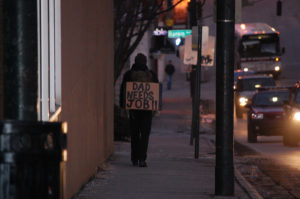
There are times when I’m grateful my conventional working life is behind me and I can wait (patiently) for the next humble pension payment. My needs are small – I can sit on the front veranda with a cup of coffee made on our machine for about 15 cents, enjoy my banana toasty, share the crumbs with the birds and do the crossword. Some may call me a leaner, but I’ve done my share of lifting, mate.

Meanwhile, out there in the thrust and parry world of staying in work, where HR is a growth industry, workers are lobbying for their next short-term contract, working out how long their redundancy payment will last or (forgive me for thinking this), shafting a colleague so they can get a better-paid job. Some, who make life plans based on aforementioned contracts, find said agreements withdrawn without notice for budgetary reasons. Yep, the veranda is better.

For one thing, the pension is linked to wage increases, which is more than you can say for Newstart (Australia’s unemployment benefit), which is indexed to the CPI. The September indexation will be calculated at 0.18%, which, on the single/childless fortnightly rate, is less than $1.

Surveys have repeatedly told the government of the day that half the 700,000 Australians who rely on Newstart are living below the poverty line. A 2015 study found that on any given day there were fewer than 10 rental properties in Australia that were affordable for people on the allowance.

Australian Council of Social Services chief executive office Cassandra Goldie told New Matilda the Newstart payment ($527.60 per fortnight for singles without children), had not seen a real increase since the Keating years (1991-1996). The major parties seem disinclined to increase the allowance, even when prompted by the Business Council of Australia. In 2013 the Greens lobbied for a $50 per week increase but failed to find sufficient parliamentary support.

This is a shameful state of affairs, the iniquities of which were plainly stated by Asylum Seeker Resource Centre founder Kon Karapanagiotidis. He tweeted on a Q&A TV debate about welfare that what a politician could claim for one night for staying in Canberra for work was equivalent to an entire week on Newstart. The Conversation fact-checked this statement and found it to be fundamentally true.

It might not seem like much, but after September 20 (next Tuesday), Newstart recipients will lose the twice-yearly $105.80 “income support bonus” added by Labor as part of its “Spreading the Benefits of Boom” package. In 2013, the Coalition announced the bonus would be scrapped from a range of benefits as Labor had funded it through the minerals resource rent tax (which the Coalition has since abolished). The Palmer United Party agreed to the bonus being scrapped on the condition it stayed until after the (July 2016) election. So rather than increasing this egregiously low payment, the Coalition is (let’s use a Tele headline word here), slashing it an amount which for a single person on Newstart provided a choice between a bacon and egg burger, a subsidised prescription, a pot of beer or an escapist video to watch after the Saturday ritual of circling jobs in the newspaper that by Monday will have already gone.

The ABC reported yesterday that Australia’s unemployment rate had dropped from 5.7% to 5.6%, but the rate of part-time work remains at an all-time high.

Since December 2015 there are now 105,300 more persons working part-time, compared with a 21,500 decrease in those working full-time.

In this country, part-time employment is defined as people in employment who usually work less than 30 hours.

The Australian (owned by an expatriate billionaire well-known for expecting senior employees to work long hours for a fixed salary), wrote that part-time work was ‘good for the over-40s’.

Economist Jim Stanford of the Australian Institute’s Centre for Future Work told the ABC in July the proportion of Australians working part-time has now reached a record 31.9%.

“Australia’s part-time employment rate has surged 4 percentage points since the GFC (2007) and is now the third highest in the OECD,” he said.

There are a few questions we should be asking about part-time work, chiefly: can you live on part-time income? If you are working part-time, is it by choice, or is that all you could find? Inter alia, did you know if you are on Newstart, and have found a part-time job as dish pig at a local café, you can earn up to $104 per fortnight before the allowance is affected? Break out the wine cask.

Let’s just imagine life on Newstart (equivalent to a night’s claimable accommodation for a working politician, remember?)

You are a 40-something male that has been “let go” – the latest in a succession of jobs that did not work out. You’ve spent your payout and your second wife has booted you out. You spend all day in the public library job-hunting, playing Solitaire and scribbling calculations on how you can live on $263.80 a week. A mate has rented you his caravan down the end of the paddock for $140 a week. Bargain. That leaves $123.80 for food and petrol (did I mention the caravan is 16 kms from town?)

Meanwhile, the rego is due, there was a letter in the mail with a photograph of you doing 122 kms in a 110 kms zone and then there is the dentist, who reckons you need two crowns and two root canal treatments.

You buy a packet of Panadol max and wash a couple down with the last lukewarm stubbie in the 20-year-old caravan fridge. Life’s great, isn’t it?

Australian society seems sharply divided between those who’d feel sorry for this fictional fellow’s plight and donate money to Lifeline and the hard-liners who’d say he’s a leaner who brought it all on himself (and how come he can afford beer?)

We need, if I may use a corporate weasel-word, a new paradigm. A UK think tank, the New Economics Foundation, proposed a utopian scenario for Europe that envisaged a society where those who can work are engaged for 20 hours a week. Anna Coote of NEF said there would be more jobs to go around, energy-hungry consumption would be curbed and workers could spend more time with their families. The model already exists in Germany and the Netherlands, the latter topping the OECD chart for part-time work. Coote mused about the rationale around jobs and growth and whether aiming to boost (insert country of choice) GDP growth rate should be a government’s first priority.

“There’s a great disequilibrium between people who have got too much paid work and those who have got too little or none.”

The Guardian’s Heather Stewart cited Keynesian economist Robert Skidelsky, who co-wrote a book with his son Edward: “How Much Is Enough?’ Skidelsky said the ‘civilised’ solution to technological change and fewer jobs is work-sharing and a legislated maximum working week.

There’s much need for a quantum shift/new paradigm, with youth unemployment at 13.2% in the UK and between 25% and 50% in seven Eurozone.countries.

It would not take much imagination to export these Eurozone ideas to Oceania (where youth unemployment is running at 13.5%).

Unhappily, Canberra’s politicians seem entirely lacking in imagination and worse, bereft of social conscience.

All 225 Federal politicians and Senators should think about this social issue on September 20, particularly if they are claiming overnight accommodation. Do claimable expenses run to the mini bar?


No interest at all

piggy-bank-1239661
Johanna Ljungblom/FreeImages.com

Though the headline might put you off, we must ask: why are interest rates dropping, who does it affect and where will it all end?

Few people would be unaware that the Reserve Bank of Australia (RBA) dropped the official cash rate to 1.50% on August 2, the lowest rate since records have been kept.

The supposed reason is to stimulate the economy (that is, to encourage spending and borrowing). It is theoretically OK to do this when inflation is low or falling as it is now. Conversely, as inflation rises, so do interest rates (RBA considers that this will restrain borrowing and spending).

An official cash rate of 1.50% is a huge problem for self-funded retirees such as yours truly and She Who Supports Ethical Investment. Four years ago we invested in a bank term deposit paying 5%, with interest paid annually. The annual payment dropped into our bank account this week. But where do we turn when this tiny golden goose gets killed off next year?

On current speculation, cash rates could drop to 1.25% by the second quarter of 2017. Given that inflation is currently 1%, that is a pretty skinny return.

The theory is we (self-funded retirees and younger people trying to save), will turn to the share market, where one can not only get better yields, but also the prospect of capital gains (and a tax break via dividend imputation). That means the company paying the dividend has already paid tax on it, so the franking credits (tax component) is refunded to the investor. But as we all know, the share market is volatile; you can lose money, companies can reduce or suspend dividends; gadzooks, companies can go broke and your modest $12,000 investment drifts away like steam from a kettle.

We’re told inflation has dropped from 1.7% in January to 1% in June, yet each week we seem to spend more at the supermarket and the petrol pump. House insurance premiums are rising, ditto rego, electricity and water rates. What’s really going on?

The low interest scenario, not by any means restricted to Australia, is set to continue for the foreseeable future.

Pre the GFC (2008), self-managed retirees could obtain interest rates of 6% to 7% on term deposits so their SMSFs were earning a fair, tax-protected return, sufficient to pay pensions and preserve capital (thus avoiding the inevitable dip into the public purse).

In this low interest rate environment, the biggest risk is that naïve investors will be lured into higher-rate schemes which are either unsecured and risky or just outright scams. The best known of scams is the Ponzi scheme, where a promoter offers you 12% on your investment, making interest payments with new deposits and eventually fleeing to some country with no extradition treaty.

Caveat emptor, mate.

Nevertheless, an official interest rate of 1.5% looks generous compared to the UK, US and Japan, the latter entering negative interest* territory in February. In post-Brexit UK, the Bank of England cut the cash rate this month to 0.25%, its first rate cut in seven years. The rationale for doing so was to support growth and return inflation to a sustainable target of 2%. UK inflation was 0.3% in May, so we can see what they mean.

Steve Worthington, adjunct Professor at Swinburne University of Technology revealed an odd cultural reaction to negative interest rates in an article written for The Conversation.

One month after the Bank of Japan’s decision to unleash negative interest rates, applications to join the loyalty programmes of Japanese department stores such as Mitsukoshi, Daimaru and Takashimaya (which offer discounts on goods of 5% to 8%), were 100-200% higher than in the same month of 2015.

Such consumer behaviour undermines the intentions of the central banks. Prof.Worthington proffers that if the weapon of negative interest rates does not work as expected on currency values or domestic consumption and investment, what else is there left to deploy to prevent deflation and a further slowdown in economic activity?

Prof. Worthington says negative interest rates are intended to boost domestic demand by forcing banks to lend money out and encourage consumers to both borrow and spend.

But they cannot bank on the unpredictable behaviour of individuals and organisations. Prof Worthington referred to the unexpected result this week after New Zealand’s central bank cuts its cash rate to a new low of 2%.

“Rather than that lowering the value of the NZ dollar, it has actually sent their dollar higher – economics theory meets reality and is found wanting!”

Many Euro Zone countries are already in negative interest mode, Japan has just joined the club and the US (0.5%) and UK (0.25%) is as close to zero as you can get. There are even a few economists in Australia who believe we could be at zero interest within a couple of years.

A collaborative essay in the Wall Street Journal examined the trend to negative rates, uncovering some evidence the policy was backfiring. The authors wrote:  “some economists now believe negative rates can have an unintended psychological effect by communicating fear over the growth outlook and the central bank’s ability to manage it.”

If the primary motive of low or zero interest rates is to encourage citizens to borrow or spend, it appears to be a lost cause. The OECD index of household savings shows savings are high and likely to go higher in countries such as Germany, where the percentage of disposable income which is being devoted to saving rose to 9.7%, and is forecast to rise to 10.4% this year.  The OECD also forecasts the rate to rise in Japan.

While Australians now are saving just under 10% of their disposable income, in the noughties we were saving virtually nothing and gearing ourselves into unsustainable debt.

A Federal Treasury paper, The rise in household saving and its implications for the Australian economy, theorises that had household savings remained at  2004-05 levels, consumption would have been 11% higher than its current level – about 6% of GDP.

“The primary effect of the turnaround in household saving has therefore been to reduce the extent to which interest rates and the exchange rate have needed to rise to maintain macroeconomic balance.”

The paper noted that subdued household spending will also present challenges to the retail and residential construction sectors.

So what does the average punter do – buy a safe (apparently ‘trending’ in Japan), stash the cash under the mattress, buy gold bullion, collectables or vintage wines?

You can still find a few banks with term deposit rates around 3%, though the rate does not vary much between six months and five years.

Self-funded retirees who need a certain level of return to maintain their lifestyles have only a few options: take riskier investment strategies (hybrids, debentures, unlisted property trusts), dig in to capital; apply to Centrelink for a part-pension or (shudder) start job-hunting. (Either that, or forget about that trip overseas…Ed).

*instead of receiving a return on deposits, depositors must pay regularly to keep their money with the bank.