
Where social housing meets the working poor

social-housing-working-poor
Graph supplied by the Grattan Institute

I suppose you have been waiting for me to wax eloquent about the Federal Government’s $10 billion housing plan and why don’t they get on with it?

Don’t blame me. I didn’t vote for The Greens, who seem to think their role in government is to block legislation just because they can. The Greens MPs in Parliament want the Federal Government to freeze rentals for two years. This seems to be predicated on some naïve proposition that the Labor Premiers buddy up with the Feds and persuade the others to fall in line.

What part of States Rights do they not understand? As Prime Minister Anthony Albanese rightly says, the Federal Government could not impose a nation-wide freeze on rentals even if it wanted to. The mechanism for such a move lies with the respective State and Territory governments. I can’t imagine that telling the landlords (and developers) in their constituencies that they can’t raise rents for two years would help State or Territory government re-election chances next time round. Having said that, the Australian Capital Territory has implemented a rent ‘cap’ so anything’s possible.

The Bill, which stalled through lack of support in June, has been tabled again this week although not much has changed. There is talk (at chat show level) of a double dissolution – that is, Mr Albanese will go early to the people and let them decide. Unlikely.

There are a few things to note about the Housing Australia Future Fund. For one thing it’s not a new idea. The $10 billion fund was an election promise, which means its formation goes back well before 2020. We already had a Future Fund (which primarily invests in the share market and in commercial property). The Labor Government’s plan to co-opt this fund into investing in the volatile housing market has made it a target for the Coalition and dissident independents.

One of the issues as I see it is the Bill has been designed as an economic/financial policy instrument. Given the size and severity of the housing problem in this country (affordability, rental housing shortages and homelessness), it should have been designed foremost as social policy, letting the numbers take care of themselves, as numbers do.

The Greens are not alone in their critique of the Albanese government’s housing policy. Numerous housing advocates say that despite the size of the Housing Australia Future Fund, it will scarcely touch the sides of the problem. The legislation promises 30,000 new social and affordable houses in the first five years. Once the fund starts generating returns, more social and affordable projects can be started.  And as Housing (and Homelessness) Minister Julie Collins added, this will include 4,000 homes for women and children affected by family and domestic violence, or older women at risk of homelessness.

That’s all very well, but numerous reports concur that the current social housing need is for more than 100,000 dwellings. A report by the National Housing Finance and Investment Corporation (NHFIC) showed that Australia is facing a shortfall of 104,000 houses in the next five years. This is brought about primarily because the construction industry can’t keep up with demand. Then there are mitigating factors like rising interest rates and the ever-increasing cost of raw materials.

This glum forecast came at a time (April) when rental vacancy rates in every capital city in Australia were at or below 1% (Ed: and likewise in regional cities and towns). Bad weather in 2022 added to the woes of builders; some of whom closed their doors, leaving home buyers with half-finished dwellings and cost over-runs.

The NHFIC is forecasting 1.8 million new households over the next decade, with just 148,500 new dwellings added this financial year. The total will drop to 127,500 in 2024-25, with the biggest drop in apartments and multi-density dwellings (40% down on levels experienced in late 2010).

In 2021, the Grattan Institute took a futuristic look at how we could build 100,000 social housing dwellings by 2040. As you can see by the table above, this would depend entirely on State and Territory government assigning matching contributions.

Grattan Institute economic policy director Brendan Coates wrote:

“If matched state funding was forthcoming, the Future Fund could provide 6,000 social homes a year – enough to stabilise the social housing share of the total housing stock. It would double the total social housing build to 48,000 new homes by 2030, and 108,000 by 2040.”

Four Corners should do an investigation on what exactly is meant by the terms ‘social, affordable and community housing’ and who benefits. Once upon a time there was just public housing. It was owned by the government and traditionally leased to people who were on government pensions and unlikely or unable to find paid work. The rental for people in these circumstances was traditionally struck at 25% of income. The Department of Human Services also calculates rent assistance for people in this category. Now, however, we have public/private partnerships which develop ‘affordable’ or ‘community housing’ properties. While the rents charged to these properties still look attractive (to those in the private market), it can represent up to 40% of disability or aged pension income. The properties are typically built new by private developers on land bought or provided by the relevant Government (or Council). These projects are financed by investors, so even though the housing provider may be a ‘not for profit’, the profit motive is inherent, whereas with public housing it is not.

Whatever the Federal Government and its State and Territory counterparts are going to do about social housing, they’d best get on with it. The Australian Housing and Urban Research Institute (AHURI) has estimated that the need for future social housing will be 1.1 million dwellings by 2037.

The 2021 Census recorded there were almost 350,000 social housing dwellings across Australia (just under 4% of the number of all households), at the end of June 2021.

AHURI recently reported there were 165,000 applicants on the waiting lists for public housing, more than 40,000 applicants for community housing and just over 12,000 applicants for State owned and managed Indigenous housing.

“If we add together all the households on the waiting list and those already in social housing, we find that over half a million (close to 565,000, or just over 6%), Australian households were living in, or had requested to live in, a form of social housing.”

All that aside, there is the ever-growing cohort of ‘working poor’ – Australian families where one or both parents have jobs. But their household income can’t keep up with high private market rentals and the cost of living in general. Not to mention the 1.8 million Australian households Roy Morgan Research says are at risk of mortgage stress.

No quick fixes in sight although the CFMEU (one of the country’s last robust unions), wants the government to impose a Super Profits tax on the top echelon of companies.

The Guardian reported that CFMEU says a super profits tax of 40% of excess profits would ‘comfortably’ cover the cost of building more than 750,000 new social and affordable homes.

The CFMEU revealed this bold plan last week at the National Press Club, tabling a commissioned report by Oxford Economics. The report assumed that a permanent 40% tax on excess profits on companies with over $100m annual turnover, would raise an average $29bn a year, enough to fund the construction of 53,000 new homes each year.

Yep, that’ll happen.


Apartments, starter housing and the impatience of youth

housing-apartments
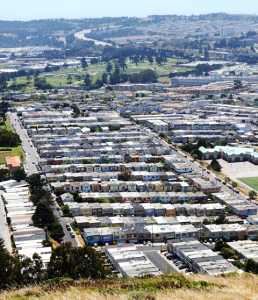
Housing: Inspiration for the song ‘Little Boxes’ – tract housing in Daly City, northern California; image by Tim Adams https://en.wikipedia.org/wiki/Little_Boxes

A developer friend from my days as a business journalist sent me his frank appraisal of the housing affordability crisis, which he described as more of a ‘crisis of expectations’. There are many Brisbane suburbs, Dan wrote, where post-war houses sell for less than $450,000. He named a few – Keperra, Ferny Grove, Grovely, all 12 kms from the CBD with good public transport networks and excellent shopping amenity.  Most of these homes are ex- housing commission or ex- war service homes built in the 1950s & 1960s. They tend to be on larger blocks of land than is common in the more sought-after inner city. But they are not on the shopping list of generation X or Y.

“Young home buyers don’t want a bar of them,” Dan said. “They want to be in the trendy inner suburbs with cute Queenslanders which have already been renovated.

“These (older) suburbs are ripe for gentrification and renovation, but the young guns want four bedrooms, a plasma screen on every wall and hip cafés on every corner.

“And they don’t want to dedicate their weekends to renovations, mending fences, tidying up yards, gardening and landscaping.”

As we observed last week, in the first part of this commentary on residential development, many of today’s generation think they can bypass the ‘starter home’.

This means buying a sound, but probably tired, older property in an outer suburb and gradually improving it as time and money allows. At some point in the property cycle, there will be an opportunity to take a profit and move up another rung. And at least older suburbs have character.

In 1962, US songwriter Malvina Reynolds wrote the quintessential commentary on middle-class conformism, ‘Little Boxes’. American activist songwriter Pete Seeger made it a big hit in 1963. You are maybe familiar with the song from its revival as the theme song to the TV series ‘Weeds’ or Roz Pappalardo’s cover with the Wayward Gentlemen.

“Little boxes, on the hillside, little boxes made of ticky-tacky

Little boxes, little boxes, little boxes all the same.”

This satire on fast-developing tract housing in the sprawling outer suburbs of San Francisco does not seem out of place in Australia, 2018. The Little Boxes of our generation are stacked one atop the other in apartment blocks where you can step out on to the balcony and listen to the traffic, admiring the view of your neighbour’s balcony.

The little boxes analogy also exists in the fast-developing outer suburbs of Brisbane – the conurbation developing along the transport corridors between the north and south coasts. The typical house and land package in these new suburbs are quite generic, dominated by a two-car garage which typically takes up a quarter of the house. The house often takes up 80% or more of the land on which it sits, so there is little opportunity to adapt the property as your family grows.

There are advantages and disadvantages to buying an older house in an older suburb. The main disadvantage is it will probably have been rented for years and the upkeep let slide. The main advantage is there will be enough land for kids and dogs, a garden and maybe even a pool!

Older housing such as the ones described by our property developer can be bought by anyone who has saved up a deposit of about $90,000, along with sufficient income to service mortgage repayments of about $2,000 a month.

Considering that many young people in Brisbane are paying between $1,600 and $2,400 a month in rent, that seems like an affordable deal.

While the humble starter home in the post-war suburbs is an option, younger people seeking affordable housing are attracted to inner Brisbane’s proliferating apartment blocks. There was a time (the 1970s and 1980s) when the only people who lived in city apartments were the caretakers of city office blocks. Now, the CBD and its close neighbours (South Bank, New Farm, Fortitude Valley, West End, Kangaroo Point, Milton etc.) have a well-documented over-supply of new apartments.

Brisbane inner city is the only Queensland region where a majority of households’ dwellings are flats/apartments (50.1%) and townhouses/semi-detached (7.4%). The Australian Bureau of Statistics 2016 Census showed that 41.7% of inner Brisbane housing stock is detached houses (compared with 76.6% for Queensland overall).

My take on the Census data for inner Brisbane suggests that the majority of people living there can afford the city lifestyle.

Almost 30% of households in this region earn more than $3,000 a week, with 56% earning between $651 and $2,999 per week. The proportion of people renting (49.9%) is higher than the state and national figures, but the income numbers suggest they can easily afford the median rent of $415 per week. This is not to say the inner city is completely populated by the well-to-do. Some 15% of residents earn less than $650 a week and 11.9% share expenses by living in ‘group households’.

The key demographics attracted to inner city apartments are international students, well paid young professionals and my cohort, older people who have downsized from big houses in established suburbs. If you own a big Queenslander in Ascot, it’s not hard imagine the property selling for $1.2m, which means the empty nesters can buy a three bedroom apartment in South Bank and have change left over to furnish it anew and take a cruise or two. They will also have to budget for storage costs, as there will typically be no room in the high-rise apartment for antique furniture, paintings, vintage cars, boats, jet skis and all the knick-knackery collected over a lifetime.

BIS Oxford Economics created a stir in April with a widely quoted report which highlighted the long-term oversupply issues facing Brisbane.

The report said 20% of Brisbane apartments were vacant and 52 projects had been shelved as a result of the over-supply, The withdrawal of 10,000 apartments before they were even built demonstrates the seriousness of the supply issue, which could last until 2025, report author Angie Zigomanis said.

Domain.com.au reported that BIS arrived at this (disputed) forecast by analysing occupier demand instead of sales demand. Despite the withdrawal of planned apartment buildings, there are another 3,500 apartments being added to the inner Brisbane market before Christmas.

So to answer the question posted last week (can tree changers afford to move back to the big smoke), it all comes down to the price cycle and what a long-term over-supply might do to apartment prices in coming years. The trick might be to shop around in the middle ring suburbs. Instead of looking for a starter home, determined downsizers might find there are three-bedroom apartments in the regional hubs (like Chermside), priced between $500k and $600k.

If you are willing to forego the inner city vibe, you’re still only a 20-minute bus ride from the CBD, but you won’t have to worry about what the over-supply will do to property prices. And the dog, if you still have one, will be able to ‘stretch his legs’ on the lawn outside.

Postscript: If you liked my Nauru song, I have made it available as an MP3 download, with 50% of net proceeds going to a local refugee charity. Here’s the link. http://store.cdbaby.com/cd/bobwilsonandthegoodwills2


Homeless for a rainy night

homeless-for-night
The Hope Centre for the homeless, Logan. Photo used by permission

For some, today is a reminder that anyone can become homeless, with various agencies (and reality TV) bringing this urgent issue to light. It also marks the end of the financial year, a kind of witching hour for those engaged in financial markets, investing in rental housing, or running Australia’s businesses, large and small.

For seventy-nine intrepid souls, our charity sleep-out on Maroochydore beach was thwarted by early morning drizzle turning into heavier rain.

Some abandoned their posts, leaving sheets of cardboard for others to make shelters with. Others took up the scarce positions under the eaves of the Maroochy Surf Club.

I took refuge in a nearby toilet block, mopping my wet hair with a sweatshirt. I decided I’d done enough, including raising $700+ and headed home in the wee hours. I briefly imagined a truly homeless mother in a similar situation. The two-year-old wants to be carried and the seven-year-old is saying “This is dumb, I wanna sleep.” So they walk 300m in the rain to the 1997 Ford wagon and do as best they can.

The St Vincent De Paul Society homelessness sleep-out raised more money this year ($125,577) with fewer people sleeping out. That’s an impressive result from a regional population of 300,000, (1,500 of whom are homeless).

The 2016 Census homeless tally (105,000 in 2011), won’t be known until 2018. But a 2014 Australian Bureau of Statistics survey found that 351,000 Australians had experienced homelessness in the previous 12 months.

There were a few speeches last night before we headed out to a balmy 17 degree Maroochydore evening. Mix FM’s Todd Widdicombe threw gentle barbs at local politicians and did a good job of generating competitive bidding for the charity auction (including a pillow sold to local politician Steve Dickson for $320).

St Vincent De Paul Society tells us most social housing on the Sunshine Coast was built more than 30 years ago. The Coast’s private rental vacancy rate is less than 2% and one-bedroom units are hard to find. A chart of social housing demand shows that 64% of people are looking for accommodation for one person. Developers on the coast tend to build three and four-bedroom homes and two or three-bedroom units. Many units are rented to holiday-makers.

Older people facing a tougher future

This is not a problem unique to the Coast. Pensioners and working parents have been priced out of the rental market in all metropolitan areas across Australia, according to National Shelter’s Rental Affordability Index (RAI), released on May 17.

Chief Executive of COTA Australia (Council on the Ageing) Ian Yate told a conference this week that older Australians were the forgotten faces of the housing crisis. He cited as examples the 70 year old divorcee facing homelessness, the 80 year old with a knee replacement who can’t find appropriate or affordable accommodation, the 68 year old couple retiring, still with a significant mortgage.

“Older Australians are increasingly falling through the cracks in the growing housing affordability and supply challenge,” he said. “A growing number of older Australians need to rent, rather than owning a home outright.

“We are already starting to see rates of home ownership by older Australians decline, and this is forecast to drop even further in the next 10-15 years.”

Anglicare’s annual report into housing affordability shows that welfare recipients and single-person households are the least likely to find appropriate accommodation. Queensland’s stock of social housing is just 3.6%, compared with a national average of 4.5%.


Rents are generally lower on the Sunshine Coast and the weather markedly warmer than the Southern States, even in winter. Little doubt this is why young people take their battered old wagons, surfboards and sleeping bags to the beach.

While many people in crisis use their cars as a refuge between one home and the next, others have developed an on-the-road lifestyle.

I once met a woman in her 50s whose camper van is her home and always on the road, unless she’s visiting family in one state or the other. Recently we met a couple who have a permanent caravan moored in a small town van park. They also have a bigger van for their grey nomad adventures. Safe to say most of their capital is tied up in these depreciating assets

For those who’d rather have a fixed abode, the Queensland Government recently made a ‘better-than-nowt’ commitment to provide 5,500 new social and affordable housing units over the next 10 years. Last year, the Government launched a Better Neighbourhoods initiative in fast-growing Logan City, with an affordable housing target of 3,000 by 2030.

Hoping for Hope Centre II

Family and Kids-Care Foundation established the Hope Centre in 2009, a complex of 19 self-contained units, designed for individuals and small family groups in crisis.

President Tass Augustakis told FOMM the charity is currently considering participating in the Better Neighbourhoods Logan initiative, seeking funding for a second Hope Centre which can accommodate larger family groups.

“The thing that got me going to start the Hope Centre was seeing women sleeping in cars with their kids. It just shouldn’t be happening, but it still is.”

Family and Kids-Care donated the land for the first Hope Centre and raised funding from the Federal Government to build it.

“After reading about the State Government’s affordable housing strategy, I’m organising a meeting to discuss Hope Centre II,” he said.

“We can provide the land, but we need the Government to contribute between $10 million and $12 million to build a four or five-level unit building.”

Cameron Parsell, a researcher with the University of Queensland, last year revealed that it costs governments more to provide services to the homeless than it costs to provide standard accommodation.

He produced ‘compelling and robust’ data in The Conversation which showed that chronically homeless people used state government funded services that cost approximately $48,217 each over a 12-month period. He compared this with another 12-month period in which the chronically homeless were tenants of permanent supportive housing.

“The same people used state government services that cost approximately $35,117 – $13,100 less when securely housed, compared to the services they used when they were chronically homeless.”


Urban studies researcher Emma Power, also writing in The Conversation, says single, older women are among the fastest-growing groups of homeless people in Australia. Yet most are unable to apply for community housing because the sole eligibility criterion is their low-income status.

Sadly, women who are not leaving a violent situation or who do not have a recognised disability will risk homelessness before they qualify for community housing.

The answer is for governments to provide more secure, low-cost social housing and/or increase rent-assistance payments across the board.

But as Power points out, the latter is not ideal. Although it assists renters in the short-term, it effectively subsidises private landlords.

This has been going on for a long time and it is getting worse, despite a lot of work by charitable organisations like St Vinnies. I tucked myself into my cosy bed (early) last night, feeling OK about raising the equivalent of a fortnight’s rent for someone.

But it is a band-aid at best.

Further reading:

http://www.huffingtonpost.com.au/2017/06/27/australias-homelessness-crisis-summed-up-in-four-news-events_a_23005274/

Everyone should have a home


Housing bubbles here and abroad

(New housing in Pokeno, 57 kms south of Auckland city. Risky motorway photo taken by Bob, who will go to any length for FOMM readers!)

Kiwis and Aussies aged 45 and over share one obsessive thought at this moment in time: how will our kids ever be able to afford their own home? Unless the housing bubble bursts, they probably never will be able to, even when the Boomers die off and leave their kids a residual estate.

The housing market both here and in Aotearoa has got away from humble wage earners. On my all-too quick visit to the old country, Auckland’s steaming hot housing market was all anyone could talk about. After a January dip in median prices (a reaction to new tax laws introduced in late 2015), the March figures revealed a $100k hike in the median price to $820,000.

Stories abound of people who bought a cottage in a then-dowdy Auckland suburb for $100k or less in the 1980s and sold last week for $1 million. The New Zealand Herald’s front page on April 13 proclaimed “Here we go again” to head a story about Auckland’s median house price. The story continued on page 3 where Labour Housing spokesman Phil Twyford said the $70k increase in the median price in just one month was almost one and a half times the median income in Auckland.

Not surprisingly, investors accounted for 44% of the 3000+ sales used to determine this alarming figure. This is similar to the Australian trend, where for the past two years just over 50% of housing loans have been made to investors.

Buyers with cash and/or equity are surging into the Auckland housing market and many pundits feel it is inevitable that it will join Sydney in having a $1 million median house price.

Everyone I spoke to told me that Auckland/New Zealand has the highest income to mortgage ratio in the world. The crusty old journo in me demanded that this be verified. The International Monetary Fund, which keeps track of housing costs vs income, indeed placed New Zealand 1st, ahead of Germany, Estonia and Austria. In sixth place came the UK and in 9th place Australia.

The ratio compares housing valuations to average income, the higher rankings showing that house prices have risen much faster than income. (Conversely, if you can score a job in Spain, where unemployment is still running at 22%, you can buy a cheap apartment and go running with the bulls in Pamplona).

If you were wondering how this is relevant, Spain’s economy went pear-shaped after their real estate market tanked in 2008. Caveat emptor!

The problem when housing markets get hot is the price rises are not matched by the prospective buyers’ incomes. In 2015, the median house price in Auckland increased $83,000, against a median income of $46,800. The data for this NZ Herald story, headed “Does your house earn more than you do?” was sourced from NZ Work and Income and the New Zealand Real Estate Institute.

In Sydney’s over-heated market, house prices are up to 12 times median income, according to a Sydney Morning Herald report in November. In mid-2015, the median Sydney house price was a headline $1,004,767, against a median household income of $85,067.

Meanwhile in Aotearoa, those determined to get their toe on the first rung of the housing ladder are fleeing south, as far as Huntly (a former mining town 97.2 km from the big smoke on State Highway 1), and north to Wellsford 77.3kms away. The plan is to buy, commute, save and over time upgrade closer to Auckland.

Pokeno, once a small Waikato hamlet just outside Auckland city limits, is now a forest of houses, if not nestling, then sprawling over the once green rolling hills. New housing is evident on both sides of the four-lane motorway which now extends to Hamilton and beyond. I had a trawl through real estate.com and was unable to find much new in Pokeno under $600k. So the early birds have already got their worms and now it is just another suburb of Auckland, a 57 km commute to the city.

Others have absconded to small towns like Te Aroha, Wairoa and Dannevirke, where a decent house and block of land (known as a ‘sixtion’) can be had for less than $150k.

New Zealand has few barriers in the way of investors – until recently there was no capital gains tax (as such) and no inheritance tax. Prime Minister John Keys introduced new measures in last year’s Budget, one of which was a tax payable if the (investment) property was sold within two years of purchase. Keys refused to call this a capital gains tax, saying New Zealand already had one, but the government has to prove “intent” to make a profit.

New Zealand also tightened its foreign investment rules and now requires all foreign buyers to declare a tax identification number from their home country. Kiwis don’t call it negative gearing, but as in Australia, expenses relating to investment housing (depreciation, interest, maintenance etc) can be offset against rental income.

Those who support a continuation of negative gearing in Australia claim that if it was abolished the property market would collapse. The Real Estate Institute of Queensland (REIQ) said 79% of its members and landlord clients believed that investors would abandon the strategy if Labor’s negative gearing changes were brought in. (Labor proposes to restrict negative gearing to new homes and ‘grandfather’ or exempt existing investment houses.)

REIQ Chairman Rob Honeycombe said the findings confirmed that changes to negative gearing would be disastrous for the Queensland property market.

“That will have a crippling effect on house values and on the rental market, where the private rental market plays such a critical role in keeping rents affordable,” he said.Prime Minister Malcolm Turnbull, no doubt sensing the pre-election atmosphere, has declared he will make no changes to negative gearing in next week’s Budget. The estimated 1.5 million people who invest in residential property would be sure to vote for the politician with the least disagreeable tax policy.

Meanwhile, the 25-44 age group, once the heart of the first home buyer cohort, is struggling to save for a deposit, faced by high rents and stiff competition for affordable housing. Assuming they could find a house in Sydney or Auckland for $700,000, it still means they have to save $140,000 for a deposit (about 14 years at $200 a week).

Their plight creates a dilemma for well-intentioned property investors, those who have simply decided that bricks and mortar is the best form of investment. Sure, they get the tax breaks, but they also have to take the investment risk in the first place and then the secondary risk that they might get the tenants from hell. The third risk may be a Pamplona-type charge for the exits if Labor gets up and changes the rules.

Part of the solution lies with the 814,000 Australians (2011 estimate), who have paid off their mortgages. Whatever their circumstances, they are the only people who, either by gifting money or using their equity for a loan, can help their adult children buy a house. Waiting for the bubble to burst is another option. Or you could move to Spain…there are apartments in Pamplona priced from 39,000 euros (about $A58,000). Buena suerte con eso

 (Thanks to Laurel (She Who Also Sometimes Writes) for being a splendid substitute when I was abroad )


Goodwill housing

While we’re all getting in the goodwill mood, Australians need to think seriously about this country’s housing problem. There isn’t enough of it to go around and what property is available is often out of the reach of low income households.

 Housing affordability chart

(Percentage of age groups with mortgages: ABS Surveys of Income and Housing)

This is no overnight thing. Tax concessions which favour property investors have led to a big swelling of their ranks – some 1.18 million. First there was negative gearing, re-introduced in 1985, which allows investors to claim rental expenses and interest on housing loans against their income. Second, the 50% capital gains tax exemption which property investors have enjoyed since 1999. Most invest on the expectation of future capital gain, rather than negative gearing benefits.

A 2014 article in The Conversation by Kate Shaw revealed that Australia’s GDP contribution of real estate transactions is the highest in the world – three times higher than in the US. Around one in seven Australian taxpayers owns one or more investment properties. Australia also has one of the highest levels of household debt in the OECD, due to mortgage borrowings.

As recent research on Australia’s rental market has found, those in the lowest 40% of gross income group struggle to meet rental costs and in capital city markets like Sydney or Melbourne pay up to 65% of their income for rental accommodation.

As a rule of thumb, low income earners paying 30% or more of their gross income in rent or mortgage payments are suffering housing stress.

Gavin Wood and Rachel Ong writing for The Conversation earlier this year underlined the growing problem of housing affordability. In 1982, the ABS survey of income and housing stated that 168,000 (or 10%) of home buyers spent more than 30% of their gross household income on housing costs. By 2011, those numbers had soared to 640,000, or 21% of all home buyers.

Wood and Ong also found that young first time buyers are finding it increasingly difficult to buy a home. As the chart above shows, the rate of home ownership in the 25–34 year age group slumped from 56% in 1982 to only 34% in 2011.

Wood and Ong say one in six Australians own two or more houses and 30% are holiday houses (2010 figures).

The Australian Housing Urban Research Institute (AHURI) says that while private rental is an important and growing part of our housing system, it has failed to serve the housing needs of low-income people. The 2006 ABS Census showed that 22% of households rent privately. In 2006, private renter dwellings numbered 1.47 million Australia-wide, an increase of 11 per cent since 2001.

But new research by A.C Nielsen for domain.com.au estimates that up to a third of Australians over 18 are renting, with higher proportions in the Northern Territory (43%) and Queensland (36%).

The stumbling block for people looking to rent a house or unit in a capital city is the up-front cost (usually a month’s rent and a bond (assuming $1000), not to mention storage and moving costs. FOMM figures the average establishment costs of a lease in one of five capital cities to be $2,828).

And domain’s rental market research shows it can be a short-lived reprieve, with 47% of Australians living in their current rental property for less than two years, and only 27% in the same property for more than five years.

Housing policy NGO National Shelter instigated the Rental Affordability Index as a response to media and political obsession with house purchase markets. The Index highlights the severe housing stress experienced by renting Australians. The report was produced by National Shelter, Community Sector Banking (CSB) and SGS Economics and Planning.

National Shelter executive officer Adrian Pisarski says the index fills major gaps in housing data, as it tracks household rents against household incomes in capital cities and regions across Australia.

“It reveals deterioration in our rental affordability, a result of 25 years of policy inadequacy and market failure. It shows why our low income households live in poverty and why life is a struggle, often a desperate one for moderate income working families.”

The RAI gives households who are paying 30% of income on rent a score of 100, a critical threshold for housing stress. A score below 100 indicates severe housing stress.

The report’s key finding is that while average rental affordability remained below 30% across all states, households in the lowest 40% of income consistently face severely and extremely unaffordable rents. This is the case in all regions of Australia. In the worst cases, non-family households are spending more than 60% of their income on housing (Sydney and Melbourne). Causes of homelessness, then, are shifting from traditional factors (escaping abuse, substance misuse, mental health issues), to being pushed out of the housing market by those with higher incomes.

People who are struggling to live on a government payment are the worst-affected by the crisis in affordable housing, according to the 2015 Anglicare Australia Rental Affordability Snapshot. The snapshot across all cities and regions shows that of the 65,500+ properties assessed for suitability, less than 1% were available for single people living on government allowances. Single people on the minimum wage would find 3.3% of these properties to be affordable. A working couple would fare better, with 23.8% of these properties suitable for their level of income. An age pensioner couple would find only 3.4% or 2,239 properties affordable.

Pisarski says the basic problem remains the lack of affordable rental properties and the lack of housing supply in general. He says one of the results is an emerging trends towards inter-generational living, with two and sometimes three generations under the one roof.

Australians are afforded little in the way of tenant protection, compared with cities in the US and Europe where rent controls and security of tenure are considered to be an important adjunct to social security.

Shaw makes a few broad comparisons between tenant legislation in Victoria and Germany. Rents can be increased in Victoria every six months with no limit on the amount (though the tenant may have grounds for appeal). In Germany, rent increases are capped at 20% every three years. In Victoria, 60 days is the standard amount of notice to vacate. In Germany notice varies according to how long the tenant has lived there: three months is the minimum for someone who has lived in the property for less than five years. Six months’ notice is required for a tenancy between five and eight years; nine months for longer than eight years.

In a perfect world, the Australian government would be looking to offer tax incentives to investors to rent to eligible (low-income) families at well below market rent. There was such a scheme, called the ‘National Rental Affordability Scheme’, but this only applied to investors building new dwellings, and as of September 2015, at least in Queensland, even this limited scheme was shut down:

To end this penultimate FOMM for 2015 on a cheery note, I read recently of one landlord who gave his tenants a one month ‘rent holiday’ as a Christmas present and thanks for being good tenants.