We’ll need a huge crowd to stop war against Iran

Stop-Adani-rally
Image: A Stop Adani rally, courtesy of https://www.facebook.com/stopadani/

I’m not good with crowds – not since the early days of journalism in Toowoomba when I under-reported numbers at the annual Carnival of Flowers parade. “Next time check with the police,” I was told and mostly continued to do so, on occasions when crowds gathered for newsworthy events.

It is not always a given that members of the constabulary will give you an accurate-enough figure of crowds. Police under-estimated by 50% or so the size of street marches in Australia’s capital cities in 2003, protesting John Howard’s involvement in George Bush Jnr’s unjustifiable war with Iraq.

Oh, we remember that! Mr and Mrs Outraged Parents of One joined 99,998 others on February 16, 2003, marching from Roma Street, along Adelaide Street and down Edward Street to the Botanic Gardens. It was a steamy Brisbane day and there were concerns for the health and hydration of toddlers and the elderly.

On the same day, rallies in Adelaide, Darwin and Sydney attracted 200,000 people while two days earlier, 150,000 marched in Melbourne. This was part of a co-ordinated global protest on the same day, when, according to the BBC, between six and 11 million people were involved in more than 60 countries. Rome broke a world record for the biggest single-city anti-war protest, with three million participants.

It might say something about the relative futility of protest in that the ill-advised invasion of Iraq in March 2003 led to ongoing conflict until the withdrawal of 170,000 US troops in 2011. Although their tenure is uncertain, there are 5,200 US troops in Iraq as part of a security agreement with the Iraq government. Along with US-employed contractors, this brings the ‘friendly fire’ equation into any strike on neighbouring Iran.

It seems you need really big protest numbers to get governments to back off even a little bit. An estimated 2 million people thronged Hong Kong’s streets this month.

When a quarter of the population protests, you can understand city authorities putting an unpopular plan on the back-burner. Protesters feared that Hong Kong’s economy and society would be irretrievably damaged by a proposed extradition law (allowing visitors and residents to be sent for trial in China). Hong Kong chief executive Carrie Lam was forced to suspend the draft legislation. You may recall mass protests and sit-ins in Hong Kong circa 2014 as residents took part in the Umbrella Movement’, to complain about China deciding who will govern the city.

Meanwhile civil disobedience (نافرمانی مدنی) is ramping up in Iran, despite a brutal crackdown by the State’s security police. Prior to 2017, years passed between bouts of people marching in Iran’s capital, Tehran. Nevertheless, people took to the streets of Tehran for three days in a row in 2017, protesting largely about economic hardship and alleged corruption within government. Protests continued in 2018 amid what Amnesty International called “a year of shame”.

Thousands were arrested as authorities sought to crush dissent, as protests continued against poverty, corruption and authoritarianism. Amnesty International said more than 7,000 people were arrested, many arbitrarily. Protestors included students, journalists, environmental activists, workers and human rights defenders.

“Hundreds were sentenced to prison terms or flogging and at least 26 protesters were killed. Nine people arrested in connection with protest died in custody under suspicious circumstances.” 

Amnesty director Philip Luther said the scale of arrests, imprisonments and flogging sentences revealed the extreme lengths the authorities have gone to in order to suppress peaceful dissent.

And while Australian journalists wax indignant about the Australian Federal Police raids on the national broadcaster, this is what can happen to scribes reporting the facts in Iran.

In Australia, attempts at repression are mostly left to conservative politicians and like-minded social media commentators. Last week, two Extinction Rebellion protestors glued themselves to a zebra crossing in Queen Street during a Stop Adani rally, prompting Federal MP Ken O’Dowd to post on Facebook. He cited a Courier-Mail article which quoted Police inspector Geoff Acreman as saying: “The stunt was a ridiculous waste of resources.”

“I’m sure we will all agree,” said O’Dowd, to which 98 people responded with comments like ‘‘make them a speed bump’’, ‘‘leave them there overnight’’, or ‘‘take away their dole money’’. Discourse cuts both ways, thankfully, and this post also attracted comments from people who see the folly of ignoring the climate crisis.

While glueing yourself to a public road does seem an extreme form of dissidence, it is important to remember that Australia does not have a national charter of rights.

While Victoria, the ACT and Queensland have each introduced a State-based charter of rights, in other States, the pendulum is swinging the other way.

Human Rights Law Centre executive director Hugh de Kretser writes that there have been attempts by State governments in Tasmania, New South Wales and Western Australia to curb the power of protests. Mooted changes to State laws include severe penalties, excessive police powers and the creation of ‘broad, vague offences’.

Mr de Kretser says protest has defined a number of key social advances and environmental saves in this country. Without protests we might not have the eight-hour day, women’s right to vote, protection of the Franklin and Daintree rivers and advancement of Aboriginal land rights. Protest also stopped our involvement in the Vietnam War and ended the criminalisation of homosexuality.

He says these issues will come into sharper focus in coming years, with increased attention on climate change, workplace disruption and the implementation of the Uluru Statement.

When, we wonder, will Americans start to push back against the hawk-like Trump administration that has taken the world too close for comfort to an armed conflict with Iran?

For now, President Trump appears to favour increased sanctions against Iran, but experts on armed conflicts say these are parlous times.

South China Morning Post opinion writer Rob York asks the question: where are the mass protests in the US about President Donald Trump first threatening North Korea and now coming close to armed conflict with Iran?

York recounts the nervous days in 2017 when Trump and North Korea leader Kim Jong-un played a high stakes game of chicken. This was thankfully hosed down by conciliatory summits in 2018. Now York asks why there are no mass demonstrations about a potential strike against Iran by the US.

“Since June 9, the world has watched Hong Kong’s protest movement closely. The mood of Americans in my social circle turned from dread to relief and then to awe as Hongkongers took to the streets, making it difficult for a government they feel no longer represents them to function.

But Americans are hesitant to do the same. So what if their country sleepwalks into a wholly unnecessary conflagration?”

As commentators have pointed out, Trump has a lot to lose if the US stumbles into a war with Iran, not the least a pre-election promise to the contrary.

As always, Trump’s habit of tweeting in the early hours of the morning comes back to haunt him. Thanks to Mr Shiraz for unearthing this.

“Don’t let Obama play the Iran card in order to start a war to get elected – be careful Republicans” – The Real Donald Trump on Twitter, October 23, 2012.

The last word goes to David Bowie’s chillingly appropriate song, used in the credits to the 2016 TV drama, Berlin Station. It’s an earworm.


Global Insights On Neglected Political Issues

neglected-political-issues
Image: war-time voting at Perth Town Hall, State Library of WA https://flic.kr/p/eUK9Pa (It’s a long shot but the State Library of WA is keen to identify the people in this war-time photo)

There have been issues aplenty for people to mull over ahead of tomorrow’s Federal election, not all of them as obvious as climate change, refugees or the Murray Darling.

Chair of Australia21, Paul Barratt, named those issues as his top three in a contribution to John Menadue’s Pearls and Irritations newsletter. But he also added 10 neglected political issues. They include inequality, reversing the cuts to research and development, early childhood education and a world-class NBN. Barrett, a former Departmental secretary of Defence and Primary Industries and Energy, would be aware of the global statistics on internet speed. Increasing the latter is, after all, the main aim of a world-class NBN.

A report in the Canberra Times last month showed that Australia dropped three places to 62nd for fixed broadband. The latest Ookla Speedtest Global Index showed that Australia is far behind many comparable economies and a few developing nations. The download speed of 35.11 Mbps recorded for March is only 60% of the global average of 57.91 Mbps.

However, a spokesman for Communications Minister Mitch Fifield told the Canberra Times Ookla didn’t measure the speeds of which the NBN is capable.

“It measures the speed packages that households purchase – which is the main determinant of speeds received.” The spokesman said around half of the 5.1 million people connected to the NBN had chosen 25 Mbps or lower, eschewing the faster options.

Australians not yet connected to the NBN network are limited to an average speed of 8 Mbps with an ADSL connection (by way of explanation if I have not replied to your emails).

Barrett points out that faster internet is not just about downloading films or online gaming; it is about the needs of industry in the city and the bush as well as social benefits like remote delivery of medical services.

Coal and climate change

Whether you believe that climate change is the only real issue in this election or not, Australia is demonstrably dragging the chain in terms of mitigation. This is without a doubt the No 1 neglected political issue.

Australia is performing worse than most other advanced countries in achieving Sustainable Development Goals (SDGs). The global SDG Index ranked Australia 37th in the world (down from 26th last year and behind most other wealthy countries including New Zealand, Canada, the United States and the United Kingdom.

Efforts to sway the country away from its love-affair with fossil fuels have struggled against the incumbent government’s determination that ‘coal is good for humanity’. There’s no doubt about the growing demand for coal to generate electricity in China and India and there’s no shortage of players, including Gina Rinehart and Clive Palmer, poised to open up new mines in the Galilee Basin. It’s not hard to figure out why. Australia exported $US47 billion worth of coal – 36.9% of global trade in 2018. Demand for thermal coal to fuel power stations is highest in China, the US and India. New coal-fired power stations planned by those three nations total 334,773MW of capacity – an increase of about 23%. Research portal carbonbrief.org exposes the folly of this, saying that CO2 emissions from existing plants alone are enough to ‘breach the carbon budget’ limiting global warming to1.5 or 2C.

The good news, if you are a climate change believer, is that 14 countries (including the UK and Canada), have signed up to phase out coal power generation by 2030.The Stop Adani campaign had its genesis in 2007 when environmental campaigner Tim Flannery alerted people to the likelihood of the Galilee Basin in central west Queensland being exploited. The arguments against development of the 27 billion-tonne thermal coal resource include the low quality of Galilee Basin coal, a required expansion of an export port too close to the Great Barrier Reef for comfort and the environmental record of the applicant (Adani).

As the above infographic explains in detail, there are concerns about the amount of water required to operate (a) the mine and (b) the port. The Indian coal and power company has posted a rebuttal of claims that it will take 12 gigalitres of water from the Great Artesian Basin.

Refugees and border paranoia

The United Nations Association of Australia set out its position on refugees and asylum seekers in April last year, saying that current policies and measures need to be reviewed.

“Australia’s current policy only shifts the problem to other countries.”

“Australia’s reputation as a welcoming host country and as a responsible global citizen is diminished by our current treatment of asylum seekers and refugees arriving spontaneously, as evidenced by arguments from within the Australian community and from the UNHCR. There are alternatives.”

The UNAA states the obvious – processing arrivals offshore is not cost-effective. Between 2012 and 2016, the cost to Australia was an estimated $9.6 billion. Though costs have reduced as arrivals have decreased, the estimated cost of offshore processing for 2017-18 was $714 million.

(Offshore processing costs blew out by 52% during 2018-19. The latest Budget records that estimated actual spending in 2018-19 on offshore processing will be $1.158 billion – Ed)

Despite the weight of international criticism, Australia has persisted with the practice of detaining refugees offshore and turning boats around.

It is important to know that the Labor Party has largely promised to maintain the status quo, although it would look at New Zealand’s offer to resettle refugees from Manus and Nauru,

Australian expat musician James Fagan, who has been living in the UK for 20 years, has often had to wear criticism of Australia’s refugee policies.

But he is being asked less often, since the Brexit campaign revealed what he called the “dark underbelly of xenophobia and racism in the UK”.

“Five or 10 years ago, when Tampa and all that stuff was in the news, I used to get a lot of questions in the UK.  The one that sticks in my mind was the Armenian delicatessen owner who asked me about how I felt about my homeland’s treatment of refugees. He had Armenian friends and relatives in Australia and had been following the Tampa situation closely. He asked me if I was embarrassed. I said yes!

“But I’ve stopped being asked the question and the sad truth of it is that the longer a country persists in a particular course of action, the less it becomes newsworthy.”

Which brings us to No 10 in Paul Barratt’s list of neglected political issues – the need for empathy and compassion in government.

It should be a matter of conscious public policy that empathy and compassion underpin everything we do in the public sphere,” he writes.

“Recent Royal Commissions have demonstrated how strongly human motivations drive behaviour. Humans have a powerful competitive and acquiring motivation, which tends to turn off other motivational systems that link to caring and supporting others.

“So developing a compassionate mindset is important because it has shown that this mind-set organises our motives, emotions and actions in ways that are conducive for our own and other people’s wellbeing.”

“Recognising the needs and aspirations of every human being necessarily implies refraining from demonising any social group – refugees, the unemployed, the poor, the homeless, etc.”

Mr Speaker, I commend the Mindful Futures Network to the House (and the Senate).


(The above quote could well have come from the late ex-Prime Minister Bob Hawke. Valé to a great Australian politician who was respected by both sides of politics. SWETB) (SheWhoEditsThisBlog)

More reading – what Labor and the Greens were saying about a coalition before the 2016 election. https://bobwords.com.au/greens-coalition-bridge-far/

The budget that forgot climate change

climate-change-power-station
power station image by Benita Welter from Pixabay

‘The budget that forgot climate change’ may be a slightly misleading headline, even though Greens Leader Richard Di Natale essentially said as much when interviewed on 2GB. He was elaborating on a press release issued on Budget night which castigated the Federal Coalition for virtually ignoring climate change.

“(Treasurer) Josh Frydenberg said in his speech that we owe our children budget discipline,” Di Natale said. We owe our children a plan for their future, and that should mean tackling climate change through a managed transition away from fossil fuels to a clean, green, jobs-rich renewable economy. By any measure this budget fails to do that.”

The Australian Youth Climate Coalition (AYCC) was blunter still, describing it as a “nightmare” budget.

“Scott Morrison’s government has given us budget that sets more money aside for a ring road in Cairns than for dealing with climate change – the biggest social and environmental crisis facing our generation,” the AYCC said.

“The LNP intends to set aside just $189 million over the next four years to deliver their so-called climate action plan – which, by the way, fails to so much as mention a transition away from coal and gas”.

To be fair, climate change did get two mentions in a Budget loaded with tax cuts to woo the nation’s middle-income earners (and an ‘oops we forgot the poor people’ moment, when the energy supplement was later extended to include NewStart recipients).

You know the old adage about shutting the barn door after the horse has bolted? The Coalition’s idea of dealing with climate change is to create a $3.9 billion Emergency Response Fund which will be used to mop up after severe storms, floods, bushfires and cyclones. The fund will grow to $5 billion over the next decade, the Treasurer said.

The Australian Financial Review’s Queensland Bureau chief Mark Ludlow outlined where the government had found the money for the Emergency Response Fund.

The fund, which will need to be passed in legislation, will be created from the leftover allocations from the former Labor government’s Education Investment Fund as well as money that had previously been allocated to the National Disability Insurance Scheme which is no longer needed.”

One ought to mention, as Ludlow did, the government already picks up the tab for post-disaster funding under the existing Natural Disaster Relief and Recovery Arrangements. The NDRRA comes into play once State or Territory funding has been exhausted.

More promisingly, the government announced a $3.9 billion Future Drought Fund, which at least acknowledges that Australia needs to plan on the assumption that drought will continue to plague the outback, if not the entire eastern seaboard.

The Climate Council took to Twitter on Budget night to spell out its disappointment.

“The divide between the parties when it comes to Coalition’s focus on tax and surpluses, and Labor’s focus on climate policy, might come down to this: would you rather leave your children with a smaller federal debt or a worldwide climate crisis.”

The tweet was linked to a University of Melbourne Budget analysis which said Australia was not on track to meet its Paris Climate commitment of a 26% to 28% reduction in emissions off 2005 levels.

“We are projected to achieve a 7% reduction, and the budget on Tuesday night offered little to suggest we can change course.”

The Climate Action Tracker (CAT) rates Australia’s position on climate change as “insufficient”, which is the same rating given in 2011. CAT is an independent scientific analysis produced by three research organisations tracking climate action since 2009. CAT tracks progress towards the globally agreed aim of holding warming well below 2°C, and pursuing efforts to limit warming to 1.5°C.

The Climate Action Tracker’s latest verdict (December 2018) notes that Australia’s climate policy has further deteriorated in the past year, “as it focusses on propping up the coal industry and ditches efforts to reduce emissions”.

“The Federal government is ignoring the record uptake of solar PV and storage and other climate action at State level.

“The Australian government has turned its back on global climate action by dismissing the findings of the IPCC Special Report on Global Warming of 1.5°C and announcing it would no longer provide funds to the Green Climate Fund (GCF).”

The 2019 Budget confirmed that Australia’s contributions to the UN’s major fund would end in December, with a final contribution of $19.2 million. Australia has given $187 million to the fund, which finances developing world projects that cut emissions or promote resilience to climate impacts.

You may recall when John Howard belatedly made a pre-election commitment in 2007 to establishing a national Emissions Trading Scheme, starting no later than 2012.

Dubbed the Climate Change Fund, it promised that revenue from emissions trading was to be re-invested into climate change initiatives.oward made

I mention this only to point out that Tuesday’s announcement was just a rebadged Climate Change Fund – a new name for the same objectives.

The Morrison Government pre-committed $2 billion to the ‘Climate Solutions Fund’, which aims to reduce greenhouse gas emissions across the economy. It does so by (continuing) to purchase low-cost abatement through the existing Emissions Reduction Fund. Already there are claims that the government plans to use ‘Kyoto carryover credits’ to reduce our greenhouse gas pollution, even though comparable countries have ruled out doing this.

Ah well, at least we signed up for the Paris agreement, well after incoming Prime Minister Kevin Rudd honoured a pre-election promise and ratified the Kyoto protocol in 2007.

Some 195 member countries including Australia agreed to the Paris agreement in late 2015. The agreement’s long-term goal is to keep the increase in global average temperature to well below 2 °C above pre-industrial levels, and to limit the increase to 1.5 °C.

So it has been a long journey from the first Australian greenhouse gas emissions reduction proposal 30 years ago. In 1989, Senator Graham Richardson, who must have had an inkling of what lay ahead, made a Cabinet submission for a 20% reduction in 1988 Australian greenhouse gas emissions levels by 2005.

So what does the future hold after the budget that forgot climate change, some six weeks out from a crucial Federal election where the Opposition Labor Party offers a mixed bag of policies, including a big commitment to renewable energy and climate change mitigation?

A book delivered to my mailbox yesterday delivers an unpalatable verdict. Author Anna Skarbik says Australia can be a carbon-neutral country by 2050 – “if we just get on with it”.

Skarbik is a contributor to Advancing Australia – ideas for a better country, just published by The Conversation through Melbourne University Press.

She states that the Federal Coalition’s current emissions reduction target of 26% to 28% by 2030 is not enough to meet the zero target by 2050. Federal Labor will also have to boost its promise of a 45% reduction in carbon emissions to meet this target.

“Australia would need to cut emissions by 55% below 2005 levels by 2030 to get there without undue economic disruption,” Skarbik wrote.

As she observes: “Lack of consensus on climate policy over the last two decades has cost us dearly.”

Recommended viewing:

Y dig up coal? Maleny’s contribution to the Stop Adani campaign:


Take me to your leader – the quest continues

leader-politics
(Leader image, old man in park taking time out from politics and spin), Bob Wilson circa 1978

Imagine a flying saucer lands in your back yard and an alien (drooling or not) alights.

“Take me to your leader,” it telepathically commands, as it is from an advanced civilisation, intent upon savings ours.

“Aw yeah, mate.” (pointing). “That’s our leader over there, the one in the striped designer shirt, mingling with the homeless folk.”

If you dig around on the Internet long enough you’ll find lists of world leaders people would rather not introduce to their granny, never mind to an alien. The lists are usually described as ‘the 10 or 20 worst world leaders’ and include despots like North Korea’s Kim Jong-un, Russia’s Vladimir Putin, Syria’s Bashar al-Assad and Sudan’s Omar al-Bashir.

Alas Malcolm Turnbull, PM of Australia; the only list I found him on was the ‘hottest heads of state’ leader ladder, languishing in 12th place behind total spunks like Canada’s Justin Trudeau, New Zealand’s Jacinda Ardern, France’s Emmanuel Macron or Haiti’s Jovenal Moise.

One ought not to touch on politics when striking up conversations at Christmas parties. At one such event, I ventured that the Australian Federal Government was having an ‘Annus Horribilis’ and seemed incapable of making firm and sensible decisions.

I had voiced what I thought was a commonly-held theory, but soon found out what I should have known; on average, at least one-third of people voted for that motley group of indecisive dual citizens who went to work on just 64 days in 2017.

“So what do you think about Turnbull’s piss-weak energy policy?” I began at another Xmas do, when I probably should have said, “Strange weather for this time of year, don’t you think?”

That person moved away, but left me a clean run at the cheese platter.

From my point of view, the LNP in Canberra blundered from one disaster to another in 2017, momentarily making itself look good by introducing marriage equality laws, which in truth should have been enshrined in 1980-something. The poll was estimated to cost the taxpayer $122 million and then we endured weeks of angst while the same-sex marriage law was debated, after 61.6% of the 79.5% of people who voted had told them that’s what they wanted in the first place.

The great shame, or should I say sham, is that the Turnbull government, deliberately or not, distracted the people from more serious issues (climate change, the Adani coal mine, Manus Island), by turning the same-sex marriage debate into an expensive, non-binding referendum-style exercise. They could have used one of those 64 sitting days to have a free vote. We’d have achieved the same result and deployed the $122 million to more laudable outcomes (like finding emergency accommodation for the 6,000 or so Australians who sleep rough each night).

We’ve seen from recent State elections and Federal by-elections that the people are not happy with the mainstream parties. The drift towards the Greens on one side and One Nation on the other mimics the rise of populism the world over.

Political commentator Michelle Grattan, speaking at the launch of The Conversation Yearbook in Brisbane, said so many people in Australia are disgusted with politics they are ‘‘tuning out”

“People think (politicians) are behaving badly, because they are behaving badly. They (politicians) alienate the public – they are aware of it, but it’s beyond them to regain the people’s trust.”

Grattan said focus groups in north Queensland, ahead of the State elections, saw through Malcolm Turnbull’s ploy to cancel a week’s parliamentary sittings. This was ostensibly to allow the House and the Senate to resolve the citizenship issue and to work through the same sex marriage debate.

But here’s the thing: the NQ focus groups didn’t much like Malcolm Turnbull, but neither did they warm to Bill Shorten as an alternative leader.

The Queensland election continued a national, if not international trend: voters are fed up with mainstream parties and are casting their votes elsewhere.

In Queensland, 30.9% of first preference votes went to minority parties, while the informal vote was higher than average, at 4.58%. In the Bennelong Federal by-election, 10 minor parties grabbed 19.15% of the first preference primary vote, although that did not stop the LNP’s John Alexander (45.05%) taking the seat.

So what else happened in 2017?

While it wasn’t a party political issue, the rise of the social media hashtag #MeToo movement had its high point when Time Magazine chose #MeToo as its influential “Person of the Year”.

If you had been living under a rock, #MeToo is a movement where women who have been harassed, assaulted, bullied and otherwise vilified (primarily by men), came out and stood with their sisters.

The movement started with casting-couch revelations about Hollywood movie producer Harvey Weinstein and flushed out similarly bad behaviour all over the world. The Australia media chimed in, outing former TV gardening host Don Burke for a series of alleged indiscretions. Sydney’s Telegraph made an allegation about Australian actor Geoffrey Rush, who responded with a writ for defamation.

On a more positive note, 2017 turned up an unlikely winner of the Nobel Peace Prize. The prize went to the International Campaign to Abolish Nuclear Weapons (ICAN). The organization received the award for drawing attention to the catastrophic humanitarian consequences of any use of nuclear weapons.

There were other examples of positive news in 2017, amid the political scandals, terrorist attacks, humanitarian crises and natural disasters.

A December 19 report by Katrina Sichlau, News Corp Australia Network, found that renewable energy employed 10 million people worldwide.

(Aside – that makes the Queensland Premier’s contested claim that the proposed Adani coal mine would employ 10,000 people look rather sad).

The same article said France and Britain had launched a Clean Air Plan which will make sense to people who have visited either country this year or last. In a year when Queensland’s land-clearing reached Brazil-like proportions, Pakistan planted one billion trees.

If I may add to this optimistic list, New Zealand elected a woman in her 30s as Prime Minister (Jacinda Ardern), largely at the whim of (Queen)-maker Winston Peters, a veteran politician who saw sense in forming an alliance with the savvy young Labour leader.

Probably the less we say about Donald Trump the better, as he seems to thrive on publicity, be it good or bad. Trump continues to use Twitter like a flame-thrower, this year setting diplomatic fires in North Korea, Israel, and Germany and within the US itself.

Trump reportedly plans to go ahead with a visit to the UK in 2018, despite the recent twitter row with UK PM Theresa May. If you’ll recall, Trump retweeted videos posted by radical right group Britain First, inaccurately blaming Muslims in the UK for terrorist attacks.

There has been much misreporting about Trump’s ‘working’ visit to the UK. The White House at one point thanked the Queen for her “gracious invitation” to meet with President Trump at Buckingham Palace. The Guardian Weekly reported on December 15 that a formal state visit was not envisaged. “The Queen is likely to be preoccupied with preparations for a Commonwealth summit.”

As myth-buster Snopes points out, there is a long standing tradition that the Queen does not intervene in political disputes.

We wish you all an ‘annus mirabilis’ in 2018.


Many issues in unwinnable Queensland election

election-special-maleny-police
Election special: Photo of old Maleny police station by Bob Wilson

In the interests of better community policing and the fact she had just called an election, Queensland Premier Anastasia Palaszczuk made an unequivocal promise.

The Premier, who somewhere in the Courier-Mail’s Monday election coverage recalls winning a Grade Nine competition to ‘help police fight crime’, made a commitment to hire an extra 400 police officers over the next four years. Based on a First Year Constable’s salary (including shift allowances) of $70,820, that’s a $28.32 million promise

We back our police with the resources they want, the powers they need and the pay they deserve,” she told the ABC last Sunday.

Crikey, they ought to send a couple up the hill here to Maleny, where the new $2 million police station in Macadamia Drive (staffed by four police officers), has a roaming brief to cover an area from Maleny out to Palmwoods, Beerwah, Conondale and Kenilworth.

Ms Palaszczuk’s election promise to hire more police comes a week before the 1950s-style police station in Maleny’s main street is sold at auction. The 2,344sqm property, which is zoned Community Facilities, includes an office/police station and a residence but excludes a separate lock-up.

On my calculations, this sale alone should provide the Queensland Police Service with enough money to pay the salaries of an extra 21 police officers (over four years).

Against my better judgement, I bought the election special edition of The Courier-Mail on Monday after a three-year hiatus, prompted by a series of inflammatory, misleading and discriminatory front pages. Monday’s page one was no less lurid, presenting unflattering caricatures of the three main party leaders.

I worked there in the broadsheet days, pre-tabloid, pre-redundancies, pre-online editions, four editors ago. No regrets, Coyote, as Joni would say. I entered my 70th year on Monday, BP 120/80, feeling OK and supremely relieved I had no part to play in the CM’s graphics-laden presentation of an unwinnable election.

The first two pages of the CM’s October 30 election special purport to sell us the idea they have the State’s media covered. In what amounts to a two-page ‘house ad’, the CM confirms what we already knew – Rupert Murdoch’s Queensland media empire owns almost all of the print media titles. So yes, they have it covered, but you’d expect the coverage to be suitably mainstream; about 9% of the eleven-page election coverage was set aside for stories about the Greens and how they hope to win three seats, including Deputy Premier Jackie’s Trad’s seat of South Brisbane. It appears (from vox pops interviews), that some people in West End will be voting Green because of over-development (apartments) in the inner city suburb.

The rest of the coverage focuses on the resurgence of One Nation, how Labor will suffer from its seemingly intractable position on the Adani coal mine (no mention that the LNP are all for it too), a token story about the Katter Party and proportional space for (most of) the party leaders to have their say.

So to the unwinnable election

There’s a fair chance no single party will emerge from the November 25 poll with a workable majority, so in this sense it is unwinnable.

Crikey’s Perth-based election analyst, Poll Bludger, quoted ReachTEL polling figures from September showing the LNP with a 52-48 lead on primary votes. One Nation was polling at 19.5% and Greens at 8.1%.

An earlier Newspoll had Labor on 37% and the LNP on 34%. Some of you might take this to mean that the two parties will take 71% of the primary vote. This is roughly in line with election trends around the world where one in three people did not vote for one of the major parties. This leaves the unallocated 29% to be divided up between the Greens, One Nation, Independents, minor parties and the 2% of the electorate who cast informal votes.

The poll numbers, which focus only on primary votes, are not worth much in light of the return to compulsory preferential voting (CPV). To the uninitiated, this means numbering your preferred candidate 1 and then others in order of preference (meaning the party you like the least goes last). So if no single candidate has a clear majority, second preferences of the party that polled the least number of votes are counted until a winner emerges.

Many people do not understand preferential voting, so when handed a how-to-vote-card at the polling booth, they simply fill in the numbers as suggested (or number all candidates 1 to 6 consecutively, which is known as the “Donkey Vote.”)

An Australian Institute poll last year found that only 29% of respondents knew how to correctly fill in the (preferential) Senate ballot paper. So that is not a good sign for the re-introduction of compulsory preferential voting at this election. As Griffith University’s Paul Williams pointed out (in the CM), the Australian Electoral Commission is yet to conduct an information campaign to ensure CPV is clearly understood.

University of Melbourne honorary associate Adrian Beaumont has more to say about polling and CPV in The Conversation.

The Sydney Morning Herald suggested on Monday that the return of full preferential voting and new electoral boundaries could hand One Nation a balance of power role.

Enter stage right, former Senator Malcolm Roberts, booted out after a High Court decision found he had not renounced his British citizenship.

By challenging the seat of Ipswich for One Nation, Mr Roberts, best known for his climate change conspiracy theories, could attract enough LNP second preferences to win the seat, the article suggests. (I would go ‘aarrgghh’ at this stage but that would be editorialising).

ABC election analyst Antony Green told the SMH Roberts faced an uphill battle.

“It would be highly surprising if One Nation won there on first preferences, which would mean they would have to come from behind on LNP preferences,” he said.

Ipswich West was more likely to fall to One Nation, he said, adding that One Nation also had a good chance of winning the neighbouring seat of Lockyer.

Ipswich was where Pauline Hanson originally built her One Nation party in the 1990s. Should Roberts prevail, he is being tipped to lead One Nation in Queensland. What was that about the Lord Mayor’s show and the dust cart?

On latest polling, One Nation at 19.5% would seem to be in a strong position to win seats in Queensland and maybe also control the balance of power. A scary notion for some, but you have to give credit where it is due: Pauline Hanson has found the ear of disgruntled voters, much as Donald Trump wooed that endangered species US filmmaker Michael Moore called ‘angry white men’.

In Queensland, the angry, the poor and those who feel forgotten are listening and Hanson tells them what they want to hear.

There is only one certainty about the Queensland election, whoever cobbles together a coalition from this mess will have a mandated four years in which to rule – that’s 208 ‘Fridays on our minds’…#aarrgghh

Solar no easy energy fix

solar-energy-power
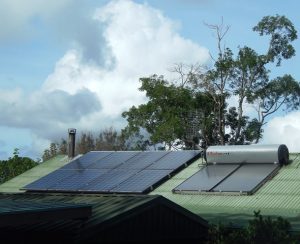
Solar-panels-energy Photo by Bob Wilson

Solar energy is great – we’ve got eight panels on the roof, a hot water system and a portable panel in the caravan. Pretty useless on Thursday, though, with ex-cyclone Debbie sending heavy rain our way. It would be great if we’d had a battery bank under the house to store the energy from the sunny weeks we’ve been having.

But battery bank technology is yet to become affordable for the 1.6 million Aussies who have solar PV panels.

I recently wrote about Australia’s troubled National Energy Network. We cited economist Professor John Quiggin, who suggested governments buy back the power grid and give the people what they want: cheap and reliable energy. Continue reading “Solar no easy energy fix”