Australasia and World War II – things you may not have known


world-war-ii-new-zealand
World War 11 and impact on New Zealand

I grew up in the backblocks of New Zealand, ignorant until quite recently about the impact of World War II at home, particularly friction between American and Kiwi servicemen.

Prior to the 90th birthday of a family member in New Zealand, I did a modicum of research to find out what it was like for a Kiwi lad growing up in the World War II years. Amongst other things, I discovered that when this fellow was 15 (April 1943), a brawl broke out between American and New Zealand servicemen in Wellington in what became known as “The Battle of Manners Street”. The brawl, which has been greatly exaggerated over the years, lasted about four hours and was eventually quelled by civil and military police. There were other antagonistic affrays between soldiers and sailors in Auckland and a second incident, in Wellington’s Cuba Street.

As happened in Brisbane and other Australian capital cities, women formed romantic liaisons with American troops. About 1,500 Kiwi women married Americans during World War II. As recounted in New Zealand History online: “The soldiers were starved of female company, and many Kiwi women were charmed by the Americans (sic) good manners and ability to afford taxi rides, ice-cream sodas and gifts of flowers.”

Between 1942 and 1944 up to 45,000 American soldiers and sailors were based in New Zealand, before or after the war in the Pacific.

Most readers would be familiar with the much-chronicled “Battle of Brisbane” – a vicious World War II brawl between US and Australian troops on November 26 and 27, 1942, an incident army censors sought to supress. The fracas was sparked by tension between US and Australian servicemen over the former’s extra-curricular activities with local women. American troops were better paid, better turned out and had access to luxuries like chocolates, nylons and cigarettes (Or as the saying apparently went ‘Over-sexed, over-paid and over here’ Ed). Smokes were available to US troops duty free from a canteen in Queen Street. Australian troops complained about the unfairness of this and, after briefly being given access to the canteen, the practice was deemed illegal.

In New Zealand as in Australia, allied troops engaging in public brawls was certainly not what the top brass wanted to read in newspapers. There is evidence that much of the detail about the three-hour Battle of Brisbane was hushed up at the time, likewise the Manners Street incident. Censorship was loosened in 2013 with the release of previously classified CIA documents. In one of these documents, a 1942 report by US war correspondent J Edward Angly (which I downloaded from the CIA website), observed that resentment was rife among Australian troops during World War II. The Americans were more affluent and by reasons of their manners and appearance, more attractive to local women. There was also some tension in that the Australian militia could not be sent to a Pacific theatre of war beyond their mandated territory. “The Americans know this and are inclined to rib the Australians about it,” Angly observed.

The “Battle of Brisbane,” where up to 4,000 people slugged it out on the streets, resulted in one fatality and eight serious injuries.

Anyone who has seen Queensland Ballet’s evocative production of ‘Cloudland’ would recall the tension between American and Australian servicemen, out for a night of drinking and dancing at Brisbane’s once famous dance hall.

On the 75th anniversary of the Battle of Brisbane, Dr Judith Powell said in a blog the incident had become such a part of Brisbane folklore that when Queenslander Jeff Horn met reigning welterweight champion Manny Pacquiao in the boxing ring at Lang Park, the event was billed as “The Battle of Brisbane”.

The Battle of Manners Street does not hold that kind of mystique, but looking into it allowed me to discover that World War II had more of an impact on Kiwis at home than we might realise.

On June 19, 1941, the liner RMS Niagara was sunk by a mine laid by the German auxiliary cruiser Orion off the coast of Whangarei, north of Auckland.  Everyone aboard escaped and was transported to shore.  But a large consignment of gold from the Bank of England worth £2.5 million pounds went down with the ship. The gold was a (then secret), payment from the UK to the US for munitions supplies.

German surface raiders operated in New Zealand waters in 1940 and 1941, sinking four ships. Japanese submarines also operated in New Zealand waters in 1942 and 1943. They sent reconnaissance aircraft over Auckland and Wellington, but did not carry out any attacks.

For all of that, Kiwis tend to remember the more emotive brawl between (inebriated) soldiers in Wellington’s streets and laneways. There were racial elements to both brawls, with the presence of African American sailors and soldiers in Australian cities a challenge to the then ‘White Australia’ policy. Various sources say the Battle of Manners Street was sparked by US servicemen and sailors complaining about Maori servicemen being served alcohol in the Allied Services Club. The Maori soldiers in turn complained the Yanks were getting preferential treatment.

Up to 1,000 people, including some civilians, were involved in skirmishes which were quelled by civil and military police three or four hours after the violence started. No reference to the riots appeared at the time in local newspapers or on the radio.

According to a 2013 update by stuff.co.nz, false rumours that two American serviceman had died that evening persisted for decades.

It is worth pointing out that servicemen on furlough typically went on drinking binges and in New Zealand at the time, pubs closed at 6pm.

The ‘Six O’Clock Swill’ was notorious for prompting binge drinking and bad behaviour in general.

Hard to imagine the Australian and US military having such antipathy today, drunk or sober, especially when it appears that we are still able and willing to support the American military when the occasion arises. Although Australia was not directly involved in missile strikes on Syrian targets, PM Malcolm Turnbull has not ruled out joining the US, UK and France in future military action if Syrian leader Bashar al-Assad again uses chemical weapons.

Never mind that, you say, what happened to the gold?

Oh, the gold? Yes, 94% of it was salvaged for HM Government by an old ship that found the wreck by dragging its anchor back and forth across the Whangarei harbour (exploding the occasional mine). According to this Wikipedia entry, there are still five gold bars down there – somewhere.

Even after 78 years, the legacies of war keep surfacing. Kiwi environmentalists are pressuring the government to assess the risk of a major oil leak from the Niagara.

Auckland Conservation Board chair Lyn Mayes told the New Zealand Herald last year that the rusting hulk was a ‘ticking time bomb’. While only sporadically leaking oil over the years, the Niagara’s two main oil tanks still contain 2000 litres of oil.

Which makes you wonder about the wrecks of 30 ships sunk by German and Japanese submarines around Australia’s coastline between 1942-1945.

I  don’t like the use of the word ‘famous’ in this list of shipwrecks as so many of them represent lives tragically lost at sea. But it is a fascinating peek into our war-time history.


Junk Drawer Quest For Missing Key

junk-drawer-quest
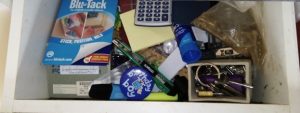
Photo: The junk drawer (after), by Bob Wilson

The small stuff autumn clean-up starts with a simple search of the junk drawer for a missing filing cabinet key. I recently shifted my office downstairs and in the shifting, all the things which were in places known to recent memory have been displaced. But it gives me a good chance to clear out what we call ‘the drawer of drawers’ – a small, deep drawer in which we throw stuff which has no particular home.

The first item in the junk drawer is an electronic button in a plastic pouch. I don’t remember what it is until squeezing it. A tune immediately begins to play, ‘Love Me Tender’, the A and B parts, faintly, reedily and slightly flat. Ah yes, that would be the satin sleep shorts from Valentine’s Day 1990-something. I surmise the idea was that one’s lover slides their hand inside the waistband (into which the button is sewn). You get the picture?

“Do you want to keep this?” I ask She Who Must Always Be Consulted.

“Aw sweet – I remember that…chuck it!”

The next items in the junk drawer are various jeweller’s screwdrivers, Allen keys and plugs you put in hardboard walls when you want to hang a picture. Then there are plastic bags full of assorted screws, nails and other wall attachments.

There are many batteries of various sizes. I set them aside to later test with the battery tester which must be in some other drawer.

Did I mention Blu-Tack? There is quite a bit of that, given our habit of posting music promo flyers all over town. I’m consolidating it into one packet clearly labelled Blu-Tack. You can see how insidiously a brand name worms its way into the language.

There are small padlocks (3) and padlock keys (7), none of which fit any padlock I can find thus far. There are 17 other keys which do not appear to have a match anywhere in the house. The old Camry key goes back quite a few vehicles. There are six plastic dimmer switch caps which became redundant last time the electrician was here.

“Do we really need to keep those?” I ask SWMABC (derisive snort).

At the bottom of the (empty) junk drawer, a tiny cockroach scrambles its way to liberty. I get the vacuum out and hoover up the cockroach grit in the bottom of the drawer. The remaining contents sit on the kitchen table awaiting re-distribution or disposal.

There’s a birthday candle, (5), which causes puzzlement until I realise there was also once a 6, which probably got thrown out after my landmark birthday. There’s a GetUp Action for Australia sticker which I just now stuck on my choir folder. There’s a Maleny Music Festival 2015 volunteer’s badge, a reminder to sign up for this year’s festival starting Friday 31st of August (and score points for being a volunteer promoter).

There’s a ball of green twine (with a strip of Blu-Tack attached), an eraser, a Niagara Falls keyring and a recipe label for Palm Street Choko Chutney. There are also quite a few small butterfly spring clips.

“Most of this shit belongs in the office,” I yell down the hall.

“There’s too much shit in the office drawers already,” comes the rejoinder. “And don’t say shit in your column.”

Motivated, I take some Bank of Queensland coin bags and separate pins, nails, screws and ‘other fasteners’ then stow them in the shed.

Will get around to that one day too, I mutter, soto voce.

So then I get stuck into the office desk drawer. There’s two paper knives (never use them), several magnifying glasses (useful), two boxes of rubber bands and lots of address labels I can’t use anymore because, as I wrote in this blog last April, I stopped paying for a private mail box.

Having drawn a blank in both drawers, I rummage through the three-drawer plastic storage container on my desk, one of which is full of USB drives, each helpfully labelled with a key tag. Oh, yes, and one of these tags is attached to the missing filing cabinet key! ‘Incroyable’ as the French would so foppishly say.

The drawer or box full of USB drives is the scourge of 21st century hoarders. Someone gives you one – “Oh you have to watch (bootlegged series)” and of course it is never returned. I still have my first USB drive, 256MB capacity (it cost $125). But if I tell you that you’ll think I’m a hoarder.

There’s a rarely-used Telstra internet dongle in this drawer, which gives me an angry hot flush when I think about Telstra’s plummeting share price, at $3.10 the lowest point since October 2011.

On Sunday I got onto Telstra’s ‘customer’ chat room to ask why it was that Telstra’s NRL app is charging data to my phone when it is supposed to be free. Incredibly, the customer service consultant told me her remit was for billing inquiries only so she’d have to transfer me to someone else. You know the story. I ended up on the ‘Crowd forum’, which is Telstra’s way of getting customers to solve their own irritating issues. A retired Telstra avatar suggested that perhaps I had not fully completed the installation process which links the NRL.com Live Pass to my mobile phone (very common, if you have the same issue – I could have told you that. Ed).

I know from reader research that 67% of you have no interest at all in rugby league, but I just want to say this one thing.

I remember when a TV reporter asked former Broncos captain Corey Parker what the Brisbane Broncos had to do to beat the Storm.

“Score more points,” was Corey’s laconic reply. He’s now a commentator with Fox Sports.

Miraculously, it seems, I feel freer and less anxious since (a) getting those unrelated issues off my chest and (b) completing the junk drawer declutter exercise.

But as happens with hoarders, the Love Me Tender button now sits on the office window sill, along with a strip of black and white negatives of uncertain provenance, a wooden frog with a fishing pole, a rabbit with one leg, a dumb-looking frog, a groovy ceramic frog with a dobro, a small concrete rabbit, a small pottery elephant, a pink piggybank, a faded postcard from Montreal, a weather station that needs a new battery and a lovely photo of SWMABC looking sweet and harmless. (Just goes to prove photos don’t always tell the truth. Ed)

junk-drawer-missing
The winning post

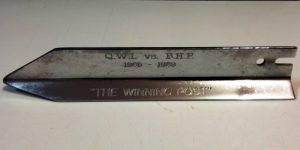
There is one more item on the window sill – a chrome-plated star picket section, ‘The Winning Post’ (pictured left). It was a souvenir from the late George Stratigos, one of the few people in the world to ever sue BHP and win. I wrote (several) news stories in the 1980s about how it took Queensland Wire Industries six years to win a Trade Practices case over BHP’s refusal to sell Y-bar to QWI, which would allow it to make star pickets, thereby competing with a BHP subsidiary. After the High Court ruling, George had a batch of ‘Winning Posts’ cast and gave them to away to remind people how sometimes the little guy can win.

Call me sentimental, but I’m hanging on to the Winning Post, tarnished as it is by age and neglect. Like life itself, even.

FOMM back pages:

and another


Facebook – does it really matter if they share our data?

first-facebook-postSince we’re discussing Facebook and who has the rights to personal information you’ve posted, I wanted to show you my ‘Wall.’  People used to call their Facebook page their ‘Wall’, though that has become passe. As walls go, this one would be ‘liked’ by Shirley Valentine fans (cultural reference), as it suggests romance and sun-bleached beaches.
    I joined Facebook in 2009 (apparently) as this is the first image I posted. At the time we were renovating the downstairs bedroom, rumpus room laundry and ensuite. Apart from hiring a guy to lay tiles throughout, we did all the work ourselves. If I’d known better, I’d have first put a coat of sealer on the besser brick wall as it took four coats of paint until it matched the hardboard on the opposite wall.

    I resisted joining Facebook for such a long time and then when I did, my posts were few and sufficiently opaque to resist understanding by all but my inner circle.

    Facebook has proved handy in terms of keeping in touch with younger family members around the world because, as we know, they don’t write letters. So too I’ve formed loose ties with musicians around the world, which can either be a way of sharing the passion or fishing for a gig.

    Later, Facebook became a good way of spreading the news about folk music events in our small town, some of which we promote.

    Dani Fankhauser’s history of Facebook on mashable.com charts the development of Facebook from its launch in 2004 and the 18 features it used to have and either changed or discontinued. I had no idea the original idea of the ‘wall’ was that people could use it like a whiteboard, leaving messages for their friends. You could change or delete what was there and replace it with your own messages. As Dani says, at one stage it was cool to ‘de-virgin’ someone (be first to post on their wall).

    The wall disappeared and Timeline took its place. Other critical changes since Facebook was launched includes the controversial and constantly changing News Feed and the over-weaning Like button which turned social interaction into a competition.

    Dani writes that Facebook used to be like a journey down the Rabbithole, being diverted down unexpected paths to discover new and interesting worlds. Now it’s like standing in front of the fridge with the door open, not quite sure what you’re looking for. Five years ago she wrote that – has anything changed?

    The hoo-haa about fake news and private data being manipulated by computer data experts should surprise no-one. If you are on Facebook, you are the content.

    You have probably read one version or another of the Cambridge Analytica scandal. The Guardian Weekly ran a two-page expose this week so if you really want to delve into it, here’s the ultimate link.

    The fall-out when this news broke was most noticeable on Wall Street. When the Observer revealed that Cambridge Analytica had harvested millions of people’s user data for political profiling, Facebook’s stock plummeted. It fell 17% between March 17 and Easter, wiping $US50 billion off the company’s value. Regulators in several countries are investigating Facebook and may try to limit how the company makes money from data.

    Meanwhile,Google, Apple and Amazon are like little kids who played a joke on someone and are now hiding behind a tree, giggling. The laugh might be on them, according to this broader story.

    There is a social movement (#DeleteFacebook), but social media analyst Andy Swan, writing for Forbes magazine, said the spike in Facebook deletions – the highest since 2004 – peaked on March 21 and has been in decline ever since.

    Most of the outrage stems from reports that Donald Trump’s campaign consultants, Cambridge Analytica, used ‘psychographics’ which allows personality traits to be manipulated.

    But what about our music pages, Mark?

    In January this year Facebook began changing the algorithms that influence what users/members see in their news feed. Facebook founder Mark Zuckerberg said the changes were made because of feedback that public content – posts from businesses, brands and media – was ‘crowding out the personal moments that lead us to connect more with each other’.

    Changes started last year and as Zuckerberg said in a Facebook post, will take months to implement. “As we roll this out, you’ll see less public content (in your Newsfeed) like posts from businesses, brands, and media. And the public content you see more will be held to the same standard – it should encourage meaningful interactions between people.”

    This must be a deeply disturbing trend for mainstream media, which has hooked its disintegrating business model to the hems of social media’s skirts.

    Our local paper, the Sunshine Coast Daily (now owned by Rupert Murdoch’s News Ltd), recently ran a 150-word ‘news story’ – Keep News #1 in your Facebook feed. The article suggested Daily readers keep up with the latest local news by ‘making a simple adjustment’.

    This means first find the SCD page on Facebook, like, click ‘follow’ then click ‘see first’.

    Well yes, it works, but it didn’t take long for the stream of sensationalist stories to ‘clutter up’ my news feed and the same could be said of choosing this option for other media outlets. Beware the Paywall!

    Just for the mental exercise, I downloaded my Facebook data. It has always been possible to download your own data and if we were smart, we’d all do it every year so we at least can find copies of the photos we posted then forgot about. Just go to your profile page and click on settings (the link is at the bottom of the page).

    Just downloading your data file does not mean you are deleting your information from Facebook. Leaving, closing your account and demanding the return of the original data is not so easy.

    But it was illuminating to trawl through this 136MB file. There is an exchange (a thread) between me and a former colleague. I wished to write something about him in my blog, about the merits of academic ambition when one is supposedly past student age. Within the conversation, my former colleague revealed quite a lot of detail about his school years, what work he did on leaving school and how he came to study journalism. I used hardly any of this information in the blog which was eventually published. But it is sitting there quietly, within my (private) Facebook data files. Let’s hope it stays that way.

    So what does the Cambridge Analytica privacy furore mean for folk who just want to post photos of their cats, dogs, partners and kids? Not much, I suspect, unless you have a ‘brand’ page like the ones I use for pur stage name, The Goodwills and this blog.

    I thought it would be fair play to share Mark Zuckerberg’s Facebook post. It is interesting for his over-use of marketing-speak and the sometimes snarky comments which follow his ‘community-oriented’ explanation for making business, brands and media pages less visible.

    I’m with the people who asked why couldn’t Facebook users simply curate their own news feed without having it dictated by algorithms.

    Meanwhile, if you want to keep the Bobwords brand page at the top of your news feed, click on the link, like and follow.

    Or not!


    Housing affordability and the empty homes scandal

    housing-affordability-empty-houses
    Housing affordability in world capitals. Photo of Melbourne’s Southbank by Ashley Rambukwella flickr CC https://flic.kr/p/KfdUMR

    The inspiration to start writing (again) about housing affordability came from left field. I was sitting back enjoying an American roots band, The Brothers Comatose, at the Blue Mountains Music Festival in Katoomba. Lead singer and front man Ben Morrison introduced the band, saying they were from San Francisco but maybe not for long. “The price of houses is crazy there (man) and most of the musicians I know are moving out because they can’t afford to live in the area.”

    “Maybe we could move here,” he suggested, and the audience groaned, knowing that housing affordability is just as big a problem in Sydney and surrounds as in San Francisco, Vancouver, New York or Paris.

    “Can we sleep on your couch?’’ he jested, before doing what musicians do to avoid thinking about the cost of living. Great band, by the way (check out this bluegrass old-style tune around one microphone).

    Morrison’s complaint rang true – I did a modicum of housing affordability research which quickly showed that the median price of a house in San Francisco’s Bay area clipped $US1.5 million in the fourth quarter of 2017. The California Association of Realtors Housing Affordability Index shows that it would cost $US7, 580 a month to service the mortgage. The average monthly rent for a two-bedroom apartment is $US3, 441.

    Housing affordability is a myth in Vancouver, Canada’s biggest West coast city. The 14th annual Demographia affordability study ranked Vancouver the least affordable among 50 American and Canadian cities. Internationally, it is ranked the third least affordable city among 293 locations around the world (Sydney was 2nd). The British Columbia Provincial Government has made several attempts to rein in the city’s galloping real estate prices, including a 15% tax on foreign nationals purchasing metropolitan real estate. Another new measure attempts to tackle a problem that plagues Sydney and Melbourne, Australia’s housing affordability problem cities.

    The BC government conducted a survey which found that 8,481 houses in Vancouver were unoccupied during a six-month period. That’s 4.6% of the housing stock. Now the government is going to levy a tax on people who own houses and don’t occupy or rent them. The tax will be calculated at 1% of the assessed value. So the owner of a two-bedroom condo in Vancouver valued at $900,000 and deemed to be unoccupied will pay the BC government $9,000 a year.

    Meanwhile, the housing boom in Vancouver is on the downturn, according to the Vancouver Courier, and they should know. Still, with a median house price around $3 million (Dec 2017) and condos going at $1 million apiece, it’s maybe time for that bubble to lose some air.

    Meanwhile Down Under, house prices keep rising

    Melbourne and Sydney made into Demographia’s top 10 list of the least affordable cities in the world. Sydney’s median house price of $1.11 million assured it of that invidious claim. Demographia ranks middle income affordability using a price-to-income ratio. Anything over 3 is rated unaffordable. On this basis, some of the world’s most affordable towns included Youngston, Ohio (1.9), Moncton, New Brunswick (2.1) and Limerick, Ireland (2.2). There are no affordable Australian cities on Demographia’s watch.

    The least affordable city is Hong Kong (19.4) then a gap to Sydney (12.9) and Vancouver (12.6). Melbourne (9.9) is slightly more unaffordable than the aforementioned San Francisco (9.1).

    Studies have shown that Melbourne is one of the big culprits in hiding empty houses among its residential property stock.

    Australia’s 2016 Census showed that 11.2% of Australia’s housing stock was described as unoccupied on Census night. Empty property numbers were up 19% in Melbourne and 15% in Sydney compared with the 2011 Census. This growing anomaly is a global trend in the world’s biggest cities which have allowed rapid apartment developments.

    Just why 1.089 million houses and units were unoccupied on Census night is hard to explain. But it probably suggests the owner/s were not in need of rental income and would rather keep the place in mothballs for use when the wealthy owners or friends and relatives visit (for the Australian Open, Melbourne Cup or the Grand Prix) or are relying on capital gain without the need to bother with tenants.

    Hal Pawson of the University of NSW wrote in The Conversation that the spectre of unlit apartments in Melbourne’s night sky prompted the Victorian government to introduce an empty homes tax. Like Vancouver, this is levied at 1% of the property’s value. Similar taxes have been introduced in Paris and Ontario. Mr Pawson, Associate Director – City Futures – Urban Policy and Strategy, City Futures Research Centre, Housing Policy and Practice, UNSW, (try getting an acronym out of that. Ed.)  says the Melbourne tax only applies to inner city and middle suburbs and, there are ‘curious’ exemptions for foreign nationals with under-used second homes.

    The flaw in the scheme is that it relies on self-reporting. Pawson says the lack of reliable data on empty homes is a major problem in Australia.

    Census figures substantially overstate the true number of long-term vacant habitable properties because they include temporarily empty dwellings (including second homes).

    Prosper Australia uses Victorian water records to estimate that about half of Melbourne’s census-recorded vacant properties are long-term “speculative vacancies”. That’s 82,000 homes. A similar “conversion factor” to Sydney’s census numbers would indicate around 68,000 speculative vacancies.

    Labor Opposition shadow Treasurer Chris Bowen has proposed a national tax on homes left empty for six months or more.

    Pawson says these “cruel and immoral revelations” come at a time when 400 people sleep rough in Sydney every night and hundreds of thousands more face overcrowded homes or unaffordable rents.

    He says Australia has a bigger problem in terms of under-utilised occupied housing. Australian Bureau of Statistics survey data shows that, across Australia, more than a million homes (mainly owner-occupied) have three or more spare (read unused) bedrooms. A comparison of the latest statistics (for 2013-14) with those for 2007-2008 suggests this body of “grossly under-utilised” properties grew by more than 250,000 in the last six years.

    While authorities are grappling with the issue and how to perhaps tighten foreign ownership laws, the ANZ Bank did its own survey. Foreign buyers were playing an increasing role in spurring demand for new houses and apartments, it found. The ANZ analysed Reserve Bank data to conclude that in 2015-2016, foreign investors bought between 30,000 and 60,000 dwellings in Australia. This equates to 15% to 25% of all new dwellings, 80% of which were apartments, which can be bought ‘off-the-plan’.

    There is good reason to suspect that the new apartment markets in Hong Kong, Vancouver, London, Paris and other desirable world capitals are underwritten to some extent by foreign nationals (including Australians).

    The problem which could arise, say in the case of a global recession, is what happens in cities like Melbourne and Brisbane where foreign investors have bought up to 35% of new stock, if these owners are forced to sell.

    Not to worry, most big box discount stores will give you a large cardboard box in which to live. The dumpster bins behind shopping centres have perfectly good food that’s just been chucked out because it has passed the use-by date.

    Trust me.

    FOMM back pages

    Travel safe this weekend, people

    Don’t touch my dividends, Dude

    dividends-franking-credits
    Photo: “How will we afford dog food without the franking credits from our dividends?” pixabay.com, CC Mike Flynn

    There have been few occasions when dividends made it on to the front pages or lead item TV news. The first time was when Treasurer Paul Keating introduced the dividend imputation scheme in 1987, largely as a way of eliminating the double-taxing of company dividends. From that day, Australian investors were given franking credits on the dividends they received on their shares. This had the welcome effect of boosting the investment return for the investor or super fund.  It was just the sort of incentive needed to encourage Australians to prepare for their retirement and aim to become self-funded retirees.

    Keating’s scheme did not, however, include the cash refund of the franking credit component of the dividend, which was introduced by John Howard and Peter Costello in 2001.

    The second time dividend imputation was ‘trending’ was last week when Opposition Leader Bill Shorten said if Labor gets back into power he would scrap the current system. While emphasising Labor would keep dividend imputation, he said the plan was to scrap excess cash refunds on tax that was never paid in the first place,

    The main targets are people with super fund balances of $1 million and more. There are plenty of those distributed among the large super fund managers but also around 30% of the self-managed fund sector are in that category.

    In 2017, 1.12 million Australians were members of a self-managed super fund. There were almost 600,000 funds with assets totalling $696.7 billion. About 30% of SMSF assets are held in Australian shares, the ones that pay fully franked (tax-paid) dividends to investors.

    What Mr Shorten’s plan appears to lack is a sliding scale which would exempt retirees whose fund balance is below a certain threshold or whose franking credit refunds are below the average ($5,000 a year).

    A 2015 study which set out to debunk the myth that one needs a minimum $1 million to retire said that half of Australia’s workers approaching retirement have less than $100,000 in super. Three years hence, the proportionate numbers won’t have changed that much. The study by the Australian Institute of Superannuation Trustees (AIST) sets out to educate people that super is designed to work in tandem with the aged pension and that it’s OK to do that. Even a low super balance of $150,000 can nicely augment your pension.

    Yet Bill Shorten says some funds are paying zero tax but picking up a $2.5 million refund cheque. At face value, that would seem to be a loophole worth closing. But at the other end of the scale are individual SMSF members with low fund balances who are undoubtedly already receiving a Centrelink part-pension. The shortfall caused by scrapping cash refunds on dividends will inevitably be recovered via a tweaking of government pension calculations on income and assets. Those who do not qualify for the pension will lose the lot.

    Just how important a subject this is for retirees is shown in the Association of Superannuation Funds of Australia (ASFA) superannuation statistics: 1.427 million individuals received regular superannuation income in 2015-2016. Weekly payments averaged from $328 (term annuity), $496 (account-based) and $616 (defined benefit). Franking credit refunds on dividends from the ATO no doubt contributed to these payments.

    Some industry super funds have come out in favour of Labor’s plan, but there is plenty of opposition, though so far there is no detail on which to base a counter argument.

    ASFA says the proposal could have a significant impact on low-income retirees both inside and outside the superannuation system.

    Chief executive Dr Martin Fahy said the system already has a $1.6 million cap in the retirement phase and reforms to superannuation and  retirement funding are working but they need time to bed down.

    “If there is a concern about individuals with large retirement savings receiving the benefit of refundable imputation credits then this would be better addressed by measures more closely linked to retirement balance,” he said.

    Currently, the Australian Taxation Office demands that if SMSF Trustees draw a Simple Pension, it must be a minimum 5% of assets (rising through increments to 14% for those aged 95 and over (!). For example, a fund with two members under the age of 80 and a balance of $450,000 must pay its members a minimum of $25,000 p.a. Providing their other assessable assets and/or income is under the threshold, they can also receive a part pension from Centrelink which could bump their annual income to around $45,000, (somewhere between a modest living and a comfortable retirement). The upside (for the country) in this fiscal strategy is that earnings will (hopefully) keep the members’ balances in the black for as long as possible. This in itself eases the burden on the aged pension system.

    And if you need extra cash for a car, a bucket list trip to the Antarctic or to pay a ransom to a hacker, you can take a lump sum. If you’re Homeland’s Carrie Matheson, track down the troll, beat him up and demand he unlock the computer. (He just threw that in for light relief, Ed).

    Policy on the run

    You will forgive me for liberally quoting other sources on this thorny subject. The ALP has not published a policy paper or issued a media release. The only thing you will find is on Mr Shorten’s website, tucked away under the category: ‘Bill’s Opinion Pieces’.

    I initially found Bill’s piece on a website run by the authority on all things super, Trish Power. Power, starting from the same position as all, except for Fairfax Media, which ‘has seen’ a policy draft, suggests it has all the hallmarks of ‘policy on the run’.

    Trish Power’s website is a good place to visit if you want to avoid the scaremongering stories in the tabloids and current affairs TV. I bought a copy of her book “DIY Super for Dummies” and found it invaluable when starting our SMSF back in 2006. It may be overstating to say the promise of franking credit refunds was one of the attractions, but nonetheless it was.

    Power and other guest writers are following this story while it remains a live issue so if you have a vested interest, here’s the link:

    It does seem as if Bill Shorten is hanging his hat on this particular peg and plans to leave it there.

    “When this (cash refund) first came in, it cost Australian taxpayers about $500 million a year,” he wrote. “Within the next few years, it’s going to cost $8 billion a year, more than the Commonwealth spends on public schools or childcare. It’s three times what we spend on the Australian Federal Police.”

    You can see where he is shining his head torch when he writes that 50% of tax refunds go to SMSFs with balances of more than $2.4 million. Fine, stick it to the top end of town, but look further into this dodgy policy, Bill, and you will see that unless you giveretirees on modest incomes a break, they will be forced to rely more on the public purse. They will resent that and in turn resent you.

    FOMM back pages: http://bobwords.com.au/super-end-week/


    Cape Town’s water crisis and other updates


    updates-Cape-Town
    Graphic courtesy of the City of Cape Town

    Well-organised journalists keep detailed diary notes on the stories they have written, with the objective of writing updates. This is how the media knows when to descend on the courts when a murder trial finally starts. Or the updates could be on Twitter.

    From my lazy post-city desk where I opine and inform about random topics, updates rarely occurs to me. Yet the same subjects crop up again and again: climate change, global warming, ocean pollution, poverty, refugees, fast-changing technology. Yes, who’d be a technology writer today? Blink and you’ll miss it.

    So to the updates: you might recall I wrote on February 23 about Cape Town, South Africa, and how it was in danger of running out of drinking water. The city authorities have now decided to defer ‘Day Zero’, when all taps were to be turned off and people would have to queue for water at standpipes.

    Nearly a month later, the city authorities, having postponed Day Zero from mid-April to early June, have pushed it out to 2019, on a date to be notified. Level 6B water restrictions are still in place and residents are being asked to limit daily use to 50 litres each.

    Cape Town may not have thought ahead far enough to provide the buffer it might need after three years of drought, but they are making up for it with a well-thought out campaign to urge people to save water.

    They’d need to, because even though combined dam levels are back to 23.6%, if the level drops below 14%, Day Zero looms again. Cape Town’s authorities are aiming to reduce average water use to 450 million litres per day (last week it was 537m litres). When I wrote my column about this, I was harking back to South East Queensland’s dire days of drought, when our combined dam levels fell below 20%.

    Brisbane implemented Level 6 water restrictions, which, if you don’t mind an empty swimming pool and a dirty car, are not too onerous. At that time, people in South East Queensland reduced their daily water consumption to 140 litres per day (half the average use).

    Check out the graphic from the City of Cape Town (above) and you’ll get some idea of how bad it could be, even though we now have a Drought-Ready plan.

    In a curiously related aside, Cape Town recently had its own outbreak of listeriosis, not (as in Australia) from contaminated rock melons, but from processed smallgoods (with the responsible firm being named).

    The Cabinet shuffle continues

    Earlier in February I joined the outrage over the disposal of two ex-government filing cabinets, stuffed tight with confidential documents from the Department of Prime Minister and Cabinet. The ABC ran a series of stories based on the documents before handing them back (to ASIO).

    Not much in the way of updates on that front although PM Malcolm Turnbull, after saying ‘heads would roll’, called for an inquiry and appointed senior public servant Ric Smith to the task. The terms of reference released on February 21 promise a preliminary report in March.

    While the Canberra press gallery are waiting for the updates Smith continues with his task of finding out how it happened and how to make sure it never happens again. Smith would appear to have a job on his hands as this was no one-off; the Canberra press has published multiple stories involving confidential documents and diaries turning up in unsecure locations.

    For instance this week Canberra Times reporter Andrew Brown turned up a similar story, albeit from 2013. The Department of Social Services sent old filing cabinets to a second hand store. The cabinets turned out to be full of personnel files, with personal information including security clearances. Brown found the un-named resident who, having established what he had bought, spent his own time trying to give the documents back to the department. Only when he wrote to the department was action taken and the cabinets collected.

    A Department of Social Services spokesman said handling processes were ‘reviewed and updated’ as a result of the breach.

    Mushroom cloud, anyone?

    In early January I tried to lighten global nuclear conflict anxiety by revisiting a list of protest songs. This column was notable for the many examples of readers telling me, “Oh but you forgot about Good News Week…”

    That’s the trouble with lists: after you’ve read them you wonder why the author bothered. You know the click-bait headlines: “These 12 amazing boob jobs will blow your mind.” And so on.

    I’ve been noticing these cartoons of North Korea’s leader and The Donald facing off with missiles, one noticeably longer than the other.

    I do wonder how this larrikin symbolism is interpreted in the Democratic People’s Republic of Korea. Mind you, the average NK citizen would never be allowed to see such salacious mischief on their heavily censored Intra-net.

    After the fact, I was reading a fascinating book by Simon Winchester who in an astonishing feat of literary and journalistic ambition sums up the history of the Pacific Ocean in just one book. I’m two-thirds of the way in and he gets my vote thus far. The first chapter in Winchester’s Pacific covers the history of nuclear testing in the Pacific.

    Winchester does not hold back, telling of the uncaring, nay brutal way the islanders of places like Bikini atoll and the surrounding Marshall Islands were herded up and deposited ‘Elsewhere’ while western forces went about perfecting atomic weapons.

    He reveals that between 1946 and 1958 the US detonated 23 atomic bombs on or near Bikini Atoll. Though they moved the islanders, ‘Elsewhere’ did not provide them with enough food. So, half-starving they were transported to another Elsewhere (which did not have a coral reef so they were unable to practice the traditional lifestyle).

    Still, it had enough food.

    All told, between 1946 and 1962 the US exploded 105 atomic devices in the Pacific. The back story to this is a minefield of missed targets and mishaps, claims and counter-claims, compensation and persistent radiation levels.

    I’d recommend Winchester’s book for the thorough way he covers any question which might arise about complex subjects concerning the Pacific; the Ring of Fire, tectonic plates, how Korea became two countries, the theory of continental drift or how surfing became a mainstream sport.

    If you want a recap of the Bikini saga, the link below is as good a place as any. Georgetown University’s Timothy Jorgenson covers the sorry history of US atomic testing in the Marshall Islands chain.

    He starts with a reference to the genesis of the bikini (swim suit). Who knew that the original 1946 design by Jacques Heim was dubbed ‘Atome’ (French for atom)? Allors!

    Oh, and let’s not forget the 193 nuclear tests France carried out in Polynesia between 1966 and 1996. Tests were stopped largely because of protests inspired by the New Zealand government’s nuclear-free stance.

    In light of all that, you’d have to wonder why all the fuss about North Korea’s six (6) nuclear missile tests. Whatever case I’m making about super powers, hypocrisy and exploitation of huddled minorities, I rest it here.

    FOMM back pages:


    Cloudstreet house concert April 22, 2018

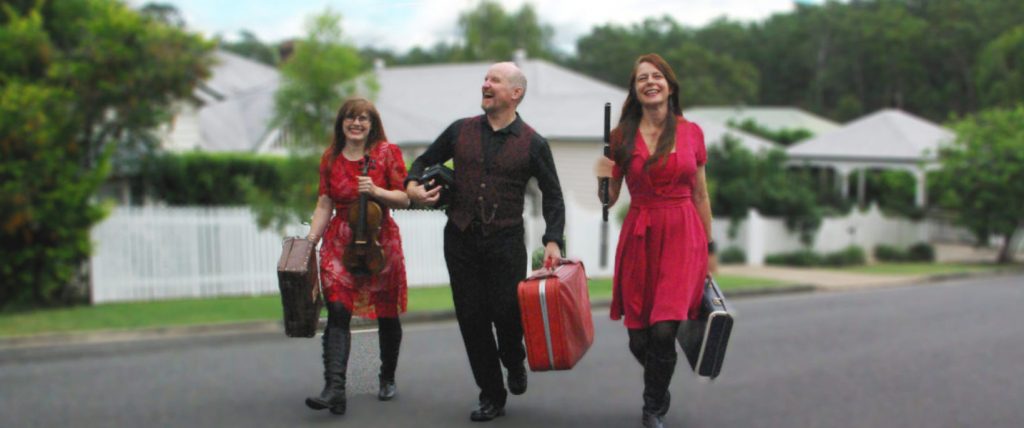
    In our 20th year of presenting house concerts we are pleased to welcome back internationally renowned folk group Cloudstreet. The Brisbane trio return to Maleny on Sunday April 22, their sixth appearance as guests of The Goodwills (Bob & Laurel Wilson).  Cloudstreet perform New Australian folk music, a combination of Anglo-Celtic and Australian traditional songs and tunes, coupled with trad-styled original songs. Their music is arranged for an array of instruments including guitar, concertina, flute, whistle and fiddle and now includes the fiddle playing and singing of Emma Nixon.

    Original members John Thompson and Nicole Murray have toured in the UK several times and have now completed two UK tours as a trio with Emma. Nicole and Emma have also performed at The Goodwills’ house concert as The Wish List.

    Hosts Bob & Laurel Wilson (The Goodwills), in company with fiddler/singer Helen Rowe, will perform an opening set of originals and covers.

    The concert starts at 2pm. Tickets are $15 and afternoon tea will be available. Bookings are essential. Email Laurel goodwills (at) ozemail.com.au

    Later in the year we will have the Brisbane trio Tin Star (June 10) and Brisbane duo Sadie & Jay (August 5). Sadie & Jay,who have been ‘on a promise’ to perform in our loungeroom for a while, will just be back from a UK tour.

    We have hired the Maleny RSL for an event on October 27 but can’t tell you about it at this early stage. Put those dates in your diaries, though.

    Goodwills’ house concerts are sponsored by the Queensland Folk Federation.

    Rising sea levels and apocalyptic fiction

    rising-sea-levels
    Photo of Kulusuk, Greenland by Nick Russill, flickr/cc https://www.flickr.com/photos/nickrussill/146760303/

    I’d always thought my song about the mountain dwellers ending up on waterfront row because of rising sea levels was not to be taken too seriously. It was an apocalyptic view of what might happen if it didn’t stop raining and, moreover, not a terribly original idea as it turned out. But the risk of flash flooding from above-average rainfall is only half the problem for people living down there, at sea level.

    A loyal reader, visiting the coast from cooler climes down south was discussing his theories about rising sea levels and coastal tourist locations like Noosa, given news of the Arctic region’s third winter heat wave in a row. His attention had been drawn to Greenland, where temperatures have remained above freezing at a time of year when it should be at least 30 below. Clearly such weather extremes in the fragile ecosystem of the Arctic region must accelerate the process of rising sea levels?

    As The Independent reports, this is happening even though large parts of the Arctic Circle are trapped in perpetual darkness.

    New global projections forecast a sea level rise of 2m by 2100, compared to a 0.74m rise in a 2013 study. So far, the forecasts that oceans would rise on average by 3mm a year has provoked a scornful debate between believers and climate sceptics. Yes, the science is not wholly believed. There are people in high places who have made naïve and disturbing statement such as “coal is good for humanity”, at a time when most scientists agree that CO2 emissions, produced largely from human activity, must be reduced.

    The spectre of melting polar ice bringing an apocalyptic end to civilisation as we know it has been a favourite theme of science fiction writers for a long time. Now there is even a fiction sub-genre known as ‘cli-fi’ which has spawned many cataclysmic climate scenarios.

    The spookiest forecast, before cli-fi was a thing, was The Drowned World, J.G Ballard’s second novel, published in 1962. Ballard’s main character is a scientist in charge of a floating research station, drifting above a submerged London, beset on all sides by encroaching tropical jungle. A 50th anniversary edition (with an introduction by Martin Amis) has been released and it is available as an ebook. I’ve not read it, though, relying on Peter Briggs’ review for the synopsis.

    Ballard eerily conjured up a world where polar ice caps have melted and solar storms have left us in an irradiated world. Europe is a series of lagoons, devoid of human life, although the tropical bugs love it!

    The most recent book in the cli-fi genre which I have read is The Ice by Laline Paull. Her 2017 mystery novel begins with wealthy tourists aboard the Vanir, traversing previously frozen Arctic oceans. The mission is to find a (now rare) polar bear, but instead they find the thawed body of an explorer who went missing years ago in mysterious circumstances.

    Fiction aside, the alarming temperature rises in the frozen north have had a bizarre impact on Europe, the US and Canada in 2018, which at this time of year ought to be seeing the first thaws of spring. A day temperature of 1 degree celsius in Greenland might not seem too warm to us Aussies, but typically the days are often up to 30 degrees colder. And this is not confined to Greenland. The most northern US city (Utqiaguik, Alaska), has also been enjoying a balmy 1 degree celsius − again that’s 22 degrees above average.

    Meanwhile,The Independent observed that a relatively high pressure system over Russia and the Nordic north and a relatively low pressure system across the UK resulted in freezing Artic air being drawn towards the UK and causing exceptionally cold weather there.

    The chorus of Waterfront Row ponders: “Little did I think when I moved to the mountains, I’d end up on Waterfront Row, renting out my shed to all those who fled the torrents and the foment down below.”

    Imagine my chagrin upon writing and recording this song to be told (by a country music fan), that the song was similar (in theme) to Graeme Connors’ A Beach House in the Blue Mountains. I had not heard of the song but googled it (as you do).

    We’re not the only ones taking ‘cli-fi’ into the realms of songwriting. Sunshine Coast songwriter Noel Gardner made up this cheery tune about the low-lying island nation of Tuvalu. He takes the role of the climate sceptic to satirise the controversy about Tuvalu and rising sea levels.

    Some years back, the tiny Pacific island nation was said to be so prone to inundation its citizens might have to become New Zealanders. As it happens, some 2,400 Tuvaluans have already moved to NZ or neighbouring islands, according to a not-for-profit group that monitors world poverty.

    They may have moved too soon, if, as the article below says, Pacific atolls like Tuvalu actually grow and float, becoming impervious to rising tides.

    Now, a study confirms what we’ve already known – atolls, and in particular Tuvalu are growing, and increasing land area, writes Anthony Briggs. “So much for climate alarmism”.

    Nevertheless, the highest elevation on Tuvalu is 15 feet and it is perpetually exposed to rising sea levels, cyclones and tsunamis.

    An article in The Conversation says previous studies examining the risk of coastal inundation in the Pacific region have been conducted in areas where the rate of sea level rise is ‘average’ – 3mm to 5mm per year. A team of authors, led by The University of Queensland Senior Research Fellow Simon Albert unearthed outlying examples.

    At least five reef islands in the remote Solomon Islands, where sea level rises are in the order of 7mm-10mm a year, have been lost completely to rising sea levels and coastal erosion. A further six islands have been severely eroded. These islands range in size from one to five hectares and supported dense tropical vegetation that was at least 300 years old.

    Last year, new projections from the National Oceanic and Atmospheric Administration (NOAA) in the US revealed that global sea levels could rise by 2 metres by 2100 if emissions remain at their current levels. As the ABC reported, this is substantially higher than the 74cm increase proposed in a 2013 Inter-governmental Panel on Climate Change (IPCC) report. Under these new projections, Sydney’s Circular Quay, Brisbane Airport, Melbourne’s Docklands and North Fremantle would be among locations at risk. So too Stradbroke Island, the Gold Coast and Sunshine Coast, while in South Australia the seaside suburb of Glenelg would also be in trouble.

    Scarier predictions have been made, with scientists taking into account the prospect of Antarctica melting, as well as the Arctic, doubling predictions of a 2m rise by 2100.

    Should we care? By 2100, the youngest person I know will be 89, so maybe she will care. Her children and grandchildren definitely will.

    And what does this mean for Australia, where the majority of the population live along narrow bands of coastal land on the east and west coasts?

    You can scare yourself (or reassure yourself) by checking out this interactive website which allows you to see the predicted results of sea level rises wherever you happen to live.

    FOMM back pages


    The risks of losing our digital photos and memories

    digital-photo-memories
    South Brisbane (Southbank), circa 1978), just prior to construction of the Queensland Cultural Centre) Author’s photo scanned from a colour slide.

    Whenever I think about going through our thousands of family and travel photos, be they in digital form, colour prints or scanned to the computer, I develop what migraine sufferers assure me is not a migraine, just a headache.

    The problem begins with the lack of a system. Few people other than professional photographers or serious hobbyists catalogue their photos and negatives in a logical way. So good luck looking for that photo of your little brother skateboarding when he was 10. It’s in there somewhere.

    Recently, a family member took on a big project – to collect photos across seven decades to put in a book for my brother-in-law’s 70th birthday. This social media-savvy young person wisely, I thought, decided to capture the images permanently in a printed book.

    The early contributions of course were box brownie snaps from somebody’s shoebox, scanned and photo shopped where appropriate. Some were from colour slides, also scanned and photo shopped, usually to obtain a larger image. Then we delved into photo albums from the 1970s, 1980s and 1990s, until the digital folders began.

    Maybe we were late adaptors to digital cameras, but we seem to have left film and negatives behind only in the early years of the 21st century. By that time, they’d been in common use for a decade, even though Steve Sassoon of Kodak invented the first digital camera in 1975. We came home after a six-month sojourn abroad in 2004 with 60 CDs of photos we burned from images downloaded on to a borrowed computer.

    Since then, my non-system has accumulated piecemeal on laptops, back-up drives and memory sticks. She Who Also Takes Photos has a smarter system in that she can readily find images by subject.

    No such luck on my computer. For example, a folder labelled ‘March, needs sorting’ on review contains just 15 (of 97) images worth keeping. In the late 1990s, we both clung to shooting film on SLRs and sending the film off to a cut-price mail order business. Digital cameras and later cameras in smart phones replaced this process, which was costly.  You often had to wait a week or more until you could relive the memories from Aunt Gladys’s 90th. If only she hadn’t blinked.

    I recall learning how to produce my own prints from negatives, albeit in black and white. Few young people today would know the thrill of seeing a photo you took that day materialise in a tray of chemicals.

    If you watched the Netflix series, The Crown, you’d have seen a dramatization of one of the best film photographers of the time in action. Tony Armstrong-Jones is depicted in the dark-room with his latest amour (Princess Margaret), trying on what appears to be a well-rehearsed seduction technique. He’d taken an intimate shot, with bare shoulders – against mores of the time (1959). Margaret, who comments, “It’s a Margaret nobody has seen,” resists his blandishments (but not for long, Ed).

    Film and self-processing makes a comeback

    As Alexandro Genova wrote in Time magazine last year, there is a small but determined resistance to digital photography among amateurs and professionals alike. Some are effusive about film and its “unexpected palette, the grain and dynamic range”.

    Portraitist Ryan Pfluger says of Kodak’s decision to revive Ektachrome film, that the “creamy ’70s tone” channels his fascination with memory and nostalgia.

    Genova’s article is framed by a stunning shot of a wildfire in Glacier National Park, Montana. The image is by professional photographer and artist David Benjamin Sherry, who processes and prints his own work.

    “There’s a spirituality that’s connected to it. I go out to take the pictures and at the end of the day I’m by myself, alone with my thoughts, in the dark room. It becomes very meditative,” he told Genova.

    No doubt the majority of hobbyists, oblivious to this meditative magic, will continue to snap what used to be called ‘candids’ on their smart phones. They can then post instantly to Facebook, Instagram, or other social media outlets.

    The 2004 earthquake and tsunami in the Indian Ocean revolutionised the way media covers news. Digital Spy’s correspondent Hunter Skipworth says the stark images of the tragedy were filmed by ordinary people, using their phones to capture images and video. From then on, anytime a major news event happened, anywhere in the world, it would be filmed by a citizen on their smart phone. That was a fairly short advance from the first commercially available digital SLR in 1991 (Nikon’s 1.3 megapixel camera, intended for use by press photographers). By the mid-1990s Casio, Kodak, Sony and others joined the race to produce an affordable digital camera. Digital Spy reveals that Apple had a short-lived flirtation in this field in 1995 with the QuickTake 100. Apple went on to focus on the Iphone with built-in cameras. Good move, Steve.

    Most smart phones have cameras which have at least 4 megapixels and often up to 12mp – good enough quality for a ‘citizen’ photo. The practise is so widespread now most newspapers carry a regular ‘reader’s photo’.

    However galling that may be to professional photographers and videographers who spent a lifetime learning their trades, it comes down to who first captures the image.

    Facebook, which had a modest debut in 2004, surfed in on an explosive wave of change. The introduction of the iPhone in 2007, universal access to broadband and perhaps the invention of the ‘selfie stick’, all helped Facebook become the behemoth it is today.

    My friend Mr Shiraz is slowly collecting images of his now adult children (and their offspring), with the idea of permanently preserving them in photo albums. He’s not alone in this quest.

    Like others with Gen Y and Gen X offspring, he can see the potential for a catastrophic fail arising from the ubiquitous habit of impulsively posting memorable photos, trusting the archiving to that most nebulous of beasts, The Cloud.

    Here’s an example, from the days when hacking mischief was in its infancy, of what can go wrong. In 2001 our computer was infected by the I Love You virus, which among other nasty deeds corrupted all JPG files. It was not such a disaster for us as we were still mainly wedded to film.

    As we plough through our old photos, a common problem arises. Here’s your father as a young lad, standing with…now who are those three other people? There’s nothing written on the back and the people who could tell you are long gone.

    The same fate awaits the millions of images consigned to the ‘cloud’ –data servers located, well, somewhere. You can establish when the image was taken, but not by whom. Nor, unless someone has ‘tagged’ the images with people’s names, can you determine who is in the photo or where it was taken.

    What is even more annoying is not knowing who took the photograph: surely that matters? I’ll leave you with this rare snap of The Goodwills busking in Melbourne’s Bourke Street (a while ago).

    No, I don’t know who took it. Perhaps it was a ‘selfie?’


    Censorship, guns and the right to arm bears


    guns-bears-censorship
    This image is classified (S) for satire under FOMM’s censorship guidelines

    I was idly wondering if I should have a go at George Christensen for pulling that silly, anti-greenies gun stunt at the firing range but self censorship kicked in. What if he knows where I live? I blanched. The process known in journalism school as ‘self censorship by osmosis’ still kicks in, even 18 years down the track.

    You may have assumed I was about to jump into the very deep pool of acrimonious discourse about mass shootings, guns and gun control. Actually, no, there are enough rabid views out there from one side and the other. Perhaps you will have seen Greens Senator Sarah Hanson-Young’s repost of the kind of vile trolling one can attract by advocating for the environment (if not, don’t bother looking it up – Ed.)

    Instead, I thought we should look at a worrisome instance of censorship; where a respected economic analyst/journalist had an article taken down by the national broadcaster, the ABC. Emma Alberice’s reasoned piece about corporate tax cuts was removed by ABC management, reportedly after complaints from on high about its alleged lack of impartiality. Alberice’s article argues there is no case for a corporate tax cut when one in five of Australia’s top companies don’t pay any tax.

    After public criticism, the ABC deflected cries of ‘censorship’ saying removing the analysis and an accompanying news story were ‘entirely due to concerns about Ms Alberici’s compliance with ABC editorial policies that differentiate analysis from opinion’.

    The analysis has since been scrutinised by experts and given the seal of approval. It has even been re-posted at a public affairs website owned by the eminent Australian, John Menadue, AO. You may recall Menadue. He started his working life as private secretary to Gough Whitlam (1960-67), before forging a career in the private sector then returning to public service in the mid-1970s. He has since led a distinguished career in both public and private life, most notably as an Australian diplomat.

    Mr Denmore, one of Australia’s more incisive commentators on media and economics, wrote this in Alberici’s defence:

    Mr Denmore (the pseuydonym of a former finance journalist), sees this issue as plain old-fashioned censorship.

    He concludes that Alberice was merely offering insights, which have got the nod from some serious-headed economists, as ‘uncomfortable truths’, which those in high government office and boardrooms found too confronting.

    Now, a week later, the ABC has reinstated* Emma Alberici’s analysis, albeit with some passages removed. As former ABC journalist Quentin Dempster reported in The New Daily, the author and her lawyers negotiated an agreed form of words for the reposted analysis.

    The removal of Alberici’s original analysis coincided with a planned US visit by a high-level delegation of Australian business and government leaders.  The latest advocate of global  of ‘trickle-down economics’,+ President Donald Trump, will meet with PM Malcolm Turnbull today. No doubt Mal will be taking notes on the US president’s ‘open for business’ approach of slashing corporate tax rates from 35% to 21%. Australia’s more modest proposal, which is currently blocked in the Senate, is to reduce the corporate tax rate from 30% to 25%, over a decade.

    +A term attributed to American comedian Will Rogers, who used the term derisively, as did later opponents of President Reagan’s ‘Reaganomics’.

    The nation’s top business leaders, under the umbrella of the Business Council of Australia, will also meet with US governors and top-level US company executives. Australian State Premiers, including Queensland’s Annastasia Palaszczuk, will also attend.

    Business Council head Jennifer Westacott told the Sydney Morning Herald she feels that Australian business is “in the weeds of politics” and

    “Meanwhile in the US they’re getting on with it.”

    Westacott and Council members support the Australian corporate tax cut proposal as the only policy that can deliver jobs and growth.

    Opposition leader Bill Shorten is taking the hard line – a corporate tax cut cannot help ordinary people, at a time when companies are using tax havens and keeping wages low. Shadow Treasurer Chris Bowen admits there is a case for company tax cuts, but said the LNP’s plan is unaffordable when the budget is in deficit.

    The attempt to gag debate on this subject is, however, more worrying than the toadying going on in Washington. Australia ranks 19th in an international survey of countries judged on press freedoms. Reporters without Borders (RSF) maintains the list of 180 countries, many of whom oppress the media in far more serious ways than plain old censorship.

    Australian media freedoms pursued by stealth

    At first glance, 19th from 180 sounds good, but Australia has some issues, not the least of which is concentration of media ownership. The risk of self censorship is high, given the lack of job opportunities elsewhere. The 2017 survey notes that new laws in 2015 provide for prison sentences for whistleblowers who disclose information about defence matters, conditions in refugee centres or operations by the Australian Security Intelligence Organization.

    I sometimes fret about a FOMM I wrote before these laws were introduced – an eyewitness account of US Marine movements after a chance encounter at a Northern Territory roadhouse.

    “Aw shucks, we all just stopped to use the latrine, Ma’am.”

    There’s more: a new telecommunications law has opened the door for surveillance of the metadata of journalists’ communications. Federal police raids on Labor Party parliamentarians in 2016 violated the confidentiality of sources. The Reporters without Borders report says the latter showed that authorities were “more concerned about silencing the messengers than addressing the issues of concern to the public that had been raised by their revelations”.

    Meanwhile, a new draft national security bill seeks to restrict foreign interference in politics and national security. It contains secrecy and espionage provisions that could result in journalists being sent to prison for five years just for being in possession of sensitive information.

    Daniel Bastard, the head of RSF’s Asia-Pacific desk, called the draft bill “oppressive and ill-conceived”.

    “If this bill were passed, journalists receiving sensitive information they had not sought would automatically be in violation of the law. If this law had existed in the United States in 1974, the Watergate scandal would never have come to light.”

    The free-wheeling nature of social media ensures that dissenting discourse does not stay banned for very long, though often exposed to a much smaller audience.

    You may censor me, but never my T-shirts

    I suppose now you want me to explain the relevance of the Right to Arm Bears T-shirt, eh? This now threadbare item was bought from a tourist shop on the Canadian side of Niagara Falls in 2010. I have been trying to find and purchase a replacement online. The manufacturer (Gildan) has similar T-shirts but none as fetching as the grumpy-looking bears wearing hunting jackets.

    Wearing a shirt that makes a political point, however ironically, is an individual’s right in a free country to express an opinion. In my case it succinctly states my position on American gun laws, just as another T-shirt bought from a stall at Woodford, depicting a full-masted, 17th century sailboat (”Boat People”) says a lot about my attitude to refugees. Perhaps I should replace it with a Save the ABC shirt. Seems like the ABC needs all the friends it can find.

    *Read Emma Alberici’s revised analysis here:

    More on press freedom.