Image: war-time voting at Perth Town Hall, State Library of WA https://flic.kr/p/eUK9Pa
This pre-election series will include timely public interest notifications and random observations about polling (the electoral roll closes tomorrow), leadership and grassroots campaigns. Readers are urged to share this with their young adult children, nephews and nieces and Joe at the bottle-oh.
Most urgently, if you are not already on the electoral roll for the 2019 federal election, you need to do it by 8pm tomorrow (April 18). If you are an Australian citizen aged 18 years or older you are required to vote in the federal election. To enrol, follow this link to complete the online form.
If you are confused about who to vote for, the ABC’s Vote Compass interactive tool will give you a fair idea. I completed mine last week and was aghast to find that 6/10 was the best I could do for a preferred leader (out of four possible choices, I scored two of them 1/10!)
This is perhaps not surprising when you learn that the figureheads of the main parties (LNP and Labor), can’t scratch up 50% as preferred leader.
An IPSO poll released last week put Scott Morrison (46%) ahead of Bill Shorten (34%) as preferred Prime Minister. Let’s not get despondent about the apparent lack of confidence in political leadership. Polls like these can be decidedly inaccurate.
For example, Paul Keating went into 1992 with a personal approval rating of just 25%, ebbing to 17% just before he won the 1993 election. Other PMs who failed to garner support as preferred leaders include Julia Gillard (23%), Tony Abbott (24%) and Malcolm Turnbull (34%). Those numbers were when all four leaders were at their lowest point of public support.
If you would like to take the temperature of the over-60 cohort, a survey by the website www.startsat60.com asked readers to rank Australian PMs between 1968 and 2018.
John Winston Howard won in a hand-canter with 58.3%; despite saying he’d never say sorry, despite the children overboard mistruths, despite following George Bush Jnr and Tony Blair into an unwinnable and unjustifiable war. Still, he did ban guns after the Port Arthur massacre. Bob Hawke ranked second in the over-60 survey with 17%, just behind Gough Whitlam (15.2%).
The other nine leaders all scored less than 5%, with Malcom Fraser and Scott Morrison attracting no votes at all. Tony Abbott and Kevin Rudd polled equally poorly with 0.6%.
I offer no conclusions on political surveys except to say that even when conducted by professional polling companies, they ought to be treated with caution.
‘The budget that forgot climate change’ may be a slightly misleading headline, even though Greens Leader Richard Di Natale essentially said as much when interviewed on 2GB. He was elaborating on a press release issued on Budget night which castigated the Federal Coalition for virtually ignoring climate change.
“(Treasurer) Josh Frydenberg said in his speech that we owe our children budget discipline,” Di Natale said. We owe our children a plan for their future, and that should mean tackling climate change through a managed transition away from fossil fuels to a clean, green, jobs-rich renewable economy. By any measure this budget fails to do that.”
The Australian Youth Climate Coalition (AYCC) was blunter still, describing it as a “nightmare” budget.
“Scott Morrison’s government has given us budget that sets more money aside for a ring road in Cairns than for dealing with climate change – the biggest social and environmental crisis facing our generation,” the AYCC said.
“The LNP intends to set aside just $189 million over the next four years to deliver their so-called climate action plan – which, by the way, fails to so much as mention a transition away from coal and gas”.
To be fair, climate change did get two mentions in a Budget loaded with tax cuts to woo the nation’s middle-income earners (and an ‘oops we forgot the poor people’ moment, when the energy supplement was later extended to include NewStart recipients).
You know the old adage about shutting the barn door after the horse has bolted? The Coalition’s idea of dealing with climate change is to create a $3.9 billion Emergency Response Fund which will be used to mop up after severe storms, floods, bushfires and cyclones. The fund will grow to $5 billion over the next decade, the Treasurer said.
The Australian Financial Review’s Queensland Bureau chief Mark Ludlow outlined where the government had found the money for the Emergency Response Fund.
“The fund, which will need to be passed in legislation, will be created from the leftover allocations from the former Labor government’s Education Investment Fund as well as money that had previously been allocated to the National Disability Insurance Scheme which is no longer needed.”
One ought to mention, as Ludlow did, the government already picks up the tab for post-disaster funding under the existing Natural Disaster Relief and Recovery Arrangements. The NDRRA comes into play once State or Territory funding has been exhausted.
More promisingly, the government announced a $3.9 billion Future Drought Fund, which at least acknowledges that Australia needs to plan on the assumption that drought will continue to plague the outback, if not the entire eastern seaboard.
The Climate Council took to Twitter on Budget night to spell out its disappointment.
“The divide between the parties when it comes to Coalition’s focus on tax and surpluses, and Labor’s focus on climate policy, might come down to this: would you rather leave your children with a smaller federal debt or a worldwide climate crisis.”
The tweet was linked to a University of Melbourne Budget analysis which said Australia was not on track to meet its Paris Climate commitment of a 26% to 28% reduction in emissions off 2005 levels.
“We are projected to achieve a 7% reduction, and the budget on Tuesday night offered little to suggest we can change course.”
The Climate Action Tracker (CAT) rates Australia’s position on climate change as “insufficient”, which is the same rating given in 2011. CAT is an independent scientific analysis produced by three research organisations tracking climate action since 2009. CAT tracks progress towards the globally agreed aim of holding warming well below 2°C, and pursuing efforts to limit warming to 1.5°C.
The Climate Action Tracker’s latest verdict (December 2018) notes that Australia’s climate policy has further deteriorated in the past year, “as it focusses on propping up the coal industry and ditches efforts to reduce emissions”.
“The Federal government is ignoring the record uptake of solar PV and storage and other climate action at State level.
“The Australian government has turned its back on global climate action by dismissing the findings of the IPCC Special Report on Global Warming of 1.5°C and announcing it would no longer provide funds to the Green Climate Fund (GCF).”
The 2019 Budget confirmed that Australia’s contributions to the UN’s major fund would end in December, with a final contribution of $19.2 million. Australia has given $187 million to the fund, which finances developing world projects that cut emissions or promote resilience to climate impacts.
You may recall when John Howard belatedly made a pre-election commitment in 2007 to establishing a national Emissions Trading Scheme, starting no later than 2012.
Dubbed the Climate Change Fund, it promised that revenue from emissions trading was to be re-invested into climate change initiatives.oward made
I mention this only to point out that Tuesday’s announcement was just a rebadged Climate Change Fund – a new name for the same objectives.
The Morrison Government pre-committed $2 billion to the ‘Climate Solutions Fund’, which aims to reduce greenhouse gas emissions across the economy. It does so by (continuing) to purchase low-cost abatement through the existing Emissions Reduction Fund. Already there are claims that the government plans to use ‘Kyoto carryover credits’ to reduce our greenhouse gas pollution, even though comparable countries have ruled out doing this.
Ah well, at least we signed up for the Paris agreement, well after incoming Prime Minister Kevin Rudd honoured a pre-election promise and ratified the Kyoto protocol in 2007.
Some 195 member countries including Australia agreed to the Paris agreement in late 2015. The agreement’s long-term goal is to keep the increase in global average temperature to well below 2 °C above pre-industrial levels, and to limit the increase to 1.5 °C.
So it has been a long journey from the first Australian greenhouse gas emissions reduction proposal 30 years ago. In 1989, Senator Graham Richardson, who must have had an inkling of what lay ahead, made a Cabinet submission for a 20% reduction in 1988 Australian greenhouse gas emissions levels by 2005.
So what does the future hold after the budget that forgot climate change, some six weeks out from a crucial Federal election where the Opposition Labor Party offers a mixed bag of policies, including a big commitment to renewable energy and climate change mitigation?
A book delivered to my mailbox yesterday delivers an unpalatable verdict. Author Anna Skarbik says Australia can be a carbon-neutral country by 2050 – “if we just get on with it”.
Skarbik is a contributor to Advancing Australia – ideas for a better country, just published by The Conversation through Melbourne University Press.
She states that the Federal Coalition’s current emissions reduction target of 26% to 28% by 2030 is not enough to meet the zero target by 2050. Federal Labor will also have to boost its promise of a 45% reduction in carbon emissions to meet this target.
“Australia would need to cut emissions by 55% below 2005 levels by 2030 to get there without undue economic disruption,” Skarbik wrote.
As she observes: “Lack of consensus on climate policy over the last two decades has cost us dearly.”
Recommended viewing:
Y dig up coal? Maleny’s contribution to the Stop Adani campaign:
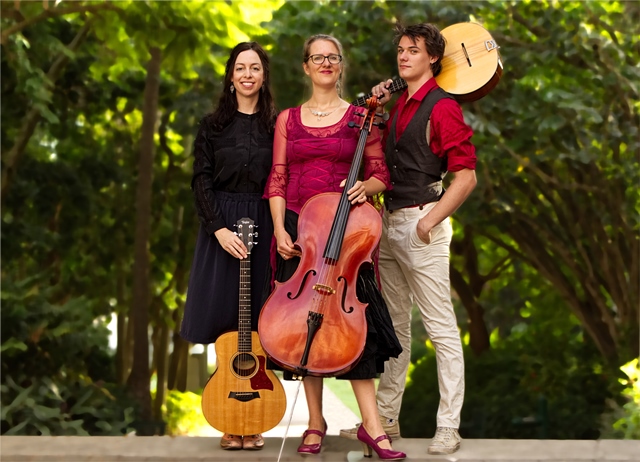
A month after releasing their new EP ‘Culloden’, awarding-winning Celtic group Gone Molly will perform at a Goodwills house concert on Sunday April 28.
Brisbane-based Gone Molly comprises Sally Harris (singer-songwriter), Rebecca Wright (cello, vocals) and a new member, multi-instrumentalist Lachlan Baldwin.
Sally has been quietly building a repertoire of songs that bring together a love of history, mythology, traditional song, tunes and sessions. Sally, Rebecca and Lachlan bring these stories to life with exquisite cello lines, heart-melting harmonies and a flair for the theatrical.
Their debut album Gone Molly features songs that breathe life into colourful characters and tales imagined or discovered.
Gone Molly took home three gongs from the Australian Celtic Music Awards in 2018, including Artist of the Year and Celtic Group of the Year. Maleny sound engineer Pix Vane Mason won Producer of the Year for his work on the debut album.
Gone Molly was a finalist in the 2019 Queensland Music Awards, which came a week ahead of the launch of their EP “Culloden” in late March.
The debut album has received favourable reviews and radio play in Australia, the UK, Canada and the US, resulting in many requests from other folk musicians to cover their songs. A second EP is due to be released in November 2019 ahead of a planned tour of the UK in 2020.
The Gone Molly house concert on Sunday April 28 starts at 2pm with an opening set from hosts and house band The Goodwills (Bob and Laurel Wilson and guest Helen Rowe). Tickets are $15. Afternoon tea will be available for a gold coin donation.
Media Bias Chart by Vanessa Otero, Ad Fontes Media
A couple of years ago I wrote an essay called ‘In search of quality news” which many people told me they found educational. The piece was sparked by a media bias infographic invented by US patent attorney Vanessa Otero.
Vanessa supplied an updated media bias chart for today’s main picture. It is self-explanatory in that the quality news outlets are clustered around the middle. The worst of the fake news and extreme right (or left-wing) biased outlets are consigned to the fringes, as they should be. If you want to see who’s who in the (US) online zoo, open this image in a new window and enlarge it.
She is currently working on a project to expand the Media Bias Chart into a dynamic, interactive web version with a lot of additional sources and features. If you are interested, a recent (lengthy) forensic analysis on her blog tackles President Trump‘s frequent claims of media bias.
My February 2016 essay introduced a few readers to an Australian collaboration between academia and journalism. The Conversation, funded by Australian universities, was launched 11 years ago to broaden the depth and variety of informed journalism. Like online news portal The New Daily (2013), The Conversation is free. Moreover whole articles can be reprinted elsewhere, with proper attribution the only proviso. The Conversation now reaches 10.7 million readers a month.
Bloggers need news and research sources like this which allow citation and lengthy extracts via Creative Commons. It’s quite an advance on the ‘Fair Dealing” provisions of the Copyright Act.
What doesn’t work is finding a likely article in The Australian only to be met with a paywall. You can’t blame them for trying, but The Guardian does not do this, nor does the ABC, SBS or Fairfax/Nine papers in general, although I have elsewhere seen ‘you have had your three free stories’ messages.
The latest Deloitte Media and Entertainment Survey (2018) found that the notion of paying for news was met with considerable reluctance. Only 10% of respondents said they would pay for news, consistent with findings over the past four years. Moreover, 22% of those who said they would pay for news would do so only if they could avoid advertising.
Gosh. So who were we selling all those newspapers to in the 1980s? That was possibly the last decade when newspapers owners could rely upon the ‘rivers of gold’ derived from classified advertising, From then, through the 1990s into the new Millennium, portals like realestate.com, domain.com.au, eBay, gumtree, carsales and ubiquitous travel sites like bookings.com or trivago.com ripped much of their traditional revenue away. Traditional media invested in these portals (investors call this hedging) but it is akin to cannibalism.
Nevertheless, news and magazine subscriptions are surviving, owned by 17% and 11% of respondents respectively (in 2017 both were 16%). “As residual hard copy subscriptions endure, there may still be non-digital opportunities for both mediums,” the Deloitte survey found. “This is especially true for magazines where print remains our most popular format.”
So yes, like me, 38% of respondents still prefer to read printed hard copies, with 51% favouring traditional news formats (2017: 55%).
I’m one of the last diehards, waiting for that Friday evening when the print edition of the Guardian Weekly arrives in my letterbox. Never mind that some of the stories in the magazine were published online up to seven to 10 days earlier.
I send links to people I think might have an interest only to be told they ‘read it last week’.
I have serious doubts about the definition of ‘read it’ in this context as a Pew Research Center survey of US online activity estimates the average time people spend ‘reading’ on a news site visit is two minutes 40 seconds. Crikey, it takes me that long to read a recipe for spaghetti bolognaise (and nip over to the neighbour’s place to borrow some parmesan).
In the US, 93% of people get some of their news from online browsing so that two minutes-something statistic is a little worrying.
So if news outlets are not attracting paid subscribers, how do they make money when online users are clearly ad-phobic? Deloitte’s 2017 survey found that one in three respondents employed ad blockers to preserve their online news feed. Almost 80% when perusing short videos skip the introductory ad and 50% abandon the video altogether if they cannot shut down the ‘pre-roll’ ad.
The most telling statistics from the Deloitte surveys (IMHO) are the ones that demonstrate how people have backed away from social media. In 2018, 55% said they use social media on a daily basis, down from 59% in 2017 and 61% the year before. Moreover, 31% say they have either taken a break or disconnected from social media.
There is increased awareness of the perils of fake news with 66% saying they were concerned about it and 77% believing they had been exposed.
As the Federal election is now just a minimum 50 sleeps away, this would be a good time to review where you are getting your news from and who can be trusted. It’s also a good time to look hard at opinion columnists of the right (and left), both in print and on TV/radio programmes.
It doesn’t take too much imagination to place Australian news outlets on Otero’s media bias chart, although be aware of your own biases! For mine, The Australian is becoming increasingly strident, its pet conservatives trotting out predictable rhetoric. Unhappily the takeover of Queensland’s regional newspapers by News Ltd has seen some of those polemical essayists (Paul Murray, Andrew Bolt), airing their views in rural papers.
Fair go! The preoccupying new stories in these country papers ought to be (a) “drought enters third year’ (image of dead sheep in dried up dam), or (b) ‘rain boosts crops’ (farmer in gumboots jumping for joy over muddy puddle).
Further reading (s) means paid subscribers, some free news
The New York Times (now with an Australian section) www.nytimes.com offers some free items and an affordable introductory subscription (s);
Investigative financial journalism www.michaelwest.com.au Michael’s expose of Australia’s top 40 tax cheats is compulsory reading;
www.thenewdaily.com free Australian news portal funded by Australian industry super funds;
www.newmatilda.com left-wing independent Australian website of politics, Aboriginal affairs, environment and media, active since 2004;
www.crikey.com.au. Launched in 2000, Crikey offers hard-hitting commentary on politics, media, business, culture and technology. Soon to include an investigative unit funded by John B Fairfax. Crikey used to have First Dog on the Moon (s);
The Guardian www.theguardian.com.au the go-to investigative newspaper, favoured by 7 out of 10 retired journalists and fans of FDOTM who defected there in 2014;
www.thesaturdaypaper.com.au notable for being launched in 2014 as a printed newspaper. TSP and The Monthly are paid publications, owned by Schwartz Media (s);
The NYT keeps a good handle on what’s happening in the US, but so too does www.politico.com;
https://bobwords.com.au/further-reading/ My list includes blogs and websites that specialise in long form journalism, interviews, reviews and creative non-fiction.
Christchurch and global grief – artwork by Isaac Westerlund
Last Friday’s massacre in Christchurch by a lone gunman was, as numerous people opined on Twitter, the per capita equivalent of New Zealand’s 9/11. The 50 people killed represent 3,000 fatalities in a similar attack in the US. That does give perspective to the overwhelming feelings of sorrow and confusion many of us felt last Friday and the global grief we have felt every day since.
New Zealand rarely makes international headlines, unless it’s an earthquake, a volcanic eruption or the Wallabies beating the All Blacks. We mourn the irrevocable loss of innocence.
Like Ten’s social commentator Waleed Aly, I did not really want to talk about this today, but as he and others have said, I feel as if I need to say something. I grew up in a sleepy little town in the North Island, a place where nobody locked up and people left their keys in the ignition while they went across the road to the dairy for a bottle of milk.
I remember the shock that was shared around the country in 1963 (I was 15), when President John F Kennedy was assassinated. Things like that didn’t happen in New Zealand so we were shocked, dismayed and very sad. Then as with Christchurch, we shared in a global grief experience.
Songwriter Kath Tait, an expat Kiwi living in London, found out about the massacre at two Christchurch mosques when she got up on Saturday morning (Friday night over here).
She wrote on Facebook: “I’m totally gutted; it’s a big shock for us NZers because we still cling to the notion that NZ is a safe peaceful place and not really a part of the wider world out there. I guess we’re wrong about that.”
George Jackson, a fiddle player now based in Nashville but raised in NZ, encapsulated his feelings by re-learning a plaintive waltz written by his great-great grandfather George Dickson.
I spent the weekend at the Blue Mountains Music Festival where more than a few festival guests had something to say about the atrocity in Christchurch, which had only just happened. As we all now know, 50 people died of gunshot wounds inflicted by a lone attacker and many more suffered serious injuries. A male person has since been arrested, by two brave rural coppers in Christchurch for, of all things, an armed offenders’ training course.
He has been charged with one count of murder and remanded in custody until April 5. Like New Zealand Prime Minister Jacinda Ardern, I refuse to speak his name. And, despite a plethora of online and offline speculation about the alleged perpetrator’s background and likely motives, it remains for a court to decide upon his fate.
Irish songwriter Luka Bloom started his set at the festival in Katoomba saying that people who perpetrate such atrocities “Do not speak for me – “they never have and they never will.”
“They have no idea about the amount of love there is in this world,” he said.
And as Laurel Wilson recounts: “When New Zealand comedy duo, The Topp Twins, who hail from Christchurch, first heard about the atrocity that had occurred in their city, they asked each other, “How can we go on stage and be funny after that?”
“The Topp twins are two openly lesbian, feminist, politically active sisters who are also very, very entertaining – loved by a great diversity of fans in their native New Zealand but also in Australia and elsewhere. They have, no doubt, known prejudice themselves, but have not let it define or limit them. I believe this is the message that they wished to convey when they decided to go ahead with their show at the Blue Mountains Music Festival. And they lifted everyone’s spirits when they finished the show with an audience participation version of ‘Da Doo Ron Ron’, complete with choreography”.
Stephen Taberner, musical director of the Spooky Men’s Chorale, is also from Christchurch. He refrained from commentary about the events of that day, instead recalling an incident he once witnessed where a mother was remonstrating with one of her kids. The mother said to one of the other kids: “Don’t stir the pot”, which Taberner said meant, “Don’t make things worse.”
The Spooky Men then closed out the festival with a stirring rendition of Joni’s Mitchell’s The Fiddle and the Drum.
Taberner’s wisdom in choosing to bypass commentary or bare his feelings was the right choice, given the amount of pot-stirring that’s been going on over the past seven days on social media and in the conventional press.
The Urban Dictionary’s broader definition of ‘stir the pot’ might give us pause for thought about which media outlet we trust:
Pot-stirrer: Someone who loves to proliferate the tension and drama between two or more feuding people/groups in public…in hopes of starting a shitstorm of drama and uncomfortable conflict…”
The above could also aptly describe our accidental Senator, who has been in the public eye, grabbing headlines for all the wrong reasons. Boycott his press conferences, I say. He will still be free to say what he wants to say, just not on the front page.
New Zealand’s Prime Minister Jacinda Ardern put the lid firmly back on the pot with an apolitical, compassionate approach that above all took the feelings and beliefs of the Muslim victims of the massacre into account. Within days, she and Muslim leaders were collaborating with police to fast-track the release of the victims’ bodies to their families. The Islamic faith requires that burial rituals happen as soon as possible. The fact the NZ PM understood this and promised that the country would also pay for the burials, built a few bridges at a time when all connection could have been lost.
Defining the nation’s role in this global grief, she wrote in a commemoration book: “On behalf of all New Zealanders we grieve, together we are one, they are us.”
These words have taken on a life of their own, as a hashtag on social media. In just three words she defined New Zealand’s inclusive attitude towards refugees and immigrants in general. Ms Ardern’s approach every day since has been consistent, compassionate and yet firm, as shown with the swift introduction of stricter gun laws.
The chief pot-stirrers, unfortunately, are the loosely-regulated chat sites and bulletin boards where people can post anonymously. Telcos including Telstra, Optus and Vodaphone are temporarily blocking websites which continue to broadcast the live GoPro video filmed by the assailant as he went about his bloody business. None of the Telcos will say which websites they are actively blocking, although they say the bans will be lifted once the video is removed.
Apart from George’s fiddle tune, the most moving thing I have seen about the Christchurch massacre is a black and white ink drawing by Isaac Westerlund of a Maori woman and a Muslim woman exchanging the Hongi. This is a traditional Maori greeting where two people briefly touch noses and foreheads, exchanging a symbolic breath of life.
Thanks to open-hearted people like Isaac Westerlund and George Jackson, the healing power of music and art help us overcome emotions we don’t quite understand and to make sense of the senseless.
#theyareus
*A Tui is a native bird with a distinctive tuft of white feathers at the throat and a beautiful call.
Songwriter Kate MIller-Heidke, Australia’s entrant in the 2019 Eurovision song contest
My first record producer once said of songwriting competitions – “The only competition I’m interested in is – can it get played on the radio.” His wise words came back to me in a week when I was reminded twice of my peripatetic career as a songwriter. One reminder was a quarterly royalty payment from APRA, derived from having five songs played on the radio in the quarter under review. The money rarely gets above three figures, but it is easy to see how the multiplier effect kicks in if you have a song that is being played on a lot of radio stations all over the world. I usually spend mine on music! Last time I bought a set of harmonicas.
Also, I received an email from the International Songwriting Competition (ISC) which informed me (a) that I was not among the 2018 semi-finalists and (b) 18,999 other songwriters had taken up the challenge. The ISC judges’ panel, which includes luminaries like Tom Waits, Kayne Brown, Adam Lambert and Jeremih, whittled this down to 1,900 semi-finalists in 23 categories.
Last week I received a second email, the names of the finalists – it’s still a packed field. The ISC Grand Prize is worth winning – a cheque for $US25, 000 and a host of sponsor-driven extras including a six-song recording package at Nashville’s The Tracking Room (plus a fully mastered album) an Art & Lutherie Roadhouse Acoustic Guitar, recording gear and free online marketing campaigns.
The competition is high-level, as the ISC is open to songwriters already signed to labels and many entrants have, ahem, a track record. This year’s finalists, for example, include (from Australia), Missy Higgins, Sahara Beck, Pete Denahy, Fiona Boyes and Georgi Kay.
ISC spokesman Jim Morgan told me that Australians have always done well in this competition, since Kate Miller-Heidke became the first Australian winner back in 2008 with Caught in the Crowd. Other Aussies who have taken the main prize include Kasey Chambers and Vance Joy with Gotye winning the Folk category.
“Out of nearly 19,000 entries for ISC 2018, 199 Australian songwriters made it through to the Semi-finals and 30 from New Zealand.”
Kate Miller-Heidke’s husband and musician partner Keir Nuttall said of their 2008 win: “I think the great stuff we got out of it was that it gave us a bit of credibility overseas and it looks great on the bio.
Keir reflected on his days entering songwriting competitions as an emerging songwriter/guitarist.
“It reminds me of when my band didn’t make it into one of the early incarnations of Triple J unearthed. In Queensland alone there were literally thousands of bands.”
Established in 1995, Triple J Unearthed has exposed 99,000 music tracks from previously unheard of bands. Each year the ABC FM station plays its Top 100 unearthed artists. If your band makes it into Unearthed, you automatically get played on national radio – then your fans take over.
One of the early winners was a band called The Rubens (also named in this year’s ISC finals). Other artists who got their start on Unearthed include Flume, The Jezabels, Northeast Party House, Tired Lion and Courtney Barnett.
fRETfEST founder Alan Buchan, who recorded my first album Little Deeds in 1998, has since been persuaded of the merit in songwriting competitions. Tamworth-based Buchan started the Regional Songwriting Competition, now in its fifth year, which gives writers in rural areas a chance to display their craft.
Nambour-based songwriter Karen Law won this year’s Illawarra Folk Festival songwriting competition with 9am on Polling Day and has received honourable mentions in the Australian Songwriters’ Association (ASA) contests over the years.
“My first songwriting competition got me into being a perform iner. In the UK while I was at Uni, I won a folk songwriting competition run by BBC Radio Shropshire Folk Show. Part of the prize was appearing in a live broadcast concert – I was terrified but I did it and it set me on the road to becoming a performer”. Continue reading “Songwriting Competitions And Radio Play”
Melbourne school strike, photo by Takver https://flic.kr/p/2dfY9tt
On days when the woes of the world are too much with us, do you ever think what life on the planet in 2040 will be like? That’s the year the Doomsayers say will be the End Times or the Apocalypse. The theory is that by 2040, planet earth will no longer be able to sustain its estimated population of nine billion.
There are serious arguments for that proposition – extreme weather events caused by climate change, lack of sufficient food and water and ever-worsening pollution. There is the ever-present threat to life on the planet of nuclear war and a rolling series of civil wars which have driven millions of refugees into other countries, with consequent social and political disruption.
Imagine 2040, then. I’ll be 91, Nibbler will be 29 (which is old for a dog); Donald Trump will be 94, ex-wife Ivana 91 and current wife Melanie a spritely 70. Sir Paul McCartney will be 97 (should his long and winding road last that long), and Justin Bieber just 46!
More importantly, children being born now will be 21 in 2040 and quite angry about the state of the world they have inherited from their parents. Those who currently are angry teenagers will already be in their mid-to late 30s and maybe producing children of their own.
The key concern for life on the planet in 2040, just 21 years away, is the ever narrowing prediction about the effect of climate change on weather patterns and sea levels.
Most scientists and some futurologists will say the No 1 problem (I call it the giraffe in the wood shed), is over-population. Bluntly, the world just will not have the resources to feed nine billion people. Already futurists are saying that in the not-too-distant future, we’ll be getting our daily protein from faux meat and insects.
It’s tempting to lean towards flippancy in a 1,200-world commentary on what the world could be like in 2040. Let’s imagine two affluent Poms meeting for breakfast at a café in downtown London 2039 (having got there in minutes by Vactrain from their bucolic suburbs 60 kms away). Smashed avocado on toast will cost something like 29 Europounds, a flat white about 8 Europounds. The waiter already has the order as Paul texted (by thought) while Vactraining. Henry will want to talk about the EU and how long can it last – surely one more year? Paul, feeling guilty about a story he read on the Vactrain newsfeed about six million Brits living in poverty, mutters about Brexit and what a disaster it was.
“That’s ancient history, Paul,” says Henry, adjusting his virtual-specs so he can scan headlines while having a conversation, as you do. Meanwhile the waiter returns (on his hover board) to say there are no avocadoes, despite reports of a glut, but they can do smashed grasshoppers.
Someone with a flair for satire could easily take a similar lead from the occasional quirky statistical forecast in futuretimeline, a community database/blog maintained by futurologist William James Fox.
For example, the autopsy report for Elvis Presley will be made public in 2027, thus scuppering the obsessions of the Elvis-lives club. By 2035, Millennials will be enjoying an inheritance boom, just ahead of a 2039 forecast that scientists will have found a cure for ageing!
By 2039, Alzheimer’s will be fully curable. This will be too late for some people already affected, but should I start to become forgetful at 87, whoever is in charge can take me along to the clinic. Hopefully, it will be bulk-billed.
Flippancy aside, most serious science-based forecasts focus on climate change, because of its potential to ruin everything.
Forecaster quantumrun.com cites an optimistic number for 2040 – the rise in global temperatures above pre-industrial levels will be 1.62 degrees. That’s just above the 1.5 degrees limit recently set by the Intergovernmental Panel on Climate Change (IPCC).
That won’t impress Sweden’s Greta Thunberg or her generational cohort. Born in 2001, she is part of what Forbes Magazine calls Generation Z, people born between the mid-1990s and early 2000s. In 2015, Gen Z represented 25% of the US population, a larger group than both Baby Boomers and Millennials.
Then aged 15, Greta sparked an international movement when she started a 20-day strike outside Sweden’s parliament in August 2018. News travelled fast on Twitter, Facebook, Instagram and WhatsApp. By November 30, the movement had gone viral. In Australia, 15,000 schoolchildren went on strike to call for action (despite much blustering in Parliament). In January this year, 35,000 European teens invaded the European Parliament in Brussels. Over the next fortnight more than 50,000 Belgian teens walked out of their classrooms.
You’ll see more of this next Friday (March 15), when the Youth Strikes for Climate movement stages a global walk-out.
Thunberg, who has since been the target of social media abuse accusing her of being a Green plant (har har), resolutely dug in. In an editorial published in the Guardian Weekly recently she told readers “Adults need to act like their house is on fire – because it is.”
She has pledged to continue her protest until global leaders act to meet the IPCC call to reduce carbons emissions by at least 50% within 12 (now 11) years.
Greta’s lone vigil outside Sweden’s Parliament led to her being invited to give a speech at the World Economic Forum in Davos in Switzerland.
“Some say we should not engage in activism,” she told delegates. “Instead we should leave everything to our politicians and just vote for a change instead. But what do we do when there is no political will?”
Meanwhile I’ve started watching Season Two of a Netflix political thriller, ‘Occupied’. The plot (set in the near future). envisages a ‘silk glove’ occupation of Norway by Russia (in cahoots with the EU), to ensure Norway’s oil and gas pipelines continue to service Europe.
In the first episode of Season One, Norwegian PM Jesper Berg announces that Norway will no longer produce or export fossil fuels, instead favouring thorium* energy plants. The series (based on an idea by Norwegian thriller writer Jo Nesbo), shows how conflicts might arise should a brave, futurist politician defy the status quo.
*thorium is a weak radioactive element that can be used in a new generation of nuclear reactors.
Climate change aside, one of the great challenges for life on the planet in 2040 is what to do with old farts like me! In 2017 the United Nations estimated the number of people in the world aged over 60 will double to 2.1 billion by 2050. The UN also expects the cohort of people aged 80 years or over to increase threefold to 425 million by 2050.
Susan Muldowney, writing for CPA Australia’s newsletter, said that by 2040, one in five Australians will be aged over 65 and 1.2 million of them will be older than 85.
“Australia’s aged-care sector has been largely government-funded and dominated by not-for-profit providers,” Muldowney wrote in the accounting association’s newsletter, In The Black.
“However, this may change over the next decade. The number of private, for-profit start-ups is expected to grow in line with the new regulatory push toward consumer-directed aged care and the generational shift from the frugal post-Depression generation.
“The culture-changing baby boomers are used to having choice – even if they have to pay for it,” she added.
Right, then, I’m off up town to order smashed avo on toast. Enjoy it while you can, I say.
Australia II entering Fremantle Harbour 2001 Image copyright WA Museum
If one symbol conjures up an image of Australia as world-beaters, it is our one-off snatching of the Americas Cup yacht race trophy in the Eighties.
Those of you old enough to remember will see in the cloud archive of your distant memory (and maybe want to press delete), former PM Bob Hawke wearing a garish black and white sports coat and declaring: “Any employer who sacks a worker for not coming in today is a bum!”
He was, of course, referring to the famous weekend in 1983 when the Americas Cup was won by Australia II, a yacht owned by entrepreneur Alan Bond’s syndicate.
The Jungian theory of synchronicity came into play when at least four different newspapers (with different owners), led with a page one headline “Sail of the Century”. It was a no-brainer for pun-happy sub editors, inspired by popular Australian TV quiz show, Sale of the Century.
The Eighties were dizzy days for Australia, five years before the Bicentenary, still searching for an identity and finding it in the braggadocio of sporting achievements. That Alan Bond went on to become the country’s most talked-about entrepreneur and subsequently fell from grace owing banks and shareholders hundreds of millions is sort of by the by. We still won the Americas Cup and Bond was still a hero, the capitalist version of Ned Kelly, if I dare.
Historian and author Frank Bongiorno covers this episode and many more in a densely researched book, The Eighties – The decade that transformed Australia. This book was a 70th birthday gift from songwriter friend Fred Smith, himself something of a historian. Perhaps he knew that I was a fledgling business reporter in the 1980s and that this text would keep me up at night. It did.
Bongiorno recalls how Alan Bond betrayed his humble background (a sign-writer with limited education). America was ahead of Australia 3-1 in the yachting series so reporters asked Bond what he thought. He declared, “We’ll win, just as we did in Gallipoli.”
I was working for the battler’s tabloid, The Daily Sun, in the 1980s, arriving there as the bountiful eighties started to crumble ahead of the October 1987 share market crash.
I’d been an all-rounder, completing whatever assignment came my way. Truthfully, I was looking for a way of avoiding ‘death knocks’ (visiting a home touched by tragedy to ask for a photo of the late family member).
And then the business editor went on leave and I was asked to ‘hold the fort’. The business editor never returned and so I held on for dear life to the trailing end of a very long learning curve.
I went on many a long lunch and used my secret weapon (I didn’t drink) so usually returned with a story or three. The 1980s was a time when the so-called ‘white shoe brigade’ held sway. These daring entrepreneurs cajoled banks, stockbrokers and investors into backing their wondrous schemes.
The likes of Bell Resources (Bond’s company), Adsteam (John Spalvins), Westmex (Russell Goward), Ariadne (Bruce Judge), Qintex (Christopher Skase) and Rothwells (Laurie Connell) went up like the rocket and down like the stick. A few lived on under different ownership structures, often going back to their core business (diversification often being the key to their downfall).
Bongiorno’s book suggests that, generally speaking, Australian business/finance journalists missed the boat when it came to exposing entrepreneurs for the charletans some of them turned out to be.
He used words like “suggestible”, “enthralled” or “mesmerised”, to describe the reaction of reporters given access to entrepreneurs like Bond, Russell Goward or Christopher Skase (himself a former finance journalist).
“The spectacular expansion of Qintex was built on Christopher Skase’s hard work, his bankers’ generosity and the public boosting offered by admiring business reporters, in awe of the rapid rise of one of their own,” he wrote.
Yet by October 1989, Qintex was being wound up, its debt to bankers ballooning to $1 billion (amid reports that Skase’s management company received more than $40 million in consultancy fees).
As Bain & Co economist Don Stammer said of those times: “the fact that the entrepreneurs’ castles were made of sand seemed to elude even the most experienced business journalist.”
The media agenda in the Eighties was to write aspirational stories about the corporate heroes re-shaping Australia. Then the share market crash of 1987 arrived and many of them headed for the exits. The publications who had talked these people up now had to find ways of tearing them down again. As always, the little people (the taxi driver who tips you about a little gold company that is going to strike it rich), got royally shafted.
At the peak of the share market frenzy in late September 1987, the All Ordinaries Index was running hot. Stockbrokers were prone to say things like ‘you could float a pea pod in this market’. Many small start-up companies went to the share market in this dizzy phase, raising capital to further their cherished dreams.
I recently sorted through old cuttings from the Eighties and found this gem about a small Queensland company looking to make artificial snow. It was quite exhilarating to follow up on the adventures of a 1980s entrepreneur/inventor, to find him still doing in 2019, what he first set out to do.
Alfio Bucceri was the inventor behind Permasnow (Australasia), a company which listed in late 1987 to raise $10 million. The goal at the time was to use the artificial snow technology in traditional ski resorts when real snow was in scarce supply.
Mr Bucceri’s dream was to develop indoor ski centres. After he sold his 33% shareholding in 1988, the company passed up the indoor ski centre opportunity and moved into other ventures such as hotels and retirement villages.
“From that point on (1988), I continued with my creative talents and created and patented new snow making machines and concepts, as well as branching into inventing toy and sporting products,” he told FOMM.
“These products include Snow4kids that now can be found on Kuta Beach in Bali, Australia and China.
“The childrens’ snow event concept is built around the new snow-making machines that I invented called the B4.
In January 2019, he exhibited the machines at the Beijing ISPO Ski Show. “They have been used for the past 10 years at Ski Resorts in China and South Korea as well as Sea World at the Gold Coast, where the snow machines make fresh snow for the Penguins every day.”
The concept of indoor ski centres that he pioneered prospered over the next 30 years, with indoor ski centres built in most parts of the world, including the Middle East and Europe.
“I was instrumental in bring indoor skiing to the Middle East in the early 1990s, when I partnered with MKM Holding’s Sheik Mana Bin Kalifha Al Maktoum to create the first Indoor Ski Centres there.”
Last year he was involved with a Permasnow installation at a new major casino project in Macau.
He does not regret his brief flirtation with the share market but found it easier going it alone.
“I have self-funded most of my projects since the 1980s. It is a longer but easier route to succeed without the restrictions placed on me during my younger days at Permasnow.”
And how ironic, given gossip just before the 1987 crash that Qintex planned to add Permasnow to its 170+ subsidiaries.
February snow at White Rock, BC, image by George Davidge
February is the one month of the year when the climate extremes of the northern and southern hemisphere starkly remind us of the threat to civilisation posed by climate change.
In the northern hemisphere, a polar vortex in January and February brought record low sub-zero temperatures to the UK, Europe, USA and Canada. Cars disappeared beneath mounds of snow; Chicago’s river froze as temperatures dropped to a rare -46 degrees Celcius (wind chill temperature). The regular temperature at -30 degrees was just 2 degrees warmer than a 34-year-old record low.
I’m reliably informed that if you go outside in this kind of extreme weather, don’t blink – your eyelids will freeze shut. Mind you, there are enough selfies and images on social media to suggest that some happy snappers took the risk.
The image above was taken this week at White Rock, a coastal town in southern British Columbia, where the average winter high and low temperatures are Celsius 8 degrees and 2 degrees. It is rare to have extreme weather there (snow storms, ice pellets and freezing rain).
Even though I live Down Under, I’m attached to songs which evoke the wintry romance of the frozen north. They include Joni Mitchell, wishing she had a river to skate away on, Dar Williams, throwing her lover’s car keys into the water (where they froze, halfway down), and Dave Goulder’s song about northern hemisphere seasons, the January Man. “The January man he goes around in woollen coat and boots of leather The February man still shakes the snow from off his clothes and blows his hands…”
Meanwhile on the other side of the planet, Australians have just survived the hottest January since 1910 to suffer more of the same in February. On January 19, Melbourne residents endured 44° Celsius (it got to 47 in some outer suburbs).
In terms of climate extremes, most of Australia received less than 20% of normal rainfall in January. Canberra, the nation’s capital, normally known for bitter cold, had a record run of four days above 40C. A Bureau of Meteorology report also highlighted record long runs of consecutive hot days.
They included:
Birdsville (Qld) 10 consecutive days over 45C
Alice Springs (NT) 16 days in a row above 42C
Cloncurry (Qld) 43 consecutive days over 40C*
Camooweal (Qld) 40 consecutive days over 40C
Walungurru (NT) 27 consecutive days above 40C
Bourke (NSW) 21 consecutive days above 40C*
*broke State records
Australians also suffered through the highest overnight minimums on record, peaking at 36.6 degrees at Wanaaring in NSW.
Bushfire burning at Girraween National Park, image by Penny Davies
Searing hot temperatures sustained over many weeks turns native forest and grasslands into tinder-dry fuel. A stray cigarette butt, a lightning strike or a spark from a tractor-slasher is all it takes. Stanthorpe, normally the coldest place in Queensland, recorded a maximum temperature of 36.9°C on January 19. This was one of the few places in the country to offer some overnight respite (10°C ). A lack of rain and sustained high temperatures contributed to a massive bushfire which started at Wallangarra on the Qld/NSW border and quickly spread to Girraween National Park.
The fire started on February 12 on the outskirts of Wallangarra, cutting a swathe through 43,000ha of bush and pasture. As of yesterday, the fire was still smouldering, although the threat to people and property around Wyberba, Ballendean and Eukey has abated. However, there’s a windy weekend ahead, so bush fire brigade volunteers will be on high alert until it rains.
Last Saturday, Queensland Fire and Emergency Services warned Granite Belt residents that a large, unpredictable fire was heading in a north-westerly direction through Girraween National Park with the potential to cross Pyramids Road. Residents of Eukey and surrounds were put on notice to be ready to evacuate.
Climate change skeptics will tell you Australia has always had climate extremes; bushfires, floods and droughts (as they drive their diesel 4WDs to a ridge for a better view – they can get 2GB reception up there too).
In the interests of balanced journalism, it seems only fair to provide a link to their view of the world):
But as we never tire of repeating here at FOMM HQ, 97% of the world’s climate scientists think climates extremes are happening and they are aggravated by human behaviour
We Aussies, sweltering through weeks of temperatures above 30°C in many locations where humidity is 70% or more, yearn for the hopefully cooler days of March. In the northern hemisphere, those enduring the extreme winter can but hope for an early thaw.
The climate change deniers and those who just don’t want to think about it need to be reminded in ways that have become obvious to a generation of bright young things who skipped school to make the point.
As you’d know, there are climate change skeptics in Australia, as there are in other industrial nations. They may be in the minority, but some of them are in government, which makes their opinions matter.
A Lowy Institute Poll of 1,200 Australians quizzed about climate change and energy found that 59% agreed with the statement: “climate change is a serious and pressing problem. We should begin taking steps now even if this involves significant costs.”
Furthermore, 84% agreed that “the government should focus on renewables, even if this means we may need to invest more in infrastructure to make the system more reliable”.
It is now five months since a United Nations climate panel warned that the world has about 12 years left to limit global warming to 1.5° Celsius. Australia and the rest of the world must virtually eliminate the use of coal for electricity within 22 years if there is to be a chance to save even some of the Great Barrier Reef. At 1.5°C, coral reefs are expected to decline by a further 70% to 90%, the report said.
More than 90 scientists drew together thousands of pieces of climate research for the report by the UN’s Intergovernmental Panel on Climate Change (IPCC). The conclusion was that global emissions of greenhouse gas pollution must reach zero by about 2050 in order to stop global warming at 1.5° Celsius. At current rates, 1.5C would be breached as early as 2040 (just in time for those born today to celebrate their 21st birthdays – Ed).
Ah me, there’s more to come on this story, with the Kids vs Climate Change movement started by then 15-year-old Swede Greta Thunberg gathering pace. Following Greta’s lone, 20-day strike in August, Australia was one of the first countries to respond. Despite scornful rhetoric and table-thumping from Prime Minister Scott Morrison, 15,000 students went on strike in November. Contrary to claims that the protests were partisan (and organised by hardcore greenies), this week students protested outside the electorate office of Opposition Leader Bill Shorten. Federal Education Minister Dan Tehan branded the ongoing protests as “appalling political manipulation”.
On March 15, teens around the world will absent themselves from school to demand action from adults in power about climate extremes. As people with teenagers know full well, they are the cohort least likely to be manipulated, politically or otherwise.
Footnote: I almost forgot to leave you with this link to Dar Williams’ beautiful song February, which has been interpreted by some as being about a couple with Alzheimer’s, using winter as a metaphor. My friend Rebecca Wright, who like me sees it as more of an ending and a new beginning song, does a fine version.
Parliament House, Canberra 1979, image by Steve Swayne https://flic.kr/p/q1Jkuq
If one believes that the Australian government will delay holding a Federal election until the last possible date (May 18) that’s just 92 sleeps away. Given the Morrison government’s historic defeat (75/74) when Parliament passed the so-called Medevac Bill, this week, I can’t see ScoMO heading up the hill to the Governor-General’s whare* for an early election. The electorate is clearly polarised and there is a high degree of suspicion about what both major parties say they’ll do and what they actually do when in power.
The problem for political parties running campaigns in such a tense environment, and why they need every one of those 92 days, is to work out how to recapture the estimated 3.14 million Australians who do not participate. That’s right, even though we’ve had compulsory voting since 1924, that’s the estimate of how many people failed to vote in 2016.
The Australian Electoral Commission (AEC) analysis found that turnout at the 2016 House of Representatives was 91%, the lowest recorded since the introduction of compulsory voting ahead of the 1925 Federal election. Turnout at the 2016 Senate elections at 91.9% was also the lowest recorded since the 1925 federal election. The missing include 1.78 million who were enrolled but did not vote, an estimated 816,000 who should be on the roll and aren’t, and 550,000 who cast a ballot paper but either filled it in incorrectly or deliberately defaced it (informal).
We know some scrutineers who, over drinkies after election night, swap notes on the best insults or graffiti on informal votes. Penises are common, so too an added box to tick with a substitute name, e.g. “Duck, D (Animal Welfare Lobby), “Trump, D (Socialist Left) or SCOTLAND!
The informal vote includes ballot papers where voters intended to make their vote count but did not fill it in correctly. Australia’s enormous Senate ballot paper, which can have more than 100 candidates, claims many victims in this way.
Why are these numbers so important, then? In 2016 the not-for-profit Y Vote claimed that people aged 18-24 who were not on the roll, didn’t show up, or voted informally could have swayed the election result one way or the other in 10 marginal seats.
Y Vote calculated wasted votes using AEC data that one quarter of Australians aged 18-24 were not enrolled. The number of wasted votes outnumbered the margins several times over in key Liberal marginal seats.
The founder of Y Vote, Skye Riggs, said young Australians felt their voices were not valued because “they don’t see politicians investing a lot of time in them”.
I’d say the close tussle between the Ayes and Noes on the Medical Evacuation Bill reflects a deeply polarised electorate; polarised and politically volatile. Remember the Wentworth by-election – when former PM Malcolm Turnbull’s solid blue ribbon seat went to cross-bench Independent Senator Kerryn Phelps? There’s no telling what the people will do.
After reading on Monday how Labor intended to insist on amendments to the Medevac Bill, She Who Takes Direct Action rang Bill Shorten’s office. She was assured Labor was not going soft on the Bill but was just ‘having a look at the language’. As it turned out, Labor wanted three amendments (one of which insisted upon a ‘character test’). Labor wanted the Minister rather than doctors to have the final say on who is flown to Australia for treatment. The Greens refused to support the amendments as proposed.
A late amendment to Dr Phelps’s Bill stipulated that the advisory panel picked by the government to oversee decisions, receive no remuneration for their role. This nicely worked around the government’s late-mail advice that the Bill was unconstitutional.
It is important to note, given the government’s steamy rhetoric that it will encourage people smugglers to send more boats, the Medevac Bill applies only to the cohort currently held on Nauru or Manus Island and is (thus far) not extended to new arrivals.
One ought not to forget, as an astute friend reminded me last week, that 80% of Australians voted for either the LNP or Labor at the last Federal election. She reminded me that Labor’s policies on immigration and refugees are not that dissimilar to the current regime. Bill Shorten’s speech to the Labor Party conference last year made that clear enough.
“We cannot and we must not and we will not allow the criminal people smuggling syndicates to get back into business…
…It is not a crime to want to come to this country. But it is a crime to exploit vulnerable people, to put them in dangerous and unsafe vessels, and have them drown at sea.
We cannot, we must not and we will not permit the re-opening of their trade in human desperation and the drownings and the irreplaceable loss of life that it brings.”
To this end Labor would insist upon:
Rigorous security, character and health assessments throughout humanitarian and general migration programs
pursuing regional resettlement.
turning back boats where it is safe to do so.
maintaining offshore processing
Those who do not care for selective quoting can look it up (Chapter Nine of Labor’s policy platform).
So while Labor appears to be prepared to give the poor a better deal (e.g. promises to review NewStart and fast-track the NDIS), if you vote Labor you are voting for a continuation of the policy of processing asylum seekers and refugees through offshore detention centres.
Offshore processing is just one of the many important issues one could sift through when deciding who would best represent a voter’s interests. There are other key issues (many now showing up in the ABC’s social media poll), including climate change, the environment, water security, health and education, not to mention whether any government should allow a foreign company to dig up Australian coal and export it.
I was talking to a Labor stalwart who had been door-knocking in one of the Sunshine Coast’s blue-ribbon seats, electorates where you’d need a 11% swing to unseat the incumbent. Our doorknocker persisted, even when faced with less than polite rebuke from Sunshine Coast Tories. What surprised him, though, was the level of ignorance/apathy: “What? Are we having an election? When? Why?”
Some of those people were probably among the 1.78 million who were enrolled but did not turn up in 2016. No doubt some of them received infringement notices and a $125 fine.
The AEC says declining voter turnout observed at Australian federal elections reflects international trends. Voter turnout has been steadily declining in most developed countries over several decades. How do we lift our game, then? And why is it that Malta’s best voter turnout (92%) exceeded Australia’s effort, yet Malta does not have compulsory voting? Perhaps Malta is less exposed to ‘shouty’ commentators?
Defence Minister Christopher Pyne declared on Monday that politics in Australia was “trapped in a self-obsessed and panic-prone spiral that is damaging Parliament’s ability to work for the good of voters.” (Probably the first and last time I’m likely to agree with Christopher Pyne. Ed)
He told the Sydney Morning Herald’s David Wroe the political environment, which had bowed to irrational pressure from “shouty” commentators, was not good for the country and that he can’t see that changing.
Yep, that ought to get the 3.14 million Australian slackers motivated to contribute to the political process. No worries, mate!