FOMM’s Technology Failure Stress Scale

IT-stress-scale
This IT message (and others) can send some people’s stress levels off the scale.

After several weeks of persistent information IT problems, I’ve invented a Technology Failure Stress Scale that deals specifically with technology failure and the inability of many human beings to cope. Unlike the better-known Holmes and Rahe Stress Scale, which measures the health impact of major life events like death of a spouse and divorce, mine is unscientific and highly subjective. Well, if it’s OK for leaders of major western governments to be unscientific and subjective, why not me?
The Holmes and Rahe stress inventory is still widely used, despite being created in 1967 (it mentions a mortgage of $20,000). The R&H test allocates points to each stressor. You take the stress test and tally up your numbers. Anything over 300 makes you highly susceptible to developing an illness. Death of a spouse (100), divorce (73), marital separation (65), imprisonment (63) and death of a close family member (63) are the top five. I was always under the misapprehension that moving house was in the top 10, but it apparently rates only 20 points. Try telling that to the renters, furiously scrubbing and vacuuming so they can get their bond back.

GPs use the Social Readjustment Rating Scale invented by psychiatrists Thomas Holmes and Richard Rahe to assess patients presenting in a highly stressed state. GPs also use the Perceived Stress Scale (PSS), a more recent psychological test to assess anxiety and depression. The test asks the patient to perceive how they feel, ranging from not at all or hardly ever, to all the time, about their moods and reactions to situations. The latter is the test used to decide if you qualify for six rebated consultations over 12 months with a registered psychologist
The PSS has also been used by researchers trying to establish the links between technology and social media and psychophysiological well-being. If this subject interests you, try these links.

I was going to write about Brexit this week, a topic I have been assiduously avoiding since the silliness began in 2016. Then my laptop started misbehaving (again) after a clean install of Windows. My technology failure stress levels went off the scale.

On Saturday, when I went to retrieve my emails from an Outlook backup – it downloading 9,000+ emails (twice) into one folder. What happened to my carefully curated sub-folders? Moreover, new emails started arriving, in pairs. Time to call in a technology failure expert, who did his expert thing, then advised me to buy a new computer. Thanks to this friendly chap, my technology failure stress levels dropped from 275 (see test below), to around 75.

FOMM’s Technology Failure Stress Scale
1/ Blue screen of death, hard drive failure, complete loss of data due to hard drive failure, virus: 100 pts (deduct 50 points if you made a reliable back-up)
2/ Recovery but with poor prognosis/replacement recommended: 50
4/ Process of reinstalling programs and data: 45
5/ (Unbudgeted) cost of repair/replacement: 35
Operating system misbehaviour and user error
6/ Accidently deleting important files/emails or archives (or hitting send-all when that’s not what you meant to do): 60 (deduct 30 if you have backups)
7 Windows updates automatically, closing down when you are in the middle of editing your round-Australia video or watching the last 10 minutes of the final episode of Breaking Bad: 55
8/ Video/Music editing programs crash before you go file/save (see above): 65
9/ ITunes updates then you can’t find your music: 55 (some would rate this 100)
10/ Software manufacturers stop supporting something on which you have become dependent: 45
I’ll leave mobile phones, smart TVs, remote controls, Bluetooth and GPS devices for another time.
Rate your overall Technology Failure Stress (from a total of 550)
More than 300: your spouse will have an 80% chance of finding you irritating. Take the dog or yourself for a long walk. Unplug the computer at the wall if a storm is brewing.
200-299: your spouse will still be finding you irritating. Take the dog or yourself for a long walk. Eat chocolate.
100-199: This is a sign that you are sufficiently tech-savvy and adaptable but still prefer to leave it to the experts.
0-99: You either eschew computers or use the free ones at the library.

Technology Failure aside, what about Brexit?

As you’d gather, I get distracted when things get stressful and a bit beyond my ken, so it was initially hard to put together a coherent narrative on the topic of Brexit (short for Britain exiting the European Union).
Why should we care, you might ask? This is some far away turf war about trade and national identity. It may also be about Britain wanting to secure its borders as more refugees teem into Europe.
Basically, the politicians thought the Brits would say Yes to staying in the EU instead of No, we’re leaving. Between the 2016 referendum and now, the British parliament has been working on an agreement which will cut ties with the EU (and cost the UK about £37 billion), call it their Brexit fee).
In the ensuing years since the referendum, there has been considerable social discord (the vote was 52/48, after all), economic uncertainty and a tougher time for Britain’s poor, the perpetual victims of economic downturns.
The European Union was formed in 1972, forging together 28 countries with (in theory) a single currency, freedom of trade and movement between countries. The EU has its own parliament and all members have to pay to enjoy the benefits of economic unity. Over time, Britain became disenchanted with the return on its (annual) contribution of £13 billion (2017). The UK gets back about £4 billion a year as ‘public sector receipts’, so it can be seen that the UK pays more into the EU than it gets back. This does not take into account the harder to quantify benefits of jobs, trade and investment.

The Brexit debate has sharply defined what the Irish and the Scots had known all along – the United Kingdom is not all that united. The Scots voted to stay in the EU and so did Northern Ireland. Thus far, the debate has been vigorous between Leavers and Remainers. Of the Leavers, 94% believe Britain will be better off without the EU; 96% of Remainers think Britain will be worse off exiting the EU.

The Guardian’s monthly reports on UK economic indicators shows that business investment has declined for three consecutive quarters. The housing market is at its weakest level since 2012 and retail sales continue to be sluggish, with visible signs of business distress on UK high streets. There have been reports elsewhere of companies moving their headquarters from England to Asia (Dyson and Sony).

The UK government is this week voting on amendments to PM Theresa May’s 585-page Accord (which was voted down on January 15). The amended deal has to be approved and then accepted by the EU. If the EU rejects May’s plan, England will be left to deal with a fragmented kingdom, Brexit representing, as commentator Fintan O’Toole observed, ‘the result of the invisible subsidence of the political order’.

At divisive, stressful times like these, one could imagine Theresa May and her staff would be quite happy if Outlook crashed and they had an excuse not to look at their emails.

More reading: Irish Times columnist Fintan O’Toole’s perspicacious view of ‘Brextinct’ and the fissiparous four-nation state is an enlightening read.

Australia Day and the beach

mindil-beach-australia-day
Mindil Beach, Darwin, 2013 (not Australia Day). Photo by Bob Wilson

There’s nothing much planned here for Australia Day (aka Invasion Day) except a trip to the (doggie) beach and an evening neighbourhood gathering at a local park.

You won’t find much flag-wearing/waving, lamb eating, dunny-racing, gumboot-tossing fervour in this essay, probably because I am among the 16% of Australians who think a national day of commemoration is unnecessary.

(Robbie Burns’ birthday (today) being the exception to the rule – Ed).

The headline item in a recent Australian Institute survey was that 84% of Australians believe it is important to have such a day. The Australian Institute survey also found that 56% of us don’t care which day it is held, just as long as we have one.

Then, if you want to buy into the ever-growing Australia Day shouting match between the extremes of the conservative side of politics and the so-called bleeding hearts, 49% of people surveyed said Australia Day should not be held on a date that is offensive to our indigenous people. (Here, here – Bob and Ed)

The other 51% probably thought there was nothing ill-timed or insensitive about Prime Minister Scott Morrison’s announcement (a year ahead), of the 250th anniversary of Captain Cook’s first voyage to Australia. Earlier this week the PM said the government will spend $6.7 million to sail a replica of Cook’s boat, The Endeavour, around Australia in 2020. The circumnavigation would be managed ‘sensitively’, Arts Minister Mitch Fifield added, and will present views both from the ship and from the shore.

The circumnavigation should, all things considered, lead to a lot of beach traffic, where sightings will be sought of The Endeavour in full sail. No mention of the fact that then Lieutenant Cook didn’t circumnavigate Australia on his journey here.

Life’s a beach – unless you live in Birdsville

If you were one of the 225 people in the national survey of 1,417 who don’t see the need for a national day of commemoration, you should at least spend part of Australia Day at a beach.

Although Australia’s vastness straddles three oceans, we are in but 7th place when it comes to countries with the longest coastlines. Canada wins, by a long margin.

Where Australia has the advantage, when it comes to people who like to surf, swim, fish, walk or just lie in the sun, is that we have 11,761 beaches, about 3,000 of them suitable for surfing. Furthermore, the weather is suitable for beach activities all year round in most States.

It could be argued then, that the quest for an ideal beach is far easier in Australia. Ideal in this context means a beach where there are as few people as possible, like one of the remote beaches of New Zealand’s East Cape. Of course, I am assuming you prefer to walk on a deserted beach instead of sharing a swathe of sand with 40,000 people (Bondi). And there are plenty of seldom explored beaches to go around if you are keen. You can get to them by driving (4WD), walking, or by boat or helicopter. No mystery as to who uses them: Australia has 5 million fishermen, 2.5 million surfers and 110,000 members of Lifesaver clubs, for a start.

Beach-loving surfer Brad Farmer wrote a book in 1984 documenting the country’s best 1,200 beaches across six states. It didn’t stop there. In 2000, Farmer and his pal, coastal scientist Professor Andy Short, agreed to collaborate and produce the benchmark of Australia’s ‘best 101 beaches’. (Queenslanders may be miffed to find there were only four beaches in the top 20 for 2018, even if No 1 was Fitzroy Island’s Nudey Beach.)

cape-hillsborough-beach
Cape Hillsborough, kangaroo beach, photo by Bob Wilson

I have not read Farmer’s book, but hope that Cape Hillsborough near Mackay got a mention. This relatively small beach, surrounded by a national park with steep, walkable headlands, is inhabited by kangaroos, often seen on the beach and in the water. We’ve been there twice, the second time (left) it rained.

Farmer, who is now Tourism Australia’s global beach ambassador, wrote a piece in The Guardian Weekly in which he did not mention Australia Day once, although he believes beaches form an integral part of our national identity.

Even if you don’t belong to the majority who believe it is important to celebrate Australia’s place as a first world, mostly tolerant democracy, you could at least look to some of the nation’s virtues. A quest for the ideal beach is not a bad way to appreciate living in a spacious, mostly convivial and civilised country. Since 85% of us live within 50 kms of the coast, it is an inevitability that most of us will spend some time at one of the 11,000+ beaches catalogued by Brad Farmer.

Within an hour’s drive of our well-populated coastal strip, one can find a surf beach, a beach where the snapper are running, a flat, shallow beach suitable for small children, a (long) stretch of beach where dogs are allowed off-leash and so on.

Those of us who like to combine bush-walking with beach-going can have the best of both worlds in places like Cape Hillsborough or Noosa National Park. If you’re not fond of crowds and looking for some splendid isolation, you can clamber down a makeshift track to a small rocky beach and just enjoy it; sketching, writing poetry or just contemplating (until the tide comes in).

However, you can see how beaches can become crowded at peak times. Sydney’s Bondi Beach (2nd) somehow made its way into a list of the world’s top five most crowded beaches. The others are Ipanema (Rio de Janeiro, Brazil), Coney Island (New York, US) Brighton Beach (UK) and South Beach (Miami US).

Tourism Australia research reveals that 75% of inbound tourists nominated visiting beaches as their number one choice of experiences. Occasional media reports of bluebottle plagues, shark attacks and crocodile sightings never seem to dent visitor enthusiasm.

Farmer, a beach enthusiast since he started surfing at 24, recommends choosing your beaches discerningly, based on all the elements you are looking for. In our case, a long, windswept beach where the tide goes out a long way is an ideal beach upon which to let dogs off the leash. Of course it must be a designated dog beach and owners must carry poo bags at all times.

He suggests that, increasingly, people are looking to combine their beach holiday with a digital detox. To do so, one must seek out the unfashionable, hard to get to beaches with poor Wi-Fi. As Farmer says (and perhaps he had Straddie, Bribie or Moreton Island in mind), they must be the beaches with “weathered characters with yarns as deep as the salt in their veins and a pristine natural environment”.

“These low-key, under-the-radar beaches are often the ones that create lasting, formative memories for our children and the beach child in all of us.”

So think of that on Saturday, while you are sun-baking, swimming, walking, surfing, fishing, playing cricket with a tennis ball or just simply walking the dog.

The lamb roast is happening on Monday.

Further reading: FOMM back pages

My friend Angela writes lively travelogues including this tribute to Queensland.

A final reminder that the (optional) FOMM subscriber drive closes on January 31. Thanks to those who already subscribed $5, $10 or more to help cover website administration costs.  If you want to know how to do this, email me directly at bobwords <at> ozemail.com.au.


Why political parties can spam without penalty

call-centre-spam
Call centre image by Richard Blank https://flic.kr/p/dZhyjR

I should feel miffed, being one of the 14.4 million Australian mobile phone owners who did not receive an unsolicited text message from the political party led by the aspiring Member for Herbert, Clive Palmer.

Some of my Facebook friends, and even those not on Facebook, let the world know in no uncertain terms what they thought of receiving an unsolicited text from the United Australia Party (UAP), previously known as Palmer United Party (PUP).

Alas, I was not one of the 5.6 million people who received texts, so had to rely on second and third-hand reports to tell me they were (a) brief) and (b) geo-targeted, (the ABC’s example of a text sent to S-E Victoria promised fast trains for Melbourne – ‘one hour to the CBD from up to 300 kms away.’) Another forwarded to me by a Queensland reader promised a tax reduction of 20% for those in regional Queensland.

Those who were affronted by receiving the unsolicited text complained, but it fell on deaf ears because (a) it is not illegal and (b) it’s January and everyone is at the beach.

When asked about the electronic media campaign, Clive Palmer told the ABC the Privacy Act allowed for registered political parties to contact Australians by text.

“We’ll be running text messages as we get closer to the election because it’s a way of stimulating debate in our democracy,” he said.

Despite Mr Palmer and AUP receiving some 3,000 complaints, he told the ABC more than 265,000 people clicked through to the link ‘and stayed for more than one minute.’

The text should have come as no surprise, as United Australia Party has been letterboxing electorates for months with the party’s distinctive yellow colours and prominent use of the leader’s image framed against the Australian flag.

As I temporarily forgot that Mr Palmer re-badged and re-launched his previously de-registered party last year, I did an internet search for PUP. All I came up with was the Polytechnic University of the Philippines, a Canadian punk rock band and the internet acronym Potential Unwanted Programs (how fitting-Ed.)

It was an easy mistake to make, so thoroughly had Clive Palmer embodied the fledgling PUP (which he de-registered after serving only one term and ‘retired’ from politics prior to elections in 2016).

But last year Clive Palmer changed the name of the party he founded and under whose name he served as the Member for Fairfax from 2013-2016. As it happens, he re-used the historical name of the UAP, under which Prime Ministers Joseph Lyons and Robert Menzies served. He told The Australian last year that the re-establishment of a UAP was ‘a significant milestone in Australian politics’.

So it is true, alas, that registered political parties can text people they don’t know without fear of reprisal. All they need is a list and Mr Palmer, who says he does not own the list or know where it came from, told the ABC you can buy such a list from ‘any advertising agency in Sydney’.

According to the Australian Communications and Media Authority (ACMA), the Spam Act allows registered political parties to send commercial emails and SMS messages to individuals as long as the message identifies who authorised the sending of the message.

Likewise, we are all fair game to receive unsolicited telephone calls at home leading up to an election (yes, I’ve had a few of those). You’d wonder why, though, given that telemarketing or cold calling has a 2% conversion rate.

ACMA says: “Opinion polling calls and calls from political parties, independent members of parliament, or candidates for election that contain a commercial element—that is, they are trying to sell you something or are seeking donations—are permitted by the Do Not Call Rules and may be made even if your number is listed on the Do Not Call Register”.

If that seems wrong to you, you can write, complain and generally make a nuisance of yourself by contacting ACMA. Tell them I sent you.

We have been dog-sitting/house-sitting in Brisbane, my laptop has been in the PC workshop for a week and it’s been too humid to think about much. So apart from tennis and binge-watching The Bureau, we have been mostly cut off from social media and its twittering masses.

The reason I knew about the UAP texting campaign was that a friend, who I will call Irate Step-mother of Three, cc’d me the reply she sent to Mr Palmer’s party. It was blistering.

Also invading our telephones and in boxes over the Silly Season were messages from people running  ATO scams (someone calls and pretends to be from the ATO, saying things like – if you don’t send us money immediately you will be arrested (and so on).

The recent round of scams prompted the ATO to provide an update and a warning on its website in December.

The golden rule, be it a scam, a marketing call or a (legitimate) electioneering contact), just hang up. You don’t even have to say ‘hello’.

As for unsolicited texts, you can delete and block sender, although you might be busy. As a marketing strategy, texting is gaining favour – the industry claims a 98% ‘open’ rate (email is 22%).

Professor of Law at University of Queensland Graeme Orr reminded us that other political parties use this tactic. Writing in The Conversation he said the Labor Party sent out texts ahead of the 2016 election purporting to be from Medicare itself, as part of its ‘Mediscare’ campaign (the LNP had talked about privatisation). This ploy led to a tightening of rules and a new offence of ‘impersonating a Commonwealth body’.

In breaking news yesterday, UAP sent out another text promising that if they were in government, they would ban the practice!

I take ACMA’s ruling on political texting and emailing quite personally. As my followers would know, I am obliged to publish a disclaimer at the end of every post where I offer subscribers the chance to opt out. All bloggers and purveyors of marketing emails and newsletters (don’t they have a habit of worming their way into your inbox), have to do this.

Registered political parties, however, can do whatever they like, so long as they don’t pretend the email/text came from somebody else. It is a travesty (something that fails to represent the values and qualities that it is intended to represent) – Cambridge Dictionary.

Now that I’ve been presented with a squeaky clean hard drive (even my contacts lists have vanished, awaiting an (edited) backup, this is the perfect opportunity to do a little electronic house-cleaning. Like everyone, I subscribed to far too many seemingly promising websites and newsletters in 2018. Yikes, some of them email every day!

The best solution is scroll down to the end of the document where you will find in the fine print an option to unsubscribe, or as the Urban Dictionary defines it:  To take yourself out of a convo (conversation) or email because it’s boring or has lost its initial humour.

That was an explanation, people, not an invitation.

Since you read this far, my subscriber drive to cover website maintenance costs is doing quite well but you only have till the end of January if you want to make a subscriber payment.  Follow this link (or not)


I’m not dead yet

i'm-not-dead-yet
I’m not dead yet – pondering the future

The world’s media has a poor track record when it comes to reporting the deaths of celebrities, going early often enough to invoke the classic Python-esque protest, “I’m not dead yet”.

Singer and actress Olivia Newton-John was the latest victim of tabloid hyperbole, when reports described her as ‘clinging on to life’. The star of Grease took to Facebook to cheerily confirm her existence, even though it is known she is ‘battling cancer’ for the third time. Reports said Newton-John was privately upset by the reports which emanated from the US supermarket tabloid National Inquirer.

Earlier this month a report on the BBC quoted Scottish comedian Billy Connolly saying that his life was ‘slipping away’. Billy, who has been enduring Parkinson’s Disease and prostate cancer for some years, posted a video on Twitter a few days later, playing the banjo and singing that he wasn’t dying just yet and sorry if he’d made everyone depressed.

In regional media circa 1980s, it was drummed into us that one should not report the death of a person without double-checking with the police, the family and/or the undertaker. But that was when newspapers could afford the luxury of a second and third line of checking and, moreover, there was only going to be one, unretractable edition, so you had to get it right.

Now, obvious errors can be corrected in an instant online, although probably not before thousands of people have shared and re-posted the original erroneous report.

Such was the case last year, when multiple publications carried reports of rock star Tom Petty’s death, some hours, as it turned out, before his actual demise from cardiac arrest. In that case, the media outlets which gave Tom an early exit cited Los Angeles police, which just goes to show that official sources are not always spot on either.

So numerous have been the instances of inaccurate reports of people’s deaths, prematurely published obituaries and so on, Wikipedia has a whole page devoted to the topic, hundreds of examples, arranged in an A to Z format.

Australian country comic Chad Morgan should be aggrieved that premature reports of his death are not included.

Chad has twice been reported as dead. In 2008 a regional radio station reported Chad Morgan’s death, which led to him coming out with the classic comment ‘I’m not dead yet’.

(The phrase might well reference a scene in the classic film Monty Python and the Holy Grail. Python Eric Idle and others are wheeling a cart through a village calling ‘bring out your dead’. John Cleese emerges with a villager over his shoulder. The villager assures the collectors he’s not dead yet and a comic three-way conversation ensues until Idle’s character smites Mr Not Dead Yet with a cudgel.)

Rock star Tex Perkins and director Janine Hosking subsequently produced the 2011 documentary of Chad’s life on the road, fittingly called “I’m Not Dead Yet”.

Last year the rumour of Chad’s demise surfaced again, the Courier-Mail reporting that it came about through misinterpreted sharing of a social media report of jazz musician Chuck Morgan’s death.

It ought to be funny but it’s not if you have been the victim of erroneous reporting. The prime retort still belongs to author Samuel Clemens (aka Mark Twain), for the oft misquoted ‘reports of my death are greatly exaggerated.” (he actually said: “The report of my death was an exaggeration.”)

As you’d imagine, large media companies pre-prepare obituaries of famous people and archive them for the appropriate day. This explains why, on the sudden death of David Bowie, hundreds of in-depth obits appeared so quickly in publications around the world. In large news organisations, an individual is often assigned to manage the obituaries section. This person manages the delicate business of persuading people to supply tributes and photographs.

Some mis-reported deaths have occurred as a result of accidental publication of pre-prepared obituaries. In 2003 CNN accidently released seven draft obituaries of major world figures. Gaffes like this have been associated with three premature obits published about Pope John Paul II. There’s been no shortage of examples. Steve Jobs, Ernest Hemingway, Karl Marx, Paul McCartney, Beyonce, Whitney Houston and Charles Manson are among those killed off early.

Folk musician Dave Swarbrick’s obituary was published in the Daily Telegraph in April 1999 after he was admitted to Coventry hospital with a chest infection. Swarbrick, who died in 2016, saw the funny side. After reading his own obituary he quipped: “It’s not the first time I have died in Coventry.”

Australian media outlets alarmed and upset monarchists in 1993 by reporting that the Queen Mother had died (eight and a half years early as it turned out). Even the national broadcaster got caught out, with an ABC news bulletin attributing the news to ‘unconfirmed reports’.

Perhaps cashing in on the familiarity of the phrase, variations on the phrase ‘I’m not dead yet’ have been used as band names, album names, song names (I found three songs with Not Dead Yet titles – Styx, Bullet for my Valentine and Jen Ledger) and the titles of at least three movies. This year rock drummer and singer Phil Collins, 67, is touring the world with his ‘Not Dead Yet’ show. The tour itself is named after Collins’s autobiography released in 2016.

In addition to the Chad Morgan-Chuck Morgan confusion mentioned above, celebrity-spotter website avclub.com identified a few misreported deaths involving similar-sounding names.

In 1998, James Earl Jones (the voice of Darth Vader), was reported dead (it was Martin Luther King’s assassin, James Earl Ray, who had died). When comedian Jerry Lewis died, several outlets announced the demise of rockabilly pianist Jerry Lee Lewis. Rocker Bob Segar (Silver Bullet Band) also suffered a similar fate on the death of activist songwriter Pete Seeger. Urgent text messages to Canadian Prime Minister Stephen Harper’s office (during a 2009 tour by former British PM Baroness Margaret Thatcher), were resolved when it was established the texts referred to the death of then Transport Minister John’s Baird’s cat, Thatcher.

More soberly, a national grassroots disability support group in the US and UK has taken the name as part of a protest movement. Notdeadyet.org opposes the legalising of assisted suicide and euthanasia, saying it is an extreme form of discrimination.

In this era of instant social media ‘news’ some of it fake and much of it un-vetted or corroborated, I’m picking we haven’t seen the last of Not Dead Yet.

You might wonder what led me down this path. She Who Plans Ahead has been suggesting we make advanced health directives. You know – where you instruct doctors to take or not take heroic measures if you are incapacitated. I went for a lone stroll through the old part of Hemmant Cemetery (see photo above) on Tuesday to ponder this unpalatable development.

Part of me wants to resist, worrying that perhaps someone will misinterpret notes on a chart and pull the plug, just as my brain is trying to get my mouth around…I’m not dead yet.


One person’s rubbish another’s treasure

kerbside-rubbish-collection-treasure
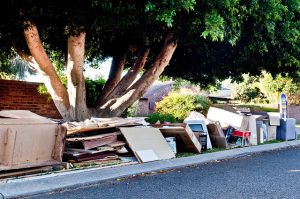
Kerbside rubbish in Stirling WA, photo by Henry Kujda https://flic.kr/p/bNqCRz

During a recent stay in a Brisbane bayside suburb, a kerbside rubbish collection was in the offing. You could tell by the untidy piles of trash lining the footpaths of suburban streets. On my daily dog walks, I became aware of a steady stream of cars with trailers doing the rounds, beating Council trucks to the treasure.

Scavenging from kerbside collections is a time-honoured tradition. Whole generations have furnished their share houses with the kerbside rejects from other people’s homes. We are talking here of household items too big to fit into a wheelie bin, but none so large two people could not lift them. So a fridge is OK, a barbecue (sans gas bottle) probably OK. The large dead limb off the ghost gum that fell on the shed is probably not OK. Most Councils have lists of items you can leave on the kerb and things that won’t be collected (like old tyres, fuel cans, pesticide spray containers, gas bottles, fire extinguishers and so on). Anything made of MDF will probably be left for Council to collect, especially if it rains before collection day.

I helped my brother-in-law carry surplus items to the kerb (an old office chair, a baby’s car seat, a single foam mattress, a dismantled bed frame, a (new) security window frame and so on). No sooner had items been placed by the kerb, a car and trailer would pull up and the driver would start throwing things into the trailer.

Further up the road the same thing was going on, with a certain frisson of tension between scavenging crews. In some ways, it seemed singularly distasteful and desperate, on the other hand, why would we care – we were the ones throwing the crap out.

As part of its War on Waste series, the ABC’s Alle McMahon looked into how different States and Territories viewed the practice of kerbside scavenging. For example, the ACT only provides kerbside collections for seniors and concession card holders. As such, it is illegal to leave items out on the verge or nature strip.

The City of Sydney carefully states: “Our legal advice is that anyone who picks up items left outside for bulky waste pick up is doing so at their own risk.”

As the saying goes: Caveat Emptor, or in this instance, Seminiverbius Emptor.

There are signs that some Councils are abandoning kerbside collections in favour of recycling stations at their local landfill. Up to 60% of waste collected in Australian is recycled, although more than 20 million tonnes of solid waste per year goes to landfill.

While the independent Noosa Shire Council still has a kerbside collection every year, the neighbouring Sunshine Coast Regional Council dumped the practice, which it deemed to be “outdated and environmentally harmful”.

Free annual kerbside collections stopped once the Sunshine Coast Councils amalgamated in 2008, but there has been some pressure to resume. Noosa Shire de-amalgamated and started kerbside collections again, the two Councils tabling vastly differing sums as to the cost of kerbside collections.

Cr Jenny McKay told FOMM she had always been a supporter of the kerbside collection concept but other councillors and staff disagreed for a number of reasons.

“A low percentage of people across the region actually take up the offer, thus making the cost per property very expensive.”

Cr McKay pointed out the council waived fees on some large items (e.g mattresses), when taken to waste facilities.

Early January is the traditional time for household clean-ups. We all warm to the task as a result of disposing of after-Christmas detritus, including careful disposal of prawn shells; the merry rattle of bottles and cans being tumbled into the recycling bin.

But all too often the cycle of change signalled by January 1 prompts people to revisit concepts of decluttering and downsizing, adding specific items to their New Year resolutions.

January often signals the impending departure of the elder child to university or the workforce. If said child is leaving home, there is often a recycling of family junk; the student gets the old fridge and the non-smart TV while the parents go to a department store and buy brand-new everything.

For older people, children long gone and developing their own hoarding habits, it becomes a tussle between feeling comfortable with the familiar and needing to let go for reasons of space and relevance.

Empty-nesters and retirees contemplating a move to a smaller living pace have a different set of problems. If they are moving from a four-bedroom house to a two-bedroom unit, then they will need to get rid of two sets of bedroom furniture as a bare minimum.

The options are: hold a garage sale, list the items on Gumtree or your favourite Facebook free ads site, donate them to charities like the Salvation Army or Lifeline. In many locations, the bigger charities will come and collect the items.

If you are in a state of flux and need to store your household goods for a while, there are no shortages of businesses ready to rent you a lockable storage space.

The self-storage industry large warehouses housing hundreds of lockable storage units – is a $1 billion+ business in Australia, busier than ever as more people relocate from large houses to small units.

But just as EBay and Gumtree disrupted the second-hand store sector, the digital sharing world has caught up with self-storage.

Spacer.com.au acts as a broker for people wanting to store personal belongings, hooking them up with citizens who have spare rooms or garages.

Spacer co-founder Mike Rosenbaum explained what his then year-old business was aiming to do in an article for Domain. Spacer’s customers are typically looking to store household goods, business stock or large items like recreational vehicles, sporting equipment or even nursery items.

“What we’re finding is [extra storage] allows people to live the lifestyle they want to live – typically close to the city or closer to amenities,’ Rosenbaum said.

The average user spends about $250 a month renting space, which typically pays for a single lock-up garage in Sydney or Melbourne.

Spacer now claims to be the largest renter of storage space in Australia, with more than 30,000 units.

The bottom line for anyone who is paying to store household goods off-site is whether the outlay (over the time kept in storage), exceeds the cost of replacement.

For those whose circumstances demand that they scour suburban streets to claim household items ahead of what is sometimes called Hard Rubbish Day, that debate is completely academic.

The Band Who Knew Too Much summed up the life of kerbside scavengers in their pithy song Hard Rubbish Night in Kew.

“This tele’s just a beauty, it’s just like the one at Mum’s, it’ll be great for watching footie; though it’s missing just one leg, I suppose I’ll have to watch it from the broken rocking chair.”

Happy New Year to all FOMM readers, wherever you are.


Revisiting a New Year call for compassion

Here’s a look back in time to my first New Year blog, January 2, 2015. I was eight months into writing the weekly essay and feeling brave. What’s ironic about this New Year call for a little more compassion among Australians is that four years later (in government at least), nothing much has changed.

This is the first edition of Friday on My Mind to link you to my website, www.bobwords.com.au. All mailing list subscribers will automatically receive the weekly posts from now on. So you don’t have to do resubscribe. If you don’t want to receive the blog you can of course unsubscribe.

I’d like some feedback on the website as it is being thoroughly reviewed in coming weeks. I already had a suggestion that the font is a bit small on mobiles, so I’m looking into that. For those of you who just joined, or those who’d forgotten I wrote this, enjoy. I’ll be back next week.

New Year compassion – photo by Eric Parker, flickr

January 2, 2015: There was a fellow selling lottery tickets in Kuranda Village last week. He was trying to gain the attention of passers-by, 99% of whom rushed past, oblivious. Sadly, I count myself among the rushers-by. I had just dropped my wife and son at the Skyrail terminal and was on a deadline to drive down the mountain to Cairns, fuel the hire car and pick them up at the other end. Mission accomplished, but now I’m feeling a teensy bit guilty about ignoring the ticket seller (I deliberately walked behind him on the way back, to avoid the crowded village streets). On reflection, I often walked past a chap with cerebral palsy who was a Queen Street regular when I worked in Brisbane and not once bought a lottery ticket. Was I just being a cheap-arse? Or did I find cerebral palsy confronting? Did I object to this fellow’s tactic of pushing his wheelchair just far enough forward that you had to make a conscious effort to go around? Perhaps I was just lacking in New Year compassion.

It appears to be an Australian character trait, although the 6.1 million people who volunteer for sporting, neighbourhood and charitable organisations would give me grief about that statement. Compassion is all about making room in your head and your heart to care about someone less fortunate than yourself. We’re a weird mob like that. We’ll run florists out of roses to fill Martin Place with tributes for three people we didn’t know who were killed in a hostage situation. But tens of thousands of Sydney workers brush past buskers, beggars, drunks, addicts, homeless people and Big Issue sellers every day of the week. What’s that all about?

The Federal Government isn’t helping us become more compassionate. The Abbott Government’s year-long reign so far has shown callous disregard for those less fortunate than themselves.
The new Minister for Social Services, Scott Morrison, seems hell bent on taking the razor to welfare, ostensibly to fund the National Disability Insurance Scheme, although the Labor Opposition says is already fully funded. In 2008, the new Minister for Immigration, Peter Dutton, became the only Liberal front bencher to boycott the apology to the Stolen Generations. This stance alone must raise questions about his empathy for asylum seekers and those in detention centres.

New Year compassion missing in action in WA

The West Australian Government could be said to be lacking in compassion, given its plans to close 100 small Aboriginal settlements in remote parts of the state. Premier Colin Barnett admits that closing communities is not a good option, but says the lack of a better one has tied his government’s hands. The Commonwealth Government has been the major funder of the 274 existing Aboriginal communities in WA but is “transitioning” that responsibility to the State over the next two years.

So here we all are, a kilo or two overweight from eating prawns, ham, pork, turkey, chicken and duck followed by Christmas pudding, fruit and custard, cream and pavlova and probably drinking more than usual if we knew we didn’t have to drive somewhere.
Did we stop to spare a thought for those who cannot afford to celebrate festive times like Christmas and New Year? Hands up those who dropped some festive fare into collection bin outside the local IGA, or who donated some money to one of the several charities collecting on behalf of needy families.

And can anyone imagine what it’s like working in an accident and emergency ward at this time of year? As of yesterday, 22 people had been killed on Australia roads over Christmas and New Year. More importantly, proportionately more people were seriously injured in car and motorbike accidents and admitted to hospital. We don’t have this year’s statistics yet, but in Queensland alone 6,173 victims of car and motorcycle accidents were admitted to hospital in 2013. Another 379 were cyclist or pedestrians, the latter two categories usually presenting with worse injuries than those who had the benefits of seat belts and air bags. So the survivors and their families need compassion as much as they need medical attention.

Since January 1, 2012, all Australian hospitals have had to admit or refer emergency department patients within four hours. This cruel deadline creates stress among medicos and nurses who routinely work 12 and 16-hour shifts. At least one of the politicians who imported this four-hour rule from the UK ought to go and spend 12 or 16 hours in the A&E of a busy city hospital and see how the workers cope with this added burden, while dealing with the human wreckage which survives road accidents.

Meanwhile we make our way in the world, perhaps developing a cynical shell from big city experiences with those less fortunate. In Adelaide last winter, a street vendor approached me waving the Big Issue. As street vendors go, this fellow was a little the worse for wear. I handed him a $20 note (the Big Issue costs $6) and he muttered something about having no change, so I left him with it. Ripped off?
A friend who has lived in Sydney for decades says professional beggars and hustlers feign homelessness in a bid to separate people from their hard cash. They can make up to $200 a day, he says, and maybe he has good reason to assume that all street beggars (Americans call them panhandlers), are on the make.
We stayed at a boutique hotel in Potts Point in March last year and were twice hustled by a women who looked a lot like the “after” photo on the posters you see of how a beautiful, bright-eyed girl turns into a smack addict. Her pleas for “Any spare coins” turned into invective after a fruitless pass along the street and back again. “Youse are all a bunch of tight-arses,” she complained.

You don’t have to give money to street people who ask you for it, be they beggars, buskers, raffle ticket sellers or Big Issue vendors. But if you allow compassion to overtake your indifference, you may at least start thinking about those less fortunate: for example, the one in 200 Australians who have nowhere to live.
There are many reputable welfare agencies which help people in need and could use donations. Or you could join the volunteer army and make a difference.
Continuing my endeavours to get my head out of the dark place it has been lately, I’ll let you know you how I’m going with my New Year resolution to show more compassion in 2015.

Seasons greetings from The Goodwills

It only ever dawns on me how much we are still doing as a musical duo (and trio- when Helen Rowe joins us) when I lodge my APRA live returns. (APRA is the organisation that pays song-writers royalties when their original songs are played).  

Highlights of 2018 included the Goodwills trio being booked at both the Maleny and Neurum Creek festivals. Both of these small festivals are staying true to the ethos of a folk festival as a community gathering of like-minded people. The latter has a cap on tickets and camping numbers, so if you are serious about going, get in early for the September 2019 festival.

In November, the trio performed at Brisbane’s longest running unplugged venue, Red Hill Folk. If you have never discovered this truly unique jewel in Brisbane’s entertainment scene, it’s at Red Hill Bowls Club every Wednesday night at 7.30. Entry is $2 and there is supper. Some nights it is an open floor event (anyone can get up and sing or recite) and occasionally there are guest acts.

We performed as a duo at the Australia all Over outdoor broadcast in Toowoomba in September. As a bonus, we got to watch the street parade and marvel at how Toowoomba has grown since we lived there in the 1980s.

Once again, we held unplugged house concerts at our home in Maleny with guests including Evan Mathieson, Cloudstreet, Tin Star and Sadie and Jay. In October Bob held a private function at the Maleny RSL to celebrate his 70th. Bob and guests performed to about 85 people and a jolly time was had by all. We called it our ‘out of house concert’. Bob sent emails to just about everyone he knows, so sorry if you missed it for whatever reason, because it is unlikely to be repeated!

Bob started writing songs again in 2018 and has a few in the works for debut in early 2019. We are working with Pix Vane-Mason to put some of these tunes down for perpetuity, so watch this space.

Bob wrote a song about refugees on Nauru, Manus Island et al and made a short video documentary to go with it. If you have not already seen this, it is worth a revisit. (

We’ll be back in the New Year with our house concert series- first one is in February. We’ll let you know the date and guest artists in plenty of time to book.

Finally, thanks to those who supported The Goodwills (and Bob’s blog, Friday on My Mind) through our website shop.

Merry Christmas and Happy New Year.

Bob, Laurel and Helen

Friday on My Mind –Ring Christmas Bells And Other Carols

Tapestry choir leader Kim Kirkman usually introduces our version of Carol of the Bells by mentioning that it featured in the soundtrack of the 1990 movie, Home Alone. This brought back memories of the parlous times in 1990 when media baron Rupert Murdoch nearly went broke. Yes, he nearly did, back when News Ltd’s total debt was a scary $7.9 billion (this was 1990, remember). What saved Murdoch was an agreement between 146 banks that refinancing was a better solution than the collateral damage from a collapsing global media empire.

The other thing that saved Murdoch was the box office success of the Christmas movie, Home Alone, starring Macaulay Culkin. Home Alone became the highest grossing Christmas movie of all time (adjusted for inflation) taking $US477 million in box office sales world-wide, against a film budget of $18 million. Murdoch’s Twentieth Century Fox was the beneficiary of the film’s success. As a recently-employed journalist, I wrote a piece stating just that (News Ltd saved by Home Alone).

The movie spawned four sequels, none of which achieved the heights of the original.

As we all now know, Rupert Murdoch’s foray into film, television and satellite TV paid off. The timely acquisition of 20th Century Fox in 1986 helped Murdoch achieve more fame and fortune via a then unknown animated show, The Simpsons. Launched modestly in December 1989, The Simpsons is still going strong, 649+ episodes later.

As one of the most popular TV shows on Fox Broadcasting, the creators of The Simpsons repeatedly got away with satirising the Fox Network. Animator David Silverman is said to have based the appearance of Homer’s boss Montgomery Burns on Fox chief Barry Dillon, using the body of a praying mantis as a model. Monty Burns is the fictional owner of Springfield’s nuclear power plant, a greedy tycoon who exploits his workers and can rarely remember their names. Hmmm, as Marge Simpson would say.

The crew of Sunshine Coast radio station Hot91 were asked to rate favourite Christmas movies for a feature in the Sunshine Coast Daily’s Weekend Magazine (also owned by Rupert Murdoch). All three DJs rated Home Alone, along with other candidates including The Grinch, Bad Santa (execrable-Ed.), National Lampoon’s Xmas Vacation, Elf, Santa Clause and Love Actually. The latter is cerebral and worth watching but I remember Home Alone as being deeply silly with some dangerous-looking stunts.

Christmas songs often get written about at this time of year, which is hardly surprising as you rarely hear them between January and November. Last year I ranked my top 12 Christmas songs (only three of which are carols).

As a member of a choir, you are expected to sing Christmas carols, which almost always lend themselves to harmonies. Our choir Tapestry racked up five performances this month, which is some kind of a record. As a serious chamber choir, we mixed it up a bit, from the ancient (Veni Veni, a Gregorian chant in Latin) to an irreverent piece about Christmas excess (The Banquet Fugue), and a short protest song (‘The Wrong Present’ aka ‘Don’t sing me Christmas Carols anymore’). We did a good job of the Little Drummer Boy and worked an uplifting key change into the last verse of Handel’s Joy to the World.

Thankfully, Kim elected to stay away from the tedious (12 Days of Christmas) and the seasonally irrelevant (White Christmas and Frosty the Snowman), although we did perform Rudolph and We Wish You a Merry Christmas for those who might have been thinking we were being a bit too precious.

This month She Who Sings O Holy Night (that was in Home Alone too), with me in tow attended quite a few Christmas parties where carol books were handed out. I got chatting to a chap who was hovering out in the kitchen (my usual retreat at parties). We discussed why people are so attached to these songs, so many of which are deeply pious, with their references to the Virgin birth, three wise men, the holy infant and home birthing in a stable.

Statistics on religiosity are unreliable; even though the 2016 Census tells us that only 52.1% of Australians identify as Christian, it is an optional question, which 9.1% chose not to answer. Otherwise, 30.1% answered ‘no religion’ and 8.2% nominated a faith other than Christian (including 2.6% or about 630,000 people, who follow Islam).

You will find other surveys which suggest that Christianity is in decline and that Australia is becoming more secular. Which begs the question why people who probably last entered a church for a wedding or funeral will happily sing along with Good King Wenceslas and Oh Come all Ye Faithful. Ah well, it is all about peace, love and goodwill so what’s not to like.

As you might suspect, however, I prefer Christmas songs that take the piss. This year’s award goes to Keir Nuttall’s classic Christmas Landfill, performed here by Keir and his partner Kate Miller-Heidke. The combination of a sweet Christmas melody and Keir’s satirical lyrics (‘fleeting joy will never decompose’) is just perfect, moreso with the help of superimposed lyrics. This video also includes KMH’s cover of Tim Minchin’s White Wine in the Sun.

I should follow this with a reassurance that I’m not dissing Christmas or the joy it clearly brings so many people. You can tell how serious I am by the inclusion of this video of Tapestry performing The Little Drummer Boy, The women had the melody, so the job for the basses and tenors was to imitate drums (hence heads buried in scores).

I should also clarify my remarks about Christmas carols and religious music in general by observing that the charismatic church Hillsong has produced Australia’s best-selling CD on a fairly regular basis. Sydney Morning Herald reviewer Bernard Zuel harshly but probably accurately described Hillsong’s 2015 Aria winning album Empires as a ‘churchy songbook sung by mostly anonymous faces scrubbed clean of any travails’. Nonetheless, the album sold 7,000 copies in its first week of release, 2,000 more than the debut solo album of former Silverchair songwriter Daniel Johns. Go figure.

Since we exposed you to Tapestry’s version of the Little Drummer Boy, let me leave you with this version by Johnny Cash and Neil Young.)

Merry Christmas from FOMM. Take care on the roads (said he who got a ticket in the mail from NZ). 

Re changes at FOMM: Next Friday you will all receive a link to a New Year blog. Thereafter, the weekly email will direct you to the website www.bobwords.com.au. Anyone can subscribe (email link at the top of the page) and of course unsubscribe at any time.

Thanks to those who have already responded to my (optional) subscriber drive for payments of a suggested $5, $10, $15 or $20 to defray the costs of running the website.

Payments can be made via PayPal or direct debit (follow this link www.thegoodwills.com/shop). The subscriber drive ends on January 31, 2019.

How the Nine Fairfax merger affects regional media

Did you know that the removal of Malcolm Turnbull as Prime Minister in August cost the taxpayer $4.5 million? Canberra Times journalist Latika Bourke revealed this in a news report, adding that the cost included $1.9 million, paid out to 35 former Prime Ministerial staffers. Crikey, I’m in the wrong business.

 Labor’s finance spokesman Jim Chalmers told Bourke the sum was another cost to voters of the ‘meaningless’ leadership change.

“Scott Morrison can’t explain why Turnbull isn’t PM anymore and why taxpayers have to foot the bill for that.”

Chalmers (a former chief of staff to Wayne Swan) said 607 staff members’ employment changed as a result of Mr Turnbull’s removal as prime minister, with 136 staff terminated and the remaining 471 re-employed. The figures, which do not include the cost of the Wentworth by-election (approx $1.6m), emerged from a Senate estimates hearing.

 Enjoy that little public interest vignette from the Canberra Times while you can. Nine is shopping around for a buyer. Nine does not want the Canberra Times because it does not have a paywall; people who might otherwise pay to read the Sydney Morning Herald or the Age have been getting their news for free from the Canberra Times, chief executive Hugh Marks told staff on Monday.

The Nine Fairfax merger means much of its regional assets will be sold – the key question being, to whom, as there are not many takers in this tightly-held media market. The same applies in New Zealand.

Kiwi columnist Bill Ralston observed in The New Zealand Listener (owned by Bauer Media), that the media industry is in the process of ‘collapsing into an untidy heap as advertising revenues and profits decline’.

Ralston was bemoaning the fate of local media outlets in the wake of the Nine Fairfax merger. Nine has already said it is not interested in the newspapers Fairfax owns in New Zealand.

If you have ever browsed a popular Kiwi website, stuff.co.nz, you may not know that Stuff/Fairfax also owns nine daily newspapers, a Sunday newspaper and New Zealand’s TV guide. Stuff also owns community newspapers, 28 of which they want to close or sell.

We’ve seen a rationalisation of (free) community titles and regional mastheads in Australia too. As you should know, Rupert Murdoch’s News Ltd bought all of the regional titles of Australian Regional Media in late 2016. This, added to the papers it already owned, delivered an absolute print media monopoly across Queensland.

News wasted no time syndicating Sky News conservative commentators including Andrew Bolt, Paul Murray, Peta Credlin and Alan Jones. A comrade in Toowoomba emailed me last year to say that the editorial space where once a column called Friday on My Mind appeared was now hosted by the aforementioned Mr Bolt.

AND WE ALL KNOW WHAT HE THINKS.

I was idly channel surfing late at night in a Rotorua motel when I stumbled upon Sky News Australia, where the hosts (Bolt, Credlin and Jones), were holding court about political events of the day.

Hold fast, my fair-minded side said, listen to what others have to say. By the time Alan Jones came on, with his scoffing dismissal of Liberal MP Julia Banks’s defection to the crossbench, I felt like the victim of a home invasion.

I switched briefly to Al Jazeera (Kiwis get a lot of free Sky channels), before finding respite in Hunting Aotearoa and a Mars Bar from the mini fridge.

So yes, it is wise to tune in and see what the right wing polemicists are saying. For example, at the time when the Kids off Nauru campaign was at its height, Paul Murray was writing in the Sunshine Coast Daily about indigenous children and venereal disease. He wasn’t saying one issue was more important than the other, he just chose that one instead.

Amidst the Nine Fairfax merger, leftish publications like New Matilda, The Monthly, The Saturday Paper and The Guardian Weekly kept on chipping away. The latter just had a magazine-makeover and a new cover price ($10.95), which might make you feel bad about reading it online (for free).

A friend recently shared an article on Facebook from Bauer Media’s The Monthly. Author John Birmingham waxed long and eloquent about Peter Dutton’s electorate and how alternative forces are plotting to overthrow the incumbent at the next election.

You might be able to read this here, though once I’d finished reading, The Monthly reminded me that I’d had my one free item and if I wanted more I’d have to subscribe. Well, I did once, for a few years.

Some of you will know that when someone shares a link to an article from The Australian (for example), you often can’t read it at all without being a subscriber. Many media companies use variations on the paywall theme. Some provide free articles (up to a specified number); some have free content and premium content.

Get used to this idea. Media organisations that opt for the paywall method will be on a subscriber drive, offering discounts, free gifts, vouchers and coupons and inducements like (trial) access to other titles.

So the Nine Fairfax merger is done and dusted, and with it went 144 back office, sales and support positions. Nine has pledged to honour the Fairfax code of editorial independence and thus far, no editorial jobs have been lost.

As Bill Ralston points out, it makes (commercial) sense for big companies to concentrate ownership of radio and TV stations, newspaper and magazines and online news outlets. They can offer better deals to advertisers and, by merging and consolidating, enjoy ‘synergies’ – shorthand for downsizing newsrooms.

Apropos the Nine Fairfax merger he makes a suggestion (which could also work in Australia), that the government-owned TVNZ ‘snaffle up the remnants of Stuff before the Fairfax papers die of exhaustion and thus, hopefully, reinvigorate both organisations’.

In Australia, a similar scenario could see the ABC ‘snaffle up’ the regional assets Nine don’t want and thus broaden the ABC’s remit from broadcasting into print and online newspaper publication.

This is an interesting proposition, given that the Australian Consumer and Competition Commission has just ruled that the ABC and SBS do not have an unfair market advantage over their commercial rivals.

In a busy year, the ACCC this week also released its preliminary report into the market power held by Google and Facebook.

Academics employed by Sydney University of Technology’s Centre for Media Transition analysed the ACCC paper. Derek Wilding and Sacha Molitorisz summarised the issues at stake, including $8 billion a year spent on online advertising revenue. This has happened at the expense of newspaper classified advertising revenue, which fell from $2 billion in 2001 to $200 million in 2016.

More than half of the annual online advertising spend went to Google and Facebook. And, as the ACCC notes, more than half of the traffic on Australian news websites comes via Google and Facebook.

One of the ACCC’s main concerns is the lack of transparency (consumers are not told how Google and Facebook algorithms work). The key concern is that we (the users) do not know how digital media platforms manage to target advertising with such uncanny accuracy.

Perhaps like me, you may have idly wondered how, after a private dinner conversation about bread makers, ads for bread makers start appearing in our social media news feed.

Toast, anyone?

Planned obsolescence strikes again

On Tuesday I joined the queue of people at the local computer shop, all clutching laptops, smart phones or PC peripherals suffering from planned obsolescence syndrome. Some of these items may still have been under warranty (joy). But in the case of my four-year-old Toshiba laptop, the optical drive, the fragile looking tray that slides out to take CDs or DVDs, had carked it.

It failed just as I finished burning a 58 minute video of our choir Tapestry’s Christmas performance. “Do you want to burn another?’ the video editing programme asked. “Yes” I clicked and the optical drive then made a noise like the dentist burnishing my teeth with plaque-stripping paste.

The young chap behind the counter (they’re all young), spent some time testing then pronounced it dead. “We have plug and play drives for about $50,” he said. “But we haven’t any in stock at the moment.”

Ah, so this is a frequent event in computer repairs and replacement land. A google search of ‘CD DVD drive failed’ brought a consensus that an optical drive in a laptop will rarely last five years.

A recent article in Lifewire explained why so many desktop computers and laptops sold today do not have CD or DVD drives installed. They are being dropped to save space and also because portable flash drives and hard drives have more capacity, perform faster and are definitely cheaper than sourcing a replacement optical drive (which includes an hour of labour to remove the old and install the new).

A while ago, I gave a copy of our latest CD to someone who has been helping me retrieve my sense of perspective. Last time I saw him he confessed not to have listened to it yet, the problem being he had nothing on which to listen to a CD except his (work) laptop which, I suspect, is never used for anything other than work. CD players are becoming obsolete. If you still have one and it has started to misbehave, it probably won’t be worth repairing. Most late model cars don’t have CD players, preferring USB, WiFi and Bluetooth to extract music from the ether.

Like so many Millenials in Australia, most of my younger relatives in New Zealand have Bluetooth speakers,which play (compressed) music streamed from their phones or tablets.

“I couldn’t find you on Spotify, Uncle,” said one.

Let’s examine the logic here. The average lifespan of a laptop computer ($400 to $1,800) is three to five years. Bluetooth speakers ($40 to $1,000) have not been around long enough for lifespans to be established,but there’s an amusing exchange on techguy.org about this very subject “until it stops working”, one wag offers. Two years seems to be the current guess, and that is largely based on the lifespan of the battery (some of which are replaceable, and some not). And don’t even start me on mobile phones (I’m on my third one in four years).

 The trick might be to buy top quality gear in the first place. One of the five components in my Technics stereo (a top line model, circa 1985 – before planned obsolescence became widespread), is showing signs of failure. The CD changer plays OK but then inexplicably stops, or skips to another track or to the middle of another track. In the office downstairs I usually play music through computer speakers from my iTunes library.  ITunes and streaming services compress music, the downside being an unavoidable degradation of audio quality. The advantage for musicians in compressing a 24MB audio file to a 2MB MP3 that can be emailed is obvious. I once emailed a demo to London at 10pm our time, to a songwriter friend who listened to it over morning coffee and sent immediate feedback.

The convenience and the speed with which music can be recorded and disseminated (and listened to on a virtual jukebox), outweighs the loss of sonic integrity.

Or you can reject planned obsolescence and go retro. One of my relatives has a quality audio system which is set up to play vinyl. There was just something so real about the velvety voice of Marlon Williams coming out of those speakers that made a mockery of my MP3 version of the same album.

Aotearoa has had a long love affair with vinyl records. EMI produced the first one from its Wellington factory in 1955 (the WinifredAtwell selection). The last vinyl record production unit closed in 1987 and EMI shipped the hardware to Australia. Many Kiwi (and Australian) artists still produce vinyl versions of their music for those who have fallen in love with or rediscovered the quality of analogue sound. A few pressing plants keep the faith, including Peter King’s King Worldwide in Ashburton (NZ) and Zenith Records in Melbourne.

As Ted Goslin writes, when explaining why vinyl is making a comeback (14m copies sold in the US alone last year); it’s become cool. Half of those buying vinyl are millennials, although 27% are over 35, buying new albums or raiding their baby boomer parents’ LP collections. 

But as we established, the immediacy of digital music is its strength. Someone once emailed me the words to an amusing parody of Joni Mitchell’s Both Sides Now, “I burnt the toast on both sides now” is funny and somehow sacrilegious, the perfect foil to slide into a broader discussion about planned obsolescence.

A friend had a toaster given to her in 1971 which had spring-loaded ‘gates’ on both sides. Although she has since bought a four-slice, pop-up toaster, the old one still works and is brought out sometimes to remind us of the days when a lot of kitchen work was not automated. Some even washed dishes by hand.

According to a blog in The Spruce, a toaster should last six to eight years. When you think about it, there’s not much to a toaster and it only has to do one job. Choice Magazine said just this when handing out one of its Shonky Awards to the (RRP $189) KitchenAid2 two-slice toaster, to which Choice gave a score of 0. The testers even took it back and got a replacement with the same poor result. Choice branded it a ‘pricey paperweight’.

We’re familiar with consumer goods which don’t come up to scratch and it’s not always a case of getting what you paid for. At FOMM HQ we’re on our third microwave in five years and this one appears to be rusting on the bottom. The Spruce blog reckons a microwave will see out nine years, a slow cooker and a coffee machine six to 10 years and a vacuum cleaner eight years. Writer Lauren Abrams say much depends on the quality of the appliance, how often you use it and how well you look after it.

The toaster in our caravan, now in its third year, gets a wipe over every three months or so and, like the house toaster, the crumb tray gets emptied at least once a year! It was an impulse buy ($7 from a Goondiwindi discount department store). It works just fine so long as I adjust the timer (if She Who Toasts Gluten-Free Bread has been there first).

In the words of Canberra parodist Chris Clarke:

I’ve burnt the toast on both sides now,
Both front and back – to charcoal black,
The toasting time I don’t recall,
I really can’t make toast, after all.

More reading:

The Waste Makers: Vance Packard (1960)

Made to Break: Giles Slade (2007)

Fixing your PC with a hairdryer