We launched this song on September 30 and Bob made a slideshow at the weekend. We think it’s an important issue so please, have a listen and a look and share. Bob and Laurel
Witty, thought-provoking songs + reflective essays

We launched this song on September 30 and Bob made a slideshow at the weekend. We think it’s an important issue so please, have a listen and a look and share. Bob and Laurel
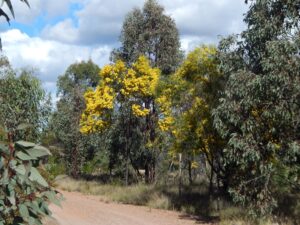
I decided to write a song about the referendum and had the idea of asking the question: what if we’d had citizens’ referenda about really controversial issues like Iraq and Vietnam? Did we get asked? Eventually the song gets round to talking about Yes23, which ought to be a fait accompli but probably not. The link will take you to Should we say Yes, which is published on our Bandcamp page. You can listen to it a few times before it will ask you for money!
Bob Wilson

The last episode of this weekly essay was published on September 1, 2023. After nine years and three months of posting a 1200-word essay on random topics every Friday, we are taking a sabbatical. When I say ‘we’ I mean me and my trusty editor, Laurel Wilson. Many thanks to the very many academics and researchers who helped me out, whether they knew it or not! The database will be available here for the foreseeable future. From time to time, you may hear from me as the muse dictates.
I leave you with an important link which will explain much of the misinformation being disseminated about the Voice to Parliament. First you need to disregard the pamphlet sent to you by the Australian Electoral Commission (AEC). While the pamphlet sets out the Yes and No cases in equal proportions, none of it has been fact-checked. Legislation forbids the AEC from doing so.
Instead, the AEC maintains a ‘disinformation register’ but you must go to the website to peruse this. Fascinating reading.
https://www.aec.gov.au/media/disinformation-register.htm
Haere Ra from Bob and Laurel (which in Te Reo Māori simply means goodbye).
Bob Wilson 8/9/23

Since this is now the way of the world, I decided to Google myself and ask ChatGPT to write a blog in the style of bobwords.com.au. The topic – ‘saying goodbye’. The following (in italics) was generated in 11 seconds.
Hey there, lovely readers of BobWords.com.au! Today, we’re delving into a topic that resonates with all of us at some point in our lives: saying goodbye. Life is an ever-changing journey filled with moments of joy, growth, and, of course, farewells. As we navigate these bittersweet moments, let’s explore how we can make goodbyes meaningful and even transformative.(Ed: making vomiting noises)
Life is like a river, constantly flowing and evolving. Just as we welcome new beginnings, we must also bid adieu to chapters that have run their course. Goodbyes mark the end of one era and the beginning of another, bringing change and growth into our lives. Embracing this natural cycle can help us move forward with grace and an open heart.
Goodbyes give us the opportunity to reflect on the beautiful moments and experiences that we’ve shared. As we bid farewell, we can take a moment to savor (sic) the memories we’ve created. These cherished moments become the threads that weave the tapestry of our lives, reminding us of the laughter, love, and connections that have enriched our journey.
Saying goodbye isn’t just about closing a chapter; it’s also about finding closure within ourselves. Every goodbye opens the door to a world of new opportunities… (I cut it off here, because I was beginning to yawn. Ed)
Now I’m starting to worry about the 7 million blogs which are published every week. I wonder how many of those writers will succumb to this techno-rubbish because it is fast, free and easy? Well, so far it is free.
As The Guardian recently discovered, Rupert Murdoch’s news empire has been publishing up to 1200 stories a week confected by ChatGPT.
A Nick Cave fan asked ChatGPT to write a song in the style of Nick Cave which he then sent to Nick who responded in his inimitable way.
For my money, nothing will ever beat Cave’s imagery: ‘my piano crouched in the corner of my room. With all its teeth bared.’ proof that technology cannot better creative genius.
I started Friday on My Mind to address what I saw at the time as one of the shortcomings of traditional media. It was more about what they were not reporting rather than the slant put on things they dId report. Unlike most bloggers, I started with an email list which grew and grew and spent little time fine-tuning the website so I’d be ‘discovered’. It was quite some time before I even realised I should be attending to SEO (search engine optimisation), shorthand for writing in such a way that Mr Google’s bots can find (and rank) your blog. Consequently, you will find that blogs written with SEO in mind will be peppered with ‘keywords,’ cynically deployed to help lift your offerings higher in the google rankings.
Social media and the 24/7 news cycle has changed the relevancy of blogs like mine. What might have been a breaking story on Tuesday (when I sometimes come up with an idea), is old hat by Friday. Much of the time I have picked random topics which may or may not be in the news cycle. Probably because I have been writing since the early 1980s, my ‘news sense’ is still intact and the random offering at times becomes accidently relevant.
There has also been an emerging coterie of media commentators who like the luxury of expanding online on a topic. As they do it for a living, you can find their utterances on most social media platforms. I noticed about a year ago the redoubtable Hugh Lunn started publishing highlights of his journalism career on Substack.
Last week I said Sayonara to Twitter/X after first downloading my data. I only opened a Twitter account because people assured me that is how people would find my blog (1200 words? TMTR (to much to read, for those born last century and/or who may not be familiar with this acronym. Ed)).
The most exciting things that happened to me on Twitter was a veteran songwriter proclaimed to his followers: “Hey people, bobwords48 is Bob Wilson, who wrote Underneath the Story Bridge.” Unlike my approach to shutting down this weekly offering, I left no trail on X (depicted on social media as a burning cross), for anyone to find me. The digital spring clean is ongoing.
My sister explained to me at our last meeting that as we age our world becomes smaller, and in many ways that is a desirable thing. Why have four email accounts when you only need one? Why have an Ebay account when you haven’t bought anything for two years?
I can hear John from Melbourne in my ear – ‘Bob, you’re waffling’.
As this is my fond farewell from this particular platform, may I thank you all for the many kind words arriving by email. I will answer them all over time. I was happily surprised to find messages from readers who have not once responded to any one column but claim to have read it every week ‘with dedication’.
As for the writing – I was helped from time to time by contributions from guests including Laurel Wilson, Norm Boniface, Phil Dickie and Lyn NuttalI. Sometimes FOMM even unearthed a real news story. In July 2017 while on a caravan trip out west, I discovered the re-emergence of prickly pear. I wrote about this infamous imported noxious weed, which we all assumed had been eradicated. Not so, and after posting this, mainstream outlets (Landline, Queensland Country Life) started picking up the story.
I was reminded about this recently when writing about the wind farm being built outside Warwick. Among the many tasks facing Acciona, the wind farm developer, 37,600 prickly pears were ‘successfully treated” as part of a weed removal project on 33,000 hectare sheep station it has leased for its 187-turbine wind farm.
“Oh yeh, it’s coming back,” my brother-in-law confirmed, on discovering several bushes/trees on his acre of land at Yangan outside Warwick.
There are some amusing pieces of writing in the FOMM archive and also a few serious ones that reflect on depression and suicide, homelessness, refugees and the climate crisis.
For those of you who received this in an email delivered by Mail Chimp, don’t forget you can revisit past FOMMs by going to the website www.bobwords.com.au and searching through nine years’ worth of archives. I have been re-reading a few, especially from our around-Australia jaunt in 2014.
I have readers in the UK, Canada, the US, China, Ireland, New Zealand, Singapore and Hong Kong (expat journos missing home). Among the most popular columns was an obit I wrote for Gough Whitlam and a rant about shutting down my private post box. If you are feeling bereft next Friday, go and choose one at random. The index app is very good – try the keywords Anzac, PO Box, Whitlam, Nullarbor, Killjoy and King for a Day to get started. Just a few I was pleased with for their wit and wisdom, even if WordPress kept nagging me to ‘improve your readability score’.
In closing, Narelle Chatbot would like to add:
So, dear readers, here’s to embracing life’s bittersweet moments, to cherishing the memories we’ve made, and to welcoming the unknown with open arms. Until next time, take care and keep embracing the journey! (Ed:…
LOL
In a week or two we expect to emerge from the studio with a timely song which I would like to share with FOMM readers.
And it’s ‘good night’ from him, and it’s ‘good night’ from her…
Bob and Laurel
 Sometimes when researching some arcane topic for this nine-year-old series of weekly essays, I get tired. No, not ‘tired of,’ as predictive text tried to anticipate. Just tired, much as political commentator Ronni Salt says in the ironic intro to her Twitter/X page – ‘I used to investigate stuff but got tired of it.’
While Ronni Salt continues (see The Shot), today I’m declaring this the penultimate (second-last) weekly FOMM. Don’t all go ‘Nooo’ at once. Nine years is a good innings and it is starting to feel like a chore. I am also finding myself repeating topics I have already vented about. The last weekly FOMM will be posted on September 1, which nicely coincides with a week away in Sydney without having to think ‘What will I write about this week and should I take my laptop?’)
The website www.bobwords.com.au will remain in place until the next web host subscription is due (November 2024).
It’s unlikely this is a complete end to my following current affairs and fulminating about this or that. A rogue column or two may sporadically emerge. You may find new songs emerging on our sister website – thegoodwills.com or on Bandcamp, as one sign of new-found liberation.
I decided to refresh my research into what I have been competing with for people’s attention. Not that Friday in My Mind counts as a blog – it’s too long, earns no money, is posted only once a week, has no ‘target audience’ as such and my attention to SEO (search engine maximisation) is fairly scant.
People find it by accident and while there are a few hundred who never miss it, there are those who have only read 6% to 10% of regular posts.
Nevertheless, I apparently have hundreds of followers on various social media portals. Given the sheer weight of blogs/rants which abound on social media, though, I suspect FOMM will, like the little list song from The Mikado, never will be missed.
Statistics on blogging make my head spin. Let me run a few of these by you (stats can be found on most online marketing company websites).
The global number of blogs is over 600 million (more or less where it was when I started in 2014), according to Firstsite.com. There are 32.7 million bloggers in the US alone and every day 7 million blogs are posted on the Internet.
There’s work in that ‘space’ for all those former newspaper reporters, that’s for sure. Most corporate, small business and startup websites maintain a blog and I assume they pay people to write them. Here’s one example, a website called Clever Girl Finance (Our mission is to empower women to achieve financial success). I started to browse through this website and realised it is based in the US. But it’s a good example of a professional website where articles are not only written but edited and fact-checked! (Who has the time for that, eh!)
I did also find this list of 10 Australian personal finance/financial planning blogs, few of which I have ever consulted, but it’s an interesting ‘space’ to investigate.
WordPress remains supreme among blogging platforms, controlling 43% of the world’s online blogs. But it’s a clunky app/programme. If your WordPress website is truly ‘broken’ you will have to pay an expert to fix it. Every time you update to the latest version, you should always do a backup, as WordPress itself advises. Updates have been known to ‘break’ websites.
OptinMonster, an online marketing company, is another source, among many, that periodically reminds readers of the powerful statistics behind blogging. For example, about 70 million posts are published each month by WordPress users (four or even five of which were mine).
Reader like commenting on blogs – 77 million opinions every month. (My experience in the first year was that 95% of comments were spam. After I found out how to block Olga from Sweden and Svetna from Slovakia, legitimate website comments were few and far between).
The average blog post takes 3.5 hours to write, ‘they’ say. You could safely double that for FOMM, much of the effort going into fact checking and proof reading. (Yay me. ED) Even when this happens, occasional hiccups occur. Last week, I referred to a 23m wind turbine tower, the zero at the end having been whisked away by an errant August westerly. Thanks Randall for pointing that out. (Ed was asleep at the wheel?)
This statistic I knew about – bloggers who write articles of 2,000+ words are far more likely to have strong results. (I started with 1200 words and on occasions drift out to 1400 or 1500. Nobody notices.)
For a while I subscribed to platforms which encourage fulsome writing – Long Reads, Medium, The Big Round Table, The Atlantic etc. Without exception, I fell away from following them as my inbox became cluttered.
I should warn that some of these essays run to 15,000 words, so are best read on a tablet with an e-book reader.
The experts reveal that while 77% of people say they read blogs on a regular basis, 43% admit to skimming blog posts. The nature of online posts, many of which use bullet points, lists, videos and photos to convey their message, encourages this skim-reading.
OptinMonster came up with this reassuring statistic; that while 46% of bloggers edit their own work, 54% have editors or have at least shown their work to someone else to review.
Elsewhere, you will find statistics that suggest the average blogger will last two years before deciding they are scattering pebbles into the ocean and barely causing a ripple. They either tire of the work involved, become discouraged by the paltry income or (more commonly), move on to other things.
I have a couple of bloggers on my list of recommended reads who have been writing longer than I have and show no signs of giving it away. Unlike me, they have books to sell and reputations to uphold.
At this point, I have no thoughts at all on how to end this long-running column/blog other than to say the final episode will be posted next Friday. Suggestions welcome!
In the interim, you might like to delve into the FOMM archives, or better still amuse yourselves with this account of an overseas junket by a New York Times writer.
Here, to prove you can actually be assigned to travel to Finland to write about such things, is Mark Binelli’s lengthy investigation into the origins of salty licorice and why some people cannot be without it.
We grew up living down the road from a Dutch family who received regular care packages from home, including that peculiar sweet (I wouldn’t call it sweet. Ed) treat. It is definitely an acquired taste. The upside is you don’t have to share with others! (True love is also buying one’s spouse salted licorice when one indulges in their love of Rocky Road…Ed.)
(PS: the local sweet shop stocks mild, double and triple strength, and no, they are not paying me to write that).
The Goodwills Newsletter
August 2023
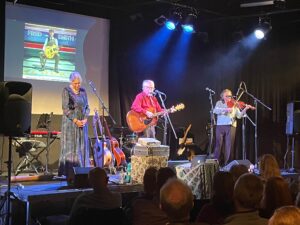
We’re delighted to announce that the Goodwills Trio will be performing at this year’s Maleny Music Festival, which is on from Friday November 10 to Sunday Nov 12, 2023. Fiddler and singer Helen Rowe joins veteran duo Bob and Laurel Wilson to present what is becoming known as ‘harmonic folk’. – mainly originals with our special 3 voice blend.
This is the 10th anniversary of the Maleny festival, which was re-invented by Noel Gardner and friends. As we all know, the original Maleny Folk Festival, which started in 1987, morphed into the Woodford Festival, which has become one of the biggest music festivals in Australia. There was always a hankering to return to the small-scale, good vibes feel of a smaller festival. Apart from the Covid-19 interruptions, it has all gone well.
The programme looks good and we will be camping there for the duration. As to when we are performing, you’ll need to check the programme later in the year.
The festival programme is being progressively released on the Facebook page – sign up here and stay in the picture. https://www.facebook.com/MalenyMusicFestival
Our public appearances this year have included Folk Redlands, Sunday Folk at Nambour (supporting Fred Smith) and a spot at The Bug in July.
Check out our music on this website or at https://thegoodwills.bandcamp.com/music

I thought it high time I wrote about wind power generation, given this region’s burgeoning reputation as Queensland’s Green Energy Hub. The Southern Downs already earned this cachet by building a 64 megawatt solar farm near Warwick. As power-generating capacity goes, this was by far upstaged by the MacIntyre Wind Farm, tipped to become the world’s largest onshore wind project.
More about Acciona’s 1.025MW wind farm later, but first, a history lesson. Just about any company with an interest in wind power generation has latched on to the quote from former US President Abraham Lincoln. Old Abe was a bit of a closet scientist, known for being the first US president to have an invention patented in his own name. Of wind power, President Lincoln said (in 1860): “As yet, the wind is an untamed and unharnessed force; and quite possibly the greatest discovery hereafter to be made, will be the taming, and harnessing of it.”
Not just Abe, though. As a blog by UK energy firm NES Fircroft explains, the idea of using wind power occurred to humans as early as 5000 BC, when wind was used to push boats along the Nile.
In the Middle East and Persia (now Iran), windmills were used to grind grain. In China around 200 B.C., they were used to pump water.
During the 9th century Persia, Afghanistan and Pakistan, wind-powered machines were developed to mill cereals and pump water. This technology progressively made its way to Europe. Windmills have been used since the 14th century by China, Italy and the Netherlands. It may also occur to readers that Australian farmers sought to harness the wind to pump water on remote properties.
Professor James Blyth of Anderson’s College, Glasgow, Scotland is credited with creating the first wind turbine in July 1887. He used to power to light his holiday cottage, but his offer to share the excess electricity with the nearby village was knocked back as his creation was deemed to be ‘work o’ the de’el’ as my Da would have said).
Also in 1887-88, American Charles F. Brush created the world’s first automatically operated wind turbine generator mounted on an 18-metre-high tower. The machine was slow and its 144 blades produced only 12 kW. It was used between 1888 and 1900 but subsequently fell into disrepair. That seemed the fate of a lot of early wind projects, most of which were experimental and none were able to attain a commercial rate of power generation.
It wasn’t until 1941 that a wind turbine was developed that could generate more than 1 MW of electricity.
Fast forward to 2023 and Acciona Energía’s 1,026-MW MacIntyre project is the company’s biggest renewable energy facility and one of the largest onshore wind farms in the world.
Developed in partnership with CleanCo, the Queensland Government’s newest renewable energy generator, the $1.96 billion wind farm is expected to be operational in 2024-2025.
Acciona’s wind farm when completed will have 180 5.7-MW turbines, each standing up to 230 metres in height.
The economies of Goondiwindi, Toowoomba and the Southern Downs are direct beneficiaries of an estimated $500 million spend during the construction phase. As work continues on the leased 36,000 hectare property 50kms south-west of Warwick, Acciano is increasing the number of on-site accommodation units to 550, to take pressure off the rental property markets in nearby towns. The end game is to generate enough power for 700,000 homes.
While all this large-scale construction and planning is going on less than 50 kms from town, I was intrigued to hear a local chap tell me he is looking at installing a domestic wind turbine on his property. What? I had no idea.
Yes, it appears that competition, improved technology and economies of scale are opening up a new green industry to help home owners who are aiming for self-sufficiency. A home wind turbine system can cost between $10,000 and $20,000. There are technical issues and obstacles in terms of local government by-laws and whether it is a suitably windy location. They pay-back period is lengthy.
If you were an early adopter of solar energy, you may well remember that in the beginning, the entry price was prohibitive. The upside only became apparent when governments agreed to provide incentives. There does not appear to be a lot of research done in Australia into small-scale wind turbines or much enthusiasm. Not so in the US, where climate writer Michael J Coren, writing in the Washington Post, found there was a 30% tax credit for home wind turbines.
The official advice from the Australian government website YourHome is that wind generators are not suitable for most homes.
“Household wind systems are much more expensive than solar PV systems, and wind turbines must be situated where they can catch smooth, strong, consistent winds. Few homes in Australia have such locations.”
In 2020, the Australian Renewable Energy Agency (ARENA) announced funding to install small wind turbines at 10 remote Australian communication sites as part of a new project to boost the uptake of the technology.
Newcastle University startup Diffuse Energy has invented a blade-less turbine which doubles the capacity of wind power generators. Their Hyland 920 turbine is capable of producing 500W of electricity.
ARENA said at the time it was funding the project on the basis it would provide a renewable alternative to diesel generators, reducing energy costs and improving resilience against bushfires and other natural disasters.
While implementation of this project ran into the usual setbacks caused by Covid-19, Diffuse Energy’s founders have their eye on the global telecommunications market. They predict it will spend more than US$3.4bn on distributed energy generation by 2024.
At the end of 2018, ARENA said there were 94 wind farms in Australia, delivering nearly 16 GW of wind generation capacity. The cost of utility-scale wind energy in Australia is expected to continue falling, with new wind farms delivering electricity at around $50-65/MWh in 2020 and below $50/MWh in 2030.
Scrolling through the highly technical Australian Energy Statistics for 2022, I discovered these references.
Renewable generation increased 18% in 2020–21, contributing 27% of total generation. Solar and wind contributed 10% and 9% per cent of total generation respectively. About 17% of Australia’s electricity was generated outside the electricity sector (by industry and households), including 7% small-scale solar PV.
It’s a long way from the 1970s (when Telstra first used solar panels to power infrastructure). Few private homes had solar then and if so, they were usually in remote locations far from power lines. According to US group Dash Energy, solar technology cost around $20 per watt in the 1970s with around 14% efficiency. Today’s solar panels average between 15-18% efficiency. Costs can be as low as $0.20 per watt. On this basis you’d expect domestic wind turbine systems to become comparably more affordable (and more efficient).
Meanwhile, work carries on at Acciona’s wind farm site where 41 turbines have been fully installed, according to its July update. And 34% of a planned 70km network of paths connecting the turbines has also been completed. Acciona will be taking (free) community bus tours out to the MacIntyre site on several dates in September, November and December. The first one is already booked out.

You’d have to give the Internet prize this week to the wag who posted a photo of Opposition Leader Peter Dutton (against a background of jubilant Australian soccer players).
“Peter Dutton needs more details before he will support the Matildas,” the satirical headline read.
The Matildas meme most accurately portrays the intransigence of the Opposition Leader’s approach to the Voice referendum, saying No because he doesn’t have enough ‘detail’.
Mr Dutton, perhaps unfairly, has been tagged the poster boy for the No vote. There are many others and some far more to the right than the LNP Leader and that’s saying something. But as a friend said during a discussion last week, those who say they are going to vote No cannot mount any form of rational argument as to why.
The Voice is a national vote to change the Constitution to recognise the First Peoples of Australia. The advisory body would give advice to the Australian Parliament and Government on matters that affect the lives of Aboriginal and Torres Strait Islander peoples.
On the face of it, you’d have to wonder what all the fuss is about. After all, in 1967, 91% of Australians voted to change the Constitution so that Aboriginal and Torres Strait Islander peoples would be counted as part of the population. As such, the Commonwealth would be able to make laws for them. At the time, the thinking was that if Australians did not pass this referendum, we would be viewed as a Pariah state, as South Africa was at the time.
As of 2023, 44 nationwide referendums have been held, only eight of which have been carried. Since multiple referendum questions are often asked on the same ballot, there have only been 19 separate occasions that the Australian people have gone to the polls to vote on constitutional amendments, eight of which of which were concurrent with a federal election. There have also been three plebiscites (two on conscription and one on the national song), and one postal survey (on same-sex marriage). Australians have rejected most proposals for constitutional amendments. As Prime Minister Robertt Menzies said in 1951, “The truth of the matter is that to get an affirmative vote from the Australian people on a referendum proposal is one of the labours of Hercules.”
The sticking point with referendums is that to be passed they need to return a majority in each State, not just a majority nationally. (Votes from those in the ACT and Northern Territory count as part of the national vote.)
Of the 44 referendums which have been held, there have been five instances where a ‘yes’ vote was achieved on a national basis but failed to win because some States voted against. Some issues arise again and again.
Votes on whether or not to adopt daylight saving time have been held in three States. Daylight saving (where clocks are wound back one hour for the summer months) is now observed in New South Wales, Victoria, South Australia, Tasmania, and the Australian Capital Territory. Daylight saving is not observed in Queensland, the Northern Territory or Western Australia.
In WA a referendum was held on 16 May 2009, the fourth such proposal put to Western Australian voters. The 2009 vote followed a three-year trial period.
After trialing daylight saving in Queensland for three years, a referendum in 1992 resulted in a 54.5% ‘no’ vote. Popular myth is that the referendum failed because ‘people out west’ feared it would fade their curtains.
In 1977, a plebiscite was held to vote for a national song. The choices included Waltzing Matilda, Song of Australia and God Save the Queen (the latter garnered only 18.78% of the vote). The dirge we now call our National Anthem topped the poll with 43.29% of the popular vote and was enshrined as the anthem.
After the Voice referendum is run and won or lost, Australians may not have an appetite for another. But surely at some stage we will be allowed to vote for I Am, You Are, We are Australian, which was not a choice in 1977, primarily because Bruce Woodley and Dobe Newton had not written it yet.
And, although Prime Minister Albanese says now is not an appropriate time to revive the Republic debate, we do note the appointment in May 2022 of Matt Thistlewaite as Assistant Minister for the Republic, among his several ministerial appointments.
On the latest Voice polls, six of 11 are showing a ‘No’ result. This is being widely construed as a sign the referendum will fail. What the polling does not take into account is that nobody under 42 has ever voted in a referendum (the last one being the failed Republican vote in 1999). Are we game to take a gamble on which way Australia’s 4.6 million Generation Zers might vote? And how many of them are voting for the first time?
The outcome of referendums has been notoriously difficult. In the lead up to the 1999 Republican referendum, the proposition was looking like a shoo-in. But there was too much difference of opinion amongst Republican factions about how a president would be elected.
In 1916, then Prime Minister Billy Hughes was reportedly ‘devastated’ when the government’s push for conscription failed. Despite Australians not being obliged to vote in those days, the turnout was high and the vote was narrowly defeated. Perhaps it was due to the complexity of the question, which did not explicitly mention conscription.
Are you in favour of the Government having, in this grave emergency, the same compulsory powers over citizens in regard to requiring their military service, for the term of this war, outside the Commonwealth, as it has now with regard to military service within the Commonwealth?
The reference to existing military service meant the requirement for compulsory military service within Australia for all men aged between 18 and 60 (in existence since 1911).
No-one seems to be overly worried about the cost of the referendum, a figure for which has been reported as high as $169 million. If you’ll forgive a rather loose calculation, on that basis Australia has spent more than $7.5 billion on referendums, only eight of which have been won.
We both decided this weekend to throw our hat into the ring, so to speak, posting selfies wearing a Yes cap from the 1999 campaign. If you are going to vote Yes it is obvious why – you have empathy for indigenous people and the hand they have been dealt and want to stop future governments from undoing all the good work that has previously been done.
The Australian Financial Review summarised the reasons why people may vote No.
“…understanding and awareness of the Voice remains poor as the Yes campaign struggles to convince undecided voters to vote for the Voice. Polling shows many Australians still don’t understand what the Voice means, or they are concerned that it risks dividing Australians or giving Indigenous people special rights.”
After they helped write the constitution at the end of the 19th century, Sir John Quick and Sir Robert Garran sought to make sure future generations understood safeguards that would allow the document to be changed only in precise circumstances. Referendums were designed with a double majority needed, in order “to prevent change being made in haste or by stealth”.
If you are still confused about what those ‘special rights’ might be or not be, here’s some intelligent thoughts on what Albanese hopes to achieve:
And (to be fair), here’s both sides of the legal debate, including a belief it will erode a fundamental principle of democracy – equality of citizenship.
(Ed: I’m constrained to say I completely disagree with the implied notion that Indigenous people already have ‘equality of citizenship’.)

I suppose you have been waiting for me to wax eloquent about the Federal Government’s $10 billion housing plan and why don’t they get on with it?
Don’t blame me. I didn’t vote for The Greens, who seem to think their role in government is to block legislation just because they can. The Greens MPs in Parliament want the Federal Government to freeze rentals for two years. This seems to be predicated on some naïve proposition that the Labor Premiers buddy up with the Feds and persuade the others to fall in line.
What part of States Rights do they not understand? As Prime Minister Anthony Albanese rightly says, the Federal Government could not impose a nation-wide freeze on rentals even if it wanted to. The mechanism for such a move lies with the respective State and Territory governments. I can’t imagine that telling the landlords (and developers) in their constituencies that they can’t raise rents for two years would help State or Territory government re-election chances next time round. Having said that, the Australian Capital Territory has implemented a rent ‘cap’ so anything’s possible.
The Bill, which stalled through lack of support in June, has been tabled again this week although not much has changed. There is talk (at chat show level) of a double dissolution – that is, Mr Albanese will go early to the people and let them decide. Unlikely.
There are a few things to note about the Housing Australia Future Fund. For one thing it’s not a new idea. The $10 billion fund was an election promise, which means its formation goes back well before 2020. We already had a Future Fund (which primarily invests in the share market and in commercial property). The Labor Government’s plan to co-opt this fund into investing in the volatile housing market has made it a target for the Coalition and dissident independents.
One of the issues as I see it is the Bill has been designed as an economic/financial policy instrument. Given the size and severity of the housing problem in this country (affordability, rental housing shortages and homelessness), it should have been designed foremost as social policy, letting the numbers take care of themselves, as numbers do.
The Greens are not alone in their critique of the Albanese government’s housing policy. Numerous housing advocates say that despite the size of the Housing Australia Future Fund, it will scarcely touch the sides of the problem. The legislation promises 30,000 new social and affordable houses in the first five years. Once the fund starts generating returns, more social and affordable projects can be started. And as Housing (and Homelessness) Minister Julie Collins added, this will include 4,000 homes for women and children affected by family and domestic violence, or older women at risk of homelessness.
That’s all very well, but numerous reports concur that the current social housing need is for more than 100,000 dwellings. A report by the National Housing Finance and Investment Corporation (NHFIC) showed that Australia is facing a shortfall of 104,000 houses in the next five years. This is brought about primarily because the construction industry can’t keep up with demand. Then there are mitigating factors like rising interest rates and the ever-increasing cost of raw materials.
This glum forecast came at a time (April) when rental vacancy rates in every capital city in Australia were at or below 1% (Ed: and likewise in regional cities and towns). Bad weather in 2022 added to the woes of builders; some of whom closed their doors, leaving home buyers with half-finished dwellings and cost over-runs.
The NHFIC is forecasting 1.8 million new households over the next decade, with just 148,500 new dwellings added this financial year. The total will drop to 127,500 in 2024-25, with the biggest drop in apartments and multi-density dwellings (40% down on levels experienced in late 2010).
In 2021, the Grattan Institute took a futuristic look at how we could build 100,000 social housing dwellings by 2040. As you can see by the table above, this would depend entirely on State and Territory government assigning matching contributions.
Grattan Institute economic policy director Brendan Coates wrote:
“If matched state funding was forthcoming, the Future Fund could provide 6,000 social homes a year – enough to stabilise the social housing share of the total housing stock. It would double the total social housing build to 48,000 new homes by 2030, and 108,000 by 2040.”
Four Corners should do an investigation on what exactly is meant by the terms ‘social, affordable and community housing’ and who benefits. Once upon a time there was just public housing. It was owned by the government and traditionally leased to people who were on government pensions and unlikely or unable to find paid work. The rental for people in these circumstances was traditionally struck at 25% of income. The Department of Human Services also calculates rent assistance for people in this category. Now, however, we have public/private partnerships which develop ‘affordable’ or ‘community housing’ properties. While the rents charged to these properties still look attractive (to those in the private market), it can represent up to 40% of disability or aged pension income. The properties are typically built new by private developers on land bought or provided by the relevant Government (or Council). These projects are financed by investors, so even though the housing provider may be a ‘not for profit’, the profit motive is inherent, whereas with public housing it is not.
Whatever the Federal Government and its State and Territory counterparts are going to do about social housing, they’d best get on with it. The Australian Housing and Urban Research Institute (AHURI) has estimated that the need for future social housing will be 1.1 million dwellings by 2037.
The 2021 Census recorded there were almost 350,000 social housing dwellings across Australia (just under 4% of the number of all households), at the end of June 2021.
AHURI recently reported there were 165,000 applicants on the waiting lists for public housing, more than 40,000 applicants for community housing and just over 12,000 applicants for State owned and managed Indigenous housing.
“If we add together all the households on the waiting list and those already in social housing, we find that over half a million (close to 565,000, or just over 6%), Australian households were living in, or had requested to live in, a form of social housing.”
All that aside, there is the ever-growing cohort of ‘working poor’ – Australian families where one or both parents have jobs. But their household income can’t keep up with high private market rentals and the cost of living in general. Not to mention the 1.8 million Australian households Roy Morgan Research says are at risk of mortgage stress.
No quick fixes in sight although the CFMEU (one of the country’s last robust unions), wants the government to impose a Super Profits tax on the top echelon of companies.
The Guardian reported that CFMEU says a super profits tax of 40% of excess profits would ‘comfortably’ cover the cost of building more than 750,000 new social and affordable homes.
The CFMEU revealed this bold plan last week at the National Press Club, tabling a commissioned report by Oxford Economics. The report assumed that a permanent 40% tax on excess profits on companies with over $100m annual turnover, would raise an average $29bn a year, enough to fund the construction of 53,000 new homes each year.
Yep, that’ll happen.

Given that a lot of my Facebook friends are musicians (and jazz musicians at that), you could get into an endless debate about who is or was the best. Moreover, one could have a lengthy dialogue about what is jazz and is it the same as blues?
It’s not hard to find lists of the top jazz singers of the 20th century. Pundits frequently put Louise Armstrong on top of the list, closely followed by Frank Sinatra or Nat King Cole. Female jazz singer lists are usually topped by Billie Holiday, Ella Fitzgerald and Nina Simone (Ed: what about Joni, eh?)
I cannot go past Nina Simone. Ironically, Nina was a precocious piano player who was told by the owner of the club where she was engaged that she had to sing as well. Whoever that person was (he wanted two for the price of one), unwittingly gave the world one of the best song interpreters of modern times.
A few of the songs Simone made famous (I Put a Spell on you, God bless the Child, Don’t Let Me Be Misunderstood) were rocked up and recycled in the 1960s and 1970s by bands like The Animals, the Alan Price Set, Creedence Clearwater Revival and Blood Sweat and Tears.
Technically speaking, you’d say Simone was a blues singer, much as you could argue the same for Billie Holiday (who wrote God Bless the Child) and Bessie Smith. Yet you will frequently find them lumped in with the jazz genre.
What brought this topic to mind was a gig our versatile choir has this morning at Warwick’s Jumpers and Jazz festival, a two-week extravaganza featuring live music, yarn-bombed trees, art exhibitions, car rallies and more.
Jazz bands and performers who sign up for Jumpers and Jazz cover a wide gamut of the genre. In the main street, where residents are offered free entertainment, the standard is always high. In 2021, we hosted Brisbane’s hot young gypsy jazz band, Cigany Weaver, most of them Conservatorium graduates and stunningly talented. I feel fortunate to know a few of these young musicians, but compared with their vast musical knowledge and technical expertise I am but a mere strummer.
The brand of original jazz Cigany Weaver play arguable belongs the Manouche genre. Each year there is an Oz Manouche festival in Brisbane. Gypsy jazz is of the style made famous by Django Reinhardt. (Ed: ex-Shadows guitarist and WA resident Hank B Marvin is a devotee of gypsy jazz and often attends this festival,)
A Manouche band typically sets up a solid tempo while the virtuoso instrumentalists in the band take solo turns. Improvisation is the key to this sometimes wild music. The soloists often take the song and its melody far away from its core and somehow (I don’t know how), the band eventually manages to pick up the tune again and play out the refrain.
For our part, East Street Singers, the acapella group we rehearse with on Thursday nights, are doing an eclectic mix – from Bill Bailey and Chattanooga Choo Choo to the Jerome Kern/Dorothy Fields ballad, The Way You Look Tonight.
The song comes from a 1936 movie, Jazz Time, but in this innovative version from 1991, Steve Tyrell and orchestra interpreted the song as a soundtrack to a compilation video featuring Fred Astaire and Ginger Rogers (singing) and dancing.
The Way you Look Tonight was originally performed by Astaire, someone I always knew of as a dancer, but he could also sing and play piano at the same time (although there is no record of him doing all three simultaneously).
Breaking this song down to four vocal parts is another exercise altogether. I do so admire the arrangers who took on these classic compositions by the old pros and re-invent them for an unaccompanied choir. In this case, William C Stickles arranged it for SATB (choir shorthand for Soprano, Alto, Tenor, Bass).
Stickles, a pianist, composer, arranger and teacher, died in 1971, aged 89. If you think about that for a moment, he’d have been in his 50s when The Way You Look Tonight was first published. US-educated, Stickles studied in Europe for seven years and worked with Isadore Braggiotti, a voice teacher in Florence, for five years. I gleaned this much from a 1971 obituary in the New York Times. Stickles was prolific and left a vast library of choral arrangements. He is best known for the choral arrangement of the Lord’s Prayer. In his twilight years he arranged many of the songs from West Side Story.
This of course is information of interest only to (a) those who are required to learn the arrangements and (b) people who like to trace things back to source. There is also giving credit where it is due.
You could say with some surety that many of today’s jazz singers, including Sinatra-influenced crooners Michael Buble, Harry Connick Jnr and Mark Tremonti, steeped themselves in the aural history of jazz. You can hear a lot of Frank’s phrasing in their voices and (if watching video), see it in the way they move. Imitation, they say, is the sincerest form of flattery. When we were rehearsing jazz songs at choir a few weeks back, the name Ethel Merman came up. We were rehearsing Gershwin’s I got Rhythm, the song which made Ethel Merman a star. The alto to my right and I immediately began trying to imitate Ethel’s brassy, emphatic way of singing.
Ethel was known for her distinctive, powerful voice, and leading roles in musical comedy stage performances. So far as I know, no-one has managed to carve a career out of trying to sound like Ethel. She had a loud voice and excellent enunciation. You will hear it in your head if you think about Anything Goes, Hello Dolly and There’s No Business Like Show Business (1954). An old school singer from Queens, New Jersey, Ethel forged a career on the stage, in an era where in musical comedy you had to be heard at the back of the theatre. Ethel tried to imitate vocal styles of stars of the times (Sophie Tucker, Fanny Bryce), but found it hard to disguise her inimitable voice.
If you didn’t know, TNBLSB was in the musical Annie Get Your Gun and was a massive hit, primarily because it is reprised four times during the show (“let’s go on with the show”). In the songwriting world, we call this kind of song an ‘earworm’. Sorry about that.
Further reading: Just as I formed the idea for today’s blog I found one from two years ago which delved into the history of the 5/4 time signature (‘Try not to get worried, try not to turn on to
Problems that upset you, oh’).* Despite the esoteric topic, it is quite entertaining!
*Andrew Lloyd Webber