Please disregard this post as it is related to fixing website errors
Lasagne and the Covid lockdown

So what does the New South Wales Covid lockdown mean for restaurants and cafes, some of which may have been planning for National Lasagne Day.
This week, New South Wales was declared a Covid red zone, with active cases more than doubling from the previous week. As of today, NSW had 916 active cases, 880 of which were locally acquired.
A broad swathe of restrictions aimed at bringing the outbreak under control means that Greater Sydney’s thousands of pubs, clubs, restaurants and cafes are very much in a holding pattern. There’s no end in sight to the lockdown ending. So they will have their hands full paying the bills, never mind planning for a special foodie day.
If you had never heard of it, National Lasagne Day (July 29) is a US celebration, a nod to the 5.5 million Italian migrants who found their way to the Big Apple and other cities since the 1800s. Currently, there are 2.2 million Italians living in the US, the majority of whom live in New York. So it is not difficult to find Italian restaurants or cafes, all of which are likely to have lasagne on the menu. And who hasn’t eaten the rich creamy dish with its layers of pasta sheets, interwoven with tomatoes, cheese, vegetables and meat sauce.
When we go out to eat, I am known for being unadventurous. If it’s not fish and chips it will be lasagne – ask anyone.
Which reminds me of the time in a Dublin pub when I decided I’d ordered haddock and chips one too many times.
“What does the lasagne come with?” I asked the waitress.
“Oh, the lasagne?” she said with a Dubliner’s lilt. “That’ll be coming with rice and chips and salad…but we haven’t got any.”
The website <www.nationalday.com> observes that lasagne first showed up in Naples, Italy during the Middle Ages. The dish made its way to America with the first Italian immigrants in the 19th century. This article in La Gazetta Italiano clears up a few myths about Italian food in the US. For example, only one third of food sold in the US as ‘Italian’ is imported from Italy.The remainder have Italian names, but they are not the real deal.
My Dad (the baker) scoffed at Italian food like pizzas. When the younger generation were planning to phone up and order pizzas he would claim (with a guttural Scots Och), that he could make a family sized pizza with meat toppings for about $2.
“What! $24 for a slice of bread in a cardboard box? Awa ye go.”
I might be recklessly paraphrasing the long-departed baker, but he is right to observe that Italian food is, in the main, highly profitable.
Of course, it depends on the reliability of suppliers, staff and other small business variables, not the least of which is rent. For even small shops in Sydney suburban high streets, rent is undoubtedly the single biggest expense.
So you have to feel sorry for bars, restaurants and cafes adversely affected by the current lockdown in Greater Sydney.
The one advantage is that Italian food is favoured by those who order takeaway foods. In 2019-2020, one pizza company alone (Domino’s), sold 105.6m pizzas, through 833 stores in Australia and New Zealand.
As numerous articles like this one in Fortune have observed, the home delivered food business boomed during Covid in 2020, Of course, one has to balance the reporting of an up-tick in takeaway/delivery pizza business against the revenue lost from in-house diners.
I was musing about this and that while waiting for our meals to arrive at the Yangan Hotel, a local watering hole outside Warwick. We shared the dining room with two other groups at separate tables. No one wore masks and (gasp) I broke tradition and ordered rissoles. (We did, however, have to sign in with the ubiquitous ‘App’. Ed)
Queensland is handling the Covid cases it does have in a responsible manner. We have 48 active cases and only one new case in the last 24 hours.
So not surprisingly, except for South-East Queensland, we no longer have to wear masks when going out, although I notice some people still do. We are (still) in the lucky country part of the country, with a major community festival starting in Warwick on Friday and all eateries open for sit-down catering.
In NSW, the lockdown rules are detailed and unambiguous for the food and drink hospitality industry; you can open, but only to sell takeaways or deliveries. But as Restaurant and Catering Association chief executive Wes Lambert told news.com,au. not all businesses can switch to takeaway and delivery service. He said small businesses were the most vulnerable to the lockdown, with some 93% of food service industry businesses turning over less than $38,500 a week.
The Australian Retailers Association urged consumers to keep their essential shopping to a minimum. The ARA said in a press release that while retail stores were open, shoppers should take up digital options like click and collect.
“Every dollar you spend keeps someone in a job. It doesn’t matter if that purchase is made in a store or over the internet,” chief executive Paul Zhara said.
Domino’s Pizza Enterprises say the competition during lockdowns has been all about carry-out vs delivery.
“Throughout Australia we’re allowed to do both at the moment, but consumer preferences have been changing (and is a global phenomenon).”
Domino’s Group managing director Don Meij said that COVID-19 had brought forward long-term demand for delivered food, ordered on-line, in all markets.
“At the same time, carry-out orders remain challenged in most markets, as specific customer segments (including CBD office lunches) have changed their ordering behaviour.”
Back in Queensland, which has just announced that the New South Wales border is closing at 1am Saturday, it’s otherwise business more or less as usual. The local coastal economies are about to get an unexpected boost after the National Rugby League (NRL) made the momentous decision of moving nine Sydney-based and three other regional teams to Queensland.
This decision will deliver a big pay-day to the hand-picked accommodation outlets which become the teams’ bases for two months and maybe longer.
Hopefully, players, staff and families (if/when the latter are allowed to travel here) will weigh in and support small business while they are here. Can you imagine south-east Queensland’s Italian eateries and their couriers coping with 500+ takeaway orders for lasagne on July 29?
Importantly, National Lasagne Day is the day before we set off (with masks) to Suncorp Stadium for the Broncos’ epic clash with the Queensland Cowboys. So they’ll all have 24 hours to sleep off that big dose of carbohydrates (assuming it comes with rice, chips and salad).
Or they (the Broncos) could be like jockeys trying to make a lightweight ride and pick away at a green salad.
Yep, that’ll happen.
FOMM back pages
Last week: No, I was not imagining the ghost of Pete Best in the reference to the ‘Famous Five” crossing Abbey Road. My Enid Blyton childhood blinded me.
Copyright and the lawyer’s letter

Most weeks this 1200-word essay comes with a copyright illustration. I’m not entirely sure it really needs one; as often when readers reply, they strip the image out. The weekly sourcing of a relevant image can be a bit time-consuming, but a worthy task.
It’s not an issue when the topic is covered by photos I have taken on the road or around town. She Who Also Takes Photos and other family members also contribute.
As a rule, I use images which are covered by a Creative Commons license, or I browse websites which provide free images.
On occasions, photographers and cartoonists I have worked with in the past positively respond to a request to use an image. As ours is a not-for-profit enterprise, the goal is to source free images.
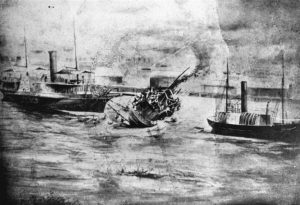
I was lured into writing about copyright and images after emailing the media department at Queensland’s State Library. I was clarifying permission to use an image of a ferry disaster on the Brisbane River in 1896 to illustrate a new song. I have seen this image used in the media but assume those media outlets also sought permission. It is folly to assume otherwise.
When I worked in the daily newspaper business, I attended a workshop for journalists about using other people’s images. A professional photographer had written to (an un-named newspaper), complaining that it had used one of his images without permission or payment. Yes, honest mistakes happen in every business, but it won’t get you off the hook. Even though the image in question had been used as an icon (postage stamp size), the publisher still had to send the photographer a cheque. And fair enough too. The difference is that a license for a one-off use would have cost a fraction of what the publisher eventually stumped up.
That was a long time ago, when free-lance photographers roamed the continent and took ‘stock’ photos which they would sell and re-sell to media outlets all over the world. I once met such a character on the road in the Northern Territory. He was away from home a lot but made a handsome living taking images in remote locations and licensing them to media outlets.
Now, in the age of smart phones and instant communication, everyone’s a photographer. Many of us freely give our images away, sending in stunning winter morning or sunset snaps for the daily weather reports. What we used to call ‘spot news’ – that is, a news story derived from being in the right place at the right time, is also the province of anyone with a smart phone and an email account. Certainly if the story is big enough and the image one of a handful, whoever took it will command a fee.
You would probably be aware that many media outlets have made photographic departments redundant in recent years. This often involved giving long-serving staffers sizeable payouts. News Corp alone laid off about 100 staff photographers between 2017 and 2021.
Some ex-news photographers continued to work as free-lancers – weddings, parties, fashion shoots. But it seems clear that in many instances photo licensing agencies like Shutterstock, Alamy, Dreamstime and Getty Images have replaced staff photographers. As you might expect, some ex-staffers make a less reliable living providing images to said agencies.
Warning: copyright laws can and do keep changing
We should be clear about copyright. If you take a photograph, the copyright is automatically yours. Even if you have offered it to a media outlet, the copyright remains with you. The small print (non-exclusive license), is important, so make sure you are covered.
At this point I should talk about social media and sharing of content. Many publishers now allow sharing under a creative commons license (you can use the content but must attribute the source). Where the water gets muddy is when someone tampers with the original work or imitates it. For example, you will sometimes see on social media a photo of the famous five crossing Abbey Road, with other characters (e.g.The Simpsons) substituted. Correct me if I’m wrong, John, but is this now an infringement of copyright? A law passed in the UK in 2012 argued that if you intentionally re-create a famous photo, you may be in breach of copyright.
If you are an artist promoting your work on-line, take care when ‘curating’ content for a slideshow or video. It’s no defence to say, ‘I found it on Google’, which at the end of the day, is a only search engine which finds appropriate images on command. If your browse YouTube videos you will often see slideshows accompanying songs with not a credit in sight. Likewise, people who edit someone else’s image to to make an on-line joke (meme) are taking a risk if the image is not theirs to use. Anyone can use a reverse search app like TinEeye to see who owns a photo, so there are no excuses. Pixsy, a US-based tech firm which monitors photographic use for more than 100,000 clients, estimates that 85% of the images uploaded to the web are used without permission or license. In 2017 Pixsy compiled this fascinating list of the 10 most famous copyright cases.
Since 2012 or so, the massive improvement in smart phone photography has led to a process academics call “the democratisation of photography”. In social media you may also come across the phrase ‘pixels for all’. It’s all to do with the speed by which images are taken and then posted.
In a recent episode of the SBS crime drama Bosch, maverick detective Harry Bosch and partner Jerry Edgar visit a Los Angeles gang house, ostensibly to ask questions. The process goes awry as suspects are taken in for questioning. Punches are thrown and Jerry ends up throwing a suspect to the ground in a choke hold
“Police brutality!” yells one suspect (a gang enforcer). By the time Bosch and Edgar get back to police HQ, footage and photos taken by neighbours and bystanders are all over Facebook.
When I worked in newspapers (before digital anything), a photographer would have to (a) attend the scene), (b) take photographs and (c) hightail it back to the office to develop the film and come up with prints for the 2pm news conference.
Today, someone can lift an image from Facebook and slap it on to the relevant on-line news page in the time it takes to walk to the editor’s office and say, “we got the headshot”.
While daily media standards may have slipped, here at FOMM HQ we strive to do the right thing. If someone has decided to share their creative content with our wider audience, the least we can do is give them a byline. The free content websites (Pixabay, Unsplash, Free Images and others), link to photographers’ websites. Commonly the photographer suggests – “Buy me a coffee’’ – which is a hint to drop a few coins in their PayPal account.
As for historic images, anything taken before 1955 is in the public domain. The photo of the Pearl, a cross-river ferry that came to grief in 1896, originally appeared in The Queenslander, attributed to N Colclough. It may be out of copyright, but full marks to the librarians and photo editors who saved negatives like these for future generations to see.
This week is a 2 for 1 special – not only do you get to learn a few things about copyright, you can follow this link to my new song ‘The Pearl’. It’s free to have a listen.
The Pearl – a folk ballad about a tragedy on the Brisbane River

Sometimes it takes years for a song to rise to the surface. I first read about The Pearl when the late journalist, Ken Blanch, wrote an account in the Sunday Mail. I wondered why nobody had written a song about that, but then went on to other things. The Pearl came to grief on a February evening in 1896. The river was in flood and the ferry was swept by the current into the anchor chain of The Lucinda, which was moored in the river. The Pearl capsized and was torn apart by the impact. As the lyrics say, the death tally was never known, but it remains among Australia’s worst ferry accidents. The song is based on newspaper reports of the day and also from talking to historians who have researched the story. The leaps of imagination are all down to me. As usual, the unreliable narrator (me) has the last word, casting himself as a character in an otherwise true story.
Those with an interest in this topic can find accounts of the time at the State Library of Queensland. Historian Paul Seto has also written a book about The Pearl.
A Special Day For Accountants – And Mike Tyson

I might not have thought about this tax topic had not a reader emailed to gently remind me that Barnaby Joyce is not a farmer, as I said last week, but an accountant.
I could be forgiven for being lured in to that way of thinking by the way Barnaby portrays himself to the electorate. He loves a photo opportunity down on the farm, wearing the big hat and looking suitably weather-beaten. Barnaby does come from a large family of sheep and cattle farmers, but he did indeed go to university and study to become a Certified Practising Accountant (CPA). He founded his own firm in St George and ran it from 1991 to 2005.
So he might even now have some muscle memory of the tension that bean counters suffer as June 30 approaches. As we all should know, that is the lucky last day to finalise business books for the year and start afresh on the morrow.
It’s called a fiscal year, this aberration which ignores the orthodox calender and creates a ‘financial year’. In Australia and a dozen other countries, the fiscal year runs from July 1 to June 30. We are in a minority, however. Fiscal years in other parts of the world run from October to September (US), April 6 to April 5 (UK), January to December (much of Europe), April to March or variations on the theme. Some countries (New Zealand and Singapore for example), use different dates for government and other taxpayers.
Fiscal years are set by Federal governments and most State and local governments and companies follow suit.
It’s not mandatory, though. Some Australian companies stick to a January-December fiscal regime, in the main to line up with overseas partners or subsidiaries.
June 30 is the big stick held over trustees of Australia’s 595,000 self managed super funds, the carrot being the opportunity to draw a pension on July 1. The stick is meant to encourage trustees to do the right thing, less they be audited, fined or penalised for operating outside the terms of the trust deed.
But perhaps your super is in one of the 220 large super funds regulated by APRA and you can leave the detail to someone else. Lucky you.
More comebacks than Mike Tyson
Accounting standards aside, we could mark June 30 for a variety of different reasons, such as birthdays. Retired boxer Mike Tyson, former AFL player Ben Cousins and decorated US swimmer Michael Phelps shared a birthday on Wednesday.
On June 30, 1937, the world’s first emergency phone number (999) was launched in London. In 1990, June 30 saw the merging of East and West Berlin’s economies. In 1997, the UK transferred sovereignty of Hong Kong to China, ushering in an era of political instability and domestic anxiety. In 2019, Donald Trump became the first US president to visit North Korea: to what end was never fully explained.
The end of the fiscal year also ushers in a few predictable campaigns by charities, urging their benefactors to give generously (so you can claim a tax deduction). Likewise, the retail sector gears up for EOFY sales. This time round, the Delta strain of Covid-10 is playing havoc with the sales campaigns of Sydney and Brisbane retailers.
As June 30 approached, you may have noticed a rise in the level of 7pm nuisance calls from numbers started with 02 something. Scammers were out and about in June, pretending to be the ATO, pretending to be from the national broadband network (yep, she’s still out there), or just being prats.
Wikipedia has a voluminous entry (5,000 words or so) dedicated to the fiscal year as it is interpreted in different countries.
Just why Australia chose July 1-June 30 is a mystery, although one could hazard a guess. Australians tend to slack off after the running of the Melbourne Cup (on the first Tuesday in November). So I just can’t see Australians poring over their household or business accounts on Christmas Eve, can you?
The song and dance about the June 30 tax deadline is ever-so misleading. Taxpayers have until October 31 to lodge their personal returns. Individuals, businesses and SMSFs using a tax agent can postpone it as late as May the following year.
A government investigation in 2009 estimated that between 1.2 million and 1.5 million taxpayers (9% of individual taxpayers), were up to three years behind in lodging tax returns. Independent researchers Colmar Brunton found there were three basic misunderstandings which accounted for much of this non-compliance:
- People thought they were below the income threshold;
- They were unemployed and not working and therefore believed there was no need to lodge;
- They were on a pension or receiving Centrelink payments and therefore believed there was no need to lodge (Some pensioners and Centrelink recipients do need to lodge a return and some don’t, hence the confusion.Ed).
Although the research is 12 years old, it’s a fair bet those three key misunderstandings are very much in play today.
The impact of Australia’s bush fires (2019-2020) and the onset of a global pandemic certainly shows up in the ATO’s 2019-2020 annual report. Commissioner Chris Jordan said net tax collections of $405 billion was down $21 billion (5%) over the previous year.
Natural disasters and pandemics not withstanding, the ATO is a money generating machine. In 2019-2020 the organisation collected gross tax of around $537 billion, and provided refunds of around $132 billion. The ATO employs 910,000 people to deal with a formidable workload. At June 30, 2020 its client base included 11.5 million individual taxpayers (not in business), 205,000 not-for-profit organisations, 36,000 public and multinational businesses, 4.2 million small businesses (including sole traders), 595,000 superannuation funds and 178,500 privately owned and wealthy groups (linked to 856,000 entities).
Not only that, 36,000 registered tax and BAS agents interacted with the ATO on behalf of their clients. And in 2020, the ATO took on responsibility for overseeing the JobKeeper scheme, early super fund redemptions and the Covid stimulus payments scheduled by Parliament. So, if you were having a hard time getting through to the ATO hotline, bear that in mind.
The ATO says 3.01 million calls were answered in the tax period (July 1 – October 31), almost double the calls received in the previous year. Of these calls, 207,741 were abandoned (6% of calls) and 485,348 calls were blocked. The average time for a call to be answered was (yes) five minutes.The ATO exceeded its phone service benchmark of 80% (87%).
Australians spend about $1 billion a year employing accountants to manage their tax affairs. The ATO has arguably made it easier to do it yourself, with much of the information (like bank interest, pensions, benefits etc), already pre-entered through data-matching. Every year at this time, law-abiding taxpayers fret about making mistakes or being late lodging their returns; or whether they will be one of the 175,000 ABNs cancelled for lack of activity.
But clearly the organisation has its sights set on much bigger targets. In 2019-2020, more than $2.4 billion was collected in cash and another $3.7 billion in tax liabilities as various task forces investigated tax avoidance, fraud, ‘Phoenix’ companies and the black (cash) economy.
So now you can see why we (Mum and Dad taxpayers), were first asked (in 1986-1987), to ‘self-assess’ when lodging individual tax returns. It’s like hiring 11.8 million staff for a one-off (unpaid) job.
And then we get to worry about it.
FOMM Back Pages (interesting to see how the ATO workforce has grown over six years.
Underneath the Story Bridge online

Well it only took 20 years or so to put my most popular song online. We recorded Underneath the Story Bridge in late 1999 on a seven-song EP which also contained covers, problematic when wanting to post music online. Along came Bandcamp which lets you post ‘singles’ Underneath the Story Bridge uses the device Randy Newman calls ‘the unreliable narrator’, that is, the narrator is a character, not me!
The original EP, Courting the Net, is now out of print although both songs were included on the Australia all Over collection, Macca’s Top 100.
We have plans to include both songs on a collection, Goodwills by Request. There are at least six or more new and unpublished songs which could be on this recording, which is, like Covid-19, a work in progress.
You can find the song here and download it for $1 (or more if you are expecting a tax return).
Bob Wilson, July 1, 2021
Heatwaves and the Winter Solstice

As the Winter Solstice came and went and our wood heater consumed the last of 2020’s firewood, the US mid-west was sweltering through an early summer heatwave.
Australia is, hopefully, at least five months away from its first hot spell. But in the US mid-west states, which have been in the grip of the worst drought in 20 years, the mercury is rising. Cue Martha and the Vandellas..
Canadian relatives had already been posting photos on social media implying a very early summer, but across the border, things are grim.
The New York Times took the opportunity to conjure up an appropriate headline “Climate change batters the west before summer even begins”.
In Arizona and Nevada, temperatures soared to 115F (46 Celcius), which would raise eyebrows even in Birdsville. Four writers contributed to a New York Times special report last weekend as Lake Mead, which supplies water to three south-western states and Mexico, fell to its lowest level since 1930. Early wildfires are burning in Utah, Montana and Arizona, while in California communities are debating water rationing.
In Texas, power utilities are pleading with customers to go easy on air conditioning in case excess demand causes blackouts.
Moreover, the June trend appears to have surfaced in some European countries, notably France. After a freak late-winter heatwave, above-average temperatures are assailing Europe.
Those with relatives living in the Northern Hemisphere will be hoping this does not signal a return to the disastrous heatwave conditions that killed 72,000 Europeans in 2003.
Not that we are immune in Australia, where it could be easy to argue that many of us live in heatwave-like conditions for at least three months of the year. At which point I should mention it seems to matter not if it is heat wave or heatwave.
It is difficult in winter to recall how it is to live through consecutive days with temperatures in the 40s. We should take our cue from the dog, who slinks off to the bathroom and splays himself on the cool tile floor.
Scientists agree (apart from those who don’t), that climate change is accelerating the severity and duration of heatwaves. Certainly in this country extreme hot spells increased markedly between 2000 and 2020.
Australia’s weather authorities have decreed a heatwave to exist when temperatures are seven degrees higher than average in any 30-day period. A report in November last year by Ralph Trancoso and others in Science Direct summarises highlights for Australia:
- Future heatwaves could last up to a month should global temperatures increase by 1.5% to 3% in coming years.
- There has been major increases in the 2000’s in comparison to previous decades;.
- heatwaves have intensified in the recent past and are projected to increase faster in future;
- heatwaves may be 85% more frequent if global warming increases from 1.5 to 2.0 °C.
In hindsight, perhaps we should have paid more attention during Australia’s ‘angry summer’ (December 2012-January 2013). The severity of the heatwave conditions then prompted a flurry of research reports on climate change.
Climate Council chief executive Amanda McKenzie chose the ABC’s Q&A forum in 2017 to claim that Australia’s heatwaves were worsening, with hot days doubling over the last 50 years.
The Conversation put this assertion to the test, asking the Climate Council, which had recently commissioned a report, for more detail.
“Climate change is making hot days and heat waves more frequent and more severe,” a spokesperson said. “Since 1950 the annual number of record hot days across Australia has more than doubled and the mean temperature has increased by about 1°C from 1910.
“”On average, that there are almost 12 more days per year over 35°C.”
Andrew King, Climate Extremes Research Fellow at the University of Melbourne, said there was not a large body of research against which to test these claims.
“But the research we do have suggests there has been an observable increase in the frequency and intensity of heatwaves in Australia. A review paper published in 2016 assessed evidence from multiple studies and found that heatwaves are becoming more intense and more frequent for the majority of Australia.”
In Australia, the general population is well versed in the art of remaining hydrated in hot weather. Regardless, heat-related deaths happen here, even though it is not often stated as such on death certificates.
UK academic Professor William Keatinge says few deaths are directly caused by heat-stress, although extreme heat exacerbates medical conditions including diabetes, kidney and heart disease. Heat stress causes loss of salt and water in sweat, causing haemoconcentration, which in turn causes increases in coronary and cerebral thrombosis.
“Other deaths in heatwaves are probably due to overload of already failing hearts, unable to meet the need for increased cutaneous blood flow in the heat.”
Writing in the British Medical Journal, Prof Keatinge said people at risk in heatwave conditions include those unable to sweat (because of diabetic peripheral neuropathy), or those taking anticholinergic drugs, barbiturates or phenothiazines, which depress reflex regulation of body temperature. Alcohol can also be dangerous in the heat, he added.
Meanwhile back in the relatively chilly southern hemisphere, Macca is due to deliver a load of ironbark firewood on Saturday morning. Even though nights have been cold here, apart from a few bleak days, it warms up to 19 or so by midday. Perfect weather to strip down to a t-shirt and jeans and shift the firewood to the shed around the back. The truth about cold snaps is you can always add another layer, crank up the wood fire or turn on electric heaters. The only real damage is to the power bill.
We do not have the same choices when weather phenomena like a heat dome pushes ‘normal’ summer temperatures to the levels usually experienced in arid places like Marble Bar or Coober Pedy (for America, read Death Valley).
The reappearance of heatwaves this summer will see a renewed focus by climate change activists on the Australian government’s inaction on climate policy.
And it’s official: Australia’s Prime Minister Scott Morrison has been formally rebuffed by the UK government, which is hosting a climate summit in Glasgow. Britain’s foreign secretary said Australia’s PM did not meet the required terms for attendance in November. The UK urged Australia to do more to reduce its carbon emissions.
It is illuminating, then, to revisit January 2020, when we were in the midst of catastrophic bushfires and a heatwave.
Mr Morrison told the media his policies on reducing emissions would ensure a “vibrant and viable economy, as well as a vibrant and sustainable environment”.
At the time, the United Nations had rebuked Australia, saying there had been no change in its climate policy since 2017. Emission levels for 2030, it said, were projected to be well above the target. The Climate Change Performance Index ranked Australia last out of 57 countries responsible for more than 90% of greenhouse gas emissions on climate policy.
Complicating matters now is the re-emergence of controversial politician Barnaby Joyce as Deputy Prime Minister. The conservative politician can fairly be described as a climate change denier. In 2012 he opposed the Labor government’s attempts to bring in a carbon pricing regime. Joyce was quoted in the SMH as claiming it would push the cost of a Sunday roast to $100. Infamously responding to public criticism of the Coalition’s environmental policies, he accepted the climate was changing, but insisted the solution was to respect God.
Heatwave? What heatwave?
FOMM back pages
One in three Aussie kids have a mobile phone

Is there anything more likely to bring on a panic attack than misplacing your mobile phones? It’s around the house somewhere, isn’t it. You tried calling the number but alas, the battery is flat.
Those of you who cannot bear to be parted with your mobile phone might not know that 33% of Australian children between six and 13 own one. Another 14% of Aussie kids have access to a mobile – for example, if they are going out alone, Mum might lend them hers. These numbers were collated in 2020 by the Australian Media and Communications Authority (ACMA).
I texted a mother of three to see what’s allowed in her house. We’ll call her Outraged Mother of Three (OMOT). She replied (on one of her 4.4 devices), that all of her kids (Grades 3-8) have phones.
“The youngest has a phone but it is not hooked up to a Sim or Wi-Fi. It was just the spare and now it’s lost.
“Due to excess use of said phones our children now no longer bring the phones to (our weekend retreat). They also have limitations on when they can use their phones.”
If you didn’t know, most Queensland schools do not allow children to use their mobiles during school hours.
OMOT says the main reason her children have phones is purely to be able to contact her, particularly when school is out.
ACMA’s research shows that children primarily use smart phones for playing games, using apps, watching videos, texting and keeping in touch with family/friends.
OMOT said one outcome of her kids having their own phones is they no longer watch TV, preferring YouTube videos.
“They also find it as a really good way to have group chats. Both of my older kids have group phone messaging with their mates from school.”
The impetus for revisiting mobile use in Australia (apart from changing last week’s distressing subject), was a blog I wrote seven years ago. In that column (May 2014), I recounted losing my mobile while on holiday in New Zealand. It was a new phone on a two-year contract, so losing it was a bit of a disaster.
The good news was that a Kiwi out jogging found it lying in the long grass outside my nephew’s house. His enterprising wife looked up the call log and dialled my wife’s mobile (as we were filling up the hire car and looking at travel insurance options). A 20 km detour later I was reunited with my then new android phone.
In 2021, after relying on them during Covid, Australians (and their children), are increasingly bound to their devices. They use them for a wide range of business, personal and entertainment communications. They send and receive emails, send and receive texts, check the odds on the footie, do internet banking and watch videos. They might check in on Facebook and interact with ‘friends’, send PM’s (private messages) to their close friends and maybe watch a music video or two. Very occasionally, they might ring someone up and have a convo (conversation).
The technology is amazing: really, it is. Thirty years ago when you were in a community choir, the choir director handed out printed scores on rehearsal night. The director would have ordered them from a music publisher and then waited weeks until they arrived in the letterbox. Now we can find and download scores (on our phones, even), print them out, and also find (free) audio rehearsal files.
The irony is that few people use the full capabilities of a smart device. I was chatting to a doctor at a barbecue when a helicopter flew overhead.
“That’ll be the rescue helicopter,” she said. She showed me an app on her phone which verified that it was indeed the rescue helicopter. The app showed where it had come from and where it was going (and when it would arrive). That’s no ordinary app, I’ll grant you, but it shows what is possible. In the days when we could travel the world, language apps were all the go. Just wave the phone at the waitress in Tokyo (who would hear a Siri-type voice intoning Shīfūdo ni arerugī ga arimasu (I’m allergic to seafood).
In 2014, when I wrote Hold the Phones, there were 11.9 million smart phones in Australia. Deloitte’s Mobile Nation report showed there were 17.9 million in circulation in 2019. It’s not just smart phones – the average internet user has 4.4 devices they use to interact with the net. The most popular devices were smart TVs, wearable devices and voice-controlled smart speakers.
See how you go with this list (5/8 for me).
- Australians spend three hours a day using their smartphones;
- 94% take their phones with them when leaving the house;
- Almost 25% watch live TV on their phones at least once a week;
- 23% stream film/TV series weekly;
- 48% check their mobile phones at least once every 30 minutes;
- 71% feel safer when they have their phone with them;
- Just over 90% took at least one active step in on-linesecurity
- 53% worry about over-reliance/addiction to their devices;
The results of a survey commissioned by ACMA showed that “nearly all Australians” (99%) accessed the internet in the previous six months in 2020 (up from 90% in 2019). I assume this includes the approx 1.7 million or so kids aged 6 to 13.
Nevertheless, the Australian Bureau of Statistics found that 2.9 million Australians were not on-line because of affordability, location or lack of digital literacy. Who knows how those people struggled last year.
ACMA’s survey (by Roy Morgan) found that Covid lock downs contributed to a significant increase in Internet-based activities. The use of communications apps soared, with 72% of Australian adults using one (up from 63% in 2019). Facebook Messenger was the most popular app (66%), followed by Zoom (43%).
There has been exponential growth in mobile data consumption – 9MB a month in 2018, according to the ABS, but growing at 40% a year.
So yes, the person opposite you staring at a screen on the commuter train is probably catching up on Mare of Easttown. This would account for the lack of eye contact and casual conversation and the panic when she realises she has gone past her stop.
It’s all very well to learn that children are already tech-savvy, but we need to find better ways to connect older Australians to the digital world. A report by the eSafety Commissioner found that 8% of Australia’s 8 million people aged 50 and over are “digitally disengaged”. This means that 640,000 older Australians (74% of them over 70), do not use the internet at all. Moreover, 6% of this target group showed no interest at all in improving “digital literacy”.
(By contrast, my 94 year old Godfather began using an Ipad long before I did. Ed)
As this research found, family and friends can play an important part in helping older Australians learn some digital tricks.
It seems like a no-brainer – get those digital-savvy kids to give Oma and Opa a few lessons – after they’ve done their homework, of course.
FOMM Back Pages:
Last week: I’m still not holding my breath.
Australia’s refugee shame

It took a little refugee girl to become gravely ill while held in an Australian detention centre to attract the attention this issue deserves.
The plight of refugees and asylum seekers has been somewhat diminished in the public eye over the past 18 months because of Covid-19. But some issues just won’t go away. As cartoonist Peter Broelman observed last week in a two-panel cartoon: an Australian going stir crazy inside four bare walls, while in the right panel are two girls, assumed to represent the Biloela Tamil children confined to the detention centre at Christmas Island.
The Sri Lankan family of four were whisked away from their home in Biloela (central Queensland) in March 2018 after overstaying their visas. After some temporary stays in detention elsewhere, they were flow to Christmas Island, where they are still the only detainees held there.
This week, Tharnicca, three, was flown to Perth for emergency medical attention, She was accompanied by her mother, Priya. News reports claim Tharnicca had been unwell for up to two weeks before being flown to Perth reportedly suffering from a blood infection.
She is now stable and with top quality medical care will hopefully recover.
But what then, given the government’s insistence that the family are not refugees and therefore not entitled to settle in Australia? It’s bad timing for the Federal Government as support groups gear up for Refugee Week (June 20-27). Ahead of the event, refugee support groups are heading to the capital for the ‘Canberra Convergence’. The June 15 event will be held on the lawns of Parliament House. Number one item on the agenda is to call for the controversial indefinite detention Bill to be repealed.
What, you didn’t know about that?
The Migration Amendment Bill 2021 will allow Australia to indefinitely hold refugees in mandatory detention centres in cases where a person’s refugee visa has been cancelled but cannot be deported because they could face persecution in their home country. A person may have their visa cancelled for a range of reasons, including security or character grounds or association with certain groups.
Immigration Minister Alex Hawke said the new bill promotes human rights because it reinforces the nation’s commitment to non-refoulement. This clumsy term means a country is forbidden from deporting refugees or asylum seekers to their country of origin if they are at risk of persecution. So the Morrison government’s solution is to lock them up with no end date in sight.
The law currently applies to 21 refugees in Australian detention, according to Guardian reporter Ben Doherty. The Bill was tabled on the last sitting day of the March session of parliament. It was voted into law on May 13 after the Senate debate was cut short.
Global outrage about this Bill suggests that Australia is breaching the Human Rights Charter by supporting the amendment.
The influence of refugee support groups cannot be underestimated. In 2018 a coalition of such groups lobbied for the medical evacuation of children from the detention centre on Nauru. This campaign became known as #KidsOffNauru and, as children were medically evacuated to Australia, support groups claimed victory.
Someone known to FOMM readers wrote a song about it.
As Asylum Seeker Resource Centre CEO Kon Karapanagiotidis said this week on the organisation’s 20th anniversary, “It’s a bitter-sweet moment”.
The ASRC was set up on a shoestring in Melbourne 20 years ago with the initial aim of providing free meals for poor families in inner Melbourne. It has grown into an asylum seeker support and advocacy organisation with annual revenue of $27.62 million. In 2019-2020, the ASRC provided shelter, free meals, healthcare and medication and paid work for asylum seekers.
Through lock-down in Melbourne, the ASRC has committed to keep paying ‘social enterprise’ staff in its cleaning and catering businesses, even when there is no work. The organisation is soon to broaden the opportunity to support ASRC Catering. In Melbourne, people can order a meal for pick up or delivery. Those who do not live in Melbourne will soon be able to support via a ‘pay it forward’ meal, providing meals to vulnerable people, such as casuals and workers in hospitality who have lost work.
The ASRC’s annual report (2019-2020) lists outcomes which include supporting 3,039 people who presented at its offices in crisis, securing 146 temporary or protection visas and distributing fresh food valued at $1.73 million to its members. It was all done through donations and the hard work of its many volunteers.
As CEO Kon Karapanagiotidis said in a live video to celebrate the ASRC’s 20th, his hope is that there no need for another 20 years of the ASRC.
“My hope is that one day we don’t need to be here.
“So when people come here seeking protection they find safety, dignity, sanctuary, a safety net, no detention, and safety and freedom”.
In the meantime, the ASRC’s annual telethon fund-raiser will be more important than ever as it continues to support asylum seeker workers through Melbourne’s lock-downs.
On the local front, the Southern Downs Refugee and Migrant Network held a welcome picnic in Warwick last Sunday to celebrate the inclusion of the Southern Downs as a Refugee Welcome Zone.
The Southern Downs Regional Council approved this initiative after a presentation by SDRAMN members. It becomes the 169th Australian local government to officially welcome refugees.
This brings our region in line with Toowoomba, not only Australia’s biggest inland city (not in the desert, Scotty), but also home to a large number of refugees and migrants. The most commonly spoken language in Toowoomba other than English is Tagalog.
Five years have passed since the last Census established that just over one in four Australians were born somewhere else (26%), a 1% increase on the 2011 Census. As the Australian Bureau of Statistics has found, Australia is now a diverse society.
More than 300 languages are spoken in our homes; we have over 100 religions and more than 300 different ancestries, This wide variety of backgrounds, together with the many cultures of our Aboriginal and Torres Strait Islander peoples, has helped to create a uniquely Australian identity. No doubt the 2021 Census, which will be held in August, will reveal how many more Australians were born somewhere else. As it is, about half of us were born elsewhere or have parents who were born overseas.
Given the diversity of our background, it behoves us to open our hearts and minds to those fleeing religious or political persecution. The so-called Indefinite Detention Bill shows just how far we are from opening our doors to those in crisis. A <change.org> petition calling for the Tamil children to be brought back to Biloela (where townsfolk support them), gathered more than 500,000 signatures this week.
Meantime, The Guardian trolled through the Budget papers to find that Australia will spend almost $3.4 million a year for each of the 239 people held in offshore detention. As one wag on Twitter commented (and it’s not a bad idea), we’d be better off giving them all $1 million each and suggesting they move to the US (or NZ) as business migrants
So yes, Kon, it would be great if we didn’t need an ASRC anymore. But I’m not holding my breath.
Queuing up for the Covid vaccination

Suddenly, getting your Covid vaccination is becoming a hot ticket item on social media. By that I mean ‘normal’ social media posts from people who actually believe in the science. I got my first shot last Thursday evening, 35 minutes later than the allotted time, but hey, I’m retired. I can watch Antique Roadshow later on catch-up.
I spent the time sitting in a packed waiting room with 50-60 other people in my age group (70+). I traded witticisms with a couple of people who seemed sceptical, but all the same sat and waited to be called.
Once I’d been injected (by my own doctor, no less), a nurse stuck a green sticker on my shirt and told me to ‘sit-stay’ for 15 minutes, to make sure I didn’t have any adverse reactions.
I came back out and sat next to a man who had previously been saying things about the government and their ‘jab campaign’.
“So is Bill Gates tracking us now?”
Apart from a slightly sore arm, it’s just another vaccination to add to the certificate from Medicare which lists them all from 2017. I didn’t even know they were doing that until I noticed an email when logged in to MyGov.
The Covid vaccination rollout may have been on the agenda for talks between Prime Minister Scott Morrison and NZ’s PM, Jacinda Ardern, but the media focused on other issues.
Morrison, who in April claimed Australia was ahead of NZ, has come in for trenchant criticism over the government’s handling of the vaccination rollout. The debate continues about the government’s decision to restrict the Pfizer vaccine to people aged under 50. The reasoning behind this decision is that the AstraZenica vaccine (for the over-50s), which has been linked to a rare clotting disorder, is too risky for younger people.
The online news source ‘The Conversation’ sent out a well-researched piece this week asking was it possible to ‘mix and match’ vaccines.
The premise of research out of Germany is that allowing people to have, say AstraZenica for the first shot and another brand for the second is to speed up the vaccination programme when it stalls due to a vaccine stock shortage
It makes sense to allow the general population to have whatever vaccine is available at the time. But talk of risks and side effects may only serve to increase what is known as ‘vaccine hesitancy’.
The government’s chief medical adviser Brendan Murphy told a Four Corners investigation last week that vaccine hesitancy was having an impact.
“We would have expected at this stage to have had a greater uptake because we’ve now got 5,000 points of primary care presence and we are supplying excess vaccine and we have seen a slight flattening, when we expected growth.”
But Professor Murphy said much of the blame lay with the media.
“I think the biggest impact on hesitancy is, frankly, sensationalist media reporting.”
“We want to be transparent, but we want people to understand that the risk of this blood clot is really tiny, and if you’re a vulnerable person, the risk of severe COVID is high.”
Apropos of which, perhaps, a few weeks ago we started binge-watching Season 17 of the long-running medical soap. Grey’s Anatomy. Despite cries of derision from the gallery (it’s a textbook, isn’t it?), Grey’s is the 8th longest-running primetime TV series. A long way behind The Simpsons (32) and Law & Order – Special Victlms’ Unit (22), but not bad for a series labelled – ‘opera, melodrama and medical procedures’.
I’d best not reveal too many spoilers for fans of Grey’s who have not yet discovered it on the Disney Channel. I had to register for adult content to watch this series, so careful is Disney about protecting kids from M or R-rated content. There’s not too much spicy action in sex scenes which are more about the before and after. But the well-researched scripts are full of what censors call ‘adult themes’ including sex trafficking, drug addiction, psychiatric disorders and patients presenting with the most complex (and gruesome) medical emergencies.
What is illuminating about Season 17 is the setting (Seattle 2020) with all episodes so far completely immersed in the emergence of Covid and its effect on frontline medical staff.
Executive producer and chief writer Shonda Rhimes has a lot to say through the characters about the disproportionate affect of Covid on black people (poor black people specifically), often living in overcrowded conditions.
It’s no accident Rhimes is known for a social conscience – in 2019 she was involved in a campaign with Michele Obama and others to encourage people to vote in the 2020 presidential election.
Rhimes and her Grey’s Anatomy star, Ellen Pompeo, have been with the show from the start. Pompeo, now 51, shares credits in Season 17 as a producer, as well as remaining as the main actor/narrator.
Pompeo is also one of America’s highest paid actors, earning $19 million a year from syndication rights and her $550,000 per episode salary.
You might recall Grey’s Anatomy (which, BTW, is a famous textbook on human anatomy first published in 1858), getting a panning in this blog. We focused on the now-infamous opera episode, where the story was told in song, over operating tables and in hot sweaty linen cupboard clinches.
This is called ‘jumping the shark’ in TV series’ parlance and usually points to writers and producers running out of ideas.
We let some seasons go by and tuned in again about series 15 when you could watch it on catch-up.
Our bizarre attachment to medical soaps aside, I feel some degree of social responsibility to warn that we have some way to go with the goal of vaccinating all Australians against Covid-19 by October (which October?). Not the least of it is the constant presence on social media of anti-vaxxer scare campaigns, most of them debunked long ago.
It’s not just Australians who are hesitant.
Nature Magazine published a survey of 13,426 people in October 2020 indicating that 71.2% of respondents were willing to be vaccinated against Covid-19 if it were proven safe and effective.
“The far-from-universal willingness to accept a COVID-19 vaccine is a cause for concern. Countries where acceptance exceeded 80% tended to be Asian nations with strong trust in central governments (China, South Korea and Singapore)”.
In April, the Royal Australian College of General Practitioners (RACGP) published a survey of 1,090 people which found just 43% of Australians thought the rollout was being done efficiently (down from 63% in March). About 63% thought it was being done safely, down from 73%; and just over half (52%) were confident the vaccines will be effective at stopping COVID-19.
The slow rollout and changes to the plan also appear to have given rise to vaccine hesitancy. One in six people (16%) said they would never get vaccinated against COVID-19, up from 12% in March. It’s a small sample, but nonetheless a demonstration of how confidence in the administration has waned during the vaccine rollout.
Meanwhile the Covid vaccination tally is two for two in this household. Tip from a friend – ask for a lollypop afterwards!