Music festivals and footie finals

music-festivals-grand-finals
Night shot of the Neurum Creek Festival marquee

Some of our musician friends in Melbourne and Sydney have ‘festival envy’, akin to the mixed emotions felt by southern footie fans who will miss out on this year’s grand finals.

As you might know, the National Rugby League (NRL) moved all teams across the border into Queensland. As a result of ongoing Covid lockdowns in Victoria and New South Wales, this year’s Grand Final will be held in Brisbane for the first time ever. Likewise, the Aussie Rules Grand Final has been moved from Melbourne to Western Australia.

As for those southern musicians, most if not all of their live music events have been cancelled or postponed. For people who combine day jobs (also affected by lockdowns), with weekend gigs, these are very hard times. It’s been harder still for those who do earn a living from music and persevere with touring plans and CD launches, only to see them curtailed by lockdowns.

So we can consider ourselves blessed to have performed at one of the few music festivals to go ahead in Australia last weekend at Neurum Creek bush retreat near Woodford (see image above).

The Neurum Creek Music Festival is in its 15th year, not counting a cancellation in 2020. It’s a medium-sized festival held outdoors (a camping weekend). The organisers hire one very large marquee with associated infrastructure for a bar and a ‘green room’ for performers. It is a minimalist event – numbers are capped at 1,000 and most of the work is done by volunteers. There were three food stalls this year and a hugely popular coffee van. The festival is billed as an ‘acoustic music’ festival,(ie no heavy drum kits or electronica, thankfully. Ed) with 23 acts performing from Friday evening through to Sunday afternoon.

Organisers Angela Kitzelman and Don Jarmey kept a daily watch on Covid developments in Queensland while planning the 2021 event.

“We sat down and assessed the risk.” Angela said. “It’s a very relaxed festival that we run and the money that we spend on it goes mainly to performers, for the marquee costs and the sound guys.

“It was looking at how much we spend and also looking at the situation in Queensland and what the health directions were.

“At the time we decided to go ahead with it, there had been a lockdown. We came out and talked to the camp site managers. They told us that in the event of a Covid lockdown cancellation, people who had booked tickets could get a full credit to do it at another time.

“We realised we could afford to do this at half capacity, as it was at the time, and be very clear that we would pick (the festival) up and put it on another date if something happened.”

After looking carefully at their finances, the organisers decided to press the ‘go’ button, without the usual lead time to host music festivals.

“We invite people to play and say this is how much we can afford to pay.

“We didn’t have enough time to invite expressions of interest so we just asked people who had played here before, abiding by our rule that performers don’t get to play two years in a row.”

“Our advantage is that people come for the festival itself. We don’t have headline performers. We often sell out before I’ve finished finalising the programme. People come here for the experience.”

While Queensland has been able to avoid ongoing lockdowns, some music festivals have been cancelled or postponed regardless. Last month, Woodfordia announced the cancellation of its six-day Woodford Folk Festival, held at New Year. Instead, the organisation will schedule smaller events called Bushtime.

The Byron Bay Blues Festival, which was cancelled just one day out from the Easter 2021 programme, has been postponed again to April 2022. The National Folk Festival, held in Canberra at Easter, has called for expressions of interest for 2022, a move which surprised many, as it was cancelled in 2020 and 2021.

Illawarra Folk Festival artistic director David De Santi took to Facebook this week to announce the cancellation of the music festival set down for 13-16 January, 2022.

It is just too hard in the current climate for a non-profit association to take the risk on a festival of the scale of the Illawarra Folk Festival,” he said.

Mr De Santi said there was a chance the festival may be able to apply for a grant from the Federal Government’s RISE Fund and reschedule later in 2022.

Despite these and many other cancellations, two smaller music festivals are going ahead in north Queensland next month. Smaller social gatherings where musicians gather to jam have been held or are set down for later in the year. Woodfordia is also staging its Small Halls tour around Queensland country areas.

Professional arts groups including theatre, ballet, opera and orchestral companies have also suffered from lockdowns and Covid restrictions. Some Queensland arts events have since gone ahead, including ballet, theatre, musicals and the Brisbane Festival. Even so, this press release from Queensland Ballet is just one example of how arts companies have struggled to stage shows since Covid started in March 2020.

Queensland Ballet artistic director Li Cunxin took the decision in May 2020 to postpone the season to 2021. Despite forecasting a 43% drop in revenue for 2020 and a drop in patronage for 2021, Queensland Ballet resumed performances in 2021. As subscribers, we were lucky to have seats for sold out performances of the 60th Anniversary Gala in March and Sleeping Beauty in June. The company also toured the regions (Tutus on Tour). and has five more ballets scheduled between now and the end of the year.

Government funding is available to support the arts, but it is relatively lean compared to the money invested in professional sport. The Federal Government’s $50 million Arts Sustainability Fund might sound generous, but it is spread over two financial years (about $2m a month). Then there is the hard-to-fathom RISE grant program. This post in The Conversation last September tosses it into the too-little-too-late basket.

For the professional sports sector, it has been mostly ‘business as usual’, although at a considerable financial cost. The NRL decided in early July to move NSW and ACT-based rugby league teams and staff into Queensland at a reported cost of $12m to $15m per month. The NRL funded the move, but it needed formal State Government permission to make it work.

As usual, money talks. It comes down to billion of dollars in sponsorship deals, international broadcast rights, betting agencies and other contractual obligations (not the least of which involves players’ salaries).

The NRL decided to relocate when there were eights weeks of the competition left to run (not including the finals). Now, primarily because of the Covid situation in NSW, the finals are being held in Queensland as well. So by the time the NRL wraps up the season in early October, the cost of what was meant to be a month-long trial may have blown out to $45 million or more.

The good news for Queensland is that local hospitality businesses have benefited from this, with more than 500 people living in hotels and serviced apartments for three months.

The hospitality flows most on ‘Mad Monday’, when players who did not make the finals let their mullets down. Let’s hope that the relatively strong Covid bubble around these 13 visiting teams remains unbreached during coming weeks.

We only need to remember the infamous Illawarra Dragons barbecue debacle to realise what could happen amid the inevitable celebrations and drowning of sorrows that follow a grand final.

Go you Rabbitohs!

More reading about music festivals

Some questions about ‘The Boy from Poowong”

hiroshima-poowong-journalism
Image: Hiroshima after the dropping of the atomic bomb in 1945. Wikimedia.org, public domain

Bob’s taking a week off as we are booked to perform at a folk festival this weekend. More about that next week. It seemed the right time to give this contribution a run. Norm originally presented this as a talk to a U3A group in Brisbane. We thought it merited wider exposure as the subject is a journalist who reported vital news from the frontline yet was suspected of being a spy. This should remind us that the McCarthy era was alive and well in Australian in the 1950s.

By guest writer NORM BONIFACE

Who was the Australian journalist who married a German Jewess in London in 1938, had one child but was divorced after 10 years? He married again and had three more children who were refused Australian citizenship by Prime Minister Robert Menzies.

He was known for being the first western journalist to report from Hiroshima after the dropping of the atomic bomb, and for his reporting from “the other side” during the wars in Korea and Vietnam.

He began his journalism at the start of WW2, during which he reported from China, Burma and Japan and covered the war in the Pacific. After the war, he reported on the trials in Hungary, and later the Korean War, the Vietnam War and on Cambodia under Pol Pot.

The Australian national security department (Commonwealth Security Service, which became Australian Security Intelligence Organization (ASIO) in 1949), opened a file on his whole family in the 1940s. Australian security was concerned by his father’s interest in helping Jewish refugees in Melbourne, and his views on the Soviet Union and republican China. A document on his own file dated February 1944 noted:

“This man is a native of Poowong (a small dairy farming town in South Gippsland, Victoria) and his past life has been such that his activities are worth watching closely. He is an expert linguist and has travelled extensively. A comparatively young man who married a German Jewess with a grown family, he seldom misses an opportunity to speak  and act against the interests of Britain and Australia.

Other documents on his file show ASIO was concerned by his “scathing criticism of American imperialism”.*

* Described in Wikipedia these days as: “American imperialism consists of policies aimed at extending the political, economic and

cultural influence of the United States over areas beyond its boundaries. Depending on the commentator, it may include military conquest, gunboat diplomacy, unequal treaties, subsidization of preferred factions, economic penetration through private companies followed by intervention when those interests are threatened, or regime change.”

He is in the Melbourne Press Club’s Hall of Fame, principally because he was the first correspondent to file from Hiroshima after the dropping of the atom bomb and described the effects of radiation sickness and death for the first time. His reports from Hiroshima were heavily censored in the United States, but they helped set the mood for a global era of nuclear deterrence.

The Australian government sent ASIO agents to Japan and Korea to collect evidence, but in early 1954, conceded it could not prosecute him.

In 1955 while overseas, he lost his passport (reported stolen). The Australian government refused to issue a replacement. Though born in Melbourne, Victoria he was refused re-entry to Australia and as a consequence became stateless. Successive Conservative Australian governments between 1949 and

1970 tried to construct a case to prosecute him, but were unable to do so. Cuba came to the rescue and provided him with a passport to permit international travel.

Around 1967, ABC journalist Tony Ferguson filmed an interview with him in Phnom Penh. It is reported that Ferguson said that the general manager of the ABC, Talbot Duckmanton, ordered its destruction.

The Australian government still refused him re-entry for his father’s (in 1969) and later his brother’s (in 1970) funerals. In 1970, attorney-general Tom Hughes admitted to prime minister John Gorton, that the government had no evidence against him. Hughes said that a prosecution for treason under the Crimes Act “cannot be mounted unless the war is a proclaimed war and there is a proclaimed enemy”, and the Australian government had not declared war in Korea or in Vietnam. (NB: Could a similar argument apply in Iraq and Afghanistan in relation to Julian Assange?)

It was not until the Whitlam government came to power in 1972 that he was permitted to return home. A documentary film including interviews with this journalist, entitled “Public Enemy Number One” by David Bradbury, was released in 1981. At the time the ABC refused to show the film. The film expressed the journalist’s views and was criticised in Australia for the coverage of “the other side” in the Korean and Vietnam Wars, and posed the questions: “Can a democracy tolerate opinions it considers subversive to its national interest? How far can freedom of the press be extended in wartime?”

From a legal standpoint his lawyers argued that both of these wars were “undeclared”. In fact the former (civil war) remains an open conflict even today (2021).

“He will be remembered by many during the Cold War years as one of the more remarkable ‘agents of influence’ of the times, but by his Australian and other admirers as a folk hero.” – Dennis Warner, war correspondent and historian.

In 2011 Vietnam celebrated his 100th birthday with an exhibition of his work in the Ho Chi Minh Museum in Hanoi.

It is in no doubt that he was a controversial figure during the Cold War years. Some hated him and some loved him. Some said he was a spy in the pay of the Soviet KGB, a secret agent for the

Communist Chinese, North Koreans or North Vietnamese, or a clandestine communist “fellow traveller”. Others said he was an “agent of influence” for one or all of the above.

Or was he just a journalist who had strong views, who saw injustice and hardship, and criticised those he believed responsible for it?

Writing in The Australian in 2008, journalist Greg Lockhart described the previous governments’ actions as “a remarkable breach of the human rights of an Australian citizen” in which it “simply exiled him for 17 years” without any legal reason.

He died in Bulgaria in 1983 at age 72 years.

Wilfred Burchett (1911-1983).

Old newshound investigates digital news

digital-media-classifieds
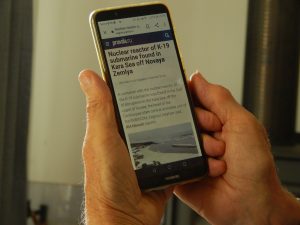
Image: Bob checks out Pravda on his Chinese smart phone – the go anywhere world

I think I already knew that 80% of Australians were dependent on digital news. Last week I was asked to give a talk at a business breakfast on ‘The past and future of newspapers’. It was a bit of a revelation, drawing on historical data and reflecting on my experience as a regional journalist in the early 1980s. At the time, the old technology (Linotype, lithography, telex, hand subbing) was making way for the computer revolution.

Prior to the mid-1980s, newspapers had an absolute monopoly over classified advertising. If you wanted to sell a car, employ someone, rent a house. hold a garage sale or post a death notice, the classifieds were the only option and they were not cheap.

The supremacy of what Rupert Murdoch once called ‘the rivers of gold’ started faltering, first with competition from specialist trade magazines and then from the fast-developing Internet.

Some brave journalists – call them early adopters – set out to start up their own newspapers. They worked from home and used desktop publishing. Their free newspapers offered ‘classies’ at heavily discounted prices and disrupted the business plan of media giants. The common response was to buy out the upstarts and shut them down.

Once the Internet began to gather momentum, advertisers started to find cheaper ways to sell things. Free on-line markets like Ebay further eroded the traditional profits of newspapers. The big media owners started to buy on-line businesses to compete on both levels. The resulting domination of digital media media advertising, mainly Facebook, has led, in this decade (2010-2021) in particular, to an accelerated decline in print newspapers.

For example, Rupert Murdoch’s once-dominant Herald Sun in Melbourne has come back to the pack. Last week Crikey did a bit of homework on the newspaper’s falling circulation figures (from a peak of 600,000 in 1990). Crikey discovered that the Herald-Sun had fallen to fourth place among News Corp’s Australian mastheads. It also lost its No 1 spot overall behind Nine’s The Age.

As of June 30, the Herald Sun had tumbled to 146,026 subscribers across print and digital products, according to internal figures reported to the US Securities and Exchange Commission.

Crikey’s Christopher Warren, who, during better times in newspapers, was president of the journalists’ union, wrote:

The ‘Don’t read the Herald-Sun’ campaigners will be eager to claim credit for the masthead’s fall. They’ve been targeting the paper for its critical coverage of Melbourne’s 2020 lock-down. 

This subscriber-only article prompted much comment on social media from Melbourne folk who apparently do not rate the Herald Sun. Mohamed Mohideen said on Facebook, “Most times they give it free in many places just to say they have a big circulation.

I use it for my cat litter.”

Global data and analytics company Nielsen says 80% of Australians turned to digital news and apps to stay informed in the June 2021 quarter. The total time spent peaked at 1.6 million hours on May 27, when the Victoria Government announced a seven-day lockdown. The next highest, 1.5 million hours, was on June 27, on the first day of the NSW Government lockdown.

Nielsen says the increase was primarily driven by news content consumed on mobile devices. The average daily time spent increased in June by 12%, compared to the same month in 2020. These figures, drawn from a Nielsen press release, are as much as the company is prepared to share. Because of a stalemate with IAB Australia, the trade association controlling on-line advertising, Nielsen stopped making the data public in January and has so far not resumed.

Nevertheless, the Internet being what it is, someone posted the June 2021 ratings on Twitter.

The June data showed ABC on-line in No 1 position with 12.83 ‘unique’ viewers, followed by news.com.au (11.72m), Nine (10.63m), 7News (9.45m) and The Guardian (6.71m) in fifth spot.

News Corp decided back in late 2017 to opt out of Australia’s system of measuring daily circulation, as reported by the Audit Bureau of Circulation. Since then, media analysts and commentators have had to rely on emerging surveys by data companies including Nielsen and Roy Morgan.

Media and marketing website Mumbrella commented that by withdrawing from the Audited Media Association of Australia, News dealt a near fatal blow to the future of print circulation audits in Australia.

News Corp said at the time advertisers should now look to Enhanced Media Metrics Australia (EMMA), which was created by the newspaper industry in 2013 to promote readership numbers, rather than circulation, as the key metric.

Eight years later, (EMMA) was ditched in favour of Roy Morgan’s ‘Total News’ metric.

The first release of Total News readership figures produced by Roy Morgan show that cross platform news reached 97% of the population aged 14+ (20.4 million) in the year to June 30, 2021.
Print (and digital) news saw a 6% increase, compared to the same period last year, now reaching 14.1 million people aged 14+.
Of the 20.4m readers, 1.3 million read newspaper print editions only; 12.8m consumed digital and print and 6.3m digital only.

When you read about the inevitable shift to digital media, it is hard to know how media owners will convince people to pay for it. According to the Australian National University’s Digital News Report 2021, the percentage of people paying for on-line news (13%) has changed little since 2020.  Of the non-payers, only 12% say they are likely to pay in the next 12 months. Only a third of Australians are aware that news outlets are less profitable than a decade ago or are concerned about it.

News Corp’s decision in 2020 to rationalise 112 regional titles across Australian has had ongoing ramifications. According to The Guardian, 20 of the regional papers owned by News Corp have been absorbed into the on-line editions of News Corp’s subscriber-only metropolitan newspapers.

Other cost-cutting measures include a decision to no longer deliver print newspapers to far flung regional Queensland (affecting Mt Isa, Longreach, Charters Towers, Emerald and towns in the State’s south-west).

PwC’s Entertainment and Media Outlook Report 2021 says that even before the pandemic, all major publishers were looking towards a predominantly digital news future to compensate for the loss of print circulation and print advertising revenue. Printed circulation revenue dropped by 6.7% in 2020 to A$735 million, and print advertising revenue fell 24% to $882 million.

As the report observed: “All major publishers leaned into rapid transformation and a shift to a a digital world.”

So here’s this week’s homework: are you a NO (newspaper only), a NAD (newspaper and digital) or a DO (digital only). Perhaps you may even be an NRN (never read newspapers). Do tell.

Here’s a few insights into the habits of digital newspaper readers, 54% of whom consume news over breakfast or on the daily commute:

  • 45% use mobile phones as the main device for reading news;
  • 27% of newspaper readers typically read 7+ issues per week;
  • 40% of newspaper readers spend 30 minutes or more reading;
  • 60% spend less than half an hour reading;
  • 10% actually pay for their on-line subscription;
  • 56% of Gen Z (aged 6-24) get their news from social media.

Alarmingly (well, I was alarmed), 10% of people over 75 get their news from social media. Let’s hope it’s not one of those obscure conspiracy-based outlets.

*I wrote about left handers a few weeks back. If you were trying to find the left handed guitar website, here it is: https://leftyfretz.com/

 More reading


Time for advance care directives

advanced-care-directive
A Covid worker taking a break. Image by Mario Hagen, pixabay.com

Today I thought it wise to mostly bypass the relentless onslaught of negative news about Covid-19. Instead, let’s talk about Advance Care Directives, Do Not Resuscitate (DNR) orders and organ donation.

I can’t imagine anyone under 50 who has given these topics a moment’s thought, but read on. Twenty years from now you’ll say to your partner – ‘Remember that piece Bob wrote about DNRs? Maybe the time has come?’

The topic arose as the Covid-19 death toll in New South Wales reached 132, including 80 since early June. The Australia-wide death toll since 2020 is now 989.

Although we have wills and have given each other enduring power of attorney, there’s something about DNRs and Advance Care Directives that sounds, well, permanent.

I came to this topic after counselling someone whose two life-long friends are simultaneously succumbing to terminal illnesses. As we age we start to experience more episodes of friends and relatives dying or being inflicted with infirmity through strokes or dementia.

The advanced care directive gives individuals the power to state what should happen to them should they be in a comatose state.

How many times have you heard someone say ‘if that happens to me, take me out the back and shoot me?’ It’s a fine philosophy. But unless you stipulate in a legal document what you want to happen if you are incapacitated but still breathing, you will remain hooked up to machines that keep you alive.

A common law Advance Care Directive allows you to specify your wishes about future health care and medical treatment.  A Directive can only be followed when a person no longer has the capacity to make decisions and the direction relates to the medical treatment or health care situation that has arisen.

DNR orders have been around since the 1970s, but problems remain communicating the wishes of loved ones. For example, a resident of an aged care home is found unresponsive and not breathing. The carer believes the resident has a DNR order in place, but it’s not documented. So they have to decide whether to leave the resident while look for the correct documentation, or stay with the resident and begin CPR (cardiopulmonary resuscitation)

This example, cited in a National Seniors magazine article, describes it as a medical and ethical problem dogging the aged care sector. While a documented DNR is legally binding, it has to be found before it can be acted upon.

Nurses report residents being resuscitated even when a DNR order is in place, and the family and the resident (after he survived) came away angry and disappointed he was put through such heroic measures.

The problem arising from the example cited is that CPR can injure people, especially the frail or old. Worse though, if the person’s heart has stopped beating for a long enough period it can lead to brain damage and a lingering and undignified end of life.

So we all know this; we have all heard similar stories. Yet here we are in our early 70s, still procrastinating about what we want to happen should we be found unresponsive and not breathing.

Those who follow any number of religions may choose to bypass the choice to have a say in what happens in their dying days. While my mother sought such treatment as there was for cancer in the 1960s, she firmly believed the outcome would be “God’s will”.

When you do get around to making a Directive, you may also wish to donate your organs, or those organs which are still in good enough shape to give away.

This is where younger people come into the picture. If you had a bad car accident and died of head injuries, what would you want to happen to your perfectly healthy heart and lungs?

Too dark for a sunny Friday afternoon? Songwriter Loudon Wainwright III put it all in droll perspective in a two and a half minute song, Donations.

“In case of an accident, who could they notify – would it be alright if they notified you?”  he begins.

After discussing his lonely life as an ‘unmarried orphan’ he envisages someone fishing out his wallet and looking for a donor card:

“As for my corneas, I don’t care who gets them, but all other organs and parts are for you.”

But Bob, you’re saying, spluttering into your cappuccino or your first cocktail – this is no laughing matter.

No, it isn’t, but neither is lying in a coma, intubated and kept alive by a machine when a signed and witnessed document could save everyone a lot of heartache.

There’s a global debate around the ethics of dealing with DNR orders during a pandemic, where ventilators are in short supply.

The journal Frontiers in Public Health says DNR was only discussed amid the H1N1 influenza pandemic in 2009, with clear global recommendations.

The unprecedented condition of the COVID-19 pandemic leaves healthcare systems worldwide confronting tough decisions. DNR has been implemented in some countries where the healthcare system is limited in capacity to admit, and thus intubating and resuscitating patients when needed is jeopardized.

Most of the 988 Australians who have died of Covid-19 were in the 70-90+ age groups. In the absence of local research, here’s an example from the US that sheds some light on the prevalence of DNRs among older people.

Of 1270 patients (median age 66), admitted to two New Jersey hospitals over three months in 2020, 640 died with death certificates attributing COVID-19. Of these, 570 (89.1%) had DNR orders.

The proportions were similar in a study carried out by Sheffield University in the UK. We could also have a debate about whether the term ‘resuscitate’ applies in Covid. Intubation is often used not to resuscitate but to keep the patient oxygenated and reduce respiratory distress.

In my teens I had a fair interest in philosophy and comparative religious studies, which probably explains why I am out here today on the agnostic high wire. I remember someone using a word which I misheard as ‘Youth in Asia”. These were the days when research was done in a library using an index card system. Eventually I discovered that euthanasia had nothing to do with rebellious teens in Asia. Fifty years or more later, the notion of assisted dying, or aid-in-dying as it is called in the US, is strongly resisted in many countries. The degree of resistance is usually linked to how devout the population is and the strictures of dogma.

Nevertheless, when faced with a terminal illness diagnosis, many people take whatever treatment or palliative care that is on offer.  Towards the end, this is typically morphine and its derivatives or, where it is legal, medicinal marijuana.

Palliative care, which has been in use since the 1960s, skirts between aid-in-dying and palliative sedation.

The boundary is “fuzzy, gray and conflated,” according to David Grube, of the advocacy group Compassion and Choices.

In both cases, the goal is to relieve suffering.

Thomas Strouse, a psychiatrist and specialist in palliative care medicine at the UCLA Medical Centre, believes there is a difference.

The goal of aid-in-dying is to be dead; that is the patient’s goal. The goal in palliative sedation is to manage intractable symptoms, maybe through reduction of consciousness or complete unconsciousness.”

Be that as it may, you are less likely to get what you want without an advance care directive.

More reading;

(NB: Herman Wouk, who is mentioned here. died on May 17, 2019 aged 103)

Three Score and Ten

three-score-and-ten
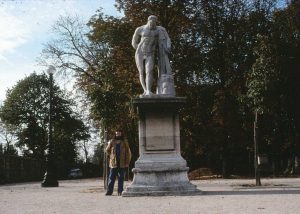
The author in 1977, reflecting on mortality and the biblical life span, still 41 years away.

We do take a while to get around to recording songs. Bob wrote this for his 70th (in 2018). The subject material is of course realising you have lived your biblical life – three score (sixty) and ten. As we all know people can and do live well into their 90s now and we know a few who made 100 or more. You can listen to the song by following this link to Bandcamp. If you like it, download it for $1.

This is one of those songs which have gone out of style – a man and a woman having a conversation. Think  ‘Goodness Gracious Me’ (Peter Sellers and Sophia Loren) or ‘Baby It’s Cold Outside’, written by Frank Loesser to sing with his then wife, Lynn Garland.

Three Score and Ten is one of a series of songs we have been recording with Roger Ilott at Restless Music near Stanthorpe. Roger’s been doing some collaborating with his brother Tony who lives in New South Wales. Like us, their forward plans have been thwarted by Covid-19 and restrictions on movement. Nonetheless it is possible to complete recording projects by remote control.

Bob dug out an ancient photo of himself posing with a statue in Paris, circa 1977. As he recalls, “I put the camera on a tripod, set the self-timer then ran like hell”.

By the way this song in no way resembles the folk ballad of the same name about a maritime tragedy, as sung by The Dubliners.

What the left hand doesn’t know

left-handers-day
Image: Left hander signing a document: athree23, pixabay.com

Last week, Friday the 13th, I intended to write about International Left Handers’ Day. Apparently it’s been a thing since 1976 – a clever way of making  people aware of this difference, at least once a year.

Clearly the organisers of International Left Handers’ Day do not suffer from  Triskaidekaphobia, a fear of Friday the 13th.

Phobias are an irrational fear of one or more of hundreds of strange things that induce panic attacks in some people. So you may not be surprised to learn that Sinistrophobia is a fear of left handed people (or objects close to the phobic person’s left hand).

I was made aware of International Left Handers’ Day by my friend and musical collaborator, Silas Palmer. In posting links to social media pages about Left Handedness, he revealed that three of the four members of Melbourne band The Royal High Jinx (he plays drums, keys, accordion and fiddle), are lefties in the literal sense. That is a clear statistical anomaly, as the norm is 10% of the population.

So what does it all mean to the 90% of us who use the right hand for most tasks requiring dexterity?

Well, it could be that you share an abode with a partner or other who is left-handed or have children who turned out that way.

I tried teaching She Who Is Also Left Handed to play guitar but it did my head in. Even now, I just can’t handle watching her chopping up onions or meat with the knife in her left hand. (You’d freak out more if I tried doing it with my right hand. Ed)

There’s been a lot of research into the science and psychology of handedness. Recently, a team at Oxford University found for the first time the role played by DNA. Scientists found the first genetic instructions hard-wired into human DNA seem to be heavily involved in the structure and function of the brain – particularly the parts involved in language.  Left-handed people may have better verbal skills as a result.

The research published in Brain magazine concludes that being left-handed (or port-sided), has often led to a raw deal.

“In many cultures being left handed is seen as being unlucky or malicious and that is reflected in language,” said Prof Dominic Furniss, a hand surgeon and author on the report.

“What this study shows is that being left-handed is just a consequence of the developmental biology of the brain, it has nothing to do with luck or maliciousness.”  (Despite the word ‘sinister’, which is derived from the Latin for left-handed. Ed)

If you grew up in the 1950s, the education system was not at all in favour of left-handed children. As the teaching of writing became widespread, teachers encouraged right-handedness by (mild examples), tying the left arm behind the back and knuckle-raps for writing with the ‘wrong’ hand. Those that persisted with their left hand were left to cope in a world designed for right handers.

Psychologist Chris McManus has suggested that the Industrial Revolution encouraged this, due to the right-handed design of the machinery in mills and factories

McManus, in his book Right Hand, Left Hand, finds an account from a school near Falkirk, Scotland, in 1880, noting that “eight children had come to school left-handed”. The phrase “had come” implies that they were not allowed to remain so.

With the decline of attempts to convert children, the numbers of left-handers has risen sharply over the course of the 20th century.

Some estimates put it as high as 18% and, as we will see, there are statistical anomalies.

Songwriter and film score composer Dory Previn wrote the definitive song about left-handedness.

The lyrics of Left Hand Lost (from the 1972 album, Mary C Brown and the Hollywood Sign), are infused with Catholic references linking the left hand to evil deeds (as in finding work for idle hands).

Previn, who wrote a good half dozen albums full of self-reflecting songs about mystical kings and iguanas, lemon haired ladies and waking up slow, starts this one with a liturgical chant.

The real attraction to this topic was a chance to name-check a few famous guitarists who have mastered the art of playing ‘Molly Dooker’ (1940s Australian slang).

Most of us would know about Paul McCartney, but there’s also a long list of players (living and dead) including Jimi Hendrix, Kurt Cobain, Noel Gallagher (Oasis), Annie Lennox, Tommy Iommi (Black Sabbath), David Bowie and Sting. Down under lefties are represented by singer songwriters Eric Bogle and Courtney Barnett, Dick Dale (Bombora), Beeb Birtles (Little River Band), Oscar Dawson (Holy Holy), WA slide guitarist Dave Hole, Kevin Curran (Hail Mary) and Kate Miller-Heidke Band guitarist Keir Nuttall.

Keir plays a 21-year-old Guild Jumbo acoustic that has been customised to suit a left hander.

It sometimes requires the addition of wooden braces inside the body to compensate for the additional stress from reversing the string order (as well as the nut and bridge),” he explained.

All of my electric guitars are made left handed.  But you often pay more, as the good ones are snapped up by collectors, so the prices are driven up.” 

Keir says he started off self-taught so it was too late to switch by the time he realised that it is expensive and frustrating being a lefty.

In an effort to join in on jams at parties, he  learned the basic shapes playing a ‘normal’ guitar upside down.

“When I taught guitar I would encourage my students to learn right handed to spare themselves the pain. Guitar is about the coordination between both hands, so I believe it doesn’t matter whether your dominant hand is fretting or picking.” 

This could be a good time to explain that some left handers (like the aforementioned Dick Dale and the late indigenous singer, Gurrumul), learned to play a conventionally strung guitar upside down.

The website https://leftyfretz.com/ is devoted to left handed guitars and how to play them. But the webmaster has also compiled an impressive collection of left-handed trivia. Like, did we know five of the last nine US presidents (not Trump) were left handed? Mensa, the elite organisation of people with high IQs, claims 20% of its members are lefties.

From this exhaustive list of left handed celebrities, I plucked just two Aussies (Hugh Jackman and Nicole Kidman). Did you know that 40% of the world’s best tennis players are southpaws (US baseball term)? Rafael Nadal was a right-handed player but taught himself to play leftie to give him an advantage (which it clearly does). Former tennis great turned commentator John McEnroe is also a Portsider.

I noted Simpsons creator Matt Groenig on one of these lists. This may explain why at least four of the characters (Marge Simpson, Bart Simpson, Ned Flanders and Mr Burns) are corrie dukit as they say in some parts of Scotland,

Specialist stores like Ned’s Leftorium do exist. The website www.anythinglefthanded.co.uk operated a shop in London’s west end from the mid-1960s. Management quit the retail space in 1996 and has been operating a home-based internet business ever since. Just in case you were wondering, some of the product lines that do very well include can openers, scissors, spiral notebooks and pens (the latter have  curved nibs so the writer can see what’s being written without putting the heel of the hand on still-wet ink).

If you’d like an insight into left handedness, try writing today’s headline with your opposite hand; that is, righties try with the left and vice versa. A fun game for any old Friday afternoon.

Angst in the time of Covid

polio-cholera-covid
Image: A young girl is given oral polio vaccine – Wikimedia CC

Amid reports of doubters who (still) believe Covid is fake news, this week we examine the history of public protest and vaccine hesitancy in times of contagion.

Those 3,000 or so people who mingled on Sydney’s streets a while back, protesting against the Covid lockdown, protesting about vaccines – it’s nothing new.

In the early 19th century, Joe Public was getting riled up by the spread of cholera and the seemingly poor response by doctors and authorities. There was similar dissent shown when the UK government sought to make the smallpox vaccine compulsory in 1854. There was an ‘anti-mask’ movement during the Spanish Flu and much stigmatisation of polio victims in the first half of the 20th century.

While the threat of cholera has been eradicated in countries with good drinking water and sanitation, there’s still a lot of it about in parts of Africa and Asia.

Cholera is a severe diarrhoeal disease which, if left untreated, can kill within hours. It is commonly transmitted via food or untreated water, particularly in countries with poor sanitation. Even now if you are travelling to Asia or Africa, your GP will advise getting vaccinated.

And here, dear reader, is where the great divide starts; the inevitable chasm between the majority who accept the science and medical advice and those who don’t. There are those who think the Covid vaccine is a plot to de-populate the planet or a conspiracy to control our minds by implanting microchips. Mine has already succumbed, as you can tell.

The first cholera epidemic (1831) emerged in Russia then somehow moved to Scotland, causing considerable angst and consternation. Just absorb this snippet from Wikipedia and put it in the context of Sydney’s Covid lockdown (and protests).

A major riot took place in Aberdeen on 26 December 1831, when a dog dug up a dead body in the city. Some 20,000 Aberdonians (two-thirds of the city’s population, although this number has been criticised as an exaggeration), protested against the medical establishment, who they believed were using the epidemic as a body-snatching scheme similar to the Burke and Hare murders of 1828”.

In the summer of 1832, a series of cholera riots occurred in various towns and cities throughout Britain, frequently directed against the authorities, doctors, or both. Of the 72 cholera riots in the British Isles that year, 14 made reference to body-snatchers (“Burkers”).

Burkers were people who believed that medical authorities were acting in co-ordination with the State to purposefully kill and reduce the population (weeding out the poor and weak). Sounds outlandish now, eh?

Despite oral vaccinations being in widespread use, the World Health Organisation (WHO) recorded 499,447 cases of cholera and 2.990 deaths in 2018, spread across 34 countries. About 75% of cholera cases were attributed to Yemen. As the WHO observes, cholera is most likely to re-emerge and spread in countries affected by war and civil unrest and/or where infrastructure has been damaged by natural disasters.

If you roll back 102 years to the Spanish Flu pandemic, it is not hard to uncover instances of public unrest. They ranged from people stigmatising those who had the virus to complaining about having to wear a mask in public.

Historian Humphrey McQueen says mask wearing was strenuously enforced in New South Wales.

The demand for masks was so extensive that to prevent profiteering, the Commonwealth Government declared butter muslin and gauze to be `necessary commodities’ within proclaimed areas.

Opponents of mask wearing saw them as breeding grounds for infection or as sapping the community’s ‘vital force’. A ‘Bovril’ advertisement alleged that anti-influenza masks were ‘like using barbed wire fences to shut out flies’.

McQueen said there was widespread support for inoculation throughout the country. By the end of 1919, 25% of people in in New South Wales had received two inoculations against Spanish Flu.

“Melbourne’s socialites reputedly arranged `inoculation parties’ where the guests got the needle in turn to slow music and a prize was awarded to the shapeliest arm.

Vaccine hesitancy is no surprise to David Isaacs, Professor of Paediatric Infectious Diseases, University of Sydney.

Writing in The Conversation, he explored the topic from smallpox through to the Covid vaccine.

In 1853, concerned by pockets of poor uptake of smallpox vaccine, the British parliament introduced the Vaccination Act, making infant smallpox vaccination compulsory.

Mandatory vaccination fomented opposition, something we should remember if considering making a modern vaccine mandatory.”
Protests quickly emerged, with more than 80,000 vaccine dissenters marching through Leicester carrying banners, a child’s coffin and an effigy of Jenner.

Eventually, the success of Jenner’s smallpox vaccine silenced the anti-smallpox vaccination movement.

I sometimes look at the smallpox scar on my arm (1955) and wonder why people were so scared of something that could spare you from a disease more contagious than Covid-19, with a 30% mortality rate.

In the first half of the 20th century, the ‘silent killer’, polio (infantile paralysis) swept quickly through the US and other countries.
The US was desperate for a polio vaccine and it got one, but not without an early setback. Virologists Albert Sabin and Jonas Salk, competed to develop the first polio vaccine.
Salk’s vaccine, made from killed polio viruses, was ready for a large clinical trial in 1954.

Five companies applied to mass produce the Salk vaccine, four major pharmaceutical firms and one Californian family firm called Cutter Laboratories. The trial results proved the vaccine worked, so vaccination began in 1955.

But within two weeks, children who received the Cutter vaccine (but not the vaccines made by the four other companies), started to develop paralysis. Of the 200,000 children given the Cutter vaccine, 40,000 developed polio, 200 were paralysed and 10 died.

The polio vaccination program stalled due to the ‘Cutter Incident’, but the fear of catching polio was so great the public was soon reassured the other vaccines had not caused polio, Prof Isaacs wrote.

I don’t remember being told this story as a child in the 1950s, lining up in a New Zealand schoolyard for the polio needle. New Zealand was as badly affected as Australia, with five polio epidemics from 1914 to 1954, resulting in many deaths and people my age being left with a lingering legacy.

Polio Australia says there are 400,000 Australian survivors of the childhood polio epidemic. At its peak between 1944 and 1954, the virus killed 1000. The highly contagious virus, spread via faeces and nasal mucous, resulted in poor people and those living in overcrowded situations being stigmatised. Then as now, outbreaks were dealt with by closing schools, borders and public facilities like swimming pools. Victims were quarantined and newspapers published a daily tally of polio cases and deaths.

Prof Isaacs compares these stories with the public concern which arose in 2020 about the Covid vaccines, primarily because of the risk of blood clots. He concludes with the ‘greater good’ argument.

In Australia, a concentration on individual risk at a single point in time ignores the benefits to the community of widespread vaccine uptake.

“History tells us the public can tolerate risk of harm from vaccines when the severity of the disease warrants the risk.

I don’t know about you, but my second AZ shot is due tomorrow. I’ll run the risk.

More reading:

The Cutter incident


Tokyo Olympics 1964 and 2020/21

Tokyo-Olympics-1964
Peter Snell takes the lead in the Men’s 1,500m Final at the National Stadium during the Tokyo Olympics, October 21, 1964. Wikipedia/public domain

There was not much else to do in sports-mad New Zealand in October 1964 other than join the legions cheering on our most famous athlete, Peter Snell, at the Tokyo Olympics.

He remains the only athlete since 1920 to win the 800m and 1500m event at the one Olympic Games. The Tokyo medals came four years after Snell, then an unknown, sneaked away with the 800m gold medal at the Rome Olympics in 1960.

The 1960s was one of New Zealand’s golden eras of sport, with the All Blacks kings of the rugby world and runners like Snell, Murray Halberg, Bill Baillie, John Davies and Barry Magee winning medals and breaking records.

It might be 57 years ago, but I recall jostling for position outside the appliance store in our small town which was broadcasting the Olympics on a black and white set, centre stage in the shop window. I was only 4ft 10 then, so had a mate give me a leg up to watch Snell take the lead on the turn and draw away with a 15 metre margin. Team-mate John Davies finished third, so all in all, a good day at the arena in Tokyo. It was also one time when watching sport on a black and white TV was not a disadvantage. (For those not familiar with New Zealand, their sports uniform colours are black and  white)

The crowd outside the shop with the TV in the window thinned out and we settled in for some more free entertainment. If this seems backward, New Zealand did not get television until 1960 and it took another four years for a relay station to be built in our region. Colour TV did not arrive until 1973.

Snell’s win, immortalised here in this YouTube video, shows why this record of winning the 800 and 1500 meters has not since been broken.

World Athletics recalls how Snell, coached by Arthur Lydiard, ran his last 300m in 38.6 and his last lap in 53.2, despite unleashing his full sprint only in the last 220 metres. The only faster time was Herb Elliott’s world record of 3:35.6 set in Rome four years earlier.

Snell’s 1:45.1 in the 800m in Tokyo was an Olympic record and the second-fastest performance of all time, behind only his own world record of 1:44.3.

Sebastian Coe, who later won Olympic medals at the same distances,  credited Snell with changing the way athletes prepared for middle-distance running – both physically and mentally.

“He would think nothing of a 20-mile training run,” said Coe. “He was unbelievably fit, with the physique of a rugby player. For four years he never lost in global competition, and he would still be a medal contender in Tokyo 2020 with the sort of times and runs he was producing in 1964.”

I was mad keen on (playing and watching) sports as a lad – just bloody useless at team sports. So I took up tennis and running. Pretty shit at that too, but at least there were no team mates to let down.

As a teenager growing up in small town New Zealand, I would spend Wednesday nights competing in track and field events (under lights). Third in a field of four was my PB!

Imagine our excitement when it was revealed that Peter Snell would appear at an exhibition run at our sports oval (and sign autographs afterwards). He apparently did this quite a bit in the early 1960s – inspiring future generations of would-be athletes.

Snell gave the local runners a head start. As one competitor recalls: “In the 880, I had 220 yards head start. I kept that until the last 220 when he flashed past me! It was a great night.

These stories of adolescence came rushing back when I was stuck at home this week, nursing a not-Covid virus and binge-watching the Olympics. I’ve been amazed at the skill shown by athletes competing in the ‘new’ BMX freestyle and skateboarding events. I sometimes watch the kids doing tricks on skateboards and BMX bikes down at our local skate bowl. I worry about the ones who don’t wear helmets and hope they don’t try to copy some of Logan Martin’s tricks.

Gold-Coast-based Martin  became the first  winner of the men’s BMX freestyle competition, clearing out from his nearest rivals. The Guardian reported that Martin, who calls the sport ‘gymnastics on a bike’, took a $70,000 gamble on winning gold when he built a replica of the Ariake Skate Park in his back yard. He did so as he was unable to travel to Tokyo to practice. Covid had also closed his local training ground, the indoor BMX park at Coomera.

Martin, 27, took to BMX after his family moved near a skate park in Logan City when he was 12. As The Guardian’s Kieran Pender put it, “Logan from Logan has been on an upward trajectory ever since, taking to the sky with his death-defying flips.

Overall, Australia’s doing very well (so far). Last time I looked (2pm), we had 42 medals, including 17 gold.

But I’m sure no one will begrudge New Zealand its 19 medals, (seven gold) for sports including rowing, canoeing and rugby. Why the focus on NZ, you might ask? Well, Tokyo 2020 is that country’s best OIympic gold result since Los Angeles in 1984, and it’s not over yet. That year, New Zealand athletes won 8 gold medals in equestrian, boxing, rowing, canoeing and sailing events to make the top 10.

Furthermore, just to show there is a database for everything, on a per capita basis, New Zealand is in third position on the medal table. The aim of this table is to show which countries punch above their weight. In this case, Australia is struggling to make the top 10.

Ah well, it will soon be over, as will (hopefully), this unspecified virus we have caught. Japan will be left thinking about how to best utilise the venues created for two weeks of international sport.

It will be Brisbane’s turn in 2032, after Paris (2024) and Los Angeles (2028).

Not everyone thinks it’s a good idea. Maverick north Queensland politician Bob Katter criticised Queensland Premier Annastacia Palaszczuk. Katter, the Member for Kennedy in far north Queensland, said the Premier would be sending Queensland into economic ruin after it was announced Brisbane would host the 2032 Olympic Games.

Known for staging publicity stunts, Katter blew up a makeshift ‘state economy’ to represent his distaste of the State hosting the Games. The State, for its part, has said the Olympic budget is $3.5 billion.

The VIP delegation which travelled to Tokyo to sell  Brisbane as the 2032 host city told reporters that 84% of the OIympic venues and arenas would be existing, refurbished or temporary structures. The famous Gabba cricket ground in Woolloongabba, already earmarked for the opening ceremony, has been promised a $1 billion makeover. There’s talk of a new stadium at Albion and of course there’s existing infrastructure originally built for the 1982 Commonwealth Games. They include the QEII (ANZ) Stadium at McGregor and the Sleeman Centre at Chandler.

As it’s still about 4,075 sleeps away yet, there’s a bit of water to flow under that particular bridge. What new sports will the Olympic Committee allow in 2032 and can Australia be competitive? It’s not that many years ago (1912-1948), that painters, sculptors, writers and musicians competed for Olympic medals. Now wouldn’t that be a thoroughly justifiable bonus for artists who suffered through the Covid restrictions?

Oh right, you can’t eat a gold medal.


Doom scrolling vs Good News Week

doom-scrolling-good-news
Photo by cottonbro from Pexels  

Today we’ll be talking about ‘doom scrolling’ and our addiction to negative news, even though we know how bad it is for the psyche.

Despite complaining about the doom and gloom fed to us through the media, we can’t quite get enough of it. Psychological studies have shown that people’s brains have a bias towards negative or sensational news. So even today, in the time of CovidNSW – The Rising, we leap upon the latest bad news – Gladys vs Dan, etc.

It seems to matter not if we (a) don’t live in NSW (b) have had our first or second shot or (c) have that Aussie character trait that says “F*** you, I’m fireproof.”

One of the drivers of the news-consuming business is what’s known in social media as FOMO (Fear of Missing Out).

News consumption has changed so much from the 1990s through to 2021 it is hard to make comparisons. We’ve always had the tabloid press and its TV equivalent and their blitz, ban, shock horror headlines.

Those of you who have a smart phone and/or a tablet will know the phrase ‘doom-scrolling’. This describes interminable flicking from one disastrous story to another, with few opportunities to absorb positive news.

The bad news is dominated by those daily 11am briefings when the Premier of the day reports the latest Covid active cases. Do we really need to know? Sure, New South Wales has a recurrence of Covid, and this time it is the highly contagious Delta variation.

But do we really have to tune in to the live press conferences on morning TV? I mean, who does that?

Well, probably many of the 11,682 people who told the Census in 2016 they use Auslan (sign language) to communicate.

Since the media began doing live crosses and 24/7 coverage of disasters (floods, bushfires, pandemics), an Auslan interpreter has been part of State government live press conferences. This may well be because Deaf Australia is an influential lobby group. This year, they have convinced the Australian Bureau of Statistics to include Auslan as a language spoken at home. So the 2021 Census may eventually reveal that the number of people who use and understand sign language is more like 20,000. I’m a bit fascinated so sometimes mute the audio and try to figure out what’s happening by watching the Auslan dude. It’s a skill. (The sign for a coal miner was a revelation. Ed)

While the 24/7 news cycle is wholly preoccupied with Covid news (with an occasional glance over to Afghanistan), some media outlets are starting to provide respite.

The ABC recently started including three or four stories at the end of its online newsfeed labelled ‘Good News’.

This is where I found out about a tiny community in South Australia (Venus Bay) which planned to buy a 100 acre block and restore it to wetlands and bush. At the time the story was posted (June) locals were prepared to put in $1,500 each.

The alternative is the land will be sold to a developer and become a golf course. (Remember when Maleny residents raised enough money to buy the block near Obi Obi creek but the owners reneged on the deal? Ed)

There is absolutely no downside to the Venus Bay story (apart for the developer, who may not get to fulfil his plans for the land).

The lesson is, as you are doom scrolling through the ABC’s online newsfeed (Police get tough on anarchists planning second Sydney lockdown protest), eventually you will get to Good News. In fact, you can customise the newsfeed so Good News is elevated to the top.

It’s not hard to find uplifting news stories. But it is much harder to convince news editors to give them a run.

Once, when I had aspirations to be an education reporter, I suggested we should send a reporter and photographer out to Chinchilla. Why? Well, four Year 12 students had received an OP1, the top academic score in the land.

What a great human interest story, I said, particularly if one or more of these kids was from a humble background. But no, at the time (and maybe still), education stories tended to focus on the negative.

Sometimes I wonder what happened to those four brainy kids. My idea of journalism would have been to write that story, then revisit it, 10 or 20 years down the track.

The Guardian’s Stephen Pinker found that the key problem is that positive and negative news stories unfold on different timelines. The news is now more like a play by play sports commentary (Ed: with similar inanities uttered at inappropriate times).

“Whether or not the world really is getting worse, the nature of news will interact with the nature of cognition to make us think that it is.”  Pinker wrote in 2017.

Bad things can happen quickly, but good things aren’t built in a day, and as they unfold, they will be out of sync with the news cycle.”

He quoted peace researcher John Galtung who opined that if a newspaper came out once every 50 years, it would ignore celebrity gossip and political scandals and instead report “momentous global changes such as the increase in life expectancy.”

As things stand now, plane crashes always make the news. Car crashes, which kill far more people, almost never do. Likewise, tornadoes and cyclones make for better television, even if they kill far fewer people than, say, asthma.

As ‘The Conversation’ found, multiple studies have shown that too much exposure to bad news can aggravate depression and anxiety. It can even bring on post traumatic stress syndrome in vulnerable people.

This is particularly so after major crises such as 9/11, the Australian bushfires or the Covid pandemic, where online news consumers can view stories and videos over and over.

The Guardian’s assertion that the media exaggerate news events for dramatic purposes can be illustrated by events in Sydney last weekend. The Australian media provided hyperbolic reports about people flouting the Sydney lockdown rules. While we who follow the advice are suitably outraged, She Who Also Doom Scrolls estimates that the 3,500 people who attended the ‘freedom’ rally represent just 0.07% of Greater Sydney’s population.

As part of what appears to be a coordinated global protest, people also gathered in Brisbane’s Botanic Gardens. Wait, we’re not in lockdown! Oh, you mean some of them believe the Covid vaccine is a de-population plot?

In France, President Macron has vowed to crack down on people who refuse to be vaccinated or protest about lockdowns.

Macron, if you remember, is something of a hard-liner. He was speaking after 160,000 people protested in France about a controversial new Covid pass that allows people who have been vaccinated to visit restaurants. France has also made it mandatory for health workers to be vaccinated.

Many marchers shouted ‘liberty’, saying that the government shouldn’t tell them what to do.

Macron urged national unity and asked, “What is your freedom worth if you say to me ‘I don’t want to be vaccinated,’ but tomorrow you infect your father, your mother or myself?

I doubt that any of us will change our media consumption habits as a result of my asking the question. Nevertheless, here’s a few links to happy cat-rescued-from-a-tree stories and this unforgettable satirical song (Good News Week), by Hedgehoppers Anonymous.

Don’t shoot the messenger.

https://www.positive.news/environment/conservation/beavers-arent-being-released-in-london-but-theyll-be-in-the-capital-soon/

 https://www.makeuseof.com/tag/need-some-good-news-for-a-change-top-5-good-news-web-sites/


Take five and all that jazz

take-five-jazz
Photo of sax player by Konstantin Aal www.unsplash.com

Warwick’s annual Jumpers and Jazz festival took me back to a day at the dentist in Maleny. I was lying prone, mouth jammed with all sorts of stuff. Soft, melodic saxophone music drifted down from the ceiling (with the poster of the Blue Mountains).
“Than Gltz?” I garbled.
Roger removed the suction hose “What’s that now?”
“Is that Stan Getz?”
“No, but good guess,” he said, replacing the suction hose.
“What’s your best guess?”
“Chrli Prker,” I choked out.
“No, not Charlie Parker – it’s Paul Desmond.”
“Ach, Dve bubck!” I replied and the conversation went on like that.

People who know I write songs often take a stab at my influences – is it Paul Kelly, Loudon Wainwright, Joni? Well, yes, but my first musical interest as a teenager (15) was jazz. Somewhere (probably in a box in the garage), are six Dave Brubeck quartet LPs. I have promised to will all such albums to my jazz-mad niece.

After I emerged from a childhood of listening to my parents’ records (classical, Scottish, opera) I discovered jazz.
First was pianist Phineas Newborn Jnr, who was famous for playing entire pieces with just the left hand. Then came the Modern Jazz Quartet, Brubeck, Oscar Peterson and so on. Then I discovered blues. But before I could truly get immersed in waking up one morning (with an awful aching head..Ed), along came the Beatles and the Rolling Stones.

Dave Brubeck and alto saxophonist Paul Desmond pioneered jazz in unconventional timings, headlined of course by the remarkable Take Five (1959). Despite the dire misgivings of his record company’s sales force at the time, Brubeck insisted it be released and was rewarded with an unlikely No 1 hit. In 1961, singer Carmen McRae also sang a version of Paul Desmond’s composition on the album Take Five Live. Ah, you didn’t know it had words, did you?

Take Five is a nod to the unconventional tempo of 5/4 (five beats to the measure), which means your drummer has to be masterful). Brubeck was interviewed in 1995 by Paul Zollo in his 730-page book, Songwriters on Songwriting. My well-thumbed copy reveals Brubeck telling Zollo how the record company’s sales people tried to cut Take Five off at the knees. They said it would not work because it wasn’t in 4/4 and people couldn’t dance to it. Moreover, they baulked at Brubeck’s album Time Out because it was all original tunes in odd time signatures.
“So I was breaking a whole bunch of rules. And then the album turned out to be the strongest selling album in years. So they were wrong!” he told Zollo.
“It’s still the most played jazz tune, maybe in the world.”
A few film makers agreed.Take Five was also used in movies including Mighty Aphrodite and Pleasantville.

Brubeck and Desmond may have pioneered 5/4 in popular music, but others picked up on it, namely film composer Lalo Schifrin. His thematic introduction to Mission Impossible is impossible, once heard, to remove from the ear. There are many others. Musician Dylan Ryche curated a Spotify playist of 48 songs in 5/4 dubbed – ‘Why not?’
Here you will find songs by Taylor Swift, Sting, Glenn Hansard, Jethro Tull, Radiohead, Sky, Blind Faith, Primus and that Andrew Lloyd Webber earworm from Jesus Christ Superstar, ‘Everything’s Alright’.
I’m not convinced that listening to multiple songs in 5/4 counts as entertainment, but the playlist shows that imitation is indeed the sincerest form of flattery.

My personal favourite 5/4 composition is multi instrumentalist and beatboxer Mal Webb’s re-creation of Geoff Mack’s Australian country standard, ‘I’ve Been Everywhere’. This required him to find 67 Australian place names with five syllables, in itself a giant task. You may have bumped in to Mal leading workshops or impromptu brass bands when we used to have big music festivals.

So last week when I was out walking along Warwick’s main street, I could hear Blue Rondo a la Turk (Brubeck), streaming out of speakers attached to street light poles.
Warwick’s Jumper and Jazz festival kicked off last Wednesday with volunteers dressing street trees in the ‘yarn bombing’ style. The statue of one-time Queensland Premier T.J Byrnes in the town’s main intersection was dressed in a multi-coloured shawl and beanie. A stage was erected in front of the town hall and jazz performers started doing their soundchecks. Jazz, as you’d know, don’t mean a thing if it ain’t got that swing.
But musicians should never really be boxed in to any one genre. Just as rock bands relish the solos (lead guitar, drums, bass), so too jazz musicians will cheerfully improvise for 20 minutes or more.
If you have never heard of Miles Davis, have a listen on Spotify – you will be astonished. I have two Miles Davis albums, the 1959 album Kind of Blue, which contained the aforementioned So What – a classic modal jazz tune. In 1970 or so I bought the double LP, Bitches Brew which runs for 94 minutes but contains only six tracks. It is not easy listening (but it’s yours eventually, dear niece!)

Meanwhile, close to the wood stove
I’ve been trying to avoid using the word ‘meanwhile’ when I want to move on to something else. So this time I will say, in due course, we (the acapella choir, East Street Singers), contributed to the jazz festival. Jumpers and Jazz was not held in 2020 so this year it’s been a case of blowing the dust off the songbooks which contain tunes you’d all know – Bill Bailey, Chatanooga Choo Choo, Five Foot Two and so on. There are some pretty melodies in there by real composers (as opposed to self-taught songwriters). They include The Way You Look Tonight, Moon River and Blue Moon. Some of us have been on a steep learning curve for today’s shopping centre gig, but we have a really good teacher, Jill Hulme, who also arranged some of the songs.
The various Jumpers and Jazz activities, including live music, art exhibitions, tree jumpers tours, sheep dog trials, car rallies and steam train excursions, have drawn a lot of visitors to the town. Because we are outside the Greater Brisbane Covid zone we feel less constrained in crowds, although quite a few people are wearing masks.

While spending this week committing jazz songs to memory, I realised how seldom I use unconventional timing in my own songs.
Most are in 4/4, some in 3/4 (waltz time), 2/4 (think bluegrass) and occasionally 6/8 which is like a speeded up waltz.
Our bush band occasionally required me to to play jigs in 9/8 (Rocky Road to Dublin, Blue Rondo a la Turk), but in the main I avoid tricky timings.
I should have said it is not a new concept – classical composers like Stravinsky, Tchaikovsky and Mr Bach have been confounding conductors since the 19th century with various tempo changes. Celtic and eastern European musicians also relish dance tunes in odd time signatures.
So here’s one you all know – Pink Floyd’s Money (from Dark Side of the Moon). Now you can impress your friends by saying (learnedly) “that’s in 7/4, you know?”
Which reminds me of the time a musician friend posted a meme on Facebook, as a response to people complaining about the (Covid) times we live in.
“These are not difficult times”, it said “ 5/4,5/8 6/8,7/8 9/8,11/8 and 13/8…these are difficult times.”