A Free Education – the Whitlam Legacy

free-education-whitlam
Students protesting about abolition of free education Image courtesy of www.solidarity.org

I will be forever grateful to the late Gough Whitlam for allowing me an opportunity to pursue a free education. I was 30 at the time with no qualifications and a chequered work history. My future lot in life was looking like casual labourer/dish pig. Not that there’s anything wrong with good honest sweat of the brow. But my undoubtedly sharp mind was frustrated by menial work and I was at a roadblock.

At the time unemployment was high and I was struggling to find any kind of work. I’d left school at 15 and had been in constant employment ever since, most of it unsuitable, apart from a three-year stint as a trainee psychiatric nurse.

Then came the concept of a mature-age tertiary degree or the prospect of studying screen-writing at the Australian Film & Television School. The latter proved a hard nut to crack, so I opted for a three-year course in journalism and media studies. What a journey. There were four school terms in a year at the time, so I figured by Easter of the first year I’d know if I could cut it or not. My results were mostly A’s and B’s so I knuckled down to full-time study, hammering out assignments on an ancient Olympus typewriter picked up at a police auction.

My student colleagues wasted no time explaining the privilege of a free university education. In 1974 it had been ushered in as one of the first in an astonishing array of social policy reforms by one Edward Gough Whitlam, without doubt our most controversial politician.

Yesterday was Remembrance Day but also the 46tht anniversary of The Dismissal, the fateful day in 1975 when the Queen’s representative in Australia, John Kerr, sacked a sitting Prime Minister. Gough Whitlam came to power in 1972 with the memorable campaign ‘It’s Time’. And it most certainly was. In a few short years Whitlam and his government dragged Australia out of a 1950s mindset into the era of afros, paisley shirts and flared jeans.

Most people under 50 are unlikely to know this story unless they studied law, politics or social policy at university. On Labor’s election, Whitlam and his deputy, Lance Barnard, formed a duumvirate (a two-man cabinet). They then spent two weeks working on a massive amount of draft legislation. If you are of my generation, I suppose your life experience will dictate what you think is the crowning achievement of these social reforms.

For me it was a free tertiary education. For women (or men) going through an ugly divorce, it was the single-parent pension.

Regardless of a ‘free’ education, the life of full-time student was a pauper’s existence, devoting most of our time to qualifying for a job-related degree. I recall doing a deal with the university bookshop and my local dentist to pay off my debts in instalments. Meanwhile, I played guitar in a bush band, worked as a free-lance journalist and took casual jobs when I could.

It is now 32 years since free tertiary education was scrapped by Bob Hawke’s neo liberal Labor government, to be replaced with the Higher Education Contribution Scheme (HECS). While Whitlam’s nemesis, Malcolm Fraser, tried ending free education in 1976 and again in 1982, it was Hawke who killed it off in 1986 by introducing a first-ever student fee. The Hawke government abolished free education by stealth, first with the $250 admission fee when students enrolled, then a fee system for international students before progressing to HECS in 1989.

The scheme began modestly, charging students a ‘proportion’ of the cost of their education. This morphed into open slather in 1994 when Labor allowed universities to ‘charge what the market would bear’, for tertiary courses.

As Tom Fiebig wrote in the socialist newsletter, Solidarity, a typical university student today will graduate with a $20,303 debt. Some 150,000 students now have more than $50,000 in debt.

Under HECS, students were given interest-free student loans, most predicated on not being due for repayment until one’s income reached a certain level.

So that was just one little thing that Whitlam and Barnard did, not nearly as universally acclaimed as the Medicare model. There was so much more: they abolished conscription, ended capital punishment, introduced no-fault divorce and a single-parent pension and started talks on Aboriginal land rights. There was equal pay for women, Legal Aid, the Federal Schools Commission, major subsidies for the arts and the National Sewerage Scheme, which put an end to Australia’s night cart collection system. While we are still today debating the need for an appropriate anthem, Gough got things started in 1972, giving God Save the Queen the flick and opting for Advance Australia Fair.

Whitlam finished our involvement in the Vietnam War, bringing the Australian Army Training Team home. Most troops, including conscripts, had already been withdrawn by his predecessor, Billy McMahon. What is not so well known is that when abolishing conscription, Whitlam arranged for the release of seven men who were in jail for refusing to go to war.

As one might expect when a new leader is stirring up a stagnant system, Gough Whitlam had his critics. He was hardly to blame for the 1970s global oil crisis, rampant inflation, lengthy recession and massive unemployment. But those disruptive events made Whitlam an easy target for those who successfully branded his government as poor economic managers.

I have chronicled many of these events in a song, ‘When Whitlam took his turn at the wheel’, which we posted on Bandcamp yesterday.

I did not have room for a verse about the ‘Blue Poles’ incident. Whitlam had opened the National Gallery, which wanted to purchase a modernist painting by Jackson Pollack. The asking price was $1.3 million (at the time a third of the gallery’s annual budget). The gallery director needed the PM’s personal approval. Although he did not need to make the purchase price public, Whitlam did so, creating a political and media scandal. Alternatively, it symbolised his foresight and vision (or his profligate spending). In 2016 there was a fresh furore when Victorian Senator James Paterson urged the government to sell Blue Poles (citing an insured value of $350 million), to reduce debt.

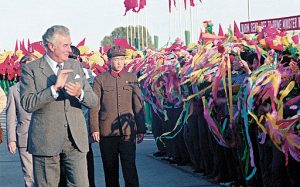
A fine orator and debater and a compelling public figure, Gough Whitlam went well on the international stage. He was the first PM to visit China, but as the song says – ‘today nobody knows’.

(Satire)

Here’s a short transcript from an interview with a sympathetic community radio station.

Natasha: Welcome, Comrade. So what made you think about writing this song, Bob?

Bob: Well, Natasha, I read a few stories recently which observed that it was the 7th anniversary of Whitlam’s death. I started thinking about the legacy that he’d left and how today’s generation is probably blissfully unaware of his achievements”.

Natasha: You have written in a previous episode of FOMM that you met Gough one time and that it did not go well?

Bob: I made the mistake of handing him my card from the Courier-Mail where I was employed as a business journalist. He looked at the card, made a scathing comment about the newspaper’s campaign against historian Manning Clark, gave my card back, turned and walked away.

Natasha: You don’t mention that in the song, although you do take a swipe at Gough’s vanity?

Bob: Yes, he probably would have thought the song was about him.

Natasha: Thanks, Bob Wilson. This is Socialist Songs Hour and here is that song, When Whitlam took his turn at the wheel.

You can listen to the song on our Bandcamp page https://thegoodwills.bandcamp.com/ and if you like, add it to your digital music collection. Share with your friends.

More reading 


Goodwills launch new song about Gough Whitlam

Whitlam-at-the-wheel
Gough Whitlam in China, image courtesy of the National Archives of Australia, CC.

We chose November 11 (Remembrance Day), to launch a new song about the achievements (and setbacks) of Gough Whitlam, our most controversial politician. The 11th marks the 46th anniversary of The Dismissal, when the Queen’s representative, John Kerr, sacked Whitlam and installed a caretaker government under Malcolm Fraser. The dramatic events of 1975 greatly overshadowed the many reforms Gough Whitlam introduced, including free education, free healthcare, no-fault divorce, a single parent’s pension and legal aid. He also ditched conscription and capital punishment and finalised the end of our involvement in the Vietnam War. And, as the photo indicates, he was the first Australian PM to visit China. Many people our age reflect on the Whitlam years as the only time in their adult lives they actually wanted to vote for someone. Unlike most politicians, Whitlam stated clearly what he wanted to do, won the election and then set out to do it all, and then more.

He abolished conscription and capital punishment and made a point of releasing seven men who had been in jail for refusing to go to Vietnam. And, as chronicled in the outstanding song by Paul Kelly and Kev Carmody, he started the process of Aboriginal land rights. Whitlam’s government had the misfortune to be taking the wheel at the time when the economy was going bad; there was inflation and massive unemployment. The global oil crisis did nothing to soothe the people who saw Whitlam as a dangerous maverick.  The song includes the downside so is not quite a hagiography, although I did admire the man for allowing me and my peers the chance of a free tertiary education.

Bob Wilson

Have a listen to the song here and if so inclined, add it to your music collection.

‘Well may we say God save the Queen…’

ScoMo’s Climate Plan to Save the Planet

ScoMo-climate-Plan
Image: twitter@GeorgeBludger, reposted from 2018 because it is so clever.

It occurred to me, having just volunteered to work for three different community groups, that what I need, apart from worrying about the Australian government’s failed policies on Covid, climate change and refugees, not to mention bushfire risk mitigation, is a Plan.

I use the capital letter deliberately as it seems that is what our peerless leader, Scotty from Marketing, wants us to do. His Plan (well, actually it’s not his Plan) should be called a Process because after all, that is what the National Party agreed to support. As we know, Deputy Prime Minister Barnaby Joyce and his country party cohorts emerged from days of climate talks to announce with fanfare great that it had ‘agreed to support a process’ to meet the government’s bare minimum target of zero net emissions by 2050.

Australia’s emissions are still among the highest in the world on a per capita basis, well behind similar developed countries.

At the COP26 climate conference in Glasgow this week, PM Scott Morrison somehow wangled his way into the discussions. It’s not that long ago (December 2020), that he was snubbed by a United Nations climate conference in London hosted by the UK and France.

British PM Boris Johnson had invited Morrison to speak at the December 12 summit but reneged. Selwin Hart, the special adviser to UN Secretary-General António Guterres on climate action, said at the time Australia had ‘not met the threshold needed to speak’.

But given a platform at COP26 (after pledging to meet zero net emissions by 2050), Morrison gave an optimistic speech, claiming that Australia’s emissions could fall by 35% by 2030. Greens leader Adam Bandt described the speech as ‘cringeworthy’, saying it contradicted statements made in Australia. The national climate plan (NDC) merely reaffirmed the formal 2030 target of 26-28% set by former PM Tony Abbott, he said.

“Australia is also siding with Russia and China to block global action on the climate crisis, refusing to phase out coal and gas, the leading causes of global heating,” he added.

The Guardian said Morrison’s 2050 plan lacked modelling, with almost a third of the abatement task comprised of cuts via unspecified “technology breakthroughs” and “global trends”, while a further 20% will be achieved through offsets.

To be fair, Morrison has been thwarted by climate change resistance from his Coalition partner, the National Party. The Plan may or may not be influenced by trade-offs demanded by the Nationals (which has a rural support base), regarding the issue of methane emissions.

Michelle Grattan wrote in The Conversation that Emissions Reduction Minister Angus Taylor had rejected the US push for a 30% reduction of methane emissions by 2030.

For city folk, methane is a global warming gas produced by cows burping and farting. Morrison backed his Minister, saying the government never had any intention of agreeing to the (methane) reduction.

Veteran finance commentator Alan Kohler has had a bit to say about climate change and the urgent need to keep temperature increases below 1.5 degrees celsius. As he wrote in The New Daily a few months ago, precise risk analysis of global warming is difficult because ‘feedback loop tipping points’ are unknown and unpredictable.

It’s known that with 1.5 to 2 degrees of warming, the combination of permafrost melt in Siberia, wildfires in the world’s forests and warming of the ocean will release more carbon dioxide into the atmosphere.

“(This) means a feedback loop could take the temperature to 2.5 degrees above pre-industrial temperatures – and perhaps beyond – no matter what we do.”

Kohler is good value, in that he often exposes seemingly turgid reports that no-one else has looked at and translates them into plain English.

For example, the Australian Prudential Regulatory Authority (APRA) issued a draft prudential practice guide on climate change which included 4 degrees of warming as one of its two “scenarios” for banks to use in their future planning.

“A 4 degree rise in the average global temperature would make large parts of the planet uninhabitable and lead to the total collapse of the banking system. No need for any planning,” Kohler commented.

“The other APRA scenario was for 2 degrees of warming or less, consistent with the Paris Agreement of December 2015, which should happen if all countries meet their Paris pledges (which they haven’t).”

Successive Australian governments have been terrified about drafting tough new laws to support carbon reduction. This is a country which cleared vast swathes of forest and scrub to establish pastoral land and open-cut coal mines. We have allowed fracking, built a vast network of gas pipelines, supported offshore oil drilling and relied on coal-fired power stations for much of our energy.

We also export millions of tonnes of coal to countries which have dirtier power stations than ours. We have exacerbated the global crisis rather than mitigating the effects of carbon emissions.

We here at FOMM HQ reckon we have been hearing about climate change, greenhouse gases and global warming since we became conservationists in the 1960s. She Who Taught Geography says she was aware of it when studying at university in the late 60s. We were called ‘tree huggers then and probably still would be now, despite knowing what we know.

So here in Australia, 50 years later, we are still in rampant denial about what rising carbon dioxide levels have done to the planet.

It’s no new thing. Swedish scientist Svante Arrhenius first predicted in 1896 that changes in atmospheric carbon dioxide levels could substantially alter the planet’s ground temperature through the greenhouse effect. In 1938, Guy Callendar connected carbon dioxide increases in Earth’s atmosphere to global warming.

By the 1990s, a consensus emerged among scientists that greenhouse gases were deeply involved in most climate changes and human-caused emissions were bringing discernible global warming.

Unhappily, many people are climate change deniers. Just like those who subscribe to Covid-19 vaccine conspiracies, they defy the majority opinion of the world’s scientists.

Perhaps they were not paying attention when some of the world’s biggest fund managers started selling off their fossil fuel investments circa 2016. The latest local example of this was the State’s biggest investor, Queensland Investment Corporation, which manages State employees’ superannuation.

The topic of fossil fuels and divestment (selling oil, gas and coal stocks) was also debated at COP26. The pro-investment argument is that 80% of the world’s energy is still sourced from fossil fuel and a sudden rush for the turnstiles is unlikely.

Fossil fuel opponents understand how divestment can turn the tide quickly by shutting down fossil fuel ‘sponsorship’ (sometimes known as ‘greenwashing’).

Yet another conference, then, where world’s leaders (average age 60), left COP26 without doing anything meaningful.

The Greenhouse Gas Bulletin’s stark message this week is that from 1990 to 2020, the warming effect on our climate by long-lived greenhouse gases, increased by 47%, with CO2 accounting for about 80% of the increase. The numbers are based on monitoring by the World Meteorological Organisation’s Global Atmosphere Watch network.  As WMO Secretary-General Prof. Petteri Taalas said: “We are way off track.”

If I make it to 2050, I can imagine 102-year-old me, spilling jelly and custard on my vintage Homer Simpson T shirt muttering: “Meh” (having been moved in a dinghy to a nursing home on high ground).

Unfortunately, ‘meh’ (shorthand for callous indifference), is the attitude of far too many people who won’t see 2050. They have all obviously forgotten climate activist Greta Thunberg’s fiery speech at the 2019 World Economic Forum in Davos.

“I don’t want your hope. I don’t want you to be hopeful. I want you to panic,” she said. “I want you to feel the fear that I feel every day and I want you to act. Our house is burning.”

More reading: Seven years ago!!!


Gender equity and ‘Men Make Dinner Day’

gender-equity-men-dinner
Share of adults that cook and/or do housework in selected European countries, by gender in 2016. Eurostat/Destatis https://www.statista.com/chart/15880/housework-europe-gender-split/

At the outset I should say that ‘National Men Make Dinner Day’ is a US invention and not celebrated in Australia – although it should be! The sub-heading is important – no barbecues or takeaway pizzas allowed.

Founder Sandy Sharkey recommends National Men Make Dinner Day for blokes who are completely lost in the kitchen.
“Keep your sense of humour (and a frying pan) and who knows, this could be the start of something beautiful (or charred)!”

National Men Make Dinner Day is the first Thursday in November (the 4th of November this year) so get to it, men. Plan the evening meal, print out a recipe, purchase ingredients (and a good bottle of red), and then get cooking.

I was musing about this on Sunday night when I was in the final stages of serving up home-made pizza for dinner. On switching the tray from the top to the bottom, the tray slipped out of my grasp and the pizza landed on the half-open oven door. Much swearing ensued as I manoeuvred the pizza back on the tray; not before spilling some of the toppings on the kitchen floor.

I’m a marginal case in the kitchen but luckily there is She Who is a Great Cook. But she occasionally tires of the routine and announces:

“I’m bored with cooking, why don’t you come up with something tonight?”

“Hello, is that Roddies Fish and Chips?”

My culinary skills include spaghetti bolognaise, Asian stir fry, pizza, sausages and veg and the occasional all-day roast in the slow cooker. Cooking in-house is enhanced around here by She Who Has a Green Thumb contributing produce from the garden.

As is my wont, I started researching the touchy topic of whether men do much cooking at home, or housework in general. It is called ‘gender equality’ in the jargon of academia.

There was much media commentary when the 2016 Census results began to trickle out. It seemed that one in four Australian men did no housework at all. That ratio has improved since then, with the Covid lockdown having a lot to do with helping men improve their cooking and housework skills.

The US-based Pew Research Center surveyed couples about how Covid had affected the way they share household duties. Pew found there were differing perceptions before and after the pandemic. For example, in 2019, 49% of men said they were satisfied with this aspect of their relationship, compared with 39% of women. In 2020 the gender gap widened, with 55% of men saying they were happy with the sharing of household duties, compared with 38% of women.

Gender equality has made big strides in the EU, except for housework, according to Martin Armstrong, writing for Statista. The most balanced split was in Sweden where 79% of women said they do cooking and housework, against 56% of men. The gap was wider in the UK (85% 49%) and the less said about Greece (84% 16%), the better.

(BTW, there must be some awfully messy households in Hungary – see above table- unless they’ve all got housemaids.Ed.)

Australia’s latest survey on household task-sharing indicates that 47% of couple households report that household chores are equally shared. I consider myself well entrenched in this cohort. I do the washing up 90% of the time (although not always to SWIAGC’s satisfaction). I vacuum 100% of the time (my Doctor told  me it’s bad for my back. Ed)  and it’s probably 50/50 in the laundry. Cooking, well, I make lunch about half of the time but cook dinner maybe once or twice a week and not on a schedule. My bad.

I am probably getting a bit long in the tooth to be blaming my upbringing, but our household in the 1950s was very traditional. Dad went to work and earned the ‘bawbees’ and did outside chores like mowing, heavy gardening (potatoes) and knocking off the occasional chook. Mum was in charge of the kitchen (and plucking and gutting of aforementioned chook). She did the laundry (in a copper), rinsing with a mangle over two concrete tubs. Those were the days! The kids had set chores which included feeding the chooks, helping with washing up and taking turns with the lawns and garden.

Dad, as they’d say ‘never lifted a finger’ in the house. To be fair, he worked night shift as a baker and slept in the afternoons, so could hardly be involved in the preparation of the evening meal. He would get up about 5pm, have a bath and sit and read the newspaper until dinner was served at 6pm.

As I entered adulthood, I vowed not to become that kind of man – the ‘head of the household’. Relationships with women who were becoming aware of feminism helped consolidate my stance.

Over the years I became aware that, feminism aside, not all couple households operated within a loose framework of gender equality. At one dinner party, as I rose to clear away plates and start serving dessert, one of the men muttered ‘Mate, you’re letting the side down’.

The Australian Institute of Family Studies carried out a study of opposite-sex couple households in 2020.  In 12% of couple families, household tasks were always done by the female and in 30% of couple families, they were usually done by the female.

By comparison, in 8% of couple families these tasks were usually done by the male and in 2% of couple families, they were always done by the male. As noted, in 47% of households, chores were equally shared.

Most males (74%) were satisfied with the way household tasks are divided compared to 52% of satisfied females. Now that is a gender gap!

Some people are just not designed for certain household chores. You are either a good cook or you’re not, IMHO. If you’re the one that always overcooks the vegies, burns the chops or drops the half-baked pizza on the oven door, why not step back and let the gourmet chef do it? I’m sure our old friend Mr Shiraz won’t mind my sharing this anecdote.

Mr Shiraz is and always has been the cook in his household and a damn fine chef he is. He and partner are also avid gardeners, so there is always a plentiful supply of fresh vegetables and herbs to spare.

Once when we were invited over for dinner, our son, who was then five, piped up: “What’s Trevor cooking tonight?”

No wonder he grew up understanding that men (and boys) must iron their own clothes, thus dutifully ironing his school shirts and shorts.

National Men Make Dinner Day’s Sandy Sharkey provides an amusing list to motivate men to do more cooking (and not just on one day).

  • First and importantly, you can wear your tool belt in the kitchen – just replace the hammer with a whisk;
  • Find recipes which include beer as a legitimate ingredient;
  • Whoever is cooking always gets more attention from the dog;
  • Since you choose the recipe, you can avoid things you don’t like (turnip, brussel sprouts, kale);
  • Some desserts (crème brulee) require the use of a propane torch (how good is that);
  • Form new bonds with male friends who also cook;
  • Participation in the kitchen earns optimum points with the wife (use them wisely).

Here is the easy way out: buy a rolled roast (no waste), place in the slow cooker with peeled potatoes, onion and pumpkin, add herbs and a dash of red wine. Put on low at 9am and by dinner time it will be ready to go. Steam some vegies and set the table.

With luck, your spouse will do the washing up!

Thanks to those who contributed to FOMM’s fund-raising campaign. If you feel inclined to subscribe for $10, $15 or $20, here is the link:

More reading


Alternative media (and a plea for alms)

alternative-media-alms
Image by John Inglar, pixabay.com Suspicious of the status quo media? There are alternatives to fake news, beat-ups and media bias.

Over the years I have found that readers value my occasional reviews of alternative media, as opposed to fake news or the mainstream media. Since the latter started finding it hard to make money (circa 2010), there have been many start-up newsletters and blogs that seek to go counter to the mainstream media. Some survive (and grow), others fade from view. It is a constant chore to keep up with who’s who in the alt-media zoo.

Alan Austin, writing for Michael West Media, said the alternative media attrition rate is high. West’s website (launched in 2016) had been the only new entrant since the Saturday Paper in 2014, Austin noted. Michael West is an investigative financial journalist who previously worked for the Australian Financial Review. On his ‘about’ page, West states: We are non-partisan, do not take advertising and are funded by readers. Our investigations focus on big business, particularly multinational tax-avoiders, financial markets and the banking and energy sectors.  In a plea for monthly contributions to keep the machine rolling, West’s slogan is – Don’t pay so you can read it. Pay so everyone can.

That’s a mantra to keep in mind when perusing daily news online. Austin names four mainstream journalism outlets which are always ranked highly among the Top 50 Australian websites: news.com.au; abc.net.au; theguardian.com and smh.com.au. Of the four, only News Corp has a strict paywall. The ABC is and always has been ‘free’. The SMH and The Guardian prefer you to sign up for a daily email which contains a lot of news. The SMH asks readers to pay but provides a lot of free content on its website, as does The Guardian, which relies on contributions.

As time goes by, it becomes obvious that ‘free’ doesn’t really mean free. It means that if you value what you are reading, you are expected to chip in. When I first started this blog, it was relatively easy to source research material from a bewildering array of choices both local, state, national and international. More frequently I am coming up against messages like ‘you have read two free articles – why not subscribe?’

Today I’d like to point you to five alternative media outlets, chosen from readers’ recommendations and my own research. The list does not favour one publication over the other. The question to ask yourself before subscribing to a free daily email is, can you keep up?

The New Daily

I have in the past read occasional articles but am now trialling a (free) subscription. One of my regular readers recommended TND with the tongue-in-cheek caveat, ‘it might be too left wing for you’. I went browsing and found an article by Michael Pascoe which warned of forces marshalling in the US for the return of Donald Trump in 2024. If not Trump (T1), then a younger, more vigorous version (T2). As Pascoe says, it is a far scarier scenario than anything Covid can throw at us.

TND, a free online news publication, started in 2013 and now has 1.7 million subscribers. TND is backed by Industry Super Holdings, with senior executives including the former editor of The Age, Bruce Guthrie, and digital publishing pioneer Eric Beecher. Unlike some of its peers, it carries ads and tends to delve into celebrity news.

Pearls & Irritations

This weekly collection of essays focuses on Australian public policy and attracts contributions from well-credentialed writers. Formed by retired public service mandarin John Menadue, P&I has no sponsors, no ads and subscriptions are ‘free’ although there is a mechanism to attract sponsors with a structured schedule of monthly donations ($10 to $100) or one-off contributions. P&I recently went on a fund-raising quest to cover expenses including ‘legal challenges’.

Last week’s edition included an article by former diplomat Bruce Haigh, who took aim at former PM Tony Abbott’s “ham-fisted intervention” in Taiwan. In a widely reported speech, Abbott listed all of China’s “sins”, from Hong Kong, Uighurs and trade sanctions against Australia, as reasons to support Taiwan politically and militarily.

“This intervention by Abbott has about it the inept diplomacy which has seen relations with China, France and the EU collapse,” Haigh wrote.

In noting that the speech had not been coordinated with regional countries and major players like the US, France or Japan, Hague asked the question ‘who put Abbott up to this?’.

“Abbott’s speech contained a strong message and a line that has been pushed by the Australian Strategic Policy Institute (ASPI).

“The tone, intended or not, reflected the language we have become used to from ASPI.”

The Australian was less critical of Mr Abbott’s pro-Taiwan speech, mentioning that it followed a similar message last year from another former Australian PM, Malcolm Turnbull.

When asked by reporters if he was representing the Morrison government, Abbott replied: “I am here as citizen. But, one thing about being a former Prime Minister is you do have a bit of a megaphone.

“I want the people of Taiwan to know that they are not nearly as isolated as Beijing would like them to feel,” he added.

I should note that this article is one of the few the conservative broadsheet makes available free of charge. You are more likely to be met with a paywall.

The Conversation

I have often referred readers to The Conversation, a digital platform where journalists present articles written by one or more academics. Not only is The Conversation ‘free’, it allows others to freely quote from and even reprint articles under a creative commons license. The project derives its content from a large, international network of academics and researchers. I make a monthly donation to The Conversation as it is often my go-to source for research and fact-checking. One interesting offering this week is a topic that has been turned over by others, including TND.

Crikey

This long-running alternative media publication has broadened its focus since the early days of focusing on media machinations. Crikey now has an investigative unit funded by former newspaper baron John B Fairfax. Crikey’s subscription model appears to be working – its mere existence says so. A visit to Crikey’s website allows the casual reader the chance to read two or three articles which are ‘unlocked’. An ad urges you to “Guard against stupid” and subscribe  “from $1 a week” (the current annual subscription is a discounted $99).

Since I mentioned the investigative unit, this week David Hardaker concluded his four-part series, ‘God in the Lodge’. Hardaker’s quest was to examine Prime Minister Scott Morrison’s public position that his religious beliefs do not influence his policies.

Crikey has been generous with Hardaker’s series, unlocking all four episodes for casual readers. It also published daily commentary on the topic by key thinkers in religion and politics.

The Saturday Paper

This publication belongs to the same stable that publishes The Monthly and the Quarterly Essay (Schwartz Media). The Saturday Paper employs some of the country’s best writers and analysts.  It is one of the few alternative media publications which has a print edition. The on-line edition provides quite a lot of ‘free’ content. But if you prefer a newspaper you can read in bed or at the dining room table, The Saturday’s long-form articles will keep you going all weekend.

Happy browsing, people. Do let me know if you uncover an independent media outlet with quality news and analysis I have not mentioned here.

Help keep FOMM going

This is also a good time to remind you of my annual plea for alms and many thanks to those who responded so promptly. It keeps me insured, maintains the website and covers other incidentals (coffee, dark chocolate, a nice lunch out for the Ed?SWPG (She who proofreads gratis.).


FOMM annual subscriber drive

Dear Friends of FOMM,

It’s time again to ask for contributions to help meet operating expenses which usually come up at this time of year. I was prompted when a long-term reader wrote a letter (it came in the mail) and tucked a $20 note in as her contribution.

It’s not compulsory though, and Friday on My Mind will continue to appear, free and without ads (except for our own outrageous music plugs).

Whatever you can afford ($10, $15, $20 etc), please send to our PayPal account using the email address goodwills <at> ozemail.com.au.

Please mark your contribution ‘FOMM subscription’. We use the funds to pay for insurance, website administration, domain name renewals and associated expenses.

The alternative is to email me and ask for bank details. Do not use last year’s bank details as we have changed to a local bank.

Friday on My Mind started in May 2014 and has been published almost every week since (I may have taken a week off around Christmas). There have also been guest columns, some written by my trusty editor, Laurel Wilson, often known as ‘She who etc” which is of course a nod to the late John Mortimer, whose crusty barrister character Horace Rumpole referred to his good lady wife as “She who must be obeyed”.

If there is a topic I have not entertained and you think I should, do mention it and I will add it to my ‘future FOMM’ folder.

Thanks in advance

Bob & Laurel

Hoarding cash in a cashless society

hoarding-cash-cashless
Image by S. Hermann and F. Richter, Pixabay.com

Australians have been hoarding cash, particularly through the first year of Covid-19, despite forecasts that we will be a 98% cashless society by 2024. Even if this prediction from global payments giant FIS comes to pass, some 540,000 Australians will still prefer to use cash.

You may recall a flurry of news stories on this topic in March. The research commented on the effect of a de facto ban on cash during the first year of Covid-19. Even now, merchants are discouraging the use of cash at point of sale.

The topic was prompted when Professor Steve Worthington of Swinburne University’s business school sent me an article he prepared for the ANZ Bank publication, Blue Notes. The topic was ‘Can cash survive the digital tide?’

Prof Worthington says the key issue with the domination of electronic transactions is that it excludes people who either rely on cash or prefer to use it. He argues that physical cash should be classified as an essential service (designated as a Public Good).

It may not surprise to learn that Australia’s high cash users are likely to be older people, have lower household incomes, live in regional areas and are less likely to have access to the Internet.

As you’d know, banks offer their customers internet banking, but you need a secure internet link to do so.

The Australian Bureau of Statistics (ABS) estimates that two million Australians do not have access to the Internet. Many Australians use public internet, most commonly at public libraries – not the most secure method of conducting Internet banking.

Prof Worthington notes that there is now more cash in Australia than ever before, with record growth in 2020. But it is not showing up in the Reserve Bank of Australia’s statistics as being circulated.

A cash payments study by the RBA in June last year confirmed that Australian consumers were continuing to switch to electronic payment methods in preference to cash. The share of in-person cash payments was still substantial; at 32% by number and 19% by value in 2019, down from 43% and 30% respectively in 2016. But generally, we have taken to tapping and going.

Meanwhile, the RBA is mystified by the rising demand for cash, which does not show up in circulation data. Cash (notes issued in excess of those returned), soared 17% during 2020. The average in the decade prior was 5% a year. The Reserve Bank went to its contingency fund twice during 2020, such was the demand for $50 and $100 notes. There are now 36 $50 notes and 16 $100 notes in circulation for every person in the country.

(“Where are mine?” – She Who Keeps Coins in a Tin for Christmas).

Tabloid newspapers and current affairs programmes go to the ‘stashed under the mattress’ cliche when reporting on this curious social trend. Given the meagre returns available on term deposits and the comparatively low cost of domestic safes, it is fair to assume some people have a stash of cash at home.

There could be many reasons for this apart from convenience; like hiding one’s income from the tax office, Centrelink or the ex.

I’m from the pounds shillings and pence era when shops would not cash a cheque unless they had previously done business with the person presenting it. Cash was definitely King then.

My Dad used to call hard currency ‘filthy lucre’ and while he took cash over the counter in the bakery shop, he always washed his hands before handling food. The term ‘filthy lucre’ does not mean that banknotes are dirty – it’s a biblical reference to ill-gotten gains. But I digress.

Australians have gravitated big time to electronic banking solutions. The biggest clue is the absence of queues at ATM machines and mass withdrawal of ATMs in city suburbs – 2,500 gone in 2020 alone.

Forecasts that Australia would be a virtual cashless society by 2024 were drawn from a new report by financial giant FIS Global. Mike Kresse, head of global payments at FIS, believes cash will be virtually retired by 2030.

“From individual consumers and small businesses to the largest clients, cash can’t compete with rising expectations for fast, safe and easy payments,” he said when launching FIS Global’s annual report.

The smartphone was already transforming payments, and the pandemic brought the future faster, accelerating the trends.”

FIS forecast that by 2024, Australia will be the fourth most cash-averse economy in the world after Sweden, Denmark and Hong Kong.

Prof Worthington says Australian authorities need to work on establishing a way to include people who still want to use cash, hence his plea to consider cash as an essential service.

“We are using less cash as a payment system, but today people still need access to cash. That may be because of a desire for privacy, convenience or as a backup payment option when all else fails.”

Cash is still the preferred payment option of many small traders and sub contractors. The Australian Taxation Office (ATO ) occasionally has a blitz on companies thought to be under-reporting income, one year targeting 45,000 small businesses.

We use a range of tools to identify and take action against people and businesses that may not be correctly meeting their obligations,” the ATO says.

Through data matching, we can identify businesses that don’t have electronic payment facilities.

These businesses often advertise as ‘cash only’ or mainly deal in cash transactions. When businesses do this, they are more likely to make mistakes or don’t keep thorough records.”

It’s comforting to know that the ATO differentiates between the cash economy, the ‘shadow’ economy and the ‘black’ economy, the latter run by organised crime groups dealing in drugs, prostitution and people smuggling.

This topic got me thinking about the day in 1984 when I was locked in a secure room with a million dollars. Our chief of staff had been asked to send a reporter and photographer to a bank branch in Toowoomba. The occasion was the arrival of Australia’s first $100 note – in this instance 10,000 notes delivered in a square block.  The cash was transported by train from the Reserve Bank mint at Craigieburn in Victoria. Secrecy was paramount and we were not told when the photo opportunity would happen until half an hour prior.

I have to tell you, a million dollars in $100 notes takes up a lot of space in a room.  Our photographer fitted a wide angle lens to best capture the great block of notes and obligatory men in suits.

These days, I almost always carry cash in my wallet and feel naked if I run out. Despite having a debit card and a credit card, it somehow just isn’t the same. Even during Covid in 2020, when retailers looked askance at people tendering banknotes, I slipped the odd five or ten across the counter. Cash will always be an attractive option for some people because (a) it is anonymous and (b) does not leave an electronic trail.

After all, until the day when marijuana is decriminalised, regular users will turn up at the usual location with $300 or so in cash. There are many such occasions when consumers are unlikely to use buy now-pay later options.

No sooner had I written that, an ad for Safepay popped up on my screen! How do they do that?

More reading:

 https://bobwords.com.au/taking-an-interest-in-recessionary-economics/


Covid triggering depression and anxiety

covid-depression-black-dog
Image: The author and black dog, moving day 2019 (before Covid-19)

It’s the lead news story you’d probably never see on prime time TV, a focus on depression and anxiety and how Covid-19 and the control response has seen more of us succumb to the Black Dog.

Newsreader: “Researchers have published new data that show the incidence of depression and anxiety among travellers stranded in Queensland has soared in recent months.

“70% of those who reported acute anxiety or depression over the past six months were people from New South Wales and Victoria who find themselves exiled in Queensland.”

(Cross-over to interview)

Interviewer: Julianna and husband Dario* have been stranded in Queensland since a road trip north in June turned into five months in exile. Our correspondent caught up with them at Sapphire, after the couple had spent a fruitless week fossicking for opals.

Julianna: “It was fun until it wasn’t fun. I mean, how many times can you go to the Qantas Museum? I miss my grandkids and I miss Victoria, the markets and all the good foods you can’t buy in outback Queensland.

Dario: “Yeh, Julianna’s right  And, you know, a 20-foot caravan might seem big until you have to live in it for months on end. It always smells like fried eggs.”

Interviewer: So you have both slipped into a state of anxiety and depression as a result of not being able to go home?

Julianna: “Yeh, well it’s not logical – I mean the sun’s shining and the birds are singing and every day we feel safe because there’s hardly any cases in Queensland. But I’ve been feeling increasingly sad and apathetic.”

Dario: “And I’ve been drinking more than I usually do…

Julianna: “You reckon?”

Satire it may be, but it’s no laughing matter, this dark mood which can inexplicably darken the sunniest Queensland day. The symptoms are not hard to read: feeling tired all the time, not going out much, feeling miserable, feeling that nothing good ever happens, relying on alcohol…

Sunday is World Mental Health Day, although why we only get one day a year is something to ponder.

Multiple studies have been carried out that link the increased incidence of anxiety and depression to the global pandemic and the response by authorities to control the virus.

Professor Richard Bryant from UNSW’s School of Psychology says people find it harder to cope as time goes by.

We are having a longer and later lockdown experience than the rest of the world, due to the lack of people who are vaccinated and the Delta strain of COVID.

What we tend to see is that people get anxious at the start, then when the effects of social isolation wear on, it becomes a depressive reaction: people’s coping resources get eroded over time.”

Prof Bryant said the Delta strain and the effect of younger people dying has elevated anxieties among that cohort because they thought COVID was mainly a risk for older persons.(Apparently not taking into account the possibility of their catching Covid and passing it on to older people, such as their parents. Ed)

He says we can learn about the trajectories of mental health in Australia by looking at countries that are somewhat ahead of us.

“For example, one study in the UK sampled people at varying points during the pandemic. This study found that two months into lockdown, which is approximately where much of Australia is positioned now, the rate of people’s anxiety had decreased marginally relative to earlier periods during the pandemic.

However, at that stage more than half of the people participating in the study were still reporting anxiety.”

Three months after lockdowns started in the UK and restrictions were beginning to ease, half of the respondents still reported being worried about the pandemic.

As always, those most vulnerable to mental health problems were young adults, the unemployed, single parents, and people with long-term health conditions. 

A recent webinar hosted by Monash Business School explored the impact that deteriorating mental health is having on the Australian economy (estimated at between $40 million and $70 million a year). Covid-19 has driven a rise in the prevalence of depression and anxiety disorders, and is linked to an overall decline in women’s mental health.

Professor Jayashri Kulkami,  Head of the Department of Psychiatry at Monash Central Clinical School, uncovered some striking findings from an online survey conducted by her research team looking at ‘Women, COVID-19 and Isolation’.

Professor Jayashri points out that the concept of quarantine is not new, and that isolation is intended to keep people safe. Paradoxically,  for some women and children, being isolated at home is doing the opposite.

“The negative consequences include the risk of losing jobs, greater economic vulnerabilities, and psychological health issues resulting from isolation, loneliness and uncertainty.”

Statistics collated by Beyond Blue, one of the many support services people can turn to, show that:

  • One in seven Australians will experience a depressive illness in their lifetime;
  • One in 16 Australians is currently experiencing depression.
  • One quarter of Australians will experience an anxiety condition in their lifetime.
  • One in seven Australians is currently experiencing an anxiety condition.
  • One in six Australians is currently experiencing depression or anxiety or both.

Fortunately, support-seeking appears to be growing at a rapid rate, with around half of all people with a condition now getting treatment.

Against those long-term stats, an Australian Bureau of Statistics survey published in July found that one in five Australians are reporting high or very high levels of psychological distress linked to the COVID-19 pandemic.

Lockdowns bring unexpected positives

The New Daily’s John Elder set out to find the hidden silver lining beneath this gloomy diagnosis. He examined a survey of 3,000 people by psychologists from the University of Strathclyde in Glasgow.

The May 2020 survey found that more than half reported positive changes in their lives since COVID-19 took hold. In particular, 87% of people were more appreciative of things usually taken for granted. Respondents reported having more time to do enjoyable things, spend more time in nature, pay more attention to personal health and pursue physical activities. (Our garden has never looked so good. Ed)

These changes in behaviour were still in train for half the participants who had reported positive effects.

A December 2020 study from the University of Sydney found that 70% of its 1,000 participants experienced at least one positive effect of the pandemic.

The top three positive effects were having the opportunity to spend more time with family; having greater flexibility in working arrangements; and appreciating having a less busy life.”

The University of Bath and the University of Lisbon surveyed mothers with one or two children (in the UK and Portugal). Many of them were working at home on reduced wages, while 93% of their children were learning from home via remote learning.

Nearly 90% of the women found that the hardships caused by the pandemic had provided valuable opportunities. More time with the family, rediscovering small pleasures – but also time to think about their one and only life, and its meaning.”

As Elder found, and you don’t know until you go looking, the Covid pandemic has been responsible for “post-traumatic growth”. This is a formal label for what happens when people undergo a transformation after suffering adversity.

Many people say they have found meaning in their lives – or at least have begin to ponder more deeply about these big questions that are answered more by feeling, than thinking.

Things to ponder on Sunday, when we reflect on the 300 million people who struggle with or just simply live with depression.

As we often say around here, when the sun is shining and the birds are singing, “Well, at least we don’t live in Afghanistan.”

*not their real names

FOMM back pages

Submarine Stakes – North Korea 71 Australia 6

Nuclear-powered-submarine
Nuclear powered attack submarine PCU Virginia returning after its maiden voyage in 2004 US Navy photo by General Dynamics Electric Boat Public Affairs CC Wikipedia

Call me late to the party, but this submarine commentary has been on the back burner for a couple of weeks. As long-term readers would know, I often eschew the 24/7 news cycle, in favour of (ahem) in-depth reports.

The headline might look like an outrageous flogging in a rugby match, but it is actually the fact of the matter. North Korea, with a population close to ours (25 million), has 71 submarines. Australia has just six. North Korea’s subs are diesel-electric only, although it does have nuclear weapons and in fact tested a missile just last week! But no nuclear subs as far as we know.

Most of North Korea’s ageing submarine fleet is comprised of relatively small coastal patrol subs or mini subs. An infographic prepared by Al Jazeera shows that the top 10 countries own a total of 343 subs, with North Korea, the US, China and Russia accounting for 247.

Six countries (the US, UK, Russia, China, France and India), have nuclear-powered submarines. The US dominates the nuclear submarine stakes with 68, ahead of Russia (29) and China (12).

That’s the global picture behind Australia’s newly-inked alliance with the US and UK (AUKUS), which led to Australia scrapping a contract with France to build 12 conventionally-fuelled attack submarines. What sharpened the topic was a timely opinion piece in the Brisbane Times by former Prime Minister Malcolm Turnbull.

He claims the hyperbole about the new defence alliance has been ‘dialled up to 11’.

I don’t usually pay much attention when a former PM critiques the government of the day. But in Turnbull’s favour, he put the French submarine deal together during his tenure, so he probably knows more about it than most. Despite a tendency to refer to ‘my government’, a trait he holds in common with Kevin Rudd, Turnbull puts the issue into perspective. For a start, he makes it clear that every country that has nuclear submarines has a nuclear industry. He also points out that while Australia is scrapping one contract, it has not replaced it with another; just “discussions’’ over the next 18 months.

“There is no design, no costing, no contract,” Mr Turnbull wrote. The only certainty is that we won’t have new submarines for 20 years and their cost will be a lot more than the Attack class submarine, the first of which was to be in the water by 2032.

Veteran investigative journalist Brian Toohey has big problems with the timeline for delivery of the nuclear subs.

What role will Australia’s nuclear-powered attack submarines play if a war with China breaks out in the next 20 years? The answer is none. The first of these subs will only become operational after 2040 and the last around 2060, if all goes well.

Worse, they will reportedly cost well over $100 billion, the latest estimate for the cost of the 12 French-Australian conventionally powered submarines that the Morrison government has scuppered.

Prior to World War 1, there was considerable dissent in Canberra as to whether we should have a submarine fleet at all. In the end we comissioned two subs in 1914 as a response to the enemy’s use of submersibles during WW1. The Royal Australian Navy Submarine Service did not operate subs during WWII but provided bases for allied navies in Fremantle and Brisbane. We also had Oberon class subs from the 1950s to 1970s, mainly used for surveillance. https://www.asc.com.au/submarines/australias-submarine-history/

Our current fleet of six Collins class submarines was built between the 1990s and 2003, subject to massive cost blowouts and delays.

The tactical advantage of the nuclear-powered sub is that it can stay underwater for months at a time without surfacing.

If you have seen movies like the Crimson Tide, The Hunt for Red October, Das Boot or Abyss, you might imagine how submariners feel, cooped up in a metal tube 24/7. There are insights aplenty in the latest BBC melodrama, Vigil. The six-part mini series is made by the team that created Line of Duty. Much is made of the psychological impact of prolonged underwater isolation, the lack of privacy and temptations to stray from a strict regime of regulations.

Australia’s AUKUS announcement is likely to rekindle the flame that burns in the hearts of those who oppose nuclear power and nuclear weapons. This will probably happen regardless of Scott Morrison’s assurances that “Australia has no plans to acquire nuclear weapons”. 

The ageing vanguard of the anti-nuclear movement (my vintage), grew up through the Cuban missile crisis, the ensuing Cold War and nuclear power station meltdowns. We had plenty of reasons to oppose Australia’s nuclear ambitions. It was (and still is) widely assumed Australia would at some point embrace nuclear energy, given that we have a plentiful supply of the raw material (uranium).

There was opposition to nuclear power, but the broader movement was aimed at stopping governments from developing (and testing) nuclear weapons. While France is getting all huffy about its scuppered submarine deal, let’s not forget the nuclear tests it carried out in French Polynesia (Mururoa and Fangataufa atolls) between 1966 and 1996. Don’t go there.

You may recall 300,000 anti-nuclear protesters cramming into London’s Hyde Park in 1983. A year later, New Zealand Prime Minister David Lange caused an international ruckus when introducing a ban on nuclear-powered vessels within NZ’s territorial waters.

When journalists asked NZ PM Jacinda Ardern about AUKUS, she said she had not been informed – “Nor would I expect to be.

Anti-nuclear protesters are also fearful of the dangers of radioactivity leaking from damaged power stations (as happened on Three Mile Island (1979), Chernobyl (1986) and Fukishima (2011). Check out these 28 accidents (that we know about).

Scarier still is this list of 38 sinkings, collisions, fires and other submarine accidents since the year 2000. Nine nuclear submarine sinkings or scuttlings have a list of their own.

Submarines have come a long way since the world’s first military submersible, The Turtle, which operated during the American Revolution in 1775. Captained by Sergeant Ezra Lee, the pear-shaped submersible failed in an attempt to attach a small mine to the hull of the gun ship, HMS Eagle, in New York harbour. The craft was powered by hand cranked propellers.

Submarines have proven to be the most lethal machines in warfare. The German U-boat fleet lost 178 boats in WWI but sunk 5,000 naval and merchant ships. Likewise in WWII, the U-boat fleet sunk some 3,300 ships, most by firing torpedoes at them.

However, submarines have many uses apart from their peace-time role as a military deterrent. My favourite is the transparent sphere used by David Attenborough’s team to bring us brilliant underwater imagery. Other uses include deep water exploration, research, filming, tourism and private recreational activities. The closest I’ve come is a glass-bottom boat on a Barrier Reef excursion. Ed)

If you have a spare $25 million or so you could ask Seattle-based shipbuilder US Submarines to show you its mid-size luxury submarine yacht model. The Seattle 1000, with a range of 3,000 nautical miles, has five staterooms, five bathrooms, two kitchens, a gym and a wine cellar spread across three levels.

Boys and their toys, eh! My post-war childhood contains a happy memory of bath time, playing with a toy submarine which came free in a cereal packet. The toy sub was powered by household baking powder and one could while away hours in tepid water watching it submerge and surface.

Perhaps you had one too.


Country of origin labelling under review

counhtry-of-origin-labelling
Image: An example of what some might like to see in revised country of origin labelling: source The Conversation

I discovered only in the last year or so that up to 70% of ham and bacon sold in Australia is imported from Europe or the US. Your regular supermarket no doubt helps out by labelling pork products so you know what you are buying.

For example, ham off the bone is almost always produced in Australia. Cheaper cuts and processed ham and smallgoods may contain up to 70% of imported pork. Australian Pork Limited recently found that 10% of shoppers admitted they failed to check or were unaware of country-of-origin labelling.The survey was carried out to support an awareness campaign in South Australia.

While all fresh pork sourced and sold in Australia is locally grown, Australian Pork Limited CEO Margo Andrae urged shoppers to identify Australian ham and bacon products.

“Consumers should check the bar chart on the country-of-origin label, located under the green and gold kangaroo. The bar chart must be almost full or have a percentage of at least 90% Australian ingredients, to guarantee the pork is Australian.” Australian Pork Limited is one of many organisations which has made submissions to a review in 2020 of the country of origin labelling regime. The Department of Industry, Science, Energy and Resources was aiming to complete its report by July 2021, but so far it has not been publicly released.

Labelling laws were introduced in July 2018, after a furore surrounding a case in 2015 where consumers contracted Hepatitis A from frozen berries imported from China and Chile.

Country of origin (CoOL) labelling requires the food product to contain a label with information stating the percentage (by weight) which is (or is not) Australian made.

For example, a label might read : “Made in Australia from less than 25% Australian ingredients.” The ideal, for those who believe our food is best, are declarations like “made in Australia from 100% Australian ingredients” or “Grown in Australia”.

Consumer organisation Choice, which campaigned for CoOL labelling as early as 2015, also made a submission to the review, voicing concerns aired by subscribers.

Consumers want to identify whether a product is local or not. However, if a product is not local or has overseas ingredients, consumers want to know the origin of these ingredients. Highlighting the proportion of Australian ingredients does not satisfy the statement ‘country of origin’ nor does it meet consumers’ expectations of food labels. For example, claims such as ‘Made in Australia from at least 25% Australian ingredients’ still leaves consumers in the dark as to where the remaining ingredients come from.”

Other improvements sought by those lobbying the department are to extend labelling to ‘non-priority foods’ which includes biscuits and snack food, confectionery, energy drinks, soft drinks, tea and coffee and bottled water. As you might expect, almost all of the 20,000 Choice subscribers surveyed for this submission said that knowing where the food and drink they buy comes from is important.

More than 90% of respondents use country of origin labelling to make decisions when buying food at the supermarket. About half said they use the labels “frequently” and 40% use it “every time”.

The CoOL scheme is administered by the Australian Consumer and Competition Commission (ACCC).

When you delve into this topic a little, it does not take long to find that imported foods take up a lot of shelf space in our supermarkets. This is particularly so for the Indian and Asian food shelves and the pasta and sauces section.

For example, when you wheel the trolley (with two wheels veering in opposite directions) into the fish aisle, here’s your dilemma.

Australia dropped out of the canned tuna business a decade ago, finding it too hard to compete with product from South East Asian countries. Countries like Thailand, where most of our canned tuna comes from, have geographical advantages over Australia and a low-cost processing and production chain.

As for canned salmon, sardines and the like, we go top shelf. We may have fallen for the advertising (bears fishing for salmon in fast-flowing Canadian rivers), but we figure the only difference between the pink or red salmon consumed in the wild by bears is that ours comes in a can (and our feet don’t get wet).

According to the Department of Agriculture, 70% of edible fish consumed in Australia is imported from Asia or New Zealand. This may sound arse-about, but Australia exports about half of its annual fisheries and aquaculture production by value ($1.5 billion in 2019-2020). A report by ABARES describes our export trade as specialising in high unit value products for the growing Asian market.

Australia’s reputation as a reliable and high-quality supplier of high unit value fisheries products, and its proximity to Asia’s fast-growing seafood market, generally insulates Australia’s trade in fisheries products from longer-term shocks. The pandemic has caused some disruption to Australia’s usual trade, particularly for products that are highly export oriented, such as rock lobster and abalone.” 

The Buy Australian Made campaign has its adherents, most subscribing to the philosophy that it creates and sustains local jobs. A friend became quite incensed recently on discovering that the can of evaporated milk she had bought was imported from Mexico. Irate, she rang the parent company to complain.

Why can’t we make it here?” she said (to me).”

She has a point, when you consider that condensed milk is just  dairy milk with the water removed and sugar added.

It wasn’t too hard to find out that we did indeed make both evaporated and condensed milk at a factory in Victoria. The owner, Nestle, announced the phased closure of the factory in August 2019, with the loss of 106 jobs.

General Manager Andrew McIver, reflecting on the decision to close and move production to Nestle’s overseas factories, said: “People just don’t buy tinned milk like they used to, and cheaper imports have eroded our business further.

Dairy Australia says imported milk comprises about 2% of Australia’s dairy imports, mostly specialty cheeses from New Zealand and Europe.

Should we really care too much about where food comes from? Some years ago, I bought a packet of frozen peas from a supermarket, not even looking or thinking about country origin. I got the bag home and read “Produce of Poland” on the label. Then I checked the map and found that Poland is just 709 kms from Chernobyl, the site of a nuclear plant meltdown in 1986.

Said packet of peas came in handy when I injured my knee (against the corner of my desk), but eventually I threw it away.

There have been enough high profile incidents of food recalls over the years to raise our levels of awareness about the risk of contamination.

Food Standards Australia and New Zealand (FSANZ) says that food recalls averaged 76 a year between 2011 and 2020. While we are all aware of cases where recalled food was contaminated by salmonella, listeria and e coli, these are in the minority.

Almost half of the recalls in 2020 were foods with ‘undeclared allergens’ (e.g. milk, eggs, peanut). Of these recalls, just over half were imported food products. Anyone can sign up to FSANZ to receive food recall alerts

Should you be unfortunate enough to buy a recalled food products before it it removed from the shelf, the advice is to return it to the retailer for a full refund.

Or, like the peas from Poland, you could just chuck it out.