A Free Education – the Whitlam Legacy

free-education-whitlam
Students protesting about abolition of free education Image courtesy of www.solidarity.org

I will be forever grateful to the late Gough Whitlam for allowing me an opportunity to pursue a free education. I was 30 at the time with no qualifications and a chequered work history. My future lot in life was looking like casual labourer/dish pig. Not that there’s anything wrong with good honest sweat of the brow. But my undoubtedly sharp mind was frustrated by menial work and I was at a roadblock.

At the time unemployment was high and I was struggling to find any kind of work. I’d left school at 15 and had been in constant employment ever since, most of it unsuitable, apart from a three-year stint as a trainee psychiatric nurse.

Then came the concept of a mature-age tertiary degree or the prospect of studying screen-writing at the Australian Film & Television School. The latter proved a hard nut to crack, so I opted for a three-year course in journalism and media studies. What a journey. There were four school terms in a year at the time, so I figured by Easter of the first year I’d know if I could cut it or not. My results were mostly A’s and B’s so I knuckled down to full-time study, hammering out assignments on an ancient Olympus typewriter picked up at a police auction.

My student colleagues wasted no time explaining the privilege of a free university education. In 1974 it had been ushered in as one of the first in an astonishing array of social policy reforms by one Edward Gough Whitlam, without doubt our most controversial politician.

Yesterday was Remembrance Day but also the 46tht anniversary of The Dismissal, the fateful day in 1975 when the Queen’s representative in Australia, John Kerr, sacked a sitting Prime Minister. Gough Whitlam came to power in 1972 with the memorable campaign ‘It’s Time’. And it most certainly was. In a few short years Whitlam and his government dragged Australia out of a 1950s mindset into the era of afros, paisley shirts and flared jeans.

Most people under 50 are unlikely to know this story unless they studied law, politics or social policy at university. On Labor’s election, Whitlam and his deputy, Lance Barnard, formed a duumvirate (a two-man cabinet). They then spent two weeks working on a massive amount of draft legislation. If you are of my generation, I suppose your life experience will dictate what you think is the crowning achievement of these social reforms.

For me it was a free tertiary education. For women (or men) going through an ugly divorce, it was the single-parent pension.

Regardless of a ‘free’ education, the life of full-time student was a pauper’s existence, devoting most of our time to qualifying for a job-related degree. I recall doing a deal with the university bookshop and my local dentist to pay off my debts in instalments. Meanwhile, I played guitar in a bush band, worked as a free-lance journalist and took casual jobs when I could.

It is now 32 years since free tertiary education was scrapped by Bob Hawke’s neo liberal Labor government, to be replaced with the Higher Education Contribution Scheme (HECS). While Whitlam’s nemesis, Malcolm Fraser, tried ending free education in 1976 and again in 1982, it was Hawke who killed it off in 1986 by introducing a first-ever student fee. The Hawke government abolished free education by stealth, first with the $250 admission fee when students enrolled, then a fee system for international students before progressing to HECS in 1989.

The scheme began modestly, charging students a ‘proportion’ of the cost of their education. This morphed into open slather in 1994 when Labor allowed universities to ‘charge what the market would bear’, for tertiary courses.

As Tom Fiebig wrote in the socialist newsletter, Solidarity, a typical university student today will graduate with a $20,303 debt. Some 150,000 students now have more than $50,000 in debt.

Under HECS, students were given interest-free student loans, most predicated on not being due for repayment until one’s income reached a certain level.

So that was just one little thing that Whitlam and Barnard did, not nearly as universally acclaimed as the Medicare model. There was so much more: they abolished conscription, ended capital punishment, introduced no-fault divorce and a single-parent pension and started talks on Aboriginal land rights. There was equal pay for women, Legal Aid, the Federal Schools Commission, major subsidies for the arts and the National Sewerage Scheme, which put an end to Australia’s night cart collection system. While we are still today debating the need for an appropriate anthem, Gough got things started in 1972, giving God Save the Queen the flick and opting for Advance Australia Fair.

Whitlam finished our involvement in the Vietnam War, bringing the Australian Army Training Team home. Most troops, including conscripts, had already been withdrawn by his predecessor, Billy McMahon. What is not so well known is that when abolishing conscription, Whitlam arranged for the release of seven men who were in jail for refusing to go to war.

As one might expect when a new leader is stirring up a stagnant system, Gough Whitlam had his critics. He was hardly to blame for the 1970s global oil crisis, rampant inflation, lengthy recession and massive unemployment. But those disruptive events made Whitlam an easy target for those who successfully branded his government as poor economic managers.

I have chronicled many of these events in a song, ‘When Whitlam took his turn at the wheel’, which we posted on Bandcamp yesterday.

I did not have room for a verse about the ‘Blue Poles’ incident. Whitlam had opened the National Gallery, which wanted to purchase a modernist painting by Jackson Pollack. The asking price was $1.3 million (at the time a third of the gallery’s annual budget). The gallery director needed the PM’s personal approval. Although he did not need to make the purchase price public, Whitlam did so, creating a political and media scandal. Alternatively, it symbolised his foresight and vision (or his profligate spending). In 2016 there was a fresh furore when Victorian Senator James Paterson urged the government to sell Blue Poles (citing an insured value of $350 million), to reduce debt.

A fine orator and debater and a compelling public figure, Gough Whitlam went well on the international stage. He was the first PM to visit China, but as the song says – ‘today nobody knows’.

(Satire)

Here’s a short transcript from an interview with a sympathetic community radio station.

Natasha: Welcome, Comrade. So what made you think about writing this song, Bob?

Bob: Well, Natasha, I read a few stories recently which observed that it was the 7th anniversary of Whitlam’s death. I started thinking about the legacy that he’d left and how today’s generation is probably blissfully unaware of his achievements”.

Natasha: You have written in a previous episode of FOMM that you met Gough one time and that it did not go well?

Bob: I made the mistake of handing him my card from the Courier-Mail where I was employed as a business journalist. He looked at the card, made a scathing comment about the newspaper’s campaign against historian Manning Clark, gave my card back, turned and walked away.

Natasha: You don’t mention that in the song, although you do take a swipe at Gough’s vanity?

Bob: Yes, he probably would have thought the song was about him.

Natasha: Thanks, Bob Wilson. This is Socialist Songs Hour and here is that song, When Whitlam took his turn at the wheel.

You can listen to the song on our Bandcamp page https://thegoodwills.bandcamp.com/ and if you like, add it to your digital music collection. Share with your friends.

More reading 


Goodwills launch new song about Gough Whitlam

Whitlam-at-the-wheel
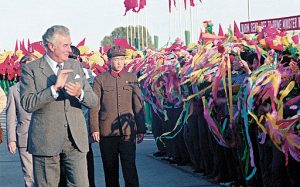
Gough Whitlam in China, image courtesy of the National Archives of Australia, CC.

We chose November 11 (Remembrance Day), to launch a new song about the achievements (and setbacks) of Gough Whitlam, our most controversial politician. The 11th marks the 46th anniversary of The Dismissal, when the Queen’s representative, John Kerr, sacked Whitlam and installed a caretaker government under Malcolm Fraser. The dramatic events of 1975 greatly overshadowed the many reforms Gough Whitlam introduced, including free education, free healthcare, no-fault divorce, a single parent’s pension and legal aid. He also ditched conscription and capital punishment and finalised the end of our involvement in the Vietnam War. And, as the photo indicates, he was the first Australian PM to visit China. Many people our age reflect on the Whitlam years as the only time in their adult lives they actually wanted to vote for someone. Unlike most politicians, Whitlam stated clearly what he wanted to do, won the election and then set out to do it all, and then more.

He abolished conscription and capital punishment and made a point of releasing seven men who had been in jail for refusing to go to Vietnam. And, as chronicled in the outstanding song by Paul Kelly and Kev Carmody, he started the process of Aboriginal land rights. Whitlam’s government had the misfortune to be taking the wheel at the time when the economy was going bad; there was inflation and massive unemployment. The global oil crisis did nothing to soothe the people who saw Whitlam as a dangerous maverick.  The song includes the downside so is not quite a hagiography, although I did admire the man for allowing me and my peers the chance of a free tertiary education.

Bob Wilson

Have a listen to the song here and if so inclined, add it to your music collection.

‘Well may we say God save the Queen…’

A degree of merit

Lee Mylne
(Photo of Lee Mylne by Tommy Campion)

For reasons which may suggest the mind is searching for mental challenges, I have been admiring the initiative of a dozen or so older people who have chosen to go (back) to university. In some cases they are university virgins, spreading their intellectual wings for the first time, post-children, pre-retirement.

Others are going back, 20 or 30 years after their first degree, to take on post-graduate study. The concept of mature age study has been around a long while, but statistics suggest the incidence of older people taking on academia is rising. The Australian Bureau of Statistics says one million Australians aged 25-64 were engaged in study last year, compared with 780,700 in 2004. Merryn Dawborn-Gundlach, a lecturer from the University of Melbourne’s Graduate School of Education, completed a PHD on how mature-age students transition into their first tertiary degrees. Mrs Dawborn-Gundlach told The Age mature age students were motivated by the push for lifelong learning. “These days you don’t have the same job for life, you retrain.”
More than 40% of mature-age students in the study said they found juggling work and study a challenge, and around 60% experienced “a general feeling of stress.”

An expensive learning curve for some

I took on university for the first time aged 30. I’d left school at 15 so was full of trepidation about the challenges ahead. Luckily the academic year was split into four terms, so by Easter I had enough results back to suggest I could finish an Arts degree.

What set me on this subject was a Facebook post by freelance travel journalist Lee Mylne, a former Daily Sun colleague. Lee (pictured above) told her friends this week she was going to university after “many years.”
She was accepted into QUT’s professional doctorate program and in three years will graduate as a Doctor of Creative Industries (Journalism). What surprised me (and Lee) was the enormous amount of support and encouragement from friends; it seems more people would do it if they could afford it.
There is a fair bit of government support out there for study initiatives, including student loans, scholarships and funding for research degrees. For example, a Commonwealth scholarship in 2014 paid just under half the cost of a humanities degree (totalling $11,574), according to data in a piece by Chris Pash in Business Insider. Subsidised or not, it is a big financial and lifestyle commitment. My niece has ventured back into academia, looking to expand on her facility for languages. But at $2000 a subject she is reconsidering.
“Academia has gone through some serious changes in the past 12 years since I last studied. Not only do you have the regular essays/presentations, you also are marked on your contribution to online blogs on the weekly topic, adding to the weight of work you have to do. Everyone can see what you write and everyone can critique what you write, and it can’t just be an opinion piece, you have to cite it.”

Back in my day, oh aye

Wind the clock back 35 or so years and the first and best thing I did at university was a touch-typing course. No email or internet research in my day! Just typing and re-typing.
Luckily there was a coterie of mature age journalism students in the first-year intake at the University of Southern Queensland.
After a week or two it started to feel like home and there was the undoubted bonus of studying Australian literature with Bruce Dawe.
It was a bit of a (financial) struggle). I had a permanent debt at the university book shop and was paying off a large dentist bill at $20 a week. But for those of us who went to university in the late 1970s and early 1980s, tertiary education was still free. As music journalist and USQ graduate Noel Mengel says: “My kids would be outraged.”
In the early days I met Kev Carmody in the university library. I knew Kev from the local folk club where he played in a bush band and had lately started singing his own songs. In the late 1970s libraries were still using index cards. Kev says he had no idea how to take a book out of a library, so he sat there reading a book, quietly watching how people went about using the catalogue system.
You’ll get some sense of this Aboriginal man’s strength of character in the documentary Songman which is being shown on ABC TV on March 15. We had a preview at his live concert in Brisbane last month.

A learned foot in the door

There’s a lot to be said for acquiring some life experience and then going for an education. There was initial resistance inside daily newspapers to the idea of academic journalists. The old school, who had started as copy boys and served lengthy cadetships, resented the slow but steady influx of graduates.
By the mid-1990s, newspaper editors were starting each year with a pile of applications from bright young things, all of whom had at least one degree. Even with a Gap Year thrown in, new graduates emerge from the system aged 20 or 21, well-educated but light on life experience.
Mature age students benefit from having acquired some life skills and wisdom, but more importantly, if you are going to university aged 29 or 30, chances are you will be 100% committed to achieving your goal.
While technically not a mature age student, Noel Mengel went back to uni after working for three years in magistrate’s courts in the Queensland public service.
“I realised I was never going to get part-time study done,” he said. “And I had a disturbing vision of winding up as a country town solicitor.”
Noel recently left The Courier-Mail after 25 years as one of the country’s leading music writers. Along the way he wrote an award-winning book (RPM), played in rock bands and still does (The Casuarinas) and his name is frequently on the lists of judges for music industry awards.

Kev Carmody went on to become an internationally known songwriter with six albums to his name, a tribute album (Cannot Buy my Soul) and a collaboration with Paul Kelly, From Little Things Big Things Grow, which as Kelly remarks in Songman, became universally known without ever being played on radio.
Carmody was and still is an important voice for his people. There will be those who would say he would have achieved all that and more without having to go to university. But then we’d not have the wonderful story about his debate with the University of Queensland over parking fines, land tenure and who owed who money!

Is there a doctorate in the house?

Meanwhile my 40-something friend Kelli is on the cusp of graduating with an honours degree in occupational therapy, some new young friends and no regrets.
“I found it agonisingly difficult at times,” she said. There are commitments and expectations for a mature age student that simply aren’t there for most school-leavers. The other issue is I now have a whacking-great debt to the government which may or may not be paid out before I die.
“But I’m an infinitely more balanced person for having completed this study, although apparently I’ve now lost my mind entirely and intend to pursue a PhD!’
“My kids said ‘Mum, didn’t you tell us that if you started talking about a PhD then we should talk you out of it?’…

“Why yes, I did, but don’t worry about what I said then….”