
Misheard lyrics and a sentimental playlist

sentimental-playlist
The author (and dog) contemplating the next move

Last Sunday, as we performed my only country song, Crossroads of Love, I allowed myself a sly inward chuckle at the misheard lyric (well, I mishear it): “So I look for directions in the stars high above’’.

It’s the kind of misheard line you’d expect of a 70-year-old bloke, but I’m not about to elaborate. This is a family show.

My songwriter friend Kelly Cork likes the song; he thinks it is a sin of omission that is has not caught the attention of a Kasey Chambers or a Garth Brooks. I always thought it was a bit corny, but it seems you can get away with corny in the country genre.

You will have to permit me a sentimental wallow this week, as I sit here at a bare desk with the laptop (and the dog) – literally the last things to be packed away. I dismantled all of my music-playing technology weeks ago, so now all I have is a tiny IPod with 1700 songs plugged into the car.

Music was uppermost on our minds last Sunday when, against common sense, we held a full-house farewell house concert with just two days remaining to finish packing.

We invited hinterland musician friends to perform: Jevan Cole, Karen and Murray Law, Tommy Leonard, Noel Gardner and Alex Bridge and Kelly Cork. A sumptuous afternoon tea was provided by the audience (Laurel had packed away her baking trays).

The Goodwills Trio ended the day with a set culminating in a medley of well-known travel songs. Not a dry eye in the house! Thanks to Helen Rowe for going the extra mile to get to rehearsals. Thanks also to Woodfordia Inc for sponsoring our concerts over the years.

In the fullness of time, we’ll be producing a history of our house concert series – the first one in Brisbane in 1996, when Margret RoadKnight agreed to be our guest. We held 40 or 50 concerts at Fairfield when we lived there and another 90 or so from the first one in Maleny in 2003 (Margret RoadKnight featured once again).

If you missed out leaving a comment in the guest book that was passed around, you could join the many people who have emailed us with comments about our house concerts. The plan is to print them out and paste them into the book.

This week, I decided to answer the question I get asked a lot about my (songwriting) influences. They are too many to count, although most will be appalled by the omission of Dylan, Springsteen and other mainstream songwriters from this top 20 Spotify list.

Bob’s Spotify Playlist (courtesy of Frankie’s Dad) There are Spotify instructions below, but if you’d rather, FD has also compiled a YouTube playlist

1/ White Winos – LWIII (Last Man on Earth)

Loudon Wainwright’s ever-so slightly wrong tribute to his mother with the last line of every verse left hanging;

2/ Disembodied Voices – Neil and Tim Finn (Everybody’s Here)

New Zealand’s best songwriters reminisce about their childhood growing up in a musical household.

3/ Roland the Headless Thompson Gunner – Warren Zevon (Genius), the title of the song says it all, the ultimate ballad about mercenaries.

4/ A Case of You– (k.d. lang’s version of Joni’s classic song), from Hymns of the 49th Parallel, a magnificently produced album of contemporary Canadian songs;

5/ Clare to Here (Ralph McTell) – poignant tale from Ralph’s early days as a builder’s labourer, as told here in this 2007 live performance;

6/ It’s Raining – Stephen Cummings – from the album Spiritual Bum, a beautiful album of songs from the former lead singer of The Sports (and hopefully an omen);

7/ They Thought I Was Asleep – Paul Kelly – classic story song from Australia’s best – and we’ll never know what happened!

8/ Our Sunshine – Paul Kelly – included here for its brilliant first line ‘So there came a man on a stolen horse and he rode right onto the page.’

(Ed: And as what I think is an interesting aside, Ned Kelly’s horse was named ‘Mirth’.)

 9/ Who Know Where the Time Goes – Sandy Denny.

The story is that a young Sandy Denny had the words to this beautiful ballad in her guitar case and it had to be prised from her by Fairport Convention band members who immediately saw its potential;

10 Cold Kisses – Richard Thompson.

This sly story about an insecure man in a new relationship is only bettered by a guitar hook no-one I know has ever been able to reproduce;

11 Took the Children Away – Archie Roach

Seriously, this should be taught at schools;

12 Cry you a Waterfall – Kristina Olsen

Kristina Olsen typically tells a hilarious story before she sings this tribute to a friend taken in an automobile accident. It’s a fine performance technique when you catch people at their most vulnerable;

13/ Say a Prayer – Fred Smith

A tragic love story woven into a snippet of Australian history of war in the Pacific;

14/ Cat’s in the Cradle – Harry Chapin

My song Watching as You Sleep has a similar theme to Harry’s lament about  not having enough time for your kids when they are growing up and then the worm turns (‘he turned out a lot like me’)

15/ Lives in the Balance – Jackson Brown

It was always a wonder to me how this stinging critique of American interference in other countries’ politics is not better-known.

16/ The Night They Drove Old Dixie Down – The Band

Robbie Robertson’s well-researched story about the American Civil War, told from a Southern family’s point of view. It has a peculiar but effective rhythmic structure, as explained in the link below.

17/ Hello in There – John Prine

The master of brevity and nuance tells a Cat’s in the Cradle type story about a lonely old couple: ‘We had an apartment in the city – me and Loretta liked living there.’

18/ Sailing to Philadelphia – Mark Knopfler and James Taylor

The story behind the Mason Dixon line, splendidly rendered by two of the world’s best songwriters;

19/ Soldiers’ Things – Tom Waits – the growling poet of life on skid row at his best here: ‘Everything’s a dollar, in this box.’

20/ Paradise – John Prine

Prine’s anti-fossil fuel anthem from a childhood in western Kentucky.

Here’s an extra song, but it’s not on Spotify. It fits well with Paradise – “If you’ve got money in your pocket and a switch on the wall, we’ll keep your dirty lights on.”. Watch and listen here:

Keep your dirty lights on – Tim O’Brien and Darrell Scott.

The refrains of both songs deserve to be sung out loud at next Friday’s Strike 4 Climate rallies.

So, while the homeless Goodwills wander off to the south-western plains, let it be known that you will never find our music on Spotify. Not until they lift the streaming royalties by a respectable margin. Despite its reputation as a music distributer that short-changes musicians, Spotify is an incredibly user-friendly, massive musical database. No wonder at last count they had 217 million subscribers (including the free accounts).

Next week: Expect FOMM late next Friday as I will be attending the Strike 4 Climate rally in Brisbane – an eyewitness report!


Demise Of The Fixed-Line Home Phone

fixed-line-phones
Australian Communications and Media Authority Communications report 2017–18.

The landline is ringing. A saxophone riff from a Men at Work song plays in my head (‘who can it be now?’). Despite my better judgement, I pick up. It goes something like this. (Pause) “This is Nicole from Australian National Broadband. We have been trying to get in touch with you as we are soon going to disconnect your landline, Press 1 now to speak to a technician.”

I don’t press 1 and after 5 seconds the call disconnects. Poor Nicole (and apologies to the two women I know named Nicole). She has been robo calling our number without success for at least 18 months. How will you describe that on your CV, Nicole? (2018-2019: scam robo call voiceover).

Once again, synchronicity strikes. Just when I decided to write about the demise of the landline, I see it is National Scam Awareness Week (August 12-16). There are serious reasons for raising awareness of telephone and internet scams, as they are costing Australians about $1 billion a year.

Scamwatch estimates that NBN scams alone are ripping $110,000 a month from people who should have tuned in for NSAW last year (when the figure was $37,000 a month).

Few real people call our landline these days. Like everyone I surveyed for this essay, we average about 15 telemarketing calls or phone scams per week. They are often the 6.50pm calls, just as you are sitting down to eat. It’s someone in an offshore call centre, trying to sell you something. Most people just hang up.

My elder sister in New Zealand always calls the landline, as does John, our oldest friend in the village. They belong to a cohort who does not have mobile phones. They persist, some would say depend on, the dying communication form of a fixed copper wire telephone line.

The 2017-2018 report by the Australian Communications and Media Authority (ACMA) said that 36% (6.7 million) of Australians have scrapped their fixed home phone line and rely on a mobile service. Some may also have a VoIP (voice over internet protocol) phone as part of their National Broadband Network deal. There is one vital difference between a landline and VoIP. The major issue with a ‘landline’ that comes with an NBN package is that it stops working when you have a power failure. (This is also the case for a hands-free phone plugged into the power, rather than a dedicated phone wired into the wall).

The latter still works when there is a blackout – you can ring Fred on the other side of town to see if his power is out too. Useful stuff like that.

Nevertheless, fixed-line use declined 7% in 2017-2018, continuing a long-term trend (although 10m people still have one).  One could suggest that people are letting go of their landlines in favour of mobiles and reducing their monthly phone/internet bill. I suspect people no longer trust their landline. As FOMM reader John No 1 said: “The value of the telephone as a means of communication is being diminished because it is impossible to know if a caller is genuine…”

Meanwhile, eight out of 10 Australians own a smartphone – 64% more than five years ago. A smart phone is infinitely more useful than a one-function landline. Smart phones users can make voice calls, send texts or use apps for messaging or voice /video calls). And, as we all know, you can browse the internet, watch streaming TV, make videos, take pictures of your cat to put on Facebook, use it as a compass or a navigation device, tune your guitar, turn it into a metronome or use it as an alarm clock.

A few FOMM readers responded to my question: why do you still have a landline? John No 2 (no mobile), says he wants to stay with a fixed-line phone because mobile reception is poor where he lives. He is also a bit peeved that after paying for a silent number, he still gets nuisance calls.  Another reader told me she uses her landline exclusively for her counselling service so she can be ‘present’ (as opposed to being out and about and distracted if a client calls on the mobile).

Ian says he ended up with a VoIP phone when he changed to the NBN, but neither he nor Mrs Ian uses it, mainly because Telstra/Optus were unable to transfer his old number. They prefer to use mobiles, as they had been doing for years before NBN showed up. Ian says that until the change was forced upon him, he’d had a landline (and the same Telstra number), for 33 years.

I tend to avoid using the home phone, instead favouring text messages. She Who Likes To Talk To People always tries calling first.

“What’s the point,” I say. “It will just go to voice mail or they will get a garbled 10-second text message transcribed from voice.”

Example: “It’s Nog here, I be roundson to pick up cheers.”

The ease of text messaging (and the fast response when you use the Facebook app Messenger), has lulled us into a world where we communicate primarily by text and email (both formats which can be easily misinterpreted), in lieu of actually talking to each other.

A while ago, I realised this form of communication was the equivalent of holing up in the castle and sending a messenger on horseback to tell Princess Desiree in yonder palace that she is the fairest in the land.

Who would know if the fair damsel received the gilded message and what happened next (mayhap she was smitten by the messenger and they rode off together into the darkening forest (cue Game of Thrones theme).

Yes, so I decided I would have a telephone conversation with someone every week. I’m behind schedule, but I have excuses.

It is probably fair in National Scam Awareness Week to observe that mobile phone users are also plagued by scam calls, robo calls and telemarketers. Nevertheless, Australians continue their love affair with mobile technology. In Australia, there are now 34.54 million mobile services in operation, compared with 31.09 million in 2013, the last time I wrote on this topic. ACMA says the volume of data downloaded on mobile networks increased fivefold between 2014 and 2018. We can probably attribute a lot of it to Netflix (50% of Australians have a subscription), and Stan (13%).

The relatively slow growth in new mobile use suggests demand has peaked. Still, that’s about 10 million more mobiles than there are people. Given this huge target market, it seems likely the scammers and hard-sell merchants will keep finding sinister new ways to catch us off guard.

Robo calls are as big a problem in the US as the opioid crisis, mass shootings and Donald Trump. The regulators have been pressing the telecommunications industry to do something about it since 2014. In response, the industry has developed a solution to stop robo calls and ‘spoofing’. The latter refers to criminals and unscrupulous people altering the calling number of their outbound calls in order to deceive the person receiving the call. For example, the call may show up in your caller ID as your neighbour or a relative. The industry has invented a new technology standard to defeat spoofing and has given it an intriguing name based on two acronyms – STIR/SHAKEN.

Sounds like something you’d order at the bar when taking Miss Moneypenny on a date.

Further reading FOMM back pages: https://bobwords.com.au/friday-on-my-mind/

Friday on My Mind – Technology And Our Private Lives

technology-privacy
“Hacker’ image by www.pixabay.com

“Och*, technology – it’s the Deil’s work,” my Scottish Dad said in 1964, when I bought one of the early transistor radios.

Dad died in 1991, so he missed the Internet (and Windows 98, the best version). He also missed WIFI, smart phones, internet banking, Facebook, Twitter, Skype, Bluetooth, video and music streaming and that nemesis of 21st century parents −  Facetime. I’m not sure what he’d make of hackers, spammers, viruses, malware, or dealing with glitch-prone software and untimely computer crashes.

As we all should know privacy risks for internet and mobile phone users include data harvesting, web tracking and government spying. Many internet security companies are now advocating the use of a virtual private network (VPN) which encrypts your data and hides your internet address. And, as this article reveals, the Internet of Things poses new cyber threats, as security is often lax or absent in domestic items like smart TVs, fridges and microwaves and other connected devices.

This week I conducted an IT security review after a sudden flood of spam emails jammed up one of our addresses (not this one). She Who Goes By Various Acronyms was extremely pinged off with the 200 dodgy emails that came several nights in succession. They were dressed up to look like emails we’d sent but had been ‘rejected by sender’.

I can’t say our Internet Service Provider (iinet) was overly helpful. They insisted that the email address had not been hacked or compromised. The support team advised me to change my password (duh) and later referred me to a service where you can report ‘new’ spam. That didn’t really help much, so I spent a good few hours doing my own troubleshooting.

As part of a usor emptor security review, I reset my WIFI router to its default settings, and then re-installed it with a complex admin password and a new WIFI password. Tedious, yes, and the tediousness extended to relaying the new WIFI password to every device that shares the same router. As a result, we slowed the spam to a trickle and now it has stopped altogether. (Yay, techy Bob-Ed)

In the early days of starting a WordPress website, my weekly posts were inundated by what is known in blogger world as ‘comment spam’ – most of it from Russia. We slowed the onslaught by installing an effective anti-spam plugin (Akismet) and stopped it by limiting post comments to 14 days.

I began to wonder about spam; who distributes it and why. Do they want to sell you stuff or are they just creating mischief? What they want more than anything is for you to click on the inevitable malware-ridden attachments. Do so at your peril.

I discovered that a sudden flood of spam can (a) bury messages you did need to find and (b) sometimes they are phishing emails. These are emails that purport to be from one of your legitimate service providers. You can usually detect them by the stilted use of English and also by the fake email address

Later, I forwarded the bogus email to iinet support and complained. Since then, I have had other attempts by swindlers to milk credit card details by forging emails. It is beyond me why a large ISP (iinet, now owned by TPG), can’t put a stop to this. I’m told scams like this are commonplace, no matter which ISP you use.

There’s a lot of it about. As you may have read recently, cyber crooks impudently set up a facsimile of the MyGov website, which holds an enormous database of tax, medical and social security detail.

Many of my Facebook friends are currently complaining about nuisance calls, phishing emails, spam or hacking of their ‘Messenger’ app. These scams are becoming so prevalent it behoves us all to put another layer of security in place. Many banks and institutions (including MyGov), use a ‘dongle’ or some form of two-step verification (a time-sensitive pin sent to your mobile).

There is a certain amount of sales-driven hysteria promulgated about the ability of ‘Russian hackers’ to covertly take control of your computer and start delving into your private details. Some swear by online password managers, but I favour an in-house, two-step method. It is tedious but safe, provided you don’t fall into the trap of allowing your web browser to save logins and passwords. Surely you don’t do that?

The anti-virus programme I uninstalled this week was quite good at doing what it is supposed to do, but it kept alerting me to potential threats and PC performance issues. Solving these supposed threats and issues meant upgrading to one or more ‘premium’ programmes.

Hassles aside, when technology works, it can be a joy to all. Last week I compiled a short video to send to my Auntie in the UK who was turning 100. My sister and her daughter sent me a video on Messenger as did my nephew. We recorded our own video greeting on the veranda at home, complete with kookaburras in the background. I called my other sister in New Zealand and recorded her audio message and then edited the clips into a 10-minute video and slideshow. I then uploaded it to YouTube with a privacy setting. My cousin in the UK said it came up great when cast to the big screen TV.

That milestone occasion got me musing about my teenage years (Auntie outlived her sister (my Mum) by 52 years. Technology sure has changed from those days as a rugby-mad teenager in New Zealand. I bought the transistor radio for one purpose; I’d set the alarm (a clock with two bells on top), and get up in the middle of the night to listen to (e.g.) the All Blacks play England at Twickenham.

Dad (left) had no interest in sport, but as a volunteer member of the St John’s Ambulance, he spent many a cold Saturday afternoon on the rugby sidelines, first-aid kit at the ready.

He’d have probably credited the ‘Deil’ with this 2019 example of electronic surveillance of professional athletes. When professional rugby players run out onto the field, a small digital gadget is tucked into a padded pouch on the back of their jumpers. The GPS tracker relays performance information to the coaching team (and, apparently, to rugby commentators). From this wafer-thin tracker they can upload data and analyse the player’s on-field movements. This is how Storm winger Josh Addo-Carr was proclaimed the fastest man in the NRL. He set a top speed of 38.5 kmh chasing a scrum kick down the left touchline in the round five match against the North Queensland Cowboys in April. He’d still get run down by a panther or a tiger, but it’s pretty darned fast.

While the top 10 stats look thoroughly impressive, I doubt the general public will get to hear about the half-fit players slacking off in the 63rd minute.

Fair go, as we say in Australia, as if it isn’t intrusive enough going into the dressing sheds and interviewing sweaty blokes in their underwear.

*general interjection of confirmation, affirmation, and often disapproval (Scots)


FOMM’s Technology Failure Stress Scale

IT-stress-scale
This IT message (and others) can send some people’s stress levels off the scale.

After several weeks of persistent information IT problems, I’ve invented a Technology Failure Stress Scale that deals specifically with technology failure and the inability of many human beings to cope. Unlike the better-known Holmes and Rahe Stress Scale, which measures the health impact of major life events like death of a spouse and divorce, mine is unscientific and highly subjective. Well, if it’s OK for leaders of major western governments to be unscientific and subjective, why not me?
The Holmes and Rahe stress inventory is still widely used, despite being created in 1967 (it mentions a mortgage of $20,000). The R&H test allocates points to each stressor. You take the stress test and tally up your numbers. Anything over 300 makes you highly susceptible to developing an illness. Death of a spouse (100), divorce (73), marital separation (65), imprisonment (63) and death of a close family member (63) are the top five. I was always under the misapprehension that moving house was in the top 10, but it apparently rates only 20 points. Try telling that to the renters, furiously scrubbing and vacuuming so they can get their bond back.

GPs use the Social Readjustment Rating Scale invented by psychiatrists Thomas Holmes and Richard Rahe to assess patients presenting in a highly stressed state. GPs also use the Perceived Stress Scale (PSS), a more recent psychological test to assess anxiety and depression. The test asks the patient to perceive how they feel, ranging from not at all or hardly ever, to all the time, about their moods and reactions to situations. The latter is the test used to decide if you qualify for six rebated consultations over 12 months with a registered psychologist
The PSS has also been used by researchers trying to establish the links between technology and social media and psychophysiological well-being. If this subject interests you, try these links.

I was going to write about Brexit this week, a topic I have been assiduously avoiding since the silliness began in 2016. Then my laptop started misbehaving (again) after a clean install of Windows. My technology failure stress levels went off the scale.

On Saturday, when I went to retrieve my emails from an Outlook backup – it downloading 9,000+ emails (twice) into one folder. What happened to my carefully curated sub-folders? Moreover, new emails started arriving, in pairs. Time to call in a technology failure expert, who did his expert thing, then advised me to buy a new computer. Thanks to this friendly chap, my technology failure stress levels dropped from 275 (see test below), to around 75.

FOMM’s Technology Failure Stress Scale
1/ Blue screen of death, hard drive failure, complete loss of data due to hard drive failure, virus: 100 pts (deduct 50 points if you made a reliable back-up)
2/ Recovery but with poor prognosis/replacement recommended: 50
4/ Process of reinstalling programs and data: 45
5/ (Unbudgeted) cost of repair/replacement: 35
Operating system misbehaviour and user error
6/ Accidently deleting important files/emails or archives (or hitting send-all when that’s not what you meant to do): 60 (deduct 30 if you have backups)
7 Windows updates automatically, closing down when you are in the middle of editing your round-Australia video or watching the last 10 minutes of the final episode of Breaking Bad: 55
8/ Video/Music editing programs crash before you go file/save (see above): 65
9/ ITunes updates then you can’t find your music: 55 (some would rate this 100)
10/ Software manufacturers stop supporting something on which you have become dependent: 45
I’ll leave mobile phones, smart TVs, remote controls, Bluetooth and GPS devices for another time.
Rate your overall Technology Failure Stress (from a total of 550)
More than 300: your spouse will have an 80% chance of finding you irritating. Take the dog or yourself for a long walk. Unplug the computer at the wall if a storm is brewing.
200-299: your spouse will still be finding you irritating. Take the dog or yourself for a long walk. Eat chocolate.
100-199: This is a sign that you are sufficiently tech-savvy and adaptable but still prefer to leave it to the experts.
0-99: You either eschew computers or use the free ones at the library.

Technology Failure aside, what about Brexit?

As you’d gather, I get distracted when things get stressful and a bit beyond my ken, so it was initially hard to put together a coherent narrative on the topic of Brexit (short for Britain exiting the European Union).
Why should we care, you might ask? This is some far away turf war about trade and national identity. It may also be about Britain wanting to secure its borders as more refugees teem into Europe.
Basically, the politicians thought the Brits would say Yes to staying in the EU instead of No, we’re leaving. Between the 2016 referendum and now, the British parliament has been working on an agreement which will cut ties with the EU (and cost the UK about £37 billion), call it their Brexit fee).
In the ensuing years since the referendum, there has been considerable social discord (the vote was 52/48, after all), economic uncertainty and a tougher time for Britain’s poor, the perpetual victims of economic downturns.
The European Union was formed in 1972, forging together 28 countries with (in theory) a single currency, freedom of trade and movement between countries. The EU has its own parliament and all members have to pay to enjoy the benefits of economic unity. Over time, Britain became disenchanted with the return on its (annual) contribution of £13 billion (2017). The UK gets back about £4 billion a year as ‘public sector receipts’, so it can be seen that the UK pays more into the EU than it gets back. This does not take into account the harder to quantify benefits of jobs, trade and investment.

The Brexit debate has sharply defined what the Irish and the Scots had known all along – the United Kingdom is not all that united. The Scots voted to stay in the EU and so did Northern Ireland. Thus far, the debate has been vigorous between Leavers and Remainers. Of the Leavers, 94% believe Britain will be better off without the EU; 96% of Remainers think Britain will be worse off exiting the EU.

The Guardian’s monthly reports on UK economic indicators shows that business investment has declined for three consecutive quarters. The housing market is at its weakest level since 2012 and retail sales continue to be sluggish, with visible signs of business distress on UK high streets. There have been reports elsewhere of companies moving their headquarters from England to Asia (Dyson and Sony).

The UK government is this week voting on amendments to PM Theresa May’s 585-page Accord (which was voted down on January 15). The amended deal has to be approved and then accepted by the EU. If the EU rejects May’s plan, England will be left to deal with a fragmented kingdom, Brexit representing, as commentator Fintan O’Toole observed, ‘the result of the invisible subsidence of the political order’.

At divisive, stressful times like these, one could imagine Theresa May and her staff would be quite happy if Outlook crashed and they had an excuse not to look at their emails.

More reading: Irish Times columnist Fintan O’Toole’s perspicacious view of ‘Brextinct’ and the fissiparous four-nation state is an enlightening read.

Planned obsolescence strikes again

On Tuesday I joined the queue of people at the local computer shop, all clutching laptops, smart phones or PC peripherals suffering from planned obsolescence syndrome. Some of these items may still have been under warranty (joy). But in the case of my four-year-old Toshiba laptop, the optical drive, the fragile looking tray that slides out to take CDs or DVDs, had carked it.

It failed just as I finished burning a 58 minute video of our choir Tapestry’s Christmas performance. “Do you want to burn another?’ the video editing programme asked. “Yes” I clicked and the optical drive then made a noise like the dentist burnishing my teeth with plaque-stripping paste.

The young chap behind the counter (they’re all young), spent some time testing then pronounced it dead. “We have plug and play drives for about $50,” he said. “But we haven’t any in stock at the moment.”

Ah, so this is a frequent event in computer repairs and replacement land. A google search of ‘CD DVD drive failed’ brought a consensus that an optical drive in a laptop will rarely last five years.

A recent article in Lifewire explained why so many desktop computers and laptops sold today do not have CD or DVD drives installed. They are being dropped to save space and also because portable flash drives and hard drives have more capacity, perform faster and are definitely cheaper than sourcing a replacement optical drive (which includes an hour of labour to remove the old and install the new).

A while ago, I gave a copy of our latest CD to someone who has been helping me retrieve my sense of perspective. Last time I saw him he confessed not to have listened to it yet, the problem being he had nothing on which to listen to a CD except his (work) laptop which, I suspect, is never used for anything other than work. CD players are becoming obsolete. If you still have one and it has started to misbehave, it probably won’t be worth repairing. Most late model cars don’t have CD players, preferring USB, WiFi and Bluetooth to extract music from the ether.

Like so many Millenials in Australia, most of my younger relatives in New Zealand have Bluetooth speakers,which play (compressed) music streamed from their phones or tablets.

“I couldn’t find you on Spotify, Uncle,” said one.

Let’s examine the logic here. The average lifespan of a laptop computer ($400 to $1,800) is three to five years. Bluetooth speakers ($40 to $1,000) have not been around long enough for lifespans to be established,but there’s an amusing exchange on techguy.org about this very subject “until it stops working”, one wag offers. Two years seems to be the current guess, and that is largely based on the lifespan of the battery (some of which are replaceable, and some not). And don’t even start me on mobile phones (I’m on my third one in four years).

 The trick might be to buy top quality gear in the first place. One of the five components in my Technics stereo (a top line model, circa 1985 – before planned obsolescence became widespread), is showing signs of failure. The CD changer plays OK but then inexplicably stops, or skips to another track or to the middle of another track. In the office downstairs I usually play music through computer speakers from my iTunes library.  ITunes and streaming services compress music, the downside being an unavoidable degradation of audio quality. The advantage for musicians in compressing a 24MB audio file to a 2MB MP3 that can be emailed is obvious. I once emailed a demo to London at 10pm our time, to a songwriter friend who listened to it over morning coffee and sent immediate feedback.

The convenience and the speed with which music can be recorded and disseminated (and listened to on a virtual jukebox), outweighs the loss of sonic integrity.

Or you can reject planned obsolescence and go retro. One of my relatives has a quality audio system which is set up to play vinyl. There was just something so real about the velvety voice of Marlon Williams coming out of those speakers that made a mockery of my MP3 version of the same album.

Aotearoa has had a long love affair with vinyl records. EMI produced the first one from its Wellington factory in 1955 (the WinifredAtwell selection). The last vinyl record production unit closed in 1987 and EMI shipped the hardware to Australia. Many Kiwi (and Australian) artists still produce vinyl versions of their music for those who have fallen in love with or rediscovered the quality of analogue sound. A few pressing plants keep the faith, including Peter King’s King Worldwide in Ashburton (NZ) and Zenith Records in Melbourne.

As Ted Goslin writes, when explaining why vinyl is making a comeback (14m copies sold in the US alone last year); it’s become cool. Half of those buying vinyl are millennials, although 27% are over 35, buying new albums or raiding their baby boomer parents’ LP collections. 

But as we established, the immediacy of digital music is its strength. Someone once emailed me the words to an amusing parody of Joni Mitchell’s Both Sides Now, “I burnt the toast on both sides now” is funny and somehow sacrilegious, the perfect foil to slide into a broader discussion about planned obsolescence.

A friend had a toaster given to her in 1971 which had spring-loaded ‘gates’ on both sides. Although she has since bought a four-slice, pop-up toaster, the old one still works and is brought out sometimes to remind us of the days when a lot of kitchen work was not automated. Some even washed dishes by hand.

According to a blog in The Spruce, a toaster should last six to eight years. When you think about it, there’s not much to a toaster and it only has to do one job. Choice Magazine said just this when handing out one of its Shonky Awards to the (RRP $189) KitchenAid2 two-slice toaster, to which Choice gave a score of 0. The testers even took it back and got a replacement with the same poor result. Choice branded it a ‘pricey paperweight’.

We’re familiar with consumer goods which don’t come up to scratch and it’s not always a case of getting what you paid for. At FOMM HQ we’re on our third microwave in five years and this one appears to be rusting on the bottom. The Spruce blog reckons a microwave will see out nine years, a slow cooker and a coffee machine six to 10 years and a vacuum cleaner eight years. Writer Lauren Abrams say much depends on the quality of the appliance, how often you use it and how well you look after it.

The toaster in our caravan, now in its third year, gets a wipe over every three months or so and, like the house toaster, the crumb tray gets emptied at least once a year! It was an impulse buy ($7 from a Goondiwindi discount department store). It works just fine so long as I adjust the timer (if She Who Toasts Gluten-Free Bread has been there first).

In the words of Canberra parodist Chris Clarke:

I’ve burnt the toast on both sides now,
Both front and back – to charcoal black,
The toasting time I don’t recall,
I really can’t make toast, after all.

More reading:

The Waste Makers: Vance Packard (1960)

Made to Break: Giles Slade (2007)

Fixing your PC with a hairdryer

Self-service gets our enterprise for a bargain

self-service-checkouts-fuel
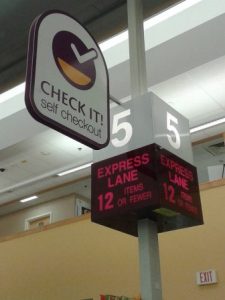
Self-service checkout, photo by eltpics https://flic.kr/p/p57BLf

You may call me a peevish old man, but these self-service supermarket checkouts give me the pip. I only encounter them when venturing out of the village, as our service-oriented IGA does not as yet have automated check-outs.

Not so a certain Brisbane supermarket which, around 5pm, seems to have nobody staffing its numerous checkouts and only one person ‘helping’ people scan their own groceries. I usually ignore the self-service corner and will wait an inordinate time to be served by a human being. Last time I was in the 12 items or less line at the same supermarket, the poor woman was switching back and forth between checkout customers and those at the cigarette counter.

Management textbooks would tell you this is successful multi-tasking and making efficient use of a staff member over what is probably a meal break. Decency would say put two people on at this location.

American Facebook page Union Thugs has a bit of a campaign going against self-service, observing that the machines (a) they kill jobs (b) they do not contribute to payroll tax and (c) they are really not that convenient.

The latter was certainly true when I returned from shopping in the city a few weeks back to find I’d charged myself twice for the same item. So back I went, burning more fossil fuel, to queue up at the lightly staffed counter where one person was multi-tasking between selling cigarettes and dealing with complaints like mine.

IGA Maleny director Rob Outridge knows the downsides of self-service checkouts but can see a time when he may be forced to introduce them. Supermarkets operate on skinny margins and the biggest fixed cost is wages, which keep on rising. So while Maleny IGA still exclusively hires people to serve at the checkouts, there may be a time when competition and the bottom line force his hand.

“The problem is your labour costs keep going up and there is no increase in productivity.”

I suspect Rob Outridge knew I was going to take a Bolshevik approach to the subject of automation doing people out of jobs. Nevertheless, he handed me his card and in that pleasant, management-by-walking-around way of his said: “Just let me know if you have any other questions.”

It’s not just that a machine replaces a worker. You (the customer) are doing the checkout job yourself – for nothing. Of course it does not stop there; we do the job of a retail employee at the ATM, the fuel pump, at toll points and just about anything someone would help you with offline is now done (by you) online.

The online world has transformed the way businesses interact with customers. In the online world there are myriad stories of businesses getting our enterprise for a bargain, as they con us into signing up for electronic bus and train cards, gadgets on your windshield which go ‘ping’ when you pass through the toll gates and so on. Last time I parked under the Brisbane Convention and Exhibition and Centre, I had to go to a machine and pay for the parking then pop it in the slot at the boom gate. There were no attendants to be seen.

It hardly seems like nine years since the toll booths closed on the Gateway Bridge and Logan Motorway. There was something refreshing about that brief interaction when you paused at the collection point and tossed your coins into the tub. When the electronic toll system Go Via was introduced in 2009, 100 toll collectors were made redundant, with 22 moving into management jobs within Go Via. Former toll collector Sharmaine Phelan told the Brisbane Times she had a tear in her eye on the last day.

“Over the years I have been here I’ve met some lovely people, some that I’ve kept in touch with who have come through the toll.”

Tolls were collected manually on the Gateway Bridge for 23 years. As a motorist, you always had to be sure to have a pile of coins ready in the console, but that was all you needed. Today, you need a beeping gadget on your windshield and an online account that has to be kept topped up or you will get a letter in the post demanding payment. Along the way, a system of debt-collecting was invented to deal with people who either didn’t have a bleeping thing on their windshield or kept forgetting to top up their account. If they are people who also ignore mail and such, then eventually the Department of Transport gets involved and pings you for non-payment of tolls.

How is that an improvement on making Sharmaine Phelan’s day, then?

Fuel stations have been exploiting their customers in this fashion for decades. Self-service fuel stations began to spread in the US and Australia in the 1970s, although at a faster rate in America. Mind you, there is still one state (New Jersey) that refuses to allow customers to pump their own gas.

Australia caught on to automated fuel service in the 1970s and the reach has been pervasive. Even in the remote outback you have to pump your own fuel and, between the hours of 9pm and 5am, you often have to go in and pay for it first. One of the downsides of self-service fuel (from the fuel retail owner’s perspective), is the minority of motorists who fill up and just drive away.

Imagine my surprise earlier this year when driving into Longreach (at night) in an urgent search for a fuel station. The only place open was not actually open but had a bowser where you could use your credit card to (a) enter how much fuel you wanted and (b) press the Pay Now button.

You might remember the rockabilly song Harold’s Super Service made popular by Merle Haggard in 1970. I suspect the writer (Bobby Wayne) was perhaps taking a dig at the about to be modernised industry with his song, in which the owner of an old Model A drives in to Harold’s Super Service and insists on getting his money’s worth.

“Gimme 50 cents worth of regular (pronounced ‘reglar’)
Check my oil too if you don’t mind.
Put some air in my tires won’t you mister,
Clean my windows too if you have time”

The National Advanced Convenience and Fuel Retailing magazine (NACS) explains how automation gained the upper hand in the US. In 1969, self-service gasoline accounted for only 16% of sales in the US. By 1982, 72% of gas sold in the US was self-service and it had climbed to 90% by 2011.

I was amazed to find, amidst the proliferating supermarket-owned and franchise outlets, that there are still a handful of petrol stations in Australia offering old-fashioned driveway service. You’ll have to read Mandy Turner’s article to find out where they are, though.

Maybe it’s just that I’m approaching a certain age, but I secretly yearn for that era when the petrol station attendant filled your tank, checked your oil and washed the windscreen at the same time – just like the song.

Harold’s Super Service, Merle Haggard and band (listener warning – it’s an earworm).

https://youtu.be/t2lIMLgB_Sg

FOMM  back pages

The value of inner city car parks

car-parks-value
Image of car parks Palma de Mallorca by Timmy L (flickr) https://flic.kr/p/TR4DFC

As you’d know, one little statistic can send me off on an investigation – like the number tucked away in a Guardian Weekly report that, globally, cars are in car parks 95% of the time.

The statistic emerged in a report about a pilot scheme in Amsterdam to reward residents with a free green space in front of their houses if they give up their parking permits. The car parks pilot scheme being trialled in six streets in an Amsterdam suburb is yet another Dutch idea designed to encourage people to give up cars and switch to carpooling, public transport or bicycles.

Residents’ cars will be stored for free in public car parks and in return something ‘green and pleasant’ can occupy the designated car space. The Guardian reports a fair degree of friction over this idea. Two early adopters (who have been heckled), have already put flower-filled tow carts in front of their houses (a cosy outdoor spot to sit in the sun and have a morning coffee and a plate of warm poffertjes).

This is not the first time Amsterdam’s Stadsbestuurders have tried to rend asunder the city’s love affair with the car. Amsterdam is widely known as the bicycle capital of the world because it is relatively compact and the narrow streets and canal bridges make driving more difficult than in other cities. When I spent time in Amsterdam (wishing I could forget what I can’t remember), the city was then trialling Sundays as a no-car day. I looked that up yesterday and find that it is 45 years since Car Free Sunday was introduced. As this blog explains, something changed in the Dutch mindset when the measure was introduced in 1973 (to dampen oil consumption amid the 1970s Oil Shock).  Since then cycling with or without clogs has clearly become a lifestyle/clean environment movement.

The Netherlands leads other European cities, with 27% of all trips attributed to cyclists, a figure that has been stable for a decade. How could it be anything less when Amsterdammers own 22.5 million bicycles (1.3 per resident). Evidently Mum, Dad and the kids are in on the trend. Denmark is a close second in Europe’s bicycle stakes (0.8 per resident).

Australians are fairly keen on bicycles too, with 3.6 million using one every week, The Australian Cyclists Party says the average Australian household has 1.5 bicycles in working order, although if you wanted to be pendantic, you couldn’t ride half a bike very far. You could of course turn it into a unicycle, learn to juggle, sing and play the ukulele at the same time and apply for a gig at the Woodford Music Festival.

Digressions aside, Australians are as deeply committed to the combustion engine as the global leader (America). The latest Australian Bureau of Statistics motor vehicle census showed there were 18.8 million registered vehicles in Australia as of January 31, 2017, a 2% increase on 2016. The 2016 Australian Census showed there were 2.95 million one-vehicle households, 3.02 million households with two vehicles and another 1.50 million households with three or more. The same Census revealed that only 1.1% of Australians rode their bikes to work. The sole occupant car dominated work trips – from 65.6% in Sydney to 79.9% in Adelaide.

The notion that cars are parked 95% of the time is a figure largely calculated on public car parks which are utilised 85% to 95% of the time. Just dwell on that next time you are doing laps in one of Brisbane’s large shopping malls, waiting for a spot.

Last Saturday we went to a Queensland Ballet double bill (Carmen and The Firebird) which, I must say, we enjoyed more than the reviewer in The Australian did, apparently. There were three curtain calls.

Afterwards, we walked back to the multi-level car park where I realised (despite my disdain for automation), that I had no option but to pre-pay as there were no humans in the parking booths. The machine hungrily gobbled my $20 and dispensed the ticket. You should all know the routine by now – drive to boom gate 1, insert ticket and the boom (should) automatically rise to let you drive out.

Them were the good old days, mate

Not that I want to return to days of yore, but when we first started going to the ballet in 1988, you could quite often score a free car park somewhere in South Brisbane or West End. We’d leave home early and sometimes snag a space in Fish Lane. Ah, those were the days. Now we usually park in the Brisbane Entertainment and Convention Centre car park as it has 1,500 spaces, so is the place least likely to be full around South Brisbane’s entertainment and dining precinct. If I recall, when this complex first opened in 1996, parking 2-4 hours cost $8. That’s inflation for you.

A Colliers International white paper in 2015 predicted city parking would become more expensive in Australia, as no new multi-storey car parks were being approved. Some, in fact, have been demolished to make way for new apartment buildings. The other factor in parking becoming more expensive is that many cities now impose a congestion levy on property owners.

New technology is set to disrupt the parking business model though; one example being Divvy Parking, a digital start-up which hooks up motorists with under-utilised car parks within commercial office buildings. In late 2016, New South Wales car insurance company NRMA took a 40% stake in Divvy Parking.  An NRMA study found that 30% of urban traffic congestion was caused by people driving around looking for a car park. And, according to NRMA, a third of parking spots within centrally-located commercial buildings are under-used. NRMA Group chief executive Rohan Lund told the Australian Financial Review that smart technology would be as crucial to solving Australia’s mobility issues as bricks and mortar infrastructure.

All over the world, cities are introducing measures to thwart or discourage drivers from bringing their vehicles to the inner city. These range from London’s Congestion Charge to Madrid’s blanket ban on non-resident vehicles. Only locals, taxis, buses and zero-emission delivery vehicles are allowed within Madrid. This is not the first time the padres de la ciudad have tried to beat congestion and pollution within Madrid’s city centre. In 2005, a pedestrian-only zone was introduced in a densely-populated inner city neighbourhood.

Interestingly, there are no Australian cities named in Business Insider’s recent article on 13 cities planning to ban cars to one degree or another. Most of the cities are in Europe (Oslo, Berlin, Paris, Hamburg, Copenhagen) but also China, Mexico and South America. Many of the plans are based on making it easier to walk and cycle. Several cities are planning to build bicycle-only super-highways.

Ah well, next time I go to the ballet maybe I’ll take my half a bicycle and wobble on down to the train station. (She Who Broke a Bone Falling on the Stone Steps) “Don’t forget your helmet, dear.” More reading:


Facebook – does it really matter if they share our data?

first-facebook-postSince we’re discussing Facebook and who has the rights to personal information you’ve posted, I wanted to show you my ‘Wall.’  People used to call their Facebook page their ‘Wall’, though that has become passe. As walls go, this one would be ‘liked’ by Shirley Valentine fans (cultural reference), as it suggests romance and sun-bleached beaches.

    I joined Facebook in 2009 (apparently) as this is the first image I posted. At the time we were renovating the downstairs bedroom, rumpus room laundry and ensuite. Apart from hiring a guy to lay tiles throughout, we did all the work ourselves. If I’d known better, I’d have first put a coat of sealer on the besser brick wall as it took four coats of paint until it matched the hardboard on the opposite wall.

    I resisted joining Facebook for such a long time and then when I did, my posts were few and sufficiently opaque to resist understanding by all but my inner circle.

    Facebook has proved handy in terms of keeping in touch with younger family members around the world because, as we know, they don’t write letters. So too I’ve formed loose ties with musicians around the world, which can either be a way of sharing the passion or fishing for a gig.

    Later, Facebook became a good way of spreading the news about folk music events in our small town, some of which we promote.

    Dani Fankhauser’s history of Facebook on mashable.com charts the development of Facebook from its launch in 2004 and the 18 features it used to have and either changed or discontinued. I had no idea the original idea of the ‘wall’ was that people could use it like a whiteboard, leaving messages for their friends. You could change or delete what was there and replace it with your own messages. As Dani says, at one stage it was cool to ‘de-virgin’ someone (be first to post on their wall).

    The wall disappeared and Timeline took its place. Other critical changes since Facebook was launched includes the controversial and constantly changing News Feed and the over-weaning Like button which turned social interaction into a competition.

    Dani writes that Facebook used to be like a journey down the Rabbithole, being diverted down unexpected paths to discover new and interesting worlds. Now it’s like standing in front of the fridge with the door open, not quite sure what you’re looking for. Five years ago she wrote that – has anything changed?

    The hoo-haa about fake news and private data being manipulated by computer data experts should surprise no-one. If you are on Facebook, you are the content.

    You have probably read one version or another of the Cambridge Analytica scandal. The Guardian Weekly ran a two-page expose this week so if you really want to delve into it, here’s the ultimate link.

    The fall-out when this news broke was most noticeable on Wall Street. When the Observer revealed that Cambridge Analytica had harvested millions of people’s user data for political profiling, Facebook’s stock plummeted. It fell 17% between March 17 and Easter, wiping $US50 billion off the company’s value. Regulators in several countries are investigating Facebook and may try to limit how the company makes money from data.

    Meanwhile,Google, Apple and Amazon are like little kids who played a joke on someone and are now hiding behind a tree, giggling. The laugh might be on them, according to this broader story.

    There is a social movement (#DeleteFacebook), but social media analyst Andy Swan, writing for Forbes magazine, said the spike in Facebook deletions – the highest since 2004 – peaked on March 21 and has been in decline ever since.

    Most of the outrage stems from reports that Donald Trump’s campaign consultants, Cambridge Analytica, used ‘psychographics’ which allows personality traits to be manipulated.

    But what about our music pages, Mark?

    In January this year Facebook began changing the algorithms that influence what users/members see in their news feed. Facebook founder Mark Zuckerberg said the changes were made because of feedback that public content – posts from businesses, brands and media – was ‘crowding out the personal moments that lead us to connect more with each other’.

    Changes started last year and as Zuckerberg said in a Facebook post, will take months to implement. “As we roll this out, you’ll see less public content (in your Newsfeed) like posts from businesses, brands, and media. And the public content you see more will be held to the same standard – it should encourage meaningful interactions between people.”

    This must be a deeply disturbing trend for mainstream media, which has hooked its disintegrating business model to the hems of social media’s skirts.

    Our local paper, the Sunshine Coast Daily (now owned by Rupert Murdoch’s News Ltd), recently ran a 150-word ‘news story’ – Keep News #1 in your Facebook feed. The article suggested Daily readers keep up with the latest local news by ‘making a simple adjustment’.

    This means first find the SCD page on Facebook, like, click ‘follow’ then click ‘see first’.

    Well yes, it works, but it didn’t take long for the stream of sensationalist stories to ‘clutter up’ my news feed and the same could be said of choosing this option for other media outlets. Beware the Paywall!

    Just for the mental exercise, I downloaded my Facebook data. It has always been possible to download your own data and if we were smart, we’d all do it every year so we at least can find copies of the photos we posted then forgot about. Just go to your profile page and click on settings (the link is at the bottom of the page).

    Just downloading your data file does not mean you are deleting your information from Facebook. Leaving, closing your account and demanding the return of the original data is not so easy.

    But it was illuminating to trawl through this 136MB file. There is an exchange (a thread) between me and a former colleague. I wished to write something about him in my blog, about the merits of academic ambition when one is supposedly past student age. Within the conversation, my former colleague revealed quite a lot of detail about his school years, what work he did on leaving school and how he came to study journalism. I used hardly any of this information in the blog which was eventually published. But it is sitting there quietly, within my (private) Facebook data files. Let’s hope it stays that way.

    So what does the Cambridge Analytica privacy furore mean for folk who just want to post photos of their cats, dogs, partners and kids? Not much, I suspect, unless you have a ‘brand’ page like the ones I use for pur stage name, The Goodwills and this blog.

    I thought it would be fair play to share Mark Zuckerberg’s Facebook post. It is interesting for his over-use of marketing-speak and the sometimes snarky comments which follow his ‘community-oriented’ explanation for making business, brands and media pages less visible.

    I’m with the people who asked why couldn’t Facebook users simply curate their own news feed without having it dictated by algorithms.

    Meanwhile, if you want to keep the Bobwords brand page at the top of your news feed, click on the link, like and follow.

    Or not!


    The risks of losing our digital photos and memories

    digital-photo-memories
    South Brisbane (Southbank), circa 1978), just prior to construction of the Queensland Cultural Centre) Author’s photo scanned from a colour slide.

    Whenever I think about going through our thousands of family and travel photos, be they in digital form, colour prints or scanned to the computer, I develop what migraine sufferers assure me is not a migraine, just a headache.

    The problem begins with the lack of a system. Few people other than professional photographers or serious hobbyists catalogue their photos and negatives in a logical way. So good luck looking for that photo of your little brother skateboarding when he was 10. It’s in there somewhere.

    Recently, a family member took on a big project – to collect photos across seven decades to put in a book for my brother-in-law’s 70th birthday. This social media-savvy young person wisely, I thought, decided to capture the images permanently in a printed book.

    The early contributions of course were box brownie snaps from somebody’s shoebox, scanned and photo shopped where appropriate. Some were from colour slides, also scanned and photo shopped, usually to obtain a larger image. Then we delved into photo albums from the 1970s, 1980s and 1990s, until the digital folders began.

    Maybe we were late adaptors to digital cameras, but we seem to have left film and negatives behind only in the early years of the 21st century. By that time, they’d been in common use for a decade, even though Steve Sassoon of Kodak invented the first digital camera in 1975. We came home after a six-month sojourn abroad in 2004 with 60 CDs of photos we burned from images downloaded on to a borrowed computer.

    Since then, my non-system has accumulated piecemeal on laptops, back-up drives and memory sticks. She Who Also Takes Photos has a smarter system in that she can readily find images by subject.

    No such luck on my computer. For example, a folder labelled ‘March, needs sorting’ on review contains just 15 (of 97) images worth keeping. In the late 1990s, we both clung to shooting film on SLRs and sending the film off to a cut-price mail order business. Digital cameras and later cameras in smart phones replaced this process, which was costly.  You often had to wait a week or more until you could relive the memories from Aunt Gladys’s 90th. If only she hadn’t blinked.

    I recall learning how to produce my own prints from negatives, albeit in black and white. Few young people today would know the thrill of seeing a photo you took that day materialise in a tray of chemicals.

    If you watched the Netflix series, The Crown, you’d have seen a dramatization of one of the best film photographers of the time in action. Tony Armstrong-Jones is depicted in the dark-room with his latest amour (Princess Margaret), trying on what appears to be a well-rehearsed seduction technique. He’d taken an intimate shot, with bare shoulders – against mores of the time (1959). Margaret, who comments, “It’s a Margaret nobody has seen,” resists his blandishments (but not for long, Ed).

    Film and self-processing makes a comeback

    As Alexandro Genova wrote in Time magazine last year, there is a small but determined resistance to digital photography among amateurs and professionals alike. Some are effusive about film and its “unexpected palette, the grain and dynamic range”.

    Portraitist Ryan Pfluger says of Kodak’s decision to revive Ektachrome film, that the “creamy ’70s tone” channels his fascination with memory and nostalgia.

    Genova’s article is framed by a stunning shot of a wildfire in Glacier National Park, Montana. The image is by professional photographer and artist David Benjamin Sherry, who processes and prints his own work.

    “There’s a spirituality that’s connected to it. I go out to take the pictures and at the end of the day I’m by myself, alone with my thoughts, in the dark room. It becomes very meditative,” he told Genova.

    No doubt the majority of hobbyists, oblivious to this meditative magic, will continue to snap what used to be called ‘candids’ on their smart phones. They can then post instantly to Facebook, Instagram, or other social media outlets.

    The 2004 earthquake and tsunami in the Indian Ocean revolutionised the way media covers news. Digital Spy’s correspondent Hunter Skipworth says the stark images of the tragedy were filmed by ordinary people, using their phones to capture images and video. From then on, anytime a major news event happened, anywhere in the world, it would be filmed by a citizen on their smart phone. That was a fairly short advance from the first commercially available digital SLR in 1991 (Nikon’s 1.3 megapixel camera, intended for use by press photographers). By the mid-1990s Casio, Kodak, Sony and others joined the race to produce an affordable digital camera. Digital Spy reveals that Apple had a short-lived flirtation in this field in 1995 with the QuickTake 100. Apple went on to focus on the Iphone with built-in cameras. Good move, Steve.

    Most smart phones have cameras which have at least 4 megapixels and often up to 12mp – good enough quality for a ‘citizen’ photo. The practise is so widespread now most newspapers carry a regular ‘reader’s photo’.

    However galling that may be to professional photographers and videographers who spent a lifetime learning their trades, it comes down to who first captures the image.

    Facebook, which had a modest debut in 2004, surfed in on an explosive wave of change. The introduction of the iPhone in 2007, universal access to broadband and perhaps the invention of the ‘selfie stick’, all helped Facebook become the behemoth it is today.

    My friend Mr Shiraz is slowly collecting images of his now adult children (and their offspring), with the idea of permanently preserving them in photo albums. He’s not alone in this quest.

    Like others with Gen Y and Gen X offspring, he can see the potential for a catastrophic fail arising from the ubiquitous habit of impulsively posting memorable photos, trusting the archiving to that most nebulous of beasts, The Cloud.

    Here’s an example, from the days when hacking mischief was in its infancy, of what can go wrong. In 2001 our computer was infected by the I Love You virus, which among other nasty deeds corrupted all JPG files. It was not such a disaster for us as we were still mainly wedded to film.

    As we plough through our old photos, a common problem arises. Here’s your father as a young lad, standing with…now who are those three other people? There’s nothing written on the back and the people who could tell you are long gone.

    The same fate awaits the millions of images consigned to the ‘cloud’ –data servers located, well, somewhere. You can establish when the image was taken, but not by whom. Nor, unless someone has ‘tagged’ the images with people’s names, can you determine who is in the photo or where it was taken.

    What is even more annoying is not knowing who took the photograph: surely that matters? I’ll leave you with this rare snap of The Goodwills busking in Melbourne’s Bourke Street (a while ago).

    No, I don’t know who took it. Perhaps it was a ‘selfie?’