Stamp of approval a one-horse race

stamp-winx-race
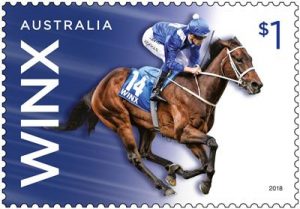
Australia Post celebrates Winx’s record-breaking 26th consecutive win with a commemorative stamp

You’d have to say Australia Post had a bit riding on the champion mare Winx winning her 26th consecutive race at Warwick Farm last Saturday. Let’s say at the outset that this is about stamp collecting, not horse racing (surveys show the latter subject turns FOMM readers off – or politics – that was a three horse race…Ed.)

Whether you like horse racing or not, the existence of Winx the super horse must have filtered through, as it is many a moon since any horse won this many races on the trot, which is racing parlance for an unbroken winning streak.

Celebrating the mare’s place in equine history, Australia Post released a commemorative stamp, pictured here by courtesy of AP and ‘with perforations’ as requested. Journalists received the press release from Australia Post about a minute after the race was run and won.

We plan ahead for important activities, achievements, and national events in the calendar, and had extra resources on standby to assist in producing the special stamps,” an Australia Post spokesperson said, in response to our obvious question.

So all ended well. If you are a stamp collector or philatelist as it is known in the trade, you will already have ordered your first day covers, special 26-stamp packs, a set of maxi cards and a medallion cover.

Horse stamps are not that unusual – examples include Black Caviar in 2013 and a set of four stamps issued in 1978. They featured Phar Lap, Bernborough, Peter Pan and Tulloch. The collection is notable for fine art work by Brisbane artist Brian Clinton.

Like Dusty Springfield, I was wishin’ and hopin’ and thinkin’ and prayin’ that either Malcom Turnbull or his nemesis were philatelists so I could make this politically relevant. But it seems only one (former) Federal politician, Philip Ruddock, collects stamps. This seemingly innocuous hobby at times embroiled the then Immigration Minister in controversy.

Ruddock, now Mayor of Hornsby Shire, was a member of Amnesty International. Critics found his membership of the organisation was at odds with his government’s hard-line immigration policies. In 2000, Amnesty asked Mr Ruddock not to wear his lapel badge when performing ministerial duties and not to refer to his membership when promoting policies opposed by Amnesty. AM 18/3/2000

In a profile for The Good Weekend in 2002, writer Richard Guilliatt was given a look at Ruddock’s collection, which spans three generations. Guilliatt, perhaps innocently, suggested that the high dramas of the job had spurred the stamp collecting hobby on.

“…every month letters pour into Ruddock’s Parliament House office in Canberra, imploring him to liberate the men, women and children detained behind razor wire in Australia’s desert camps for Third World asylum seekers,” he wrote. “Those letters come affixed with all manner of exotic stamps, which Ruddock gets his secretary to tear off so he can take them home to his house in the leafy northern hills of Sydney, to be packed away for sorting.

“That’s one of the good things about getting a lot of letters from Amnesty International,” Ruddock told Guilliatt.

If few politicians collect stamps, at least a dozen former Prime Ministers featured on Australian stamps in the 1950s and 1960s. It’s important to note that all received the honour after their deaths.

“Until the introduction of the Australia Post Australian Legends Awards in 1997, the only living person allowed on a stamp was the reigning monarch”, the spokeperson told FOMM.

Nevertheless, the PM’s head on a postage stamp seems clearly out of fashion now, in this era when one is never quite sure if the PM will last his or her term. But there have been enough sporting celebrities, athletes, actors, singers, writers and decorated soldiers to compensate.

In an aside for crime fiction aficionadas, the most infamous stamp collector award must surely go to Lawrence Block’s fictional hit man, Keller. John Keller is the protagonist in Block’s crime series which began with Hit Man in 1998. Keller collects pre-1940 stamps and uses down-time between ‘jobs’ to visit stamp shops and exhibitions. It’s a kind of cover for his apparent lack of legitimate income, not unlike Block’s gentleman burglar and antique bookstore owner, Bernie Rhodenbarr.

Many famous people are listed in various publications and websites as stamp collectors. The collection does not have to be distinguished to command a price. Former Beatle John Lennon’s collection of 550 stamps from his childhood was bought by the Smithsonian Institute’s National Postal Museum in 2005 for about $A74, 000.

Which brings me to the best-selling commemorative stamp of all time – the Elvis stamp released in 1993, Perhaps the delay since the rock singer’s death in 1977 was due to persistent ‘sightings’ of the late Mr Presley. Even today you will find folk who will tell you he is still alive and living under an alias, like someone in witness protection. Elvis would be 83 if still alive today.

The US Postal Service printed 500 million commemorative stamps – three times the usual print run. It was the most highly publicised stamp issue in the USPS history. The people were asked to choose between two designs (1.2 million votes), the majority preferring the stylised image of the young rocker, microphone in hand.

Stamps can be highly controversial items. For instance, the first secular Christmas stamp in the US, with its pair of white candles and a wreath with a red bow, was released in 1962.

Critics said it crossed the line between church and state. The public was also unenthused about a 1963 design – an illuminated Christmas tree in front of the White House.

Public takes dim view of Surfing Santa

The most controversial Australian stamp was also a Christmas release.  The 1977 stamp featured a humorous depiction by Adelaide artist Roger Roberts of Santa Claus riding a surfboard. Some members of the public were affronted, saying the postal service was not taking Christmas seriously. Until 1975, all Christmas stamps featured religious themes, often based on the traditional nativity story. There was no such fuss about the mix of secular and Christian stamps released in 1976.

If you thought the popularity of email would adversely affect stamp collecting, the market is as robust and profitable as ever. As an extreme example, the One-Cent Magenta from British Guiana, issued in 1856 and thought to be unique, sold at a New York auction in 2014 for a record $9.5 million.

In 2007, the Australian collection of Arthur Gray was sold through Shreves auction house in New York for more than $7 million. Among the spectacular results was the $265,000 paid for a block of four 1919 £1 brown and blue Kangaroos.

So did you collect stamps as a child? Did you, as I discovered, learn at some point in your cash-strapped adulthood that the collection was worthless?

We had a family friend who spent most of her younger years travelling to exotic climes and would write, with bundles of stamps included ‘for wee Bobby’.

I gave away stamp collecting and its fussy handling (gloves and tweezers and corners to mount the stamps rather than pasting them in the album), around about the time I realised girls were interesting.

I still have those two old albums tucked away somewhere – among Father’s Letters, I’m thinking.

Somewhat related reading:
Multiculturalism under siege

multiculturalism-perilli-monument
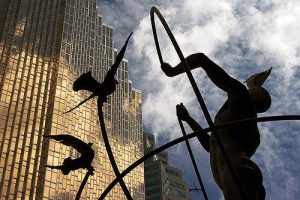
Monument to Multiculturalism in Toronto, a sculpture by Francesco Perilli. Photo by Shaun Merritt https://flic.kr/p/5d7sTp

My plan to write something cuddly and wholesome about Multiculturalism Month in Queensland was derailed somewhat by the egregious maiden speech of crossbench Senator Fraser Anning.

One of our newest politicians, he chose his maiden speech to call for a return to the White Australia policy, suggesting that a plebiscite be held to ask Australians if they want ‘wholesale non-English speaking immigrants from the Third World and, in particular, whether they want any Muslims’.

Politicians who make incendiary speeches are often misquoted, so this is exactly what Senator Anning had to say about Muslims.

“A majority of Muslims in Australia of working age do not work and live on welfare. Muslims in New South Wales and Victoria are three times more likely than other groups to be convicted of crimes. We have black African Muslim gangs terrorising Melbourne. We have ISIS-sympathising Muslims trying to go overseas to fight for ISIS and, while all Muslims are not terrorists, certainly all terrorists these days are Muslims. So why would anyone want to bring more of them here?”

He said a lot of other things too; about countering the growing threat of China both outside and within Australia; about building coal-fired power stations to return us to the cheapest power in the world, and about (ahem) restoring personal freedoms and free speech.

The thing that outraged many, however, was his use of the words, ‘the final solution’, made infamous by the Nazis in WWII. Senator Anning seems unrepentant, amid claims the speech was deliberately structured to be controversial and raise his profile. He claims the use of the term “final solution” (the Nazi regime’s euphemism for exterminating Jewish people), was “inadvertent”. But he has not backed down, saying the outrage is coming solely from political opponents.

The counterpoint to Senator Anning’s divisive speech was a plea for consensus by the Member for Chifley, Hon Ed Husic. His response in Parliament described the experiences of his Bosnian parents, who came to Australia in the 1960s.

“My old man worked on the Snowy Mountains scheme. Dad worked with his hands and Mum stayed home to make sure we had a family that could take advantage of all the great things in this country.

“Like many kids of migrants, I carry a debt – a debt of gratitude to this country that we were able to achieve this. I went to university. I could count on one hand the numbers of folks in my family or from my Dad’s generation that got to do that. Now I get to serve in this place (Parliament) and regardless of my faith, my commitment to the community is what I’m judged on.”

Opposition leader Bill Shorten weighed in, saying  “…As leaders, as representatives of the Australian people, as servants of diverse communities in a great multicultural nation, we cannot stay silent in the face of racism.”

Even former MP John Howard condemned the tone of Anning’s speech, which is a bit rich coming from the bloke who introduced the One Australia policy in 1988, which called for an end to multiculturalism (and opposed a treaty with Aboriginal Australians).

Anning might not have read the spray in the Tweed Daily News from Australian-born journalist Charis Chong, who said that although she drinks all kinds of Australian beer and has a Weber in her backyard, “I’ll never be Australian enough”.

She talks of her negative experiences as an Asian Australia, but also her true friendships with people who don’t talk about assimilation – “they are just nice, decent people who appreciate each individual person for who they are.

“The problem with Senator Anning’s comments is that they seek to exclude people from ever being good enough to be ‘Australian’ simply because they don’t look ‘white’ or want to practice a certain religion.”

Katharine Murphy writing for The Guardian warned that the Anning speech was a sign that Australia was being caught up in global nationalist debates.

What we are witnessing in national politics is the latest manifestation of Australia’s cultural cringe. Far right political operatives, and the media voices prepared to give them succour, are importing the nationalist debates that have sprung up in the shadow of the global financial crisis.”

Murphy is correct in saying that debates about race, multiculturalism, sovereignty and immigration have flared up elsewhere because of deep resentments felt by the losers of globalisation. While Australia was not as deeply affected by the GFC, the ‘outrage consciousness’ that exists elsewhere is being imported, validated and projected here, she said.

The 2016 Census revealed a lot about the ethnic makeup of Australia. Nearly half (49%) of Australians had either been born overseas (first generation Australian) or one or both of their parents had been born overseas (second generation Australians). Of the 6.16 million overseas-born persons, nearly one in five (18%) had arrived since the start of 2012. While England and New Zealand were still the next most common countries of birth, the proportion of those born overseas who were born in China and India has increased to 8.3% and 7.4% respectively. Malaysia now appears in the top 10 countries of birth (replacing Scotland) and represents 0.6% of the Australian population. While 52.1% of Australians identify as Christians, those who listed Islam as their religion numbered 620,200 or 2.6% of the population.

One might imagine that immigrants and refugees settling in regional and rural Australia would receive a chilly reception from the stereotypical ‘rednecks’ of the bush. But Prof. Collins wrote in The Conversation that a research project on immigrants living in regional Australia a decade ago dispelled this myth, with 80% of respondents reporting a warm welcome.

“Our new research confirmed this finding, with 68% of the refugees surveyed in Queensland overall – and 81% in Toowoomba – reporting it was ‘very easy’ or ‘easy’ to make friends in Australia.”

Meanwhile, people who believe in embracing multiculturalism continue to celebrate its existence, which in Queensland is the month of August.

If you live in regional Queensland and support cultural diversity, you could look out for BEMAC’s Culture Train. (BEMAC is Queensland’s leading multicultural arts producer, presenter and artistic development organisation).The train will be making 15 whistle stops on a tour that starts today. A group of five culturally diverse musicians will present free concerts and workshops starting at Dunwich (Stradbroke Island), then on to Dalby, Chinchilla, Roma, Charleville, Longreach, Barcaldine, Emerald, Rockhampton, Gladstone, Childers, Cherbourg, Toowoomba, Ipswich and finishing at the Brisbane Multicultural Centre on August 31. The Culture Train 2018 ensemble is: Sarah Calderwood: Celtic singer-songwriter, flute & whistle player, Chong Ali: Vietnamese rapper and emcee, Marcelo Rosciano: Brazilian percussionist, Ben Kashi: Persian dulcimer and percussionist and Gertrude Benjamin: Torres-Strait Islander folk and soul singer.

Sarah, who is also musical director, said the group would be performing shows which combine songs from the group’s vastly different cultures backgrounds, with individuals performing solo work as well.

“The five of us are thrilled to not only celebrate this diversity through music and storytelling,” she told FOMM, “but to promote inclusion and bring communities together to collectively celebrate multiculturalism in regional, rural and remote communities.”


Simple as ABC – a public radio/TV licence


ABC-Budget-Cuts
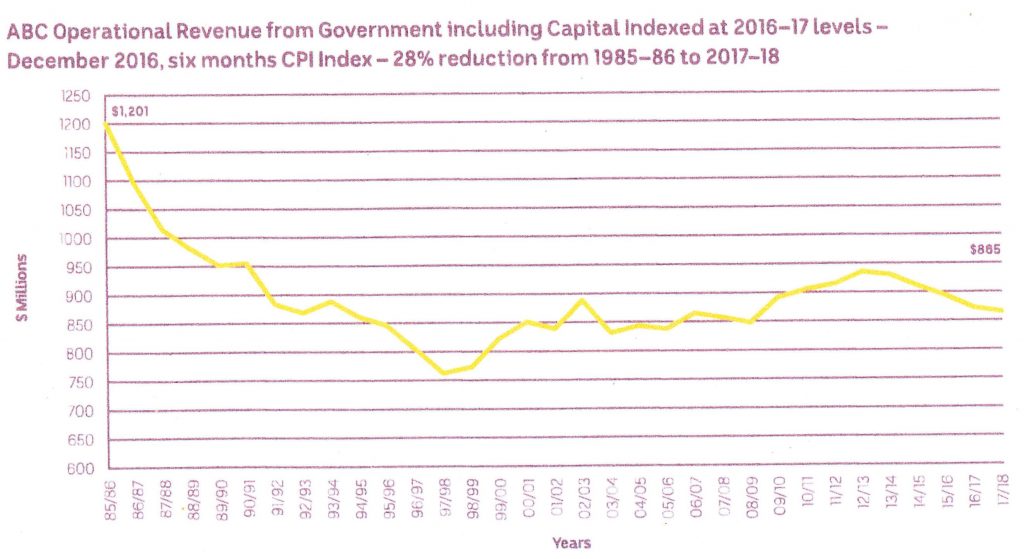
Chart: ABC annual report 2016-2017

At first glance, Treasurer Scott Morrison’s plan to slash $83.7 million from the ABC operating budget seems mean-spirited. At second glance, when he tells reporters ‘everyone has to live within their means’, it still seems mean-spirited.

The Budget proposal comes at a critical time for the ABC, which has been dealing with cumulative cuts of $254 million since 2014.

The Federal Treasurer, having painted the picture large, sent a hospital pass to Finance Minister Mathias Cormann to handle the outrage. Mr Cormann defended the decision to freeze indexation for three years (which amounts to $83.7 million), saying that all taxpayer-funded organisations have to find efficiencies.

The national broadcaster has been tightening its belt so much there is no room left for another notch. Managing director Michelle Guthrie sent an email to all staff saying as much, which she amplified in a press release. Ms Guthrie said the impact of the decision could not be absorbed by efficiency measures alone, as the ABC had already achieved significant productivity gains in response to past budget cuts.

She referred to Budget measures starting in 2014 with a 20% cut to the operating budget. The ABC was told to slash $254 million from its operating budget within five years. The broadcaster began to make cuts which were expected to save $207 million in 2015.

Jobs were lost, through natural attrition or redundancy, and the ABC also started reviewing its property portfolio and transmission network. As I have written previously, there was a general hubbub of protestation about this, circa November 2014.

“Petitioners were petitioning, GetUp was getting up, the ABC Friends group was lobbying and raising funds. They should have seen it coming,” I wrote.

A graph in the ABC’s latest annual report (above) shows how its operational budget has waxed and waned, dropping 28% from 1985-1986 to 2017-2018. As the graph indicates, the ABC has weathered some very lean years, particularly 1997-1998, under John Howard and Peter Costello.

The ABC annual report says 2017–18 was the third year to reflect previously announced Government-funding reductions. As part of the ABC/SBS Additional Efficiency Savings measure, there was a year on year increase of $7.7 million in the cut to the ABC’s base funding, bringing the total decrease in base funding to $55.2 million per annum.

This week Ms Guthrie said the ABC was continuing to implement various savings initiatives to address funding cuts, comprising efficiency savings in support functions and transmission (to cover the previously budgeted reduction of $12.5 million required in 2018–19).

Back to the drawing board, then.

Ms Guthrie said the decision came at a critical time for the ABC, as it starts triennial funding negotiations with the Government.

“The ABC is now more important than ever, given the impact of overseas players in the local media industry and the critical role the ABC plays as Australia’s most trusted source of news, analysis and investigative journalism.”

There is also a risk that the Enhanced Newsgathering initiative will not be renewed (at a cost of $43 million). The ABC acknowledges a decision on this funding is yet to be made by the Government. Considering the hullabaloo that followed economic reporter Emma Alberici’s analysis of the government’s plan to cut corporate tax rates, these financial constraints must be seen as ideological and punitive.

Opposition leader Bill Shorten said the ABC was “one of the pet hates of the Liberal Party”, and it’s hard to disagree.

“Because the ABC occasionally asks questions of the government they’re going to wind back $83 million,” he told the ABC.

But Finance Minister Mathias Cormann says the ABC will still receive $3.2 billion over those three years.

“This is effectively equivalent to the efficiency dividend that applies to nearly all other government taxpayer-funded organisations,” he added.

One of the early victims of successive budget cuts was the ABC Fact Check Unit, which was closed down in May 2016. ABC news director Gaven Morris said at the time “Unfortunately, having a standalone unit is no longer viable in the current climate.”

In March 2017, however, the unit was revived as a joint venture between RMIT University and the ABC. The unit’s brief, as it was before, is to ‘test and adjudicate on the accuracy of claims made by politicians, public figures, advocacy groups and institutions engaged in public debate’.

Which governments taxed us the most?

You may have seen an infographic on social media which the Fact Check Unit verified. It shows which governments taxed us the most, spanning the years between Whitlam and Turnbull. Tax as a percentage of GDP peaked in the Howard years at 23.5%. The Whitlam years averaged 19.4%. The Abbott/Turnbull years thus far average 21.7%. Interestingly, the turbulent years of Rudd/Gillard/Rudd averaged 20.9%.

So isn’t it satisfying to publish information like that and know it has been fact-checked and found to be factual? In this era where fake news and what I’d call ‘sponsored news’ leaves us with a skewed perspective, it is refreshing to see the ABC has found a new way to maintain standards.

There were some moments in the Federal Budget one could choose to laud; tax cuts, better reverse mortgage opportunities for pensioners and more funding for the homeless, albeit dependent on State contributions. But there was no respite for people on NewStart and no real plan to address housing affordability.

And, as the Climate Council pointed out, there was nothing at all in the Budget to address climate change – the words were not even mentioned.

For perspective, take a moment to think about the Federal Treasurer’s $50 million plan to redevelop the Meeting Place Precinct in Botany Bay (including a $3 million statue of Captain James Cook). Yes, it’s in Mr Morrison’s electorate, but surely that’s a side issue, Leigh?

If I may revisit an idea from Simple as ABC in 2014, the budgetary travails of the ABC and the ideology motivating it could simply be avoided. All it would take is an annual public radio/TV licence; $35 per household per year would (now) raise about $300 million. If the government of the day would guarantee indexed funding of $1 billion a year, the ABC could plan, rebuild and restore quality for the long-term.

Let’s be reminded that we all paid a radio licence from 1920 and continued doing so until colour TV was introduced in the early 1970s. Not every household in Australia would be happy about paying this licence fee. Some would see it as subsidising those dangerous lefties and bleeding hearts at the ABC and SBS.

But something radical needs to happen, to arrest the decline in quality (e.g. ABC online), restore transmission to remote areas (try getting an ABC station on your car radio when travelling in country areas-Ed.) and ensure money can be found for important investigations.

Every week since 1961 the award-winning Four Corners has continued to unearth important stories. Investigative journalism is an expensive business which requires reliable funding and a relatively free hand.

If we want more important stories like the live sheep export scandal, the solution is simple as ABC: We need to consistently fund the national broadcaster and guarantee its editorial independence.

Further reading: Mr Denmore thinks the media should boycott the Budget Lockup:

http://bobwords.com.au/simple-abc/

http://bobwords.com.au/simple-abc-part-2/


Censorship, guns and the right to arm bears


guns-bears-censorship
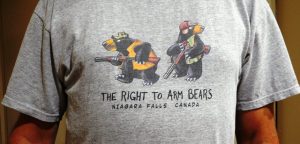
This image is classified (S) for satire under FOMM’s censorship guidelines

I was idly wondering if I should have a go at George Christensen for pulling that silly, anti-greenies gun stunt at the firing range but self censorship kicked in. What if he knows where I live? I blanched. The process known in journalism school as ‘self censorship by osmosis’ still kicks in, even 18 years down the track.

You may have assumed I was about to jump into the very deep pool of acrimonious discourse about mass shootings, guns and gun control. Actually, no, there are enough rabid views out there from one side and the other. Perhaps you will have seen Greens Senator Sarah Hanson-Young’s repost of the kind of vile trolling one can attract by advocating for the environment (if not, don’t bother looking it up – Ed.)

Instead, I thought we should look at a worrisome instance of censorship; where a respected economic analyst/journalist had an article taken down by the national broadcaster, the ABC. Emma Alberice’s reasoned piece about corporate tax cuts was removed by ABC management, reportedly after complaints from on high about its alleged lack of impartiality. Alberice’s article argues there is no case for a corporate tax cut when one in five of Australia’s top companies don’t pay any tax.

After public criticism, the ABC deflected cries of ‘censorship’ saying removing the analysis and an accompanying news story were ‘entirely due to concerns about Ms Alberici’s compliance with ABC editorial policies that differentiate analysis from opinion’.

The analysis has since been scrutinised by experts and given the seal of approval. It has even been re-posted at a public affairs website owned by the eminent Australian, John Menadue, AO. You may recall Menadue. He started his working life as private secretary to Gough Whitlam (1960-67), before forging a career in the private sector then returning to public service in the mid-1970s. He has since led a distinguished career in both public and private life, most notably as an Australian diplomat.

Mr Denmore, one of Australia’s more incisive commentators on media and economics, wrote this in Alberici’s defence:

Mr Denmore (the pseuydonym of a former finance journalist), sees this issue as plain old-fashioned censorship.

He concludes that Alberice was merely offering insights, which have got the nod from some serious-headed economists, as ‘uncomfortable truths’, which those in high government office and boardrooms found too confronting.

Now, a week later, the ABC has reinstated* Emma Alberici’s analysis, albeit with some passages removed. As former ABC journalist Quentin Dempster reported in The New Daily, the author and her lawyers negotiated an agreed form of words for the reposted analysis.

The removal of Alberici’s original analysis coincided with a planned US visit by a high-level delegation of Australian business and government leaders.  The latest advocate of global  of ‘trickle-down economics’,+ President Donald Trump, will meet with PM Malcolm Turnbull today. No doubt Mal will be taking notes on the US president’s ‘open for business’ approach of slashing corporate tax rates from 35% to 21%. Australia’s more modest proposal, which is currently blocked in the Senate, is to reduce the corporate tax rate from 30% to 25%, over a decade.

+A term attributed to American comedian Will Rogers, who used the term derisively, as did later opponents of President Reagan’s ‘Reaganomics’.

The nation’s top business leaders, under the umbrella of the Business Council of Australia, will also meet with US governors and top-level US company executives. Australian State Premiers, including Queensland’s Annastasia Palaszczuk, will also attend.

Business Council head Jennifer Westacott told the Sydney Morning Herald she feels that Australian business is “in the weeds of politics” and

“Meanwhile in the US they’re getting on with it.”

Westacott and Council members support the Australian corporate tax cut proposal as the only policy that can deliver jobs and growth.

Opposition leader Bill Shorten is taking the hard line – a corporate tax cut cannot help ordinary people, at a time when companies are using tax havens and keeping wages low. Shadow Treasurer Chris Bowen admits there is a case for company tax cuts, but said the LNP’s plan is unaffordable when the budget is in deficit.

The attempt to gag debate on this subject is, however, more worrying than the toadying going on in Washington. Australia ranks 19th in an international survey of countries judged on press freedoms. Reporters without Borders (RSF) maintains the list of 180 countries, many of whom oppress the media in far more serious ways than plain old censorship.

Australian media freedoms pursued by stealth

At first glance, 19th from 180 sounds good, but Australia has some issues, not the least of which is concentration of media ownership. The risk of self censorship is high, given the lack of job opportunities elsewhere. The 2017 survey notes that new laws in 2015 provide for prison sentences for whistleblowers who disclose information about defence matters, conditions in refugee centres or operations by the Australian Security Intelligence Organization.

I sometimes fret about a FOMM I wrote before these laws were introduced – an eyewitness account of US Marine movements after a chance encounter at a Northern Territory roadhouse.

“Aw shucks, we all just stopped to use the latrine, Ma’am.”

There’s more: a new telecommunications law has opened the door for surveillance of the metadata of journalists’ communications. Federal police raids on Labor Party parliamentarians in 2016 violated the confidentiality of sources. The Reporters without Borders report says the latter showed that authorities were “more concerned about silencing the messengers than addressing the issues of concern to the public that had been raised by their revelations”.

Meanwhile, a new draft national security bill seeks to restrict foreign interference in politics and national security. It contains secrecy and espionage provisions that could result in journalists being sent to prison for five years just for being in possession of sensitive information.

Daniel Bastard, the head of RSF’s Asia-Pacific desk, called the draft bill “oppressive and ill-conceived”.

“If this bill were passed, journalists receiving sensitive information they had not sought would automatically be in violation of the law. If this law had existed in the United States in 1974, the Watergate scandal would never have come to light.”

The free-wheeling nature of social media ensures that dissenting discourse does not stay banned for very long, though often exposed to a much smaller audience.

You may censor me, but never my T-shirts

I suppose now you want me to explain the relevance of the Right to Arm Bears T-shirt, eh? This now threadbare item was bought from a tourist shop on the Canadian side of Niagara Falls in 2010. I have been trying to find and purchase a replacement online. The manufacturer (Gildan) has similar T-shirts but none as fetching as the grumpy-looking bears wearing hunting jackets.

Wearing a shirt that makes a political point, however ironically, is an individual’s right in a free country to express an opinion. In my case it succinctly states my position on American gun laws, just as another T-shirt bought from a stall at Woodford, depicting a full-masted, 17th century sailboat (”Boat People”) says a lot about my attitude to refugees. Perhaps I should replace it with a Save the ABC shirt. Seems like the ABC needs all the friends it can find.

*Read Emma Alberici’s revised analysis here:

More on press freedom.

Keeping Cabinet secrets safe

Keeping-Cabinet-Secrets
Keeping Cabinet secrets, image by Ricky Lynch

Zounds, it’s only the ninth day of February and some records have been set, including the biggest ever accidental leaking of Cabinet secrets. In un-related news, the weather bureau said last Saturday (the 3rd) was the coldest February day in 100 years. We didn’t have a fire on because we had no dry wood, but some Hinterland folks were better organised. BOM said it was 18 degrees but with the rain, fog and all-day and all night drizzle, it felt like 16.

Our New Zealand, Canadian and UK friends and relatives would no doubt scoff at 16-18 degrees being described as chilly. But this is the sub tropics after all, and a week earlier we were enduring temperatures in the mid-30s.

Although it was comparatively balmy in Canberra last weekend (25/10, 27/14), the atmosphere was decidedly chillier. Prime Minister Malcolm Turnbull turned up for the ABC’s Insiders programme on Sunday vowing that “heads would roll” over the accidental disposal of two filing cabinets full of Cabinet secrets.

The cabinets went to a Canberra second hand office furniture store and were purchased by a citizen who later drilled them open. The (Parliamentary) Cabinet papers dating back 10 years, many marked Top Secret or AUSTEO (Australian Eyes Only), were handed to the ABC. The national broadcaster published nine stories based on the Cabinet secrets over the following days before explaining how they came into the broadcaster’s possession. The ABC deemed some material too sensitive for publication because of national security issues.

In the meantime, Australia’s spy agency ASIO visited ABC headquarters in Sydney and Brisbane and negotiated secure storage for the documents and eventually reclaimed the Cabinet secrets.

Patrick Weller, Griffith University’s Adjunct Professor at the Centre for Governance and Public Policy, judged that the use of the papers by the ABC seemed random. “The ABC was probably aware they had limited time to play the story before it became public and everyone else jumped aboard,” he wrote in The Conversation.

“The story was more about the filing cabinets than the cabinet papers, about the carelessness rather than the content,” Prof. Weller said.

Prof. Weller argued that the leaking of (historical) Cabinet papers is not such a disaster for governments in that they are often time specific, advising about matters long forgotten and maybe even now seen as minor incidents.

As the rules go, historical Cabinet papers are made available after 30 years; once a year in January we get to see another batch. They make for interesting reading if you are a historian or a political academic, but rarely anything more than that. Prof Weller says most Cabinet papers could be released within five years. Only a few would matter.

International eyes on sloppy Aussies

Nevertheless, the story caught the attention of the world’s media and Australia’s international allies – the US, Canada, the UK and New Zealand. The Washington Post commissioned a piece from Australian writer Richard Glover, who pithily summarised the Cabinet secrets affair as “Deep Drawers”.

As Glover observed, the key problem with the sale of unchecked government furniture is that anyone could have bought them, then handed their contents to a foreign agent or government.

He quoted Andrew Wilkie, a former intelligence analyst now sitting MP: “It sends a signal to our intelligence partners and allies that Australia might not be trustworthy when it comes to sharing information and intelligence with us.”

Prime Minister Malcolm Turnbull said on Sunday the “shocking failure” would be fully investigated and the people responsible held accountable.

The idea that public servants, entrusted with highly confidential documents, would put them in a safe, lock the safe, lose the keys, and then sell the safe without checking what was in it – it beggars belief,” he told Insiders

It’s not just governments. Forbes magazine guest writer Mark Emery, director of a document management company, cited examples of big organisations mishandling confidential data. They included paper documents from four hospitals in Massachusetts found un-shredded in a public dumping facility. Another hospital in the same state admitted that personal records of 800,000 people were “missing”.

In Dallas, Texas, prisoners on parole were allowed to work off community service hours by sorting and shredding confidential documents, such as birth certificates and medical records. The practice was scrapped in 2012.

Richard Glover mentions similar circumstances in the 1990s when diplomatic bags were sent to be laundered at Wandsworth prison in the UK. In 1991, Canada’s diplomatic bags (full of top-secret NATO documents)  were mistakenly sent there too, and went missing soon after.

Mistakes happen, in business, in government and in our private lives. Who has not sent a sensitive email intended for one person to many people? The digital data system is just as prone to this kind of mishap as the traditional paper file system.

When computers first started becoming dominant in business (in the 1990s), we were sold the myth of the “paperless office”. Twenty years later, even a micro-business like mine goes through a couple of reams of paper per month. Most people I know who run any kind of consulting business buy a shredder and keep it working (don’t forget to take staples out first!)

Last year in Sydney and Melbourne there were reports of medical files and legal papers found dumped in unlocked kerbside recycling bins. When stories like this make it into the media, they should at least make individuals aware of the need for safeguarding sensitive information.

In the 1980s, I’d been court reporting in a country city for several years. I always archived my jumbo-size reporters’ notebooks – filled on both sides with untidy scrawl – a mix of shorthand and my unique form of notetaking. The second time we moved house, I looked at the four archive boxes full of musty notebooks and decided I had to get rid of them.

I found a waste recycling firm which offered “secure disposal”. They dropped off a big wheelie bin at my place, the lid secured with chains and a padlock. Once I’d filled it up, I called the firm and they picked up the bin. The firm assured me the notebooks would be “burned or pulped”. This exercise cost $75, but what a salve for my conscience. The majority of matters heard in court never make it into the news or are briefly summarised. More importantly, magistrates and judges may decide to supress reporting. There was an example of a district court trial where I took copious notes only to find out that the defendants’ and plaintiffs’ names could not be published. Later a blanket ban was issued and we couldn’t print anything. Notwithstanding, a good court reporter will write everything down – better to have too much than not enough.

So that’s why I was feeling suitably smug, all these years later, when the strange case of “Deep Drawers” hit the news. It’s hard enough to keep secrets secret in the era of digital ‘cloud’ storage, super hackers and whistle-blowers. But Richard Glover’s oblique reference to “Deep Throat” (nickname of the Watergate source), nevertheless reminds us that if we want to discard sensitive paper files, dispose of them as I did.

If that was all a little heavy for an early autumn Friday, here’s a few songs about February to help you cope with the cold (or the heat).

The list did not include February, a poignant tune by Dar Williams, but here it is anyway.


King decrees universal basic income

king-basic-income
King decrees universal basic income Image by Jason Train, Flickr https://flic.kr/p/f1BBQu

The question for the week is, what, apart from introducing a universal basic income, would you do if you were King, President or Prime Minister for a day? The term ‘King for a Day,’ which has inspired more than a dozen pop songs and an obscure opera by Verdi, implies that for 24 hours you get to be loved by the masses. You can loll about in a high-backed chair, gold orb and sceptre in hand, and be fawned over – mint juleps and the like.

In the Silly Season, media outlets tend to ask people questions like this, for a news slot or an inconveniently empty news hole next to a couple of ads. The ABC North Queensland asked a bunch of 11-year-old kids and some senior citizens what they’d do if they were Prime Minister for the day. Some of the answers were predictable enough. Sophie, 11 said, “Give everyone a day off so adults can take their kids out (and make theme parks free).” James (10) said he’d employ more scientists so Australia can get its research skills up (reserve that kid a cabinet post, circa 2030). Keira (11) wanted more national parks; Charlotte (11) wanted a program for kids to do work experience and be taught something they want to do.

If I could be King for a Day, I’d single out the dysfunctional tax and welfare systems and propose the following reforms:

Introduction of a universal basic income for all adults: $25k a year, indexed, no strings attached. Adults are free to earn money over and above the $25k, but it will be taxed on a sliding scale to the maximum rate for anyone earning more than, say, $150k.

Hypothetically, a previously unemployed or under-employed couple could, with a tax-free household income of $50,000, find jobs, start a business, renovate the spare bedroom, and join Airbnb and ramp up their annual income in a myriad of ways. Their only duty would be to the Tax Office.

Treasury boffins would be responsible for reforming the tax system to ensure the universal basic income could be funded and that as few people as possible are disadvantaged. Treasury could find ways to encourage business to work with this new system, for example offering generous tax rebates for research and development.

In my Kingdom, all forms of social welfare would be replaced by a new regime, overseen by the Office of Financial and Social Opportunity and Incentivisation (NOOFASOI). The office would oversee payment of the UBI and iron out the inevitable wrinkles in a new and untested system.

This is not just a FOMM flight of fancy

Countries as diverse as Finland, France, Ireland, Norway, the US, Canada, New Zealand, Holland, Iceland, India and Brazil are either talking about universal basic income or trialling it in one form or another. Switzerland had a referendum, and while the people said no, it shows how front of mind this issue has become. Indeed, Australia has a university-sponsored programme to research income security.

And the Parliament of Australia published this comprehensive yet concise policy paper by Don Henry, for those who want to find out more.

The media went on a feeding frenzy recently after the end of the first year of Finland’s two-year trial to dole out a subsistence amount (no strings attached) to 2,000 unemployed Finns. The Finnish government (wisely) is letting the experiment run and will only look at it the results when the trial ends.

I would not pretend to understand the complexities of financing a universal basic income and the social engineering required to make it work.

An OECD report in 2017 said that despite well-publicised campaigns for a Basic Income, no country has put a BI in place as a pillar of income support for the working age population.

“The recent upsurge in attention to BI proposals in OECD countries, including those with long-standing traditions of providing comprehensive social protection, is therefore remarkable,” the report says.

It’s not so remarkable when one looks into the growing inequality that is being spawned by job losses as a result of automation and digital disruption. As Oxfam said last week, 42 people hold as much wealth as the 3.7 billion people in the poorest half of the world’s population.

This is clearly not sustainable. 

From where I sit, the domination of the contract or ‘gig economy’ and a part-time, casual workforce has left the welfare system behind. Moreover, the welfare bureaucracy is unrealistically punitive, in that it forces the unemployed to prove they are pursuing fast-disappearing jobs to qualify for support.

Mainstream conservative publications including The Economist and the Financial Times have canvassed the UBI debate. As the FT said, it “strengthens a sense that the traditional welfare state is no longer fit for purpose”.

The advances in artificial intelligence (AI) are threatening many jobs around the world, the FT said, adding that most workers have come to accept that the job for life has gone for good.

But if the intent of a UBI is to lift people out of poverty and ensure wealthier people pay their fair share of tax, it’s not that simple.

The OECD report concludes that introducing a UBI in countries with strong social support systems would not solve poverty and would lead to higher taxes. Others warn against dismantling welfare systems, which, however flawed, are at least a safety net for the poor and disadvantaged.

George Zarkadakis, an AI engineer and writer, outlined some of the flaws in an article for Huffington Post. Zarkadakis dismissed talk of taxing the cash reserves of fully automated companies, saying this would affect their ability to invest and innovate; they would lose their competitive position to low-tax or zero tax regimes. Likewise, he was sceptical about the hi-tech and energy companies that are lobbying for (and prepared to help fund) a UBI, arguing that this would give them undue political influence.

The ancient ideal of a UBI (Thomas More’s social satire, Utopia, published in 1516), frees creative people and artisans around the fringes of the commercial world to develop their skills without financial pressure. The ‘shall we tell Centrelink?’ poser goes into the dustbin of history, along with the often inaccurate stereotype of the ‘goddamn, long-haired hippy dole bludger’. People on disability pensions would no longer have to get stressed about the fluctuating cycles of their illnesses. For example, a person receiving the blind pension (which is not means tested), can lose it if they recover some sight. There is also the travesty where workers made redundant find out that 30 years of paying tax counts for nothing. Unless their payout is locked up in super, they’ll have to spend every cent of it before dipping into the public purse.

Even a theoretical discussion about a UBI should alert us to many of the anomalies in our welfare system, which arise from outdated legislation and an institutionalised idea that people are out to rort the system.

As for my Kingly privileges for a day (you can tell how far along we are with ‘The Crown’), I was so busy hunting grouse, inspecting broodmares, dallying with ladies-in-waiting and whatnot, I never got around to doing anything. Terribly sorry.

More reading: Hardship in Australia

Hobson’s Choice – guide to preferential voting

preferential-voting
Hobson’s Choice – preferential voting sand photo by Bob Wilson

By Laurel Wilson

I wasn’t born in Australia, but I got here as quick as I could, and have been here a long time, having been educated in Brisbane (or at least I went to school and University there.) But I don’t recall being taught anything about our voting system. Perhaps it was considered to be not all that relevant, as the minimum voting age was 21 at the time.

After finishing a Dip.Ed. at the University of Queensland, I eventually landed a teaching job in Stanthorpe – regarded in those days as a ‘hardship’ post, perhaps because it was considered to be a long way from Brisbane and it was rumoured to snow there at times in winter.

As most teachers would have experienced, the newer teachers were generally assigned to what was considered to be the ‘less desirable’ classes – in my case, this included the 9B2E2- Industrial Boys class. I really liked those kids and found them to be intelligent and respectful. We all struggled through sessions of ‘Citizenship Education’, known, it must be confessed, by teachers and students alike, as ‘Shit Ed’, such was the turgid quality of the textbook.

Having to teach the subject did, however, result in my having first to grasp and then explain the concept of ‘preferential voting’ to my class of young boys.

So, dear readers, it has come to this – there’s an election on in Queensland tomorrow to decide whether we’re to have three years of a Labor Government (we will have four year terms from 2020 onwards), or whether the Liberal-National Coalition will resume where they left off nearly three years ago. There is, of course, the possibility that Pauline Hanson’s One Nation may get the nod.

In a system which I understand is particular (some would say peculiar) to Australia, voting is compulsory and elections are decided by a system of ‘preferential voting’, rather than the more common ‘first past the post’ system used in most other countries. To add to the complications, Queensland has reverted to ‘full preferential voting’, rather than the ‘optional preferential’ system used last election. This means that we must now place a number next to every candidate on the ballot paper in order of preference. Until recently, I was unaware that this change had occurred. I suspect this move was done rather quietly in some midnight Parliamentary sitting, but it may have just been the fact that I have, for some time, eschewed reading newspapers and watching TV news.

Those who already have a grasp on our voting system may choose to stop reading now, or continue if you’re curious to see whether someone who wasn’t born here can actually understand and explain the intricacies of ‘preferential voting’….

[For those not living in Queensland, the main parties contesting the election are Labor (incumbents- centre-left oriented, the original ‘workers’ party’); LNP- a coalition of Liberal (not the North American version of Liberal) and National parties (centre-right); Pauline Hanson’s One Nation (further to the right on many issues, populist); The Greens (emphasising environmental and social issues) and Katter’s Australia Party (rural conservatives). Some electorates will also have ‘Independents’- not officially aligned with any party.]

The ‘first past the post’ system of electing representatives has never been the case in Queensland. Preferential voting was introduced here in 1892 – 26 years before Prime Minister Billy Hughes introduced it for Federal elections, including the Senate. The rationale apparently was to allow competition between the conservative parties without risking seats. That worked out just fine, then.

The drawback of the preferential system is that a person can win a seat with as little as 35% or even less of the popular vote, providing there are more than 2 candidates vying for election in that seat. Of course when there are only 2 candidates, ‘preferential voting’ is not really relevant, as one candidate is bound to secure more than 50% of the valid votes on the first count. (I did ask Mr FOMM what would happen if there was a draw – we came to the conclusion that there would have to be a by-election. Any better ideas?)

To give an example of the ‘first past the post system’: – in this imaginary electorate, there are 1000 valid votes cast.

Candidate A from the ‘Let’s Not Party’ party gets 350 votes

Candidate B from the ‘Up the Workers’ party gets 300 votes

Candidate C representing the ‘Treehuggers’ gets 200

Candidate D from the ‘Please Explain’ party gets 125

And Candidate E – an Independent gets 75

If this were ‘first past the post’, candidate A from the ‘Let’s Not Party’ party would win, leaving 650 electors NOT getting their choice of candidate.

Under the full preferential system, electors must vote for all the candidates in the voter’s order of preference – e.g. candidate A was the ‘first preference’ of 350 voters, candidate B was the first preference of 300 voters and so on. A candidate must get 50%+ 1 of the votes to win. In the above example, no candidate has gained 50% +1 of the votes on ‘first preferences’, so that is when ‘second (and often third) preferences’ come into play.

Every valid vote must have a person’s preferences marked 1 to 5 in the above example, as there are 5 candidates. The next step is to count the ‘second preferences’ of the candidate with the lowest number of ‘first preference’ votes. This candidate is then eliminated from the count. In this case, the second preferences of those who voted for candidate E are counted. Say 50 of these go to candidate B and 25 to candidate C

The new count is:

A gets 350 +0    = 350

B gets 300 + 50 = 350

C gets 200 + 25 =  225

D gets 125 +0 = 125

(Candidate E eliminated)

Still no-one with 501 or more, so the 2nd preferences of candidate D are counted and candidate D is eliminated from the ‘race’. 100 people voting for candidate D have marked candidate B as their second preference and 25 have marked candidate A as their second preference

A gets 350 +0    =   350+25= 375

B gets 300 + 50 = 350+100= 450

C gets 200 + 25 =   225+0= 225

D gets 125 +0 =   125- preferences distributed and candidate D eliminated

STILL no-one with 500+1, so the 2nd preferences of candidate C are counted and candidate C is then eliminated from the ‘race’. 100 people voting for candidate C have marked candidate A as their next preference and 125 have marked candidate B as their next preference. (At the risk of losing the plot, but to be completely accurate, I must add that the 2nd preferences of 200 of candidate C’s voters are counted, as candidate C was their first choice, but the 3rd preferences of 25 people are counted, as candidate C was their 2nd choice)

A gets 350 +0    =   350+25=375+100=475

B gets 300 + 50 =350+100=450+125=575

C gets 200 + 25 =   225+0=225 preferences distributed and candidate C eliminated

Finally, we have a winner – candidate B from the ‘Up the Workers’ party is the first,  second (or third) preference of the majority of voters. I guess you could say this means ‘B’ is the least disliked of the candidates, so gets the nod.

So over to you, good Queenslanders. Be sure to vote on Saturday, and don’t forget to number all the squares on the ballot paper to be sure that your vote counts. And in the true tradition of elections, have a polling day sausage in a blanket and be nice to the people distributing ‘how to vote’ cards – they might just come in handy this time.

More reading:


Many issues in unwinnable Queensland election

election-special-maleny-police
Election special: Photo of old Maleny police station by Bob Wilson

In the interests of better community policing and the fact she had just called an election, Queensland Premier Anastasia Palaszczuk made an unequivocal promise.

The Premier, who somewhere in the Courier-Mail’s Monday election coverage recalls winning a Grade Nine competition to ‘help police fight crime’, made a commitment to hire an extra 400 police officers over the next four years. Based on a First Year Constable’s salary (including shift allowances) of $70,820, that’s a $28.32 million promise

We back our police with the resources they want, the powers they need and the pay they deserve,” she told the ABC last Sunday.

Crikey, they ought to send a couple up the hill here to Maleny, where the new $2 million police station in Macadamia Drive (staffed by four police officers), has a roaming brief to cover an area from Maleny out to Palmwoods, Beerwah, Conondale and Kenilworth.

Ms Palaszczuk’s election promise to hire more police comes a week before the 1950s-style police station in Maleny’s main street is sold at auction. The 2,344sqm property, which is zoned Community Facilities, includes an office/police station and a residence but excludes a separate lock-up.

On my calculations, this sale alone should provide the Queensland Police Service with enough money to pay the salaries of an extra 21 police officers (over four years).

Against my better judgement, I bought the election special edition of The Courier-Mail on Monday after a three-year hiatus, prompted by a series of inflammatory, misleading and discriminatory front pages. Monday’s page one was no less lurid, presenting unflattering caricatures of the three main party leaders.

I worked there in the broadsheet days, pre-tabloid, pre-redundancies, pre-online editions, four editors ago. No regrets, Coyote, as Joni would say. I entered my 70th year on Monday, BP 120/80, feeling OK and supremely relieved I had no part to play in the CM’s graphics-laden presentation of an unwinnable election.

The first two pages of the CM’s October 30 election special purport to sell us the idea they have the State’s media covered. In what amounts to a two-page ‘house ad’, the CM confirms what we already knew – Rupert Murdoch’s Queensland media empire owns almost all of the print media titles. So yes, they have it covered, but you’d expect the coverage to be suitably mainstream; about 9% of the eleven-page election coverage was set aside for stories about the Greens and how they hope to win three seats, including Deputy Premier Jackie’s Trad’s seat of South Brisbane. It appears (from vox pops interviews), that some people in West End will be voting Green because of over-development (apartments) in the inner city suburb.

The rest of the coverage focuses on the resurgence of One Nation, how Labor will suffer from its seemingly intractable position on the Adani coal mine (no mention that the LNP are all for it too), a token story about the Katter Party and proportional space for (most of) the party leaders to have their say.

So to the unwinnable election

There’s a fair chance no single party will emerge from the November 25 poll with a workable majority, so in this sense it is unwinnable.

Crikey’s Perth-based election analyst, Poll Bludger, quoted ReachTEL polling figures from September showing the LNP with a 52-48 lead on primary votes. One Nation was polling at 19.5% and Greens at 8.1%.

An earlier Newspoll had Labor on 37% and the LNP on 34%. Some of you might take this to mean that the two parties will take 71% of the primary vote. This is roughly in line with election trends around the world where one in three people did not vote for one of the major parties. This leaves the unallocated 29% to be divided up between the Greens, One Nation, Independents, minor parties and the 2% of the electorate who cast informal votes.

The poll numbers, which focus only on primary votes, are not worth much in light of the return to compulsory preferential voting (CPV). To the uninitiated, this means numbering your preferred candidate 1 and then others in order of preference (meaning the party you like the least goes last). So if no single candidate has a clear majority, second preferences of the party that polled the least number of votes are counted until a winner emerges.

Many people do not understand preferential voting, so when handed a how-to-vote-card at the polling booth, they simply fill in the numbers as suggested (or number all candidates 1 to 6 consecutively, which is known as the “Donkey Vote.”)

An Australian Institute poll last year found that only 29% of respondents knew how to correctly fill in the (preferential) Senate ballot paper. So that is not a good sign for the re-introduction of compulsory preferential voting at this election. As Griffith University’s Paul Williams pointed out (in the CM), the Australian Electoral Commission is yet to conduct an information campaign to ensure CPV is clearly understood.

University of Melbourne honorary associate Adrian Beaumont has more to say about polling and CPV in The Conversation.

The Sydney Morning Herald suggested on Monday that the return of full preferential voting and new electoral boundaries could hand One Nation a balance of power role.

Enter stage right, former Senator Malcolm Roberts, booted out after a High Court decision found he had not renounced his British citizenship.

By challenging the seat of Ipswich for One Nation, Mr Roberts, best known for his climate change conspiracy theories, could attract enough LNP second preferences to win the seat, the article suggests. (I would go ‘aarrgghh’ at this stage but that would be editorialising).

ABC election analyst Antony Green told the SMH Roberts faced an uphill battle.

“It would be highly surprising if One Nation won there on first preferences, which would mean they would have to come from behind on LNP preferences,” he said.

Ipswich West was more likely to fall to One Nation, he said, adding that One Nation also had a good chance of winning the neighbouring seat of Lockyer.

Ipswich was where Pauline Hanson originally built her One Nation party in the 1990s. Should Roberts prevail, he is being tipped to lead One Nation in Queensland. What was that about the Lord Mayor’s show and the dust cart?

On latest polling, One Nation at 19.5% would seem to be in a strong position to win seats in Queensland and maybe also control the balance of power. A scary notion for some, but you have to give credit where it is due: Pauline Hanson has found the ear of disgruntled voters, much as Donald Trump wooed that endangered species US filmmaker Michael Moore called ‘angry white men’.

In Queensland, the angry, the poor and those who feel forgotten are listening and Hanson tells them what they want to hear.

There is only one certainty about the Queensland election, whoever cobbles together a coalition from this mess will have a mandated four years in which to rule – that’s 208 ‘Fridays on our minds’…#aarrgghh

Dawe, Morrow and Gessen – Satire and The Rise Of Populism

Dawe-satire
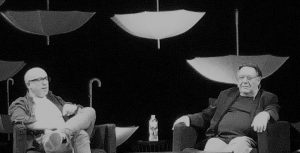
Satirist Bryan Dawe (left) and comedian Julian Morrow at Integrity 20. Photo by Frances Harper

Actor/satirist Bryan Dawe has such a low-key, laconic approach to ‘giving a talk’ that the journalistic instinct to take notes deserted me. Dawe is the surviving half of the satirical act Clarke & Dawe, but he is much more than that. He told the audience at Griffith University’s Integrity 20 Summit that when it came to political satire, he and John Clarke had never been short of material over 25 years of producing their weekly TV show.

Dawe introduced one of his best-known satirical characters, boozy retired judge Sir Murray Rivers QC; Dawe as interviewer/straight man to Sir Murray’s confused bigot. His presentation was funny; funny and sad, as he often referenced his late partner in satire John Clarke, who died in April this year. Dawe’s ‘talk’ would have been illuminating for the year 11 and 12 students attending Integrity 20, as Dawe summarised his unhappy days at school where he left early after being told by a careers adviser he would not amount to anything because he came from the ‘wrong postcode’.

Dawe joined Julian Morrow of The Chaser and The Checkout for a discussion on satire, comedy and how to know when you’ve gone too far. When asked that question by panel chair Rebecca Levingston, both agreed that nothing was off limits.

While agreeing that one could satirise and make jokes about anything, Morrow conceded that The Chaser’s skits post-9/11 were “too soon”. Levingston prompted Morrow to revisit the time The Chaser (a TV satire show), penetrated security at the 2007 APEC conference in Sydney with a fake motorcade transporting a ‘Mr bin laden of Canada’. As Morrow recalled “We never expected to succeed.”

Both satirists agreed that there are powerful people who always try to have good satire shut down, probably because nothing is funnier than the truth, greatly exaggerated. The trick, said Dawe, was not to engage with critics, trolls and others whose power base was being diminished by The Chaser’s sharp sketches or by John Clarke’s familiar introduction: “Thanks for having me, Bryan.”

Bryan Dawe’s presentation was the ideal tone for Integrity 20’s afternoon session, which followed serious and at times contrary debate about hate speech, free speech, censorship, the global rise of populism and how to destroy democracy.

Masha-Gessen-populism
Masha Gessen, photo by Bengt Oberger, Wikipedia CC

You may have heard Richard Fidler on Conversations interviewing Masha Gessen, an exiled Russian American journalist and author. Her speech ‘How to Destroy Democracy’ and later contribution to a panel discussion on populism was a highlight of Integrity 20.

New York-based Gessen outlined the seven lessons in ‘imagining the worse’, in which the rise of populism destroys democracy. These include destroying the sense of participation, conspiracy myth-making, and engaging in the ‘forever war’, (which in the US means a 16-year war against ‘terrorism’, an unidentifiable foe, with no end point in sight).

Gessen, an outspoken critic of Donald Trump, also referred to the way democracy could be destroyed simply by degrading language.

“Trump is a master at that. He lies and lies to convince you that something that’s not true is true. There’s no way for a journalist not to quote his lies.

“Trump says he’s the subject of a witch hunt when that’s the opposite of what he means. He creates word salad and makes it difficult to work out what it all means. It’s a direct assault on how we all live because language is the main tool we use to co-exist.”

Even while Gessen was articulating this I was thinking about former PM Tony Abbott’s ludicrous comments about goats, volcanoes and climate change. However daft the comments seemed, journalists had no option but to quote what he actually said at a climate conference in London.

As Ricky Gervais said this week in a thought-provoking tweet:

Some opinions are so stupid they hurt my feelings. But that’s my problem. It’s a person’s right to hold as stupid an opinion as they like. (@rickygervais):

A panel discussion followed on the global rise of populism. Panel chair Luke Stegemann summarised the rise of populism in countries including Italy, Poland, the UK, France and Germany. “Australia is not immune by any means,” he added, citing the resurgence of Pauline Hanson’s One Nation and how it taps into the frustrations, racism and bigotry of people who are angry about immigration and furious about globalisation and the perceived impact these issues have on their jobs.

One ought to keep in mind that populism − a movement for the people and against a privileged elite − can occur across a broad political spectrum. It is possible, as panellist Geoffrey Robertson QC observed, to have left-wing populism.

The origins of populism date back to the 1800s when rural peasants revolted against their robber baron landlords. Today it is more about polarising the electorate and pitting angry poor people against (poor and possibly angry) immigrants and asylum seekers.

The privileged elite seem to survive with wealth intact, whichever way the populist wind is blowing.

Rachel Kleinfeld of the Carnegie Endowment for International Peace said the common perception was that supporters of populism are racists and bigots.

“There is a racist fringe but the core of populism is about high inequality and why people don’t understand why politicians don’t listen.”

Geoffrey Robertson said young people were disenchanted about the rampant capitalism that democracy encourages. This was in response to Kleinfeld’s comment that only 52% of people aged 18 to 29 think it is preferable to live in a democracy. Robertson said the key threat imposed by populist leaders was the attempt to replace an independent judiciary with their own people.

Kleinfeld made comparisons between Donald Trump and outsider president Andrew Jackson (1828-1834), who enjoyed two terms and put his successor, Martin Van Buren, in place to ensure 12 years of a populist government.

The Atlantic made much of the Trump/Jackson similarities.

“Jackson, like Trump, won over many white working-class voters, who brushed aside critics who warned that he was unstable and a would-be dictator. He maintained their loyalty even though, like Trump, he was of the elite.”

I can’t recall who started it, but it seemed all panellists agreed that Trump, despite being widely reviled, would easily take another term in office. They didn’t say so, but it seems obvious that Trump has a like-minded and seemingly un-impeachable successor in Mike Pence sitting on the bench (wearing a Martin Van Buren t-shirt).

If you were not yet confused about populism and its multiple meanings, Cas Mudde, a professor at the University of Georgia, coined the phrase “thin ideology”. This means to merely set up a framework: pure people versus a corrupt elite. Thin ideology can be attached to all sorts of “thick” ideologies such as socialism, nationalism, anti-imperialism or racism.

I will leave it to the reader to decide what type of populism exists in Australia.

Monday I’ve got Friday on my mind

I leave you with a tribute to the late George Young, who co-wrote the song from which this essay takes its name. Young and co-writer Harry Vanda and their band The Easybeats had an international hit with Friday on My Mind in 1967. Here’s a terrific cover from Richard Thompson and band from the album 1000 Years of Popular Music. (Please don’t listen to the Bruce Springsteen version that comes up after that…Ed)


New Zealand politics stirs ghost of Norman Kirk

New-Zealand-politics
Norman Kirk meets Gough Whitlam in 1973. Photo: Archives NZ

I became aware of New Zealand politics, circa 1960 when a tall Kiwi farmer with coiffed hair and a plummy accent won an election in his own right. After serving as interim PM in 1957, Keith Jacka Holyoake went on to become Sir Keith and later the country’s Governor-General, the only person ever to hold both offices.

The National Party (Conservative) leader ruled New Zealand politics from 1960 to 1972, ousted by a Whitlam-esque Labour figure, Norman Kirk (left). After a promising start, Kirk battled ill health through 1974 and died in office, aged just 51.

Kirk, a working class man who built his own h0me at Kaiapoi, could have been anything. He once said, “People don’t want much, just someone to love, somewhere to live, somewhere to work and something to hope for.”

As Labour scholar Vittoria Trevitt recounts for the Chifley Research Centre, Kirk immediately set about turning New Zealand politics on its head. Social security benefits were increased and new social programmes introduced. Like Whitlam, Kirk ushered in a single parent’s pension. He encouraged Kiwis to build new homes, formed appeal boards so tenants could oppose rent increases and introduced ‘second chance’ re-finance loans for divorcees and others.

Workers benefited from a ‘no fault’ national accident compensation scheme. The Kirk government also increased the minimum wage, improved leave entitlements and fast-tracked equal pay legislation.

As an aspiring scribe in the early 1970s, I became a Kirk fan when he established a fund for writers. And idealists initially embraced the “Ohu Scheme”, where marginal land in remote rural areas was granted to people who wished to establish alternative settlements or intentional communities.

By Trevitt’s account and other sources, it was Norman Kirk who scrapped compulsory military service; Kirk who on day one called NZ troops back from Vietnam; Kirk who ensured that people who had served in the military would have entitlements and employment opportunities. He refused to host a Springbok tour in 1973 because of South Africa’s apartheid policies and confronted France over nuclear testing in the Pacific. And he turned Waitangi Day into a public holiday. Not bad for just 21 months in office.

Kirk’s successors, Hugh Watt and Bill Rowling, lasted until late 1975 when they were rolled by Rob Muldoon’s National Party. In turn, Muldoon was ousted nine years later by David Lange, whose term as Labour Prime Minister is possibly best remembered by his refusal to allow US nuclear-powered or nuclear-armed ships into New Zealand waters.

(Vin Garbutt sings Lynn Clark’s anti-nuclear song Send the Boats Away (song starts at 0.58)

As head of New Zealand politics, Lange held office for two terms and Labour reigned until 1990. After Jim Bolger’s stint as National PM (1990-1997), the National’s Jenny Shipley had a two-year spell before being evicted by Labour’s Helen Clark, who held a coalition together for three terms before resigning from politics, seemingly disillusioned.

Since 2008, the National Party’s John Key has held sway, until his surprise exit from New Zealand politics last year in favour of caretaker PM Bill English.

So to the Kiwi Labour Party (they spell it with a ‘u’). Exiled since 2008, they have been buoyed by polls, a young, positive leader in Jacinda Ardern and a Whitlam-esque slogan: “let’s do this.” (kia mahi a tenei). Ardern stands a better than 50/50 chance of becoming New Zealand’s third female prime minister and the eighth Labour leader since Joseph Ward in 1906. If so, Australia’s government ought to be worried.

She may have to form government with the Greens and the Maori party, but the polls are saying it could happen. Roy Morgan election poll projections show Labour with 49 seats, Green with 11 seats and Maori Party two seats (62 seats).  The poll predicts National will win 50 seats, NZ First seven seats and Act NZ one seat (58 seats).

I had lost touch with what is now known as the Green Party of Aotearoa New Zealand, after a flirtation in the early 70s with the vanguard movement, the Values Party. As has happened here, many staunch Labour voters in NZ have drifted to the Greens. As a former Labour diehard source puts it: “Labour has sold us out before and they’ll do it again. They can only be a real government of progress with the guidance and support of a Green coalition partner.” 

Lobbying Kiwis living abroad

This week we got an email from James Shaw, co-leader of the Green Party of Aotearoa.

“Kia Ora,” he began, meaning G’day or What’s up Bro?

The Green Party needs every vote we can get to ensure the outcome is the most environmentally-friendly and progressive result possible.”

Don’t sit this one out,” said James (Bob resisting the urge to add “to Red Molly”- this one is for RT fans- ed.).

Party Vote Green from anywhere in the world to make sure New Zealand remains a great place to call home.”

The Greens have a reformist agenda which includes a Zero Carbon Act, a Climate Fund and a 1.2 billion tree planting programme. The party opposes new coal mines, fracking, and deep-sea oil and gas drilling.

My sources in NZ and the UK reckon the campaign to recruit expat Kiwis (assisted here by the Australian Greens), is a smart move. “People living in London and elsewhere like the idea of ‘the clean green NZ’. We also have a lot of youth abroad and they tend to vote progressive,” one Green supporter said.

Last I heard there were 650,000 New Zealand citizens living in Australia. There’s no shortage of election issues in New Zealand politics: housing shortages and property prices, health needs/shortages, offshore drilling, water purity and river pollution are just a few. Swinging voters, the so-called “Middle NZ” – people who typically own more than one property – might be swayed to the conservatives by speculation of a Labour/Greens capital gains tax (NZ doesn’t currently have one).

In the Red corner, Labour’s effervescent leader Jacinda Ardern, 37, is gaining an international profile.

As this BBC article “Can ‘stardust’ beat experience?” reveals, Ardern’s elevation to the top job in Labour politics is no accident. A left-wing activist in her teens, she worked in former PM Helen Clark’s office and in the UK as a policy advisor to Tony Blair. She’s been a politician since 2008.

In the Blue corner, incumbent Prime Minister and leader of the National Party Bill English has been a politician since 1990 and Finance Minister twice. He was deputy PM under John Key from 2008 to 2016. In December 2016, When Key suddenly resigned as prime minister, English won the leadership unopposed (with Key’s endorsement).

A new National Party promotional video seeks to counter Ardern’s appeal to women by portraying English, a father of six, as a family man. Bill’s wife Mary recalls the era of cloth nappies when her husband was a stay-at-home dad.

“Bill ran the nappy bucket. That was his job.”

The video includes positive interviews with Education Minister Nikki Kaye and Deputy Prime Minister Paula Bennett. Former PM John Key praises English for keeping a cool head during the global financial crisis and shrewdly notes Bill’s love of rugby.

Now that ought to do the truck.