The FOMM alt-Christmas playlist

Alt-Christmas-playlist
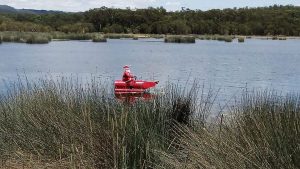
Alt-Christmas playlist Santa escaping shopping centres to go fishing in Ewen Maddock Dam, photo by Bob Wilson

The first thing you’ll notice about my carefully curated alt-Christmas playlist is the absence of Six White Boomers and The 12 Days of Christmas. I’ll walk out of the room if someone starts on that tedious epic. I was intending to write a Grinch-like piece this week, but instead decided to share my eclectic view of the world through an alt-Christmas playlist.

What set me off on this tangent, dear reader, was making visits to three different shopping centres in the past three weeks. It wasn’t so much the crowds, the noise, the proliferation of tattoos or the inappropriate wardrobe choices that got me down. It was being assailed, or should that be wassailed on all sides by different streams of Christmas music. It ranged from Bing and that tired old northern hemisphere trope to Jose Feliciano wishing us a merry one from the heart of his bottom.

For someone whose preferred background music is Bach or Riley Lee playing the shakuhachi, it is an assault on the senses. It seemed to me, though, that most people were oblivious to Rudolph and Frosty the Snowman, as they trudged around shopping centres at Carindale, North Lakes and Morayfield. In fact, as their laden trolleys would indicate, they seemed intent upon spending.

A survey this week by finder.com.au reckons Australian shoppers will spend $492 (each) on Christmas gifts alone. Women will apparently spend $58 more than men. Finder’s Bessie Hassan said the 2017 spending estimate was slightly lower than 2016, when Australians spent on average $539 on Christmas presents.

The shopping swarms were probably to be expected, given the 3.6% rise in the consumer confidence index between November and December. The Westpac Melbourne Institute’s Index is 5% above the average for the September quarter, which saw a ‘disturbing’ slump in consumer spending.

While consumer confidence may have bounced back at a critical time for retailers and their landlords, the keepers of the index are circumspect.

“…with ongoing weak income growth, a low savings rate and high debt levels, we cannot be confident that consumers have the capacity to sharply lift spending, despite higher confidence.”

The irony of my three visits to large shopping centres is, had I planned ahead to buy the small but well-chosen gifts, I could have done it online and saved myself the grief.

So to the FOMM alt-Christmas playlist; they’re not all leftie, anti-Christmas rants and there’s a thread of peace and love running through all of them.

There are a couple of genuine carols, a peace anthem or two, some Australian content and more.

My music correspondent Franky’s Dad offered to create a Spotify alt-Christmas play list for me. Until he did that, I had not subscribed to Spotify. (Hands up who else has no idea what ‘Spotify’ is. Ed.) Unlike many list stories you will find on the Internet, these songs are not in order of preference. I happen to like all of them, but feel free to disagree or tell me which alt-Christmas song I should have included instead.

All of the links here are to YouTube videos. Just dip into them as the spirit moves you. For those who have Spotify, here’s the link:

1/ The Little Drummer Boy, interpreted here by my favourite acapella group, Pentatonix. If you like the group and this genre of music, they do a splendid version of Jolene with songwriter Dolly Parton.

2/ River, by Joni Mitchell. Ah, what a wistful, sad song. They’re cutting down trees and putting up reindeer, singing songs of joy and peace. But Joni just wants a river to skate away on (as you do if you live in Canada).

3/ Fairytale of New York, The Pogues and Kirsty MacColl, a bawdy anti-Christmas ballad of drunkenness and fractious relationships. I like the bit where the boys from the NYPD sing Galway Bay. A classic.

4/ I’m growing a beard downstairs for Christmas, Kate Miller-Heidke and The Beards. This quirky, M-rated Christmas satire won the best Comedy/Novelty song category in the 2015 International Songwriting Competition.

5/ 7 O’Clock News/Silent Night, Simon & Garfunkel, 1966. Half a century later, this timeless carol’s theme of peace and goodwill is still being drowned out by the negativity of global news.

6/ Suddenly it’s Christmas Loudon Wainwright III. Yep, it starts with Halloween (forget about Thanksgiving, that’s just a buffet in between). As Loudo sings – it’s not over till it’s over and they throw away the tree.” The Spotify version is a remix, but the impudent tone is still there.

7/ Happy Xmas (War is Over). One of John Lennon and Yoko Ono’s many pleas for world peace.

8/ Getting Ready for Christmas Day, Paul Simon. From early in November to the last day of December, he’s got money matter weighing him down. Simon cleverly intersperses the lyric with a 1941 sermon, voiced by black American preacher, Rev J.M Gates.

9/ The Silver Stars, Brisbane Birralee Voices. This is an Australian carol by William James which has also been sung by our Maleny chamber choir, Tapestry.

10/ Little Saint Nick, the Beach Boys. I’ve got Macca from Australia all Over to thank for this as he played this merry tune to close out his show last week. It sounds a bit like a rebadged Little Deuce Coupe, but who’s complaining.

11/ How to Make Gravy, Paul Kelly. Where would we be in Australia without the letter to Dan from Joe, who’ll be spending Christmas in jail? Kiss my kids on Christmas Eve and make sure you add a dollop of tomato sauce to the gravy.

The Christians and the Pagans, Dar Williams. The definitive song about disaffected families and how they come together at Christmas and try to find common ground.

(Our friend Rebecca Wright does a cracker version of this one).

Meanwhile, people, there are only 2+ days more shopping days to spend your quota. The Australian Securities and Investment Commission’s Money Smart tells us that the average credit card debt after the holiday season is $1,666.  While 82% of Australians will pay this off in up to 6 months, 11% will take six to 24 months; 4% will take two years or more and 3% believe they will never pay it off.

If you are worried about waking up with a debt hangover, go here, where you’ll find helpful tips, It’s probably too late for this year, but as Loudon Wainwright observes, of all such holidays, ‘it’s not over till it’s over’.

Season’s Greetings and take care on the roads – Bob and Laurel.

Flashback to Christmas 2015

The scary truth about the paralysis tick

paralysis-tick
Paralysis tick (Ixodes holocylus) The Conversation

It is sometimes difficult to separate the facts about the paralysis tick from the myths and home-grown remedies suggested by well-meaning folks. You may have heard some of the suggestions on how to combat the tiny, toxic parasite that can kill dogs, cats and humans. The home-spun remedies include (for removal) kerosene, a hot needle, a hot match, Vaseline or methylated spirits.

No, you need to first kill the tick, by freezing it or using a scabicide. The Australian Society of Clinical Immunology and Allergy (ASCIA) recommends using a ‘freezing’ spray commonly used to treat warts and available at pharmacies.

A cream used to treat scabies also does the trick but you need to leave it on for 20 minutes before removing the tick, with tweezers or patented tick removers (firm grip and a slight twist). Or if you have freeze-killed the tick, it should just drop off at some point. Experts are divided on which is the best approach.

While there are 75 different tick species in Australia, the primary culprit which can kill animals and cause a life-threatening anaphylactic reaction in humans is the paralysis tick or Ixodes holocylus. The paralysis tick occurs along the Eastern seaboard of Australia, primarily in wet sclerophyll forests (the ones with ‘gum’ trees and a lower layer of rainforest plants or shrubs) and temperate rainforests).

Since I went to an information workshop organised by Barung Landcare in Maleny, I have been somewhat over-zealous in my daily inspections of the moist parts of the body where ticks latch on. At times, I imagine I have a tick, when it is more likely a mosquito bite, but one can never be too cautious.

In the last month She Who Picks Peaches without Wearing a Hat reported in with ticks (i) behind her ear and (ii) on the crown of her scalp. In both cases these were the paralysis tick at the nymph stage which I killed with a scabicide then removed in the recommended manner.

“Little bastards,” quote SWPPWWAH.

Everyone agrees: the abnormally cool spring coupled with recent rains has raised the paralysis tick threat to critical. Then other day I ran out to the washing line to take in clothes before a storm arrived. This was the classic mistake – running barefoot on to the lawn where ticks can promptly run up one’s trouser legs. Imagine the horror when I picked up the (empty) laundry basket and saw two paralysis ticks scuttling around inside.

“WTF,” I exclaimed to SWPPWWAH. “How do they do that?”

According to a rural myth, the little bastards can jump, like fleas. Well, no, I left the laundry basket sitting on the lawn! But ticks do ‘quest,’ that is, they hang off the end of a blade of grass or a plant/tree branch waiting for a host to brush by. Ticks go through three life stages from the time a female lays about 3,000 eggs (larva, nymph and adult).

As dedicated readers may recall, I had what was described as a mild to moderate anaphylactic shock reaction to a paralysis tick bite in 2013. (Jeez, what must it be like to have a major reaction?) If you want to relive the ordeal (I don’t), go here:

I now carry an Epipen everywhere I go. I also kit myself out in light coloured gardening clothes, gumboots, hat, smother myself in insecticide and hang a tick repeller around my neck. The latter emits an electronic pulse said to repel ticks up to three metres.

There were two speakers at the Maleny workshop, retired vet Leigh Findlay (who spoke about dogs, cats and ticks) and Dr Ted Chamberlain, senior medical superintendent at Maleny Soldiers Memorial Hospital. The 69 people who attended mingled outside the function room exchanging tick anecdotes and describing their most recent attack.

Attendees included several people who have a recently diagnosed type of tick bite allergy called Mammalian Meat Allergy or MMA. Once their lives have been saved the first time, MMA sufferers will doubtless be advised to avoid eating red meat. Mammalian meat allergy is the result of acquiring the carbohydrate, alpha-gal, from ticks.

Dr Chamberlain told workshop attendees that Maleny hospital sees people with a tick bite on average once a week and 20 serious cases of anaphylaxis each year. He added that before he came here, he’d seen two cases over a 25-year medical career.

Dr Chamberlain identified two ‘hot spots’ for ticks – the Blackall Range (Sunshine Coast hinterland) and the northern beaches of Sydney. He believes there are two reasons for the increase in ticks. One is the change in climate, the other is that people unwittingly create tick habitat by allowing native vegetation to flourish. The main issue with maintaining natural habitat is that it encourages tick hosts including bandicoots and possums.

But are there ways of ridding your habitat of ticks in general? The number one solution is the insectivorous Guinea Fowl. There is a practical problem with keeping guinea fowl on your land as you can tell by (listening) to this 30 second YouTube video

Guinea fowl eradicate ticks (and other insects) by systematically stripping grass and plant stems with their beaks. Free-range chooks will also peck away at ticks and other insects, but not so effectively.

A few myths busted

Ticks do not fly or fall out of trees. If there is one latched on to your head it has been crawling around on your body for at least two hours;

The size of the tick bears no relationship to the severity of the allergic response;

Do ticks cause Lyme Disease? You may have seen an episode of Insight on SBS last year when host Jenny Brockie asked that question. The science says ‘no’ but an acrimonious debate has arisen as people succumb to strange illnesses which seem related to tick bites.

Certainly more research needs to be done to explore the genesis of “lyme-like illness” but for now, I’ll stick with the science answer: “…there is no definitive evidence for the existence in Australia of B. burgdorferi, or any other tick-borne spirochaete that may be responsible for a local syndrome being reported as LD.”

Nevertheless, a tick bite can cause swelling and infection and induce flu-like symptoms. Cases of tick-borne Rickettsia and Babesia have been documented in Australia. Some ticks bites can result in life-threatening illnesses including tick typhus and severe allergic reactions. It is now broadly accepted that forcibly removing a tick without killing it first may increase the severity of any allergic reaction.

The University of Sydney, which has been conducting research in this field for 12 years (with input from Dr Chamberlain), says the best method of avoiding ticks is to stay away from known tick infested areas.

Right. I’m looking out the window here at our serene country environment, the green rolling hills, the native trees blowing in the wind, native birds flitting about, the creek burbling away at the bottom of the block; the peace and quiet.

Not bloody likely.

(Paw note: I removed a 2mm long tick from the dog’s lower eyelid(!) last night. Amazing to me was that he lay passively in my lap while I poked around trying to get a good grip on the nasty little parasite that was causing him discomfort. The dog is on tick/flea preventative medication, but it is important to check them regularly anyway. Ed)

F

Catch a (brush) turkey for Christmas

turkey-christmas
Brush turkey for Christmas dinner? – image by She Who Takes Bird Photos, aka Laurel Wilson

The only thing more difficult than taking a photo of a brush turkey is selling the notion of preparing one for a (budget) Christmas lunch. Those of you quick on the uptake will have already registered that Mr FOMM is being ironic. Brush turkeys as you may know are a protected and even endangered species. Besides, they have a “stuff you’ attitude which is refreshing (bok!) And the chicks are cute.

As it happens, turkey is the least popular meat for people laying in provisions for Christmas. The ubiquitous Christmas ham leads the pack by a good margin, along with chicken, then turkey.

Northern hemisphere folk might find this hard to fathom, but rich hot food is not a priority for the Australian Christmas lunch. No, we prefer ham, chicken, prawns, a variety of cold salads and condiments, followed up with fruit salads, ice-cream, custard and yoghurt, all of it more befitting our typical 30+ degree Christmas Day. The diehards do Christmas pudding, but as we all know, it takes a long afternoon nap to sleep it off.

Retailers work hard at this time of year to sell us on the idea of (a) over-eating (b) over-spending and (c) eating food we rarely eat. The latter includes turkey, which has its biggest sales between December 20 and 24. I’m aware turkey is very big in the US and Canada on November 23 (Thanksgiving). According to the University of Illinois, 88% of Americans surveyed by the National Turkey Federation eat turkey on Thanksgiving; 46 million turkeys are eaten each Thanksgiving, 22 million at Christmas and 19 million at Easter

Compare that with Australia, where 3 to 5 million turkeys are killed and sold for meat every year. On average, Australians eat approximately 1kg of turkey per person per year, most of which is consumed during one week at Christmas.

You’ll pay about $110 for an organic turkey, or about $22 a kilo.

You can find loads of information on the Internet about meat consumption, much of it available on animal welfare websites, which point out the factory-like habitat of animals being fattened for consumption. I have a few things to say about that and one is that after being sent on an assignment to one of Queensland’s largest (cattle) feedlots, I went vegetarian for two or three months.

As you may not know, there are 2.1 million Australians (11.2%) who say they are vegetarians (Roy Morgan Research, 2016). Vegans are lumped in with vegetarians, though it’s not the same thing.

If you were curious about what vegos eat at Christmas, musician Emma Nixon says she makes a roast vegie, quinoa and lentil salad.

“It’s good hot or cold. I take the leftovers to Woodford

Another muso, Karen Law, says her family eats fish but is otherwise fully vegan. This year they might throw some salmon on the bbq, plus a lot of salad, bbq sweet potato and kipfler potatoes.

Folk dancers Peter and Linda Scharf favour tofu kebabs, with satay sauce, falafels, bean patties, salads with extra trimmings and dressings. Not to mention plum pudding (no suet) and a couple of glasses of ‘fermented grape juice’.

To spew or not to spew

Meanwhile, non-vegan Aussies are very big on eating prawns at Christmas – 50,000 tonnes were consumed last year at this time. Just so you know, 80% of prawns sold in Australia are imported and it costs about $50 a kilo to buy locally-caught prawns.

As I am one of an indeterminate number of people for whom prawns induce violent chundering*, I cannot explain the appeal. I watch people spending inordinate amounts of time shelling prawns (is that the right term) and it always seems to me there is more to throw out than what makes it into the ice bucket.

One Christmas past we returned from a holiday at the beach to be greeted with an awful smell, which was quickly traced to a full, broken, leaking and putrid wheelie bin on the street outside our house. Someone had waited until our (clean) bin was collected and replaced it with their munted* bin full of prawn waste. Eeuuw, people!

Full credit to Brisbane City Council waste management who (a) picked up the offending bin within 24 hours and (b) replaced it with a brand-new bin.

But I digress (yet again)

We are a wealthy country with relatively high disposable income, low-ish unemployment and a reputation for spending more than we earn.

Australian Retailer Association executive director Russell Zimmerman told SBS News last year that food and drink accounts for 40% per cent of the total Christmas spend.

The Pork Producers of Australia said that in the four weeks leading up to Christmas, 8.4 million kilos of ham was sold in 2015 and about the same in 2016. In terms of traditional bone-in hams, it was about 4.3 million kilograms in 2015 and 4.6 million kilograms in 2016 – an increase of 7.6%.

Our local research found that the price of Christmas hams can range from as little as $7 a kilo in discount supermarkets to $18 a kilo for organic and/or free range ham bought from a butcher. A premium boneless leg of ham could cost you upwards of $30 a kilo.

That seems cheap when you read about Spain’s jamon imberico, the truffle of the pork world. A 7.5 kg leg can cost between $A180 and $A720. Iberian ham comes from blackfoot pigs, raised on pasture planted with oak trees. According to my favourite source (The Guardian Weekly), the demand for Iberian ham in China is such that the escalating price is denying humble Spaniards their once-a-year treat.

Just so you know what you’re eating, all fresh pork sold in Australia is 100% Australian grown. However, approximately two thirds of processed pork (ham, bacon and smallgoods products) is made from frozen boneless pork imported from places like Denmark, the Netherlands, Canada and the United States.

According to an international study by Caterwings, Australians chew their way through 111.5 kilograms of meat per year, per person. (Someone’s eating our share). This data probably does not take into account the 11.2% of Australians who are vegetarians and vegans, the 604,000 Muslims as well as those of the Jewish faith who do not eat pork; or the unknown number of people who have developed a mammalian meat allergy by exposure to ticks (more on that topic next week).

If you can’t afford $90 or so for a leg of ham, I have a suggestion. There are these prehistoric-looking birds that roam around the scrub. They are notorious for scratching up people’s vegie gardens and using leaf litter and mulch to make huge mounds, inside which they lay their eggs. Yes, they are protected and indeed endangered (the chicks are left to fend for themselves as soon as they can walk around). But who’s to know if you knock one off, pluck and gut it, stuff it and cook for 17 or 18 hours or until tender? Don’t forget the basil.

Just don’t throw the waste and left-over meat in the wheelie bin and forget to put the bin out. That would be unneighbourly.

*Munted – Kiwi for ‘damaged or unusable.’

*chundering – Oz for vomiting

Christmas 2016

A new way to pay off a speeding fine

speeding-fine
FOMM-mobile, caught for speeding

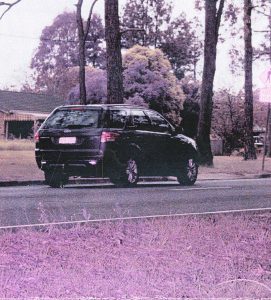
There came in the mail a rare thing – a ‘Go Fast Award’ or speeding fine. In this case, a speed camera captured our Ford Territory in transit on Caloundra Road (off Steve Irwin Way leading into Landsborough). Oh, you know that road too?

The infringement notice alleges the vehicle was doing 68kmh in a 60kmh zone. Fair enough, those are the road rules and I broke them.

“Tch, tch,” said She Who Never Speeds, consulting her diary to confirm that it was me, not she, who was driving at the time the award was made. “You might get in trouble using their photo,” she added.

Their photo my arse!

The speeding fine is $168 and I will also accrue one demerit point on a previously unsullied drivers’ licence. No big deal, you’d think. Alas, this will put a dent in my personal spending money, the next tranche of which is not due until January 1.

You should complain!” said She Who Never Speeds, “What about that money tucked away in your TAB account? Imagine if you were on Newstart!”

I did some homework on the Queensland Treasury offshoot called the State Penalties Enforcement Register (SPER), which will come to an arrangement if you can’t pay fines by the due date.

Debts registered with SPER  come from a wide pool of infringement notices and court orders. Every now and then one of the tabloids will spice up a slow news day with a beat-up drawn from statistics kept by SPER. The most common tactic is to focus on which postcode boasts the biggest SPER debt.

The ‘Struggle Street’ approach uncovers Logan City/Kingston, the Gold Coast and surrounds and Ipswich/Booval as the regions with the highest SPER debt (all-up tally $73.56 million). By stark contrast, the postcode 4468 (Morven, (near Augathella), has a SPER debt of just $7000. The postcode 4025 (Moreton Island) is another with a low SPER debt of $15,000 (people hooning about the sand dunes in 4WDs, no doubt).

The lower numbers in such isolated places may indicate fewer drivers and/or a more law-abiding population. The truth is rather more prosaic – an absence of speed cameras. It is no coincidence that the suburbs with the highest SPER debt are those in proximity to motorways and heavily trafficked main roads.

There’s no way to dress up SPER’s unhappy bottom line. As of October 2017, SPER debts totalled $1.20 billion. Treasurer Curtis Pitt told the ABC in May that SPER debts had doubled over five years to more than 1.5 million new cases. The Labor government has blamed the increase on the previous LNP regime, for loading up SPER debts with unpaid tolls from bridges and tunnels.

You can get some sense of how long it might take SPER to rein in this runaway debt by looking at its collection rate ($283 million in 2016-2017 and $93 million for the five months to October). Nevertheless SPER managed to keep growth of the debt pool down to 3% (compared to 15% in 2015-2016).

If you will allow me to illustrate the SPER dilemma for low-income Queenslanders, consider an unemployed person existing on the paltry fortnightly payment provided by Newstart. SPER will probably settle for $20 a fortnight, automatically taken from the welfare recipient’s payment.

As Harriet (not her real name) bewailed of her most recent speeding fine, “It will take me 10 years to repay all this (expletive) debt and in the meantime I keep getting (more expletives) what you call Go Fast Awards. You smug bastard!”

But wait. While Harriet emulates her pet fox terrier’s habit of chasing its tail, SPER has come up with a new scheme to help people suffering genuine hardship.

From today, Queenslanders facing hardship can apply for Work and Development Orders (WDOs). People unable to repay accumulated fines and penalties will be able to clear their debts by attending counselling or education courses. Previously the only recourse was to perform unpaid community work.

WDO is a case management system which considers a person’s whole debt history and circumstance rather than just focusing on individual debt.

WDOs will be available to people who are experiencing domestic or family violence, are homeless or under financial hardship, or those with a mental illness, intellectual or cognitive disability or serious substance use disorder.

A SPER spokesperson said WDOs would replace the Fine Option Order system, with debts reduced at a rate of $30 an hour. Participants are allowed to work up to 33 hours per month.

SPER will now partner with government and community-based sponsors who will manage people undertaking financial or other counselling, education, vocational or life skills courses, and unpaid community work.

The Community Service scheme was first introduced in Toowoomba in the mid-1980s as an alternative to fines and custodial sentences. Courts order offenders to complete a set number of hours of supervised community work. Those who do not complete their ‘hours’ get breached and are liable to be re-sentenced for the original offence.

The 2016-2017 Attorney-General’s annual report cites examples of the kind of unpaid work offenders may be required to do. In the Southern Region, offenders from Ipswich Probation and Parole can now perform community service making paper or crochet poppies for donation to local Councils and RSLs (for events such as Anzac Day and Remembrance Day).

In the Brisbane region, 17 offenders spent eight days over a period of four weeks repairing and painting the Sandgate-Redcliffe District Cricket Club’s fence. A total of 271 hours was spent working with club members to repair damaged palings and apply two coats of paint to approximately 1km of fencing.

In 2016–17, a total of 371,262 hours of court-ordered community service was completed in Queensland, equating to a value of approximately $9.1 million. While this equates to less than 1% of SPER debt resolved in 2016-2017, the community benefits are hard to dispute. The social merits of WDOs are also laudable, although some would see this as being ‘soft on crime.’

Meanwhile, what about the speeding fine issued to She Who Never Speeds, due for payment by December 19?

If you are one of the thousands of Queenslanders who got caught by a speed camera either exceeding the limit or running a red light, you know how this goes. The ‘ticket’ goes to the owner of the registered vehicle. If he/she was not the driver at the time the alleged offence was committed, the owner fills out a statutory declaration stating he/she was not the driver. If She Who Never Speeds sends the statutory declaration in a week or so before the due date, by the time a new infringement notice is sent out to the driver (me), the fine will not have to be paid until (guessing) the end of January, 2018.

In the interim, I’m wondering if I can wangle an informal WDO with SWNS – we pay the fine out of general housekeeping and I will carry out 5.6 hours of (supervised) heavy gardening. People who know what She once did for a living will find this wryly amusing.


Hobson’s Choice – guide to preferential voting

preferential-voting
Hobson’s Choice – preferential voting sand photo by Bob Wilson

By Laurel Wilson

I wasn’t born in Australia, but I got here as quick as I could, and have been here a long time, having been educated in Brisbane (or at least I went to school and University there.) But I don’t recall being taught anything about our voting system. Perhaps it was considered to be not all that relevant, as the minimum voting age was 21 at the time.

After finishing a Dip.Ed. at the University of Queensland, I eventually landed a teaching job in Stanthorpe – regarded in those days as a ‘hardship’ post, perhaps because it was considered to be a long way from Brisbane and it was rumoured to snow there at times in winter.

As most teachers would have experienced, the newer teachers were generally assigned to what was considered to be the ‘less desirable’ classes – in my case, this included the 9B2E2- Industrial Boys class. I really liked those kids and found them to be intelligent and respectful. We all struggled through sessions of ‘Citizenship Education’, known, it must be confessed, by teachers and students alike, as ‘Shit Ed’, such was the turgid quality of the textbook.

Having to teach the subject did, however, result in my having first to grasp and then explain the concept of ‘preferential voting’ to my class of young boys.

So, dear readers, it has come to this – there’s an election on in Queensland tomorrow to decide whether we’re to have three years of a Labor Government (we will have four year terms from 2020 onwards), or whether the Liberal-National Coalition will resume where they left off nearly three years ago. There is, of course, the possibility that Pauline Hanson’s One Nation may get the nod.

In a system which I understand is particular (some would say peculiar) to Australia, voting is compulsory and elections are decided by a system of ‘preferential voting’, rather than the more common ‘first past the post’ system used in most other countries. To add to the complications, Queensland has reverted to ‘full preferential voting’, rather than the ‘optional preferential’ system used last election. This means that we must now place a number next to every candidate on the ballot paper in order of preference. Until recently, I was unaware that this change had occurred. I suspect this move was done rather quietly in some midnight Parliamentary sitting, but it may have just been the fact that I have, for some time, eschewed reading newspapers and watching TV news.

Those who already have a grasp on our voting system may choose to stop reading now, or continue if you’re curious to see whether someone who wasn’t born here can actually understand and explain the intricacies of ‘preferential voting’….

[For those not living in Queensland, the main parties contesting the election are Labor (incumbents- centre-left oriented, the original ‘workers’ party’); LNP- a coalition of Liberal (not the North American version of Liberal) and National parties (centre-right); Pauline Hanson’s One Nation (further to the right on many issues, populist); The Greens (emphasising environmental and social issues) and Katter’s Australia Party (rural conservatives). Some electorates will also have ‘Independents’- not officially aligned with any party.]

The ‘first past the post’ system of electing representatives has never been the case in Queensland. Preferential voting was introduced here in 1892 – 26 years before Prime Minister Billy Hughes introduced it for Federal elections, including the Senate. The rationale apparently was to allow competition between the conservative parties without risking seats. That worked out just fine, then.

The drawback of the preferential system is that a person can win a seat with as little as 35% or even less of the popular vote, providing there are more than 2 candidates vying for election in that seat. Of course when there are only 2 candidates, ‘preferential voting’ is not really relevant, as one candidate is bound to secure more than 50% of the valid votes on the first count. (I did ask Mr FOMM what would happen if there was a draw – we came to the conclusion that there would have to be a by-election. Any better ideas?)

To give an example of the ‘first past the post system’: – in this imaginary electorate, there are 1000 valid votes cast.

Candidate A from the ‘Let’s Not Party’ party gets 350 votes

Candidate B from the ‘Up the Workers’ party gets 300 votes

Candidate C representing the ‘Treehuggers’ gets 200

Candidate D from the ‘Please Explain’ party gets 125

And Candidate E – an Independent gets 75

If this were ‘first past the post’, candidate A from the ‘Let’s Not Party’ party would win, leaving 650 electors NOT getting their choice of candidate.

Under the full preferential system, electors must vote for all the candidates in the voter’s order of preference – e.g. candidate A was the ‘first preference’ of 350 voters, candidate B was the first preference of 300 voters and so on. A candidate must get 50%+ 1 of the votes to win. In the above example, no candidate has gained 50% +1 of the votes on ‘first preferences’, so that is when ‘second (and often third) preferences’ come into play.

Every valid vote must have a person’s preferences marked 1 to 5 in the above example, as there are 5 candidates. The next step is to count the ‘second preferences’ of the candidate with the lowest number of ‘first preference’ votes. This candidate is then eliminated from the count. In this case, the second preferences of those who voted for candidate E are counted. Say 50 of these go to candidate B and 25 to candidate C

The new count is:

A gets 350 +0    = 350

B gets 300 + 50 = 350

C gets 200 + 25 =  225

D gets 125 +0 = 125

(Candidate E eliminated)

Still no-one with 501 or more, so the 2nd preferences of candidate D are counted and candidate D is eliminated from the ‘race’. 100 people voting for candidate D have marked candidate B as their second preference and 25 have marked candidate A as their second preference

A gets 350 +0    =   350+25= 375

B gets 300 + 50 = 350+100= 450

C gets 200 + 25 =   225+0= 225

D gets 125 +0 =   125- preferences distributed and candidate D eliminated

STILL no-one with 500+1, so the 2nd preferences of candidate C are counted and candidate C is then eliminated from the ‘race’. 100 people voting for candidate C have marked candidate A as their next preference and 125 have marked candidate B as their next preference. (At the risk of losing the plot, but to be completely accurate, I must add that the 2nd preferences of 200 of candidate C’s voters are counted, as candidate C was their first choice, but the 3rd preferences of 25 people are counted, as candidate C was their 2nd choice)

A gets 350 +0    =   350+25=375+100=475

B gets 300 + 50 =350+100=450+125=575

C gets 200 + 25 =   225+0=225 preferences distributed and candidate C eliminated

Finally, we have a winner – candidate B from the ‘Up the Workers’ party is the first,  second (or third) preference of the majority of voters. I guess you could say this means ‘B’ is the least disliked of the candidates, so gets the nod.

So over to you, good Queenslanders. Be sure to vote on Saturday, and don’t forget to number all the squares on the ballot paper to be sure that your vote counts. And in the true tradition of elections, have a polling day sausage in a blanket and be nice to the people distributing ‘how to vote’ cards – they might just come in handy this time.

More reading:


The naked retiree and life in the ‘Lucky Country’

retiree-lucky-country
Retirees on park bench – Image by Just call me Mo https://flic.kr/p/eiewLK

Now that the naked retiree headline has got you in, time to say a quick hello from Stradbroke Island where I am taking a couple of weeks out with family. Today let me introduce you to guest blogger Kathryn Johnston who has a few thoughts to share on how retirees are getting on in the “Lucky Country.” Kathryn wrote this, the first in an occasional series, on New Year’s Day, coinciding with a new pension regime for retirees.

By Kathryn Johnston

This post titled “the naked retiree” is the beginning of a perspective of what is happening in Australia for older Australians. What does it mean to be a naked retiree? It is not about going to Alexandria Bay Beach on the Sunshine Coast or skinny dipping in a backyard pool. It is about the political landscape in Australia and its impost on older Australians. Politicians are our country’s custodians. They are elected to manage our country, our wealth, our health, our future.

As an older Australian I am interested in how older Australians are faring in this “great” country of Australia. Even while I write these words “great country” I ask, are older Australian’s getting a “fair go”? In 1964 when Donald Horne’s book “The Lucky Country” was released most of the populace understood he used the term ironically. Horne penned the words “Australia is a lucky country, run by second-rate people who share its luck.” Over time, others misinterpreted Horne’s message and have used the term “lucky country” to mean we have the best of everything in Australia. In Australia, today, as we live on borrowed money and older Australian’s live on borrowed time we find we are not so “lucky”.

My question is “why are older Australians subject to ‘unfair’ political decisions made law through the parliament, laws that no politician will ever be subject to?” The decisions have been made and older Australians are the target and method for “getting the budget back on track”. The catch-cry is that without the changes to age pension entitlements commencing today – 1 January 2017, the age pension will no longer be sustainable in the decades ahead. Is there another way?

This matter first came to my attention when I was in Tasmania in October. There was an article in The Mercury newspaper titled “retiree battles to stop pension cuts”. Ron Tiltman, 76 years of West Hobart tells how he will be affected by aged pension cuts. From 2017 he is $14,000 worse off a year. For Mr Tiltman he decided to take his superannuation in cash after his partner and former teacher became ill with cancer. After her death, his entitlements under the current rules were he would receive $33,000 a year of her defined benefit superannuation and a part age pension of $580 a year. At the start of 2016 Mr Tiltman’s pension was cut to $270 and as of today, he will not receive any government pension. The Association of Superannuation Funds of Australia (ASFA) benchmarks the annual budget needed for Australians to live a modest and comfortable lifestyle. These are detailed below:

ASFA Retirement Standard   Annual living costs        Weekly living costs

Couple – modest $34,216 $658
Couple – Comfortable $59,160 $1,138
Single – Modest $23,767 $457
Single – Comfortable $43,062 $828

For Mr Tiltman to live a comfortable standard of living, which is what he planned for, he will need a yearly budget of $43,062. Now, under the government changes to the age pension, he must live a more modest lifestyle. As he said “it was implied that it would only be wealthy people affected – this is just wrong. Many of these people (i.e. those affected by the changes) are on very modest incomes and in fact 68% of those affected have a defined benefit income of less than $35,000.” Further, he said “this has hurt me – I’ve paid my taxes and now you see these politicians walking out of their jobs with huge pensions of their own” [1].

On 17 December, 2016 I read a letter to the editor of the Toowoomba Chronicle from Ray Harch who explained how he and his wife’s pension will be cut by more than $130. In his words “a great Christmas present”. If they had purchased a retirement unit at $500,000 they would have been eligible for a full pension but they chose to keep some money aside for unforeseen events as they aged. He questioned why older Australians should be penalised, those who had saved and planned for a more comfortable retirement. As he said the government “while at the same time wasting billions on other, in many cases, stupid programs”.

Then in the Brisbane Courier Mail it was reported that “half of older Australians fear they are ‘financially unprepared’ for retirement with looming pension changes. More than a quarter of Australians aged 55 and over are worried they will not be able to afford food or household bills, new research has shown.”[2]

One of the most telling stories [3] I have read in recent months is from Bob Parry, a pensioner who has more than 60 years’ experience as an accountant. Mr Parry was so angry about the changes he wrote to the Prime Minister, Mr Malcolm Turnbull. Mr Parry did several calculations and found that a single pensioner who had total assets of $541,295 under the “old” rules would receive a part pension of $9,761 per year but under the “new” rules they would lose their entire part pension. Their fortnightly income would drop from $955 to $579 a fortnight. Similarly, a pensioner couple who own their own home with joint total assets of $814,128 under the “old” rules receive $14,065 per year. Under the “new” rules their fortnightly income would drop from $1480 to $939.

Under the Turnbull government, whatever way you look at it, it is a mean-spirited cut for older Australians. Those who have worked conscientiously over their lifetime and gone without, in so many areas, will no longer have a comfortable retirement.

Due to the cuts and changes, many older Australians will soon be “skint” with savings eroded as they dip into their capital. The changes will make every older Australian spend their savings until ALL older Australians are in the same “paupers” pool relying on the full pension and a less than modest lifestyle. The government changes are successful in one area, that is, in penalising “middle Australia” to improve the life of the less advantaged. This is the life of the “naked retiree” – skinned to the bones! Older Australians who depended on and planned for retirement under the “old” rules – living in the “lucky country”.

You can read more on the “naked retiree” and other reflective topics in Kathryn’s blog, Scattered Straws. https://scatteredstraws.com/

Notes

[1] Story by Jessica Howard, The Mercury, Friday, 28 October 2016, p. 17

[2] Story by Monique Hore, Brisbane Courier-Mail, 30 December 2016, p. 18

[3] http://thenewdaily.com.au/money/retirement/2016/09/14/age-pension-assets-test/ – story by Jackson Stiles

Next week: She Who Also Sometimes Writes will have a pre-election piece for your greater edification. Meanwhile, I’m going for another nap.


Wikipedia and the 105-year-old blogger

wikipedia-blogger-carlsson
Dagny Carlsson (aka Bojan) image by Almega – https://www.flickr.com/photos/almega/9206567927/in/photolist-f2xXun-f2y4TM, CC BY 2.0, https://commons.wikimedia.org/w/index.php?curid=51725946

For reasons yet to be linked to Wikipedia, this week I ended up on the home page of a 105-year-old Swedish blogger who goes by the moniker Bojan. I know, it sounds like material for a Nordic noir series. When starting out with the online arts at the age of 100, Bojan starkly rejected comparisons with the ‘100-year-old man who climbed out of the window and disappeared,’ (a popular Swedish novel by Jonas Jonasson).

Bojan’s invariably short pieces reflect on the wonders of daily life that people half her age take for granted. She comments often about the seasons, the weather, old age and being single and alone.

In one recent blog (I found one dated November 5, 2017), Bojan wrote about Swedes who live by themselves. The Google-translate app I suspect renders the English somewhat less fluent than it might be in, say, a Henning Mankell thriller. But you’ll get the drift.

“The other day I read the news that in Stockholm, there are thousands of single-family households, more specifically 380,000 or 40% of the population live by themselves. In the past, there was some suspicion of living alone, but now it is more tolerated. It’s also easier to be single when there are several of them. I myself have been single since 2004 and I think so, of course. It was obviously more enjoyable to be part of a flatness (sic?), but it is pointless to feel sorry for it. Single households are today Sweden’s most common housing form, and nobody thinks it’s something strange. At first, I thought it was pure sorrow to live by myself, but one must get together and live on.”

Bojan started getting together and living on at 100, after buying a computer and teaching herself how to use it. Some of her more recent posts suggest she has become a reluctant ‘cause celebre’ through the conventional media’s fascination with a centenarian who has mastered the online universe. She has done many interviews, appeared on TV chat shows and been the subject of a film, “Life Begins at 100”.

Filmmaker Asa Blanck tracked Dagny Carlsson down and persuaded her to participate in a project which even he admitted was likely to be thwarted by the subject’s death. But no, Dagny turned 105 in May and continues to amuse readers, day by day. (A sequel is planned – the very definition of optimism).

Dagny’s blog is as Blanck found her – “a brusque old lady – all gallows humour”. She promised readers she would not be intentionally nasty but if she ‘trod on toes’, she did not really give a damn, or det kvittar mig, as they say in Sweden. Dagny dreamed of being a teacher when she was young but ended up working as a seamstress. She escaped an abusive first marriage and found love with her second husband, who died when she was in her 90s.

As Blanck observed: “She had managed to rise above her strenuous, grey existence and she had decided she would finally do what she had wanted to do all her life: write.”

Sweden’s blog-readers soon caught up with Bojan’s racey, funny insights and seemingly outrageous behaviour for ‘someone of her age’. For example, she writes about women wearing jeans and how they never did in her day. At 101 she went out and bought a pair of denims.

Ah yes, now I remember how I ended up on Bojan’s blog. I’d been deeply delving into the Wikipedia universe – a free community encyclopedia we writers tend to take for granted. Anyone can contribute, edit or update ‘Wikis’ within Wikipedia. You just need to register as an editor and then be mindful your input will be monitored by a legion of truly vigilant Wikipedia editors. Your input could be as simple as correcting a typo to contributing a new biography of someone you think should have a Wikipedia entry.

One of the things that fascinate me about Wikipedia is the community vigilance which results in entries being updated very quickly. Within hours, it seemed, of the news of Tom Petty’s death, someone had updated his Wikipedia bio, including the premature announcements on social media and the controversy surrounding the timing of Petty’s fatal cardiac arrest.

Wikipedia is essentially a collection of some five million articles in English and another 40 million in 293 languages, all contributed pro-bono by people who care about history, accuracy and detail.

I asked my blogger friend Franky’s Dad if he had ever edited items for Wikipedia. Yes, said FD, a few hundred since 2006. He’d even created a piece about a singer, Bob Wilson. I was momentarily aghast until discovering the latter is a singer, guitarist and songwriter from Pleasant Valley California. Franky’s Dad, aka Lyn Nuttall, maintains a music trivia website www.poparchives.com.au, which aims to find out ‘Where Did They get That Song?’

FD reckons editing Wikipedia is one thing but creating a new entry can be hard yacka, what with their exacting standards for formatting and referencing.

The Listener’s technology correspondent Peter Griffin confessed he was a Wikipedia ‘freeloader’ until deciding to attend an edit-a-thon in Wellington. Events like this were attended by 70,000 people worldwide last year. The main idea is to pick a neglected subject and add to the body of work. There is also a push to correct what is seen as a gender imbalance. Griffin was not confident until encouraged by a veteran Wikipedia editor to “get stuck in and break things”.

The key intention is to keep it factual – not easy in the Trumpian world of fake news and flat-out fabrication. Griffin’s group were on safe enough ground, however, collating biographies of female scientists.

“The seasoned editors smiled knowingly as we fumbled along,” Griffin wrote in The Listener’s September 16 print edition.

“But after a full day, we’d created about 20 biographies of women in science and extensively edited 30 more.

“I’d like to think we increased the sum total of the world’s knowledge.”

Even famous racehorses have a Wikipedia entry. Australian racing’s latest super-horse, Winx, has won 22 races in succession, amassing more than $7 million in prizemoney for her owners. A few weeks back she won the country’s premier race (The Cox Plate), for the third time. No such profile for Regal Monarch, a racehorse with just four wins to its name, put down after falling in race four on Melbourne Cup day.

You’d think tragedies like this (remember Dulcify, 1979), would prompt connections to retire Winx to lush green pastures and make another fortune at stud. But there is an ambitious program in 2018 to race the mare again in Australia and against the best in Europe.

There was even talk she might contest the Emirates Stakes in Melbourne this weekend. But trainers know. Chris Waller last week said Winx would go to the spelling paddock. At least someone other than me could see that Humidor’s fast-finishing second in the Cox Plate did her in.

As Peter Griffin found at the edit-a-thon, only facts are allowed in Wikipedia, and each fact must be backed by a rigorous reference. So seriously is this edict taken, editors this year banned the UK Daily Mail as a source, citing poor fact checking, sensationalism and fabrication.

Additionally, bots continually crawl the Wikipedia site for signs of vandalism (intentional corruption).

So I guess I’ll keep my opinions about Winx to myself, then.


Many issues in unwinnable Queensland election

election-special-maleny-police
Election special: Photo of old Maleny police station by Bob Wilson

In the interests of better community policing and the fact she had just called an election, Queensland Premier Anastasia Palaszczuk made an unequivocal promise.

The Premier, who somewhere in the Courier-Mail’s Monday election coverage recalls winning a Grade Nine competition to ‘help police fight crime’, made a commitment to hire an extra 400 police officers over the next four years. Based on a First Year Constable’s salary (including shift allowances) of $70,820, that’s a $28.32 million promise

We back our police with the resources they want, the powers they need and the pay they deserve,” she told the ABC last Sunday.

Crikey, they ought to send a couple up the hill here to Maleny, where the new $2 million police station in Macadamia Drive (staffed by four police officers), has a roaming brief to cover an area from Maleny out to Palmwoods, Beerwah, Conondale and Kenilworth.

Ms Palaszczuk’s election promise to hire more police comes a week before the 1950s-style police station in Maleny’s main street is sold at auction. The 2,344sqm property, which is zoned Community Facilities, includes an office/police station and a residence but excludes a separate lock-up.

On my calculations, this sale alone should provide the Queensland Police Service with enough money to pay the salaries of an extra 21 police officers (over four years).

Against my better judgement, I bought the election special edition of The Courier-Mail on Monday after a three-year hiatus, prompted by a series of inflammatory, misleading and discriminatory front pages. Monday’s page one was no less lurid, presenting unflattering caricatures of the three main party leaders.

I worked there in the broadsheet days, pre-tabloid, pre-redundancies, pre-online editions, four editors ago. No regrets, Coyote, as Joni would say. I entered my 70th year on Monday, BP 120/80, feeling OK and supremely relieved I had no part to play in the CM’s graphics-laden presentation of an unwinnable election.

The first two pages of the CM’s October 30 election special purport to sell us the idea they have the State’s media covered. In what amounts to a two-page ‘house ad’, the CM confirms what we already knew – Rupert Murdoch’s Queensland media empire owns almost all of the print media titles. So yes, they have it covered, but you’d expect the coverage to be suitably mainstream; about 9% of the eleven-page election coverage was set aside for stories about the Greens and how they hope to win three seats, including Deputy Premier Jackie’s Trad’s seat of South Brisbane. It appears (from vox pops interviews), that some people in West End will be voting Green because of over-development (apartments) in the inner city suburb.

The rest of the coverage focuses on the resurgence of One Nation, how Labor will suffer from its seemingly intractable position on the Adani coal mine (no mention that the LNP are all for it too), a token story about the Katter Party and proportional space for (most of) the party leaders to have their say.

So to the unwinnable election

There’s a fair chance no single party will emerge from the November 25 poll with a workable majority, so in this sense it is unwinnable.

Crikey’s Perth-based election analyst, Poll Bludger, quoted ReachTEL polling figures from September showing the LNP with a 52-48 lead on primary votes. One Nation was polling at 19.5% and Greens at 8.1%.

An earlier Newspoll had Labor on 37% and the LNP on 34%. Some of you might take this to mean that the two parties will take 71% of the primary vote. This is roughly in line with election trends around the world where one in three people did not vote for one of the major parties. This leaves the unallocated 29% to be divided up between the Greens, One Nation, Independents, minor parties and the 2% of the electorate who cast informal votes.

The poll numbers, which focus only on primary votes, are not worth much in light of the return to compulsory preferential voting (CPV). To the uninitiated, this means numbering your preferred candidate 1 and then others in order of preference (meaning the party you like the least goes last). So if no single candidate has a clear majority, second preferences of the party that polled the least number of votes are counted until a winner emerges.

Many people do not understand preferential voting, so when handed a how-to-vote-card at the polling booth, they simply fill in the numbers as suggested (or number all candidates 1 to 6 consecutively, which is known as the “Donkey Vote.”)

An Australian Institute poll last year found that only 29% of respondents knew how to correctly fill in the (preferential) Senate ballot paper. So that is not a good sign for the re-introduction of compulsory preferential voting at this election. As Griffith University’s Paul Williams pointed out (in the CM), the Australian Electoral Commission is yet to conduct an information campaign to ensure CPV is clearly understood.

University of Melbourne honorary associate Adrian Beaumont has more to say about polling and CPV in The Conversation.

The Sydney Morning Herald suggested on Monday that the return of full preferential voting and new electoral boundaries could hand One Nation a balance of power role.

Enter stage right, former Senator Malcolm Roberts, booted out after a High Court decision found he had not renounced his British citizenship.

By challenging the seat of Ipswich for One Nation, Mr Roberts, best known for his climate change conspiracy theories, could attract enough LNP second preferences to win the seat, the article suggests. (I would go ‘aarrgghh’ at this stage but that would be editorialising).

ABC election analyst Antony Green told the SMH Roberts faced an uphill battle.

“It would be highly surprising if One Nation won there on first preferences, which would mean they would have to come from behind on LNP preferences,” he said.

Ipswich West was more likely to fall to One Nation, he said, adding that One Nation also had a good chance of winning the neighbouring seat of Lockyer.

Ipswich was where Pauline Hanson originally built her One Nation party in the 1990s. Should Roberts prevail, he is being tipped to lead One Nation in Queensland. What was that about the Lord Mayor’s show and the dust cart?

On latest polling, One Nation at 19.5% would seem to be in a strong position to win seats in Queensland and maybe also control the balance of power. A scary notion for some, but you have to give credit where it is due: Pauline Hanson has found the ear of disgruntled voters, much as Donald Trump wooed that endangered species US filmmaker Michael Moore called ‘angry white men’.

In Queensland, the angry, the poor and those who feel forgotten are listening and Hanson tells them what they want to hear.

There is only one certainty about the Queensland election, whoever cobbles together a coalition from this mess will have a mandated four years in which to rule – that’s 208 ‘Fridays on our minds’…#aarrgghh

House Concerts 2018

Yes, well will be having another series of house concerts in 2018 with the first date in February yet to be confirmed. Our guests in 2017, including Brad Butcher and Kelly Cork, Cloudstreet, Kieran Halpin and Gone Molly attracted full houses. Enjoy the short video from the Gone Molly concert and check back here in January for an update.

The Goodwills

[embedyt] https://www.youtube.com/watch?v=cdYyqZer0wM[/embedyt]


Dawe, Morrow and Gessen – Satire and The Rise Of Populism

Dawe-satire
Satirist Bryan Dawe (left) and comedian Julian Morrow at Integrity 20. Photo by Frances Harper

Actor/satirist Bryan Dawe has such a low-key, laconic approach to ‘giving a talk’ that the journalistic instinct to take notes deserted me. Dawe is the surviving half of the satirical act Clarke & Dawe, but he is much more than that. He told the audience at Griffith University’s Integrity 20 Summit that when it came to political satire, he and John Clarke had never been short of material over 25 years of producing their weekly TV show.

Dawe introduced one of his best-known satirical characters, boozy retired judge Sir Murray Rivers QC; Dawe as interviewer/straight man to Sir Murray’s confused bigot. His presentation was funny; funny and sad, as he often referenced his late partner in satire John Clarke, who died in April this year. Dawe’s ‘talk’ would have been illuminating for the year 11 and 12 students attending Integrity 20, as Dawe summarised his unhappy days at school where he left early after being told by a careers adviser he would not amount to anything because he came from the ‘wrong postcode’.

Dawe joined Julian Morrow of The Chaser and The Checkout for a discussion on satire, comedy and how to know when you’ve gone too far. When asked that question by panel chair Rebecca Levingston, both agreed that nothing was off limits.

While agreeing that one could satirise and make jokes about anything, Morrow conceded that The Chaser’s skits post-9/11 were “too soon”. Levingston prompted Morrow to revisit the time The Chaser (a TV satire show), penetrated security at the 2007 APEC conference in Sydney with a fake motorcade transporting a ‘Mr bin laden of Canada’. As Morrow recalled “We never expected to succeed.”

Both satirists agreed that there are powerful people who always try to have good satire shut down, probably because nothing is funnier than the truth, greatly exaggerated. The trick, said Dawe, was not to engage with critics, trolls and others whose power base was being diminished by The Chaser’s sharp sketches or by John Clarke’s familiar introduction: “Thanks for having me, Bryan.”

Bryan Dawe’s presentation was the ideal tone for Integrity 20’s afternoon session, which followed serious and at times contrary debate about hate speech, free speech, censorship, the global rise of populism and how to destroy democracy.

Masha-Gessen-populism
Masha Gessen, photo by Bengt Oberger, Wikipedia CC

You may have heard Richard Fidler on Conversations interviewing Masha Gessen, an exiled Russian American journalist and author. Her speech ‘How to Destroy Democracy’ and later contribution to a panel discussion on populism was a highlight of Integrity 20.

New York-based Gessen outlined the seven lessons in ‘imagining the worse’, in which the rise of populism destroys democracy. These include destroying the sense of participation, conspiracy myth-making, and engaging in the ‘forever war’, (which in the US means a 16-year war against ‘terrorism’, an unidentifiable foe, with no end point in sight).

Gessen, an outspoken critic of Donald Trump, also referred to the way democracy could be destroyed simply by degrading language.

“Trump is a master at that. He lies and lies to convince you that something that’s not true is true. There’s no way for a journalist not to quote his lies.

“Trump says he’s the subject of a witch hunt when that’s the opposite of what he means. He creates word salad and makes it difficult to work out what it all means. It’s a direct assault on how we all live because language is the main tool we use to co-exist.”

Even while Gessen was articulating this I was thinking about former PM Tony Abbott’s ludicrous comments about goats, volcanoes and climate change. However daft the comments seemed, journalists had no option but to quote what he actually said at a climate conference in London.

As Ricky Gervais said this week in a thought-provoking tweet:

Some opinions are so stupid they hurt my feelings. But that’s my problem. It’s a person’s right to hold as stupid an opinion as they like. (@rickygervais):

A panel discussion followed on the global rise of populism. Panel chair Luke Stegemann summarised the rise of populism in countries including Italy, Poland, the UK, France and Germany. “Australia is not immune by any means,” he added, citing the resurgence of Pauline Hanson’s One Nation and how it taps into the frustrations, racism and bigotry of people who are angry about immigration and furious about globalisation and the perceived impact these issues have on their jobs.

One ought to keep in mind that populism − a movement for the people and against a privileged elite − can occur across a broad political spectrum. It is possible, as panellist Geoffrey Robertson QC observed, to have left-wing populism.

The origins of populism date back to the 1800s when rural peasants revolted against their robber baron landlords. Today it is more about polarising the electorate and pitting angry poor people against (poor and possibly angry) immigrants and asylum seekers.

The privileged elite seem to survive with wealth intact, whichever way the populist wind is blowing.

Rachel Kleinfeld of the Carnegie Endowment for International Peace said the common perception was that supporters of populism are racists and bigots.

“There is a racist fringe but the core of populism is about high inequality and why people don’t understand why politicians don’t listen.”

Geoffrey Robertson said young people were disenchanted about the rampant capitalism that democracy encourages. This was in response to Kleinfeld’s comment that only 52% of people aged 18 to 29 think it is preferable to live in a democracy. Robertson said the key threat imposed by populist leaders was the attempt to replace an independent judiciary with their own people.

Kleinfeld made comparisons between Donald Trump and outsider president Andrew Jackson (1828-1834), who enjoyed two terms and put his successor, Martin Van Buren, in place to ensure 12 years of a populist government.

The Atlantic made much of the Trump/Jackson similarities.

“Jackson, like Trump, won over many white working-class voters, who brushed aside critics who warned that he was unstable and a would-be dictator. He maintained their loyalty even though, like Trump, he was of the elite.”

I can’t recall who started it, but it seemed all panellists agreed that Trump, despite being widely reviled, would easily take another term in office. They didn’t say so, but it seems obvious that Trump has a like-minded and seemingly un-impeachable successor in Mike Pence sitting on the bench (wearing a Martin Van Buren t-shirt).

If you were not yet confused about populism and its multiple meanings, Cas Mudde, a professor at the University of Georgia, coined the phrase “thin ideology”. This means to merely set up a framework: pure people versus a corrupt elite. Thin ideology can be attached to all sorts of “thick” ideologies such as socialism, nationalism, anti-imperialism or racism.

I will leave it to the reader to decide what type of populism exists in Australia.

Monday I’ve got Friday on my mind

I leave you with a tribute to the late George Young, who co-wrote the song from which this essay takes its name. Young and co-writer Harry Vanda and their band The Easybeats had an international hit with Friday on My Mind in 1967. Here’s a terrific cover from Richard Thompson and band from the album 1000 Years of Popular Music. (Please don’t listen to the Bruce Springsteen version that comes up after that…Ed)