
When you go to vote tomorrow, be thankful we live in a democracy where we have freedom (up to a point) to choose who leads us.
Think about the 52 nations which are not a democracy. They are run either by a dictator or an autocratic regime. Within the borders of these countries, the general population has no say at all. In almost all those nations there is no free and independent press. Troublesome journalists are murdered or, more commonly, jailed. The 2021 World Press Freedom Index compiled by Reporters Without Borders (RSF) shows that journalism is completely or partly blocked in 73% of the 180 countries ranked by the organisation. RSF keeps a running tally of journalists killed since January this year: (26 journalists and two media workers) and 461 journalists and 18 media workers who are in prison for doing their job.
Safe to say these scribes were just trying to get the word out from one of the 52 nations that don’t have a democracy. They include China, North Korea, Myanmar, Afghanistan, many Middle East Kingdoms and a host of African countries. The 2021 survey by The Economist’s Intelligence Unit says that only 6.6% of the world’s population lives in one of 21 “full democracies”.
Australia operates under the Westminster system of democracy, that is, we’re not a monarchy, but the British monarchy plays a role. Just how much of a role was demonstrated in 1975 when the Governor-General John Kerr sacked the sitting Prime Minister, Gough Whitlam.
Every Australian citizen aged 18 and over (with the exception of prisoners serving over 3 years and those of ‘unsound mind’) gets a vote (voting is compulsory in this democracy), and a rigid system of checks and balances aims to stamp out cheating.
The electoral roll closed last month, so these figures are current: 17.793 million eligible voters (96.8%) will go to the polls. If you were wondering, the Australian Electoral Commission (AEC) estimates there are 564,240 Australian who are eligible to vote but are not on the roll.
Think about that for a moment.
The main advantage of compulsory voting is it allows certainty about the voter turnout and ensures there’s enough of everything to go around. It also means the Democracy Sausage* providers can estimate stock with minimum wastage.
Our election results are muddied by a confusing system of preferential voting. Rather than the first past the post system preferred by the US, UK, New Zealand, Canada and others, voters must number their choices by preference. If you don’t, or otherwise muck up the ballot paper, your vote will not be counted.
This farcical system forces rabid voters of the right and left to apportion part of their vote to a party they wouldn’t point the garden hose at if it were on fire. So rather than choosing the party/politician of your choice, voters must number other candidates in order of preference. When votes are counted, the distribution of preferences can be crucial in a tight contest.
The preferential voting system was introduced in the 1920s by Billy Hughes during the formation of the Country Party. Hughes saw it as a means of avoiding the two conservative parties splitting the vote (to the benefit of Labor).
This example collated by the ABC demonstrates how the preferential system can deliver unexpected outcomes:
“The Corangamite by-election on December 14, 1918 was the first Federal poll conducted under the new system. Previously, voting had been on a first past the post basis.
In a field of five, Labor led on primary votes. Future Labor Prime Minister James Scullin polled 42.5% of the vote. But a tight exchange of preferences between four competing conservative candidates saw Scullin’s vote rise to only 43.7% after preferences. The Victorian Farmers Union candidate came from 26.4% on primaries to win with 56.3% after preferences.”
(Ed and Scribe disagree on this point. Under the ‘first past the post’ system, a person can be elected even though the majority of voters didn’t vote for them Eg say there are five candidates in an electorate. Candidate A gets the most ‘first past the post’ votes with 37% Candidate B gets 35%, C, D and E the remainder. So ‘A’ wins, even though 63% of voters didn’t want that candidate and nearly as many preferred ‘B’. Under the preferential system, the winning candidate will be the one who gains the most first preference votes, combined with the second preferences of the unsuccessful candidates, meaning most people end up with their first or second preference as their representative. If this is clear as mud, you weren’t paying attention in Citizenship Education classes…)
If that seems wrong to you, that is the system we have inherited.
Consider the vote counts for the 2019 election. On a two-party preferred basis (after preferences are distributed), the Liberal National Coalition (LNP) received 7.34 million votes, a 51.33% majority against Labor’s 6.90 million votes (48.7%). It’s not often emphasised, but Australia’s Green party took just over 10% of the popular vote in 2019, amassing some 1.47 million votes. While the Greens still have only one Federal member, the party has nine seats in the Senate.
Australia’s best-known election analyst, Antony Green, said this about preferential voting, apropos the 2019 surprise result (polls had consistently said the LNP would lose):
“For all the talk of preferences deciding elections, in the end who wins depends more on whether Labor or the Coalition have the higher primary vote,” Green said.
“In the last two decades, Labor’s first preference support has trended down largely because of the growth in Green (party) support.”
Earlier this year Mr Green published a graph which illustrates the influence of preferences on election results.
The other factor which sways election results in this geographically vast and relatively under-populated land is electoral boundaries.
Our electorate, Maranoa, is impossibly large – almost 730,000 square kilometres – encompassing 17 Local Government Areas. The electorate is so large we have seen little of the Labor candidate, given that he lives in Barcaldine, about 1,000 kms North-West. The result is academic, apparently, with the seat being held by conservatives since 1943. Federal MP David Littleproud looks set for another term in Parliament, despite having to wrangle an electorate three times the size of Victoria.
Contrary to popular myth, political parties don’t redraw electoral boundaries. This task is carried out by the Australian Electoral Commission to maintain the concept of ‘one vote, one value’. Boundaries are frequently re-drawn in physically large states (Western Australia, New South Wales and Queensland) as their populations shift and grow. On a Federal level, the same thing is done to ensure each State and Territory has seats in the House of Representatives in proportion to their population.
The one issue that has had little or no coverage in the election campaign is the apparent desire on both sides of politics for Australia to become a Republic.
Yes, I know we had a referendum in 1999 and the motion was defeated, but successive polls have shown political support for Australia to become a Republic (but not in Queen Elizabeth II’s lifetime).
I’m not suggesting that Bill Shorten’s stance on this topic contributed to his defeat in 2019, but he was on record as saying he would have held a plebiscite if elected in 2019. While Labor and the Greens support Republicanism, there is also support within conservative parties. We should not forget that the 1999 referendum was driven by one Malcolm Turnbull, who 16 years later served one term as Australia’s (Liberal) Prime Minister.
While your imagination is reeling at the thought of President Albanese, President Morrison or President Wong, you could donate a couple of dollars for your Democracy Sausage on the way out of the polling booth.
I’m not sure what happens in other democracies, but down here local community groups like Lions, Rotary, school P&Cs and such run barbeques at polling booths and offer voters a sausage on a bun or a piece of (white) bread.
I’d make two observations about this: 1/ the aim is to donate money to a good cause; 2/ you don’t have to eat it.
But it’s an Aussie tradition, eh, like two-up on Anzac Day and wrapping yourself in a flag on Australia Day. Who am I to put a dampener on that?
#bobforpresident
FOMM back pages

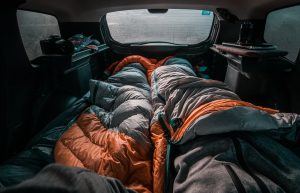




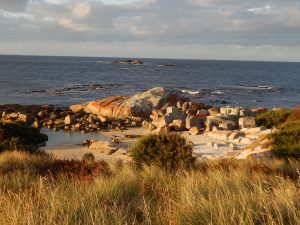

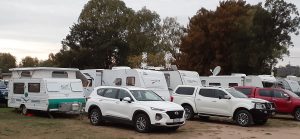
 Sometimes we come across quite an impressive ‘free camp’ – the one at Wyalong being an example. There was plenty of room as well as some interesting displays such as a reproduction miners’ hut. We stopped there for a lunch break on our way to Narrandera. This area is in the ‘Bland’ shire (named after an early European settler, rather than a description of the surroundings). Someone there has a sense of humour, as they have combined with the town of ‘Dull’ (a village in Scotland) and ‘Boring’, which is in Oregon, to form the ‘League of Extraordinary Communities’) Their slogan was ‘Bland- far from Dull and Boring’.
 Our Ferry ride to Tasmania wasn’t until the next evening, so we had a whole day in Melbourne to do some sight-seeing. We were rather thrilled to have a celebrity tour guide. Margret RoadKnight took us first to the Van Gogh installation. This had been to Brisbane, but we didn’t see it there, so it was a treat to experience it in Melbourne. Several of his paintings were projected video style along the walls of the exhibition space, interspersed with information about his life. Van Gogh sold very few of his works during his lifetime, but he said he was sure that one day his paintings would be worth more than the cost of the canvas and the paints he put on them. Very prophetic of him.
 Next morning saw us in Devonport. We took a slow drive to Stanley, stopping at Ulverstone for breakfast and at the little town of Penguin, where Bob posed for the obvious photo alongside the giant penguin statue. Stanley’s main feature is ‘The Nut’, a large flat-topped rock – remnant of some ancient volcanic activity. There is a walking track to the top, but we were satisfied with walking half-way up the very steep track, stopping several times for photographs (or to catch our breath – probably the latter). There is a chair lift to the top too, but it was not operating on the day because of the strong wind gusts. I suspect I may not have partaken of it at any rate.
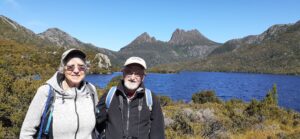
 We were in Tasmania to do some walks, so walk we did – around the circumference of Dove Lake. This is classified as a grade 3 walk, so quite do-able for the average person, but I wouldn’t say it was a walk in the park (Ed: bahaha). Actually we were pretty fatigued by the time we got to the end and hopped or staggered back on to the bus to take us back to the campsite. Groans on getting aboard the bus were fairly common, so I didn’t feel too conspicuous.
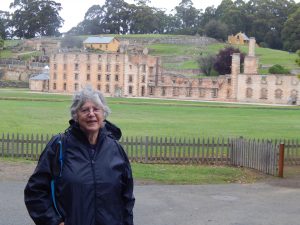
 From there, it was on quite a scenic route to Strahan, a fishing port on the West Coast of Tasmania. It is also a major tourist attraction, as it is from there that tourists can catch the boat trip up the Gordon River. It was another beautiful late summer/early autumn day with barely any wind and a very smooth sail on the large passenger boat. Definitely a ‘must do’ if you’re touring Tasmania. The cruise included a passage through the narrow ‘Hell’s Gates’ – named either for the difficulty of the passage in a sailboat and/or the feelings of the convicts transported to the notorious Sarah Island penal settlement. On the way to Sarah Island, we passed several Salmon and Trout ‘farms’ anchored in the harbour. The ecological wisdom of these has been disputed, particularly by famous author Richard Flanagan whose title for his work about the salmon farms is ‘Toxic’. Sarah island has some very good interpretive signs indicating the original buildings that are now in quite deteriorated condition. The cruise included a stroll through remnant rainforest – trees of such ancient lineage that their ancestors grew before birds were part of earth’s ecology. A silent forest.
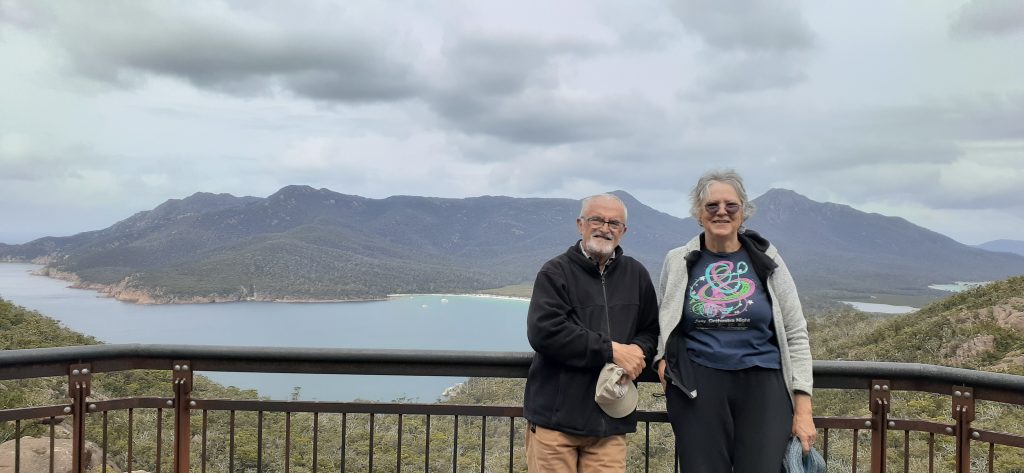
 The two hour walk at Lake St Clair was well worthwhile and not quite as challenging as the Dove Lake walk. Fewer tourists too, which made bird-watching more feasible. Birdlife was plentiful, but not co-operative with the amateur photographer, so no photographic proof. I did get a photo of the Tiger Snake which was lying curled up near the walking track. Tassie’s Tiger Snakes are black with pinkish bellies, similar to the mainland Red-Bellied Black Snakes, but the former are reputedly much more aggressive and toxic, so we were glad this one appeared to be pretty sleepy!
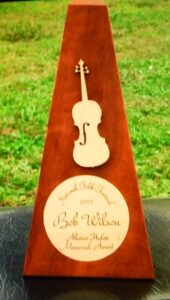
 Bob Wilson’s song, When Whitlam took his turn at the wheel, is the 2022 recipient of the Alistair Hulett Songs for Social Justice Award.