Impressions of Tasmania Part 2

impressions-tasmania-two
A lucky sunset shot coming in to Port of Melbourne

If you have a yen to go to Tasmania, here’s three key pieces of advice. Go in spring or autumn, take clothing and footwear for all seasons and, most importantly, allow more time than we had (18 days).

I’m taking up the travelogue as we arrived for three days in Hobart (having arranged to drop our car into the dealers to troubleshoot a faulty sensor). We checked in to the Hobart showgrounds, a spacious complex close to the city.

After luckily finding a good ‘local’ breakfast cafe in the city, we set off on a day tour of Hobart. The double-decker bus found its way into some tight spots (a lookout at Battery Point). Our driver informed us that Battery Point has the country’s most expensive real estate (per square metre). We spent an hour at the Royal Tasmanian Botanical Gardens, a compact but very beautiful oasis with a Japanese garden (and an ice cream van we didn’t manage to find). We went to the Cascades and heard all about an early settler, Peter Degraves, who had a plan to use the crystal clear water from the Cascade springs to build a brewery.

impressions-tasmania-two
Cascade Brewery (est 1883)

He formed this plan while doing time in Hobart gaol for fraud. On his release in the early 1830s he set about building the Cascade Brewery, which is still operating, producing beers and non-alcoholic beverages. It is not only a working brewery but a tourist attraction.

In the afternoon we headed off on a catamaran which took us to one of Hobart’s modern curiosities, MONA (Museum of new and old art). The catamaran ride was splendid, sailing at speed under the Tasman Bridge, catching sight of Australia’s $529 million icebreaker, Nuyina, which is based in Hobart. (Ed: The boat ride was nice – MONA was pretentious, IMHO)

Saturday was a day of highlights. First a day trip through the beautiful Huon Valley to Geeveston where friends introduced us to a gourmet café, The Old Bank, which serves local game dishes. Go there! In the late afternoon we set off to Rosny, which is a nearby suburb of Hobart where songwriter Fred Smith was performing that night. Fred recruited a local band to present his latest concert about Afghanistan, which includes the evacuation of 4000+ people with Australian visas from Kabul Airport. It’s a harrowing audio-visual presentation with images, videos and Fred’s narration, coupled with his insightful songs about Afghanistan and Afghans.
impressions-tasmania-two
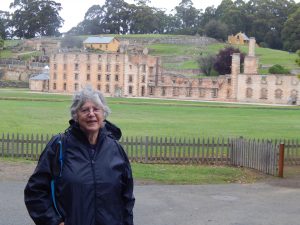
Laurel Wilson at Port Arthur

On Sunday we set off for Port Arthur. Like all road journeys in Tasmania, the distances are short but the roads require more careful, slower driving than we are used to on the mainland. I’d not been to Port Arthur before, but the ruins of the convict colony are evocative and the guides are knowledgeable. This is one place where you could spend an extra day, as the ticket to the historic site is also good for the following day. There’s such a lot to take in.

On balance, our colonial forebears treated convicts as brutally as they  slaughtered the indigenous people of Tasmania. The cat of nine tails, which was traditionally steeped in sea water so crusts would form on the knots, was a particularly barbarous instrument of punishment. It was not uncommon for convicts to receive 100 lashes. Some of them died as a result. It’s not hard to conjure up the atmosphere when this place was home to 2,000 people, including 1,200 criminals we’d call recidivists (re-offenders) today.

From Port Arthur we drove up the fabled East Coast with its scenic wonders and wildlife. On advice from a friend we stopped at Eaglehawk Neck, a narrow isthmus containing another convict relic. An officer’s garrison was built at Eaglehawk Neck to capture convicts trying to escape Port Arthur. The Dogline at the narrowest part of the neck is where a line of ferocious dogs patrolled to prevent convicts escaping. We also took in a couple of spectacular blow-holes which are common on the Tasman coast.

Mayfield Beach Conservation Area, east coast Tasmania

We were aiming for Swansea but accidentaily ended up at a lovely free camp at Mayfield Beach. The Mayfield Beach Conservation Area was quite popular but we managed to manoeuvre our van into a site under some trees. It was right next to the road but after 7pm there was so little traffic it was not an issue. The park is maintained by park rangers but is in fact a scenic reserve. There are loads of places like this around Tassie and the best part is that, unlike a lot of Queensland free camps, you can stay for 2, 3 or even 4 weeks. (The Mayfield Beach camp sign says in small letters that merely moving to a different site after 30 days is not permitted).

Next day we did tourist stops at Kate’s Berry Farm, a popular place for people who appreciate good coffee and blackberry jam. Then we went to a strange place called Spiky Bridge. It is part of the infrastructure built by convicts with the aim of thwarting overland escape from Port Arthur.

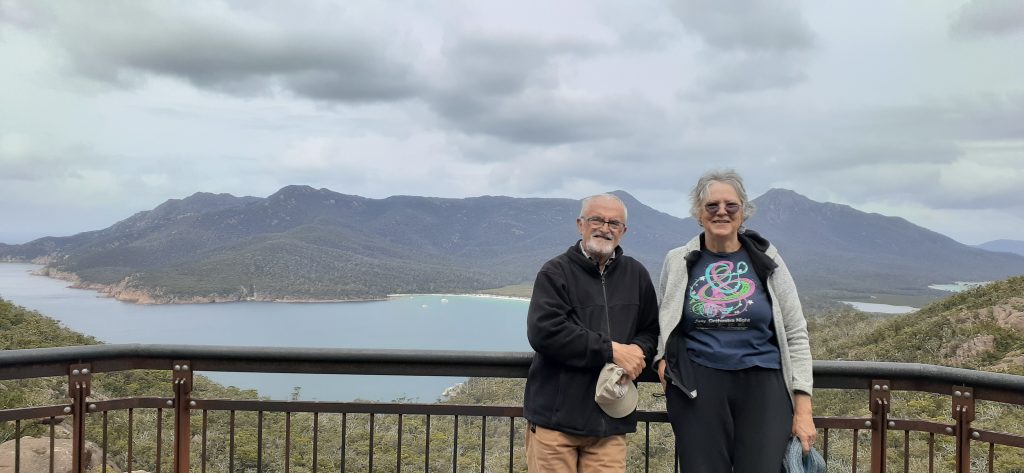
Later we took the steep walk to the lookout at Wineglass Bay, admiring the young couple who took a two-year-old girl and a baby in a backpack to the top and back again. Those kids will grow up loving the wilderness and never know why. The mother took our photo up there, while we were trying hard to look as if we had got our breath back, given the so-so cardio fitness of a pair of 73-year-olds. Friends who have done this walk in the past tell us it used to be a rock scramble to the top. No fancy lookout and safety barriers then.

A Tasmanian devil, posing ever so nicely

We stopped the night at Bicheno at a caravan park because the Coles Bay national park camp site was full. The bonus was we could spend a good few hours at Natureworld, with its well-stocked aviaries, local fauna and a disease-free colony of Tasmanian Devils. We got there in time to watch these ugly critters fighting over a kangaroo tail. Been there, got the T-shirt. (Ed: they were a bit cute – like a Staffie!).

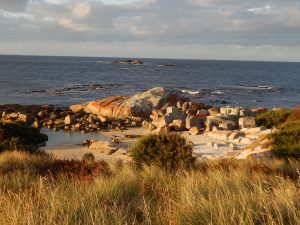
We ended up staying in a caravan park again at St Helen’s when, if we’d thought about it, we could have travelled into the Bay of Fires and stayed at one of the many free camps on the beach. Ah well. We had a jolly fine day trip including a walk along the beach from Walsh’s Lagoon. You can walk the whole 11km from Binalong Point to Eddistone Point along the the Bay of Fires. The walk is mainly along the beach but the trek implies a bit of organisation in a group with a car at either end. Bay of Fires is distinguished from other beaches by its orange granite rocks (the colour is caused by lichen. There are also ancient middens along this trail, evidence of indigenous settlement. We reached the northerly terminating road (The Gardens) near sunset which is the right time to be there although there was a bite to the wind.
impression s-tasmania-two
Bay of Fires at sunset

We got chatting to a guy with a vintage Chev truck built on a Holden chassis with a V8 engine. He was on his way to a hot rod rally at Ulverstone near Devonport. The things people spend money on, eh!

Next day we set off on a hilly winding road to Scottsdale, stopping along the way at the Pyengana Cheese factory (recommended) where we had freshly made scones with home-made butter and cream. We bought our rellies some cheese to go with their Huon pine cheese board.

From there we drove on to one of Tasmania’s famous short walks – St Columba Falls. It is a short, east walk apart from a bit of downhill to the lookout. Because Tassie’s been in a drought the tallest falls in the State were not roaring like they usually do. but spectacular none the less.

The 15 minute walk goes through myrtle and sassafras groves with an under story of ferns, moss and fungi. Later on the drive we stopped at Weldsborough to check out an ancient myrtle grove with the ubiquitous understory of moss, fungi and ferns, Very dark and prehistoric.

impressions-of-tasmania-two
Old growth forest in north-east Tasmania

Not everything in Tasmania looks like that. Earlier in the day I tried (and failed) to take a ‘Tasmanian Mullet’ photo – where the lower slopes of a steep hill had been clear felled for pasture, leaving forest remnants clinging to the top, like a monk’s tonsure.

The hilly drive to Scottsdale, east of Launceston, goes through the town of Derby which has become famous among mountain bike enthusiasts. There are several bike shops there which hire bikes and take riders in tour buses to the many organised trails through the hills.

We stayed at a free camp in Scottsdale, Northeast Park, which is named after George Northeast who first established a community pool and reserve there in the 1930s. The project was taken up again in the 1980s by the local Lions group who did a lot of work establishing picnic facilities and tracks for walkers and cyclists.

On our way to Devonport we stopped in at Sheffield, known as the town of murals, to catch up with friends. Saturday morning we queued to board the Spirit of Tasmania for a day voyage. The thoughtful people at Devonport provide a toilet for people sitting in their cars waiting to board. Four stars! And five stars to Bass Strait which turned on one of its swell-less days for a smooth voyage. We arrived in Melbourne at 8.30pm and then navigated our way through the suburbs to a caravan park in Coburg. (Ed: night driving on a Melbourne freeway not recommended when towing a van). t was the weekend of the Grand Prix so the van park was full and it took a while to sort out where we were supposed to park. But by 9.30 were set up – exhausted and ready for bed.

The journey home was Melbourne to Albury, then to Cowra which has a Japanese prisoner of war cemetery and a Japanese garden. On to Dunedoo where we ran into friends who were on their way to the National Folk Festival. Somewhere along the road I got a call from well-known folk singer Bob Fagan to say that my song, ‘When Whitlam took his turn at the wheel’, was this year’s recipient of the Alistair Hulett Songs for Social Justice award. It was presented at the National Folk Festival’s closing concert (in my absence). My songwriter friend Ross Clark who accepted the award on my behalf, has since been sending me photos of the award (like a garden gnome) posed in various locations as he travelled back to Brisbane.
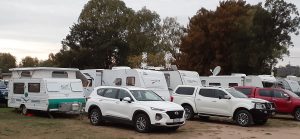
Ready,set…

I’ll leave you with this image, from Cowra Showgrounds, with a flotilla of road rigs (ours on the left) lined up ready for a 5am getaway. These are just a few of the 800,000 registered recreational vehicles on Australian roads. As the ABC reported this week, those on the road include families seeking lifestyle changes and ditching the school system after lengthy pandemic lockdowns and restrictions. Many are on the road permanently, both for reasons of lifestyle and necessity (more on that next week).

So that’s our land and sea return journey to Tasmania, some 6,500 kilometres in 30 days. Now you know why we needed to shout ourselves a night at Armidale’s Moore Park Inn and dinner at Archie’s restaurant on the last night. Hang the expense.
(all photos by Bob & Laurel Wilson)

PS: Last Saturday I got a call from an 03 number. I ignored it, as you do, but the number left a voice mail. It was a friendly young woman from TT-Line Company, better known as the Spirit of Tasmania. Had I lost anything on my recent holiday, Sally asked? ‘Ah, yeh, I still haven’t found my teblet’, I said, realising that when I’m anxious I revert to Kiwi. After a few key questions (make, size, colour), Sally asked for my pass code. It must be a different one to the one I use at home because it wouldn’t open. Not to be thwarted, Sally asked me if I had another email address (I do). I deduced she’d spotted my Gmail address when she tried to turn it on. I’m expecting it back any day now.
 

Impressions of Tasmania Part 1

impressions-tasmania-travel
Trying to get our breath back at the Wineglass Bay lookout, eastern Tasmania.

As promised, the new few weeks will recap our month-long sojourn from Warwick to Melbourne then Tasmania and the return trip. Enjoy the respite from the hostilities of the election campaign. This is a special edition (longer than usual – a 5-minute read).

Before the memory of our lovely trip fades, we thought it would be good to jot down some of the highlights.

Not that we’re superstitious or anything, but we left it until the day after the Ides of March to set off on our month-long trip to Tasmania and back.

The first night was spent at one of our more familiar camping spots – the Goondiwindi Showgrounds. It’s only about two hours from Warwick, but we didn’t want to do a long drive on the first day. In fact, most of our drives were less than 350km in a day, and even less than that in Tasmania, where the roads are often quite winding and hilly.

When caravanning, our preferred stop-overs are generally Showgrounds campsites, as they are less formal than standard Caravan Parks as well as being quite a bit cheaper (around $20-$25 for a powered site). The nights were often quite chilly, so it was good to be able to plug in our little fan heater. We do brave the occasional ‘free camp’, but they are usually fairly primitive, with toilets only and no showers.  Next stop Narrabri and another Showgrounds campsite. We stopped off at the Visitors’ Information Centre, usually a ‘must do’ when travelling to a new place. There was a video running there showing some of the local Aboriginal people with interesting tales to tell. We also knew of a good ‘birding spot’, birding being one of our interests when on the road.

The townspeople had developed a large artificial lagoon and wetlands in the 90s and the area now attracts a variety of birds – the more common (to us, anyway) Wood Ducks and Corellas, but also large Spoonbills and Herons ‘fishing’ in the shallows.

We drove to Coonabarabran the next day but didn’t go out to the Warrumbungles National Park this time as we had a fairly long drive to do (long for us, anyway – over 360km). We normally drive no faster than 95kmph when towing and often somewhat slower, as many of the roads have been cut up by floodwaters. We keep an eye out for what is following us – this is made easy by having a camera on the back of the van which sends a signal to a screen in the car. If we start developing a ‘tail’, we pull over when it’s safe to do so. I’m a bit surprised that so few vehicles acknowledged this bit of grey nomad courtesy with a toot of the horn, but perhaps I’m just old-fashioned.

Sometimes we come across quite an impressive ‘free camp’ – the one at Wyalong being an example. There was plenty of room as well as some interesting displays such as a reproduction miners’ hut. We stopped there for a lunch break on our way to Narrandera. This area is in the ‘Bland’ shire (named after an early European settler, rather than a description of the surroundings). Someone there has a sense of humour, as they have combined with the town of ‘Dull’ (a village in Scotland) and ‘Boring’, which is in Oregon, to form the ‘League of Extraordinary Communities’) Their slogan was ‘Bland- far from Dull and Boring’.

The next day we drove through Ned Kelly’s old stamping ground – Jerilderie, where he committed a rather famous/infamous bank robbery. The bank in question is now a B&B with a rather impressive rose garden in front. We obtained a map of the town which pointed out many of the buildings/areas relevant to Ned’s exploits.

Then on to a rather unusual ‘free camp’, in that we parked the caravan in the yard of an old friend in the town of Kyabram – North West of Melbourne. Penny and Randall were very hospitable hosts who gave us dinner and then Randall treated us to Bach’s cello concerto, played on guitar by memory – a rather extraordinary feat, we thought.

Then on to Coburg, a suburb of Melbourne which has the closest Caravan Park to the Tasmanian Ferry Terminal. This is the only ‘full on’ caravan park we stayed at. It’s termed a ‘holiday park’, which means Kiddies’ playgrounds, swimming pool, etc. and vans parked rather close together. It did have a laundry, though, which we made good use of, after several days on the road.

Our Ferry ride to Tasmania wasn’t until the next evening, so we had a whole day in Melbourne to do some sight-seeing. We were rather thrilled to have a celebrity tour guide. Margret RoadKnight took us first to the Van Gogh installation. This had been to Brisbane, but we didn’t see it there, so it was a treat to experience it in Melbourne. Several of his paintings were projected video style along the walls of the exhibition space, interspersed with information about his life. Van Gogh sold very few of his works during his lifetime, but he said he was sure that one day his paintings would be worth more than the cost of the canvas and the paints he put on them. Very prophetic of him.

Next stop was ‘The Vault’ where there is an exhibition of major Australian performers. Margret had donated her first guitar to the exhibition and I spotted a festival poster where she featured. (Ed: There’s also Missy Higgins’ first songbook from her days at Geelong High).Then on to the National Gallery where we saw an exhibition of bark and pole paintings from Arnhem Land. Of course, one could spend hours at the Gallery, but time was limited, so we continued to a spot that for some time has been my ambition to visit, but not for entertainment. Our Federal Government, to its everlasting shame, has been incarcerating several asylum seekers who were sent to Australia for medical treatment. Instead, they were locked up in a shoddy hotel for years, with no access to fresh air or outdoor exercise. We stood there for some time as a small gesture of solidarity. (Just prior to the announcement of the next Federal election, the remaining detainees were released – not out of compassion, but most likely because some ‘focus group’ has told the current regime that incarcerating innocent people was not popular).

We were using public transport, so Margret walked us through Carlton, where we caught the bus back to her place, after having the ritual coffee in an Italian cafe.

After a long delay boarding the Spirit of Tasmania, we set sail about 11pm. We had a cabin, so after a sentimental rum and coke for me (the drink to drink when sailing), we headed off to our cabin for the night. The passage was quite rough, but not too uncomfortable, as we were lying down and could look out the porthole if we wanted to.

Next morning saw us in Devonport. We took a slow drive to Stanley, stopping at Ulverstone for breakfast and at the little town of Penguin, where Bob posed for the obvious photo alongside the giant penguin statue. Stanley’s main feature is ‘The Nut’, a large flat-topped rock – remnant of some ancient volcanic activity. There is a walking track to the top, but we were satisfied with walking half-way up the very steep track, stopping several times for photographs (or to catch our breath – probably the latter). There is a chair lift to the top too, but it was not operating on the day because of the strong wind gusts. I suspect I may not have partaken of it at any rate.

From Stanley, we drove to the small West Tasmanian town of Waratah. Its claim to fame is a waterfall right in the middle of town. In the past, it had been harnessed to provide hydro-electric power for the nearby tin mine, but this was no longer operative. I happened to see a notice on the wall of the Post Office advertising a singing session on Thursdays. So that was serendipitous, as we arrived on the very day. The group was very welcoming and we enjoyed a two hour singing session with them.

The other useful thing about Waratah is that it is a relatively quick drive to our next destination – Cradle Mountain National Park. There is a caravan park just outside the National Park itself. The cost of staying there reflects its proximity to a world class National Park, rather than the quality of its amenities. There had been quite heavy rain for a couple of days before we arrived (fortunately to a lovely sunny day) and there was quite a bit of construction happening in the caravan park, so the access roads left something to be desired. The van site was very tight, but fortunately a helpful fellow guided us into the spot.

We were in Tasmania to do some walks, so walk we did – around the circumference of Dove Lake. This is classified as a grade 3 walk, so quite do-able for the average person, but I wouldn’t say it was a walk in the park (Ed: bahaha). Actually we were pretty fatigued by the time we got to the end and hopped or staggered back on to the bus to take us back to the campsite. Groans on getting aboard the bus were fairly common, so I didn’t feel too conspicuous.

From there, it was on quite a scenic route to Strahan, a fishing port on the West Coast of Tasmania. It is also a major tourist attraction, as it is from there that tourists can catch the boat trip up the Gordon River. It was another beautiful late summer/early autumn day with barely any wind and a very smooth sail on the large passenger boat. Definitely a ‘must do’ if you’re touring Tasmania. The cruise included a passage through the narrow ‘Hell’s Gates’ – named either for the difficulty of the passage in a sailboat and/or the feelings of the convicts transported to the notorious Sarah Island penal settlement. On the way to Sarah Island, we passed several Salmon and Trout ‘farms’ anchored in the harbour. The ecological wisdom of these has been disputed, particularly by famous author Richard Flanagan whose title for his work about the salmon farms is ‘Toxic’. Sarah island has some very good interpretive signs indicating the original buildings that are now in quite deteriorated condition. The cruise included a stroll through remnant rainforest – trees of such ancient lineage that their ancestors grew before birds were part of earth’s ecology. A silent forest.

The road from Strahan to Queenstown is rather challenging when towing a caravan as it has steep uphill sections and frequent blind corners. It’s a good advertisement for diesel all-wheel drive vehicles, though, as the Hyundai Santa Fe was very sure-footed on the road, which apart from the steepness and the blind corners, was somewhat slippery from recent showers.

Queenstown is no less dreary than it was last time I was there, some fifteen years ago. Closed shops and pubs everywhere, no doubt the result of a dearth of tourists over the past two years when Tasmania was cut off from the mainland owing to the unfortunately necessary Covid protocols. Hopefully things will look up now that tourists are again welcome. (Ed: not that this counts as election comment, but the first thing we saw in Queenstown was one of those union billboards depicting Scott Morrison: “Mate, it’s not my job’).

Once we got to Lake St Clair caravan park, we were rather dismayed to see the narrow site which had to be negotiated around a bend while avoiding several large trees. Watching people park their vans is usually good entertainment for those who are already set up. Our general method for the trickier sites is for Bob to drive while I stand outside the car and direct him left/right/ back/ forth, in my usual dulcet tones. (Ed: bahaha – haha)

The two hour walk at Lake St Clair was well worthwhile and not quite as challenging as the Dove Lake walk. Fewer tourists too, which made bird-watching more feasible. Birdlife was plentiful, but not co-operative with the amateur photographer, so no photographic proof. I did get a photo of the Tiger Snake which was lying curled up near the walking track. Tassie’s Tiger Snakes are black with pinkish bellies, similar to the mainland Red-Bellied Black Snakes, but the former are reputedly much more aggressive and toxic, so we were glad this one appeared to be pretty sleepy!

As we only had a month for this trip to Tassie and back, there were some time constraints, so we had planned most of the overnight stops in advance in order to minimise the amount of time searching for suitable places to stop. However, we also managed to be a bit flexible, so when we saw that there was a National Park (Mount Field) quite near Hobart, we decided to stay there overnight instead of the stop we had originally planned. I was a bit puzzled how I had overlooked an obvious National Park, but I came to the conclusion that it must have been in the crack of the map. This was one of the few overnight stops where we didn’t have a powered site. However, the van is equipped with a solar panel on the roof and an Andersen plug from the car to the van, so the ‘house battery’ in the van is usually fully charged by the time we stop for the night. We had replaced the old battery before we left as it wasn’t charging properly. The fridge and stove in the van run on gas. Lights, charging points, the fan, radio and the TV can all run on 12 volt and all are pretty efficient, so a few days without 240v is no real hardship, as long as we have plenty of blankets in the winter.

The volunteer caretakers at Mount Field looked rather familiar. Turns out I knew them from Maleny, where the husband volunteered at the Maleny Information Centre when I was there.

Of course the trip was not all beer and skittles, whatever that means (Ed: a life of indulgence). Although we had the car serviced and a warranty issue attended to before we left on the trip, what I refer to as the ‘bloody little orange light’ made its presence felt again on our way to Hobart. This light is a ‘Malfunction Indicator Light’ (MIL) which indicates something amiss with the oxygen sensor – part of the emission control system on the car. And now I’ll stop pretending I know what I’m talking about… We had this problem before, and it ended up being a faulty sensor itself, rather than a major issue with the vehicle. However, it doesn’t do to assume this is the case, so we contacted the Hobart Hyundai dealer, who, to his credit, agreed to look at the car the next day while we were off sight-seeing in Hobart. They concluded it was another of the oxygen sensors that was malfunctioning but sort of indicated that unless the car started acting strangely (e.g. losing power, using excessive fuel, smelling like rotten eggs), it was probably OK to drive. Not terribly comforting, as we had some 2000km still to go. But as Shakespeare said at some stage, ‘All’s well that ends well’ – no further issues with the MIL on the rest of the Tasmania leg or the drive home to Warwick.

To be continued…(all photos by Laurel or Bob)

Postscript from Bob

songwriting-award
Bob’s award 2022

Thanks to those who commented on my Facebook post about my Whitlam song receiving the Alistair Hulett Songs for Social Justice award.  


Confessions of a Tree Hugger

tree-hugger-confessions
Tall timbers at Heritage Landing, Gordon River, Tasmania.

Our whistle-stop tour of Tasmania (18 days) reminded me much of my teenage years in New Zealand as a fledgling Tree Hugger. Tasmania itself reminds Kiwis of the home country, with its hilly roads, sparse population and evidence of man’s attempts to harness the wilderness. Tassie’s north-west coast in particular looks like the rugged beech forests of the South Island’s west coast.

(Photo: tall timbers at Heritage Point on the Gordon River.)

There are other reminders; the valleys cleared for cattle and sheep farming and small crops, and roads lined with poplars (a species introduced as a wind break), just starting to put on their golden autumn coats.

After just a week in the World Heritage Listed north-west national park, I could see why people keep coming back to the Apple Isle (to see and feel the magic things they missed the first and even second time).

It could all so easily have been lost to industry and development.

The informative day tour on the Gordon River from Strahan reminds us of the 1970s conservation battle to save the Franklin and Gordon Rivers from a proposed dam and hydro scheme. It is extraordinary to contemplate today the mind-set of those who opposed conservationists’ efforts to block the dam and hydro complex. It was not until Bob Hawke’s newly elected government took the Tasmanian Government to the High Court that the dam was stopped.

The Tasmanian Wilderness World Heritage Area is one of the largest conservation areas in Australia, covering 15,800 square kilometres – about 25% of Tasmania. The cherished north-west attracts serious hikers, bushwalkers, bird watchers, botanists and nature lovers from all over the world. Serious walkers make the 80 kms trek from Cradle Mountain to Lake St Clair, which takes six or seven days. Hikers carry everything they need on their backs, stopping at national park huts along the way. Recently (2020) a marathon event was started, with runners completing the trail (which is considerably up hill and down dale), in eight hours or so.

Having walked the six kilometre undulating track around Dove Lake, reading about the ‘run’ reinforced my personal goal to cap bush walks at 6kms (up and down) or 10 kms flat. You have to know your limits.

You might think that Tasmanian conservationists, having managed to save a quarter of the island from mining, logging and development, could rest easy. Not for a minute. There has been ongoing activism and opposition to logging and mining in the Tarkine (Takanya) for a decade or more.

The Tarkine in the north-west corner of Tasmania is the largest temperate rainforest in the southern hemisphere. Veteran conservationist Bob Brown is leading the latest challenge to the Tarkine, home to ancient native forest and threatened wildlife species. Brown’s latest campaign centres on a newly discovered valley which contains a grove of 2,000-year-old Huon pines. These particular trees are threatened by the activities of a mining company which has an exploration licence in the Wilson River catchment, where Brown and rafting companions discovered the Huon pines. As an article in National Geographic explains, this is a big deal because Huon pines are now rare in Tasmania after decades of logging by “piners”. Logging was banned in the 1970s, but you can never say never where mining companies are involved. Activists are trying to stop the mining company clearing trees (as part of its exploration licence).

There are a lot of minerals under the ground in Tasmania. The early miners came with pan and shovel for the gold but later the serious money came for iron ore, copper, zinc, lead and tin. There were always tin mines in Tasmania which went in and out of operation as the international price of tin rose or fell. Today tin has become a valuable commodity because of the advent of storage batteries for electric cars and solar farms.

Tasmanian activists are mounting a legal challenge against Venture Mining’s plan to mine iron ore in the Tarkine, Likewise, there is a protest against plans by a majority-owned Chinese mining company, MMG, to build a tailings dam in the Tarkine. Tailings dams are where mine operators store the liquid waste from mining operations. As you may have read over the years, there have been numerous occasions when tailings dams collapsed or started leaking toxic sludge into local rivers.

If you want an insight into the doggedness of the Tasmanian activist, check out Ben’s blog from the Tarkine front line. Ben and his friends are serious about their mission, willing and able to shackle themselves to trees and bulldozers to stop logging before it starts.

Since I started this week’s missive with the word Tree Hugger, I should explain that the word Tree Hugger is a disapproving term used to describe someone who is ‘too concerned about protecting trees, animals and other parts of the natural world from pollution and other threats’. (Britannica dictionary).

My Tree Hugger days started in the 1960s with a track-marking programme in Te Urewera National Park (New Zealand’s North Island). Volunteers helped rangers to cut paths for the growing numbers of tourists who wanted access to the North Island’s biggest stand of old native bush. It covers an area of 2,147 square kilometres and is a refuge for rare birds and native timbers like Kauri, Remu and Totora that once covered the entire country.

As an election looms, politicians of all persuasions should remember the times that governments fell, partly due to so-called Tree Hugger campaigns. The Franklin blockade and Bob Hawke’s promises to stop the dam helped him win government in 1983. Also remember Queensland Premier Wayne Goss’s defeat in 1996 was, in part, attributed to plans to build a highway through a koala habitat.

People who progress from nature lovers to conservationists to activists inevitably don’t notice the conflicts inherent in their actions. Just like developers who never give up on a development approval, no matter how much opposition there is, protesters can become just as bloody-minded.

There was a photo on social media a few years ago of hundreds of kayaks clogging up a harbour. The flotilla was protesting deep-sea petroleum extraction. Someone commented that it should dawn on the protestors that their kayaks were made from petroleum products.

I was dwelling on this sort of irony while pumping $116 worth of diesel into our SUV, one of Australia’s five million registered diesel cars. The other 15 million private vehicles in Australia are fuelled by unleaded petrol (the majority) with a small proportion powered by LPG or electricity. All, apart from electric vehicles, exacerbate the planet’s serious climate change crisis through their emissions.

After a round-Australia tour in 2015 we worked out our carbon footprint and converted it to a sum of money which we donated to a Landcare group. The idea is that the $300 or so be used to re-plant trees and replenish the carbon sink. It’s a noble gesture but probably futile on the scale of land clearing still going on in all states and territories including Tasmania (which has only 11% of its rainforest left). As we always say (when shaking our heads at the latest flood-plain housing development) – “Who the hell approved that?”

She Who is Also a Tree Hugger says it’s a battle between people who give a shit about the environment and people who don’t. She expanded on this to describe that many of the people who don’t subscribe to environmental principles are fundamentalist Christians whose view is that they were put here to be fruitful and multiply and have dominion over the earth.

Amen, sister.

Overnight by ferry to Tasmania

ferry-to-Tasmania
Night image of the Spirit of Tasmania by Laurel Wilson

As we were queuing to board the car ferry, Spirit of Tasmania, I couldn’t help thinking about a few folk songs that commemorate ferry tragedies of the past 150 years or so. If that seems neurotic, bear with me.

We booked our car and caravan on the ferry in November, probably the last opportunity to book a return ticket for March/April 2022. At the time, we had no clear indication we’d be able to go, pending the Covid state of play at the time. We knew that had the trip been cancelled/postponed, we’d be able to redeem the booking at a later time.

She Who Hitchhiked Around Tassie in 1967 has now been to various parts of the island state three times. My one and only flirtation with Tasmania was a trip to the Longford Folk Festival in 1981. I’d won a song-writing competition with a tune about the Russian invasion of Afghanistan. I got there via an overnight bus from Brisbane to Melbourne and a cheap stand-by flight to Launceston.

Apart from spending a few hours walking around Launceston while waiting for a flight to Brisbane (no more 36-hour bus rides for me), that was my total exposure to Tasmania.

In March 2022, I’m looking forward to the next 18 days touring around. But first I had to suppress the emerging panic attack in our cabin once the ship’s engines kicked in. The goal was to overcome anxiety and reignite my love affair with the sea.

My first experience at sea was a big one – a six-week voyage from Tilbury docks in London to Wellington New Zealand in 1955. I was six going on seven and dogged in my determination to avoid being confined to the ship’s nursery. I was eventually released into Dad’s care on the condition that I was not allowed to wander around the ship unsupervised.

Dad and I shared a two-berth cabin, while Mum and the girls were in another cabin downstairs. I seem to recall being taken up on deck by my sisters while Mum and Dad ‘spent time together’ in our cabin.

I got the travel bug as an adult, starting with a trip to Europe in the 1970s – a combination of a sea cruise and international flight. We sailed on a small Greek ship popular with backpackers for its cheap fares. The route was Sydney, Melbourne, Adelaide, Fremantle and Singapore where we stayed a couple of nights and then caught a flight to Athens.

My memories of that trip include observing crew members patrolling the ship armed with rifles as we navigated the hundreds of Indonesian islands between Fremantle and Singapore. Pirates ruled those waters then, as they still do today. Sailing adventures in the 1970s included an overnight crossing to Crete on an old, overcrowded ferry which segregated men on one side and women on the other. I still have no clue what that was about. Over the years, I have sailed on a variety of ferries – a mix of adventures and misadventures, including Dover to Calais before the Chunnel (seasick).

I’ve crossed Cook Strait between Wellington and Picton a few times and it is always turbulent to one degree or another. Kiwis who are old enough to remember would not forget that stormy night in 1968 when the inter-island ferry, The Wahine, capsized in Wellington Harbour with the loss of 157 lives. I was 20 at the time and itchy to travel. But I found that tragedy very sobering and it quite often influenced whether or not I boarded a dodgy ferry in the Mediterranean.

The main reason we remember maritime tragedies is the folk songs that have been written about them (Gordon Lightfoot’s Wreck of The Edmund Fitzgerald for starters). The late Roy Bailey wrote one about the Herald of Free Enterprise, a vehicle ferry which capsized and sank in Zeebrugge Harbour in Belgium with the loss of 193 lives. The tragedy on March 6, 1987 occurred not long after the ship sailed. An inquiry found that the main reason for the accident was the bow doors of the roll-on roll-off ferry were not raised before it sailed.

New Zealand folksinger Anna Leah had a minor hit in 1968 with her song about the Wahine, still New Zealand’s worst maritime disaster.  The Wahine capsized close to shore, but the storm was so ferocious rescue efforts were greatly hampered.

Last year, I wrote a folk ballad about the 1896 sinking of the Brisbane cross-river ferry, The Pearl. It’s a tragic but true story.

Maritime tragedies linger in our memory because of the media attention (always dredged up again at 10, 20 and 50-year intervals). There have been far worse ferry tragedies in Asian and African countries, with a far greater loss of life. Some of these accidents involved collisions and fires. Some claimed 1000 lives and more, largely because of overcrowding. But our insular media rarely report these tragedies, (unless there was an unlucky Australian on board).

Despite my experiences as a sailor, I was in some trepidation about the Tasmanian ferry until I did some research on the Spirit of Tasmania.

The latest Spirit of Tasmania, launched in 2002, is the third ship to carry the name since the Melbourne to Devonport voyage was established in 1985. There are plans to replace these vessels in 2023-2024 with even larger ships (bearing the same name, as is the tradition). These vessels (also built in Finland) will each carry 1800 passengers.

The Spirit of Tasmania sailed late, at 11.30. We found the bar for the obligatory rum and coke (and a lime and soda for Bob) and then retired for the night.

After turning out the cabin light and settling in, I did a few ‘this is just a passing thought’ exercises to quell the anxieties and then slept fitfully. At some point I woke and the ferry was barging its way through heavy seas and rolling a little. But by first light we had entered calmer waters.

The previous evening when I watched the ferry cruising into Station Pier at the Port of Melbourne, I realised that this vessel is larger than the Rangitiki, the ship we sailed on from Tilbury (UK) to Wellington, New Zealand in 1955.

The Spirit of Tasmania (there are two of them) were manufactured in Finland. They have bars, restaurants and cinemas and a range of cabins for all budgets. The process of embarking and disembarking was very thorough (Tasmania has strict quarantine rules and the company has rules about what can and can’t be taken on board).

My only complaint was a lack of facilities (toilets) for those queued for hours in their vehicles. I told She Who Hitched Around Tassie in 1967 I had a great business idea for some enterprising young person. who in ScoMo parlance wants to become a Lifter rather than a Leaner. The Comfort Station operator would cruise up and down the queues of vehicles on a bicycle towing a two-wheeled cart loaded with sterilised urine containers. (Comfort Station would also offer containers not unlike those provided to female soldiers when they are out on jungle patrols – Ed: they are called Shewee). The cart operator would make the return trip down the other side of the queued vehicles (collecting full bottles and tips).

If you have seen that Mel Brooks movie, The History of the World Part 1, where the servant follows the King around with a gold bucket, you will get the picture.


Martial Law Or Just Do What You’re Told?

Martial-law-Brisbane-Ekka
Inventive Brisbane Ekka photo by David Kapernick

This may be Good Friday, but by any definition it’s not all that flash, given varying states of emergency in Australia and attempts to police COVID-19 restrictions (emergent but not quite martial law).

Well may you scoff, as hysteria spreads in the US about the very real prospect of the Commander in Chief ordering the armed forces to take over. Outspoken New York governor Andrew Cuomo has dismissed martial law rumours in his state, although he has tightened business restrictions. As always, the global situation changes by the day.

According to <militarynews.com>, there are more than enough believers that martial law could soon apply in some US states. As we should know, that means the abandonment of civil liberties, free speech and all recourse to legal protections through suspension of habeas corpus. This has happened in recent times in countries relatively close to us, including Fiji, East Timor and Aceh.

Martial law occurs when military control of normal civilian functions is imposed by a government. Civil liberties, such as the right to free movement or protection from unreasonable searches, can be suspended. Civilians may be arrested for violating curfews or for offences not considered serious enough (in normal times) to warrant detention.

The United States has imposed martial law in one or more States on more than a dozen occasions since the formation of the Union. Most were declared because of wars, civil unrest or natural disasters. President Trump has more wiggle room in 2020, thanks to John Warner’s National Defense Authorization Act, brought into law by President George W. Bush on October 17, 2006. In addition to allocating funding for the armed forces, it also gave the president the power to declare martial law and to take command of the National Guard units of each State without the consent of State governors.

The Atlantic reported last month on the extraordinary power available to the President simply by invoking a ‘national emergency’.

This delivers more than 100 special provisions not usually available in peacetime. For example, he can shut down many kinds of electronic communications inside the US, freeze Americans’ bank accounts and deploy troops inside the country to subdue domestic unrest. As The Atlantic’s Elizabeth Goitein observes, it would be OK if one trusted the President to do the right thing. But she points to past abuses, such as President Roosevelt’s rounding up and detaining Japanese nationals, even US citizens, after the bombing of Pearl Harbour. More recently, George W Bush supported programmes of wiretapping and torture after the 9/11 terrorist attacks.

As far back as the Civil War, some presidents have had misgivings about martial law. President Lincoln defended the suspension of habeas corpus, saying that while it was constitutionally questionable, it was “necessary to preserve the union”.

It may surprise readers to find that Australia was subject to martial law, notably Tasmania and NSW, during the Frontier Wars of the late 1800s.

Governor Arthur declared martial law (against indigenous peoples) in Tasmania in November 11, 1828.  Soldiers were given the right to apprehend without warrant or to shoot on sight any Aboriginal person in the Settled Districts who resisted them. The edict stressed that tribes that surrendered should be treated with every degree of humanity; and that “defenceless women and children be invariably spared”.

The Tasmanian state of martial law remained in place for three years. Meanwhile, Governor Brisbane introduced his own version of martial law in New South Wales. I have lost count of the Australians who have told me “we were never taught that at school”. Even now, some of the evidence is disputed, but at least there’s enough of it out there to make up your own mind.

Roll forward to 2020 and we have an executive Cabinet running Australia, only recalling Parliament one time, to vote on spending a lot of money to keep the economy in ‘hibernation’. There is a bi-partisan delegated legislation committee to oversee these measures, but how much influence does it really have?

The most sensible analysis I’ve read of this National Cabinet Committee is from libertarian blog, <Cattalaxyfiles>.

The writer describes the Cabinet (the nation’s first ministers – the Prime Minister, premiers and territory leaders), as an attempt at ‘cooperative federalism’. But he argues it has no constitutional authority.

 “The Commonwealth might not actually have the power to do many of the things that are currently being done. The States do. The ‘National Cabinet’ is an unconstitutional fig leaf that allows the States to coordinate their activities while appearing to have a unified national approach.”

Even with just a humble State of Emergency in place, Australian citizens have reportedly been subjected to harassment by police in NSW. Can someone sit on a park bench and eat a kebab? Not if the police have spoken to the same guy twice in the same day, apparently.

Life seems relatively benign in Queensland, compared with zealous police patrols of NSW streets, markets, shopping centres and beaches. Nevertheless, Queensland police have the power to order you to move on (when did they not?) and if you are flagrantly breaking the rules (using a kids’ playground for example), expect to get run in.

But is this anything new?

The National Museum of Australia may be closed, but you can still read online a summary of stern health measures taken by Australian authorities in 1918 and 1919, during the Spanish Flu pandemic’.

“The Australian Quarantine Service monitored the spread of the pandemic and implemented maritime quarantine on 17 October 1918, after learning of outbreaks in New Zealand and South Africa.

“The first infected ship to enter Australian waters was the Mataram, from Singapore, which arrived in Darwin on 18 October 1918. Over the next six months, the service intercepted 323 vessels, 174 of which carried the infection. Of the 81,510 people who were checked, 1102 were infected.”

Despite all best efforts, the illness spread and 15,000 people died of pneumonic influenza, the nation’s name for Spanish Flu. The death toll equated to 2.7 people in every 1000, one of the lowest death rates in the world.

History will show whether or not we can improve on this, more than a hundred years later. Much depends on how long we can all hang in there under virtual house arrest. The cancellation of the Royal Queensland Show (the Ekka) is a clear sign that authorities expect the pandemic to still be around in August.

Authorities decided that exposing up to 400,000 people to the coronavirus was too big a risk. Also, the State government has taken an option over the 22ha Brisbane Showgrounds site for temporary hospital accommodation, just as it happened in 1919, at the peak of the ‘Spanish Flu’ pandemic.

We can only imagine what a blow the Ekka announcement was to the State’s farmers – their annual chance to leave the drought and bushfires behind, put on their best duds and escape to the city.

It’s for the best, they say, but we don’t have to like it.

Further reading: NSW civil liberties advocate Nicholas Cowdery warns extended adjournment is “unacceptable and dangerous for democracy”

https://www.health.gov.au/news/health-alerts/novel-coronavirus-2019-ncov-health-alert/government-response-to-the-covid-19-outbreak