Arthritis and the global business of hip replacements

arthritis-hip-replacements
Photo by www.pixabay.com

Who’d have known there were 2.150 million Australians who suffer from arthritis? It was one of the questions in the 2021 Census (asking about long-term health problems). I don’t recall answering the question, but don’t doubt that I ticked the top 3 boxes.

The three biggest long term health issues in Australia are: mental health, arthritis and asthma.

The 2021 Census was the first time the Australian Bureau of Statistics (ABS) asked about diagnosed long-term health conditions. Two million-plus people reported having at least one of the top three – mental health (2,231,543), arthritis (2,150,396) and asthma (2,068,020).

Of those who responded to the survey, 4.78 million reported having one of the 10 long-term health conditions; 1.49 million reported having two of the health conditions and 772,142 had three or more.

Let’s focus on health issue number two – arthritis. There’s a bit of it in my family and when the weather is cold or I have been playing guitar, typing or weeding, ‘Arthur’ reminds me he is king of my castle.

So far it is just swollen hand joints (thumb and pinkie) and occasional pain in the hip and femur. Despite having major surgery on both knees in 1969, I’ve ducked the serious inflammation that attacks hips and knees.

I once met the late jazz musician, Don Burroughs, who suffered with arthritis in later life. He told me he’d successfully taught himself different techniques for playing clarinet, flute and saxophone. Veteran guitarists will tell you similar stories of how to play, holding the instrument in different positions.

The Australian Institute of Health and Welfare shed some light on the subject in 2020 with a report that looked at an array of musculo-skeletal conditions that affect the bones, muscles and joints. These conditions include long-term (chronic) conditions such as osteoarthritis, rheumatoid arthritis, juvenile arthritis, back pain and problems, gout, and osteoporosis or osteopenia (low bone density).

The latter caught my attention as I recently checked in with the Bone Bus and had scans done of my hips, knees, spine and upper arms.

The Bone Bus is a travelling clinic with the sole purpose of measuring patients’ bone density. The scan is one of three procedures people over 70 can have that is wholly funded by Medicare. I had the pneumonia and shingles vaccines about 18 months ago. But ever since then, I was away travelling when the bone bus came to town.

According to John Hopkins Medicine, a bone density test is used mainly to diagnose osteopenia and osteoporosis. It is also used to determine your future fracture risk.

I have not seen a doctor about my scan yet (it can take a week to see a GP in this town – or any other for that matter), but I’m fairly relaxed about it. I’ve had a couple of tumbles in the garden and in the house in recent years and suffered only bruises of the flesh and ego.

Not so for some of my peers, who have either had a hip or knee replacement or fractured a hip after a fall.

Friends who broke a hip report a good rate of recovery. One friend was back driving six weeks later. Another was getting about town on a walking stick within a month.

The main issue when an older person falls and fractures a hip is the risk of death. The one-year mortality rate after hip fracture is 21%, once the fracture is surgically addressed. If not, the one-year mortality is about 70%.

This means 4 out of 5 older persons will survive the first year after a hip fracture. This mortality rate has remained unchanged since the 1980s.

The Conversation goes one step further, saying a hip fracture can often be a ‘death sentence’. The statistics around hip fractures in the elderly are alarming, notably that 27% of hip fractures occurred after a fall in an aged care facility.

Age is a key risk factor, with hip fractures more likely to occur in those aged 65 or older. They’re primarily a result of a fall, or when the hip collides with a solid object such as a kitchen bench. However, they can also occur when there has been little or no trauma.

Cognitive impairment such as dementia can increase the risk of falling. Frailty, poor vision, the use of a combination of medications, and trip hazards in the home also increase the likelihood of falls. Osteoporosis, a disease characterised by low bone mass and degradation of bone tissue, is another significant risk factor for hip fractures.

Data from the AIHW  collated in 2017 found that 93% of new hip fractures were the result of a fall-related injury, of which 87% were minimal trauma (low-impact) falls. Nearly half (48%) occurred in the person’s private home, and, as mentioned, 27% occurred in an aged care facility.

Falls and fractures aside, if your hips are problematic, replacement surgery with advanced robotics and titanium prosthetics is the preferred option to waiting for the inevitable fall.

The hip replacement procedure has improved greatly since it started to become commonplace in the early 1990s. This YouTube video explains by animation how a compromised hip joint is replaced.

Osteoarthritis is usually the condition that leads to requiring a hip replacement. People with bad hips do have options (first line of treatment is anti-inflammatory drugs). Eventually, though, GPs are more likely to suggest a hip replacement than not. The technology for the procedure has improved to the point where the successful, pain-free recovery rate is above 95% and 90%-95% at the 10-year mark.

Surgeons have been able to replace worn-out or diseased hip joints since the 1960s, but it wasn’t until the late 1980s that people began actively seeking it out as an option.

About 44,000 Australians sign up for a hip replacement every year with more than 90% reporting a good outcome.

An article attributed to Fortune Business Insights shows that hip replacement surgery is a $US6.57 billion global business. Despite a 12.1% decline in turnover through 2020 (as Covid postponed elective surgeries), the business of replacing hips is huge.

Globe Newswire reported that the global market size is projected to hit US9.91 billion by 2028. The forecast growth is due to the “growing prevalence of osteoarthritis in the geriatric community.

The market’s growth is also attributable to “favourable health reimbursement policies.

We are fortunate in Australia that such procedures are paid for by Medicare, albeit after a lengthy waiting period. A hip replacement can cost between $19,439 and $42,007 (median $26,350). You probably know people who have had both hips done. Three cheers for free medical care (introduced by Gough Whitlam in 1974 and further enhanced by Medicare in 1984).

Meanwhile I should, I know I should, go back to the aged person’s gym that focuses on stretching and flexing, working on the all-important core strength which helps us keep our balance.

As for knees, which are more problematic, I already wrote about that.

FOMM back pages

A Free Education – the Whitlam Legacy

free-education-whitlam
Students protesting about abolition of free education Image courtesy of www.solidarity.org

I will be forever grateful to the late Gough Whitlam for allowing me an opportunity to pursue a free education. I was 30 at the time with no qualifications and a chequered work history. My future lot in life was looking like casual labourer/dish pig. Not that there’s anything wrong with good honest sweat of the brow. But my undoubtedly sharp mind was frustrated by menial work and I was at a roadblock.

At the time unemployment was high and I was struggling to find any kind of work. I’d left school at 15 and had been in constant employment ever since, most of it unsuitable, apart from a three-year stint as a trainee psychiatric nurse.

Then came the concept of a mature-age tertiary degree or the prospect of studying screen-writing at the Australian Film & Television School. The latter proved a hard nut to crack, so I opted for a three-year course in journalism and media studies. What a journey. There were four school terms in a year at the time, so I figured by Easter of the first year I’d know if I could cut it or not. My results were mostly A’s and B’s so I knuckled down to full-time study, hammering out assignments on an ancient Olympus typewriter picked up at a police auction.

My student colleagues wasted no time explaining the privilege of a free university education. In 1974 it had been ushered in as one of the first in an astonishing array of social policy reforms by one Edward Gough Whitlam, without doubt our most controversial politician.

Yesterday was Remembrance Day but also the 46tht anniversary of The Dismissal, the fateful day in 1975 when the Queen’s representative in Australia, John Kerr, sacked a sitting Prime Minister. Gough Whitlam came to power in 1972 with the memorable campaign ‘It’s Time’. And it most certainly was. In a few short years Whitlam and his government dragged Australia out of a 1950s mindset into the era of afros, paisley shirts and flared jeans.

Most people under 50 are unlikely to know this story unless they studied law, politics or social policy at university. On Labor’s election, Whitlam and his deputy, Lance Barnard, formed a duumvirate (a two-man cabinet). They then spent two weeks working on a massive amount of draft legislation. If you are of my generation, I suppose your life experience will dictate what you think is the crowning achievement of these social reforms.

For me it was a free tertiary education. For women (or men) going through an ugly divorce, it was the single-parent pension.

Regardless of a ‘free’ education, the life of full-time student was a pauper’s existence, devoting most of our time to qualifying for a job-related degree. I recall doing a deal with the university bookshop and my local dentist to pay off my debts in instalments. Meanwhile, I played guitar in a bush band, worked as a free-lance journalist and took casual jobs when I could.

It is now 32 years since free tertiary education was scrapped by Bob Hawke’s neo liberal Labor government, to be replaced with the Higher Education Contribution Scheme (HECS). While Whitlam’s nemesis, Malcolm Fraser, tried ending free education in 1976 and again in 1982, it was Hawke who killed it off in 1986 by introducing a first-ever student fee. The Hawke government abolished free education by stealth, first with the $250 admission fee when students enrolled, then a fee system for international students before progressing to HECS in 1989.

The scheme began modestly, charging students a ‘proportion’ of the cost of their education. This morphed into open slather in 1994 when Labor allowed universities to ‘charge what the market would bear’, for tertiary courses.

As Tom Fiebig wrote in the socialist newsletter, Solidarity, a typical university student today will graduate with a $20,303 debt. Some 150,000 students now have more than $50,000 in debt.

Under HECS, students were given interest-free student loans, most predicated on not being due for repayment until one’s income reached a certain level.

So that was just one little thing that Whitlam and Barnard did, not nearly as universally acclaimed as the Medicare model. There was so much more: they abolished conscription, ended capital punishment, introduced no-fault divorce and a single-parent pension and started talks on Aboriginal land rights. There was equal pay for women, Legal Aid, the Federal Schools Commission, major subsidies for the arts and the National Sewerage Scheme, which put an end to Australia’s night cart collection system. While we are still today debating the need for an appropriate anthem, Gough got things started in 1972, giving God Save the Queen the flick and opting for Advance Australia Fair.

Whitlam finished our involvement in the Vietnam War, bringing the Australian Army Training Team home. Most troops, including conscripts, had already been withdrawn by his predecessor, Billy McMahon. What is not so well known is that when abolishing conscription, Whitlam arranged for the release of seven men who were in jail for refusing to go to war.

As one might expect when a new leader is stirring up a stagnant system, Gough Whitlam had his critics. He was hardly to blame for the 1970s global oil crisis, rampant inflation, lengthy recession and massive unemployment. But those disruptive events made Whitlam an easy target for those who successfully branded his government as poor economic managers.

I have chronicled many of these events in a song, ‘When Whitlam took his turn at the wheel’, which we posted on Bandcamp yesterday.

I did not have room for a verse about the ‘Blue Poles’ incident. Whitlam had opened the National Gallery, which wanted to purchase a modernist painting by Jackson Pollack. The asking price was $1.3 million (at the time a third of the gallery’s annual budget). The gallery director needed the PM’s personal approval. Although he did not need to make the purchase price public, Whitlam did so, creating a political and media scandal. Alternatively, it symbolised his foresight and vision (or his profligate spending). In 2016 there was a fresh furore when Victorian Senator James Paterson urged the government to sell Blue Poles (citing an insured value of $350 million), to reduce debt.

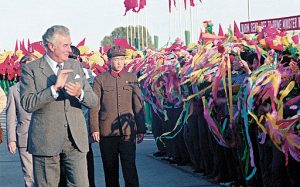
A fine orator and debater and a compelling public figure, Gough Whitlam went well on the international stage. He was the first PM to visit China, but as the song says – ‘today nobody knows’.

(Satire)

Here’s a short transcript from an interview with a sympathetic community radio station.

Natasha: Welcome, Comrade. So what made you think about writing this song, Bob?

Bob: Well, Natasha, I read a few stories recently which observed that it was the 7th anniversary of Whitlam’s death. I started thinking about the legacy that he’d left and how today’s generation is probably blissfully unaware of his achievements”.

Natasha: You have written in a previous episode of FOMM that you met Gough one time and that it did not go well?

Bob: I made the mistake of handing him my card from the Courier-Mail where I was employed as a business journalist. He looked at the card, made a scathing comment about the newspaper’s campaign against historian Manning Clark, gave my card back, turned and walked away.

Natasha: You don’t mention that in the song, although you do take a swipe at Gough’s vanity?

Bob: Yes, he probably would have thought the song was about him.

Natasha: Thanks, Bob Wilson. This is Socialist Songs Hour and here is that song, When Whitlam took his turn at the wheel.

You can listen to the song on our Bandcamp page https://thegoodwills.bandcamp.com/ and if you like, add it to your digital music collection. Share with your friends.

More reading 


Goodwills launch new song about Gough Whitlam

Whitlam-at-the-wheel
Gough Whitlam in China, image courtesy of the National Archives of Australia, CC.

We chose November 11 (Remembrance Day), to launch a new song about the achievements (and setbacks) of Gough Whitlam, our most controversial politician. The 11th marks the 46th anniversary of The Dismissal, when the Queen’s representative, John Kerr, sacked Whitlam and installed a caretaker government under Malcolm Fraser. The dramatic events of 1975 greatly overshadowed the many reforms Gough Whitlam introduced, including free education, free healthcare, no-fault divorce, a single parent’s pension and legal aid. He also ditched conscription and capital punishment and finalised the end of our involvement in the Vietnam War. And, as the photo indicates, he was the first Australian PM to visit China. Many people our age reflect on the Whitlam years as the only time in their adult lives they actually wanted to vote for someone. Unlike most politicians, Whitlam stated clearly what he wanted to do, won the election and then set out to do it all, and then more.

He abolished conscription and capital punishment and made a point of releasing seven men who had been in jail for refusing to go to Vietnam. And, as chronicled in the outstanding song by Paul Kelly and Kev Carmody, he started the process of Aboriginal land rights. Whitlam’s government had the misfortune to be taking the wheel at the time when the economy was going bad; there was inflation and massive unemployment. The global oil crisis did nothing to soothe the people who saw Whitlam as a dangerous maverick.  The song includes the downside so is not quite a hagiography, although I did admire the man for allowing me and my peers the chance of a free tertiary education.

Bob Wilson

Have a listen to the song here and if so inclined, add it to your music collection.

‘Well may we say God save the Queen…’

Readers guide to Friday on My Mind

Friday-on-My-MInd-Bob-Wilson
“Retired” journalist Bob Wilson with five years’ worth of Friday on My Mind. Photo by She Who Rarely Gets A Mention

A few weeks ago I promised you an overview of the past five years’ worth of Friday on My Mind missives, but the Federal election got in the way. Sorry about that. Today it’s a mostly politics-free zone.

I started this weekly column (it was supposed to be a one-off) with my theory (and not at all an original idea), about taking refugees and asylum seekers off Nauru and Manus Island and resettling them in small Australian towns.

But ‘The Pittsworth Solution’ wasn’t the first to get a run.

Other topics got in the way, like explaining why Morris dancers dance up the sun on the first of May. That was episode No 1; and not only have I written about this pagan ritual since, I have actually participated.

I write on random topics, often mixing subject material so if you have specific interests (solar energy, travel, politics, refugees, media analysis), use the search function to find stories.

We were travelling the outback in 2014 and on many occasions since, so there are many road travel adventures. In my naivety, I wrote about crossing the Nullarbor as if no-one had ever done it (or written about it) before.

 Some of the outback posts were popular, including one about people dumping garbage (Kiljoy was here) and the time we met the Black Dog Ride, a gang of motorcyclists circumnavigating the continent to raise awareness about depression and suicide.

Some 264 episodes (316,884 words) later, I’m still FOMMing (the weekly missive is known among hard-core fans as FOMM).

Thanks to my elder sister who lives in New Zealand, I have five ring binders crammed with hard copies of Friday on My Mind. She does not have a computer so every two months or so I print out the latest and mail them off. I got in the habit of printing two copies so now have a filing cabinet drawer full of fat FOMM folders. (Downsizing, dear, remember the promise about de-cluttering. SWTSO (She who throws stuff out)

Those of you adept in the online arts might scoff to learn it took me a couple of years to discover I could insert a search function into the website. This is a very handy way to check if you are about to repeat yourself, which is not hard to do when you’ve been maintaining a blog for a long time. One of Australia’s longest-serving bloggers, economist John Quiggin, had one solution for this, posting at Christmas 2015:

“Here’s a Christmas post from my blog in 2004. The theme is that nothing about Christmas ever changes” (although he does go on to discuss the “war on Christmas”).

This is billed a readers’ guide to FOMM, as at last two thirds of readers receive the weekly email and have no need to visit the website other than out of curiosity or because I have linked an old (but relevant) article. Tip: Links to other articles are coloured blue.

I had occasion to update my curriculum vitae (CV) the other day and found that, yes, you can teach the old dog new tricks, as 107-year-old Swedish blogger Dagny Carlsson put it, after taking her first computer lesson at 99.

Under ‘other skills and experience’ I can now add webmaster, after designing and maintaining two WordPress websites with little outside help.

When you first visit the <bobwords.com.au> website, click on ‘Bio’ in the header. This is where I talk about myself in the third person, which, as any clinical psychologist would tell you, is not a healthy thing.

Nevertheless, here’s a line from my self-penned bio which has been quoted elsewhere. I said I’d started FOMM mainly from a sense of exasperation with the sins and omissions of the daily media.

“ As Bob (that’s me) told a fan: “not that I want to bite the hand that used to feed me, but I think intelligent readers want more than a picture of Kate Middleton’s bum.”

Amen, brothers and sisters.

My Recommended Reading section keeps evolving. The website statistics manager tells me it has had 199 visits of late, so hopefully some of you will also become fans of writers suggested there.

Some recommended blogs disappeared as they fell victim to blogging deficit syndrome. I’m not aware of anyone who keeps actual track of the world’s 500 million blogs, but it’s a fair guess at least half of them were single-use, short-term or, if they started out with ambitions of longevity, fizzled out after a year or two.

I have written a couple of pieces about blogging, including the one when I stumbled upon Dagny Carlsson and explored the wonders of Wikipedia.

In this one, I discovered how blogging in some countries can be a life-threatening activity.

I started off quietly, emailing the weekly rant to a small email list which grew and grew as people shared with their friends. Then, as the list got larger, I enlisted MailChimp, which somehow evades spam catchers and also schedules delivery if you are not going to be home on the day you would normally send the email. MailChimp also tells me how many of you actually opened the email!

FOMM is neither a blog nor a citizen journalism site as it mixes news, research and whimsy with a fair amount of (small l liberal) opinion.

I had a conversation on election day with a former colleague. We bemoaned the absence of what was once the journalist’s mantra – “tell both sides of the story”. Hard to believe there was a time not so long ago when one would never put personal opinion into a news story, or the news pages for that matter.

I regard Friday in My Mind as a newspaper column without the newspaper. Some columns provoke a torrent of emails; other times there is a lamb-like silence. If I make a mistake and SWTSO misses it too (uncommon), I am certain to find out about it from an alert reader, sometimes within minutes. The beauty of being online is you can correct it right away.

Few people post online comments, but those who do are inevitably adding something relevant to the topic. Despite the relative lack of feedback, my website statistics show a fairly consistent readership. Inexplicably, the most-read column of the past five years is this one about bipolare disorder and gout, where I found research that made the connection between one and the other.

Other popular reads were first-person accounts about adverse reactions to paralysis ticks and at least six items dealing with depression and anxiety.

Readers liked my recent take on the Christchurch tragedy and, going back a while, tributes to David Bowie and Gough Whitlam.

So if you have joined the FOMM flock in the last year or two or more recently, there’s quite a trove of documented journalism and comment to explore.

For example, if you enter ‘David Bowie’ in the search window you will be rewarded with Canadian astronaut Chris Hadfield’s celestial performance of Space Oddity.

Friday-on-my-Mind-Bob-Wilson
Bob at work (The Daily Sun) mid-1980s

Depending which boxes you ticked below the line on May 17, you may have to take the ‘leftie rubbish’ with a grain of salt, as a few long-term conservative readers apparently do.

We can thank Pliny the Elder for translating addito salis grano. In the modern context it means to view something with scepticism or not to interpret something literally. A good motto for Friday on My Mind, I reckon.