Take me to your leader – the quest continues

leader-politics
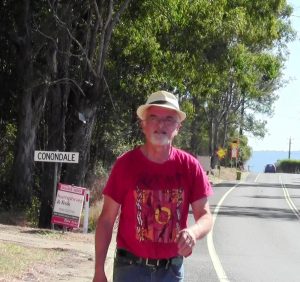
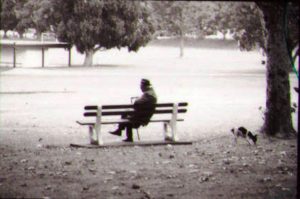
(Leader image, old man in park taking time out from politics and spin), Bob Wilson circa 1978

Imagine a flying saucer lands in your back yard and an alien (drooling or not) alights.

“Take me to your leader,” it telepathically commands, as it is from an advanced civilisation, intent upon savings ours.

“Aw yeah, mate.” (pointing). “That’s our leader over there, the one in the striped designer shirt, mingling with the homeless folk.”

If you dig around on the Internet long enough you’ll find lists of world leaders people would rather not introduce to their granny, never mind to an alien. The lists are usually described as ‘the 10 or 20 worst world leaders’ and include despots like North Korea’s Kim Jong-un, Russia’s Vladimir Putin, Syria’s Bashar al-Assad and Sudan’s Omar al-Bashir.

Alas Malcolm Turnbull, PM of Australia; the only list I found him on was the ‘hottest heads of state’ leader ladder, languishing in 12th place behind total spunks like Canada’s Justin Trudeau, New Zealand’s Jacinda Ardern, France’s Emmanuel Macron or Haiti’s Jovenal Moise.

One ought not to touch on politics when striking up conversations at Christmas parties. At one such event, I ventured that the Australian Federal Government was having an ‘Annus Horribilis’ and seemed incapable of making firm and sensible decisions.

I had voiced what I thought was a commonly-held theory, but soon found out what I should have known; on average, at least one-third of people voted for that motley group of indecisive dual citizens who went to work on just 64 days in 2017.

“So what do you think about Turnbull’s piss-weak energy policy?” I began at another Xmas do, when I probably should have said, “Strange weather for this time of year, don’t you think?”

That person moved away, but left me a clean run at the cheese platter.

From my point of view, the LNP in Canberra blundered from one disaster to another in 2017, momentarily making itself look good by introducing marriage equality laws, which in truth should have been enshrined in 1980-something. The poll was estimated to cost the taxpayer $122 million and then we endured weeks of angst while the same-sex marriage law was debated, after 61.6% of the 79.5% of people who voted had told them that’s what they wanted in the first place.

The great shame, or should I say sham, is that the Turnbull government, deliberately or not, distracted the people from more serious issues (climate change, the Adani coal mine, Manus Island), by turning the same-sex marriage debate into an expensive, non-binding referendum-style exercise. They could have used one of those 64 sitting days to have a free vote. We’d have achieved the same result and deployed the $122 million to more laudable outcomes (like finding emergency accommodation for the 6,000 or so Australians who sleep rough each night).

We’ve seen from recent State elections and Federal by-elections that the people are not happy with the mainstream parties. The drift towards the Greens on one side and One Nation on the other mimics the rise of populism the world over.

Political commentator Michelle Grattan, speaking at the launch of The Conversation Yearbook in Brisbane, said so many people in Australia are disgusted with politics they are ‘‘tuning out”

“People think (politicians) are behaving badly, because they are behaving badly. They (politicians) alienate the public – they are aware of it, but it’s beyond them to regain the people’s trust.”

Grattan said focus groups in north Queensland, ahead of the State elections, saw through Malcolm Turnbull’s ploy to cancel a week’s parliamentary sittings. This was ostensibly to allow the House and the Senate to resolve the citizenship issue and to work through the same sex marriage debate.

But here’s the thing: the NQ focus groups didn’t much like Malcolm Turnbull, but neither did they warm to Bill Shorten as an alternative leader.

The Queensland election continued a national, if not international trend: voters are fed up with mainstream parties and are casting their votes elsewhere.

In Queensland, 30.9% of first preference votes went to minority parties, while the informal vote was higher than average, at 4.58%. In the Bennelong Federal by-election, 10 minor parties grabbed 19.15% of the first preference primary vote, although that did not stop the LNP’s John Alexander (45.05%) taking the seat.

So what else happened in 2017?

While it wasn’t a party political issue, the rise of the social media hashtag #MeToo movement had its high point when Time Magazine chose #MeToo as its influential “Person of the Year”.

If you had been living under a rock, #MeToo is a movement where women who have been harassed, assaulted, bullied and otherwise vilified (primarily by men), came out and stood with their sisters.

The movement started with casting-couch revelations about Hollywood movie producer Harvey Weinstein and flushed out similarly bad behaviour all over the world. The Australia media chimed in, outing former TV gardening host Don Burke for a series of alleged indiscretions. Sydney’s Telegraph made an allegation about Australian actor Geoffrey Rush, who responded with a writ for defamation.

On a more positive note, 2017 turned up an unlikely winner of the Nobel Peace Prize. The prize went to the International Campaign to Abolish Nuclear Weapons (ICAN). The organization received the award for drawing attention to the catastrophic humanitarian consequences of any use of nuclear weapons.

There were other examples of positive news in 2017, amid the political scandals, terrorist attacks, humanitarian crises and natural disasters.

A December 19 report by Katrina Sichlau, News Corp Australia Network, found that renewable energy employed 10 million people worldwide.

(Aside – that makes the Queensland Premier’s contested claim that the proposed Adani coal mine would employ 10,000 people look rather sad).

The same article said France and Britain had launched a Clean Air Plan which will make sense to people who have visited either country this year or last. In a year when Queensland’s land-clearing reached Brazil-like proportions, Pakistan planted one billion trees.

If I may add to this optimistic list, New Zealand elected a woman in her 30s as Prime Minister (Jacinda Ardern), largely at the whim of (Queen)-maker Winston Peters, a veteran politician who saw sense in forming an alliance with the savvy young Labour leader.

Probably the less we say about Donald Trump the better, as he seems to thrive on publicity, be it good or bad. Trump continues to use Twitter like a flame-thrower, this year setting diplomatic fires in North Korea, Israel, and Germany and within the US itself.

Trump reportedly plans to go ahead with a visit to the UK in 2018, despite the recent twitter row with UK PM Theresa May. If you’ll recall, Trump retweeted videos posted by radical right group Britain First, inaccurately blaming Muslims in the UK for terrorist attacks.

There has been much misreporting about Trump’s ‘working’ visit to the UK. The White House at one point thanked the Queen for her “gracious invitation” to meet with President Trump at Buckingham Palace. The Guardian Weekly reported on December 15 that a formal state visit was not envisaged. “The Queen is likely to be preoccupied with preparations for a Commonwealth summit.”

As myth-buster Snopes points out, there is a long standing tradition that the Queen does not intervene in political disputes.

We wish you all an ‘annus mirabilis’ in 2018.
 

John Hewson and integrity in a post-truth world

john-hewson-integrity
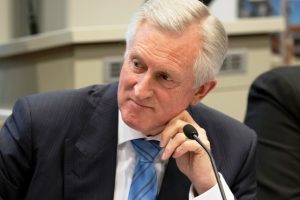
Photo of John Hewson – Crawford School of Public Policy

Nobody can call out an errant politician better than former Liberal Opposition Leader John Hewson. In the 22 years since he resigned from politics, Hewson has become a respected academic, the darling of TV panel shows like Q&A, and a regular on the celebrity speakers’ circuit. Yesterday, Hewson was a keynote speaker at Griffith University’s two-day summit, Integrity20.

Who better to address the opening topic “Post-Truth, Trust and the Ethics of Deceit?” Hewson has been speaking out about fake news and the propensity of politicians to stray from the facts, long before Donald Trump made it a catch phrase. He is also an advocate for evidence-based public policy, often identifying where politicians have used models and commissioned reports to suit their version of the facts.

So to Hewson’s opening address yesterday, where he used the climate change debate to support his argument for ‘evidence-based public policy’.

“We had a very hard-line position as a response to the climate challenge back in the early 1990s. I was calling for a 20% cut in emissions by the year 2000 off a 1990 base. We are yet to know how we are getting the 5% reduction in emissions by 2020 off a 2000 base. And of course, we’re committed under the Paris Accord to cut emissions by 26% to 28% by 2030.

“What’s happened over that period is drift – the issues have been left to drift. Housing affordability’s been left to drift, the climate response has been left to drift and the final line of that drift is the mess we have in the energy sector. Electricity and gas prices are running away to the point where the average household is struggling to afford to pay its power bills.

“These are the outcomes of negligent government over a very long period of time.”

Hewson believes the situation can be turned around, but it will take some years to reverse the damage. He said what the country needed was an honest debate about leadership.

“And leadership is going to be about telling people honestly the way it is. To get good policy up we have to educate people to accept the magnitude of the problem.

“But we don’t have any debate now in this country – it’s all negative. One side puts its hand up and says let’s do X and the other side immediately says no.”

One in three voted for someone else

He said people had lost faith in the two-party system. In the last election, one in three people did not vote for one of the major parties. The protest vote was not just something that had happened only in Australia, he added, citing Brexit, the US, France and Germany as recent examples.

“It’s a longer term trend and it will get worse before it gets better.”

The path to restoring voter confidence, he said, was by focusing on the issues that affect people – the cost of living, health, housing, childcare and education.

But the main problem was that the ‘wrong people’ were in government.

“If you asked them why they went into politics, they’d say to make a difference and leave a better world for their grandchildren.

“And then they do the opposite.’

Hewson, who will be 71 next Sunday, had a distinguished career in politics. He was leader of the Australian Liberal Party and Leader of the Opposition between 1990 and 1994. Before and after politics he has worked as a senior economist for organisations, including the Australian Treasury, the Reserve Bank and the International Monetary Fund.

In this context, it seems uncharitable to recall that in 1991 he advocated an unpopular goods and services tax. He lost the 1993 election to Paul Keating over the “Fightback Package”, of which GST was a central element. Ironically, Paul Keating (who first advocated a GST in 1985), shamelessly exploited public opinion to thwart Hewson.

All that aside, Hewson at least clearly outlined what he was going to do in 1991-93 and stuck to it. He is known still as a straight shooter, a man who once said he lived in hope of ‘spin-free politics’.

Day one of the Integrity20 Summit was not just about politics and truth. ABC presenter James O’Loghlin chaired a panel discussion about solving the world’s problems through innovation.

Inventor and futurist Mark Pesce showed a short video of a robot working on a farm in Indonesia. He described it as just two wheels, an axle and a smartphone on the end of what looks like a selfie stick, collecting data and producing crop reports. These robots cost about $2,500 and can be shared around a farming community. He also demonstrated how 3D printers, aligned with a simple robot used in smart phone technology, can reproduce all the plastic parts to build another 3D printer. Eventually, robots will also be able to assemble the printers – and that’s just the edges of the innovations universe.

CSIRO scientist Stefan Hajkowicz said the impact of Artificial Intelligence on the future of work had been greatly over-stated. He thought there were many areas where robots and humans would work side by side – in hospitals for example. The robot would do the blood test and the nurse would soothe the patient’s concerns.

But it turns out robots are crap at irregular tasks we humans take for granted, A robot cannot tie your shoelaces, for example. And, as Hajkowicz added, they can’t fold towels. They tried to get a robot to fold a towel. It took 20 minutes and did the job badly.

Today I attended the final full-day session of Integrity20, hastily scribbling notes and pressing stop/start on my hand-held recorder. You may wonder how I met my deadline – marvel at my prowess.

M.Y Prowess (sub-editor): “Isn’t it time I had a byline?”

BW: Ghost writers should be read and not heard – and try using commas instead of dashes – please – some of my readers find it tiresome.”

Next week: Bryan Dawe on satire, media censorship and the global rise of populism.


North Korea – 21st Century Missile Crisis

North-Korea-Missile
Workers in North Korea tending crops on Migok Farm, Sariwŏn. Photo by ‘Stephan’

If you’re old enough to remember the Cuban missile crisis, you’re probably less inclined to see the North Korea/US standoff as a prelude to the End Time.

In October 1962 (I was 13), President John F Kennedy and his Russian counterpart, Nikita Khrushchev, arm-wrestled over Soviet missile sites built on Cuban soil. Russia had taken steps to build missile silos on Cuba as a response to similar US installations in Turkey and other central Europe locations. As Cuba is just 90 nautical miles from Miami, Florida, this news prompted urgent meetings of defence and intelligence chiefs and then-POTUS John Fitzgerald Kennedy.

In October 1962, an American spy plane spotted what looked like a missile site being built on the island of Cuba. Thus began a tense, 13-day stand-off, during which time many people genuinely believed the world was about to end. Wealthy Americans commissioned fallout shelters (some are still being used today to take refuge from hurricanes).

You can say this about the US defence apparatus, they keep detailed historical records. Whether it is the unexpurgated truth is another matter. As Jack Nicholson’s character Colonel Nathan R Jessup in A Few Good Men famously says to prosecutor Lt Daniel Kaffee, who presses him for “the truth” – “You can’t handle the truth.”

In this instance, US intelligence agencies identified 15 SAM (surface-to-air missile) sites in Cuba.

The Soviets established a missile base on Cuba because they feared the US would invade Cuba, after the failed Bay of Pigs invasion in April 1961 by a CIA-sponsored paramilitary group.

At the time, there was still a lot of angst about Cuba; members of the CIA-sponsored Brigade 2506 were still being held captive after the Bay of Pigs invasion.

President Kennedy needed to resolve this situation, quickly and peacefully. The crisis ended with the Kennedy-Khrushchev “agreement” of October 28, 1962. Less well-known was a dispute over Soviet IL-28 bombers based in Cuba. The US claimed they were “offensive weapons” under the October 28 agreement. Kennedy also made a (then) secret agreement to remove US missile sites from Turkey. These events ended the crisis but continued the “Cold War” (which ended in 1991) between Russia and the US.

So to 2017 and North Korea’s threat to target Washington or New York (or more likely Tokyo), with nuclear-tipped missiles.

You may have watched Monday’s Four Corners/BBC expose on the assassination of Kim Jong-un’s half-brother, Kim Jong-nam. This documentary was, I thought, a little bit too informed by ex-CIA sources, US think-tanks and North Korea-watchers. It would be good to sit down in a bar with a regular DPRK citizen to see if they really are oppressed.

“Howzit goin’ Choi? Gettin’ enough to eat? Been threatened or beaten up lately?” Mate, do you get Outback Truckers on DPRK TV?”

If reports about poverty, famines, repression, reprisals, executions and endemic surveillance are true, you could hardly blame a DPRK citizen for having a drink or four. Communist regimes commonly keep alcohol prices down and relax access to it as a means of helping citizens cope with a bleak lifestyle.

North Koreans predominantly drink hard liquor; Soju, a colourless spirit akin to vodka, taken neat. Its alcoholic content ranges from 17% to 60%.

“North Koreans’ main hobby is probably drinking,” said Simon Cockerell, a tour guide who has led more than 100 trips to the DPRK for foreigners.

But the World Health Organisation ranks North Korea below 128 countries whose alcohol consumption per capita is vastly more than the DPRK’s modest 3.7 litres (94.9% of which is spirits). Australians and New Zealanders drink four times as much.

If you want some raw insights into life in North Korea, cartoonist Guy Delisle’s 2001 graphic novel of his time in North Korea is a good start. The first part of Pyongyang – a journey in North Korea begins with a customs official in the dimly-lit airport terminal suspicious of Delisle’s tatty copy of 1984. “What kind of book is this?” The official relaxes when Delisle tells him he has a work visa arranged with a North Korean animation studio.

Once in country, Delisle kept a diary, illustrated with his drawings of Pyongyang and things that happened as he was chaperoned around by minders. I borrowed it from the local library a few years back and found it blackly fascinating and a little subversive.

A Hollywood movie was planned based on Delisle’s book starring Steve Carell. But the movie was cancelled, reportedly because of the kerfuffle over Sony’s film, The Interview.

Love, love, love is all you need

Last weekend, we spent four glorious days and nights away from the constant stream of doomsday news. About 1,000 people from a broad spectrum of society congregated at a bush campground on the fringes of the D’Aguilar National Park. When people ask me what a folk festival is like, I tell them it’s not so much about the music (often heartfelt songs of equality, justice and humanitarianism), but the harmonious atmosphere.

Many performers took time out between songs at the Neurum Creek Music Festival to observe how sweet it was to have some respite from the constant barrage of end-of-the-world scenarios.

Comedians and folksingers Martin Pearson and John Thompson, reunited as Never the Twain, took a moment from manic wisecracks and parodies to touch the collective soul. The Fred Small song Scott and Jamie is a five-minute story about a gay couple who adopt two boys and are living the dream until social services intervene. The refrain – ‘Love is love, no matter who, no matter where’ rippled out across the festival venue. A hush fell; dogs dialled it down to rapid panting. Even the bar staff fell under the spell.

Four people sitting in front of me rose to their feet at the song’s end, to applaud the splendidly rendered version and the sentiment. It may be a forlorn hope to think that we can cure the world by singing songs of love and peace like ‘Imagine’, ‘Redemption Song,’ or ‘All you Need is Love’. But what else can a pacifist do?

She Whose Family Immigrated from Canada in 1964 thinks her Dad picked this place on the map to escape proximity to a looming nuclear war between two super powers. It didn’t happen then, but there have been scary moments since – September 11, 2001 in particular.

What now? Will we see a new surge of refugees from Japan and the US testing Australia’s world-famous, inclusive asylum seeker policies? Perhaps, as the latest issue of Popular Mechanics suggests, people will invest in bomb shelters instead. Those with wealth enough can spend tens of millions on ‘Doomsday Condos’, shelters big enough to cater for the extended family, friends, pets, the family lawyer…

Or you could travel to a village in Ontario, contribute ‘sweat equity’ and join other idealists maintaining the world’s biggest nuclear shelter, Ark 2.

Sigh. Détente would be easier, and cheaper. You know – détente as in ‘a relaxing of tensions between nations through negotiations and agreements’. Or rapprochement, even. But this would require Donald Trump and Kim Jong-un to clasp hands across a table and sign an Accord.

We wish.

See more on this topic: ‘Surviving Armageddon’

A backwards step for world peace

backwards-bob-conondale
A backwards step to make a point about world peace

In 2009, Greens candidate Peter Bell walked several kilometres backwards from a Mackay fast food franchise to the office of the National member for Dawson, De-Anne Kelly.

He told ABC radio at the time he did this to highlight the backwards nature of the Howard Coalition’s policies on industrial relations and climate. Despite making headlines with this stunt, Bell polled only 3,489 votes (4.4% of the Dawson ballot). But he made his point, in public.


There was a time when if someone said you’d taken a step backwards, they meant a return to older and less effective ways of doing things. The Cambridge Dictionary’s example: “The breakdown in negotiations will be seen as a step backwards.”

You could argue the ‘step backwards’ is in vogue here and around the world; for example the public re-emergence of white supremacists in the USA. President Trump set the mood for this, with florid statements about expelling Muslims and building a wall to keep Mexicans out.

Now Trump and North Korean leader Kim Jong-un are trading threats about the latter’s reported development of missiles capable of delivering nuclear war heads. One of Trump’s responses, tweeted in the early hours, was to bring down ‘fire and fury’ on North Korea. Does that not seem like a backward step for world peace?

Australia’s non-compulsory, non-binding postal vote about a simple social justice issue is also a step backwards. The Australian government’s stubborn commitment to this $122 million folly could have been avoided if PM Malcolm Turnbull had called a free vote for all federal politicians.

There’s a backwards look too about the kerfuffle over whether you can be a politician in Australia while also a citizen of another country − even when you didn’t know you were a dual citizen. I seem to recall the media making much of Julia Gillard’s Welsh background and Tony Abbot’s British roots. So what? We all came from somewhere else, didn’t we?

“Whatever”, as the Gen Xers used to say, one should never say rash things in print like “if anyone can hum a few bars of Song of Australia I’ll walk backwards to Conondale.”  Several readers challenged me about their memories of Song of Australia, the fourth choice when Australia last held a plebiscite in 1977. Regular FOMM reader Elaine Beller wrote to say that in the years leading up to the plebiscite, she was a teenager living in Townsville, and a member of the local youth choral society.

Just wanted you to know that I really enjoy reading FOMM each week,’ she wrote. “However, I also wanted to let you know that walking backwards to Conondale is on!”

“We had to learn all the patriotic songs for a public performance on The Strand, so the citizens of Townsville could make an educated choice,” she said. “So, I can sing/hum more than a few bars of Song for Australia! The lyrics had us kids in fits of laughter (‘gushing out with purple wine’ being a particular favourite).”

Caroline Carleton wrote the poem (later set to music by Carl Linger) in 1859, her winning entry for a competition held by the Gawler Institute.

I still can’t believe I walked backwards to Conondale on the strength of such purple prose as:

There is a land where honey flows
Where laughing corn luxuriant grows;
Land of the myrtle and the rose.
On hill and plain the clustering vine
Is gushing out with purple wine,
And cups are quaffed to thee and thine – Australia.

So, while I was steeling myself for the backwards trek to Conondale (note how I carefully did not specify from where), I did a little research on the art of backwards perambulation.

Shannon Molloy writing in The Courier-Mail about colourful Qld political characters, found an endearing photo of former Industrial Relations minister Vince Lester walking backwards.

“The intriguing figure of 1980s politics was famed for his hobby of walking backwards, often for hours at a time. He would complete trips in the name of charity, once rear wandering for several hours between two regional towns.”

Colourful Queensland MP Bob Katter once promised to “walk to (or from, according to some reports) Bourke backwards if the gay population of North Queensland is any more than 0.001%”. Despite his half-brother since coming out as gay and Katter being (often) reminded about this loose remark (there was a rainbow protest outside his Mt Isa offices in 2011), he maintains that gay marriage isn’t an issue in his electorate. It appears he never did take up the threat to walk frontwards or backwards to or from Bourke in Western NSW (about 1,600 kilometres to his Mt Isa electoral office).

Sometimes known as ‘retro walking,’ the seemingly unusual habit of walking (or running) backwards is widely recommended for fitness.

You will find many health and fitness links on the Internet which suggest walking backwards strengthens little-used muscles, improves balance and is good for people with knee, hip and back problems.

Some people even do it for a living.

Seaman Nathan Winn is a tour guide for the Pentagon, and routinely walks up to eight kilometres backward per day (including escalators)

Whatever you do, don’t try walking down stairs, steps or steep bush tracks backwards (or backward as they say in the US). As Seaman Mann found, when he tried going down the up-escalator, it’s embarrassing and definitely not funny.

I walk every day but if you want to have some idea how far you’re walking and set some goals to increase the tempo and distance, a pedometer is useful.

It is said that for maximum fitness from walking you need to chalk up 10,000 steps a day. That’s about eight kilometres, the same as that logged by Seaman Winn, but in a forwards direction.

If you fell asleep in your recliner while reading this on your IPad, you may want to do something about your general level of inertia.

Here’s a suggestion: Sign up for Steptember (a fund-raiser for Cerebral Palsy), where you pledge to walk 10,000 steps on each of 28 days during September.

Or you could just donate money and loaf in the recliner and watch old movies on SBS on Demand, Stan or Netflix. I’ve been looking but have not yet found the critically panned 2008 remake of The 39 Steps, a spy thriller starring Rupert Penry-Jones (Silk and Spooks). I’m curious, having seen the 1959 remake starring Kenneth More (which was spiffing). Never did see the original (Hitchcock, 1935).

UK author John Buchan wrote the book at a clifftop nursing home in Broadstairs while recovering from illness. A set of wooden steps which led from the garden to the beach are thought to have inspired the title. In the book these steps become the escape route (frontwards) down to a quay where the villains’ vessel, Ariadne, is waiting to speed them away.


Happiness, harmony and Central Africa

Co-cheol-harmony-happiness
Melbourne harmony singers Co-Cheol

A musician friend alerted me on Monday that not only was it his birthday, it was also International Day of Happiness. Once I’d finished doing cartwheels around the room in response to this spiffing news, I wished the dear boy a very happy birthday. As if that was not enough to get the cockles of the heart percolating, the next day She Who’ll Sing at the Drop of a Hat went down town to celebrate World Harmony Day.

Continue reading “Happiness, harmony and Central Africa”

Great wall of Mexico

great-wall-mexico
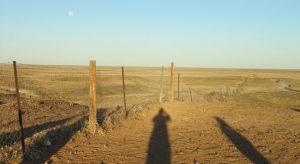
South Australia dog fence Photo by Bob Wilson

There are precedents for President Donald Trump’s plan to build, or complete a 3,208 kilometre wall between Mexico and the US. The Australian outback features not one but two barrier fences, sprawling the length and breadth of the country.

A tour guide took us on a sunset tour out to the ‘dog fence’ near Coober Pedy in 2014. The South Australian section of the 5,531km fence which runs from the SA border to Queensland is 2,250 kms long.  Built in the 1880s, it’s the longest fence in the world and keeps wild dogs out (or in).

In Western Australia there’s also the 3,256 kms long Rabbit Proof Fence. Possibly because there’s a movie by that name, it is now known as the State Barrier Fence of Western Australia. Having done our share of outback travel, we can tell you that rabbits are still breeding away and undermining parts of Australia, despite myxomatosis, 1080 poison and vermin proof fences. Western Australia’s fence was completed in three stages in the early 1900s as an attempt to isolate the west from the national rabbit plague.

Just so you all know, dingoes and rabbits were not asked to pay for the construction of these fences.

Yes, it makes you think.

There’s no doubt that well-built vermin fences, extending a long way into the ground, have been successful at keeping rabbits and other pests from undermining Australia and also prevent dingoes from savaging livestock. So the cost is defendable, as is the ongoing expense of sending out boundary riders on weekly repair patrols. Feral camels do the most damage, so not surprisingly; there are plans for a taller (electrified) fence.

So what about President Trump’s wall between Mexico and the US? Despite the fact that a 1000 kilometre stretch was completed by George W Bush’s government, this is still going to be a $20 billion exercise. Crikey, that’s about 30% of the US education budget, right there.

And speaking of education, a Pew Research survey found that 61% of Americans think a wall between the US and Mexico is a dumb idea.

Our Albuquerque correspondent, despite living 693 kilometres from the New Mexico border at Juarez, thinks the wall is ‘insulting, a blight and really bad foreign policy.”

Thanks to Bloomberg and heavyweight sources like the Department of Homeland Security, here’s what we know about the challenges facing President Trump’s wall. The notoriously porous border between the US and Mexico is almost 3,208 kilometres long, two-thirds of it tracking the Rio Grande River. The border passes through cities including San Ysidro (California) and El Paso (Texas), rural farmland, desert, mountains and wildlife reserves. The border features 30+ patrol stations and 25 ports of entry.

Barriers already extend along a third of the border, giving President Trump’s contractors something of a head-start. Most of the California, Arizona and New Mexico borders have existing barriers. These range from 5.5m high iron and corrugated metal fences to what our Albuquerque correspondent calls “pedestrian fencing.’

Bloomberg reports that in 2015, the Customs and Border Patrol claimed an 81% strike rate for apprehending and turning back Mexicans attempting to cross illegally (or should that be irregularly).

No-one really knows how many undocumented Mexicans are living in the US but informed estimates figure around 11 million. There have been amnesties in the past, but that does not appear to be an option under a Trump administration.

A Pew Research Centre survey conducted in 2015 found that 72% of Americans (including 80% of Democrats, 76% of independents and 56% of Republicans), thought undocumented immigrants should be allowed to stay “if they meet certain requirements.

Most of the existing border fence was built after 2006, when President George W. Bush signed the Secure Fences Act. I hate to be pedantic, but the act specifically says “Fences” not walls. When President Trump talks about his vision, most of us imagine a Great Wall of China or the 8m high sections of the West Bank edifice.

Al Jazeera reports that the West Bank security fence is the largest infrastructure project in Israel’s history. Nearly 15 years old, the 706km long fence costs Israel $260 million a year to maintain.

The ‘separation barrier” as it is coyly known, comprises mostly 2m high, electrified barbed-wire fences with vehicle-barrier trenches and a 60m exclusion zone on the Palestinian side. But in densely populated urban areas with space limitations, the Israelis built an 8m concrete wall.

Walls built between countries or within countries are always controversial, and, well, brutally divisive.

There’s no space at this time to delve into the tragedies of the Berlin Wall, which divided East and West Berlin for 27 years, for reasons which now seem specious. History shows that barrier walls built for whatever reason are destined to become decaying tourist attractions,

Visitors to Britain often schedule a visit to Hadrian’s Wall, a fascinating relic of 122AD when the emperor Hadrian demanded a wall be built east from Wallsend on the River Tyne to Bowness-on-Solway in the west. Hadrian’s Wall was the north-west frontier of the Roman Empire for nearly 300 years, built by the Roman army (to separate the barbarians from the Romans). Hadrian’s Wall was made a World Heritage Site in 1987.

In 2010 English folksingers Julie Matthews and Chris While joined a group of songwriters to write songs inspired by Hadrian’s Wall. Their song which emerged from the All Along the Wall project, Rock of Gelt, imagines a bored centurion who has been dragooned, if that is the appropriate word, into “building the Empire’s last frontier.”

There are only a handful of inscriptions to be found along the remains of the stone wall, including a piece of graffiti found in the Gelt Valley. It translates to: “Daminius didn’t want to do it,” which becomes the repeated refrain at the end of the song.

So will Donald Trump persist with a plan to build/complete a wall that 61% of Americans do not want? No doubt the 39% who want it would argue it will employ large numbers of people, through the building phase, then on maintenance and security.

Maintenance of walls and fences is an ongoing issue – just ask a fencing contractor called in to repair or replace fences wrecked or washed away in floods. The annual maintenance bill to keep the Dingo Fence in sound repair is around $10 million, according to an article in The Conversation. The authors argue for a re-think of the country’s vermin fence policies, including a plan to move a section of the fence to test whether the now endangered dingo can help restore degraded rangelands.

The humanitarian question is, if you must build a barrier wall or fence, surely you should have to justify the exclusion of a species?

As poet Elvis McGonnagal wrote, inspired by the Along the Wall project:

“Walls entomb, walls divide

Walls barricade the unknown

Berlin, Belfast, Gaza

Walls set difference in stone

 But the same sun that sets on the west bank

Rises up on the eastern wall

A man’s a man in Mesapotamia

A man’s a man in Gaul.”

*thanks to Julie Matthews for the insights

In search of quality news

Maleny-sunset-tree
Where I go to escape the news, fake or otherwise

Some of my Facebook friends have been on a search for quality news – and a way to divert Donald Trump stories and memes from their news feed. There was just too much analysis, too many suspect ‘news’ stories from unfamiliar sources and hundreds of derogatory memes which only serve to confirm readers’ biases.

Australian comedian and folk singer Martin Pearson had evidently had enough too. He shared an insightful infographic (see below) which makes plain where media outlets sit in terms of quality news and partisanship. Pearson shared Vanessa Otero’s media infographic with a plea to his 1,520 friends to check the sources of news, especially if it is about Donald Trump:

“Please, you should all follow SNOPES on FB straight away; you get a good supply of reporter-checked news and fact-checked news straight to your page. And take a look at the info-graphic. If a news story confirms your bias, check its source.”

Vanessa Otero is a US patent attorney who enjoys snowboarding, reading, writing and observing communication patterns. Her infographic, originally posted on Twitter, was re-posted and shared so many times Otero went to her blog to explain in detail the reasoning and methodology.

quality-news
News Infographic by Vanessa Otera (Creative Commons)

The infographic places media outlets on a chart which clearly suggests where the publication or electronic media outlet sit in terms of quality news and partisan bias. The ‘utter garbage/conspiracy theory’ news outlets, be they conservative or liberal (that is, left of centre), end up on the extremes of the chart, grouped as ‘don’t read this’ or ‘Just no’. I note with a chuckle Otero places local TV news, US Today and CNN (dressed in partisan blue), as ‘sensational or clickbait’, though apparently relatively unbiased, so earning the category – “better than not reading news at all”.

Otero writes: “I wanted to take the landscape of news sources that I was highly familiar with and put it into an easily digestible, visual format. I wanted it to be easily shareable, and more substantive than a meme, but less substantive than an article.”

That much worked – the infographic was shared 20,000 times on Facebook and viewed one million times on Imgur. Otero said this is evidence that she accomplished the goal of reaching people who hardly ever engage with lengthy editorials. And as she self-deprecatingly acknowledges, very few will read her “boring-ass article” about the methodology behind it.

“Many non/infrequent readers are quite bad at distinguishing between decent news sources and terrible news sources. I wanted to make this chart in the hopes that if non/infrequent readers saw it, they could use it to avoid trash.”

Otero has said that considering all feedback, she’d make some changes to future versions of the chart (like moving The Economist more to the centre).

Otero’s chart is no one-off, though. Business Insider cited the Pew Research Centre to compile an infographic on the most (and least), trustworthy media sources in AmericaThe most trusted news outlets, that is, purveyors of quality news, are British, topped by the BBC and The Economist.

Conversely, BuzzFeed and The Rush Limbaugh Show are at the bottom.

There’s a difference between trusted and most popular, however. Pew polled 3,000 Americans in a random sample to find that they get most of their news from local TV, Facebook, and major networks like CNN and Fox News.

Some Australians who reacted to Otero’s publication wanted to know when someone would do a similar exercise on the highly concentrated Australian media market.

I suspect an Australian version of the search for quality news would look quite different; less crowded and lack the dubious news sources which appear to flourish in the US. There have been attempts in recent years to loosen the stranglehold a handful of media companies hold over Australian media audiences. They include Crikey, The Monthly, the Saturday Paper, New Matilda and The Conversation, the latter a collaboration between academics and journalists. Whatever subject you wish to research has probably been turned over there at least once and if not, send them an email and suggest a topic.

In this article from December 2016, authors Tim Dwyer and Denis Muller explore the concentration of media ownership in Australia.

They cite market research firm IBISWorld’s findings that the industry’s four largest players, News Australia, Fairfax Media, Seven West Media and APN News and Media, accounted for more than 90% of industry revenue in 2015-16. A very small list of owners, notably News Australia and Fairfax Media, publish content that reaches the large majority of Australians.

Since then, 12 Queensland and NSW regional daily newspapers and 60+ non-dailies and 40+ websites were sold to News Corp for $36.6 million.  APN News and Media agreed to sell Australian Regional Media (ARM) last June (News was already a 14.9% shareholder). It was approved by the foreign investment and competition regulators in late December. For Queenslanders, this means that Rupert Murdoch’s News Ltd owns every substantial newspaper in the State, from the Cairns Post in the north to the Tweed Daily News in the south and the Toowoomba Chronicle in the west.  News also publishes Brisbane’s suburban weeklies.

Only the Fairfax-owned online newspaper, Brisbane Times, stands out as a daily voice of difference.

The latest iteration of newspaper monopoly in Queensland has received surprisingly little coverage or analysis − much less so than when Rupert Murdoch took over The Herald & Weekly Times group in 1987. That transaction delivered him ownership of every daily newspaper in Brisbane. The competition watchdog ruled that Murdoch must sell one of these to an ‘independent’ owner. So he kept the Courier-Mail, The Telegraph and Sunday Mail and sold the Daily Sun and Sunday Sun.

As for the ARM/News merger, The Australian quoted Australian Competition and Consumer Commission (ACCC) chairman Rod Sims:

“The ACCC reviewed the acquisition very closely, as News and ARM are the two largest newspaper publishers in Queensland. However, feedback from readers raised very few concerns and suggested that there is not close competition between the paid daily Queensland papers published by News and ARM.”

Having said surprisingly little about this, the ABC’s Mediawatch made its 2017 return on Monday with a special on ‘Fake News,’ a term now so pervasive it has wormed its way into the Macquarie Dictionary (and FOMM).

As Mediawatch host Paul Barry said:

“Fake news is hardly a new phenomenon, nor is believing stuff that defies all evidence.

“But in a world where anyone can set up a website and so many are on social media, it can spread like wildfire. Almost 2 billion people log onto Facebook every month. And Facebook works by giving them the news they want.”

Craig Silverman of National Public Radio (NPR) said in December, fake news works because “we love to hear things that confirm what we think and what we feel and what we already believe.’

“It tells people exactly what they want to hear. It makes them feel very comforted and it gets them to react on the platform. And the platform sees that content does really well and Facebook feeds more of it to more people.

So as Martin Pearson advised, and I concur, be sceptical, subscribe to a source that fact checks (Snopes, The Conversation).

Above all, don’t immediately share something on Facebook or Twitter without reading first, thinking about it and doing some checking.

We can only hope that’ll happen…LOL

http://bobwords.com.au/elephant-captured-nullarbor-plain/


Birthday musings about ageing and mortality

old-man-and-birthday-dog
Old man and dog – photo by Bob Wilson

So I’ve picked a table at the combined 70th birthday party, met the woman next to me and nodded to her husband. It’s an outdoor setting for 40 people with five big tables and much background noise from kitchen activities. We say hello to the hosts, and, according to the way their lips moved, they reply “glad you could make it to our birthday”.

After a while, I set my hearing aids to ‘noisy room’ which basically meant I could talk to the person on my right and She Who Sits on My Left. After the main meal I got up and milled about, having one-on-one discourse with people who tended to lean towards me and say things like “Sorry I missed that?”

The birthday girl made a short but gracious speech without benefit of microphone. We were all lip-reading like billyo.

“It’s good to see you all – and as Keith Richards said, ‘it’s good to see anybody,’ ” she quipped.

The birthday boy also spoke briefly and said that while it was lovely to see us all, he doubted he’d ever see all of us again in the same room. It was just the right sentiment for a 70th, where the guests were either approaching that day or had passed it some years earlier.

Crikey, this is becoming a habit, raising our glasses to people crossing the threshold of seven decades. Who’d have thought?

The conversations ranged around ageing, mortality, health scares, belief systems, technology and Donald Trump. I told someone mortality rarely occurred to me these days though when I turned 40 I’d lie awake observing my heart beat and wondering if and when it would stop. Neurotic, yes, but you knew that.

Comedian, actor and writer George Burns, who died at 100, once said “You can’t help getting older, but you don’t have to get old.” Burns also said that when he was a boy, the Dead Sea was only sick. So he carved out a later-life career making fun of his ability to live into his 90s and still smoke cigars.

Making A Movie About Moses

Some people seem able to reach a great age staying mentally supple. I picked up a book in the library by one Herman Wouk, author of the Caine Mutiny, et al. Turns out this book (The Lawmaker, about a new Moses movie), was written when Wouk was 98. He followed up at 99 with: Sailor and Fiddler: Reflections of a 100-Year-Old Author. He described the latter as “…the story of my life, light-hearted because I’m an inveterate Jewish optimist.” It was released in January 2016 to mark his 100th birthday. Wouk married Betty Sarah Brown in 1945. Betty, who was also his literary agent, died in 2011, aged 90.

I felt a surge of guilt about my long-neglected habit of keeping a daily journal when I read that Wouk has been doing this since 1932. What a trove for historians.

Like Wouk, George Burns advocated staving off old age by continuing to work.

“Age to me means nothing. I can’t get old, I’m working,” he said. “I was old when I was twenty-one and out of work. As long as you’re working, you stay young.”

Yeh, maybe, but Burns also said the key to longevity is to avoid stress and tension. Just how you do that and keep working is a secret many of us have never learned.

So we of the nearly-70 brigade return to our routines, tucked away in our semi-rural house, fans set on high, watching Breaking Bad and waiting for the next invitation to an event that isn’t a funeral. No wonder so many older Australians buy a road rig, preferably with the bumper sticker ‘adventure before dementia’, and traverse this big red continent.

In our society, siblings resolve between them the decision about caring for elderly parents. Some take care of their parents in their own homes, or under the one roof. Others hand-ball the folks to a retirement village, preferably one with an associated nursing home.

The onset of dementia usually accelerates the decision to admit Mum and/or Dad to an aged care facility. It’s not easy caring for people with dementia and it can only get worse.

In some societies, this outplacement of old folk is not culturally acceptable. Seniors, demented or not, are the respected elders of the tribe and take their rightful place at the head of the table.

Global Agewatch maintains an index which measures income security, health, personal capability and whether elders live in an “enabling environment”. Indicators include life expectancy, coverage by pension plans, access to public transit and the poverty rate for people over 60.

Switzerland is the best place to be if you are past 65 and wondering what comes next. Norway and Sweden are 2 and 3 in this important global index, which is to be updated in 2018.

Australia is ranked 17th, below countries including Canada, the UK and New Zealand. Australia ranks highly in some domains (health, social connectivity) but it ranks lowest in its region in the income security domain (62), due to high old age poverty rate (33.4%) and pension income coverage (83%) below the regional average.

So yes, some societies revere the elderly and there is never any question about one’s parents being moved to a retirement village or aged care facility. In China and Japan there is the Confucian code of filial piety, in essence a system of selfless subordinate relationships. An article by Mayumi Hayashi, however, considers the myths surrounding family care, filial piety and how these systems can break down in urban Japan.

Hayashi says the limits of family care were recognised by successive governments in the 1960s. But public residential care was restricted to people lacking financial means and family support. Other problems with Japan’s system include family ‘care’ that involves neglect and abuse. From the 1970s, large numbers of ‘abandoned’ older people became resident in hospitals, often with little need of medical care. This ‘social hospitalisation’ remains stigmatised, says Hayashi, and an option of last resort, like Obasuteyama.

The latter is a Japanese custom of the distant past where frail aged relatives (usually women), were allegedly taken to remote mountain areas and left to their fate. The practice was said to be most common during times of drought and famine. It was also sometimes mandated by feudal officials (although Wikipedia notes a citation is needed to verify this).

Myths persist of similar practices among other societies – for example the Inuit, placing their frail old ones on ice flows and letting them drift off to a certain death.

The notion of a loving son or daughter propping their old Da up against a tree in his favourite part of the forest has (for me) some appeal. The alternative, 24/7 care in an aged care facility, has none. The denouement is the same.

More reading:

Founder and former chairman of National Seniors Australia Everald Compton, now in his 80s, continues to campaign for seniors.

Kathryn Johnston’s blog Scattered Straws has lately has been focussing on the (financial) plight of the Naked Retiree.


Trump vs the rest

US-Supreme-Court
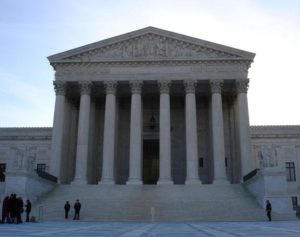
US Supreme Court – photo by Freeimages.com

President-elect Donald Trump is taking the oath of inauguration tomorrow (our time) burdened by a legacy of some 75 unresolved civil court cases. Trump or his businesses are involved in these cases, all at varying stages, with Trump as plaintiff or defendant. This would normally be business as usual for Trump, but for the fact that he is the President-elect.

Exhaustive research by US Today shows Trump and his businesses have been involved in more than 4,000 civil cases over the past three decades. They include branding and trademark cases, contract disputes, employment cases, personal defamation suits and about 190 government and tax cases. About half of the civil suits involve Trump’s casino businesses and a large number involve his real estate businesses.

US Today set a team of reporters and researchers on a monumental, ongoing task of tracing the litigious President-elect’s track record.

Of immediate concern are the 75 open cases in the background as Donald John Trump prepares to take office as US Commander-in-Chief.

The type of civil action which can prove difficult for an incoming President or Prime Minister is defamation. Some consider it unsporting for the leader of a country to sue someone (usually a media organisation) for defamation. As the number one public figure in a democracy, you’re supposed to roll with the punches.

This may not be the case with Donald Trump. During his presidential campaign, he threatened to sue all the women who accused him of unwanted sexual advances and also said he would sue media outlets who reported the claims. (By extension this ought to be worrisome to anyone who re-posted related remarks on Facebook or Twitter).

US Today say that although Donald Trump has frequently threatened to sue for defamation, he rarely follows through and has won only one of 14 cases since 1976.

It may well have been the case if he had not won the presidency that Trump would have pursued the women he called ‘liars’. However, it would seem a bridge too far to expect a brand-new President to deal with such distractions, which, if pursued to trial, could result in (President) Trump being called to give testimony under oath. So as his presidency begins, can we expect to see more civil cases being dropped or settled?

The BBC reported that Mr Trump faced three fraud cases related to Trump University, which closed in 2010. The first case, brought by students who claim they were deceived by Trump University’s marketing, was to have been heard 20 days after the election.

Although repeatedly saying during his campaign that he would “never settle”, in November Trump closed all three cases in a $25 million private settlement.

The issue of Trump and his legal legacy has not been greatly pursued by the media, but it is an immediate impediment and distraction to his getting on with making America great again.

The President-elect will no doubt make his own mind up whether he can afford to be distracted by these 75 legal challenges, carried over from his volatile business life and the long campaign to establish himself as a presidential contender. None of these cases can be ignored. As plaintiff he must either pursue his claim or withdraw. As defendant, he must defend or offer to settle. In just one example cited by the BBC, Trump is being sued by Republican political consultant Cheryl Jacobus. She filed a $4 million libel lawsuit claiming he “destroyed her career” by calling her a derogatory name on Twitter.

John Dean, former legal advisor to Richard Nixon, analysed similar outcomes for four other Presidents in a Newsweek article. Theodore Roosevelt, Harry Truman, John F. Kennedy and Bill Clinton all carried civil suits into the Oval Office. Most of these cases were quickly disposed of; however Bill Clinton was not so fortunate. Clinton vs Jones went all the way to the US Supreme court, which held that a US president is not immune from civil litigation involving matters occurring before he took office. If you had forgotten or were curious, searching Clinton vs Jones will take you on a journey.

I’ve been pursued by one or two lawyers whose clients claimed I had defamed them (in my newspaper reporting days). Typically, a news outlet can make a claim for defamation go away by printing or broadcasting an apology. Since most cases of libel amount to mistakes (the mistake occurred in the production process), apologising seems the sensible option.

Or the publisher can get on his high horse and defend the charges, which can, as you may have noticed, cost millions and go on for years.

It is often the case for those mounting a defamation case, here or in the US, that the length of time it takes to come to trial and the extent of legal costs increasingly encourages the aggrieved person to settle for an apology and (sometimes) an undisclosed amount.

I worry about people who make heated comments online about politicians. There’s no doubt the people they are castigating deserve a level of criticism. But it has to be defensible.

There have already been cases in Australia where people were sued for defamation over Facebook posts with some payouts approaching six figures. So next time you’re set to post about the neighbour’s barking dogs or the idiots who party till five in the morning every day of the week, take a break, go for a walk, calm down.

Meanwhile, here’s a bit of evidence that politicians may not always be prepared to take the flak that comes with being a public figure, Crikey has compiled a list of politicians who have sued Australian media outlets for defamation. It’s a long list.

As for Donald Trump and his ongoing civil litigation caseload, the length of time it takes for a case to come to trial may be one factor influencing decisions to settle. The average time (in America) from complaint to trial is 22 months and all that time the legal system’s meters are running. According to California Labour and Law’s Eugene Lee, a US Bureau of Justice Statistics national survey revealed that only 3.5% of disputes were resolved by trial. Most are resolved by settlement.

Columnist Sadhbh Walshe writing in The Guardian claims America’s ‘litigious society’ is a myth. He cites data that shows only 10% of injured Americans ever file a claim for compensation and only 2% file lawsuits.

“So we’re really not all that litigious, yet we continue to be treated with kid gloves as though all it will take is a scraped knee for us to be on the phone to our lawyers.”

This will be no comfort at all to incoming President Trump, whose net worth of $3.7 billion makes him an obvious target. US Today also looked into presidential candidate Hillary Clinton’s exposure to the courts. They found her named in 900 actions, most as defendant. More than a third of these claims were lodged by federal prisoners, activists and other citizens seeking redress from government.

The ‘pick a big target’ tactic seems at odds with the argument that the ‘litigious society’ is a myth. What do you reckon?


Elephant captured on Nullarbor Plain

elephant-nullarbor-plain
Photo by Mario Micklisch https://flic.kr/p/peLSQA

An African elephant dubbed ‘Ferd’ by social media followers has been cornered in an industrial shed near a roadhouse on the Nullarbor Plain. Ferd escaped from the Perth Zoo three months ago and has been spotted variously in WA and the Northern Territory. Facebook posts claimed sightings on Groote Eylandt.

Shed owner Tony is making a bit of cash on the side charging travellers $10 to pose for an elephant selfie. The Grey Nomad website www.welikefreestuff.dot described this as “exploitation” and lamented the lack of a seniors’ discount.

“It’s weird,” said Tony. “Everybody takes selfies to post on Facebook but nobody actually wants to talk about the elephant in the room.”

At which point you can see this  story about Ferd the elephant is not unlike the proliferating fake news stories on social media which commonly use a  headline and intro like this to suck you in. The more insidious fake news items, however, are portrayed as legitimate news stories and are often picked up and shared.

Satire is not fake news and vice versa

Some of the fake news websites which churn out stories cast themselves as satirists, but it is a loose label, apt to blow off in the wind. A yarn about an elephant wandering the Australian desert is probably satire.

It is satire when someone suggests the Pope is marrying (famous female pop singer) and running for the White House. Fake news is a story about the Pope endorsing Donald Trump (quickly debunked by hoax tracking website www.snopes.com.

WTOE 5 News, which broke the story, claimed that news outlets around the world were reporting on the Pope’s unprecedented endorsement. But Snopes found that no reputable news publications confirmed it, because WTOE 5 News, masquerading as a local television news outlet, does not publish factual stories.

But social media is not so discriminating. As Harvard University’s Nieman Journalism Lab pointed out, this fake yarn, which appeared in July, was shared almost 1 million times, versus 36,000 shares for the story debunking it.

One such story prior to the US election suggested the Amish had committed their vote to Donald Trump. Only 10% of Amish vote at all.

Another story suggested Barack Obama was abolishing the oath of allegiance in US schools. Sounds believable but simply not true.

Before people caught on to the idea of making money by spreading fake news on social media, the so-called supermarket tabloids cornered the market.

Here you will see obviously misleading headlines like “Diana is still alive” or “Hillary Gay Crisis” or “Aliens settle in San Francisco”.

By contrast, fake news stories circulated on social media prior to the election were entirely plausible – until you read to the end or read the website’s disclaimer.

But who has the time to (a) read the whole article before (b) sharing it or (c) checking out the veracity via factcheck.com or snopes.com?

Fake news here to stay

David Glance, writing in The Conversation, says fake news is driven by advertising and is here to stay. Glance, Director of Centre for Software Practice, University of Western Australia, says a great deal of the recent fake news targeted at Trump supporters appears to have originated in the Macedonian town of Veles. Websites with legitimate-sounding names fed pro-Trump fake news, which in turn generated large revenues from traffic generated through Facebook shares.

Glance says it may be tempting to think that news from reputable media organisations is more reliable, but they too are still influenced by partisan opinion and the pressures to advertise and generate traffic and sales.

“Ultimately, there is no protection from fake news other than to adopt a sceptical view of all news and take the truth of it on balance of likelihood and confirmation from multiple reputable sources.”

Facebook and parent company Google say they are going to crack down on fake news sites. The New York Times reported last week that Google would ban websites that peddle fake news from using its online advertising service. Facebook updated its policy, which already says it will not display ads on sites that show misleading or illegal content, to include fake news sites.

Paul Who?

So who are the people who spend their days (and nights) churning out fake news? Some publications have identified Paul Horner, described by Wikipedia as an internet news satirist and writer. Horner confesses to being as described and highlights a few of the stories he has written that have been picked up and shared by internet news sites. The Amish was his, so too Obama banning the oath of allegiance and Horner has recently told the Washington Post that he helped get Donald Trump elected.

Horner’s various websites pose as legitimate websites, but if you jump to the disclaimer, the author leaves himself an out by clearly stating that “…all news articles contained within are fiction, and presumably fake news.”

As David Glance observed, mainstream media is not immune to fakery, or at least allowing embellished news to be published. The blame is placed upon gutted newsrooms, where veterans with 20 years’ or more experience are replaced by school leavers and interns. The Guardian quoted an (un-named) journalist who described the pressure to perform online:

“So much news that is reported online happens online. There is no need to get out and doorstep someone. You just sit at your desk and do it and, because it is so immediate, you are going to take that risk. Editors will say, ‘The BBC got that six seconds before we did.’”

Some editors defend the bull at a gate approach as online news can be instantly updated (or taken down), when errors become obvious. FOMM can confirm this strategy as we have occasionally corrected minor errors on our website (it’s Hillary with two l’s, Bob).

Fake news is nothing new. As David Glance says, quoting French philosopher Michel de Montaigne (re the turmoil and divisions of 16th century France):

“Is it not better to remain in suspense than to entangle yourself in the many errors that the human fancy has produced? Is it not better to suspend your convictions than to get mixed up in these seditious and quarrelsome divisions?”

Fake news stories only a problem if you read them

Facebook has been blamed by some commentators for helping The Donald get elected, but it’s a specious argument. Filmmaker Michael Moore said people in America’s forgotten ‘rust belt’ made their minds up about Trump years ago.

Moore was interviewed in July by www.cnn.com (a real news website), where he talked about the reasons why Trump would win.

If he’s able to pull it off, it will be because on that day, a lot of angry white guys, a lot of guys who have a justifiable right to be angry — guys and women– who have suffered during the last decade,” Moore said.

The Pew Institute says 13% of Americans (about 41 million, 41% of whom are over 65); do not have internet access because: the internet is too difficult to use (34%), they have no interest in going online (32%), or internet access is too expensive (19%).

Moore’s angry white men were never going to be swayed by fake stories about the Pope or the Amish, if indeed they read them in the first place.