War mongers and interjections from ex PMs

war-mongers-ex-PMs
Bushmaster on patrol in Iraq 2008, Australian War Museum CC

Why is the media so enthralled with the utterances of ex-Prime Ministers, namely Paul Keating, John Howard or Kevin Rudd? Keating has been critical in recent months of the current government (his lot, I remind you) about defence issues.

Keating first lashed out at the Albanese Government in March over the nuclear submarine announcement. He described the $368 billion arrangement to buy nuclear submarines through the AUKUS defence pact as “the worst international decision by a Labor government since Billy Hughes tried to introduce conscription.” Strong words.

Keating used the National Press Club in Canberra to criticise Labor for its “incompetence” in backing the decision to sign up to AUKUS while in opposition. At the same time, Keating attacked policy decisions by defence minister Richard Marles and Foreign Affairs minister Penny Wong as “seriously unwise”, accusing them of allowing defence interests to trump diplomacy.

As it turned out, he was baying into an empty chamber, as veteran sleuth Brian Toohey discovered. The US (a key member of the AUKUS triumvirate) has said it cannot now sell three to five used Virginia class nuclear submarines to Australia, as Toohey related in the public policy journal, Pearls and Irritations.

Toohey wrote that the chief of US Naval operations Admiral Michael Gilday was recently reported from Washington as saying the US shipyards are only producing subs at a rate of about 1.2 a year. A minimum of two a year is needed to fill the US Navy’s own requirements. Until then, Gilday said, “We’re not going to be in a position to sell any to the Australians.”

“If Albanese were genuinely a good friend of America,” Toohey wrote, he would say ‘we don’t want to deprive you of any nuclear submarines, so we’ll buy readily available conventional subs that serve our needs’.

Toohey added, “Instead of grabbing this chance to get out of an impossible commitment, he behaves as if everything is still on track.”

The veteran journalist and author (he’s 79) broke numerous stories about national security and politics in his heyday, regularly receiving leaks that enraged and embarrassed politicians.

\The submarine deal is not the most recent example of ex-PM Keating getting stuck into his own party.

As The Guardian’s Paul Karp reported this week, Keating labelled the head of NATO, Jens Stoltenberg, a “supreme fool” for wanting to increase NATO’s ties with Asia. Keating’s comments coincided with Prime Minister Anthony Albanese’s travels to Germany and the NATO leaders’ summit in Lithuania. (NATO stands for the North Atlantic Treaty Organization.)

This state visit produced announcements about Australia’s material support for Ukraine via the donation of 30 Australian-made Bushmasters. Known in military parlance as Protected Mobility Vehicle or Infantry Mobility Vehicle, the Bushmaster is an Australian-built four-wheel drive armoured vehicle. ($2.45 million each).

Mr Albanese also confirmed on Monday that the German Army would buy 100 Australian-built Rheinmetall Boxer armoured vehicles. In case you did not know, this is something the Queensland government should be crowing about as the Boxers will be manufactured at Rheinmetall’s plant in Ipswich, near Brisbane. (The German company owns 64% of this joint venture – just thought you should know that.)

The Prime Minister’s announcements this week are yet another sign he and his executive team are well capable of making big decisions and acting upon them, despite criticism from the left and right. From my perspective, the Labor government seems to be a good deal more ‘hawkish’ than some of its predecessors. Then again, the top echelons of government in Canberra are no doubt privy to daily security briefings which could be prompting the escalating defence strategies.

Not the least there is China’s increasing economic and diplomatic push into the Asia Pacific, namely the Solomon Islands, Sri Lanka and Papua New Guinea.

Keating has been a strident critic of the Albanese government’s apparent strategy to prepare for possible aggression from China. He would prefer, I suppose, closed-door diplomacy.

Paul Keating, I’ll remind you, was infamous in his political career for an ability to deliver invective-laden tirades that inevitably drew headlines.

But who cares what Paul Keating thinks about anything? He had his day at the Despatch Box.

There’s a reason the likes of Rudd, Howard and Keating are ex-Prime Ministers. The people – that’s you and me and Freddie next door, not to mention their own party – got sick of them and voted them out. Brilliant, motivated and influential as they once were, they are not the least bit relevant now.

In tackling this topic, about which I know little, I relied on some expert research from the policy wonks who write for Pearls and Irritations (recommended), the Australian Strategic Policy Institute, and a defence blog which recently took a similar position on interjections by former PMs.

As Stephen Kuper wrote in DefenceConnect,

“Our world has changed significantly since the 1990s — gone are the heady days of elated optimism in the aftermath of the collapse of Lenin and Stalin’s “evil empire”,[ in its place] the global information super highway, a truly global economy responsible for lifting hundreds of millions, if not billions out of abject poverty, yet it seems, someone has forgotten to tell former prime minister Paul Keating.”

It is worth noting (from another source) that Australia’s Defence spending under the Keating government (1991-1996), was slightly above or below 2% of GDP, which is the financial benchmark for ensuring the country can be independently protected from aggression.

Defence spending was between 3% and 4% of GDP during the Vietnam war and has peaked above 2% at various times, including the 1980s when the world was in a relatively benign state.

Marcus Hellyer of the Australian Strategic Policy Institute wrote a two-part report in 2019 about the reasoning behind (and the flaws) of working on 2% of GDP. As he observed, GDP rises and falls, and any number of global crises can interfere with this way of calculating defence budgets. For example, former PM Kevin Rudd’s stimulus-spending during the Global Financial Crisis put a serious kink in the defence spending supply hose.

“As official predictions for GDP growth change, the Defence Department’s future funding changes,” Hellyer wrote. He argued that defence spending based on 2% of GDP was likely to fall short of the fixed-funding line presented in a 2016 defence white paper.

“If a future government sticks to 2% of GDP rather than the white paper line, the Defence Department would take a substantial funding cut.”

The strategic risk arises with what defence calls its ‘future force’, much of which will not be delivered until 2030. It is probably already unaffordable under the white paper’s funding model.

Australian Budget papers reveal a funding shortfall with the 2023-2024 defence budget ($54.9 billion), projected to be $5 billion short.

If I may editorialise now, that’s a serious problem for any Australian politician trying to wear big boots to a global foreign policy conference. While Albanese, Marles and Wong have been shoring up alliances with the US, UK, Japan and now, it seems, Germany, most strategic analysts agree that Australian needs to become more self-reliant (with the added financial burden that implies).

I was digging around looking for a quote about peace to finish this uneasy essay on a positive note and found one from an unlikely source.

Peace is not absence of conflict; it is the ability to handle conflict by peaceful means.” – Ronald Reagan.

Yep, he said it.

Celebrating Multicultural Australia

Australian Bureau of Statistics chart shows growth in population of people born elsewhere since the mid-1940s

Australia is more culturally diverse than ever, according to the first results from the 2021 Census. Almost half our population of 25.76 million people have at least one parent born overseas. Almost a quarter of Australians (24.8%) speak a language other than English at home. Just over a quarter (27.6%) report being born overseas (Ed: and that includes him and me – Scotland and Canada’s loss is our gain, we modestly reckon).

In the five years since the last Census, India has become the second-most common overseas country of birth, shifting New Zealand and China down the list. The above chart from the Australian Bureau of Statistics shows the shifting demographic.

Dr Sukhmani Khorana, Senior Research Fellow, Western Sydney University, says the growing number of first-generation migrants means Australians’ ancestry will change significantly over the next decade.

“Australia will continue to change and look different, and we must ensure our institutions and policies reflect this,” Dr Khorana wrote in The Conversation.

“That work, by governments and policy makers, should begin now so they can gain trust and maximise the belonging of these communities. Research shows feelings of belonging lead to better socio-economic outcomes”.

Dr Khorana believes there would have been substantially more immigration were it not for the COVID pandemic with its restrictions and lock-downs.

Dr Khorana highlights an important item from the Census data:

  • the number of people who are either born overseas or have a parent born overseas is greater than half (13.26 million people or 51.5%).

The data shows Australia is as multicultural or even more so than countries such as Canada, the United Kingdom and the United States. Canada’s latest Census (2016) showed that 21.9% of people were immigrants, led by people from South Asia. Similarly, data from the UK’s 2018 Census showed that 14% of the UK population was from a minority ethnic background. In the city of London, this figure was 40%.

Dr Khorana, who conducts research for migrant and refugee-focused organisations in Western Sydney, says Australia would have received more migrants had it not been for the COVID pandemic, which shut borders from early 2020.

Census data shows the pandemic led to an 80% decrease in the number of overseas visitors, which affected the tourism, hospitality and higher education sectors of the economy.

We also received fewer relatives of overseas-born Australians, for example on family-sponsored visas.

Our local refugee and migrant network organised an event in Warwick last Sunday. Visiting chefs prepared samples of ethnic food from five different countries. There was also music and dancing. About 60 adults and children showed up at St Mark’s Hall including two Hazara Afghan families wearing traditional dress.

Southern Downs Regional Council Mayor Vic Pennisi attended the event and made a short speech. Italian-born Cr Pennisi related his arrival in Australia as a child “with not one word of English. He grew up in Stanthorpe in a time he acknowledged was not as friendly towards ethnic minorities as Australia is now.

“I left school after Grade 10 and now I’m Mayor of the Southern Downs Regional Council and only in a country like Australia could you do that.”

The event, ‘A Taste of the Southern Downs’, was open to the public, with cooking demonstrations and a chance to sample dishes from South Korea, China, The Philippines, Afghanistan and Nigeria.

Southern Downs Refugee and Migrant Network organized the event with the support of a grant from the Queensland Government and sponsorship from Acciona’s McIntyre Wind Farm Project.

Our contribution to the event was to set up our PA, make a multi-cultural music play list and present a short set of Australian folk songs. Our theme was the Anglo-Saxon immigrant experience. She Who Still Has a Canadian Accent sung ‘Un Canadien Errant’, a traditional French language song about a young Canadian exile forced to leave Quebec.

We learned two new songs, Farewell to old England and The Shores of Botany Bay, and performed my immigration story, Rangitiki.

Earlier, we listened to guest speakers who impressed me with their command of English language. Even though most grew up in Australia, if you are from Asia, knowing what ‘cooking from scratch’ means is quite impressive stuff. Few of us could translate this to any of the many Asian dialects!

Likewise, a Hazara Afghan and friend of our group, related his story coming from Afghanistan as an unaccompanied minor in 2012. Now a confident young man with a good command of English, he gave some insights into the sacrifices refugees make when forced to flee their home countries. After a decade in Australia, he has only recently been re-united with his family.

Donations were raised for a Melbourne group, Hazara Women for Change. This group aims to support the ongoing education of Afghan women. Afghanistan’s rulers, the Taliban, have shut down schools and forbid women from receiving an education. That’s the least of the worries for persecuted minorities like the Hazara trying to survive within Afghanistan.

The United Nations recently released a report voicing concern over the Taliban authorities’ carrying out human rights violations with impunity. This included extra-judicial killings of individuals accused of affiliation with armed groups, but also cruel, inhuman, and degrading punishments, and excessive use of force by Taliban officials.

The report documented a total of 237 extra-judicial killings. Most of them (160), targeted former members of the Afghan military and government.

No matter how uncertain their future may be as refugees in Australia, Afghan citizens who were evacuated last August will be grateful to be here, although lamenting those family members left behind.

I had to do some digging to establish the 2021 population of people born in Afghanistan. As you might expect, given the upheaval in that country since the last Census, the Afghan population here has grown from 46,800 in 2016 to 67,030 in mid-2021. And that was before the Taliban came back and some 4,100 people with Australian visas were evacuated to this country, many of them Afghans. For perspective, there are about eight million Hazaras living in Afghanistan and neighbouring Pakistan.

While Australia is a multi-cultural country, the population is still dominated by English-speaking people who were either born here or came from countries where English is the first language.

The top five most common places of birth (outside Australia) are led by England (468,465), India (362,187), New Zealand (267,327), China (239,951) and the Philippines (113,035), followed by Vietnam, South Africa, Italy and Malaysia. People who ticked the ‘born elsewhere’ box numbered 364,949 (includes countries not identified individually by the respondent and people born at sea).

People from the UK still rank among the top five sources of ancestry including English (33%), Irish (9.5%) and Scottish (8.6%).

In his election campaign in May, then Opposition leader Anthony Albanese said becoming prime minister with his Italian surname would proves “you can do anything in this country”.

“We’re a diverse country, and the fact that I have a non-Anglo-Celtic name … I think it sends a message out there hopefully to multi-cultural Australia that you can achieve anything in this country,” he said after being elected in May.

Indeed. We also have a Senate leader named Wong.

It wasn’t always like that.

FOMM back pages (2018)

Multiculturalism under siege


Australia enters a brave new world

crossbench-history-green
Australia’s crossbench in history. Chart courtesy of Ben Raue

The reactions to Labor’s somewhat unexpected election win on Saturday night have reflected the about-turns that occur when the political climate changes. As always, there were positive opportunities for some. Sydney University wasted no time congratulating incoming PM Anthony Albanese, an alumni member. It should also be noted that former Prime Ministers who attended Sydney University included Gough Whitlam, John Howard and Malcolm Turnbull. So much for universities being the breeding ground of Marxists.

Former Liberal PM Malcolm Turnbull took to social media to wish Albo (as he is known in Aussie shorthand), all success in his new job ‘from one good bloke to another’.

Another former PM, John Howard, was drafted late into the Liberal campaign to mix it up in marginal Sydney seats in an election Howard said was ‘too tight to call’. As far as I can tell, Mr Howard has not had anything to say in the aftermath of Saturday’s poll. Why would he?

The Guardian’s top satirist, First Dog on the Moon, gave a harsh farewell to Scott Morrison’s government: “Good riddance you jabbering ghouls.” At the same time, the cartoonist was sharpening his quill ready to skewer the incoming PM. One dog says “I love Albo, I really do” while the other says Albo is a “gazillionaire landlord with a bunch of properties”. (His register of interests doesn’t indicate this. Ed) It won’t take long for the honeymoon to end.

Fair to say the Labor Party did not win this election – rather, the Liberal Party lost it, giving up seats not only to Labor but the Greens and Independents. The Greens improved their national vote, up 1.9% to 12.3%. This might give you some clue to the voting tendencies of young voters.  As polls had shown, the 18-34 cohort was most worried about climate change. Given that neither of the major parties had bold things to say in the campaign about the climate crisis, it’s not surprising that young people would vote Green.

My favourite pundit accurately predicted the partial disintegration of the major parties vote in favour of independents. Veteran blogger Everald Compton wrote an unequivocal essay detailing why the Liberals would lose seats (and where) and who would gain. He was mostly right.

Top of Everald’s wish list was that we would end up with a Prime Minister who is neither Albo or ScoMo. Well that didn’t quite happen, but as the 90-year-old blogger rightly asked:

“Why have we reached this point where politics is at its lowest ebb of my lifetime. Indeed, a huge percentage of voters rank it as the lowest of the low?

“The cause is that political parties on both right and left are tightly controlled by small groups of power brokers who produce privileges for elite people, while arrogantly insisting that it is all really ultra democratic.”

The mainstream media, represented for the most by Rupert Murdoch’s News Ltd., is still to fully mount a persuasive argument as to how and why their editorials got it so wrong.

Retired News executive Chris Mitchell came out swinging, blaming journalists, particularly the ABC, for inaccurately portraying Scott Morrison as someone who had a problem with women.

Peta Credlin and others on the conservative channel Sky News had some predictably caustic things to say which lost their sting as a result of the undeniable swing to Labor, Greens and Independents.

Former PM Kevin Rudd, who is leading a campaign for an inquiry into News Corp and the power it wields, posted a telling graph on social media. It showed that in the lead up to the election, News Corp front pages ran 188 pro-Liberal stories, compared with just 38 for Labor and 99 ‘neutral’. Our State newspaper, the Courier-Mail, carried more than a few anti-Labor stories, going hard with an ‘Albo’s S****show’, story based on the Labor leader’s first campaign gaffes, including not knowing the current official interest rate. (By the bye, I didn’t know what it was either).

The media in general will have some dungeon-searching to do, given the extent to which their political writers failed to see the rout coming, particularly Western Australia’s swing against the Liberals.

American broadcaster CNN reported the election result as a clear win for climate action. CNN said the election showed a strong swing towards Greens candidates and Independents who demanded emissions cuts far above the commitments made by the ruling conservative coalition.

CNN said the climate crisis was one of the defining issues of the election, as one of the few points of difference between the Coalition and Labor, and a key concern of voters, according to polls.

Marija Taflaga, lecturer in politics and international relations at the Australian National University, said the swing towards the Greens was remarkable. “I think everyone has been taken by surprise by these results…I think it will mean there will be greater and faster action on climate change more broadly.”

Labor has promised to cut emissions by 43% by 2030 and to reach net zero by 2050, partly by strengthening the mechanism used to pressure companies to make cuts.

As the Prime Minister-elect headed to Tokyo for talks with the leaders of the US, India and Japan, China made its first official comment on the election win.

As the ABC reported, Beijing showed it is willing to patch things up with the newly elected Albanese government after more than two years of a cool relationship with the former government.

Premier Li Keqiang’s congratulatory message used ‘warm language’ referencing the Whitlam Labor government’s establishment of diplomatic ties with the People’s Republic 50 years ago.

Mr Li said China was “ready to work with the Australian side to review the past, face the future, uphold principles of mutual respect, mutual benefit.”

While vote counting continues (it could take a week or more to decide the close seats), one thing is certain, this government will have the largest cross-bench in our history.

The cross-bench refers to independent politicians who usually vote with the government but can and will cross the floor to vote with the opposition if so moved. Australia has only ever had between three and five cross-benchers.

This time around, there will be 15 and maybe more Green and Independent politicians helping to inform the government of the day.

As Everald Compton said last Friday, this will create a long overdue and stable government that achieves progress and prosperity with justice and compassion.

“The Coalition will be decimated and divided and in need of total reform as they have self-destructed.

“The remnants of the Liberal Party will break up, with the Pentecostals separating from the Moderates. The National Party, having lost seats, will have a bitter leadership turmoil. Their extreme right will join with the Pentecostals.” (Everald was wrong about the National Party losing seats- they were re-elected in all of the seats they held before the election. Otherwise, his predictions are pretty accurate. Ed)

The one big loser from Saturday’s election is the United Australia Party, which reportedly spent $100 million trying to make an impact. UAP won no seats and only improved its vote by 1.7% to 4.1%. By contrast, the Legalise Cannabis Party attracted more than 75,000 Senate votes on a shoe-string budget and may gain a Senate seat, at the expense of perennial campaigner Pauline Hanson.

The shape of things to come may be that Albanese’s Labor government will need support from the cross-bench to introduce new policy. The numbers so far suggest Labor should be able to govern in its own right. Failing that, welcome to a European-style government where Greens and Independents have the final say. It’s not a bad thing.

Hoarding, Free Vaccines, Panic Buying

Hoarding-vaccines-panic-buying
Image of COVID-19 by iXimus from Pixabay

Life goes on, amid news reports of panic buying and hoarding, as reporting of the coronavirus (COVID-19) continues to terrify the masses. We have seen manifestations of this terror in the past fortnight with an (ongoing) share market correction, led by the US and blindly followed by investors in Australia and elsewhere. So far it is no more dire than the corrections during the GFC. The popular theory is that global share market investors fear the effect the coronavirus could have on business, imports and exports and the ever-valuable tourism market.

The seven-day share market correction was followed at home by reports of panic buying of non-perishable groceries. Shelves were cleared in supermarkets, amid assurances by retailers that their supply chains were solid. Hand sanitiser is at the top of a curious list.

Toilet paper was one of the items bought in bulk, prompting one Australian supermarket chain to limit sales of dunny rolls to one four-pack per person. Social media gurus have been busy making memes of Aussies swathed in dunny paper, speculating about what sorts of things one needs to hoard, assuming the worst (global contagion, financial mayhem, collapse of law and order).

I looked but could not find references to food or toilet paper in this list from a survivalist website. There are lots of solid tips about water filtration, fire-lighting, charging batteries (with solar), emergency lighting, fishing equipment and a multi-use gadget called a Spork. Oh, and they list a variety of weapons for hunting and self-defence including a crossbow.

By happenstance, last week I picked up a battered copy of The First Horseman by John Case from a public library sale.

The plot involves a virologist (and a journalist), who is trying to locate and exhume five miners who died of Spanish Flu in 1918 while working in the Arctic. The bodies are buried in ice, so the plan is to harvest the hopefully preserved Spanish Flu virus and develop a vaccine. You guessed it, there’s a bad guy; a megalomaniacal cult leader who thinks there are too many people in the world.

As I continued to read The First Horseman, cases of coronavirus increased world-wide. As of 1st of March, there were just fewer than 80,000 cases in China (3.5% death rate) and some 7,000 cases in other countries, with a death rate of 1.4%). In Australia, the number of reported cases rose to 41. The World Health Organisation (WHO) has previously said the mortality rate of coronavirus varies from 0.7% to 4%, depending on the quality of healthcare and the urgency of the response in affected countries. This week the WHO upgraded the mortality rate to 3.4%, which brings us back to comparisons with the Spanish Flu which had a mortality rate of 2% to 3%, although it afflicted some 500 million people around the world. Author John M Barry put it in perspective when he said in his book The Great Influenza that the flu killed more people in 24 weeks than HIV/AIDS did in 24 years.

A major study done by Chinese researchers said that 80.9% of people diagnosed with Coronavirus exhibited mild symptoms and recovered. Only 13.8% of cases were described as severe and only 4.7% as critical. The highest fatality rate is for people aged 80 and older, at 14.8%. The majority of people who died suffered pneumonia-like symptoms.

Pneumonia is a lung inflammation caused by bacterial or viral infection. (Have you had lunch yet?).The air sacs fill with pus and may become solid. Inflammation can affect both lungs.

Patients usually spend a few days in hospital hooked up to intravenous antibiotics and oxygen/nebulisers to help them breathe. Some forms of pneumonia are contagious. You didn’t know that? Yes, it spreads the same way as the common cold and other viruses.

Pneumonia in the elderly happens fast and the prognosis is poor. The elderly are more susceptible to severe pneumonia, which has a mortality rate as high as 20%. Of the 2.6 million pneumonia deaths in 2017, 1.13 million were aged 70 or older.

Egad! Now where did I file that letter from the medical centre – the one offering (free) immunization for pneumonia? Yes, it’s true; there are advantages to crawling over the peak of the hill, past the 69 sign. I am eligible for a bone density scan ($125), a shingles vaccine ($217) and a vaccine against catching pneumonia ($133), free of charge.

I recommend this reliable website to track the escalation of coronavirus. Of the 52 Australians diagnosed with the virus, 22 have recovered, two have died and six (including health workers in aged care facilities), are the only patients who did not have a recent history of travel to high-risk countries.

It’s not so easy tracking the health of the global share market.Global investors are second-guessing themselves, ignoring Tuesday’s rally (after a seven-day selloff which hacked 11% off the value of the market). On Wednesday, the all ordinaries index was down 113 points after Tuesday’s Reserve Bank interest rate cut. It bounced back again on Thursday by a similar amount and yes, down 111 points on Friday morning.

The volatility is a finger in the air to the world’s central banks, which seemingly colluded in a co-ordinated campaign to cut rates. The conundrum for investors is this: invest in term deposits or bonds and let inflation erode your capital, or trust the share market to claw back value, restore confidence and keep paying dividends.

Despite the clear fact that losses on a share portfolio are paper losses unless physically sold, a major market correction triggers certain events.

The young and brave who hold ‘geared’ share portfolios probably faced a ‘margin call’ last week. Gearing means borrowing money from a financial institution to buy listed shares.

The main catch with borrowing money to buy shares is this: if your portfolio (valued say at $100k), drops in value to $85k, you, the borrower will have to find $15,000 in cash to cover the lender’s risk.

A major study of investors carried out by the Australian Stock Exchange concluded, inter alia, that only 5% borrow to buy shares. Nonetheless, in a survey asking investors this very question, up to 60% of those aged between 25 and 44 seemed keen on the idea.

The other event triggered by a share market collapse is that those retirees receiving part pensions from the government have to report what Centrelink describes as a ‘change in your circumstances’.

So if your part-pension is calculated on assets, you duly report a 10%-12% decrease in the (paper) value of your share portfolio. This should increase your part-pension proportionately. As usual, if you don’t sell, nothing changes apart from the balance on a spreadsheet.

So, of these two global contagions, which will first be healed?

As the ABC’s Alan Kohler pointed out, despite the correction, Australian shares are still over-valued. My take on the share market volatility is to say that when a market is down 200 one day and up 120 the next, day traders are making a killing.

But market volatility is a risk in itself as the fear contagion wafts down to Mums and Dads investors, who all may decide to hide it under the mattress.

As for the coronavirus, senior citizens’ organisations are taking modest steps to ensure their constituents (the age group most at risk) follow simple but effective rules to avoid spreading viruses.

I actually think this set of rules ought to apply in general, adding: “If you are sick, stay home until you are not.” (To which the bolshie Ed aka SWPT adds, that’s one of the many problems of a casualised workforce- even if you’re sick, you can’t afford to stay home – ‘do you want germs with that?’)

Bushfire smoke, dust storms and asthma

Bushfire-smoke-Brtisbane
Image: Bushfire smoke over Brisbane CBD from the Convention Centre, November 11, 2019. David Kapernick © David Kapernick Photography

Images of Brisbane shrouded in an asthma-inducing smoky haze on Monday reminded me of Queensland Ballet’s season launch in 2009. We had driven down for the matinee on a day when a massive dust storm was predicted. By the time we came out, the dust haze was so thick you could barely see the ABC headquarters across the road from the Lyric Theatre.

No doubt those of you who remember that were reliving it on Monday, only this time it was bushfire smoke, drifting in from all sides: NSW, the Sunshine Coast or from Cunningham’s Gap where the highway has been closed since Sunday .

ABC’s 7.30 report invited an air quality specialist on to the programme who judged Brisbane’s air quality on November 11 to be 6 times above the level when air pollution starts to cause problems for people with respiratory problems. On that day, air quality in Queensland’s capital city (population 2.28 million) was worse than China’s biggest city, Beijing (population 21.24 million).

We tend not to get such alarmist warnings on days when plain vanilla air pollution is bad. It is the obvious nature of bushfire smoke (the smell, the poor visibility, the 24/7 media attention), that raises it to public alert level.

The reason health authorities get worried about bushfire smoke in the atmosphere is that the fine particulate matter in the smoke is hazardous to health. Moreover, the longer it takes to clear, the more serious the risk of exposure becomes. Particulate matter known as P10 and P2.5 are harmful to humans and animals: other sources of these fine particulates include power stations, vehicles, aircraft, and dust from unsealed roads, residential wood fire smoke, bushfires and dust storms.

Brisbane’s topography doesn’t help – the city lies in a basin and is prone to temperature inversions, which trap polluted air. Many cities around the world share this fate. Temperature inversions happen when the air is warmer above the pollution that the air on the ground. The smog is trapped, to the detriment of inhabitants in cities including Beijing, Los Angeles, Chengdu, Lima, Milan and Mexico City.

Before we get into air pollution and air quality monitoring, let’s run a short history of asthma, for the benefit of the nine out of 10 lucky Australians who don’t suffer from it.

In 400 BC, Hippocrates came up with the Greek word for asthma (άσθμα), to describe noisy breathing, the characteristic wheezing which so often signals an asthma attack.  Hippocrates (himself) was the first physician to link asthma to environmental triggers and specific, hazardous trades like metalwork.

In layman’s terms, asthma is describes the situation in which you can breathe in but have difficulty breathing out. Someone in the throes of a bad asthma attack is over-inflating their lungs, quite possibly making it worse by hyperventilating.

Medically, it is described as a narrowing of the airways, usually averted by the administering of an inhaled bronchodilator medication or a steroid-based preventer.

Patients presenting at emergency departments with severe asthma are often put on a nebuliser, a machine which administers an inhaled bronchodilator through a mask worn over the mouth and nose.  As I recall, last time I was on a nebuliser (when suffering anaphylaxis), relief was rapid and restorative.

Excuse me if I sound really old, but I recall taking tablets for asthma, before inhalers became commonly prescribed. In the 1940s and 50s, asthmatics were either given epinephrine injections (adrenaline) or aminophylline tablets. As I recall, the latter made me jittery, wakeful and a bit weird, although childhood friends would tell you I was like that already.

Statistics maintained by Asthma Australia reveal the burden of the disease on individuals, their carers and Australia’s health system. The cost of the disease, measured by its long-term impacts, was $28 billion in 2015 ($11,740 per person).

In 2017-208, there were 38,792 hospitalisations in which asthma was the main diagnosis; 44% were for children aged 14 or younger,

People with asthma are more likely to report a poor quality of life, but medical practitioners now are more pro-active about encouraging patients to have an asthma plan. But more needs to be done, with fewer than one in five asthmatics aged 15 and older having a written plan.

bushfire-smoke-astham
Bushfire smoke at Yangan, drifting in from Spicer’s Gap. Photo by Bob Wilson

(Note to self: this includes you, Bob. Make sure you have a spare puffer for times when (a) the puffer runs out (b) you have lost or misplaced it or c) the air looks like this).

The rate of deaths from asthma has remained stable since 2011. There were 441 deaths due to asthma in 2016-2017.

Mortality rates are higher for people living in remote or lower socioeconomic areas, and for Aborigines and Torres Strait Islanders.

Meanwhile, parts of Queensland and NSW remain shrouded in bushfire smoke. Numerous scientists and firefighters have voiced concerns that this may only be the beginnings of a long, dry and bushfire-prone summer. Climate change-denying pollies bewilderingly blamed the Greens for conspiring to limit hazard reduction burns.  Cathy Wilcox brilliantly summed this up in a four frame satirical cartoon (2nd one down the page).

The Guardian took the fact-checking route.

On November 11, the World Air Quality Index rated several areas of Brisbane including Rocklea, South Brisbane, Woolloongabba, Wynnum, Wynnum West, Lytton and Cannon Hill as ‘very unhealthy’.

The state’s chief health officer Jeannette Young told the ABC that everyone should stay indoors for the next 24 to 48 hours.

“Treat this seriously and don’t be complacent. Whether you’re in Logan or Lowood or anywhere in between, everyone needs to limit time spent outdoors while these conditions remain,” Dr Young said.

The term “particulate matter” – also known as particle pollution or PM, describes the extremely small solid particles and liquid droplets suspended in air. PM can include soil dust and allergens and their size affects their potential to cause health problems.

PM10 refers to particles with a diameter of 10 micrometres or less (small enough to pass through the throat and nose and enter the lungs).

PM2.5 refers to smaller particles able to enter the blood stream, causing serious adverse health effects over time.

So what’s ‘normal’ and how does that compare to Remembrance Day in Brisbane? The World Health Organisation (WHO) says the average PM2.5 level of cities across the globe measured over a 24-hour period is 35µg/m (or 3.5 micrograms per cubic metre). An ideal level of pollution (no negative health impacts), is 25µg/m.

The Brisbane CBD was at a PM10 and 180µg/m at 9:00am on Monday – 10 times the amount of pollution on an average day.

As we so often blithely say: ‘it’s a first-world problem’.

The WHO estimates that 1.6 million people die every year in India from air pollution. India has some of the most polluted cities in the world. This report from the BBC attributes air pollution in Delhi to motor vehicles, construction and industrial emissions, the burning of crop stubble and the residue of fireworks set off for a Hindu festival.

In early November P2.5 levels in Delhi were seven times higher than Beijing in early November, the report said.

If you were paying attention, those comparisons also applied to Brisbane on Remembrance Day, 2019. Lest we forget.

Further reading: https://blissair.com/what-is-pm-2-5.htm

https://bobwords.com.au/whipping-dust-storm/


Solar no easy energy fix

solar-energy-power
Solar-panels-energy Photo by Bob Wilson

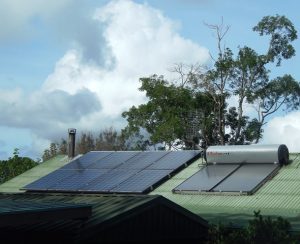
Solar energy is great – we’ve got eight panels on the roof, a hot water system and a portable panel in the caravan. Pretty useless on Thursday, though, with ex-cyclone Debbie sending heavy rain our way. It would be great if we’d had a battery bank under the house to store the energy from the sunny weeks we’ve been having.

But battery bank technology is yet to become affordable for the 1.6 million Aussies who have solar PV panels.

I recently wrote about Australia’s troubled National Energy Network. We cited economist Professor John Quiggin, who suggested governments buy back the power grid and give the people what they want: cheap and reliable energy. Continue reading “Solar no easy energy fix”