Submarines or social housing?

housing-crisis-homelessness
Image by Jon Tyson www.unsplash.,com

One of our readers commented that on the same day the media were banging on about the Federal Government’s $368 billion submarine plan, a lone SBS panel programme focused on the national housing crisis.

It is tempting to compare spending on affordable housing with the capital cost of up to five nuclear-powered submarines. The Federal Government’s (annual) commitment to affordable housing (currently $1.6 billion), equates to about 13% of its annual submarine budget (ie if the $368 billion is spread equally over 30 years). This assumes that successive governments will continue to spend that much on affordable housing (and submarines).

While housing is the responsibility of individual States and Territories, the Federal Government develops national policy and funds it with grants to the States and Territories.

That’s the theory, but in reality the critical shortage of housing, the cost of housing and the rising tally of homelessness is a clear and present danger to Australia’s social stability. Just this week the 2021 Census data on homelessness was released – what kept them, you might ask?

More than 122,000 people in Australia experienced homelessness on Census night, an increase of 5.2% from 2016, according to the Australian Bureau of Statistics (ABS).

The ABS interpreted the numbers as representing 48 people for every 10,000 people, compared with 50 people for every 10,000 in 2016.

While that is a reduction, the historical snapshot would seem to be an unreliable statistic, given that measures to reduce the spread of COVID-19 throughout 2021 contributed to some of the changes in the data.

“During the 2021 Census, we saw fewer people ‘sleeping rough’ in improvised dwellings, tents or sleeping out, and fewer people in living in ‘severely’ crowded dwellings and staying temporarily with other households,” ABS spokesperson Georgia Chapman said.

The affordable housing issue is not just about people sleeping in doorways. A new report produced by the Queensland Council of Social Services (QCOSS) clearly shows that working families are among those falling prey to the acute rental housing market shortage. It’s worse in some States than in others.

The report from QCOSS and The Town of Nowhere campaign is sobering reading. It predicts more than 220,000 households in the State will not have affordable housing within 20 years.

The report was prepared by national housing expert, University of New South Wales Professor Hal Pawson, and UNSW colleagues.

The tough conclusions include that there are around 150,000 households across Queensland with unmet housing needs. This includes 100,000 households who would typically be eligible for social housing. These households are either experiencing homelessness, or are low-income households in private rentals, paying more than 30% of household income in rent.

The figure is more than twice the official indicator of 47,306 households on the Queensland social housing waiting list. The latter has grown by 70% over the past three years.

Un-met housing needs are highest in satellite cities south of Brisbane. Pawson’s study shows that 10% of all households in Logan, Beaudesert and Gold Coast are homeless or living in unaffordable housing.

Professor Pawson said Queensland would need 11,000 affordable and social homes each year for the next 20 years, about 2,700 of which would need to be social housing.

He told the ABC the government had promised to build 13,000 social and affordable homes by 2027. But the QCOSS report found that the number of people with “very high need” for social housing was 37% higher than the system could accommodate.

In the decade leading up to 2017, there was “minimal” investment by State and Federal governments in affordable and social housing, Professor Pawson said.

“Unless they can get a grip on the situation, it’s a problem that over the next generation will continue to become more stressed and more pressurised.”

Much of the blame for the current problem is laid at the feet of private landlords. Private rentals in Queensland have risen as much as 33% since 2020. The sharpest increases, however, have been in regional markets. For example, over the past five years median rents rose by 80% per cent in the industrial town of Gladstone, by 51% in the tourist town of Noosa and 33% in the Gold Coast area. Nearly 60% of low-income households in the private rental market are facing unaffordable housing costs, with 15% in extreme housing affordability stress (rent accounting for more than half of total income).

While rentals have risen steeply, the bigger problem is a lack of rental accommodation. Rental vacancies are close to zero not only in Brisbane and the Gold Coast but also in regional towns.

The report states: “Queensland’s private rental housing has seen several years of declining vacancy levels and rent inflation rates far above the national norm. More generally, the sector remains entirely dominated by small-scale investor landlords whose usual prioritisation of capital growth over rental revenue inherently compromises tenant security.”
The upshot of this is that landlords are selling on the rising market, resulting in fewer houses for rental. Coupled with this is the inadequacy of tenant rights on rents, security and conditions. The Queensland Government enacted significant rental regulation reforms in 2022, but these fell far short of the changes advocated by tenants’ rights campaigners.

The Productivity Commission reported last year on the National Housing and Homelessness Agreement framed by the Albanese Government.

The agreement provides $1.6 billion a year in federal funding to the States and Territories, with the aim of improving access to affordable and secure housing.

However, the Commission judged the programme ineffective and in need of a major shake-up. With rents rising and vacancies falling, low-income private renters are spending more on housing than they used to. One in four households have less than $36 a day left for other essentials, the Commission said.

For those who might argue against more investment in social housing, there are success stories. The Queensland Government has funded a small number of permanent supportive housing (PSH) tenancies for people who have experienced long-term homelessness. PSH combines subsidised long-term housing with access to intensive but voluntary support services. One PSH programme, Brisbane Common Ground (BCG), established in 2012, is a 146-unit apartment block with 24/7 on-site support. Studies reported high tenancy sustainment rates and tenant satisfaction levels. It also produced significant savings via reduced use of emergency services and crisis accommodation. (QCOSS Report).

Despite the success of projects like BCG, there are many examples of State governments backing away from the commitment to social housing. For example, the New South Wales government is reportedly preparing to sell its Waterloo social housing complex in Sydney. The ABC reported that Waterloo Estate, the biggest social housing estate in Australia, houses almost 2,500 people.

The 18ha site will be redeveloped under a NSW government strategy called Communities Plus, where public land is offered to developers on the proviso 30% of what they build is dedicated social housing. This is clearly a retrograde move away from a project that is 100% dedicated to social housing. Meanwhile, more than 51,000 hard-pressed households are waiting for a home in NSW.

In an even more backward step, Darwin’s local Council has reportedly been issuing $162 fines to ‘rough sleepers’. The latter may or may not be indigenous people known as ‘longgrassers.’ (see link below)

Darwin Council issued a statement saying it had been subject to significant pressure from some current Northern Territory government MLAs. The MPs wanted to increase the number of infringements (and the size of fines), issued to vulnerable people who are sleeping rough in public places. (And what happens when these people cannot pay the fines? Imprisonment for non-payment? I guess that’s one way of getting people off the streets..Ed)

In its defence Council said council rangers issued fines as a “last resort”.

“We do not consider the fining of vulnerable people the solution to complex issues such as homelessness.”

More reading

https://www.theguardian.com/australia-news/2022/jul/12/queenslanders-miss-out-on-social-housing-due-to-failures-to-build-homes-and-inaccurate-waiting-lists

https://www.drbilldayanthropologist.com/resources/Longgrass%20people%20of%20Darwin%202012.pdf


A dystopian view of contactless travel

contactless-travel-cctv
A pigeon’s view of CCTV cameras

Amidst the airport’s security cameras, facial recognition technology and contactless check-in, it took a dog (and a human) to catch me out. We were about to exit customs in New Zealand when a customs officer with a beagle on a lead passed us by. The beagle tracked back, put his front paws on my trolley and sniffed at my black shoulder bag.

“Have you had food in that bag, Sir?” the Customs Officer asked.

“I bought a sandwich at the airport in Brisbane and ate it on the plane,” I explained.

“What kind of sandwich was it?”

“Um, chicken – chicken and avocado.”

She smiled: “Right, well he’s trained to sniff out chicken.” She gave the dog a treat and we continued on to the exit.

Apart from a side trip to the duty free shop, this was the only human contact we had, coming and going, apart from a tired-looking Brisbane customs officer at the end of a very long queue, collecting arrival forms and pointing us to the exit.

When tackling the now ubiquitous automatic check-in kiosk, I began to realise that my new passport, complete with a photo of a stern-looking 74 year old, contains a microchip which identifies me on facial scanners.

As Smart Traveller summarises:

All Australian passports, except for emergency passports, are ePassports. An ePassport contains an electronic chip that helps to confirm your identity. International airports in Australia, and some overseas, allow Australians with ePassports to use automated passport control machines.

At our point of departure were check-in kiosks where your boarding passes are printed from a machine, along with baggage tags. The first time I tried this I accidentally pasted the baggage receipt (which you are supposed to detach but nobody explained that) on the checked-in bag. A burly chap watched as I hefted my 16kg bag on to the conveyer belt. He kindly retrieved pieces of bar code from my sticker and pasted them on the side of my suitcase. Then we proceeded to Customs check-in where you had to pour out perfectly good water, remove everything from your pockets (belt, wallet, passport, phone, even a soggy hankie) and stand like The Terminator  in the X-ray machine.

I dislike having to remove my belt as I have enough trouble keeping my pants up with a belt. Once I’d passed through X-ray and been re-united with my stuff, I stood around in everyone’s way and took as long as possible to put my belt on, stuff the hankie back in my pocket, etc.

“Move along please, Sir.”

Now to the duty free shop, where assistants (all two of them), limited conversation to “$72.99 – on card?”

By the way, who carries cash in these times? One day we are all going to get caught out like we did when trapped in a post-Cyclone town.

Power cuts and cell phone outages neutered ATMs and EFTPOS machines all along New Zealand’s east coast. Did they not think of that?

(I distinctly remember whingeing about that at the time, as well as complaining on behalf of our country cousins who can’t rely on the Internet. Ed)

My lasting memory of leaving Auckland (after going through the same contactless palaver), was a life-sized cardboard cut-out of a smiling airport employee, bidding us ‘Haere Ra’ (goodbye come again).

The people that used to do that sort of job are probably working unsociable hours at one of the airport’s fast-food joints.

One of my friends who found himself unexpectedly flying to England for his mother’s funeral, clutching an emergency passport, commented on Facebook about travel in 2023 – “It’s not like it was.”

One could imagine he was not in the mood, but he’s right – the absence of friendly people making sure we end up in the right place together with the security overkill at both ends is exhausting. On a brighter note, at least no-one comes through the aircraft spraying insecticide before you disembark. Remember that?

Dirk Singer writes that the contactless travel trend began during the Covid pandemic as a means of limiting human contact. Understandably, the whole world was concerned about this in 2020 and 2021, Maybe not so much in 2022 and 2023, but the trend has been accelerated by the acceptance that our face is now our boarding pass.

Biometric scanners can be quite confronting if you are among the 40% of people who get anxious when they travel. The machine barks at us: stand there, remove your glasses, stay still, don’t smile. If we somehow manage to put our feet in the right place and follow the rest of the instructions, the little gate will slide open just long enough to let one person through. I briefly wondered what would happen if you just stood there in the gate, like a reluctant sheep? How long would it take for one of the few remaining airport employees to arrive and sort you out?

There’s more social distancing to come. Some companies are trialling robotic food deliveries within airports. How long before the food trolley coming down the aisle is driving itself? Crikey, even the dunny flushes itself.

The latest developments envisage robots staffing airport check-in desks, carrying out security protocols, cleaning and even delivering food to passengers waiting in airport lounges.

The proponents of contactless travel (airlines) like to tell us it is safer, healthier and less stressful. Yes, but what about those of us who routinely lose our minds when in the confines of an airport (or to a lesser degree, a railway station)?

According to kiwi.com, 40% of people become anxious to some extent at the thought of travelling on an airplane. Moreover, 6% of people are affected by aviophobia — the clinical fear of flying.

As for Facial recognition scanning, it has been around for a long while now. In addition to its use at airports, these days it is used by police and security services to review CCTV footage. As you probably know, Great Britain once led the western world when it came to installation of CCTV cameras (4 million). I clearly recall a Billy Connolly travelogue where he encountered one of the silent watchers on a bridge in Scotland. Billy being Billy leaned into the lens and extended his middle finger.

‘Person of Interest’, a TV drama series frequently featured investigators scanning crowds, using facial recognition technology. Suddenly they have a hit. The person of interest’s file pops up on the right side of the screen. Nowhere to hide, just like George Orwell’s protagonist Winston Smith in 1984.

The combination of CCTV and facial recognition used by governments and private enterprise has the personal freedom movement in a panic.

Last year there was considerable outrage when Choice magazine broke a story that major Australian retailers were collecting biometric information in-store. Bunnings, KMart and the Good Guys all agreed to ‘pause’ their use of the technology while the legality is being assessed.

As for the spread of CCTV cameras, Comparitech.com’s Paul Bischoff ranks China at the top of a global survey of cities under surveillance.

China has an estimated 540 million surveillance cameras (54% of the global total) to cover 1.46 billion people. That’s 372.8 cameras per 1,000 people. (The latest development in China is to identify people jaywalking and send them an instant fine (by text).

Sydney, at the other end of the scale, has 4.67 cameras per 1000 people and Melbourne 2.13. So where would you rather live?

There’s a lot in this study and it is hard to make comparisons. But the inescapable truth of it is, like Orwell’s Winston Smith, we are all being watched.

It was terribly dangerous to let your thoughts wander when you were in any public place or within range of a telescreen. The smallest thing could give you away.” Winston Smith, 1984.

Squeezed between inflation and interest rates

inflation-interest-rates
The Australian cash rate since 1998 (Reserve Bank of Australia chart)

I just happened to be reading a novel set in the Edwardian era at the same time as the media was going bonkers (again) about the Reserve Bank raising interest rates by 0.25% to 3.6%. In Louis de Bernieres’s* book, The Dust That Falls from Dreams, one of the characters is holding forth about the sudden rise in the bank rate and subsequent collapse of the share market in 1914.

Hamilton McCosh, a daring entrepreneur and investor, is at first delighted when the bank rate goes to 4% because he has ‘a few bob invested here and there’. Then the rate doubles to 8% and quickly rises to 10%.

“Just as I was gleefully rubbing my hands the blighters closed the Stock Exchange”, he tells his pals at the Atheneum, a gentlemen’s club.

This is late July 1914, you gather, a few weeks before World War I broke out. McCosh didn’t know then that the stock market would stay closed for five months. Rather than cause inflation, this financial crisis functioned like the ultimate credit squeeze. Inflation stayed low, well at least until 1915, when it rose rapidly to 12% then to 25% in 1917.

In the pre-war period, De Bernieres’s McCosh is aghast – you can’t get credit anywhere and there’s a rout on the stock market. “What’s Serbia got to do with us?” he complains.

In 2023 you could insert “Ukraine’“and immediately realise that we have seen cycles like this before. In times of war, the supply of money is tested, oil is expensive and hard to source, there is much unemployment, securities can’t be sold and supplies of necessities are dwindling.

The 1914 financial crisis in the City was a liquidity crisis of massive proportion, the likes of which was not seen again until 2007/2008. Amidst much intervention by the government and the Bank of England, the day was ultimately saved.

In De Bernieres’s novel, McCosh regroups and singles out two stocks he thinks will do well – Malacca Rubber and Shell Oil (as he calculates where money will be spent in the war effort).

Self-interest and venality arises quickly whenever a country’s financial welfare is threatened. Survival of the shiftiest is the order of the day.

At this point in time, many of Australia’s mortgage holders must be in a state of anxiety as yet again the goal posts are moved.

Not that the RBA had any option. Monetary policy is under pressure from forces beyond the Reserve Bank’s control. We are not the only country where inflation and interest rates have risen sharply. You can chart the increases in Australia back to the onset of a pandemic in March 2020, then steeply rising since Russia’s invasion of Ukraine, in February 2022.

The impact of Covid is what initially sent the cost of living index soaring. From March 2020, when it was 2.2%. Inflation rose steadily through the Covid years, driven up by stock shortages, the impact of bushfires and floods on production, disruptions to supply chains and the ever-rising cost of fuel.

Inflation reached 7.3% in the September quarter of 2022, about six months after Russia invaded Ukraine. The RBA now thinks inflation may have peaked (at 7.8% in December 2022). But as ABC business reporter Peter Ryan observed, the March quarter figure will be the one to clarify matters when released on April 23. Wherever it rests, Australia’s inflation rate is a long way north of the 2%-3% range promised in 2019.

When inflation rises, central banks almost always use monetary policy to beat it into submission. This week’s interest rate rise – the 10th in a row,   takes the official cash rate to 3.6%.

As Peter Martin observed in a timely piece for The Conversation, Tuesday’s interest rate hike was the culmination of a process that has added $1,080 to the monthly cost of payments on a $600,000 variable mortgage.

Martin, Visiting Fellow, Crawford School of Public Policy, Australian National University, calculated this increase ($12,960 per year) by comparing payments on the National Australia Bank’s base variable mortgage rate before the Reserve Bank started its series of hikes in May 2022.

Before the Reserve Bank began raising the cash rate, the base variable rate was 2.19%. It’s about to be 5.49%, pushing up the monthly payment on a $600,000 mortgage from $2,600 to $3,680.

The Reserve Bank acknowledges it is a “painful squeeze”, but hints it might not need to squeeze much harder.

There’s more pain across the ditch. NZStats revealed that the annual inflation rate for 2022 reached 7.2%. Housing and household utilities was the largest contributor to the annual inflation rate. This was due to a 14% hike in the cost of building a house and rentals also rose.

As if to demonstrate its independence from the government of the day, New Zealand’s Reserve Bank pretty much ignored the impact of Cyclone Gabrielle. While all around people were shovelling silt out of their houses, the RBNZ increased the cash rate from 4.25% to 4.75% on February 22. This was a more dramatic increase than seen this week in Australia. But New Zealand is anxious to suppress the spiralling cost of housing. You’d think a country which is over-endowed with pine forests would have this covered, eh?

I guess the new UK prime minister will want to take credit for the drop in inflation recorded in January (8.8%) compared with 9.7% in December 2022. The Bank of England Governor has warned that it may need to raise rates again if inflation re-asserts itself. After 10 successive increases since December 2021, the official rate is at 4%. Meanwhile in the US, the Federal Reserve is flagging higher and faster rates rises (4.75% in February), despite inflation dropping below 7%.

Why does all this matter and who does it matter to? If you are young, working and buying your own home, yet another 0.25% increase in the cash rate wrecks your household budget. Those who borrowed their deposit (from the Bank of Mum and Dad) will be desperate for another pay rise, as inflation eats into the recent 4.5% increase in wages.

As The Guardian reported just last month, almost 25% of borrowers were at risk of mortgage stress as of December 2022. Another 800,000 borrowers face higher repayments as fixed loans end later this year and revert to the variable rate.

Tim Lawless, research director at CoreLogic, says the clear reason for mortgage stress is that interest rates increased faster and earlier than anyone was thinking. (Whatever happened to the notion of buying a modest first home then upgrading as finances permit?Ed.)

“We are expecting that the rate of mortgage stress will push higher into 2023,” Lawless told The Guardian, “partly because of higher interest rates, but also because of the cost of living.”

Theo Chambers, chief executive of Shore Financial added: “People probably borrowed more than they could have today. With borrowing capacities down almost 35% from 12 months ago, these people wouldn’t get approved today.”

As for De Bernieres’s Hamilton McCosh, how is he supposed to earn a living in Edwardian Britain, he fumes, saddled with four children, a truculent wife and two mistresses current (one retired), all of whom have children to feed?

As the Norwegian playwright Henrik Ibsen once said, “Home life ceases to be free and beautiful as soon as it is founded on borrowing and debt“.

*author of Captain Corellli’s Mandolin


The Goodwills Trio at Folk Redlands March 19

goodwills-trio-folk-redlands
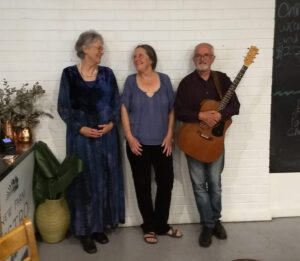
The Goodwills Trio at The Bug (photo Helen Corr)

Sunday March 19, 2023

The Goodwills – guest artists at Folk Redlands

Victoria Point Bowls Club, 3 Poinciana Avenue, 1pm.

The Goodwills Trio (Bob & Laurel Wilson and Helen Rowe) have been performing at clubs and festivals for the past six years. Bob & Laurel have been performing together since the late 1970s, so have a large repertoire including songs Bob has written. Bob’s songs have been featured on the ABC radio show, Australia all Over. Three songs, Big Country Town, Courting the Net and If It Doesn’t Rain Soon, Mate, have been included on Ian McNamara’s compilation albums.

In 2022 Bob won the Alistair Hulett Songs for Social Justice award with his song When Whitlam Took his Turn at the Wheel. Subsequently, The Goodwills released an eight-track EP containing five new songs and live versions of three older songs. They have released six CDs since 1998. although two of the older albums are out of print.

Bob and Laurel live in Warwick now, so the logistics for rehearsing with Helen means she gets to spend time in the country. Helen adds vocal harmonies, whistle and fiddle and occasionally sings her own songs.

The usual format for Folk Redlands is blackboard artists first, who each perform two or three songs, a break and then the guest act from 3pm to 4pm. Bar and snacks are available.


New Zealand’s under-reported cyclone

cyclone-forestry-slash
Photo 01: Forestry waste (slash) piled up on Gisborne’s Waikanae Beach

A Pakeha (Non-Māori) friend in Auckland, who has been studying Te Reo Māori language for some years, thinks all New Zealanders should know at least 100 words.

On our visit there between February 9 and 24, I began to realise how many Māori words I do know, and this time I learned a few new ones including Huripari.

This is Māori for storm or, if expressing the extremity of a cyclone, hurricane or tornado, you might say: He āwhā nui, ā, he tino kino te pupuhi o te haumātakataka.

Cyclone Gabrielle swept through Northland, Auckland, Coromandel, Bay of Plenty, Waikato and down the East coast.

Gabrielle did not receive much media coverage here in Australia, despite inflicting a damage bill conservatively estimated at $NZ13.5 billion. More than 250 roads are closed; 1000 people are still living in shelters, many cannot return to their homes and at least 11 people died. Roads cut between Wairoa and Napier and Taupo and Napier could take months to clear, rebuild and re-open. Many homes have been red-stickered, which in local parlance means they are ‘munted’. (A non-Māori word meaning destroyed)

I’ll admit we took the Cyclone warnings too lightly. We landed in Auckland on February 9 and stayed with friends, who had their own disaster stories after Auckland’s dramatic deluge on January 30.

From there, we drove to Rotorua for a truly immersive experience. We were surely among the few Australian Pakeha people at the Indigenous All Stars vs NZ Māoris rugby league match. It was a beautiful sunny day with no hint of what was to come. The sport started early with a mixed touch footie game (a draw), then the Indigenous women’s team played their Māori counterparts (who won).

Then to the main event. Former NRL legend Greg Inglis appeared on camera, looking good in a suit. He was being interviewed by Sky Sports before the match. The crowd of 25,000 got involved in the pre-game Indigenous welcome dance and Māori haka. Much of the cheering and roaring was saved for the advancing haka party.

The match was played in good spirit; few injuries and only one sin bin for a high tackle. The Māori team more than held their own, but thanks to the athletic brilliance of Brisbane Broncos player Selwyn Cobbo, who scored three tries, the Indigenous team won 28-24.

We chatted to a group of Aboriginal women from Moree and other places. They flew over especially for the game and were ready to fly back on Sunday, weather permitting. They seemed happy to be among whanau (extended family). (I loved the whole experience. Ed)

Next morning we set off to walk through Rotorua’s Redwood forests, which are quite impressive, the tracks heavily used by locals cycling and walking their dogs. My sister texted, anxious about the weather report. She wanted us to drive through the Waioeka Gorge to Gisborne ASAP. There was evidence of previous slips on this road, which is quite often closed for a day or two while road crews clear the way. It is a mountainous valley road with steep hills prone to slips (landslides).

By the time we arrived in Gisborne, the ominous black clouds we saw building up beyond Rotorua had pursued us to the coast. We bunkered down for the night as strong winds and heavy rain developed. My sister lives close to but on the ‘high’ side of the river. Her house is sheltered and well insulated, so the only real clue we had to the ferocity of the weather was to watch the big pine tree swaying around behind her neighbour’s house.

We lost power on Monday, but thankfully it was restored by the evening. The Hawkes Bay towns of Wairoa, Napier and Hastings were less fortunate. By the end of the week, power had only been patchily restored in Napier, where a major substation was submerged by flood waters.

Our collective anxiety levels were high as we lost cell phone and internet connection so had no idea what was going on in the outside world, apart from staying glued to the 24/7 coverage on NZ1 TV. At least I had contacted my other sister in Hastings on Sunday night to tell her we had arrived safely in Gisborne. Then there was no phone communication for six days. So much for the VoiP phones foisted upon us all in place of reliable copper landlines. (What ‘genius’ didn’t foresee that this lack of communication would happen in the case of widespread power blackouts? Ed)

New Zealand’s Prime Minister Chris Hipkins was quick to get to the front line – no side trips to Hawaii for Hipkins, who replaced Jacinda Ardern as leader after her resignation on January 13.

One story I found while browsing Australian media was filed on Monday by the ABC, with Hipkins announcing a global fundraising effort.

The appeal will fund longer-term recovery projects and target wealthy expatriates, businesses and ‘anyone with affection for New Zealand’, Hipkins said.

According to the Department of Home Affairs, around 660,000 New Zealanders live in Australia, a third of them in Queensland.

Despite the obvious interest in news from home, people who were looking for it went to Stuff.co.nz. The Weekend Australian, by contrast, made no mention of Cyclone Gabrielle at all.

This FOMM was aided and abetted by the aforementioned ABC report and news drawn from Stuff.co.nz, the Gisborne Herald, Hawkes Bay Today and the NZ Herald.

Cyclone Gabrielle hit New Zealand’s North Island on February 12, taking out roads and bridges and leaving tens of thousands without power or connectivity. A National State of Emergency was declared for only the third time in the nation’s history. Disruption to supplies of clean water was just one of the problems.

The drama is by no means over. Police are still searching for four people who are not accounted for. Heavy rain at the weekend hampered clean-up efforts and, as is common in this part of the world, the occasional earthquake came along to ramp up anxiety levels.

Hipkins said early on in live TV broadcasts that it was time to ‘get real’ about New Zealand’s transport, power and communications infrastructure. Opposition Leader Chris Luxon started off well by acknowledging the role climate change had played in this catastrophe. But he later mounted a law and order campaign, after reports of looting and intimidation by gangs.

He described ex-Cyclone Gabrielle as the most damaging natural disaster in a generation. That didn’t stop the Reserve Bank from raising interest rates to 4.5%, in times when ordinary working Kiwis are finding it hard just to pay for groceries and fuel.

The New Zealand Government has announced an inquiry into forestry practices which saw tonnes of debris (known as ‘slash’) washed down rivers and into the ocean. Along the way, this trash inevitably aggravated damage to bridges and roads. The photo above shows forestry waste piled up on Gisborne’s Waikanae Beach. On a good day, it is the East Coast’s favourite safe swimming beach. What more can I say other than share this second photo.

On a positive note, hundreds of Kapa Haka groups from all over New Zealand (and a few from Australia), took part in Te Matatini, a celebration of Māori culture and traditions held at Auckland’s Eden Park.

I was particularly impressed by the group from Wairoa, a coastal town devastated by flooding. The dancers smeared their lower legs in mud, as if to say ‘Cyclone – what Cyclone?’ These are resilient people, caring for family and community, and, despite catastrophe, still with a sense of humour. Kia Kaha.

From the archives (2) Blogging and human rights

blogging-human-rights
Iranian protest photo Christopher Rose

In case you were curious, the word blog in Farsi looks like this – وبلاگ. Iranians who didn’t like the way things were going in their country started وبلاگ’ing like crazy after the 2000 crackdown on Iranian media. Iranians who interact with the internet are by definition risk-takers.
Photo Christopher Rose
As recently as late 2016, five Iranians were sentenced to prison terms for writing and posting images on fashion blogs. The content was decreed to ‘encourage prostitution’.
The Independent quoted lawyer Mahmoud Taravat via state news agency Ilna that the eight women and four men he represented received jail time of between five months to six years. He was planning to appeal the sentences handed down by a Shiraz court on charges including ‘encouraging prostitution’ and ‘promoting corruption’.

The immediacy of blogging appeals to those who live under oppressive regimes. They use the online diary to inform the world of the injustices in their country as and when they happen. I cited Iran (Persia) as just one example of a country where expressing strong opinions contrary to the agenda of the ruling government is extremely risky business.
The founder of Iran’s blogging movement, Hossein Derakhshan, an Iranian-Canadian blogger, spent six years in prison (the original sentence was 19 and a half years), before being pardoned by Iran’s supreme leader, Ali Khamenei. Derakhshan also helped promote podcasting in Iran and appears to have been the catalyst that spawned some 64,000 Persian language blogs (2004 survey). Clearly there is/was a level of dissent among people who think the right to free speech is worth the risk of incarceration or worse.

Blogging can be a lot of things in Australia, but risky it rarely is, so long as you are mindful of the laws regarding defamation and contempt of court. Not so for bloggers or citizen journalists of oppressed countries who try to get the facts out.
It is no coincidence that most of the countries guilty of supressing free speech are among the 22 countries named by Amnesty International as having committed war crimes. They include Yemen, Saudi Arabia, Syria, Sudan and, closer to home, Myanmar, where persecution and discrimination persists against the Rohingya. Amnesty’s national director Claire Mallinson told ABC’s The World Today that not only are people being persecuted where they live, 36 countries (including Australia) sent people back into danger after attempts to find refuge.
Amnesty’s 450-page Human Rights report for 2015-2016 does not spare Australia from criticism, particularly our treatment of children in custody, with Aboriginal children 24 times more likely to be separated from their families and communities. We are also complacent when it comes to tackling world leaders and politicians accused of creating division and fear.

Still, at least if you live in Australia you can openly criticise something the government is doing (or not doing), apropos this week’s Q&A and the Centrelink debt debate.
According to literary types who seem to have warmed to my turn of phrase, FOMM is not a blog as such, but an example of ‘creative nonfiction’ which I am told is not only a genre, but also something taught at universities.
I never knew that.
Bloggers in comfortable democracies like ours use blogs to write about cats, dogs, goldfish, cake recipes, fashion, yoga, raising babies, travel adventures and produce how-to manuals about anything you care to name.
The definition of a blog is ‘a regularly updated public website or web page, typically run by an individual or small group, written in an informal or conversational style.’
Scottish comedian and slam poem Elvis McGonagall, who you met last week, satirises the blog format with this entry.
Monday:
Woke up. Had a thought. Dismissed it. Had another. Dismissed that. Stared at the cows. The cows stared back. Scratched arse. Shouted at telly. Threw heavy object at telly. Had a wee drink. Had another. Went to bed.
Tuesday to Sunday – repeat as above

The definitive blog is an online daily diary, kept by people while travelling, carrying out some stated mission like preparing for an art exhibition, producing an independent album, dieting or training for a triathlon. Most of these literary exercises are abandoned at journey’s end, or on completion of the mission. A fine example of this is folksinger John Thompson’s marathon effort to post an Australian folk song each day for a year. He did this from Australia Day 2011 to January 26, 2012.
Some of the tunes have ended up on albums by Cloudstreet, Thompson’s musical collaboration with Nicole Murray and Emma Nixon.
The social worth of a blog, though, is when an oppressed human being writes a real time account of what atrocity or infringement of human rights is happening in their third-world village, right now.
There are millions of blogs circulating on the worldwide web, many of which are concerned with marketing, selling, promoting and luring readers into subscribing to the bloggers’ products and/or clicking on sponsors’ links. It is nigh-on impossible to find a list of blogs independently assessed on quality, although some have tried.
The Australian Writers Centre held a competition in 2014 to find Australia’s best blogs, dividing entries into genres like Personal & Parenting, Lifestyle/Hobby, Food, Travel, Business, Commentary and Words/Writing. The competition attracted hundreds of entries which were whittled down to 31 finalists.

The AWC told FOMM it has since switched its focus to fiction competitions but has not dismissed the popularity of blogging. Even so, continuity is an ever-present issue.
The 2014 winner, Christina Sung, combined travel and cooking, two topics which spawn thousands of blogs worldwide, into The Hungry Australian. But as happens with blogs, the author has somewhat moved on since then. As Christina last posted in September 2016: ‘Hello, dear readers! Apologies for my lengthy absence but I’ve been working on a few writing projects lately’.
Likewise, the author of The Kooriwoman, the Commentary winner for a blog about life as an urban Aboriginal in Australia, has not posted since January 2016.
It is not uncommon for finely-written blogs like those mentioned to have a hiatus or disappear without notice, for a myriad of reasons linked to other demands and distractions in the authors’ lives.
The few lists of Australian blogs you can find tend to rank them on popularity (numbers of followers or clickers). The top 10 blogs in this list are all about food or travel.
http://www.blogmetrics.org/australia
Hands-down winner Not Quite Nigella is a daily blog curated by Lorraine Elliott who according to blogmetrics has 28,523 monthly visitors. It’s not hard to see why – the blog is constantly updated with recipes, restaurant reviews, travel adventures and the like, featuring mouth-watering photos and a chatty prose style.
So there are those like Lorraine who make a living from blogging and those who start with a skyrocket burst of enthusiasm and fall to ground like the burnt-out stick.
Whatever your absorbing passion in life happens to be – cross-dressing, wood-carving, wine-making, writing haikus, collecting Toby jugs, quilt-making, proofreading or growing (medicinal) marijuana, you can bet someone out there has created a blog.
Just yesterday for no reason other than a bit of light relief after months of heatwave conditions, I searched for ‘grumpy spouse blog’ and got 22 hits. Have a look at this one – it’s choice.

From the archives (1) Bedside Manners

bedside-tables-manners
Bob’s bedside table (an example) Zoom in to see what he’s reading

So I’m visiting John in hospital and it’s just as well I didn’t come the day before, he says, because he was in a world of pain. Knee operations are like that. Hospital rooms evoke all kinds of memories, most of them not very pleasant, even a private room with a TV, telephone and a view of the painless world.

John was telling how his daughter phoned on his world of pain day to see how he was. The phone, on the bedside table, just out of reach, rang and rang. Somebody had moved the bedside table so they could set up the contraption that monitors one’s vitals.

There’s a small fortune to be made for someone who invents and promotes a bedside cabinet suited to the largely bed-ridden. It may well be that someone already owns the patents or has actually produced a prototype. They would go well in hospitals. The standard hospital brand tends to be a metal box on castors, usually with two (lockable) drawers and a cupboard to store your clothes, shoes and toiletries.

What is really needed, if you happen to be supine in bed and unable to roll over and reach out, is a bedside table that will come to you. I’m not an inventor, designer or cabinet maker, but I envisage the patient with a remote control pressing ‘turn left’ and with a barely perceptible whir, the bedside table obediently turns so it is facing the bed. The patient presses ‘rise” and the table rises, until the patient presses ‘stop’. ‘Open top drawer’, and the top drawer slides open, to offer an array of things one might need:  reading glasses, hearing aids, wallet, mobile phone, private medical insurance card.

Those of you quick on the uptake will immediately see the broader commercial opportunities of such a user-friendly bedside table. The home model would have a built in power board for mobile phone, e-reader, MP3 player or whatever gadget you keep in the bedside cabinet that might require recharging. Ahem.

At this stage of musing it is important to note the debunking of the myth that one risks brain cancer by keeping a mobile phone next to the bed.  The ABC’s Catalyst program is under attack for a program this week linking Wi-Fi and mobile phone use with brain cancer. According to the Australian government’s radiation safety agency ARPANSA, there is “no established evidence” that low levels of radiofrequency radiation from these devices cause health effects. The Conversation, an excellent source of analysis by academics and journalists, asked experts for their opinions.

If you search ‘bedside table’ you will find hundreds of designs (and prices) but nearly all follow the basic principle of a night-stand – a vertical cabinet with two or three drawers or two drawers and a cupboard. Once you’re in bed, only the top drawer is easily reachable and of course every time you lean over to look for something, there’s a risk you will knock something off the top (where many of us keep things like books, reading glasses, contact lenses, hearing aids, a glass of water, e-reader, wallet, and so on – not unlike the illustration above.

The smart bedside table would have a tissue dispenser built in to the side (also touch of a button) to free up space on the top of the cabinet. Bedside tables (the typical bedroom suite comes with two), are not designed with age groups in mind.

The 18-35 groups could get by with a wooden chair, on which to place current reading (e.g. Wild, by Cheryl Strayed, The Art of Asking by Amanda Palmer, On the Road by Jack Kerouac), and the essential accoutrements of the young and impulsive.

The 36-49 groups used to favour clock radios so they could get up with the lark listening to classic FM. These days it is likely to be a smart phone alarm and an MP3 player programmed to play your early morning playlist. Books may include: The Seven Habits of Highly Successful People by Stephen Povey or conversely, Summer on a Fat Pig Farm by Matthew Evans.

We elders need a lot of space on the table top. There’s the aforementioned hearing aids, a glass of water (to drink), a glass of water (for our teeth), one or even two of those Monday to Sunday prescription boxes so you don’t forget to take what the doctor ordered. There’s often a torch so those of us with cataracts don’t walk into walls or doors.

The over-65 top drawer is likely to contain a plastic folder with five or six prescriptions repeats, boxes of medications, tubes of ointment for various aches and pains and itches, several old watches, cufflinks (who wears cufflinks?), pebbles, feathers and shells collected from the last beach walk, a Swiss army knife, a pedometer with a flat battery, hearing aid batteries, a scattering of coins, a few buttons that ought to be in the button tin, the thumb splint from last time you had a bout of tendonitis, a well out of date asthma puffer, a well-thumbed copy of Meditations for Men Who Do Too Much, five bookmarks and a card with all your pins and passwords disguised as telephone numbers.

How are we doing so far?

The second drawer of your typical bedside table might be the place you keep bulkier objects like a wheat bag (put in microwave for 40 seconds and apply to aching body part), the leather writing compendium a well-meaning friend gave you for your 21st birthday and which you cannot bear to throw away, even though it is a mid-20thst century curio containing five old address books and a Valentine from 1974.

The bottom drawer is where you should keep a pouch containing important personal papers so you can grab it and run if there is a fire.

If your bedside table has a bottom drawer or a cupboard, you could try a psychological experiment:  Every Sunday night, list everything that has happened in the news this week that you don’t want to think about and lock it away.

A year later you can read these 52 pages: Cardinal Pell. Who was he again? Oh, the asylum seeker babies. The Hague ruled on that, didn’t they? Anyway, they all went live in New Zealand.

A cluttered bedside table can be a trigger for allergens. At least once a month you should throw everything on the bed and give the cabinet a jolly good clean. Then put back less stuff. Go on, you can do it – who needs two watches that don’t work, an empty floss container or a tube of Dencorub with a 2009 use by date?

Some of you might wonder why I didn’t write about asylum seeker babies or Tim Minchin’s song about the cardinal, or that proposal by the Australian Chamber of Commerce and Industry – (journalist Paul Syvret called it a ‘brain fart’) – to turn age pension payments into a loan, repayable on the sale of the pensioners’ home.

As you can clearly see, especially if you zoom to 200% and examine the photo above, I had other things on my mind.


Disappearing acts


By Guest writer Lyn Nuttall

Introduction by Bob

I did say last week I’d be serving up items from the FOMM archives while I’m away, but could not resist this post by Lyn Nuttall, curator of the website Pop Archives (Where did they get that song?).

The other day some bloke tweeted, “Anyone remember Dionne Warwick?”

Dionne Warwick answered, “Doesn’t ring a bell.”

When I wrote about a Top 20 hit by Sydney singer Jennifer Ryall I said that she was “lost to history”. I hadn’t been able to find out much about her, and there was nothing after the mid-1970s.

Jennifer Ryall finally emailed to tell me she wasn’t lost, and her own history turned out to be rich and varied. In the following days she gave me a lot of information, full of interest, which I used to write up a decent account of her career.

I now avoid suggesting that people are lost, or that they disappeared or vanished, just because they haven’t released any music for a while.

It’s a trap that fans can easily fall into. When a performer we know only through their media persona stops performing, there is a sense that they have literally disappeared.

We might even sympathise with them for their downfall, even if we have no idea what they are doing these days. However fulfilling their life away from the music (or film or TV) business might be, their absence suggests that they no longer do anything. They exist for us on the public stage and when they’ve gone it’s as if they don’t exist.

The jazz trumpeter, composer and bandleader Red Perksey migrated to Sydney via France in 1951. He soon established himself on radio and records, and in live gigs, and he became Musical Director for a Sydney record company.

Red and his orchestra had a hit with (A Little Boy Called) Smiley from the film Smiley Gets A Gun (1958), and they backed Vic Sabrino on his version of Rock Around The Clock (1955), a record some call as the first Australian rock’n’roll record. He was clearly a bright and likeable personality who pops up here and there in the newspaper archives.

Red Perksey 1950s (photo)

In 1958 Red was photographed joshing around poolside at a deejays’ convention, and he was giving lunchtime concerts at a Sydney music store. Then there is nothing. No more listings in the radio guides, no more gigs advertised, no more affectionate write-ups. He disappeared?

I had written what I believe is the definitive biographical sketch of Red Perksey. He was born Siegbert Perlstein in Berlin in 1921, of Jewish German-Polish background. I traced his progress from Berlin in the 30s, to Palestine in the mid-40s and Paris in the late 40s. He and his wife Zizi came to Australia by refugee ship in the early 50s, and were later naturalised here. The only later date I had was his death, in 1995, but from 1958 until then, nothing.

Eventually, someone emails. A niece, probably his only surviving relative, emailed from Paris with some answers.

To Australian audiences, to the Sydney newspapers, and (retrospectively) to this archival forager, Red Perksey had disappeared.

Meanwhile, a couple known as Bert and Anne were living in a remote French village where Bert painted, sculpted and made furniture. Bert was also a musician, and sometimes he joined in with local groups.

To us, they had disappeared; in France, Red Perksey and his wife were in plain view to their fellow villagers.

I guess my point is, there are more places in this world than the public stage.

ends

(Lyn later emailed me to explain how he tracked Red down).

“At the French National Library (BnF) I found song copyrights from 1950, which helped place Red in France and active at that time.

“I got a lead from a French book of pseudonyms at the Internet Archive that gave me his real name. Then he was easy to find at the Israeli national archives. They had had facsimiles of loads of documents to do with him and his wife when they applied for Palestinian citizenship in the 40s, including passport photos, dates of birth etc. A Jewish refugee agency had passenger lists from refugee ships going out to Australia.

And there they both were!”

Postscript by Bob

While I greatly admire Lyn’s dogged pursuit of facts supposedly lost in the dross of pop culture, I probably spoiled it for him with my obscure comment on his blog.

I asked did he know that the Ron Sexsmith wrote a song called ‘Disappearing Act?” This of course had nothing to do with Lyn’s blog other than his headline. Then again, Ron is a brilliant and prolific artist who rarely makes headlines and for a time there (between 2008 and 2011) he too seemed to disappear.

I was never so happy to learn in 2011 that his career was being revived by Canadian heavy metal producer Bob Rock, resulting in Long Player Late Bloomer, Ron’s first album since 2008. A strange coupling but it worked!

I recall Ron Sexsmith appearing at The Zoo, a daggy Fortitude Valley music club, in 2008. Tickets were $45 and the show was just Ron, his baby face and an acoustic guitar. Not a minder or a roadie to be seen.

Happy to report the award-winning Canadian singer-songwriter is this month releasing his 18th album – The Vivien Line. I have no idea what it will be like, but given songs from his back catalogue like Disappearing Act, Gold in Them Hills, Cheap Hotel, Fallen, Whatever it Takes and Secret Heart, I’ll be ordering one. Still not ringing a bell? Ron’s songs have been covered by famous singers including Rod Stewart, k.d Laing, Nick Lowe, Michael Buble and Emmylou Harris. Coldplay’s Chris Martin recorded a duet with Ron of Gold in Them Hills as a bonus track for the 2002 album Cobblestone Runway. That’s the same album featuring Disappearing Act and one of Ron’s best.


Why our media mostly ignores New Zealand

New-Zealand-News
Photo of Auckland with rain looming by Bernard Spragg https://flic.kr/p/2kXpL9W

The young New Zealand journalist broadcasting from down town Auckland described the rain storms which drenched Auckland last weekend as ‘completely apocalyptic’.

This may not be overstating the case. as Auckland received 284mm (nearly a foot in the old measurement) in the 24 hours from Friday to Saturday –  and it kept on raining.

As The Guardian reported on Monday, intense rain on January 27 brought more than 200mm in 18 hours, as recorded by most of Auckland’s weather stations. Some parts of the city were hit with more than 150mm in three hours, prompting flash flooding and landslides. These totals are almost 300% of a normal January rainfall and beat the previous record set in January 1986. You have to go back to 1969 to find more rain that that – 420mm in February 1869.

New Zealand is not unaccustomed to rain – you can tell how much the country gets by how green are its valleys. But Auckland is not at all used to cloudbursts on a scale more often associated with northern Queensland or the Gold Coast and Sunshine Coast hinterland. ABC Breakfast crossed to a Kiwi correspondent on Monday morning, who used the A word but also added ‘it’s still raining’.

By Tuesday, it had eased to ‘light rain showers’ with precipitation at 19%  and humidity at 89%. As we all know, any amount of rain closely following a 300mm deluge will wreak havoc with saturated catchments.

Generally speaking, you won’t see, hear or read much about New Zealand on Australian media. If it’s not an earthquake, a volcanic eruption or a mass shooting, they usually don’t bother. One of the reasons for this is that Rupert Murdoch’s News Ltd does not own any newspaper or electronic media in our Pacific neighbour country.

But journalists and others who support Kevin Rudd’s campaign against News Corp’s monopolistic approach might be disturbed to read this.

News Corp did report on the deluge after it initially discovered that two people had died, and there was scary looking footage on a couple of TV networks. Auckland is built on a chain of extinct volcanoes, so many residents live in houses perched on hillsides. Excessive rain causes landslides or slips, as they are called over there. One news channel had footage of a house in Remuera (think Ascot or Toorak) which in Kiwi parlance was ‘munted.’

I’m due to arrive in Auckland next Thursday. For purely selfish reasons, we hope the rain has gone by the time we get there. Among the news stories to emerge from the wet weekend was the cancellation of Elton John’s two concerts at Mt Smart Stadium, better known as the home of the Warriors rugby league team.

Our contact said Elton was also trapped in Auckland as all flights were grounded during the worst of it. One dejected Elton fan could be heard, wading through the drowned streets, clutching a bottle in a soggy paper bag, lustily singing: “I guess that’s why they call it the blues”.

The Australian chimed in later this week with a report, not so much about the death toll of four, but criticism of Auckland’s Mayor for not doing enough. When do Mayors ever do enough eh?

One of my old friends from newspaper days was a Kiwi who was recruited during a little-known period in Australian newspaper history when there was a dire shortage of sub-editors.

Publishers advertised abroad and subsequently hired experienced people from New Zealand, the UK, Canada, South Africa, Northern Ireland and the Pacific Islands. My friend, now retired, hails from Otago. As I recall, he would arrive 10 minutes early for his shift and sift through the AAP news agency feed looking for stories about New Zealand. These would be copied to an internal directory so that those of us in the building whose accents were often chucked off at could keep up with what’s going on at home.

I’ve not done in depth research, nor could I find any, that makes findings on the Australian media’s scant regard for what happens across the ditch. Jacinda Ardern of course got more column inches than any Kiwi politician since Rob Muldoon. Earthquakes, eruptions and mass shootings also attracted the mainland media pack but not much else. It has to be quirky news, like this week’s announcement of the first All Black rugby union player to come out as openly gay.

The online new website Stuff said the former All Black decided to “open up that door and magically make that closet disappear”. Known as All Black No 1056, Campbell Johnstone, who played three tests for the All Blacks in 2005, did confide in some teammates and his family during his playing days. He made his debut against Fiji and played his last game against the British and Irish Lions.

Statistically speaking, of the 1207 Kiwi men who have played rugby union in the famous black jersey with silver fern, 53 of them would be gay.

That this rates as a ‘news story’ from the Australian perspective is a solid example of editors’ approach to selecting New Zealand news. As Jerry Seinfeld would say ‘Not that there’s anything wrong with that.”

We have read stories here about the incoming Prime Minister, replacing Jacinda Ardern. Fair to say he had no media profile in this country, unlike Jacinda, whose shock resignation made headlines in New York, London, France, Canada and Australia.

She may be criticised for not doing enough policy-wise, but she dealt with an unprecedented series of catastrophes in her country that marked her as an international leader of substance. She may be taking time out  to be a wife and mother, but I’m sure we have not heard the last of her in politics or academic life.

One example of big news stories from New Zealand which probably did not rate here are those about three Nobel Prize winning scientists.

The most recent was the late Alan MacDiarmid (2000), while Maurice Wilkins (1962) and Ernest Rutherford (1908) also took out the honour.

Meantime, I’m trying to finish the notes for a Basic Computer Skills course that starts three days after I get back from a family visit to New Zealand. As always, I’m trying to balance spending time between family and friends and also having what young Kiwis used to call a ‘OE’ (overseas experience).

As part of that, we will be attending the first major rugby league game of the season, the Indigenous All Stars vs NZ Maoris at Rotorua. She Who Got Up at 10am New Zealand Time claimed early bird seats and also found (with some difficulty) a place to stay.

Next day we are heading off to Gisborne to spend a few days with my sister before travelling further south to catch up with the rest of the whanau. We will take the inland road through Waioeka Gorge because, something that probably didn’t make the news here, a cyclone has destroyed some parts of the East Cape road.

We were going to take the slow drive (5.5 hours) around the Cape to Gisborne for sentimental reasons. It is a beautiful, unspoiled, under-populated part of the country.

I’m taking a rare holiday from FOMM so the following three weeks will feature (a guest blog) then episodes from my Back Pages (curated from almost nine years of archives). Kia Ora and Aroha.

Physiotherapists in demand

phsyiotherapists-in-demand
Image by Matias Maiztegu, www.pixabay.com

Every day I walk anywhere, I silently thank the physiotherapists who got me back on my feet after a serious motorcycle accident in 1969. Too long ago and yet still traumatic to relate, so I’ll skip the detail of the accident and fast forward to the rehab centre.

Once out of plaster, able to use crutches and manage a flight of stairs, those with serious injuries were packed off to a rehabilitation centre. Those physios, I remember well, were relentless in the quest to restore flexibility and muscle strength to wasted limbs.

I’d fractured both kneecaps and had them removed, so on release from hospital had limited movement. My quads were so far gone I could hook an umbrella around my thigh.

Enter the first physio who introduced me to the pedal-driven lathe, on which we made wooden collection plates, cheese boards, wine goblets and other items that required hours of repetitious pushing up and down, first one foot then the other.

Then it was into the (heated) pool to developed further flexion through weight-bearing exercise. There were sessions with muscle-stimulating machines, weights and frequent massages to break up the scar tissue.

We were given three good meals a day and then sent off to bed at 8.30. One night we all sneaked out and found a pub down the road; discovering it was by no means an original idea.

My knees got better with time, although I still can’t squat down and kneeling is something I’ve learned to do as seldom as possible. If I get a flat tyre I call the RACQ.

I was musing about this on day three of the great rose garden refurbishment project, spending more time on my knees than I’m used to. Once the day warmed up, I’d shower and retire to the lounge to watch the Australian Open. I’m a fair-weather tennis fan and only get engrossed when we’re into the quarter finals.

He Who Was Deported for not Being Vaccinated is back again, and, despite a troublesome hamstring, seems destined to take home the AO trophy. As all the leading tennis pros do, he brought his own physio. He may even have brought two if you peruse this story.

No doubt you have all had dealings with a physio at one time or another. It doesn’t take much. Common complaints referred to physios include lower back problems, broken wrists, ankle sprains, knee injuries, shoulder conditions, achilles tendon and pectoral strains, tendinopathy, arthritis and the dreaded hamstring strain. Novak Djokovic has had a dodgy hamstring since he set foot in Australia but his physios are obviously skilled at keeping him on the court. He is in superb physical condition too, which helps.

Given the dominant form he displayed against Alex de Minaur (6-2 6-1 6-2), his hammies are just fine.

As Novak said early on: “It’s up to God, and my physio to help me. Let’s take it day by day, I hope I’ll be able to recover.”

The hamstrings are the muscles at the back of the thigh, attaching above the hip joint and below the knee joint. Adequate resilience of the hamstring muscles and their tendons, which attach the muscle to bone and are essential for movement, is essential and fostered by sport-specific exercise.

Retired ballet dancer Martin Collyer has just finished undergraduate studies at UQ for a degree in physiotherapy. One of his placements was at a former workplace, Queensland Ballet headquarters in West End. Like all elite athletes with a retirement age around 35, he made plans, initially working as a yoga teacher.

He said he chose to study physiotherapy despite some disappointing experiences with physios on the few occasions when he suffered injuries as a professional dancer.  He related an anecdote from a group he was teaching about a long-term yoga teacher who was studying for a bachelor of physiotherapy. She chose to stop, after four years and much effort.

The reason cited was that physiotherapy was, “too focused on individual joints and muscles; too narrow,” leaving the individual feeling that yoga was a more ‘holistic’ approach. Martin was asked for an opinion.

“I said that while there are tremendous physios, the individual may matter more than the modality. There are great chiropractors working from the evidence base and using exercise as treatment, just as there are physios who may disregard the evidence base.

“Physio’s origins are in massage, but the profession has evolved a great deal over the years. Increasingly, the evidence supports exercise as best-practice management for a majority of musculo-skeletal conditions. This means that the training physios receive, with an emphasis on manual therapy and other passive techniques (e.g. ultrasound), may not adequately support them. While exercise was covered in my physio undergraduate degree, it was arguably insufficient.

“Because of my prior experience in movement and movement coaching, I feel confident with this aspect of practice, but what about the individual who had little experience with sports and exercise prior to studying physiotherapy?”

Through four years of study, Martin said it dawned on him that the issues physios treat are public health problems.

“If more people were more physically active, far fewer people would suffer from musculo-skeletal complaints. The best sort of exercise is the sort you’ll keep showing up to.”

The popularity of physiotherapy as a study course appeals both to those who want to be practitioners and those who use it as an entrée to medical school.

The Australian Physiotherapist Association (APA) tabled recent data that showed there were 35,290 registered physiotherapists in Australia. Physiotherapy continues to be a female-dominated workforce (66%) and a Gen-Z profession with the majority of registrants aged 25–40.

The stumbling block for most people who are referred to a physiotherapist is the cost. Typical fees for a 30-minute or 60-minute session are between $80 and $120 per session. Your GP can issue a chronic condition treatment plan (subsidised) but this has limitations.

The Grattan Institute recently released a paper advocating a review of Medicare arrangements for allied health services.

Grattan Institute author Anika Stobart advocated scrapping the existing Medicare items for allied health and re-directing funding through local Primary Health Networks. These networks would contract providers to perform services with no (or very low) out-of-pocket fees for referred patients.

Stobart says that even though services are subsidised, they can still be very expensive.

“Last year, only 56 percent of allied health services were bulk billed, and patients paid on average $55 out-of-pocket per appointment.

Just this week there were news reports of a pending review of Medicare and its funding model. The Albanese government’s Strengthening Medicare Taskforce recommends moving from subsidising GP consultations alone to wrapping in care provided by nurses and paramedics.

Health minister Mark Butler said the current system is “no longer fit for purpose and flagged changes in the May budget. Given that one in six GP presentations are for musculo-skeletal conditions, there’s a good case to review the Medicare treatment plan system.

I ran into the treatment plan limitations when seeing a physio for a rotator cuff (shoulder) injury some years ago. I quickly used up my “free” sessions but opted to keep going at around $70 a session. My physio claimed credit for the reduced inflammation and increased mobility over time. I said the symptoms eased once I started taking magnesium tablets. She politely but firmly disagreed.