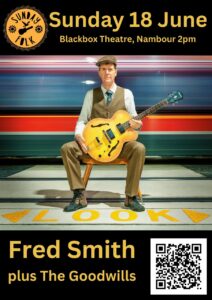
If you are within cooee of Nambour on Sunday June 18 what better way to spend an afternoon that a concert with celebrated songwriter Fred Smith and a reunion with The Goodwills.
Fred will be launching his new CD ‘Look,” a departure from his material about Afghanistan. Fred says it is about “the ordinary stuff of our lives and the world we live in: the speed of modern life, love, isolation, and the internet in a world that seems to be lurching forward by a rolling series of crisis.”
The Goodwills Trio are the support act for this concert at Nambour’s Black Box Theatre. Bob and Laurel and fiddle player Helen Rowe will present some of Bob’s songs arranged for three-part harmony. Maleny people will remember our long-running series of house concerts at Maleny. Fred performed there three times before his popularity necessitated a move to the RSL!
Sunday Folk organiser Karen Law tells us bookings are being made even at this early stage. A booking link is included below.
Sunday Folk is at the Black Box Theatre, 80 Howard Street, Nambour. Tickets are $25/$23 and children under 18 – $18.
View from the Window in Le Gras“, the world’s first photograph. This is a colourised version of the 1826 original by Jonnychiwa – Wikimedia, CC.
It was a long overdue computer overhaul that brought to my attention we had a combined database of images (jpeg files) totaling more than 100,000. Gee willikers as they used to say in the 1950s sit-coms, to express amazement (today expressed as WTF or Holy F*** Batman, etc).
Gee willikers is described in the Urban Dictionary and elsewhere as a ‘minced oath’ – like the perfect gentleman turning a forming curse into Jeepers, Jings or Cripes.
All which has little to do with the discussion we are about to have – except, what the whillikers are we to do with a database of 100,000 digital photos?
The quantity is not so surprising when researchers* estimate that people in the US take on average 20 photos per day (Asia-Pacific 15 per day).
She Who Took Most of Ours (SWTMOO) swears there is a lot of doubling up in there, while sorting photos into years, topics and other identifiers.
We have both had computers, digital phones and cameras for the past 20 years. On that basis, it’s only 5000 photos a year, or 2500 each, on average. As you can see by the research, we came out just below average (14 photos per day).
As we all know, though, only two or three of a set of photographs taken on any one day will be keepers. So why not just delete the other 24 there and then? Those 40 or 50 mobile phone shots of the eclipse, nearly all of which were duds.
I came to this audit of our digital baggage while setting up SWTMOO’s new computer. While reinstalling backups from the old, failed computer, I decided to store only photos from 2018 onwards in the default Pictures folder. Then began the process of locating and moving pre-2018 digital photos from various portable hard drives (including my own collection on another PC).
This is when you run into the folders within folders trap and the occasional folder unhelpfully named ‘Photos’ or ’Folder’.( I plead ‘not guilty’ to that one. Ed) Many of these photos are from our travels around Australia and also overseas, although the latter seems like a long time ago now.
Did I mention we also have a cupboard stacked with photo albums from the pre-digital era? We are children of the WWII era where photos were scarce mementos of hard times, romance and childhood. Just as people today can lose their photo collections to floods, bushfires and other catastrophes, so too our war-era parents lost family photos in the Blitz.
War-time refugees driven out of their homes left everything except what they could carry. Photography was an expensive hobby in those days. If you are going through great-grandma’s things and can only find a handful of creased box brownie snaps, that is fairly typical. Formal portraits from the world wars that survived offer few clues to the people who inherited them. No-one thought to write on the back (in pencil, even) just who is in the photo.
Not that photo hoarding is a new thing – check out the street photographer Vivian Maier, a reclusive character who died unrecognized in 2009. A Wikipedia entry described how Maier took more than 150,000 photographs during her lifetime, most in the 1940s and 1950s. These unbidden images of people and architecture in Chicago, New York and Los Angeles were unpublished until after her death. A collector acquired some of Maier’s photos in 2007, while others found Maier’s prints and undeveloped negatives in boxes and suitcases. Her photographs were first published on the Internet in July 2008, Let that be a lesson to you, SWTMOO.
Most of the equipment Maeir used is the stuff of museums now, as camera sales dwindle and smart phone trade soars.
As Matic Broz writes in Photutorial.com, * the proliferation of smart phone cameras and the rapid improvement in technology dominates the digital photo scene. In 2020, 82% of digital photos were taken by smart phones and that is expected to rise to 92.5% in 2023.
If you still have a digital camera (as we both do), you are in a dwindling minority of people who prefer, like professional photographers, to shoot images with digital or analog cameras and interchangeable lenses.
The convenience of the smart phone/camera is that most people have it with them all the time, like a wallet or watch.
Whatever brand of smart phone you can afford will do the trick and then some. The latest Apple Iphone, for example, has a 12 megapixel main camera and a 12mp wide angle camera. All the same, you can buy a digital camera for under $300 which will have a 20mp lense and probably a 30mm zoom as well.
In a world where there are 12 trillion photographs in existence and a myriad of ways to distribute them, who would actually pay staff photographers to take them? Newsrooms across the nation and electronic media in general have pared down their in-house photographic units accordingly. Staffers have been replaced by freelancers, photo sharing sites like flickr.com, and online agencies which either sell or give away digital images. Not to mention the keen amateurs who send their sunrise/sunset/storm phone snaps to the TV weather people.
According to Photutorial.com,* which seems to be the portal that keeps statistics on this topic, 1.81 trillion photos are taken worldwide every year. By 2030, this will have grown to 2.3 trillion photos every year.
The average user has around 2,100 photos on a smartphone in 2023. Apple smartphone users have 2,400, while Android users have 1,900. (My Samsung cheap ‘smart’ phone seemingly refuses to delete photos until it’s damn well good and ready, despite my varous attempts. Ed)
Even though the global pandemic reduced the number of images taken by 25% in 2020 and 20% in 2021, the growth of digital images has continued unabated. And why not? It’s cheap, available and social media makes it easy to share images with friends and family.
The major issue with digital imagery is its ephemeral nature. One of my long-term readers has been keeping a hard copy family photo album for a long while now. All of those Facebook photos of baby’s first steps, toddler’s first tantrum, first day at Kindie etc, all carefully copied to a flash drive. There are places which have DIY photo kiosks where you can select, crop and request images and come back an hour later and collect the still warm prints. The cost is nothing in the scheme of things. The big question is, do the young parents of today’s generation want hard copy photo albums of those precious moments?
“Mum, I shared it on Insta – didn’t you get it?”
The trap for those who accumulate vast numbers of digital photos and videos is the storage space they take up. At a rough guess our 100,000 photos consume close to 500GB of data, video considerably more. If you store data in the ‘cloud,’ be it a cluster of cumulus owned by Apple, Google, Microsoft or competitors like Dropbox, you may be enjoying a ‘free’ account now. Be aware that fees apply once you pass whatever limit has been set by your cloud provider.
The wonder of digital imagery is the ability to scan old photos and keep them on a hard drive (above the 2022 flood level). Here’s a scan of a ‘selfie’ from 1984, just to prove the point. No idea at all where the original colour print is. The sign says (left) swimming allowed (right) swimming prohibited. Kiwis, eh!
The bottom line (red) shows the unemployment benefit – flat-lining since 1993 apart from the Covid stimulus and the token Budget increase. Chart from ACOSS in 2023 dollars
Just as well the Commonwealth Government Budget wasn’t tabled last week – that would have been too much of a mixed message.
A nation’s budget is all about redistribution of wealth, a concept worth keeping in mind at a time when £100 million of British taxpayers’ money was spent on an unnecessary coronation pageant.
As has been repeatedly pointed out, Prince Charles became King by default on September 8, 2022, on the death of his mother, Queen Elizabeth II. There was no pressing reason to stage a mediaeval pageant, however splendidly well done.
This week, the media’s attention swung back to the King’s southern hemisphere colony, as Treasurer Jim Chalmer presented his budget.
So much had been flagged already that one does have to question is there a critical reason for the media embargo till 7.30pm on Tuesday.
As I started writing this on Tuesday morning, much of the Budget’s headline measures had already been revealed. This included a $15 billion spend on cost-of-living relief; $1.5 billion of it in electricity bill relief for 5.5 million households and 1 million small businesses. I should point out that this is from an ABC article published on Tuesday morning. The ABC’s business reporters Ian Verrender and Gareth Hutchens were all over it.
One of the other measures flagged earlier aimed to change the dispensing rules at pharmacies. Australians will be able to buy two months’ worth of medicines on a single prescription, with the change affecting more than 300 common medicines. This overrides the current rule that only 30 days’ supply of medicine can be applied to one prescription.
The ABC and other media outlets also seemed confident, ahead of the Budget, that Chalmers would produce a surplus and indeed he did. You can’t please everyone, though. Greens leader Adam Bandt said the government had prioritised delivering a ($4.5 billion) surplus over supporting people in poverty.
“Labor’s second budget is a betrayal of people who were promised that no one would be left behind,” he said in a tweet on social media.
Other leaked or pre-announced budget measures included cheaper child care and a (long overdue) pay rise for aged care workers. Welfare recipients received higher payments, but nowhere near the level asked for by lobbyists.
The Budget is a document which sets out how taxes paid by Australian businesses and individuals will be spent. It is a massive number, equating to 29% of GDP. In 2021-2022, $683 billion was raised in taxes across all levels of government. This was 15.2% higher than the previous year. A table prepared by the Australian Bureau of Statistics shows an upward trajectory for taxation revenue. The slight blip in 2019-2020 was due to disruption to employment by the onset of Covid-19 and its attendant lockdowns. Total tax revenue includes all Commonwealth, State and Territory taxes, GST, those indirect taxes that still exist and excises imposed on alcohol, tobacco and fuel.
The cost-of-living package is one thing, but the government has been under enormous pressure to raise the level of unemployment benefit. The Australian Council of Social Service (ACOSS) last month presented a detailed brief to Treasurer Jim Chalmers. A former Commonwealth Treasury head, Ken Henry, appeared on television as the ACOSS brief’s anointed spokesman. In a call to raise the level of NewStart and Youth Allowance, ACOSS said some 750,000 people in communities across Australia live on unemployment and student payments that do not cover the cost of housing, food, transport and healthcare.
The single rate of Newstart is (or was) less than $40 per day and living on Newstart and Youth Allowance presents the biggest risk to living in poverty. ACOSS wanted the rate raised to within 90% of the aged pension, so were almost certain to be disappointed.
In an open letter to the Prime Minister, ACOSS said 80% of people receiving JobSeeker payments have been receiving the benefit for more than 12 months. The same research found that seven in ten people on income support were eating less or reporting difficulty getting medicine or care. In December 2022, Anglicare found that there were 15 Jobseekers competing for each entry-level role.
“The longer people remain on income support, the harder it is to transition back into paid work,” the letter said.
ACOSS chief executive officer, Dr Cassandra Goldie, said post-Budget that while the $20 per week pay rise was welcome, it did not go far enough.
“The (increase) to JobSeeker and related payments is well below the Economic Inclusion Advisory Committee’s findings. The committee said that it needs to rise by at least $128 a week to ensure people can cover the basics.”
ACOSS and others are right to complain. Australia has the lowest rate of unemployment payment in the OECD. One in four people on Newstart have only a partial capacity to work because of illness or disability.
The ABC’s business reporter Gareth Hutchens wrote an intriguing analysis in May 2021 about the ‘full employment’ policies of governments prior to the 1970s. Then followed a policy aimed at creating a permanent pool of unemployed as a means of promoting economic growth and making Australia more globally competitive. Along with rising unemployment came a political ploy to blame the victim. The term ‘dole bludger’ emerged, first used by Liberal MP Bert Kelly, a pioneer of “New Right” political ideas. But the phrase was also promoted by Clyde Cameron, minister for labour in Gough Whitlam’s Labor government (1972-1975).
As unemployment soared in the mid-1970s, being without a job was recast as the fault of workers for being ‘too lazy’. There was much debate about the need for ‘overly generous’ income support. (Anyone who has ever been on it would dispute its ‘overgenerosity’. Ed)
Policymakers from the early 1980s started using an unemployment rate of 5% as a deliberate policy tool.
“How could everyone be expected to find a job,” Hutchens wrote. “There haven’t been enough jobs to go around, by design.”
Now, almost 50 years later, the long-term unemployed are still being victimised over a deliberate policy to keep them out of work.
If I may hark back to a FOMM from 2018 when we speculated about what one could do were one made King for a Day:
King Bob decreed: “I’d single out the dysfunctional tax and welfare systems and propose the following reforms:
Introduction of a universal basic income for all adults: $25k a year, indexed, no strings attached. Adults are free to earn money over and above the $25k but will be taxed on a sliding scale to the maximum rate for anyone earning more than, say, $100k.
In my Kingdom, all forms of social welfare would be replaced by a new regime, overseen by the Office of Financial and Social Opportunity and Incentivisation (NOOFASOI). The office would oversee payment of the UBI and iron out the inevitable wrinkles in a new and untested system.”
In the real world, countries as diverse as Finland, France, Ireland, Norway, the US, Canada, New Zealand, Holland, Iceland, India and Brazil are either talking about a UBI or trialling it in one form or another. In 2016, the Parliament of Australia published this comprehensive yet concise policy paper by Don Henry, for those who want to find out more.
While I leave you to make of that what you will, I’ll be delving into the 997-page Budget, seeing what’s in it for me. As we all do.
The official invitation, by heraldic artist Andrew Jamieson https://www.royal.uk/news-and-activity/2023-04-04/the-coronation-invitation
How well I remember the coronation of Princess Elizabeth II on June 2, 1953. Then resident in Scotland, I was four years and seven months old and had just finished reading Das Kapital and was moving on to The Condition of the Working Class in England. I had also asked for Stories,Tales and Fables by the Marquis de Sade but faither said ‘Nae bairn should be reading that’ and offered instead ‘Noddy on the Runaway Train’.
Memories can be unreliable, as we know, certainly for people of my age, recounting the glory days of bygone youth. Just don’t ask me what I had for breakfast yesterday.
But I digress, as the world awaits tomorrow’s pageant involving the coronation of King Charles III and Queen Camilla. Charles officially ascended to the throne after the death of Queen Elizabeth. eight months ago. Now the official ceremony begins, just as many of us ask, will this ancient ritual then finally be consigned to the dustbin of history.
Charles has requested a lower-key affair than his mother’s coronation. For example, the guest list is capped at 2000 dignitaries, well below the 8000+ who attended Lizzie’s crowning at Westminster Abbey in 1953.
There’s a goodly scattering of Australians and expats among the invitees; including, of course, the Prime Minister, Anthony Albanese and the Governor-General, David Hurley. I should observe that the invitation goes to whoever is Head of State at the time, so it could just as easily have been that back bench bloke.
Mr Albanese was then asked to nominate a certain number of Australians and expats to attend. No doubt Dame Edna Everage would have been on the list, had she and her alter-ego not so recently died.
Rock singer Nick Cave’s fans were perplexed by his decision to accept the invitation. It should be noted that Cave, though Australian, has not lived here since 1980 and usually resides in England.
On his quirky blog, The Red Right Hand Files, Cave answered fans who wanted to know if the young Nick Cave would have been so inclined.
Cave answered that the young Nick Cave, like so many younger selves, was ‘young and mostlydemented’. Cave, who says he is no monarchist, nor a republican, is nevertheless fascinated by the royals.
“I guess what I am trying to say is that, beyond the interminable but necessary debates about the abolition of the monarchy, I hold an inexplicable emotional attachment to the Royals,” he wrote in his blog.
Cave is not listed as one of the performers at the ‘Coronation Concert’ to be held in the grounds of Windsor Castle the day after the ceremony. Lead performers include Kate Perry, Lionel Ritchie, Take That and Andrea Bocelli. The Coronation Choir, whose members include refugee choirs, NHS choirs, LGBTQ+ choirs, and deaf signing choirs, will also perform. Ten thousand tickets were issued free via public ballot. We’ll get to watch it free via the BBC, which is producing and broadcasting the concert on Sunday.
Rolling Stone, while delving into the Nick Cave controversy, named musicians who were reportedly asked to perform but declined, including Sir Elton John, Harry Styles, Adele and Robbie Williams. Gone are the days, it seems, of being ‘commanded’ to perform.
Australia’s entertainment world will be well represented at the coronation ceremony, with invitees including ballet dancer Leanne Benjamin, soprano Yvonne Kelly and comedian Adam Hills.
The Prime Minister’s selection includes indigenous artist Wiradjuri, and expats British gallery owner Jasmine Coe, Barbican Centre CEO Claire Spencer, NHS nurse Emily Regan and Oxford vaccinologist Merryn Voysey.
The Australian Financial Review reported that Mr Albanese and UK High Commissioner Stephen Smith this week hosted a function for the Australian group at the envoy’s Kensington residence. Smith, if you’ll recall, served as a Minister in the Rudd and Gillard governments from 1993 to 2013.
Charles and Camilla have invited foreign royals to Saturday’s ceremony, as reported by People magazine. They include Denmark’s Crown Prince Frederik and Crown Princess Mary, Spain’s King Felipe and Queen Letizia, and Monaco’s Princess Charlene and Prince Albert.
After much speculation to the contrary, it is confirmed that Charles’s sons, Princes Harry and William, will attend.
Our friends in the folk music world may be pleased (or displeased) to see the motif of the Green Man used in the official invitation (see above) by heraldic illustrator Andrew Jamieson. The Royals interpret this as “The Green Man (being) an ancient figure from British folklore, symbolic of spring and rebirth, to celebrate the new reign”. We’ll take that as a win.
While Buckingham Palace is talking up the Coronation as an income-producing tourism event, economists are dubious. Bloomberg’s Tom Rees notes that the extra bank holiday is set to drag down what otherwise may be gathering momentum in the UK economy.
Forecasters warned that the additional day off on May 8 will help trigger a 0.7% slide in GDP in May and could tip the economy into a minor contraction in the second quarter.
It will be the second time in a year that royal events have weighed on growth, but analysis suggests the impact of those events is declining.
The Centre for Economics and Business Research estimates that extra tourism and spending in pubs, (which are allowed to stay open later over the weekend), will provide a £337 million boost to the economy.
Britain’s GDP was down 0.1% in the three months through September, after an extra day off at the end of the period for the funeral of Queen Elizabeth II.
There has been inevitable criticism of the cost of the coronation (upwards of £100 million). It comes at a time when Britons are battling a cost of living spiral (inflation of 10%), a nurses’ strike for higher wages and other dramas.
Despite a budget dramatically lower than the equivalent spent in 1953, there is still the largesse of the gold carriage.
After the coronation, the couple will take part in the Coronation Procession, seated in the Gold State Coach. The coach is 260 years old and used at every coronation since William IV in 1831. According to Yahoo News, which should know, the coach was commissioned in 1762 for a then cost of £7,562. Today it is worth over £3.5m.
Comparisons are odious, I know, but last year the Trussell Trust, which administers Britain’s biggest food bank, spent £7.5m, £4.5m more than in the previous year, replenishing food bank stocks for the needy. The Guardian explained that this is due to food donations from individuals and local charity food drives failing to keep pace with demand.
The coronation is undoubtedly an historic occasion and should be rightfully observed as such, even as members of the Commonwealth such as Australia may soon consider a referendum on whether we should become a Republic. Charles had reportedly asked that the coronation budget be a modest one, in light of tough economic times. Not that Charles will have to put his hand in his purse* – the coronation is funded by the British taxpayer.
As British songwriter Leon Rosselson said in his sarcastic 1979 song, On her Silver Jubilee:
‘Oh, the magic of the monarchy, the mystery sublime Growing gracefully and effortlessly richer all the time’.
*King Charles inherited $500 million in assets from his mother and is overseer of a vast portfolio worth $46 billion. (Forbes magazine).
Light Horse Regiment representatives, Warwick, Qld. Photo by Laurel Wilson
The firewood guy wanted to deliver a ute load to our house on Tuesday. “But it’s Anzac Day,” I said. He replied: “It’s just another day to me, mate.”
I was musing about this (while stacking firewood).
I’m guessing he would be a Millennial (born between 1982 and 1994). The oldest of this cohort would have been nine years old when George Bush Snr authorised the invasion of Iraq in 1990-1991 (the Gulf War). They’d have been 21 when George Jnr launched the immoral ‘Weapons of Mass Destruction’ invasion of Iraq in 2003.
Millennials missed Vietnam by decades and have been raised in an era where conflicts and civil wars are daily fare on mainstream and social media. The post-Vietnam conflicts have given rise to an anti-war polemic, given voice to by songwriters including Jackson Browne (Lives in the Balance):
There’s a shadow on the faces Of the men who send the guns To the wars that are fought in places Where their business interests run.
Anzac Day was once solely to remember the fallen from World War 1 (1914-1918), which ended 108 years ago. It has been broadened to embrace the returned and fallen soldiers of all conflicts.
There were hundreds of school children among the thousands who attended Warwick’s Anzac Day parade and service in Leslie Park (photo above).
Their parents, we have to assume, are Gen Xers, born between 1965 and 1980. Old enough to have been aware of Vietnam and the divisive nature of the war and our involvement in it.
I have no argument with schools sending delegates to the Anzac Day commemoration and the laying of wreaths. In many small towns, schools attend dawn services and a speech is given by a senior student.
Taking half a day once a year to think about the 103,021 Australians who have died in all armed conflicts is the least we can do. It’s also a day to honour the returned servicemen of WWII, who number fewer every year.
In 2014 songwriter Eric Bogle told his hometown newspaper AdelaideToday why he was no longer performing ‘And the Band Played Waltzing Matilda’. In the 1970s, when Bogle wrote this song, Anzac Day looked as if it was on its way out. The song emerged at the time when anti-Vietnam war sentiment was at its peak and the RSL was on the nose. Hence one of the closing lines “Someday no-one will march there at all.”
I wasn’t around in the WWI era, so I can only rely on historical accounts to emphasise the nationalistic fervour of the times, when those who did not go to war had white feathers put in their letterboxes. There were conscientious objectors in WWI and WWII. They were society’s pariahs in those days and were often jailed for the duration of the war.
The jailing of conscientious objectors was less common during the Vietnam War, but there were those who, for personal reasons, chose not to engage in warfare and death. Vietnam instead gave rise to an emerging peace movement, particularly in the US, Canada, New Zealand and Australia. In short, the Woodstock generation did not want any part of a war where our troops were being sent on spurious grounds.
One of former Prime Minister Gough Whitlam’s first policy decisions was to scrap conscription and complete the withdrawal of Australian troops in Vietnam. Subsequent to this decision, conscientious objectors were released from Australian jails.
I bring you this potted history only to make the point that Australia’s involvement in international conflicts since Vietnam (1955-1975) has been politically contentious. This was no more evident than when hundreds of thousands of Australians took to the street to protest PM John Howard’s decision to send troops to Iraq in 2003. Many people believed this was an illegal war and that Iraq had no weapons of mass destruction. Iraq had a despot for a leader, but special services could have taken care of that without involving Australia in an unpopular war that solved nothing.
Australia’s involvement in Afghanistan began in 2001 when Prime Minister John Howard committed military personnel after the attacks on the World Trade Centre. Howard invoked Article VI of the ANZUS Treaty – the only time the Treaty has been invoked, to justify our involvement.
That was by no means the end of it – from 2006 to 2013 Australian troops worked alongside Dutch and US soldiers in Uruzgan Province. 26,000 Australian military personnel were engaged in Afghanistan between 2001 and 2021. By the end of the Uruzgan mission in 2013, Australia had lost 40 men in southern Afghanistan.
As diplomat and songwriter Fred Smith recounted in a song when leaving Afghanistan: “40 good men in the ground and we’re going home”.
Australia has spent $7.5 billion on the Afghanistan exercise, with, it must be said, ongoing support from both the ALP and the Coalition. The effort is looking wasted now, since the Taliban over-ran the country in August 2021. Fred Smith is currently touring a show, “The Sparrows of Kabul”, which updates the Afghanistan story and describes the tense days in August when Australia evacuated 4,100 Afghan civilians.
Anzac Day respects Australian soldiers, sailors, airforce and navy personnel who have been involved in 28 wars and conflicts, either as allies or peacekeepers. These include conflicts close to home – East Timor, Bougainville, Indonesia and the Solomon Islands.
This fascinating Wikipedia entry covers Australia’s military involvement from the Boer War (1899-1902) through to our debated involvement in Iraq, Afghanistan and the ongoing war against ISIL. This entry is unique, in that it also covers the military involvement of Colonial troops in the ‘dispersal’ of Aborigines and dispossession of land from 1799 to 1901.
Professor Robin Prior of the University of South Australia, commenting on a survey, said the Australian public would decide upon Anzac Day’s relevance.
“Ordinary Australians made Anzac Day what it is, and public opinion will probably determine its demise sooner rather than later.”
A poll taken in 2021 showed that 58% of Australians intended to go to a ceremony or march on April 25, 2021. South Australia recorded the lowest number (44%). The research also showed a growing number believe the Anzac story is losing its relevance. The poll was taken while many Australians were avoiding crowded places while Covid was running rampant.
The survey of more than a thousand people found that although almost all agree Anzac Day is well respected, a third hold the view that its significance is being forgotten.
“What’s interesting is whether as we get further and further away from the world wars, that trend will continue,” Prof Prior said.
Romain Fathi of Flinders University found that the number of Australians attending Anzac Day dawn services fell by 70% between 2015 and 2019.
Anzac Day dawn services were cancelled in 2020 due to COVID-19, but attendance had started to erode well before the pandemic, he wrote in ‘The Conversation’. Fathi’s research looked at changing patterns in the commemoration of Anzac Day overseas and at Australian dawn services. The biggest decline in crowd numbers was at Gallipoli itself, where numbers fell from 10,000 in 2015 (the centenary year) to 1,434 in 2019.
And yet 2023 commemoration services in Sydney and Melbourne reportedly drew big crowds, as well as in Brisbane, where rain did not deter people from attending.
I’m leaving the last word on this topic to the late great songwriter John Prine, from Hello in There:
“ We lost Davy in the Korean war And I still don’t know what for, don’t matter any more.”
Electric cars changing the recycled battery story – www.pixabay.com
Friday on My Mind – The future for recycled batteries
Luckily, the no-name brand batteries worked and the magnetic light above the stove once again works – but only until the batteries expire.
We are all of us dependent to one degree or another on the efficient workings of batteries, be it in our car or cars, caravans (the ones that draw energy from solar panels) or the many different types of batteries used in our many household devices.
One thing we older people notice (and grumble about) is that batteries don’t last as long as they once did. Not so long ago, it was typical to buy a car battery with a two-year warranty and it would probably last five years. We all know someone with a sad bad battery story.
In the future, we will all rely more heavily on batteries than we ever did before. As the world heads towards the transition from fossil fuels, batteries will play a critical role in sustaining green energy such as solar panels and wind farms.
A recent article in Nature flags the most important issue in this transition – the far-from sustainable end of life process attached to conventional batteries. A panel of leading global experts contributed to the Nature article, which looked at how energy technology development can integrate sustainability principles.
We should all know about rechargeable lithium-ion batteries. They have already revolutionised portable electronics. We all have at least a dozen lithium-ion batteries of one type or another running household devices.
That includes laptop computers, tablets, mobile phones, cameras, hearing aids (with chargers), clocks, power tools and all manner of electronic gizmos. Lithium-ion batteries will become critical in the future via decarbonisation of transport, enabling battery-powered electric vehicles.
But as usual, the world is not quite ready to cope with exponential market growth. Nature’s panellists agree this will lead to a sustainability problem. Other challenges include the scarcity of raw materials required for battery chemistry.
There are places where you can leave dead batteries to be recycled or disposed of in a responsible manner. The Battery World franchise, for example, provides a drop-off facility for all types of batteries and so do Aldi, Officeworks, Bunnings and more.
As we’d know, town and city transfer stations have long provided a collection point for used lead-acid batteries, and many garages participate in the scheme.
Most recycle stations collect exhausted single-use alkaline batteries which, until the mid-1990s, contained mercury. These batteries too can be dropped at a recycling collection station. These batteries are a substantial problem if they end up in landfill. It’s not just the toxic chemicals that leach in the ground, used batteries pose a considerable fire risk. This is why we are now asked to tape the terminals. (News to me. Ed.)
There is an ongoing education programme to teach people how best to dispose of lead-acid batteries as well as a national network of collection stations. But the bigger problem is the proliferation of lithium-ion batteries (LIB) and other types of rechargeable batteries.
There are new laws now to enforce the considered storage and disposal of so-called ‘button’ or ‘coin’ batteries, after fatalities involving small children.The smart advice is to wrap these batteries in Sellotape and keep them in a jar for when you next go to an LIB recycling station.
Australia’s Commonwealth Scientific and Industrial Research Organisation (CSIRO) says only 10% of Australia’s lithium-ion battery waste was recycled in 2021, compared with 99% of lead acid battery waste. Mind you, this is quite an improvement on Australia’s record from five years ago (less than 2%). We’ll need to keep up the effort, though. Lithium-ion battery waste is growing by 20% per year and could exceed 136,000 tonnes by 2036.
If recycled, 95% of lithium-ion battery components can be turned into new batteries or used in other industries, the CSIRO says.
The national science agency completed a major report in 2020 on the long-term potential for recycling and re-use of LIBs (lithium-ion batteries) (Ed trying hard not to make sarcastic remarks about the other sort of Libs.). As things stand, Australia’s economy is losing between $603 million and $3.1 billion by not fully utilising the value associated with battery metals and materials due to “poor LIB collection rates, offshore recycling and landfilling of the LIB battery waste.”
Australia is playing catch-up when you look at what’s going on in other jurisdictions, where manufacturers are forced to reclaim exhausted batteries.
Depending on the type of battery, waste streams may consist of various heavy metals and toxic compounds, including hazardous metals such as mercury, lead, nickel and cadmium. The most common battery types being recycled are lead acid (LAB), nickel metal hydride (NiMH) and alkaline batteries. Unfortunately, the re-cycling method used with lead acid batteries is not compatible for recovery of materials from lithium-ion batteries.
Australia has a national battery recycling scheme called B-Cycle. This program has partnered with approximately 100 organisations across Australia to provide recycling drop-off points for the public.
For example, Aldi supermarkets offer a free battery recycling service at all their Australian stores. All brands of AA, AAA, C, D and 9V batteries (both rechargeable and non-rechargeable) are accepted. Simply drop your used batteries into the dedicated bins in store.
Dumping lithium-ion batteries and their equivalent in landfill creates a long-term toxicity problem. Batteries can take 100 years to break down; and when they do, the heavy metals used in manufacture linger on in the soil.
Perth-based Envirostream is one company poised to benefit from the push to recycle LIBs, a relatively new industry in Australia. Publicly listed Lithium Australia is the parent company of Envirostream which also has a plant in Victoria. The West Australian reported that Victoria’s Environmental Protection Agency has granted Lithium Australia a 99-year operating licence. The agreement allowed Envirostream to continue processing up to 500 million tonnes of lithium and specified electronic waste a year at its Campbelltown premises. Envirostream also has a deal with Bunnings to collect spent batteries from all its Australian stores and selected stores in New Zealand.
That is more or less the state of play in Australia’s push to recycle lithium batteries. We can all play our part. For some years, I’ve been using rechargeable batteries whenever possible. There’s a small capital outlay at the start – say $50 for a battery charger and a set of AA batteries. Thereafter, we use solar-generated power to recharge batteries to operate devices like cameras, digital recorders, mouse and keyboard and so on. The batteries will (or should) last for years. If you take this approach, then your household is taking partial control of the battery waste problem. Rechargeable batteries don’t last forever, however, and they also should be recycled via collection stations.
Meanwhile, I’m relieved to know that my zinc air hearing aid batteries are considered to be non-hazardous. Nevertheless, they typically last for a week or 10 days and there is no commercial recycling solution. Also, they belong to the button/coin category of battery which could easily be swallowed by a child (or a dog). One of my peers has a sophisticated set of hearing aids which can be programmed to interact with a smart phone. They come with a charging station for (yes, you guessed it) rechargeable lithium-ion batteries. Which is more harmful to the environment?
Uluru – A symbol of Aboriginal spirituality- Photo Laurel Wilson 2008
That’s the problem when the media over-simplifies complex issues and frames them as four-word headlines. Perhaps it was an ill-conceived monicker from the start. Then there’s that popular song by John Farnham which has assumed anthem-like status – “You’re the Voice, try and understand it.”
Whatever they want to call it, allowing Australia’s first people to have a say in how they are governed is surely in the national interest. As we prepare in 2023 to change Australia’s constitution to ensure black fellas have a say, it seems absurd that anyone would oppose the idea.
It’s not that long ago we had a ‘White Australia’ policy and successive governments since have struggled to deal with indigenous people in an equitable way. Our recent past is littered with stories of neglect, mismanagement and outright racism. The voluminous Black Deaths in Custody report finalised in 1991 made 339 recommendations, few of which have been implemented.
Most involved procedures for black persons in custody, liaison with Aboriginal groups and police education. There have been 540 black deaths in custody since the report was concluded. In 2021-2022 there were 24 indigenous deaths in custody, well above the long-term average.
In the 1980s and 1990s indigenous songwriters Kev Carmody and Archie Roach and indigenous bands like Yothu Yindi gave voice to the many grievances of Aboriginal people. A few academics kept kicking over the issues so many others tried hard to bury. The trenchant criticism of Bruce Pascoe’s Dark Emu is one example of how badly the “No” vote wants to supress any re-interpretation of white fella history.
We’re not the only nation to marginalise and mistreat our indigenous peoples. But per capita we stand out in the crowd. We may have got past the nanny state stupidity of the Stolen Children era, but in more recent times (2007) John Howard introduced the Intervention to once again interfere in the rights of Indigenous people to manage their own affairs. Nevertheless, Howard went to the 2007 election promising to hold a referendum on constitutional recognition.
Kevin Rudd won that election and in February 2008 delivered an apology in Federal Parliament for the mistreatment of Indigenous Australians. In the speech he committed to closing the gap on Indigenous disadvantage and made a statement of recognition.
In 2008, six ambitious targets were set to address the disadvantage faced by Indigenous Australians in life expectancy, child mortality, education and employment. While some of these targets have been met, Indigenous people still have a lower life expectancy than non-indigenous.
Since then, there has been bi-partisan support for advances like the 2013 Aboriginal and Torres Strait Islander Peoples Recognition Bill.
Two years later,Liberal MP Ken Wyatt tabled a report, with support from the Government, Labor and the Greens, on progress towards a referendum on Indigenous recognition in the constitution. Then followed a summit with 40 of the nation’s most influential Indigenous representatives. A Referendum Council formed at that time travelled to 12 different locations around Australia and met with over 1,200 Aboriginal and Torres Strait Islander representatives. The meetings resulted in a consensus document on constitutional recognition, the Uluru Statement from the Heart.
Now, after 16 years of lead-up work, the Labor Government led by Anthony Albanese has started work on its key election promise to give Aboriginal people a seat at the table.
On April 5, after months of fence-sitting, Opposition leader Peter Dutton said that the Liberal party would not support what he described as “the Prime Minister’s Canberra Voice”. (Can’t you just hear the dog whistle. Ed.)
The sticking point is the Coalition wants to remove the clause that says indigenous people can make direct representations to executive government.
Mr Dutton’s statement makes it clear that while the Liberals are saying ‘yes’ to constitutional recognition for Indigenous Australians, it is only on their terms. The Coalition’s policy proposes that constitutional recognition be split from practical outcomes. The Liberals would instead legislate to establish local and regional Voices.
The Liberals, marginalised in Parliament and seemingly cast out into the political wilderness, are in no position to promise the Aboriginal people anything. Already, five Liberal MPs are advocating a conscience vote and there have been key defections, including this week’s shock resignation from the Liberal’s shadow cabinet by Shadow Attorney-General Julian Leeser.
Leeser, who was also Shadow minister for Aboriginal Affairs, revealed on Tuesday he was quitting the front bench to concentrate on the ‘Yes’ vote. This compounded the Liberals’ woes, after losing the safe Liberal seat of Aston to Labor in a by-election on April 1. Then followed the resignation of former MP Ken Wyatt, stating that he was quitting the party because of his opposition to the party’s position on the Voice.
It is worth recounting that Nationals MP Andrew Gee resigned in November 2022 when the Nats said they would oppose the Voice. Gee, now an Independent, cited his intention to back the Voice.
Meanwhile, Tasmania’s Liberal Premier Jeremy Rockliff has said he will support Anthony Albanese’s Voice proposal, as will Tasmanian Liberal Bridget Archer. While Mr Dutton’s statement binds his front benchers to follow the party line, back benchers are free to vote as they see fit.
Putting all that aside, what do Indigenous people think about the Voice, or did we forget to ask them? Since ‘Invasion Day’ in January, some indigenous people have made it clear that Labor’s Voice does not go far enough. Some disagree with the Uluru Statement from the Heart and there has been a mixed response to former Greens senator Lidia Thorpe’s opposition to the Voice. While Peter Dutton “wants a fight” as acting PM Penny Wong said this week, elder statesman Noel Pearson calmly says his people will “take the high road”.
But can any one document (framed by constitutional lawyers) speak for the diverse wishes of 250 separate Aboriginal clans or tribes?
Academic Kelly Menzel writes that Indigenous people have been burned before in past attempts and campaigns to have Indigenous people included in the Constitution.
One example is the Aboriginal and Torres Strait Islander Commission (ATSIC)), an Indigenous national advisory body to the Australian government. ATSIC had limited executive powers and was abolished by the Howard government in 2004 . At the time, the Aboriginal and Torres Strait Islander Social Justice Commissioner William Jonas condemned the the move, stating the government:
“Seeks to ensure that the government will only have to deal with Indigenous peoples on its own terms and without any reference to the aspirations and goals of Indigenous peoples.”
Prof Menzel, Associate Dean Education, Gnibi College, Southern Cross University, says indigenous people need better clarity around what the Voice actually means.
“What we have seen happen to (Lidia Thorpe) in speaking out about the Voice has made it difficult for mob to write and speak publicly on it if they oppose it.
“We risk being dismissed or attacked by both non-Indigenous and Indigenous peoples.”
The constitutional referendum, to be held between October and December, needs a majority of yes votes in a majority of States and Territories. Polls so far indicate the ‘Yes’ lobby needs to do a lot of work in Western Australia and Queensland.
The more serious issue is that of the 44 referendums held in Australia’s history, only eight were passed. All of those had bipartisan support.
I assume I’m preaching to the converted here, but it behoves us all to at the very least understand what the constitution is and how it works.
(Ironically, when I was teaching in the early 70’s, the only students to study Citizenship Education were those deemed to be ‘too dumb’ to learn Geography. Ed)
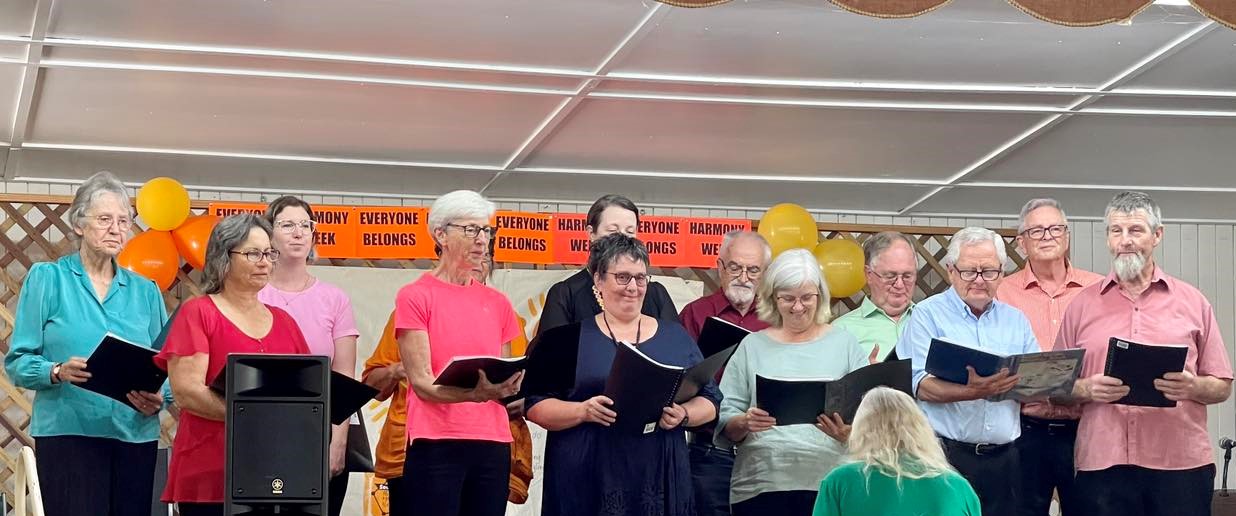
East Street Singers (spot The Goodwills) photo by Joel Richters
Never too early for a date claimer (so you can plan your busy lives). We’ve been asked to open for Fred Smith when he revisits Nambour’s Sunday Folk on June 18. Fred has performed at house concerts held when we lived in Maleny and we keep bumping into him (Tasmania, WA, Woodford). See details of this gig at the end of this report on our recent gigs.
March was a busy month for a pair of septuagenarians. On March 19 we performed at Folk Redlands with our third member Helen Rowe. The following weekend (March 26) Laurel and I were part of the afternoon’s entertainment for a refugee fundraiser in Warwick. The occasion was National Harmony Week and the cause to raise money to help settle a refugee family in Warwick.
Eighty people attended and we raised $1353 on the day for the Southern Downs Welcome Circle, which is sponsoring a refugee family who move to Warwick in May.
We opened the show with a half-hour set followed by East Street Singers who sang contemporary music, a break from the Gilbert & Sullivan pieces we are learning at the moment. Laurel and I are both in the choir so much changing of hats went on through the afternoon. Penny Davies and Roger Ilott closed the concert with some lovely soft, melodic songs which they encouraged people to sing along with.
Penny was also MC on the day (talk about wearing too many hats) and Roger thankfully took over managing our Yamaha PA which we needed in St Mark’s Anglican Hall.
Then on Friday March 31 we were part of the entertainment at a U3A Warwick end of term social. The venue was a contemporary history museum, The Kompound, noted for its dedication to the humble Kombi wagon.
Other entertainment on the night included a Scottish Country Dancing demonstration, the U3A line dancers and a Djembe drumming group.
Our next formal gig is supporting Fred Smith for a concert at Nambour’s Folk on Sunday on June 18, 2023. The venue is Nambour’s old ambulance station (now the Black Box Theatre). If you’ve not heard Fred Smith before, it would be worth the effort to (a) look him up https://fredsmith.com.au/ and (b) come along.
Friday on My Mind – Good Friday or just another day
April 7, 2023
By Bob Wilson
At the start of Joe Cocker’s live album, Mad Dogs and Englishman Joe mutter (incoherently) “Uh, uh – it’s Easter.”
Pause – “I was just gonna say don’t get hung up about Easter,” says someone in the band, probably Leon Russell.
A poor pun and in incredibly poor taste when you consider (well, in Australia anyway), that 43.9% of the population identify as Christian.
On Easter weekend, Christians honour the epic Bible story of the crucifixion and the resurrection. They would not care for Leon Russell’s inappropriate pun and some might even be offended that I recounted it, today of all days.
Christians accept the story that Jesus was crucified (by the nasty bureaucrats of the day), locked away in a tomb after his death and then arose from the dead, leaving an empty tomb. This supernatural feat of resurrection underpins almost everything Christianity is about; that Jesus died for our sins and only by accepting his love can we be saved.
I was raised a strict Methodist, by kind-hearted Calvinists who took the Bible literally. At times, I had nightmares after a particularly vivid fire and brimstone sermon by crusty old Methodist Ministers, who, even in the 1960s, were presiding over ever-diminishing congregations.
It’s no accident that the Methodist church has all but disappeared, absorbed into the hierarchy of less extreme religions. I asked my parents one time why they decided to leave Scotland and travel to New Zealand and was loosely quoted scripture (Ruth) “Wither thou goest, so shall I follow.” This was a wee bit before Germaine Greer.
She Who Does Not Go To Church But Lives By Christian Philosophy asked what I was writing about this Friday. When told she replied: “Wither thou goest I go to Wednesday morning coffee group.” A right pair of blasphemers we are, but clearly our hearts are in the right place. Ask anybody.
The correct text from the book of Ruth 1:16 reads:
“And Ruth said, Intreat me not to leave thee, or to return from following after thee: for whither thou goest, I will go; and where thou lodgest, I will lodge: thy people shall be my people, and thy God my God.”
That particular translation comes from the King James Bible. Theologians will tell you it is about fidelity. No way is it about a mere woman doing what she is told by a man who (citing the old marriage vows), must be honoured and obeyed.
If you are interested, this website cites at least 30 different translations or interpretations of the same verse.
The Census question about religion is the only one on the Australian Bureau of Statistics form that is voluntary. Nevertheless, 93% of Australians answered the question in 2021, up 2% on the 2016 result. This is where I got the statistic that 43.9% of those who filled in their Census form identified with Christianity. If you go back several Censuses, this figure has dropped from 61.1% in 2011. If you go back to 1966, 88% of Australians said they were Christian.
By contrast in 2021, 38.9% of Australians stated they had ‘no religion’ (it was 22.3% in 2011).
Other religions (the ones that are growing) include Hinduism (up 55.3% to 684,002 people (2.7% of the population).
Likewise, Islam has grown by 813,392 people, 3.7% of the population.
The Christian Research Association notes that the fastest rate of decline in numbers between 2016 and 2021 was in The Salvation Army (28%), followed by the Uniting Church (23%), the Presbyterians and Reformed (21%), Anglicans (20%), and Lutherans (16%). There was a slower rate of decline among the Churches of Christ (9%), Latter-day Saints (6%), Catholics (4%) and Pentecostals (2%).
When Easter approaches, it conjures up memories from my teenage years when I left school early and went to work with Dad in the bakery. Dad was an old-school baker, taught his craft in Scotland in the days when bakers used lots of dried fruit in hot cross buns. (I accidentally bought fruitless hot-cross buns- how ‘disappointment’! Ed)
As I recall, the production line began about 6pm on Wednesday and we’d still be hard at it by noon on Thursday. People came from all over the region to buy Dad’s buns. I seem to remember we made 100 dozen or so. We always sold out.
Hot cross buns, with their thin pastry cross tops, symbolise the crucifixion of Jesus on Good Friday.
They were invented by medieval monk Thomas Rocliffe in the 14th century. As the County Life blog opines, ‘were he alive today, he might stop and say a prayer for forgiveness when he reached the hot-cross-bun aisle of a supermarket’. These sticky fruit buns, sold all year round in an assortment of flavours, are pale imitations of the original.
“There are even buns filled with fudge, a sickly notion that might have Brother Rocliffe fleeing back to the safety of St Albans Abbey.”
Dad made his fruit mix a month or so before Easter, leaving it to steep in a marinade. Come the time for baking, he was very generous in his allocation of fruit.
Much has been written about the decline of Christianity in Australia. The reasons are manifold, but statistics suggest the decline started with the cultural changes within the traditional family unit (Dad the breadwinner and Mum the housewife), which held sway in the 1950s. Then came the sexual revolution, hippies, Vietnam, the summer of love, women’s liberation and an ever-increasing level of higher education among people in general. In the past 20 or 30 years, people may have turned away from churches of all denomination after revelations of abuse of powers amongst ministers, clerics and priests.
Despite my stated position on organised religion, I salute those who attended Mass and other Easter services today. As the Census figures suggest, you are swimming against the tide. But it was always thus.
In the years of the Reformation (1550-1600), Thomas Cromwell became a notorious figure in politics as he cosied up to King Henry VIII.
Cromwell was involved in developing much of the religious legislation for the Reformation and was responsible for making sure it became law.
Monasteries owned over a quarter of all the cultivated land in England at the time. By destroying the monastic system, Henry could acquire all its wealth and property while also removing its Papist influence. Cromwell organised the dissolution of the monasteries in England, dissolving more than 800 religious houses in the 1500s. A brutal period in history.
There has always been opposition to (certain types of) religion and persecution often follows. We can see it today in the millions of refugees fleeing persecution, often because they are of a religious minority.
Today in Australia the agnostic among us and those who simply follow their own personal creed see no need to go to church. As comedian and composer Tim Minchin observes in his Christmas song, White Wine in the Sun:
I don’t go in for ancient wisdom I don’t believe just ’cause ideas are tenacious It means they’re worthy.
For many of us, this is just a four-day holiday weekend, complete with hedonistic rituals like rugby league and AFL matches and horse racing. For Australians who have declared themselves Christians, it also means time to reflect on their beliefs. Suum cuique, I say (to each his own).
One of Glengallan’s automatic mowers doing its autonomous thing – photo by Jonno Colfs
Friday on My Mind – We need volunteers – you, you and you!
March 31, 2023
By Bob Wilson
Last time I wrote about volunteering in Australia (2019), I confessed to having not done much of it at all. A lot can change in four years. I became re-acquainted with a former journalist colleague, Donna Fraser, who just happens to be chair of the Glengallan Homestead Trust. I had been to visit the partially restored sandstone homestead several times and could well remember what it looked like in the 1990s. Falling down, unoccupied and unloved.
“Why doesn’t someone save that old building?” we’d all say, and then forget about it until next time.
Donna suggested I might like to volunteer as a tour guide. I tagged along on a couple of tours with one of the long-term volunteers. A few weeks later, I was on my own – and enjoying it. I was at that stage still reading from a cheat sheet, put together by Donna from historical information. Glengallan Homestead was restored after the Trust received a $2 million Centenary of Federation grant in 2001. A new Heritage Centre was built, including a cafeteria, a gift shop and administration rooms. The restoration included replacing the old shingle roof and the rotting verandas, which had collapsed during the 70 years the homestead was neglected.
Glengallan is now one of the popular tourist destinations on the Southern Downs, with visitors and locals calling in from Wednesday to Sunday. General manager Jonno Colfs, who took over the job in September 2021, has introduced some innovations. The Trust recently purchased four automatic mowers, which quietly potter around the 5 acre Homestead block from 6am till nightfall, guided by GPS and smart enough to return to the recharging station at night. The mowers were bought with proceeds of a grant; and not only that, bought locally (from the Killarney Co-operative). Jonno says the mowers have become something of an attraction on their own. They are constantly on the move and the rule for visitors is – give way to mowers.
He also increased the cost of admission to $15 (it had been $10 since the Homestead was opened). He brought cafeteria prices more in line with what visitors would expect to pay In Warwick or Toowoomba.
Since taking on the job of General Manager, Jonno has been busy writing grant applications. One grant paid for upgraded signage, spotlights and a garden makeover. He’s also been promoting the seasonal market, which hit a new record in March, with 67 stalls registered. The next market day is the first Sunday in June- 4th of June.
I never tire of visiting Glengallan and its 5 acres of park-like grounds. If you have any sense of history at all it’s not hard to imagine this as the grand edifice at the heart of a 44,000 acre station. There were golden years in the 1800s, but when entrepreneur John Deuchar began building Glengallan in 1867, a drought and rural downturn was on the cards. Deuchar went broke and even though subsequent owners had some good years on the land, no money was invested in the house, which was left vacant and fell into disrepair.
As if being on a roster of volunteer tour guides was not enough, I joined a local refugee support group in 2020 and in late 2021 was asked if I’d stand as chairman.
“How am I going to do this? I asked a friend who has served on many boards as director and/or chair.
“You’ll be fine,’ my learned friend said, after a few probing questions. He emailed me a link to ‘your responsibilities as chair of a not-for-profit’. I also borrowed a book on meeting procedures from the library .
In 2021 I joined the University of the Third Age (U3A) committee as a ‘spare’. Over time, that morphed into newsletter editor, website editor and now publicity officer. In the corporate world they call it ‘mission creep’ which basically means, well, doing more than you signed up for.
If you volunteer for anything you have to accept you will be seconded on to sub-committees and working groups. That’s how it works.
Volunteering Australia’s definition of volunteering is “time willingly given for the common good and without financial gain”. The word ‘willingly’ stands out.
Much has been written about volunteer burnout. This is a state of mind very much like workplace stress, except you are not pulling in the big bucks to tolerate similar issues and hassles.
Like other community-minded people in this town who have ideas and energy, I have somehow managed to get a bit over-committed. I was so busy in March I found myself double-booked when asked to take a tour around Glengallan.
I do have a succession plan to scale down my volunteering in 2024. Apparently I am not alone. Volunteering Australia last month launched a Strategic Plan to avert the decade-long decline in volunteer numbers.
The size of the volunteer workforce has dwindled from more than 5 million people in 2019 to a low point of just under 3 million (according to the 2021 Census).
But that’s still a lot of people contributing selflessly to a cause they believe in. People aged 40-54 years are more likely to volunteer (30.5%) than other age group, which is interesting, given that most of them would have day jobs. For the 70+ group, the number is 28.0%.
The most common types of organisations for which people volunteered related to sport and physical recreation (30.7%), religious groups (23.1%) and education and training (18.8%).
The majority (66.4%) volunteered for one organisation only, 23.0% for two and 10.4% for three or more.
I realise the latter puts me in a minority and might also prompt accusations of ‘virtue signalling’ which is how young people describe making yourself look good or ‘skiting’ as we used to call it.
The onset of Covid-19 in March 2020 tore a huge hole in the framework of national volunteering. A study conducted by the ANU Centre for Social Research and Methods found that the proportion of adult Australians engaging in formal voluntary work, which is done through an organisation or group, fell from 36% in late 2019 to 24.2% in April 2021. In the 12 months leading up to April 2021, only 54.4% of those who had stopped volunteering had resumed, exacerbating a decline in the national rate of volunteering from 36% in 2010 to 29% in 2019.
More recent research by the Institute of Community Directors reveals that 58% of charities reported a decline in volunteering. The report speculates about generational change as one reason, citing a YouGov Consumer Sentiment Survey. This survey found that 23% of Baby Boomers volunteer several times a week, compared with 14% of Gen Xers, 11% of Millennials and 9% of Gen Z (those aged 12 to 24). Those are scary statistics when you realise that 51% of Australian charities are wholly dependent upon volunteers.
As I write this, three U3A volunteers are reviewing my spelling, grammar and syntax before we email the Term Two newsletter out. That will be the easy part, unlike the First Term newsletter, 160 copies of which were printed, folded, labelled and mailed to members by a small army of volunteers. Nothing wrong with signalling other people’s virtues. They know who they are.
 If you are within cooee of Nambour on Sunday June 18 what better way to spend an afternoon that a concert with celebrated songwriter Fred Smith and a reunion with The Goodwills.