Yes, well will be having another series of house concerts in 2018 with the first date in February yet to be confirmed. Our guests in 2017, including Brad Butcher and Kelly Cork, Cloudstreet, Kieran Halpin and Gone Molly attracted full houses. Enjoy the short video from the Gone Molly concert and check back here in January for an update.
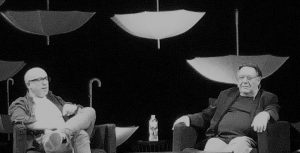
Satirist Bryan Dawe (left) and comedian Julian Morrow at Integrity 20. Photo by Frances Harper
Actor/satirist Bryan Dawe has such a low-key, laconic approach to ‘giving a talk’ that the journalistic instinct to take notes deserted me. Dawe is the surviving half of the satirical act Clarke & Dawe, but he is much more than that. He told the audience at Griffith University’s Integrity 20 Summit that when it came to political satire, he and John Clarke had never been short of material over 25 years of producing their weekly TV show.
Dawe introduced one of his best-known satirical characters, boozy retired judge Sir Murray Rivers QC; Dawe as interviewer/straight man to Sir Murray’s confused bigot. His presentation was funny; funny and sad, as he often referenced his late partner in satire John Clarke, who died in April this year. Dawe’s ‘talk’ would have been illuminating for the year 11 and 12 students attending Integrity 20, as Dawe summarised his unhappy days at school where he left early after being told by a careers adviser he would not amount to anything because he came from the ‘wrong postcode’.
Dawe joined Julian Morrow of The Chaser and The Checkout for a discussion on satire, comedy and how to know when you’ve gone too far. When asked that question by panel chair Rebecca Levingston, both agreed that nothing was off limits.
While agreeing that one could satirise and make jokes about anything, Morrow conceded that The Chaser’s skits post-9/11 were “too soon”. Levingston prompted Morrow to revisit the time The Chaser (a TV satire show), penetrated security at the 2007 APEC conference in Sydney with a fake motorcade transporting a ‘Mr bin laden of Canada’. As Morrow recalled “We never expected to succeed.”
Both satirists agreed that there are powerful people who always try to have good satire shut down, probably because nothing is funnier than the truth, greatly exaggerated. The trick, said Dawe, was not to engage with critics, trolls and others whose power base was being diminished by The Chaser’s sharp sketches or by John Clarke’s familiar introduction: “Thanks for having me, Bryan.”
Bryan Dawe’s presentation was the ideal tone for Integrity 20’s afternoon session, which followed serious and at times contrary debate about hate speech, free speech, censorship, the global rise of populism and how to destroy democracy.
Masha Gessen, photo by Bengt Oberger, Wikipedia CC
You may have heard Richard Fidler on Conversationsinterviewing Masha Gessen, an exiled Russian American journalist and author. Her speech ‘How to Destroy Democracy’ and later contribution to a panel discussion on populism was a highlight of Integrity 20.
New York-based Gessen outlined the seven lessons in ‘imagining the worse’, in which the rise of populism destroys democracy. These include destroying the sense of participation, conspiracy myth-making, and engaging in the ‘forever war’, (which in the US means a 16-year war against ‘terrorism’, an unidentifiable foe, with no end point in sight).
Gessen, an outspoken critic of Donald Trump, also referred to the way democracy could be destroyed simply by degrading language.
“Trump is a master at that. He lies and lies to convince you that something that’s not true is true. There’s no way for a journalist not to quote his lies.
“Trump says he’s the subject of a witch hunt when that’s the opposite of what he means. He creates word salad and makes it difficult to work out what it all means. It’s a direct assault on how we all live because language is the main tool we use to co-exist.”
Even while Gessen was articulating this I was thinking about former PM Tony Abbott’s ludicrous comments about goats, volcanoes and climate change. However daft the comments seemed, journalists had no option but to quote what he actually said at a climate conference in London.
As Ricky Gervais said this week in a thought-provoking tweet:
Some opinions are so stupid they hurt my feelings. But that’s my problem. It’s a person’s right to hold as stupid an opinion as they like. (@rickygervais):
A panel discussion followed on the global rise of populism. Panel chair Luke Stegemann summarised the rise of populism in countries including Italy, Poland, the UK, France and Germany. “Australia is not immune by any means,” he added, citing the resurgence of Pauline Hanson’s One Nation and how it taps into the frustrations, racism and bigotry of people who are angry about immigration and furious about globalisation and the perceived impact these issues have on their jobs.
One ought to keep in mind that populism − a movement for the people and against a privileged elite − can occur across a broad political spectrum. It is possible, as panellist Geoffrey Robertson QC observed, to have left-wing populism.
The origins of populism date back to the 1800s when rural peasants revolted against their robber baron landlords. Today it is more about polarising the electorate and pitting angry poor people against (poor and possibly angry) immigrants and asylum seekers.
The privileged elite seem to survive with wealth intact, whichever way the populist wind is blowing.
Rachel Kleinfeld of the Carnegie Endowment for International Peace said the common perception was that supporters of populism are racists and bigots.
“There is a racist fringe but the core of populism is about high inequality and why people don’t understand why politicians don’t listen.”
Geoffrey Robertson said young people were disenchanted about the rampant capitalism that democracy encourages. This was in response to Kleinfeld’s comment that only 52% of people aged 18 to 29 think it is preferable to live in a democracy. Robertson said the key threat imposed by populist leaders was the attempt to replace an independent judiciary with their own people.
Kleinfeld made comparisons between Donald Trump and outsider president Andrew Jackson (1828-1834), who enjoyed two terms and put his successor, Martin Van Buren, in place to ensure 12 years of a populist government.
The Atlantic made much of the Trump/Jackson similarities.
“Jackson, like Trump, won over many white working-class voters, who brushed aside critics who warned that he was unstable and a would-be dictator. He maintained their loyalty even though, like Trump, he was of the elite.”
I can’t recall who started it, but it seemed all panellists agreed that Trump, despite being widely reviled, would easily take another term in office. They didn’t say so, but it seems obvious that Trump has a like-minded and seemingly un-impeachable successor in Mike Pence sitting on the bench (wearing a Martin Van Buren t-shirt).
If you were not yet confused about populism and its multiple meanings, Cas Mudde, a professor at the University of Georgia, coined the phrase “thin ideology”. This means to merely set up a framework: pure people versus a corrupt elite. Thin ideology can be attached to all sorts of “thick” ideologies such as socialism, nationalism, anti-imperialism or racism.
I will leave it to the reader to decide what type of populism exists in Australia.
Monday I’ve got Friday on my mind
I leave you with a tribute to the late George Young, who co-wrote the song from which this essay takes its name. Young and co-writer Harry Vanda and their band The Easybeats had an international hit with Friday on My Mind in 1967. Here’s a terrific cover from Richard Thompson and band from the album 1000 Years of Popular Music. (Please don’t listen to the Bruce Springsteen version that comes up after that…Ed)
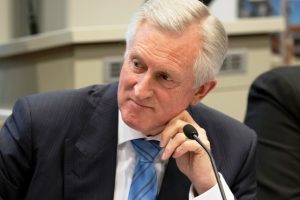
Photo of John Hewson – Crawford School of Public Policy
Nobody can call out an errant politician better than former Liberal Opposition Leader John Hewson. In the 22 years since he resigned from politics, Hewson has become a respected academic, the darling of TV panel shows like Q&A, and a regular on the celebrity speakers’ circuit. Yesterday, Hewson was a keynote speaker at Griffith University’s two-day summit, Integrity20.
Who better to address the opening topic “Post-Truth, Trust and the Ethics of Deceit?” Hewson has been speaking out about fake news and the propensity of politicians to stray from the facts, long before Donald Trump made it a catch phrase. He is also an advocate for evidence-based public policy, often identifying where politicians have used models and commissioned reports to suit their version of the facts.
So to Hewson’s opening address yesterday, where he used the climate change debate to support his argument for ‘evidence-based public policy’.
“We had a very hard-line position as a response to the climate challenge back in the early 1990s. I was calling for a 20% cut in emissions by the year 2000 off a 1990 base. We are yet to know how we are getting the 5% reduction in emissions by 2020 off a 2000 base. And of course, we’re committed under the Paris Accord to cut emissions by 26% to 28% by 2030.
“What’s happened over that period is drift – the issues have been left to drift. Housing affordability’s been left to drift, the climate response has been left to drift and the final line of that drift is the mess we have in the energy sector. Electricity and gas prices are running away to the point where the average household is struggling to afford to pay its power bills.
“These are the outcomes of negligent government over a very long period of time.”
Hewson believes the situation can be turned around, but it will take some years to reverse the damage. He said what the country needed was an honest debate about leadership.
“And leadership is going to be about telling people honestly the way it is. To get good policy up we have to educate people to accept the magnitude of the problem.
“But we don’t have any debate now in this country – it’s all negative. One side puts its hand up and says let’s do X and the other side immediately says no.”
One in three voted for someone else
He said people had lost faith in the two-party system. In the last election, one in three people did not vote for one of the major parties. The protest vote was not just something that had happened only in Australia, he added, citing Brexit, the US, France and Germany as recent examples.
“It’s a longer term trend and it will get worse before it gets better.”
The path to restoring voter confidence, he said, was by focusing on the issues that affect people – the cost of living, health, housing, childcare and education.
But the main problem was that the ‘wrong people’ were in government.
“If you asked them why they went into politics, they’d say to make a difference and leave a better world for their grandchildren.
“And then they do the opposite.’
Hewson, who will be 71 next Sunday, had a distinguished career in politics. He was leader of the Australian Liberal Party and Leader of the Opposition between 1990 and 1994. Before and after politics he has worked as a senior economist for organisations, including the Australian Treasury, the Reserve Bank and the International Monetary Fund.
In this context, it seems uncharitable to recall that in 1991 he advocated an unpopular goods and services tax. He lost the 1993 election to Paul Keating over the “Fightback Package”, of which GST was a central element. Ironically, Paul Keating (who first advocated a GST in 1985), shamelessly exploited public opinion to thwart Hewson.
All that aside, Hewson at least clearly outlined what he was going to do in 1991-93 and stuck to it. He is known still as a straight shooter, a man who once said he lived in hope of ‘spin-free politics’.
Day one of the Integrity20 Summit was not just about politics and truth. ABC presenter James O’Loghlin chaired a panel discussion about solving the world’s problems through innovation.
Inventor and futurist Mark Pesce showed a short video of a robot working on a farm in Indonesia. He described it as just two wheels, an axle and a smartphone on the end of what looks like a selfie stick, collecting data and producing crop reports. These robots cost about $2,500 and can be shared around a farming community. He also demonstrated how 3D printers, aligned with a simple robot used in smart phone technology, can reproduce all the plastic parts to build another 3D printer. Eventually, robots will also be able to assemble the printers – and that’s just the edges of the innovations universe.
CSIRO scientist Stefan Hajkowicz said the impact of Artificial Intelligence on the future of work had been greatly over-stated. He thought there were many areas where robots and humans would work side by side – in hospitals for example. The robot would do the blood test and the nurse would soothe the patient’s concerns.
But it turns out robots are crap at irregular tasks we humans take for granted, A robot cannot tie your shoelaces, for example. And, as Hajkowicz added, they can’t fold towels. They tried to get a robot to fold a towel. It took 20 minutes and did the job badly.
Today I attended the final full-day session of Integrity20, hastily scribbling notes and pressing stop/start on my hand-held recorder. You may wonder how I met my deadline – marvel at my prowess.
M.Y Prowess (sub-editor): “Isn’t it time I had a byline?”
BW: Ghost writers should be read and not heard – and try using commas instead of dashes – please – some of my readers find it tiresome.”
Next week: Bryan Dawe on satire, media censorship and the global rise of populism.
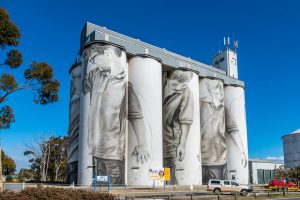
A mural by Giudo van Helten on 30m grain silos in Coonalpyn, South Australia. https://flic.kr/p/XUsAK9 Steve Swayne
You wouldn’t always associate grain silos with the national funding crisis facing Australia’s mental health sector. Mental Health Australia chief executive Frank Quinlan did just that, using the silo analogy to lament the distribution of funds that so often see alcohol and drug problems and mental health problems dealt with separately.
He cited the 2016 Australian Institute of Health and Welfare report on alcohol and drug use which states that one in four people who abuse substances had also been diagnosed or treated for a mental illness.
Mental illness was the subject of a short film shown at Gympie’s Heart of Gold Festival last weekend. A psychiatrist is late for his 11am appointment with a new patient – a man who suffers from delusions that he is…a psychiatrist. It sounds like a man walks into a bar joke, but in this case, the clever premise for a 13-minute film by Josh Lawson (actor/writer) and Derin Steele (director).Lawson and Steele control the farcical plot and sharp dialogue with the panache of John Cleese and Connie Booth.
The film won the best Australian short film award at the Heart of Gold Festival, the 10th year of this splendidly curated short film festival held in Gympie. I’m happy for the writer/director that they won best Australian short for a film by using humour to have something to say about psychiatry and mental illness.
Seeing is believing – maybe
Unlike physical disabilities (cerebral palsy, MS, spina bifida, brain or spinal cord injury, epilepsy, muscular dystrophy or the long-term effects of a serious stroke), mental illnesses are hardly ever that obvious. Once the mentally ill person’s latest acute episode has settled, they can present in society, well, as normal as you and me.
The point is well made in “The Eleven O’Clock” where the secretary (a temp), accepts what she sees as “normal”.
There is, alas, nothing funny about mental health, its proven links to alcohol and drug abuse and a lack of co-ordinated national funding that leaves so many mentally ill people in a cyclical holding pattern.
As Mental Health Australia chief executive Frank Quinlan wrote in a recent MHA newsletter, separate plans and strategies to deal with mental health perpetuate the silo model of funding.
Quinlan writes that Primary Health Networks, set up in 2015, offer an opportunity to genuinely integrate and co-ordinate programmes and services.
“But this is only going to happen if we can break down the boundaries that see separate streams of funding for drug and alcohol issues, mental health issues and various psychosocial supports.”
The 2016 AIHW report, which canvassed 23,772 people, noted that 27% of illicit drug users have a mental health issue, compared with 21% in 2013. Mental illness occurred in one in four users of ecstasy and cocaine and in 42% of methamphetamine users (29% in 2013).
The abuse of amphetamines and derivatives doesn’t let righteous boozers off the hook. One in five people who drink alcohol at risky levels have also been diagnosed or treated for a mental illness. That was a 25% increase over three years.
Patrick McGorry, professor of psychiatry at the University of Melbourne, says the overlap between mental ill health and substance abuse is enormous, yet treatment for drug abuse and mental health has been “progressivelyde-funded, de-medicalised and split off from mental health care.”
He told ABC News: “Mental ill health drives self-medication with drugs and alcohol and yet virtually no services are equipped to respond to this toxic blend.”
Meanwhile, many community mental health programs, be they government-funded units or NGOs, have been ring-fenced within the National Disability Insurance Service. This means that the mentally ill who do not qualify under the NDIS may be without support outside of acute hospital wards. The Federal Government set aside $80 million in the May budget with the intention of plugging the gap.
Sebastian Rosenberg, Senior Lecturer, Brain and Mind Centre at the University of Sydney, said the federal budget’s promise of $115 million in new funding over four years was one of the smallest investments in the sector in recent years. The Council of Australian Governments (CoAG) added more than $5.5 billion to mental health spending in 2006, while the 2011-12 federal budget provided $2.2 billion in new funding.
“In 2014-15, mental health received around 5.25% of the overall health budget while representing 12% of the total burden of disease,” Rosenberg wrote in The Conversation.
“(These figures) speak to the fact mental health remains chronically underfunded. Mental health’s share of overall health spending was 4.9% in 2004-05. Despite rhetoric to the contrary, funding has changed very little over the past decade.”
Rosenberg says Australia lacks a coherent national strategy to tackle mental health.
“New services have been established this year, but access to them may well depend on where you live or who is looking after you. This is chance, not good planning.”
This is where the silo analogy reappears: those with the gold key to the silo door will get a quick fix. Treasurer Scott Morrison said the $80 million allocated over four years for ‘psychosocial services’ was for Australians with a mental illness such as severe depression, eating disorders, schizophrenia and post-natal depression. The funding, which seeks matching contributions from the States, includes those who had been at risk of losing their services during the transition to the NDIS.
Some 230,000 Australians with severe mental illness have chronic, persisting illness and most have a need for some form of social support. This can range from low intensity or group-based activities to extensive and individualised support. The latest data available on this subject suggests that 22% of people with psychosocial disabilities have been unable to meet access requirements for the NDIS. (NDIS/COaG Quarterly report).
So $20 million a year won’t go very far, although as much as $160 million a year could be available if all States chip in. But each State and Territory will have to retain responsibility for what was previously known as community mental health services.
Still, you’d agree it’s a better application of taxpayer funds than the $20 million spent in 2015 on charter flights to and from detention centres on Nauru and Manus Island.
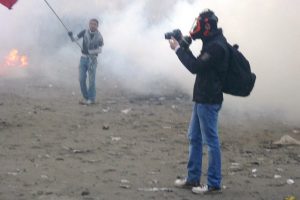
Photojournalist wearing a gas mask covers civil unrest in Cairo. Image Alisdare Hickson
Not for the first time, I’m ruminating about the deadly risks facing journalists working in conflict zones or countries like North Korea, Saudi Arabia, Ethiopia, Egypt or even India.
It’s 1am and I’m reading the Guardian Weekly, starting with its world roundup, where my eye is drawn to a headline: “Indian journalist beaten to death.” In just 100 words we are told that Shantanu Bhowmick’s death at the hands of a stick-wielding mob brings the tally of reporters killed in India since the 1990s to 29.
The International Federation of Journalists (IFJ) outlines the risks facing individuals in India who have made Right to Information (RTI) requests. Since the law came into force in 2005, at least 69 people have been murdered after they filed RTI requests. Another 130 journalists have been victims of assault and 170 reported being harassed.
The Committee to Protect Journalists says that 1,746 journalists and 104 media workers have been killed world-wide since 1992.
What makes these statistics more compelling is that the majority of deaths were not random: a motive was confirmed in 1,253 cases.
The Committee to Protect Journalists maintains a list of the riskiest countries in which to work as a journalist. The list is based on the use of tactics ranging from imprisonment and repressive laws to harassment of journalists and restrictions on Internet access.
Eritrea is No 1 on the list of regimes which censor the press and the Internet, followed by North Korea, Saudi Arabia, Ethiopia, Azerbaijan. Vietnam, Iran, China, Myanmar and Cuba.
There are 23 journalists behind bars in Eritrea. None has been tried in court or even charged with a crime. The Internet is available, but only 1% of the population goes online, using slow, dial-up connections. Only 5.6% of Eritreans own a cell phone. In North Korea, 9.7% of the population have (official) cell phones but an unknown number have phones smuggled in from China. A few individuals have Internet access, but schools and institutions are limited to a tightly controlled Intranet.
The CPJ says tactics used by Eritrea and North Korea are mirrored to varying degrees in other heavily censored countries.
“To keep their grip on power, repressive regimes use a combination of media monopoly, harassment, spying, threats of journalist imprisonment, and restriction of journalists’ entry into or movements within their countries.”
This was not helping my insomnia. I turned to page nine, to reporter Joshua Robertson’s full-page coverage of Australia’s same-sex marriage debate. The story includes interviews with residents of Warwick (Queensland), apparently the last bastion of the ‘No’ vote.
Robertson went to an un-named club in Warwick, a town of 15,000 on the Southern Downs, to interview un-named people about the town’s apparent reputation as a ‘No’ Vote stronghold.
“The bible says it’s wrong, and that’s all there is to it,” one woman in the club said, chiding her husband, who was yet to make up his mind.
The reporter also travelled to Roma, an oil and gas town in western Queensland. He interviewed a public servant who said he felt more comfortable being “out” in Roma that in Sydney or Melbourne.
Meanwhile in Queensland
As news assignments go, Joshua Robertson’s Queensland Diary would not fall into the category of risk that faced Shantanu Bhowmick or the other 44 foreign journalists and media workers killed so far in 2017.
These global statistics make the life of a working journalist in Australia look comparatively benign. But not so if you accept an assignment to file news reports, video or images from conflict zones. In 2015, Australian journalist Peter Greste laid a wreath at a new memorial in Canberra recognising the contribution of war correspondents. It was fitting that Greste was chosen for this honour as he’d not long returned to Australia after being imprisoned in Egypt, along with Al Jazeera comrades.
The memorial in a sculpture garden at the Australian War Memorial honours 26 war correspondents killed in combat zones. They range from William Lambie (Boer War 1899-1902) to cameraman Paul Moran, killed during a suicide bombing in Iraq, 2003. Also named is sound recordist Paul Little, who died in a German hospital in 2003 after being caught up in an ambush in Iraq. Also laying a wreath in September 2015 was Shirley Shackleton, widow of Balibo Five reporter Greg Shackleton, one of five Australian journalists killed in East Timor in 1975.
And Australians might want to think about these crucial issues of press freedom and the right to information. On Monday, the ABC’s Four Corners, still the best in the business, sent a reporter and producer to India to dig into the background of conglomerate Adani. It was a good example of journalists taking risks in risky territory. The Four Corners team were grilled for five hours by ‘crime branch’ police after filming at a controversial Adani-owned site. Four Corners investigated Adani’s environmental record and business probity because the Indian company wants the Australian Government to provide a $1 billion loan to underwrite the world’s biggest coal mine in western Queensland and associated rail and port infrastructure.
Joshua Robertson’s Queensland Diary, meanwhile, reminds us that not so very long ago, the State lived under a repressive regime. In 1989 the last criminal charges were brought (in Roma) under Queensland’s homosexuality laws. These were the last days of the Joh Bjelke-Petersen regime (1967-1987), an era when news gathering or protesting was riskier than they are today.
As one of the thousands of bearded, long-haired men who joined their saffron-robed women, wafting about King George Square in a cloud of patchouli essence and acrid cigarette smoke, championing anything that was anti-Joh, I suspect my photo is in a dusty Special Branch file somewhere.
Journalists working in Queensland through the Joh-era needed a Press Pass, which had to be shown whenever entering government buildings. I still have my pass, signed by the former Commissioner of Police, Terry Lewis.
One of several “enhanced” ATM’s located in the Alberta Arts District of Portland, Oregon. Photo by Ian Sane https://flic.kr/p/X2R8op
If you were feeling all warm and fuzzy about the Big Four banks deciding to drop the hated ‘foreign’ ATM fees, sorry, the feeling won’t last. For a start, the Commonwealth Bank’s decision to go first didn’t last long. The CBA announced the fee abolition early on Sunday (aiming for a slow news day lead). But within hours, Westpac, the ANZ and National Bank of Australia had all suddenly (on a Sunday) released statements that they had come to the same point of view. The likely reason is that the boards of all four banks (and others) have had the ATM fees item on their agendas for a while now, just waiting for the right time to tell their media people to press “go”.
And they make it sound like they’re doing us all a big favour. Banks have been gouging ATM fees (typically $2 or $2.50) since the Reserve Bank of Australia first said they could, in March 2009. The main ‘victims’ of this unjust fee (for using an ATM owned by another bank), were the people who travel interstate or intrastate and had no choice.
RBA data tells us there were 251.65 million ‘foreign’ ATM withdrawals in the last financial year. Deutsche Bank estimates the Big Four have foregone about $117 million by dropping the ATM fee, according to the Australian Financial Review. But that’s a modest amount compared to the $4.4 billion we collectively pay out in bank fees every year.
RateCity analysis of RBA data shows the average mortgage holder paid $471 on banking fees last year. That includes $240 a year in home loan fees and $231 in credit card fees.
In this context as some have suggested, the ATM fees abolition story is a PR smoke screen. ABC senior business correspondent Peter Ryan said of Sunday’s news coup…“the planned, if not co-ordinated, decision is mostly about banks doing what it takes to avoid a royal commission into bad banking behaviour.”
The most recent media disclosures about money laundering allegations compound other image issues for banks, including financial advice scandals and allegations of market manipulation and misleading conduct.
While the big bank PR people might be spinning this as “listening to our consumers”, the real story is ATMs are becoming less popular.
Reserve Bank of Australia (RBA) data shows ATM use is falling and falling sharply. Monthly withdrawal transactions have fallen from a high of 78.427 million in December 2008 to 48.684 million in January 2017.
Banking analysts ascribe this sharp downturn in ATM use to the now ubiquitous “tap” method of paying for anything from a Mars bar to a week’s worth of groceries. There is also the “any cash out?” query whenever you spend money in a supermarket or bottle shop.
Pat McConnell, Visiting Fellow, Macquarie University Applied Finance Centre, says new technologies will soon be launched that further undermine ATMs. The biggest will be the New Payments Platform (NPP). Another is OSKO, a new payment mechanism from the developers of BPAY.
McConnell writing for The Conversation, says the NPP will change the way that payments are made in Australia.
“Rather than putting a payment on a credit card or waiting a few days for a payment from another bank to clear, with NPP payments will be cleared in a few minutes or less. Using NPP, anyone will be able to make an almost instantaneous transfer of funds into the bank of a supplier, such as a plumber.”
As McConnell puts it, with NPP, everyone with a smartphone and spare cash is an ATM.
Technology changes go some way to explaining why so many bank branches are closing or relocating to kiosk-style retail outlets. Last week, for the first time, I withdrew cash from an ATM outside the local Bank of Queensland branch. I did so because the Suncorp branch in Maleny closed in mid-September and with it went the Suncorp ATM. Suncorp’s advice was to use (a) the BOQ-branded ATM across the road or (b) withdraw cash at the Post Office. Transaction duly completed, I was pleased/relieved to find that I was not charged a fee for using the other provider’s ATM.
(Incidentally, Suncorp announced on Tuesday it would scrap ‘foreign’ fees on its 400 ATMs Australia-wide by the end of December).
There are still six ATMs in Maleny, although the jury is out as to which won’t charge a fee if you bank with someone else.
In case you didn’t know, some ATMs (the ones found in pubs, casinos, convenience stores, roadhouses and other retail outlets) may charge you a fee regardless. What the Big Bank decision to scrap ATM fees means for their business model remains to be seen.
Maleny has just two banks left (Bank of Queensland and Maleny Credit Union (now called MCU Ltd). The ANZ left its ATM in place and established a mobile business bank at the other end of the street.
Since 2007, the number of bank branches in Australia has dropped from 6,600 in 2007 to fewer than 5,600. Branch closures are ongoing, with the Finance Sector Union recently revealing Westpac branch closures in Western Australia and Victoria.
When our local Suncorp branch closed, we went in to check out rumours of cake. Yes, there was (gluten-free) cake, iced in Suncorp colours.
We popped in to say “bye”, but ironically tellers were too pre-occupied serving customers for other than a quick “thanks and good luck”.
What’s bothering me more, honestly, is my habit of collecting gold coins in a container and, once I have $100 or so, banking the cash in my account. Oh, you do that too? The gals at Suncorp didn’t have a problem with this old-school habit. We were told (by Suncorp) we could do basic banking business at the local Australia Post branch. I queued up yesterday, banked $30 in gold coins and it was no drama at all. I even got a receipt.
Now, about that late fee for missing a credit card payment by one day…
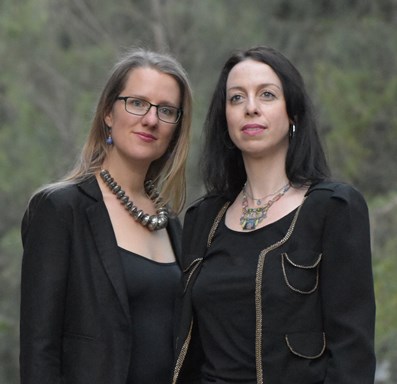
Popular Brisbane folk duo Gone Molly (Sally Harris and Rebecca Wright) are the featured artists for The Goodwills’ next house concert on October 22. Over just two years this exciting duo has become well known on the Australian folk festival and club circuit. They most recently performed at the Neurum Creek and Maleny music festivals in September.
Sally Harris was born in the north of England and writes songs that draw on the traditions of Anglo-Celtic tunes and story-telling. Her songs bring together a love of history, mythology, traditional song, tunes and folk music sessions. She and cellist/singer Rebecca Wright weave these songs and stories into contemporary arrangements for cello, guitar and vocal harmonies.
Rebecca Wright is a solo singer/songwriter and guest cello-singer with numerous acts. Artists she has performed with include Fred Smith, Judy Small, Cloudstreet, Mark Cryle, and The Wish List. Currently based in her hometown of Brisbane, Rebecca plays in a duo with her husband Donald McKay, and a Scottish dance band (The Ceilidh Clan).
Gone Molly (see live video here) is meanwhile finalising a debut CD with producer Pix Vane-Mason at his Conondale studios. Sally and Rebecca successfully financed the project through crowd-funding portal Pozible.
This will be the last Goodwills’ house concert for 2017 and follows a sell-out crowd for Irish songwriter Kieran Halpin on August 6. Other acts to perform in the Goodwills’ loungeroom through 2017 include Brad Butcher and Kelly Cork, Chuck and Chrissy Euston and Cloudstreet.
The Gone Molly concert starts at 3pm with a set from hosts The Goodwills and guest singer/fiddle player Helen Rowe. For bookings and directions, email Laurel goodwills (at) ozemail.com.au or use the contact page on this website. Tickets are $15/$12.
Goodwills’ house concerts are sponsored by the Queensland Folk Federation.
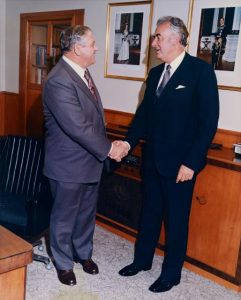
Norman Kirk meets Gough Whitlam in 1973. Photo: Archives NZ
I became aware of New Zealand politics, circa 1960 when a tall Kiwi farmer with coiffed hair and a plummy accent won an election in his own right. After serving as interim PM in 1957, Keith Jacka Holyoake went on to become Sir Keith and later the country’s Governor-General, the only person ever to hold both offices.
The National Party (Conservative) leader ruled New Zealand politics from 1960 to 1972, ousted by a Whitlam-esque Labour figure, Norman Kirk (left). After a promising start, Kirk battled ill health through 1974 and died in office, aged just 51.
Kirk, a working class man who built his own h0me at Kaiapoi, could have been anything. He once said, “People don’t want much, just someone to love, somewhere to live, somewhere to work and something to hope for.”
As Labour scholar Vittoria Trevitt recounts for the Chifley Research Centre, Kirk immediately set about turning New Zealand politics on its head. Social security benefits were increased and new social programmes introduced. Like Whitlam, Kirk ushered in a single parent’s pension. He encouraged Kiwis to build new homes, formed appeal boards so tenants could oppose rent increases and introduced ‘second chance’ re-finance loans for divorcees and others.
Workers benefited from a ‘no fault’ national accident compensation scheme. The Kirk government also increased the minimum wage, improved leave entitlements and fast-tracked equal pay legislation.
As an aspiring scribe in the early 1970s, I became a Kirk fan when he established a fund for writers. And idealists initially embraced the “Ohu Scheme”, where marginal land in remote rural areas was granted to people who wished to establish alternative settlements or intentional communities.
By Trevitt’s account and other sources, it was Norman Kirk who scrapped compulsory military service; Kirk who on day one called NZ troops back from Vietnam; Kirk who ensured that people who had served in the military would have entitlements and employment opportunities. He refused to host a Springbok tour in 1973 because of South Africa’s apartheid policies and confronted France over nuclear testing in the Pacific. And he turned Waitangi Day into a public holiday. Not bad for just 21 months in office.
Kirk’s successors, Hugh Watt and Bill Rowling, lasted until late 1975 when they were rolled by Rob Muldoon’s National Party. In turn, Muldoon was ousted nine years later by David Lange, whose term as Labour Prime Minister is possibly best remembered by his refusal to allow US nuclear-powered or nuclear-armed ships into New Zealand waters.
(Vin Garbutt sings Lynn Clark’s anti-nuclear songSend the Boats Away (song starts at 0.58)
As head of New Zealand politics, Lange held office for two terms and Labour reigned until 1990. After Jim Bolger’s stint as National PM (1990-1997), the National’s Jenny Shipley had a two-year spell before being evicted by Labour’s Helen Clark, who held a coalition together for three terms before resigning from politics, seemingly disillusioned.
Since 2008, the National Party’s John Key has held sway, until his surprise exit from New Zealand politics last year in favour of caretaker PM Bill English.
So to the Kiwi Labour Party (they spell it with a ‘u’). Exiled since 2008, they have been buoyed by polls, a young, positive leader in Jacinda Ardern and a Whitlam-esque slogan: “let’s do this.” (kia mahi a tenei).Ardern stands a better than 50/50 chance of becoming New Zealand’s third female prime minister and the eighth Labour leader since Joseph Ward in 1906. If so, Australia’s government ought to be worried.
She may have to form government with the Greens and the Maori party, but the polls are saying it could happen. Roy Morgan election poll projections show Labour with 49 seats, Green with 11 seats and Maori Party two seats (62 seats). The poll predicts National will win 50 seats, NZ First seven seats and Act NZ one seat (58 seats).
I had lost touch with what is now known as the Green Party of Aotearoa New Zealand, after a flirtation in the early 70s with the vanguard movement, the Values Party. As has happened here, many staunch Labour voters in NZ have drifted to the Greens. As a former Labour diehard source puts it: “Labour has sold us out before and they’ll do it again. They can only be a real government of progress with the guidance and support of a Green coalition partner.”
Lobbying Kiwis living abroad
This week we got an email from James Shaw, co-leader of the Green Party of Aotearoa.
“Kia Ora,” he began, meaning G’day or What’s up Bro?
“The Green Party needs every vote we can get to ensure the outcome is the most environmentally-friendly and progressive result possible.”
“Don’t sit this one out,” said James (Bob resisting the urge to add “to Red Molly”- this one is for RT fans- ed.).
“Party Vote Green from anywhere in the world to make sure New Zealand remains a great place to call home.”
The Greens have a reformist agenda which includes a Zero Carbon Act, a Climate Fund and a 1.2 billion tree planting programme. The party opposes new coal mines, fracking, and deep-sea oil and gas drilling.
My sources in NZ and the UK reckon the campaign to recruit expat Kiwis (assisted here by the Australian Greens), is a smart move. “People living in London and elsewhere like the idea of ‘the clean green NZ’. We also have a lot of youth abroad and they tend to vote progressive,” one Green supporter said.
Last I heard there were 650,000 New Zealand citizens living in Australia. There’s no shortage of election issues in New Zealand politics: housing shortages and property prices, health needs/shortages, offshore drilling, water purity and river pollution are just a few. Swinging voters, the so-called “Middle NZ” – people who typically own more than one property – might be swayed to the conservatives by speculation of a Labour/Greens capital gains tax (NZ doesn’t currently have one).
In the Red corner, Labour’s effervescent leader Jacinda Ardern, 37, is gaining an international profile.
As this BBC article“Can ‘stardust’ beat experience?” reveals, Ardern’s elevation to the top job in Labour politics is no accident. A left-wing activist in her teens, she worked in former PM Helen Clark’s office and in the UK as a policy advisor to Tony Blair. She’s been a politician since 2008.
In the Blue corner, incumbent Prime Minister and leader of the National Party Bill English has been a politician since 1990 and Finance Minister twice. He was deputy PM under John Key from 2008 to 2016. In December 2016, When Key suddenly resigned as prime minister, English won the leadership unopposed (with Key’s endorsement).
A new National Party promotional video seeks to counter Ardern’s appeal to women by portraying English, a father of six, as a family man. Bill’s wife Mary recalls the era of cloth nappies when her husband was a stay-at-home dad.
“Bill ran the nappy bucket. That was his job.”
The video includes positive interviews with Education Minister Nikki Kaye and Deputy Prime Minister Paula Bennett. Former PM John Key praises English for keeping a cool head during the global financial crisis and shrewdly notes Bill’s love of rugby.
Workers in North Korea tending crops on Migok Farm, Sariwŏn. Photo by ‘Stephan’
If you’re old enough to remember the Cuban missile crisis, you’re probably less inclined to see the North Korea/US standoff as a prelude to the End Time.
In October 1962 (I was 13), President John F Kennedy and his Russian counterpart, Nikita Khrushchev, arm-wrestled over Soviet missile sites built on Cuban soil. Russia had taken steps to build missile silos on Cuba as a response to similar US installations in Turkey and other central Europe locations. As Cuba is just 90 nautical miles from Miami, Florida, this news prompted urgent meetings of defence and intelligence chiefs and then-POTUS John Fitzgerald Kennedy.
In October 1962, an American spy plane spotted what looked like a missile site being built on the island of Cuba. Thus began a tense, 13-day stand-off, during which time many people genuinely believed the world was about to end. Wealthy Americans commissioned fallout shelters (some are still being used today to take refuge from hurricanes).
You can say this about the US defence apparatus, they keep detailed historical records. Whether it is the unexpurgated truth is another matter. As Jack Nicholson’s character Colonel Nathan R Jessup in A Few Good Men famously says to prosecutor Lt Daniel Kaffee, who presses him for “the truth” – “You can’t handle the truth.”
In this instance, US intelligence agencies identified 15 SAM (surface-to-air missile) sites in Cuba.
The Soviets established a missile base on Cuba because they feared the US would invade Cuba, after the failed Bay of Pigs invasion in April 1961 by a CIA-sponsored paramilitary group.
At the time, there was still a lot of angst about Cuba; members of the CIA-sponsored Brigade 2506 were still being held captive after the Bay of Pigs invasion.
President Kennedy needed to resolve this situation, quickly and peacefully. The crisis ended with the Kennedy-Khrushchev “agreement” of October 28, 1962. Less well-known was a dispute over Soviet IL-28 bombers based in Cuba. The US claimed they were “offensive weapons” under the October 28 agreement. Kennedy also made a (then) secret agreement to remove US missile sites from Turkey. These events ended the crisis but continued the “Cold War” (which ended in 1991) between Russia and the US.
So to 2017 and North Korea’s threat to target Washington or New York (or more likely Tokyo), with nuclear-tipped missiles.
You may have watched Monday’s Four Corners/BBC expose on the assassination of Kim Jong-un’s half-brother, Kim Jong-nam. This documentary was, I thought, a little bit too informed by ex-CIA sources, US think-tanks and North Korea-watchers. It would be good to sit down in a bar with a regular DPRK citizen to see if they really are oppressed.
“Howzit goin’ Choi? Gettin’ enough to eat? Been threatened or beaten up lately?” Mate, do you get Outback Truckers on DPRK TV?”
If reports about poverty, famines, repression, reprisals, executions and endemic surveillance are true, you could hardly blame a DPRK citizen for having a drink or four. Communist regimes commonly keep alcohol prices down and relax access to it as a means of helping citizens cope with a bleak lifestyle.
North Koreans predominantly drink hard liquor; Soju, a colourless spirit akin to vodka, taken neat. Its alcoholic content ranges from 17% to 60%.
“North Koreans’ main hobby is probably drinking,” said Simon Cockerell, a tour guide who has led more than 100 trips to the DPRK for foreigners.
But the World Health Organisation ranks North Korea below 128 countries whose alcohol consumption per capita is vastly more than the DPRK’s modest 3.7 litres (94.9% of which is spirits). Australians and New Zealanders drink four times as much.
If you want some raw insights into life in North Korea, cartoonist Guy Delisle’s 2001 graphic novel of his time in North Korea is a good start. The first part of Pyongyang – a journey in North Korea begins with a customs official in the dimly-lit airport terminal suspicious of Delisle’s tatty copy of 1984. “What kind of book is this?” The official relaxes when Delisle tells him he has a work visa arranged with a North Korean animation studio.
Once in country, Delisle kept a diary, illustrated with his drawings of Pyongyang and things that happened as he was chaperoned around by minders. I borrowed it from the local library a few years back and found it blackly fascinating and a little subversive.
A Hollywood movie was planned based on Delisle’s book starring Steve Carell. But the movie was cancelled, reportedly because of the kerfuffle over Sony’s film, The Interview.
Love, love, love is all you need
Last weekend, we spent four glorious days and nights away from the constant stream of doomsday news. About 1,000 people from a broad spectrum of society congregated at a bush campground on the fringes of the D’Aguilar National Park. When people ask me what a folk festival is like, I tell them it’s not so much about the music (often heartfelt songs of equality, justice and humanitarianism), but the harmonious atmosphere.
Many performers took time out between songs at the Neurum Creek Music Festival to observe how sweet it was to have some respite from the constant barrage of end-of-the-world scenarios.
Comedians and folksingers Martin Pearson and John Thompson, reunited as Never the Twain, took a moment from manic wisecracks and parodies to touch the collective soul. The Fred Small song Scott and Jamie is a five-minute story about a gay couple who adopt two boys and are living the dream until social services intervene. The refrain – ‘Love is love, no matter who, no matter where’ rippled out across the festival venue. A hush fell; dogs dialled it down to rapid panting. Even the bar staff fell under the spell.
Four people sitting in front of me rose to their feet at the song’s end, to applaud the splendidly rendered version and the sentiment. It may be a forlorn hope to think that we can cure the world by singing songs of love and peace like ‘Imagine’, ‘Redemption Song,’ or ‘All you Need isLove’. But what else can a pacifist do?
She Whose Family Immigrated from Canada in 1964 thinks her Dad picked this place on the map to escape proximity to a looming nuclear war between two super powers. It didn’t happen then, but there have been scary moments since – September 11, 2001 in particular.
What now? Will we see a new surge of refugees from Japan and the US testing Australia’s world-famous, inclusive asylum seeker policies? Perhaps, as the latest issue of Popular Mechanics suggests, people will invest in bomb shelters instead. Those with wealth enough can spend tens of millions on ‘Doomsday Condos’, shelters big enough to cater for the extended family, friends, pets, the family lawyer…
Or you could travel to a village in Ontario, contribute ‘sweat equity’ and join other idealists maintaining the world’s biggest nuclear shelter, Ark 2.
Sigh. Détente would be easier, and cheaper. You know – détente as in ‘a relaxing of tensions between nations through negotiations and agreements’. Or rapprochement, even. But this would require Donald Trump and Kim Jong-un to clasp hands across a table and sign an Accord.
Renewable energy – Mount Majura solar farm, ACT (image courtesy Climate Council)
Have you ever noticed, after giving your dog a bath, how it will head straight for the nearest patch of renewable energy? Ours has a favourite sunny spot next to the dining room table where he will happily bask, while our solar-powered camping lamp, calculator and torches are recharging on the window sill.
Free sunshine – what’s not to like? As it happens, we have been preparing our little caravan for a weekend music festival in the bush. The 160 watt portable solar panel slides snugly under the bed. At $159, this has proved to be a worthy investment for our outback and bush music weekend adventures. It means you can keep topping up the caravan’s battery (if the sun is shining) and go to bed early if it’s not.
We are not expecting rain. No-one is expecting rain.
Australia’s Bureau of Meteorology has confirmed the winter just past was the hottest since records began in 1910. It was also the 9th driest winter on record. The average maximum temperature was almost 2 degrees above the long-term average.
Meanwhile, Texas is suffering unprecedented flooding courtesy of Hurricane Harvey, the reporting of which has somewhat overshadowed devastating monsoon flooding in South East Asia. So far, in the latter disaster area, 1,200 people have been killed and almost two million children were unable to get to school.
As we ironically say in the privacy of our own home – “Just as well there’s no such thing as climate change, then!”
Now all, some of, or only a small part of these extreme weather events could be ascribed to global warming/climate change, which, 97% of scientists agree, is mostly caused by human activity.
Despite this consensus on behalf of an apparently overwhelming majority of scientists, sceptics disagree. I happened to read that former Prime Minister Tony Abbott is set to deliver a speech, “Daring to Doubt,” at an annual climate sceptics group meeting in London on October 9.
You might remember Tony Abbott – his reign as PM at one year and 361 days (cumulative terms), was longer than that of Harold Holt and Billy McMahon, but not by much. Abbott the Climate Change Sceptic is infamous in some quarters as the man who canned the government-funded Climate Commission as part of a Budget cost-cutting exercise.
The Climate Commission bounced back as the privately-funded Climate Council. A new report by the Climate Council concludes that the individual States are going their own way, with mixed results.
South Australia is a clear leader in the renewable energy field, the stakes raised by the government’s decision to replace ageing coal-fired power stations with a 150 megawatt solar thermal power plant.
FOMM foreshadowed this in 2014, when the SA government was trying to negotiate the future of the coal mine which fed its Port Augusta power stations. Now, after five years of lobbying and debate, the SA government is aiming to invest $650 million in renewable energy.
It hardly seems worth mentioning that 1,900 kilometres away, the Queensland Government, in a contrarian move, remains committed to the country’s largest Greenfield export coal mine. The Carmichael mine, which includes a dedicated railway line to take coal north to Abbott Point, is deeply unpopular among environmental groups because of the potential damage it could cause to the Great Barrier Reef, both by the number of ships traversing the narrow channels, and through coral bleaching as a result of human-induced temperature increases.
On the other hand, Queenslanders’ love affair with domestic solar panels is demonstrated by the fact that 32% of households are covered in 2017. Lobby group Solar Citizens (almost 100,000 members), welcomed last week’s decision by the Queensland Government to increase the regional feed-in tariff (FiT) program. This will allow solar systems up to 30kW to receive 10.1c per kWh – six times more than what was previously agreed.
Solar Citizens has an ambitious target of one million solar roofs by 2020.
“Queenslanders know a sensible idea when they see it – with 520,000 solar homes, our State has the highest rooftop solar uptake in the country,” a spokeswoman said.
However, critics of domestic solar energy say the flaw is that those who can afford to become self-sufficient do so, and those who cannot end up paying disproportionately more for energy.)
This week, the Climate Council presented its annual ‘state of the States’ renewable energy report. CEO Amanda McKenzie said the State survey showed a major step up from last year. All States and Territories (apart from WA), have strong renewable energy or net zero emissions targets. South Australia is building the world’s largest lithium ion battery storage facility, and over 30 large scale wind and solar projects are under construction across Australia in 2017.
“The good news is that many States are surging ahead and doing the heavy lifting for the (Federal) government.”
Last week, the Victorian government flagged new legislation which would increase its renewable energy target to 40% by 2025. There is also an intermediate plan to lift Victoria’s clean energy target to 25% by 2020.
So yes, it does seem as if individual States (and Councils) are setting their own renewable energy policies, in the absence of clear leadership at a national level.
Noosa Mayor Tony Wellington did not miss an opportunity to talk up his region’s commitment to solar panels. Noosa Shire, which de-merged from the larger Sunshine Coast Regional Council (SCRC), claims 9,000 households in Noosa Shire have solar installations, which is better than the State average. Cr Wellington told the Sunshine Coast Daily Noosa’s goal was to be ‘carbon neutral’ by 2050.
Not to be overshadowed, the SCRC opened a 15 megawatt solar farm in July. The SCRC was the first local government in Australia to offset 100% of its electricity consumption with energy from a renewable source.
But what can humble citizens do, as pro-coal lobbyists clash swords with the solar and wind farm warriors? The go-it-alone mentality arises from a failure on the part of our Federal Government to stimulate investment in the renewable sector. Australia has already promised, under the 2015 Paris Climate Agreement, to reduce greenhouse gas emissions by 26% to 28% on 2005 levels by 2030. But Tony Abbott’s call as PM to reduce the renewable energy target (and now he advocates scrapping it altogether), was unhelpful.
Whatever way you judge it, a former PM addressing the Global Warming Policy Foundation is not a good look. The last Australian PM to do so was John Howard in 2013 (when he claimed global warming had stalled and was sceptical about the possibilities of an international agreement on climate change).
There have already been reports in the UK media which seized on old quotes by Mr Abbott referring to climate science as ‘bullshit’ and recycling his coal is ‘good for humanity’ comment.
As readers will know, we spent a week out at Carnarvon Gorge in July, a time of year when it is common for the temperature to dip below zero at night. We packed accordingly, then spent four nights kicking off the doona and keeping each other awake as the mercury stayed above 15.
It should be cool at night for the Neurum Creek Folk Festival, but I packed my shortie pyjamas, just in case there is such a thing as climate change.