Bob’s been editing and updating our website video page. There’s quite a bit of ‘content’ on there now, including video slideshows accompanying the studio recordings. Some of these videos have had quite a lot of views. You can help this process by liking a video, subscribing to the channel and sharing links with people you think would enjoy our music.
In 2024 we will be doing more of this as (1) it is the most cost-effective way of keeping in touch and (b) motivates us to stop watching Married at First Sight (LOL).
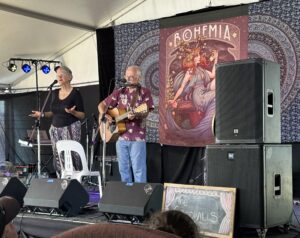
Bob and Laurel performing on the Bohemia Bar stage at the National Folk Festival in Canberra. Photo by Karina Red.
Our latest song is a fairly accurate description of contemporary life in Australia and its moral dilemmas. Bob was inspired to write this after finding an old black and white photo of his grandfather (a stonemason in Bob’s Scottish hometown). The Highland Clearances are mentioned here in the context of the plight of First Australians, homeless people and refugees.
We entered this in the 2024 Alistair Hulett Songs for Social Justice Award, the last time this award will be offered. Bob’s song, When Whitlam Took his Turn at the Wheel, was awarded the prize in 2022.
This year’s awardee is Paddy McHugh for an as-yet unreleased song about Lismore and its disastrous floods (A Hatchet in the Roof). Award coordinator Bob Fagan told the audience at a special National Folk Festival concert on March 30 that 200 songs for social justice had been written and offered to the judges in the 14 years the award has been held. After the concert (when eight of the awardees performed their songs), some audience members commented that some or all of these songs ought to be on a CD (or a download). We second that!
The 2024 concert in the Budawang included songs by Fred Smith, Penelope Swales, Snez, Miguele Heatmole, Tony Eardley, Tripple Effect, Karen Law and The Goodwills. There was also a rousing all-in version of Alistair’s famous song, “The Swaggies”, led by Murray Law and Fred Smith’s band.
Bob and Laurel performing on the Bohemia Stage at the National Folk Festival in Canberra. Photo by Karina Red
Wow, can it really be three months since my last post? I did say I needed a break.
We’ve been immersed in music for the last few weeks – a road trip to Canberra for the National Folk Festival. We were invited to participate in a special concert to celebrate the Alistair Hulett award. Alistair was a well-known leftie songwriter who died in 2010. His family set up a trust to administer an award to encourage people to write songs of social justice award. The award has now ended, after 14 years and some 200 submissions by good songwriters, all adjudicated by incomparable judges.
Our entry was one of a record number in 2024, all of a very high standard, we were told. The awardee announced on Easter Sunday was Paddy McHugh for a brilliant song about Lismore’s floods called Hatchet in the Roof. I hope he gets it out there on music platforms real soon.
Meanwhile our producer Roger Ilott of Restless Music worked away on the spare demo we did to send in for the award late last year. It sounds pretty good and we think it encapsulates some (but not all) of the many social issues which tarnish our country. Have a listen on Bandcamp
.In the fullness of time I expect I’ll write an essay about the parlous state of affairs in the Middle East, Trump’s comeback, the end of Albanese’s honeymoon period.and other juicy topics.
We plan to shut down the Bobwords website by the end of April and migrate the blog archive to our music page, Goodwills Music. So any future blogs will arrive from thegoodwills,com.
.In the fullness of time I expect I’ll write an essay about the parlous state of affairs in the Middle East, Trump’s comeback, the end of Albanese’s honeymoon period.and other juicy topics.
We plan to shut down the Bobwords website by the end of April and migrate the blog archive to our music page, Goodwills Music. So any future blogs will arrive from thegoodwills,com. If you sometimes feel like reading a Friday on My Mind you’ll find nine years’ worth of weekly musiings on that website (once we close Bobwords.
I have been writing new songs and recording them at home but there are likely to be fewer fully produced efforts like Caring for the Dispossessed. We’ll hopefully be doing more gigs and tours this year, but I can’t tell you about them in case the festivals we applied for say no thanks.
I might add, if folk and alt-country music is your preference, great acts we saw at the NFF included Harry Manx, Monique Clare, Windborne, Josh Cunningham and Felicity Urquhart, John Craigie and our very own Spooky Men’s Chorale. Their leader Stephen Taberner was given the Lifetime Achievement Award at the festival.
While we are doing some digital (and actual) housework please note we are no longer using the PO Box in Warwick so if you have it on file please disregard.
As always, if you do not want to receive creative comment from the House of Goodwills, you can unsubscribe.
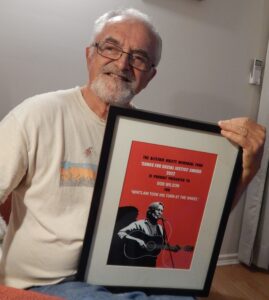
Bob with his framed award from the National Folk Festival 2022
At our age, you take the chances when they come and that is why we are heading, by invitation, to the National Folk Festival at Easter.
As one of the Alistair Hulett Songs for Social Justice awardees, we have been invited to perform Bob’s song When Whitlam Took His Turn At The Wheel at this year’s festival. The song took out the award in 2022, coinciding with the 50th anniversary of the Whitlam government’s election.
A special concert is being presented at the National Folk festival as a tribute to the late Alistair Hulett, whose family set up the award. Sadly, it is now coming to an end, with the announcement of the 2024 awardee on Easter Monday.
The Singing for Social Justice Concert will be staged at the Budawang on Saturday March 30 from 10am to 11.20am. Concert organiser John Sutton has eight awardees lined up to perform their winning songs.
Previous winners of the Alistair Hulett songwriting award include Snez, Paddy McHugh, Karen Law, Penelope Swales and Fred Smith.
Alistair Hulett, who died in 2010 aged 58, was a Scottish-born singer-songwriter. He moved with his family to New Zealand and then subsequently to Australia, where he became known as the front man for the folk punk band Roaring Jack.
His best-known songs include He Fades Away (about an asbestos miner), Song of a Drinking Man’s Wife, and a powerful ballad known as The Swaggies. His songs have won awards and been recorded by well-known folk performers including Roy Bailey, Nancy Kerr and James Fagan, Andy Irvine and June Tabor.
We are quite likely to pop up at open mikes or sessions, so if you are at the National in Canberra this year, come and say g’day.
Yes folks, it’s a list, and not just any old list. This one selects (just some) of the things that gave the writer an urge to pen ‘outraged father of one’ letters to newspapers in 2023. All are ongoing issues in 2024.
Cash is King
Kudos to our local Credit Union teller who happily counted bags of coins and deposited them in our respective bank accounts. Some banks are no longer providing such service options, claiming to be ‘ cashless’.
We have encountered (as have you), instances of retail outlets (restaurants and bars) who refuse to take cash. Last time I looked up the legislation, cash was still ‘legal tender’. Did you know that includes one and two-dollar notes, phased out in 1984 and 1988 and replaced with the very same coins we took to the Credit Union. Go figure.
While it may be very old school to secret coins away in a container for use at Christmas, this year She Who Hoards bought a bottle of Mumm and a quality red with the proceeds. It’s called saving.
Help yourself check-outs here to stay
Major Australian supermarket chains will probably persist with their policy of encouraging customers to scan their own groceries at self-service check outs. I am one (and we are many) who refuse to do this.
The major chains will tell you they are employing more people than ever to cope with new shopping options (on-line delivery). But clearly, fewer staff are required when a store has (for example) eight service check outs and eight self-service stations. There is usually at least one employee in the self-service areas, ostensibly to ‘help’ people but more likely to spot opportunistic theft.
Large retailers including Booths (UK), Walmart and Costco (US) are reportedly winding back their self-service options. Booths is removing self-service check outs at 26 of its 28 stores, saying its customers rejected them as ‘unreliable and impersonal’.
News Ltd quoted a Marks and Spencers executive that self-service check outs lead to what he called ‘middle class shoplifting’, that is theft by people who normally would not dream of it but are motivated by an “I’m owed it” attitude.
Shoplifting is up 20% in Australian supermarkets, although there is no break-down as to how much of that is down to self-service customers leaving stores without scanning some items. Supermarkets have always had losses due to staff pilfering, shoplifting and fresh food wastage. The industry calls it ‘shrink’ and it’s factored in to financial operations.
Homeless, diamonds on the soles of their shoes (not)
If anyone’s keeping a list of things various governments promised to do about housing, prioritising the homeless is not one of them.
It’s a weight of numbers thing, true, and homeless people are more likely to gravitate to States where it is possible to live outdoors most of the year. The Census figures are damning enough, but already this snapshot taken every five years is hopelessly out of date.
The Census (2021) revealed that on any given night, 122,494 people in Australia are experiencing homelessness. One in seven are children under 12 and 23% of people experiencing homelessness are aged between 12 and 24. Homelessness Australia has a more pessimistic (or realistic) picture, but it too is dated. In 2021-22, 272,700 people were supported by homelessness services (source Institute of Australian Health and Welfare). In 2021-22, a further 105,000 people (300 per day) sought help but were unable to assisted because of shortages of staff, or accommodation or other services.
What’s been done about this? Not much and even if it could be described as ‘better than the last guys’, governments are playing catch up. The stories that make headlines are homeless camps (under bridges and freeway ramps) being broken up by officialdom.
McCrindle Research reports that the average full-time annual earnings in Australia is $97,510 with household gross annual income at $121,108.
The majority of rental accommodation is expensive and in demand. House prices keep rising and interest rates are higher now than when mortgages were negotiated when rates were low. In November, 552,000 people were listed as unemployed. And don’t get me started on the plight of single pensioners who don’t own their own home.
Victorian Councillors surveyed about ‘perceptions of corruption’
In May the Independent Broad-Based Anti-Corruption Commission (IBAC) emailed all 632 Victorian local government Councillors. They were invited to participate in a perceptions of corruption survey. Reminder notices were sent over a three-week period to those who had not completed the survey. In total, 131 Councillors participated in the survey, representing a response rate of 21%. (Councils where Administrators were in place were excluded).
Almost 75% of respondents thought corruption was a problem in Victoria; 59% thought it was a problem among elected officials. Three-quarters agreed that some elected officials behaved inappropriately or unethically, but this did not necessarily extend to corrupt behaviour.
(Victorian MPs were also asked to complete the survey with similar findings and level of engagement).
Readers should be aware that this issue is not just about Victoria and Councils should expect scrutiny in an election year.
What good is the UN?
According to a databank maintained by Sweden’s Uppsala University, there have been 285 armed conflicts since the end of World War II. That doesn’t include the latest war between Israel and Gaza and who is to say there won’t be more before 2024 is out? The United Nations, previously the League of Nations, is supposed to keep the peace. The UN’s latest moves to stop the war between Palestine and Israel have so far been futile. There was a vote for a ceasefire, but it wasn’t a binding resolution. Both sides have since kept exchanging missile fire as the occupying force advanced. A United Nations Security Council bid to enforce a ceasefire was watered down to allow aid to get through to Gaza. Meanwhile, Houthi Rebels from Yemen (reportedly backed by Iran), have stepped up attacks on commercial shipping vessels travelling through the Red Sea. This too is a response to Israel’s bombardment of Gaza.
Yes, I mean no
Sydney Mayor Clover Moore was on ABC television yesterday claiming that 70% of Sydney people voted Yes in the October referendum (remember that?). I don’t remember the context but found this statistic in direct contrast to the Federal seats of Maranoa (where we live) and Fisher) where we used to live. In both these electorates the Yes vote was less than 20% and the No vote actively supported and sanctioned by sitting Federal members. Incidentally, Clover Moore defends the $6 million+ cost of Sydney setting off 50,000 fireworks at midnight as great international PR. This comes under the ‘I’m just going to leave this here’ category of social comment.
I could go on (the quality of on-line captions for the hearing-impaired, editors who organise lists into alphabetical order, hypocritical betting ads, the deterioration of ABC News (sliding rapidly into viewer-provided content and infotainment), venues that expect musicians to play for ‘exposure’, the worrying swing to the populist form of government (in Holland, Brazil and New Zealand…)
Most of all, we wish you all a Trump-free world in 2024.
So goes the simple counter melody to John Lennon and Yoko Ono’s 1971 song, Happy Christmas/War Is Over. The Vietnam war was still raging when Lennon penned this universal message for the album, Imagine.
Fifty-two years later, the 30 children from the Harlem Community Choir who sang on the recording would be in their 50s and 60s now, if still alive. I wonder if any enterprising journalists have tried to find and interview these people.
What in Lennon’s name would they think about the simple call for peace contrasted with what’s going on in December 2023?
As I wrote this, the UN Security Council was trying once more to have its Israel/Gaza ceasefire resolution passed, hopefully without another US veto. Israel insists that a ceasefire will leave it defenceless against Hamas attacks. The inference is that Hamas, as a terrorist group, will pay no heed to a UN resolution.
In case you are confused, the ceasefire resolution passed last week by the UN Assembly is a non-binding agreement. The UN Security Council, however, can force a ceasefire if it gets the resolution passed.
I turned to Al Jazeera for the latest on the Israel/Gaza war, which started on October 7, after Hamas fired missiles on Israel, with 1,200 Israel civilians killed.
The bombing raids and subsequent invasion by Israel has left at least 20,000 Palestinians dead, including large numbers of children.
Which made me wonder when our Prime Minister took the podium at a Lowy Institute function this week and backed Israel’s right to defend itself. Mr Albanese and foreign Minister Penny Wong came out early in the conflict supporting Israel, as did US President Joe Biden
Last week Penny Wong sided with the UN Assembly’s call for a ceasefire, which is a fair U-turn on the original statement. The UN General Assembly resolution was passed 153 votes to 10, with 23 abstentions.
It’s fair to say that any discussion between friends and family over the Israel/Gaza war will inevitably become terse. It usually comes down to one’s heritage and previous experience with sectarian conflicts (Ireland, the former Yugoslavia and Ukraine), which tends to divide families.
My life partner is a Canadian-born Australian who has tracked her Jewish maternal family back to Latvia, where her ancestors fled the pogroms in the late 1800s.
The key difficulty is if you disagree with Israel’s position you are seen as anti-Semitic.
(Ed: I certainly disagree with Israel’s position, and it would seem odd to classify me as ‘Anti-Semitic’- more accurately, anti-uber Zionist).
This a summary of the most recent history from the Council for Foreign Relations: (words in parenthesis are my attempts to clarify)
In 1947, the United Nations adopted Resolution 181, known as the Partition Plan, which sought to divide the British Mandate of Palestine into Arab and Jewish states. (Britain was given the mandate in 1917 by the League of Nations after seizing Jerusalem from the Ottoman Empire).
On May 14, 1948, the State of Israel was created, sparking the first Arab Israeli War. The war ended in 1949 with Israel’s victory, but 750,000 Palestinians were displaced, and the territory was divided into 3 parts: the State of Israel, the West Bank (of the Jordan River), and the Gaza Strip.
Over the following years, tensions rose in the region, particularly between Israel and Egypt, Jordan, and Syria. Following the 1956 Suez Crisis and Israel’s invasion of the Sinai Peninsula, Egypt, Jordan, and Syria signed mutual defence pacts (against Israel). In June 1967, following a series of manoeuvres by Egyptian President Nasser, Israel attacked Egyptian and Syrian air forces, starting the Six-Day War. After the war, Israel gained territorial control over the Sinai Peninsula and Gaza Strip from Egypt; the West Bank and East Jerusalem from Jordan; and the Golan Heights from Syria.
It is demonstrably the case that trouble was expected from the formation of the nation state of Israel. In short, both sides believe they are entitled to occupy the land. These beliefs go back centuries, to biblical times, even. When the British decided to leave Palestine (which they had occupied since the end of WWI), they created a doctrinal vacuum in which Arabs and Jews were supposed to co-exist.
Israel has been accused of genocide (meaning the destruction of a nation or of an ethnic group). Israel in turn says it is focused on rooting out and destroying the terrorist group, Hamas.
Whatever you want to call it, the daily footage of ongoing destruction and killing in Gaza, accompanied by hawkish statements from Benjamin Netanyahu, does not point to the UN successfully brokering a lengthy ceasefire.
I just happened to be reading The Fog of Peace, a memoir by French diplomat Jean Marie Guéhenno. Early in his tenure with the United Nations, Guéhenno was asked to review UN peacekeeping missions which had been in place for decades.
The brief was to weigh up the importance of the missions against the ongoing costs of maintaining them.
This is how I learned of the existence of UNTSO, an observer mission formed in 1949 to monitor the ceasefire between the newly created state of Israel and its Arab neighbours. This mission, based in Jerusalem, is still in place today.
Guéhenno writes that while closing down the mission made good management sense, maintaining it meant making the political point that the conflict between Israel and its Arab neighbours remains a big issue.
The UN loves acronyms so I should explain that UNTSO is The United Nations Truce Serving Organization. In 2023, the mission has 53 military observers, 81 international civilian personnel and 148 national civilian staff. Some 27 countries including Australia contribute to the ongoing operation of UNTSO. Since we are recording facts, 50 people working for UNTSO have been killed since its establishment 74 years ago.
Meanwhile, our PM and his Foreign Minister remain tied to the US, which is highly unlikely to say Yes to an immediate ceasefire without substantial amendments to the resolution.
Which brings us back to War Is Over, If We Want It.
Lennon is dead, shot by an allegedly disturbed fan in 1980. In the nine years between Lennon’s ultimate call for Peace and his death at an assassin’s hand, 84 wars, civil conflicts, military coups and insurrections went unchecked. Vietnam ended but other wars began.
As Jackson Browne observed in Lives in the Balance:
There’s a shadow on the faces
Of the men who send the guns
To the wars that are fought in places
Where their business interests run,
In the 43 years since Lennon died, there have been 104 wars in which the US was involved. While the US is not actively involved in the Israel/Gaza war, it provides aid to Israel and its foreign policy dictates what happens from here on. Should Australia be aligning itself so closely to the US, given the divisive signals that sends to the Australian people?
Forty percent of us were born overseas and 213,900 of our citizens were born in one of the 23 Middle Eastern countries.
As Lennon sang in 1971: “And so it is Christmas”.
Yes indeed, but it won’t stop Pro-Palestinian public protests in our capital cities and who are we to say they shouldn’t.
I’d probably recommend banning the above discussion at the Christmas table, even though you are now as up to date as you’d want to be.
Find a soothing playlist which should include Silent Night, O Holy Night, a couple of Australian carols (Carol of the Birds, The Silver Bells), and this one, a version of The First Noel set to Pachelbel’s Canon.
Play Fairytale of New York if you must. We prefer Dirty Old Town.
Nothing sums up the brutal futility of the Israel/Gaza war more succinctly than Two Brothers, a folk song by UK songwriter Pete Morton. The lyric imagines a mother, fed up with the squabbling siblings, Israel and Palestine: “I don’t care who started it, just try and get along.”
Morton’s song has been criticised as ‘condescending,’ that it trivialises a complex Middle East conflict. But the central message – a call for peace – can’t be dismissed.
The song was on the set list of Irish singer/songwriter Enda Kenny when he performed at the Maleny Music Festival on November 10-12.
Kenny was born in Dublin, but knows a bit about conflict, as he spent a year volunteering at the Glencree Reconciliation Centre in County Wicklow. There he worked with kids from Northern Ireland (Glencree was where the Good Friday Agreement was signed).
Maleny poet Irish Joe Lynch took up the theme at the festival’s Peace concert held on Remembrance Day. He pointed to the peace accord struck in Ireland in 1998 as a message to Israel and Gaza that enemies can lay down their guns and make peace.
The Goodwills (our band), also performed at the Maleny festival, our fifth appearance in a decade, which got me musing about work and music and how so many people can’t see it as the same thing.
Men my age often ruminate about relevancy once they have decided to give away working for a living. Some, particularly those whose work gave them a public profile, or who had Very Important Work, struggle with the ‘Bob Who? Syndrome. I’d have to say that leaving behind a job where my name was in the State’s newspaper every day didn’t bother me much at all. Given the decline in quality and relevance in mainstream media since I quit in 2005, I definitely do not regret leaving daily newspapers when I did. It also gave us an opportunity to tour New South Wales and Queensland with Macca and the Gumboot band.
After the tour in 2005, we set up a media consultancy business. Contacts I’d made in my professional life started steering work my way. Unlike my day job as a journalist/editor, it was anonymous work. But it paid the bills and until the Global Financial Crisis came along it served us well.
We operated our cottage music business in tandem and this too involved a degree of public exposure. If you are going to write songs, record them, tour, perform and sell CDs, you need to create a public profile – a persona if you will.
The 10th Maleny Music Festival was our fourth major gig for 2023. Considering that some independent musicians play live at least twice a week, that’s not much to boast about. But I was reminded at the festival when in conversation with younger musicians, that not many of us persist with it into our mid-70s.
I could and will point you to legendary Australian folk jazz and blues singer Margret RoadKnight, who at 80 has just released a new CD of material recorded over the past 35 years. The splendid album, Long Time, is available online and on the ubiquitous download and streaming apps.
Roger Ilott and Penny Davies, who have been producing folk music albums from their Restless Music studio near Storm King Dam on the Granite Belt, are ‘contemporaries’ who are also still performing and recording. Roger has added his experience and polish to some of my later-life songs. Since I seem to be writing new material again, there is little reason not to continue recording and distributing heartfelt music.
Penny and Roger have produced 25 albums of mostly original material, some in collaboration with the late Bill Scott. As you will notice if you visit their website, they too have stopped producing new CDs, relying on the download model, although as Penny says, they will make one-off CDs ‘for luddites on request’.
These days you can order a physical CD or download the music from Bandcamp, currently the champion of independent musicians. If someone pays $10 to download an MP3 album, Bandcamp sends us $7, more or less. By contrast, Spotify and the like pay fractions of a cent per ‘stream.’
As a singer-songwriter duo of considerable vintage (45 years), it’s clear that people who like our music already have the albums. New punters, like our neighbours in the caravan park, point to their motor home and complain it does not have a CD player.
If I want to deliberately listen to music (as opposed to putting it on as background), I put five CDs in the refurbished Sony CD-changer I bought for $300 and crank up the volume. My new hearing aids have a ‘listen to music’ setting which enhances the experience.
After a long period in decline, CD sales are on the rise again, just as sales of vinyl albums had begun to outsell CDs. Tony Van Veen of discmakers.com wrote in a recent blog that physical music sales for the first half of 2022 were $781 million — up more than 10% from the prior year — and on track to be over $1.6 billion for the full year.
Self-funded independent musicians have no choice now but to produce music in a range of formats, including CDs. If you order a minimum of 500 copies (the industry yardstick), it’s an expensive business. A budget of between $5,000 and $10,000 is typical. Costs include time spent recording the tracks, paying musicians who contributed their talents, paying an artist to produce CD artwork and an engineer to mix and master the album. Then you have to order the CDs and pay for the replication of artwork and music.
As you have already realised, this leaves no money at all to spend on promotion and this is where most independent CDs fail..
Meanwhile, 574 million people are listening to music on Spotify every month. It’s free (with ad breaks) or subscribers pay $180 a year. That is about the price of seven independent CDs. We’re on Spotify too. But maybe not for much longer, given Spotify’s intention to stop paying royalties to musicians who tally fewer than 1000 streams in a year.
Spotify is a listed company, with its founding shareholders owning 27.30% of the company, which last traded at $US180. According to Yahoo Finance, some 800+ institutions own the rest. This Swedish audio streaming service made $12.356B in first half revenue, an 8.02% increase from 2021.
Spotify has 226 million paying subscribers. In the most recent quarter, Spotify made a $65 million euro profit.
The average royalty payment from Spotify is $0.003 to $0.005 cents per stream. It can take 280,000 streams for a musician to earn $1000 in royalties, according to industry estimates. Rival platforms like Napster or Apple Music are more generous, but even on Napster you’d need 60,000 streams to make $1000. On the fast-emerging YouTube music streaming platform, a couple of videos we made to highlight our songs have had more than 1,000 views. That’s technically not ‘streams’ but accounts for the cents and parts of cents detailed on my most recent royalty statement.
(free to view)
Seventy percent of the royalties paid by Spotify go to the major labels which place their artists’ music on the platform. As usual, the songwriters and the musicians who created the works are at the bottom of the food chain. (It rather astounds me that musicians have agreed to this egregious arrangement. Musicians- just say ‘no’! Ed)
It’s no surprise to learn that the Musicians Union is on Spotify’s case.
PS: Check out Enda Kenny’s home page for an insight into life on the road. He’s not on Spotify so this is the place to download or buy a CD.
The Goodwills Trio (Bob and Laurel Wilson and Helen Rowe) are performing on Saturday November 11 at 10.15am at the Maleny Music Festival. We will be at the Obi Obi venue following Brisbane Irish band, The Jar. We will have to keep to time for this set as one minute of silence is scheduled site-wide for 11am to mark Remembrance Day. This Facebook link should take you to the festival programme to help plan your time there.
This is one of the original songs we will be performing – a reflection on the hard times of the Depression when some Australian families lived in shanties on the edge of towns. See you soon.
Yes, I did say I’d write the occasional piece, but not always on a Friday. Just deal with it!
Pop up library in Millmerran
Before and after the Voice referendum, I was reading an Australian classic, Coonardoo, by Katharine Sussanah Prichard.
This dark novel resonated more as we left on the day of the referendum for a western Queensland caravan trip.. At that stage, we did not know that 60%+ of Australians would vote No to the Voice.
Our first stop was Girraween national park where mobile reception is hard to find. It took a day or two for news of the referendum result to filter through. In our oft-described naivety for having positive regard for disadvantaged minorities, we did perhaps fail to see how hard the wind was blowing the other way.
In our electorate, Maranoa, the No vote topped 82%. This overwhelming response was no doubt helped along by an official endorsement from the Federal member and National Party leader, David Littleproud.
Maranoa extends 729,897 square kilometres across the Southern Outback and is socially conservative. Pauline Hanson’s One Nation finished ahead of Labor on preference count at the 2016 and 2019 elections.
Not that I ever agreed with editorials in The Courier-Mail, still the only State newspaper, but the headline in the Friday before the referendum, “Voice Care Factor Nil”’ revealed a poll showing the Voice referendum was number 17 in a list of issues rated as important. The ‘exclusive’ poll revealed an apathetic mood and gave the newspaper an opportunity to headline its editorial ‘the vibe is not enough’.
This late summary which tested the mood of the people came hard up against the difficulties of passing referenda in Australia. Only eight of 44 referenda held since Federation have succeeded. The most recent one – to decide if or not we should become a republic – happened 24 years ago. Young people voting for the first time had no adult memories of the issue or why it failed.
As I overheard a bloke saying at the petrol bowser on the Tuesday after the referendum “Aussies just don’t like change, eh?”
If you’ve not read Coonardoo, I should warn that it was shocking and controversial when first serialised in The Bulletin in 1928. It is no less disturbing a read in 2023; a work of fiction overlaying a factual environment. The story deals with a then-taboo love affair between a white station manager and an Aboriginal woman (or ‘gin’ as they are more commonly referred to in this work).
In a preface to the edition I read, Prichard defended the book as a work of fiction, but overlaid with historical and social accuracy.
“Life in the north-west of Western Australia,” she wrote, “is almost as little known in Australia as in England or America. It seems necessary to say, therefore, that the story was written in the country through which it moves. Facts, characters, incidents, have been collected, related and interwoven. That is all.”
Prichard first published the novel as a series in The Bulletin, using a male pseudonym. It caused a stir then and later, when ‘re-organised’ and published as a novel. It was the first book by a European author to portray Aboriginal people positively, at least in some ways, with insights into their language, culture, natural abilities working the land and loyalty to the station managers for whom most of them worked. As Hugh Watt, the central character explains to his new wife, Mollie, “the blacks are not servants, and we don’t pay them’’. (Which, to me, sounds tantamount to slavery. Ed) Watt is described in positive terms in relation to his treatment of blacks, doling out rations like meat, flour, salt, sugar and tobacco. He doesn’t work the ‘gins’ after noon, in recognition of the fact they have their own family and cultural obligations.
Coonardoo is an ugly read, introducing me to a term I had never heard – ‘gin shepherder’ to describe Hugh’s amoral neighbour Sam Geary. He collects ‘gins’ as mistresses and is fond of quoting the Old Testament (Solomon) to justify his exploitative behaviour.
It was well known in the period of colonisation that white station managers and workers used Aboriginal women as a sexual convenience. What was shocking about Coonardoo was the intimate portrayal of a love affair between a white man and an Aboriginal woman.
Post-referendum, as we spent a week travelling short distances between Girraween, Tenterfield Texas, Yelarbon, Goondiwindi, Millmerran and Crows Nest, I found myself seeing these towns through a different lens.
Walking around the old Council boardroom at Goondiwindi (now a museum), I could not help but dwell on Wikipedia’s sobering report of frontier conflict with the Bigambul Aboriginal people. Resistance was finally quelled in 1849 by pastoralists aided by the newly formed mounted Native Police, with up to a hundred Aboriginals killed in a “skirmish”.
After a night at the Millmerran showgrounds, we set off as tourists, checking out the town’s murals, which depict early colonial days on the farm. The museum was only open by appointment, so we took a walk through the library grounds which includes a walk past plaques commemorating early settlers. We asked an older woman walking the same path why there was no mention of the original inhabitants.
“Too long ago and it’s too divisive” was the answer.
Some 5.60 million people in Australia voted Yes. The majority of us rent or own properties on land which as they say, ‘always was and always will be’ Aboriginal land.
Conservative people who grew up on the land were encouraged to be believe the Voice was a ‘land grab’. Just as the conservative parties of the time whipped up similar fears about Mabo and the Apology, this is now and always was a furphy.
Former Prime Minister Tony Abbott is credited (or discredited) with spinning the much-repeated false hood that the National Indigenous Australians Agency (NIAA) spends $30 billion a year on programmes for indigenous peoples.
A spokesman for the NIAA told the RMIT’s fact checking department that the agency administers programs through the Indigenous Advancement Strategy (IAS) and had “provided grant funding from the IAS of $1.6 billion in the 2022-23 financial year”.
The Voice proposal was simply a change to the Constitution to give an Aboriginal and Torres Strait Islander committee a say in laws that affect them.
Proportionately small as it was, the Yes vote was broadly represented across Australia, as opposed to the notion that only ‘inner city elites’ supported the proposal. As one example, the deeply conservative New South Wales electorate of New England returned a 75% No vote, as claimed in a headline in the New England Times. Another way of looking at it is that 28,565 people in Barnaby Joyce’s electorate voted Yes.
In Maranoa, David Littleproud’s vast electorate, the No vote was declared ‘decisive’, as opposed to divisive.
While Maranoa itself returned a Yes vote of just 15.8%, the Yes vote was proportionately higher in the towns of Stanthorpe and Warwick.
One of the positives for us during the Yes campaign was that we formed a collective of like-minded people who distributed pamphlets, put signs up in their front yards, volunteered at polling booths and dared to wear a Yes badge when out shopping.
We, the people who voted Yes for a positive change, can keep the momentum rolling. We can do it in small ways. Laurel wrote a letter of support to Cr Wayne Butcher, Mayor of Lockhart River Aboriginal Council in FNQ. He was commenting on the Queensland Opposition leader David Crisafulli’s announcement that he would not support Treaty if his party won the next election.
She received a positive reply the same day – building bridges across physical and metaphysical distances. For my part, I spotted a copy of Sally Morgan’s classic ‘My Place’ at the pop-up library in Millmerran. As you can see (above), a surge of empathy motivated me to give the book a more prominent display.