Global Insights On Neglected Political Issues

neglected-political-issues
Image: war-time voting at Perth Town Hall, State Library of WA https://flic.kr/p/eUK9Pa (It’s a long shot but the State Library of WA is keen to identify the people in this war-time photo)

There have been issues aplenty for people to mull over ahead of tomorrow’s Federal election, not all of them as obvious as climate change, refugees or the Murray Darling.

Chair of Australia21, Paul Barratt, named those issues as his top three in a contribution to John Menadue’s Pearls and Irritations newsletter. But he also added 10 neglected political issues. They include inequality, reversing the cuts to research and development, early childhood education and a world-class NBN. Barrett, a former Departmental secretary of Defence and Primary Industries and Energy, would be aware of the global statistics on internet speed. Increasing the latter is, after all, the main aim of a world-class NBN.

A report in the Canberra Times last month showed that Australia dropped three places to 62nd for fixed broadband. The latest Ookla Speedtest Global Index showed that Australia is far behind many comparable economies and a few developing nations. The download speed of 35.11 Mbps recorded for March is only 60% of the global average of 57.91 Mbps.

However, a spokesman for Communications Minister Mitch Fifield told the Canberra Times Ookla didn’t measure the speeds of which the NBN is capable.

“It measures the speed packages that households purchase – which is the main determinant of speeds received.” The spokesman said around half of the 5.1 million people connected to the NBN had chosen 25 Mbps or lower, eschewing the faster options.

Australians not yet connected to the NBN network are limited to an average speed of 8 Mbps with an ADSL connection (by way of explanation if I have not replied to your emails).

Barrett points out that faster internet is not just about downloading films or online gaming; it is about the needs of industry in the city and the bush as well as social benefits like remote delivery of medical services.

Coal and climate change

Whether you believe that climate change is the only real issue in this election or not, Australia is demonstrably dragging the chain in terms of mitigation. This is without a doubt the No 1 neglected political issue.

Australia is performing worse than most other advanced countries in achieving Sustainable Development Goals (SDGs). The global SDG Index ranked Australia 37th in the world (down from 26th last year and behind most other wealthy countries including New Zealand, Canada, the United States and the United Kingdom.

Efforts to sway the country away from its love-affair with fossil fuels have struggled against the incumbent government’s determination that ‘coal is good for humanity’. There’s no doubt about the growing demand for coal to generate electricity in China and India and there’s no shortage of players, including Gina Rinehart and Clive Palmer, poised to open up new mines in the Galilee Basin. It’s not hard to figure out why. Australia exported $US47 billion worth of coal – 36.9% of global trade in 2018. Demand for thermal coal to fuel power stations is highest in China, the US and India. New coal-fired power stations planned by those three nations total 334,773MW of capacity – an increase of about 23%. Research portal carbonbrief.org exposes the folly of this, saying that CO2 emissions from existing plants alone are enough to ‘breach the carbon budget’ limiting global warming to1.5 or 2C.

The good news, if you are a climate change believer, is that 14 countries (including the UK and Canada), have signed up to phase out coal power generation by 2030.The Stop Adani campaign had its genesis in 2007 when environmental campaigner Tim Flannery alerted people to the likelihood of the Galilee Basin in central west Queensland being exploited. The arguments against development of the 27 billion-tonne thermal coal resource include the low quality of Galilee Basin coal, a required expansion of an export port too close to the Great Barrier Reef for comfort and the environmental record of the applicant (Adani).

As the above infographic explains in detail, there are concerns about the amount of water required to operate (a) the mine and (b) the port. The Indian coal and power company has posted a rebuttal of claims that it will take 12 gigalitres of water from the Great Artesian Basin.

Refugees and border paranoia

The United Nations Association of Australia set out its position on refugees and asylum seekers in April last year, saying that current policies and measures need to be reviewed.

“Australia’s current policy only shifts the problem to other countries.”

“Australia’s reputation as a welcoming host country and as a responsible global citizen is diminished by our current treatment of asylum seekers and refugees arriving spontaneously, as evidenced by arguments from within the Australian community and from the UNHCR. There are alternatives.”

The UNAA states the obvious – processing arrivals offshore is not cost-effective. Between 2012 and 2016, the cost to Australia was an estimated $9.6 billion. Though costs have reduced as arrivals have decreased, the estimated cost of offshore processing for 2017-18 was $714 million.

(Offshore processing costs blew out by 52% during 2018-19. The latest Budget records that estimated actual spending in 2018-19 on offshore processing will be $1.158 billion – Ed)

Despite the weight of international criticism, Australia has persisted with the practice of detaining refugees offshore and turning boats around.

It is important to know that the Labor Party has largely promised to maintain the status quo, although it would look at New Zealand’s offer to resettle refugees from Manus and Nauru,

Australian expat musician James Fagan, who has been living in the UK for 20 years, has often had to wear criticism of Australia’s refugee policies.

But he is being asked less often, since the Brexit campaign revealed what he called the “dark underbelly of xenophobia and racism in the UK”.

“Five or 10 years ago, when Tampa and all that stuff was in the news, I used to get a lot of questions in the UK.  The one that sticks in my mind was the Armenian delicatessen owner who asked me about how I felt about my homeland’s treatment of refugees. He had Armenian friends and relatives in Australia and had been following the Tampa situation closely. He asked me if I was embarrassed. I said yes!

“But I’ve stopped being asked the question and the sad truth of it is that the longer a country persists in a particular course of action, the less it becomes newsworthy.”

Which brings us to No 10 in Paul Barratt’s list of neglected political issues – the need for empathy and compassion in government.

It should be a matter of conscious public policy that empathy and compassion underpin everything we do in the public sphere,” he writes.

“Recent Royal Commissions have demonstrated how strongly human motivations drive behaviour. Humans have a powerful competitive and acquiring motivation, which tends to turn off other motivational systems that link to caring and supporting others.

“So developing a compassionate mindset is important because it has shown that this mind-set organises our motives, emotions and actions in ways that are conducive for our own and other people’s wellbeing.”

“Recognising the needs and aspirations of every human being necessarily implies refraining from demonising any social group – refugees, the unemployed, the poor, the homeless, etc.”

Mr Speaker, I commend the Mindful Futures Network to the House (and the Senate).


(The above quote could well have come from the late ex-Prime Minister Bob Hawke. Valé to a great Australian politician who was respected by both sides of politics. SWETB) (SheWhoEditsThisBlog)

More reading – what Labor and the Greens were saying about a coalition before the 2016 election. https://bobwords.com.au/greens-coalition-bridge-far/

Refugees settling in despite funding cuts

refugees-Toowoomba-funding
Multiculturalism: Toowoomba’s Mayayali Association (Kerala province south India) participates in the city’s annual Carnival of Flowers parade. Photo by Bob Wilson.

While refugees and migrants have been welcomed into Australia’s rural communities, successive Budget cuts have made life difficult for refugee support services. Although not attracting too many headlines, a $50 million cut in the 2018-19 Budget, and another $77.9 million over four years in the 2019-20 Budget, means that organisations trying to help refugees with the transition to a new country, a new culture and a new language are left scrambling.

The Refugee Council of Australia pointed out that the Budget found $62 million extra for Operation Sovereign Borders, while spending $50 million less on refugee support services.

“The Government has savagely cut its allocation for financial support for people seeking asylum by more than 60% in just two years, from $139.8 million in 2017-18 to $52.6 million in 2019-20”.

The 2018 cuts were particularly bad for organisations like Toowoomba Refugee and Migrants Services (TRAMS), because the government also stopped funding translation services, which means TRAMS and other networks throughout Australia have to fund their own.

Over the past 15 years, more than 4,000 families have settled in Toowoomba,130 kms west of Brisbane. They came from conflict-torn homelands of Iraq, Syria, Afghanistan and South Sudan.

TRAMS director Kate Venables told regional ABC that Federal funding was cut from $390,000 to $240,000 in late 2018, taking the organisation by surprise.

“Part of that funding now goes towards an interpreting service that was previously government funded. So really our funding was reduced to $160,000, a massive reduction for us.”

About 400 TRAMS clients are Yazadi, a persecuted religious minority from Iraq. The Yazadi follow their own religion and speak the little-known dialect of Kurdish-Kurmanji.

According to the 2016 Census, 3,657 people living in Toowoomba spoke a language other than English at home. They included Mandarin (934), Arabic (879), Tagalog (482), Dinka (474) and Afrikaans (444). Tagalog is the language of Filipino natives while Dinka is spoken by South Sudanese ethnic groups.  Most of the Yazadi refugees arrived after the Census was taken.

Toowoomba’s population has more than doubled from 73,390 in 1986 to 160,799 in 2016. In a provincial city settled mainly by people of Anglo-Saxon or German descent, that is considerable growth and diversity of population. The city also has significant communities of migrants from India and the Philippines.

When we visited last September for the Carnival of Flowers, I was taken with the way the traditional street parade had become a celebration of multiculturalism and diversity. If you want to know how multicultural Toowoomba has become, the weekend we were there, more than 2,000 South Sudanese people attended a funeral for a local Anglican priest. Some of these people came from out of town, but such was the show of support they had to hire a high school hall for the service.

According to a survey of 155 newly arrived adult refugees and 59 children from Syria, Iraq and Afghanistan who settled in suburban Brisbane, Logan and Toowoomba, those who settled in Toowoomba had the easiest time integrating and feeling a part of their local communities.

The survey by Professor Jock Collins, Professor of Social Economics, UTS Business School, University of Technology Sydney and Professor Carol Read, Professor, Western Sydney University, was funded by the Australian Research Council. The findings are the first to emerge from a three-year study of settlement outcomes of recently arrived refugees in NSW, Victoria and Queensland.

Nearly all refugees surveyed in Brisbane and Logan are Christians – a consequence of the Turnbull government favouring mainly Christian refugees from Syria and Iraq. As well as settling Yazidi refugees, Toowoomba also welcomed a smaller number of Muslim refugees from Afghanistan.

I recall checking out an Afghan takeaway and grocery shop in Toowoomba’s Margaret Street. We chatted to the young man behind the counter who said that while he liked Toowoomba well enough, he found it very quiet after the constant hubbub of Kabul (population 4.65 million).

One key issue related to immigrant and refugee settlement in regional and rural Australia relates to the warmth of the welcome. Collins and Read said 68% of the refugees in Queensland overall – and 81% in Toowoomba reported that it was “very easy” or “easy” to make friends in Australia. About 60% found it “very easy” or “easy” to talk to their Australian neighbours.

“When we revisit these families in 2019 and 2020, we expect the numbers will even be higher,” the survey authors said.

Syrian refugee Yousef Roumieh, a bi-cultural support worker with TRAMS, helps Yazadi refugees with day-to-day tasks, such as booking appointments and reading mail and text messages.

He learned to speak Kurdish-Kurmanji during a five-year stay in an Iraqi refugee camp.

“There is not enough funding to pay for the supports, this is a big problem,” Mr Roumieh, formerly a pharmacist from Damascus, told the ABC.

The Department of Social Services made it clear the onus was (now) on refugee support services to provide their own interpreting services. The department said the previous arrangement was ‘contrary to the intent of the Free Interpreting Service program’.

You may recall the Australian Story episode Field of Dreams in 2016, which told of the positive outcomes flowing from settling African refugees in the New South Wales border town of Mingaloo. It’s not difficult to find similar stories, particularly in rural Victoria and NSW. The Economist published a story in January about the 400 Yazadi refugees resettled in the NSW regional town of Wagga Wagga.  The primary school in the town had to hire interpreters to communicate with families (a fifth of its students are refugees) and the local college is busy with parents learning English and new trades. As the article observed “Few locals seem fussed about the changes and to those fresh from war zones, ‘Wagga’ is an idyll.”

Many grassroots organisations and charities have weighed in to help refugees make the transition to new towns in Australia. Rural Australians for Refugees (RAR) said resettlements had occurred in Hamilton, Swan Reach, Kerang, Nhill, Bendigo, Castlemaine, Shepparton, Albury/Wodonga, Wagga, Griffith, Leeton, Armidale, Mingoola and Townsville – “to name a few”.

In the tiny Victorian town of Nhill (pop 2,184), 160 refugees from Myanmar helped boost the town’s economy by taking jobs with a local poultry farm.

Funding for refugee support services is often derived from a variety of sources. The Nhill initiative was co-funded by the Federal government, Hindmarsh Shire and the poultry farm, Luv-a-Duck.

A report published by Deloitte Access Economics and settlement agency AMES Australia said the initiative has added more than $40 million and 70 jobs to the local economy between 2010 and 2015.

At its annual conference in December, the Labor Party made a commitment to increase community-sponsored refugee programmes up to 5,000 places per year, and boost funding for regional processing and resettlement. The unequivocal promise of support is in stark contrast to the $50 million cut to refugee services by the Coalition. Coincidentally, this is the exact sum set aside for the redevelopment of the site at Botany Bay where the British explorer and his crew first set foot on Australian soil in 1770.

That’s what elections are all about, really; you vote for the party that spends (or doesn’t spend) money on things you care about.

FOMM back pages:

Errata: Last week I somewhat underestimated the cost of a political bill board, which an informed reader told me was $10,000 a month.

Three (Political) Billboards Outside Caboolture, Queensland

political-billboards-Queensland
Billboards outside Caboolture, Queensland and all the way to Canberra

A week before Easter, I was driving back from Bribie Island when my travelling companion pointed out the first of three political billboards. The first read: “Don’t Vote Labor”. A little further down the road: “If Shorten wins, you lose.”

The third billboard featured the face of a minor party leader known for her dubious skill in empathising with those in the community who have a morbid fear of ethnic minorities.

“I’ve got the guts to say what you’re thinking,” the political billboard states.

As much-quoted advertising guru Todd Sampson said on Twitter: How do you say racism without being racist? It’s surprisingly clever…

That’s not an endorsement, I’m sure, just an adman’s view of what works.

My passenger said: “Don’t they have to say who authorised those billboards?” I didn’t see anything.”

That’s the problem with advertising on billboards – the message has to be extremely pithy and in letters big enough to be read from a car passing by. The driver has only a few seconds to take in the message; no chance to read and absorb the small print which, as required, must state the name, affiliation and domicile of the person authorising the advertising.

These political billboards were sighted in the seat of Longman, which was wrested from the LNP with a 4.73% swing by Labor member Susan Lamb in 2016. After the dual-citizen fracas, Lamb resigned from the seat but won it back again at a by-election in July 2018.

Longman includes the satellite suburbs of Caboolture and Morayfield and the retirement communities of Bribie Island. High pre-poll support for One Nation had highlighted Longman as the electorate to watch, but on the day, Labor held the seat against the LNP with a two-party preferred swing of 3.7%.

One Nation was third on the ballot with some 14,000 votes. Perhaps it was the inclusion of six minor parties and an independent alongside the four main contenders that did the damage, but the LNP lost support.

As The Conversation observed at the time, the Coalition’s by-election primary vote plunged 9.4% in Longman, compared with the 2016 election. The 3.7% swing against the LNP’s Trevor Ruthenberg vindicated election analysts’ warnings about the reliability of single-seat polling.

“While senior Coalition MPs have since put this down to an ‘average’ anti-government swing at by-elections, few in the party would have expected such a kicking in a historically conservative seat,” wrote Chris Salisbury, Research Associate at the University of Queensland.

As Salisbury warned, by-election results should not be extrapolated to likely voting patterns at a general election. But those three billboards outside Caboolture, might, I suggest, be a warning to the local sheriff to watch her back (cultural reference to a 2017 movie by Martin McDonagh, starring Frances McDormand).

As we set off the following week on a circuitous back roads journey to Canberra, I inevitably began noticing billboards, As a rule, billboards positioned outside rural towns advertise food, accommodation, fuel and agricultural products. Sometimes you will see a religious message and on occasions a hand-made billboard damning fracking or coal mining. But a month out from a Federal election, it was no surprise to see political billboards as parties ramping up their profiles.

One of the most common billboards we spotted on the road proclaimed “Unsee This”, which turned out to be a house ad for a billboard company with space to rent.

As you’d imagine, advertising your wares on the side of the highway is an expensive business. Most billboard companies offer a 28-day minimum ‘lease’.

A campaign source told me it cost about $10,000 a month for a billboard and $16,000 for a mail-out to the electorate. So all up a major candidate is up for $60k to $100k for a Federal campaign

United Australia Party leader Clive Palmer estimated he has spent $50 million on various forms of election advertising, including ubiquitous billboards featuring the man himself with upstretched arms. The original pitch was “Make Australia great”, but UAP has swung away from that slogan to wordy headlines about fast trains and zonal taxing.

One of my musician friends who drove through New England on her way home from Canberra spotted a Barnaby Joyce billboard in a field. She seemed surprised, maybe assuming that after the former deputy leader’s fall from grace in 2018, he might have quit politics for good.

But no, Barnaby Joyce is once against contesting the seat of New England for the National Party, seemingly unbeatable in an electorate where he holds a 16% majority. As one of the best-known politicians for the wrong reasons, Barnaby doesn’t really need to pay to have his face recognised in the electorate.

Inverell farmer Glenn Morris, while not running for New England or putting his face on a billboard, nonetheless attracted a lot of media attention. He put climate change firmly on the agenda with a five-day horseback ride over the Anzac Day weekend. Morris and his horse Hombre rode from Glenn Innes to Uralla, wearing a drizabone raincoat with the words “Climate Action” on the back, urging voters to consider the environment in the upcoming election.

“This is an urgent message. We need climate action, we need our leaders to step up and we also need our community to demand more from our leaders,” Morris told the Northern Daily Leader

“I’ve watched too many elections come and go while I’ve been researching climate change, with no emphasis at all on the environment.”

That much is certainly true, with The Guardian saying that the partisan climate debate, characterised by hyperbole and misinformation, had paralysed Australian politics for a decade.

Labor is promising stronger policy which the Coalition has merrily dubbed “Carbon Tax 2.0”, claiming it will impose a massive regulatory burden on Australia.

As you may have read, among a long list of measures, Labor wants to set a higher emissions reduction target (45% by 2030, compared with the LNP’s 26%), reintroduce the Coalition’s abandoned National Energy Guarantee, launch a carbon credit scheme for heavy polluters, and implement strict vehicle emission standards.

As The Guardian rightly points, out, this is policy which may not even happen, despite Labor’s best intentions.The Coalition is not showing any sign of having a substantial conversion on climate change. Labor will likely need the Greens to get various changes legislated and the Greens will want a higher level of ambition than is evident in this policy.”

As is apparent from its strong advocacy against new coal mines, The Greens will want Labor to exit coal sooner than later.

So even though many lobby groups are wont to call this the ‘climate change election’ it is entirely possible the long-running ideological deadlock will continue, with little or no change.

Sweden’s teenage climate activist Greta Thunberg says she wants adults to behave as if their house is on fire.

Unfortunately, the ‘adults’ in Canberra appear to have taken the batteries out of their smoke alarms so they can char their T-bone steaks with impunity.

For those who just joined us here at Friday on My Mind, yesterday was our fifth birthday! Give me a week to cogitate about that and next week we will have a completely subjective review of five years’ of FOMM. For now, enjoy the first episode, and, if you got up early on Wednesday to Dance up the Sun, good for you.


Electoral roll closes tomorrow

Election countdown special No 1

electoral-rolls-close-tomorrow
Image: war-time voting at Perth Town Hall, State Library of WA https://flic.kr/p/eUK9Pa

This pre-election series will include timely public interest notifications and random observations about polling (the electoral roll closes tomorrow),  leadership and grassroots campaigns. Readers are urged to share this with their young adult children, nephews and nieces and Joe at the bottle-oh.

Most urgently, if you are not already on the electoral roll for the 2019 federal election, you need to do it by 8pm tomorrow (April 18).  If you are an Australian citizen aged 18 years or older you are required to vote in the federal election. To enrol, follow this link to complete the online form.

If you are confused about who to vote for, the ABC’s Vote Compass interactive tool will give you a fair idea. I completed mine last week and was aghast to find that 6/10 was the best I could do for a preferred leader (out of four possible choices, I scored two of them 1/10!)

This is perhaps not surprising when you learn that the figureheads of the main parties (LNP and Labor), can’t scratch up 50% as preferred leader.

An IPSO poll released last week put Scott Morrison (46%) ahead of Bill Shorten (34%) as preferred Prime Minister. Let’s not get despondent about the apparent lack of confidence in political leadership. Polls like these can be decidedly inaccurate.

For example, Paul Keating went into 1992 with a personal approval rating of just 25%, ebbing to 17% just before he won the 1993 election. Other PMs who failed to garner support as preferred leaders include Julia Gillard (23%), Tony Abbott (24%) and Malcolm Turnbull (34%). Those numbers were when all four leaders were at their lowest point of public support.

If you would like to take the temperature of the over-60 cohort, a survey by the website www.startsat60.com asked readers to rank Australian PMs between 1968 and 2018.

John Winston Howard won in a hand-canter with 58.3%; despite saying he’d never say sorry, despite the children overboard mistruths, despite following George Bush Jnr and Tony Blair into an unwinnable and unjustifiable war. Still, he did ban guns after the Port Arthur massacre. Bob Hawke ranked second in the over-60 survey with 17%, just behind Gough Whitlam (15.2%).

The other nine leaders all scored less than 5%, with Malcom Fraser and Scott Morrison attracting no votes at all. Tony Abbott and Kevin Rudd polled equally poorly with 0.6%.

I offer no conclusions on political surveys except to say that even when conducted by professional polling companies, they ought to be treated with caution.

Media bias and quality news

media-bias-quality-news
Media Bias Chart by Vanessa Otero, Ad Fontes Media

A couple of years ago I wrote an essay called ‘In search of quality news” which many people told me they found educational. The piece was sparked by a media bias infographic invented by US patent attorney Vanessa Otero.

Vanessa supplied an updated media bias chart for today’s main picture. It is self-explanatory in that the quality news outlets are clustered around the middle. The worst of the fake news and extreme right (or left-wing) biased outlets are consigned to the fringes, as they should be. If you want to see who’s who in the (US) online zoo, open this image in a new window and enlarge it.

She is currently working on a project to expand the Media Bias Chart into a dynamic, interactive web version with a lot of additional sources and features. If you are interested, a recent (lengthy) forensic analysis on her blog tackles President Trump‘s frequent claims of media bias.

My February 2016 essay introduced a few readers to an Australian collaboration between academia and journalism. The Conversation, funded by Australian universities, was launched 11 years ago to broaden the depth and variety of informed journalism. Like online news portal The New Daily (2013), The Conversation is free. Moreover whole articles can be reprinted elsewhere, with proper attribution the only proviso. The Conversation now reaches 10.7 million readers a month.

Bloggers need news and research sources like this which allow citation and lengthy extracts via Creative Commons. It’s quite an advance on the ‘Fair Dealing” provisions of the Copyright Act.

What doesn’t work is finding a likely article in The Australian only to be met with a paywall. You can’t blame them for trying, but The Guardian does not do this, nor does the ABC, SBS or Fairfax/Nine papers in general, although I have elsewhere seen ‘you have had your three free stories’ messages.

The latest Deloitte Media and Entertainment Survey (2018) found that the notion of paying for news was met with considerable reluctance. Only 10% of respondents said they would pay for news, consistent with findings over the past four years. Moreover, 22% of those who said they would pay for news would do so only if they could avoid advertising.

Gosh. So who were we selling all those newspapers to in the 1980s? That was possibly the last decade when newspapers owners could rely upon the ‘rivers of gold’ derived from classified advertising, From then, through the 1990s into the new Millennium, portals like realestate.com, domain.com.au, eBay, gumtree, carsales and ubiquitous travel sites like bookings.com or trivago.com ripped much of their traditional revenue away. Traditional media invested in these portals (investors call this hedging) but it is akin to cannibalism.

Nevertheless, news and magazine subscriptions are surviving, owned by 17% and 11% of respondents respectively (in 2017 both were 16%). “As residual hard copy subscriptions endure, there may still be non-digital opportunities for both mediums,” the Deloitte survey found. “This is especially true for magazines where print remains our most popular format.”

So yes, like me, 38% of respondents still prefer to read printed hard copies, with 51% favouring traditional news formats (2017: 55%).

I’m one of the last diehards, waiting for that Friday evening when the print edition of the Guardian Weekly arrives in my letterbox. Never mind that some of the stories in the magazine were published online up to seven to 10 days earlier.

I send links to people I think might have an interest only to be told they ‘read it last week’.

I have serious doubts about the definition of ‘read it’ in this context as a Pew Research Center survey of US online activity estimates the average time people spend ‘reading’ on a news site visit is two minutes 40 seconds. Crikey, it takes me that long to read a recipe for spaghetti bolognaise (and nip over to the neighbour’s place to borrow some parmesan).

In the US, 93% of people get some of their news from online browsing so that two minutes-something statistic is a little worrying.

So if news outlets are not attracting paid subscribers, how do they make money when online users are clearly ad-phobic? Deloitte’s 2017 survey found that one in three respondents employed ad blockers to preserve their online news feed. Almost 80% when perusing short videos skip the introductory ad and 50% abandon the video altogether if they cannot shut down the ‘pre-roll’ ad.

The most telling statistics from the Deloitte surveys (IMHO) are the ones that demonstrate how people have backed away from social media. In 2018, 55% said they use social media on a daily basis, down from 59% in 2017 and 61% the year before. Moreover, 31% say they have either taken a break or disconnected from social media.

There is increased awareness of the perils of fake news with 66% saying they were concerned about it and 77% believing they had been exposed.

As the Federal election is now just a minimum 50 sleeps away, this would be a good time to review where you are getting your news from and who can be trusted. It’s also a good time to look hard at opinion columnists of the right (and left), both in print and on TV/radio programmes.

It doesn’t take too much imagination to place Australian news outlets on Otero’s media bias chart, although be aware of your own biases! For mine, The Australian is becoming increasingly strident, its pet conservatives trotting out predictable rhetoric. Unhappily the takeover of Queensland’s regional newspapers by News Ltd has seen some of those polemical essayists (Paul Murray, Andrew Bolt), airing their views in rural papers.

Fair go! The preoccupying new stories in these country papers ought to be (a) “drought enters third year’ (image of dead sheep in dried up dam), or (b) ‘rain boosts crops’ (farmer in gumboots jumping for joy over muddy puddle).

Further reading (s) means paid subscribers, some free news

The New York Times (now with an Australian section) www.nytimes.com offers some free items and an affordable introductory subscription (s);

Investigative financial journalism www.michaelwest.com.au Michael’s expose of Australia’s top 40 tax cheats is compulsory reading;

www.thenewdaily.com free Australian news portal funded by Australian industry super funds;

www.newmatilda.com left-wing independent Australian website of politics, Aboriginal affairs, environment and media, active since 2004;

The Conversation www.theconversation.com.au as discussed above;

www.crikey.com.au. Launched in 2000, Crikey offers hard-hitting commentary on politics, media, business, culture and technology. Soon to include an investigative unit funded by John B Fairfax. Crikey used to have First Dog on the Moon (s);

The Guardian www.theguardian.com.au the go-to investigative newspaper, favoured by 7 out of 10 retired journalists and fans of FDOTM who defected there in 2014;

www.thesaturdaypaper.com.au notable for being launched in 2014 as a printed newspaper. TSP and The Monthly are paid publications, owned by Schwartz Media (s);

The NYT keeps a good handle on what’s happening in the US, but so too does www.politico.com;

https://bobwords.com.au/further-reading/ My list includes blogs and websites that specialise in long form journalism, interviews, reviews and creative non-fiction.

Medevac, May Election, 3m missing voters

Parliament-Election-Missing-Voters
Parliament House, Canberra 1979, image by Steve Swayne https://flic.kr/p/q1Jkuq

If one believes that the Australian government will delay holding a Federal election until the last possible date (May 18) that’s just 92 sleeps away. Given the Morrison government’s historic defeat (75/74) when Parliament passed the so-called Medevac Bill, this week, I can’t see ScoMO heading up the hill to the Governor-General’s whare* for an early election. The electorate is clearly polarised and there is a high degree of suspicion about what both major parties say they’ll do and what they actually do when in power.

The problem for political parties running campaigns in such a tense environment, and why they need every one of those 92 days, is to work out how to recapture the estimated 3.14 million Australians who do not participate. That’s right, even though we’ve had compulsory voting since 1924, that’s the estimate of how many people failed to vote in 2016.

The Australian Electoral Commission (AEC) analysis found that turnout at the 2016 House of Representatives was 91%, the lowest recorded since the introduction of compulsory voting ahead of the 1925 Federal election. Turnout at the 2016 Senate elections at 91.9% was also the lowest recorded since the 1925 federal election. The missing include 1.78 million who were enrolled but did not vote, an estimated 816,000 who should be on the roll and aren’t, and 550,000 who cast a ballot paper but either filled it in incorrectly or deliberately defaced it (informal).

We know some scrutineers who, over drinkies after election night, swap notes on the best insults or graffiti on informal votes. Penises are common, so too an added box to tick with a substitute name, e.g. “Duck, D (Animal Welfare Lobby), “Trump, D (Socialist Left) or SCOTLAND!

The informal vote includes ballot papers where voters intended to make their vote count but did not fill it in correctly. Australia’s enormous Senate ballot paper, which can have more than 100 candidates, claims many victims in this way.

Why are these numbers so important, then? In 2016 the not-for-profit Y Vote claimed that people aged 18-24 who were not on the roll, didn’t show up, or voted informally could have swayed the election result one way or the other in 10 marginal seats.

Y Vote calculated wasted votes using AEC data that one quarter of Australians aged 18-24 were not enrolled. The number of wasted votes outnumbered the margins several times over in key Liberal marginal seats.

The founder of Y Vote, Skye Riggs, said young Australians felt their voices were not valued because “they don’t see politicians investing a lot of time in them”.

I’d say the close tussle between the Ayes and Noes on the Medical Evacuation Bill reflects a deeply polarised electorate; polarised and politically volatile. Remember the Wentworth by-election – when former PM Malcolm Turnbull’s solid blue ribbon seat went to cross-bench Independent Senator Kerryn Phelps? There’s no telling what the people will do.

After reading on Monday how Labor intended to insist on amendments to the Medevac Bill, She Who Takes Direct Action rang Bill Shorten’s office. She was assured Labor was not going soft on the Bill but was just ‘having a look at the language’. As it turned out, Labor wanted three amendments (one of which insisted upon a ‘character test’). Labor wanted the Minister rather than doctors to have the final say on who is flown to Australia for treatment. The Greens refused to support the amendments as proposed.

A late amendment to Dr Phelps’s Bill stipulated that the advisory panel picked by the government to oversee decisions, receive no remuneration for their role. This nicely worked around the government’s late-mail advice that the Bill was unconstitutional.

It is important to note, given the government’s steamy rhetoric that it will encourage people smugglers to send more boats, the Medevac Bill applies only to the cohort currently held on Nauru or Manus Island and is (thus far) not extended to new arrivals.

One ought not to forget, as an astute friend reminded me last week, that 80% of Australians voted for either the LNP or Labor at the last Federal election. She reminded me that Labor’s policies on immigration and refugees are not that dissimilar to the current regime. Bill Shorten’s speech to the Labor Party conference last year made that clear enough.

“We cannot and we must not and we will not allow the criminal people smuggling syndicates to get back into business…

…It is not a crime to want to come to this country. But it is a crime to exploit vulnerable people, to put them in dangerous and unsafe vessels, and have them drown at sea.

We cannot, we must not and we will not permit the re-opening of their trade in human desperation and the drownings and the irreplaceable loss of life that it brings.”

To this end Labor would insist upon:

  • Rigorous security, character and health assessments throughout humanitarian and general migration programs
  • pursuing regional resettlement.
  • turning back boats where it is safe to do so.
  • maintaining offshore processing

Those who do not care for selective quoting can look it up (Chapter Nine of Labor’s policy platform).

So while Labor appears to be prepared to give the poor a better deal (e.g. promises to review NewStart and fast-track the NDIS), if you vote Labor you are voting for a continuation of the policy of processing asylum seekers and refugees through offshore detention centres.

Offshore processing is just one of the many important issues one could sift through when deciding who would best represent a voter’s interests. There are other key issues (many now showing up in the ABC’s social media poll), including climate change, the environment, water security, health and education, not to mention whether any government should allow a foreign company to dig up Australian coal and export it.

I was talking to a Labor stalwart who had been door-knocking in one of the Sunshine Coast’s blue-ribbon seats, electorates where you’d need a 11% swing to unseat the incumbent. Our doorknocker persisted, even when faced with less than polite rebuke from Sunshine Coast Tories. What surprised him, though, was the level of ignorance/apathy: “What? Are we having an election? When? Why?”

Some of those people were probably among the 1.78 million who were enrolled but did not turn up in 2016. No doubt some of them received infringement notices and a $125 fine.

The AEC says declining voter turnout observed at Australian federal elections reflects international trends. Voter turnout has been steadily declining in most developed countries over several decades. How do we lift our game, then? And why is it that Malta’s best voter turnout (92%) exceeded Australia’s effort, yet Malta does not have compulsory voting? Perhaps Malta is less exposed to ‘shouty’ commentators?

Defence Minister Christopher Pyne declared on Monday that politics in Australia was “trapped in a self-obsessed and panic-prone spiral that is damaging Parliament’s ability to work for the good of voters.” (Probably the first and last time I’m likely to agree with Christopher Pyne. Ed)

He told the Sydney Morning Herald’s David Wroe the political environment, which had bowed to irrational pressure from “shouty” commentators, was not good for the country and that he can’t see that changing.

Yep, that ought to get the 3.14 million Australian slackers motivated to contribute to the political process. No worries, mate!

*Maori for house

Further reading:

Why political parties can spam without penalty

call-centre-spam
Call centre image by Richard Blank https://flic.kr/p/dZhyjR

I should feel miffed, being one of the 14.4 million Australian mobile phone owners who did not receive an unsolicited text message from the political party led by the aspiring Member for Herbert, Clive Palmer.

Some of my Facebook friends, and even those not on Facebook, let the world know in no uncertain terms what they thought of receiving an unsolicited text from the United Australia Party (UAP), previously known as Palmer United Party (PUP).

Alas, I was not one of the 5.6 million people who received texts, so had to rely on second and third-hand reports to tell me they were (a) brief) and (b) geo-targeted, (the ABC’s example of a text sent to S-E Victoria promised fast trains for Melbourne – ‘one hour to the CBD from up to 300 kms away.’) Another forwarded to me by a Queensland reader promised a tax reduction of 20% for those in regional Queensland.

Those who were affronted by receiving the unsolicited text complained, but it fell on deaf ears because (a) it is not illegal and (b) it’s January and everyone is at the beach.

When asked about the electronic media campaign, Clive Palmer told the ABC the Privacy Act allowed for registered political parties to contact Australians by text.

“We’ll be running text messages as we get closer to the election because it’s a way of stimulating debate in our democracy,” he said.

Despite Mr Palmer and AUP receiving some 3,000 complaints, he told the ABC more than 265,000 people clicked through to the link ‘and stayed for more than one minute.’

The text should have come as no surprise, as United Australia Party has been letterboxing electorates for months with the party’s distinctive yellow colours and prominent use of the leader’s image framed against the Australian flag.

As I temporarily forgot that Mr Palmer re-badged and re-launched his previously de-registered party last year, I did an internet search for PUP. All I came up with was the Polytechnic University of the Philippines, a Canadian punk rock band and the internet acronym Potential Unwanted Programs (how fitting-Ed.)

It was an easy mistake to make, so thoroughly had Clive Palmer embodied the fledgling PUP (which he de-registered after serving only one term and ‘retired’ from politics prior to elections in 2016).

But last year Clive Palmer changed the name of the party he founded and under whose name he served as the Member for Fairfax from 2013-2016. As it happens, he re-used the historical name of the UAP, under which Prime Ministers Joseph Lyons and Robert Menzies served. He told The Australian last year that the re-establishment of a UAP was ‘a significant milestone in Australian politics’.

So it is true, alas, that registered political parties can text people they don’t know without fear of reprisal. All they need is a list and Mr Palmer, who says he does not own the list or know where it came from, told the ABC you can buy such a list from ‘any advertising agency in Sydney’.

According to the Australian Communications and Media Authority (ACMA), the Spam Act allows registered political parties to send commercial emails and SMS messages to individuals as long as the message identifies who authorised the sending of the message.

Likewise, we are all fair game to receive unsolicited telephone calls at home leading up to an election (yes, I’ve had a few of those). You’d wonder why, though, given that telemarketing or cold calling has a 2% conversion rate.

ACMA says: “Opinion polling calls and calls from political parties, independent members of parliament, or candidates for election that contain a commercial element—that is, they are trying to sell you something or are seeking donations—are permitted by the Do Not Call Rules and may be made even if your number is listed on the Do Not Call Register”.

If that seems wrong to you, you can write, complain and generally make a nuisance of yourself by contacting ACMA. Tell them I sent you.

We have been dog-sitting/house-sitting in Brisbane, my laptop has been in the PC workshop for a week and it’s been too humid to think about much. So apart from tennis and binge-watching The Bureau, we have been mostly cut off from social media and its twittering masses.

The reason I knew about the UAP texting campaign was that a friend, who I will call Irate Step-mother of Three, cc’d me the reply she sent to Mr Palmer’s party. It was blistering.

Also invading our telephones and in boxes over the Silly Season were messages from people running  ATO scams (someone calls and pretends to be from the ATO, saying things like – if you don’t send us money immediately you will be arrested (and so on).

The recent round of scams prompted the ATO to provide an update and a warning on its website in December.

The golden rule, be it a scam, a marketing call or a (legitimate) electioneering contact), just hang up. You don’t even have to say ‘hello’.

As for unsolicited texts, you can delete and block sender, although you might be busy. As a marketing strategy, texting is gaining favour – the industry claims a 98% ‘open’ rate (email is 22%).

Professor of Law at University of Queensland Graeme Orr reminded us that other political parties use this tactic. Writing in The Conversation he said the Labor Party sent out texts ahead of the 2016 election purporting to be from Medicare itself, as part of its ‘Mediscare’ campaign (the LNP had talked about privatisation). This ploy led to a tightening of rules and a new offence of ‘impersonating a Commonwealth body’.

In breaking news yesterday, UAP sent out another text promising that if they were in government, they would ban the practice!

I take ACMA’s ruling on political texting and emailing quite personally. As my followers would know, I am obliged to publish a disclaimer at the end of every post where I offer subscribers the chance to opt out. All bloggers and purveyors of marketing emails and newsletters (don’t they have a habit of worming their way into your inbox), have to do this.

Registered political parties, however, can do whatever they like, so long as they don’t pretend the email/text came from somebody else. It is a travesty (something that fails to represent the values and qualities that it is intended to represent) – Cambridge Dictionary.

Now that I’ve been presented with a squeaky clean hard drive (even my contacts lists have vanished, awaiting an (edited) backup, this is the perfect opportunity to do a little electronic house-cleaning. Like everyone, I subscribed to far too many seemingly promising websites and newsletters in 2018. Yikes, some of them email every day!

The best solution is scroll down to the end of the document where you will find in the fine print an option to unsubscribe, or as the Urban Dictionary defines it:  To take yourself out of a convo (conversation) or email because it’s boring or has lost its initial humour.

That was an explanation, people, not an invitation.

Since you read this far, my subscriber drive to cover website maintenance costs is doing quite well but you only have till the end of January if you want to make a subscriber payment.  Follow this link (or not)


Ten days in Aotearoa

Aotearoa-Te-Urewera
Aotearoa – Te Urewera, looking towards East Cape. Image by Brucieb, https://commons.wikimedia.org/w/index.php?curid=2260517

As the doors swished open at Brisbane International Airport and I walked out into 35 degrees and a dusty, smoky atmosphere, I very briefly wished I hadn’t left Aotearoa behind. How I love the mellifluous way that Maori word trips off the tongue – Ao-tea-ro-a.

The Maori language uses vowels more than we do in English and it also uses them in combinations. The language has fewer consonants, preferring the use of Wh to replace the letter F, for example. The Maori alphabet has 15 letters including two digraphs (Ng and Wh) and five vowels, each of which has a short and Continue reading “Ten days in Aotearoa”

People without lists are listless

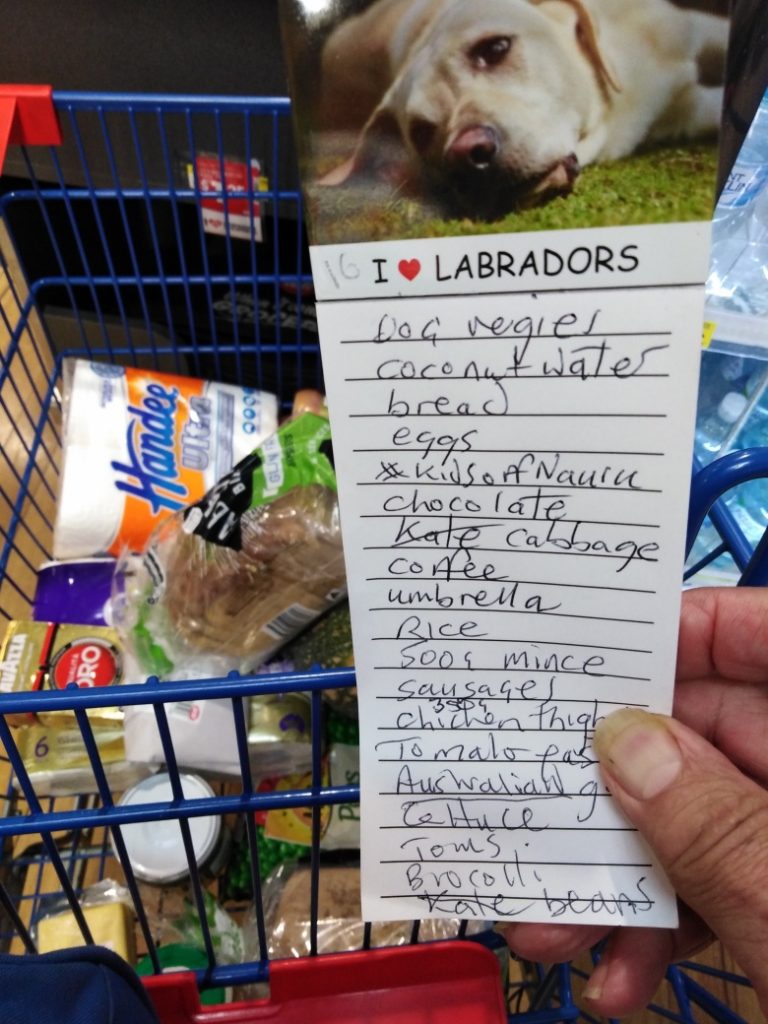
Bob’s list: “Sorry dear, there was no kale (or cabbage).”

Someone (possibly one of my lecturers), once said: ‘People without lists are listless’ – perhaps an observation on my then lack of motivation.

Decades later, I went in search of the origins of this quote and came up empty, although there are many other pithy quotes about the universal ‘to-do’ list.

Author Mary Roach, who has many opinions about lists, says that by making a list of things to be done, she loses “that vague, nagging sense that there are an overwhelming number of things to be done, all of which are on the brink of being forgotten”.

Alan Cohen, author of 24 popular inspirational books says “The only thing more important than your to-do list is your to-be list. The only thing more important than your to-be list is to be”.

I’ve been enslaved to The List since realising, as I tackled university at the ripe old age of 30, that if I wasn’t organised, it would not happen.

I‘d read a few time management books, back in the days when I aspired to be a supermarket manager, but later, embarking upon a three-year Arts degree, I made up my own system. This included hand-written term calendars posted on big sheets of butchers’ paper on the study wall. I had a diary with all lectures, tutorials and assignment deadlines colour-coded and a daily to-do list. The chief instrument of production was a huge old Olympia typewriter I bought from a Toowoomba police office sale. I decorated a large pin board with cartoons and illustrations which had something to say about productivity.

My thoughts on list-making were sharpened on a week-long trek to Gympie’s Heart of Gold film festival, followed by a spot of whale-watching. We have three one-page spreadsheets on which we tick off items every time we pack the caravan for a trip.

For reasons not easily explained, we departed from this time-honoured system and subsequently left home without a dozen items, including bath towels, phone charger, camera charger, SD card (from the camera), video camera (whale-watching, right?), a bottle of olive oil, my favourite pillow, oatmeal soap and a water bottle. Replacing the last two items was a cinch and we bought two towels from a discount department store (wash before using, the label hopefully said). The moral is, if you keep lists, actually look at them.

The three most common types of lists are (1) shopping (2) domestic chores and (3) motivational.

Motivational types will tell you it is not the items on your to-do list that matter, it is the prioritisation. People in general, but mild-mannered, non-assertive people most of all, consistently leave the most urgent and stress-inducing items for last. (Crikey, Mavis, we must talk to Jimmy (16) about his marijuana breath).

Since computers, tablets and smart phones became commonplace in homes and workplaces, the list story has taken precedence. The majority are ‘click bait’, which means whoever invented the list is getting paid for every click that takes you to an ad-festooned page. The worst of these show only one item per page, forcing you to click through if you really want to read about the 10 most successful bandy-legged men.

Some lists are, well, just way over the top. Like the one Franky’s Dad found, a list of the top 34,000 albums of all time. No, M, you don’t have time for this!

Journalist and bloggers have found that the quickest way to write a compulsive article is to turn your topic into a 10-point list. If you write a couple of paragraphs about each item you’ll quickly get to your deadline.

Lists pop up on social media all the time – ten ways to tame a wombat, 25 things you never knew about armpit hair, the top 17 crazy tattoos and so on.

Trivia aside, the shabby state of leadership and lack of sensible policy in this country suggests we all make a short list of important issues about which we feel outraged.

If you come up with more than three major items involving bad policy, prevarication, procrastination or short-term-ism, we need a change of government.

1/ #KidsoffNauru: This has become such a crisis doctors are signing an open letter to the PM; a coalition of humanitarian organisations have given the Federal Government a deadline to get 80 kids (and their parents) off Nauru. About a third of the child refugees left on Nauru are showing signs of Traumatic Withdrawal Syndrome. It is no longer OK to say it is a matter for the Nauruan government and its contractors. Whether these children are brought to Australia by November 20 or not, this has been an appalling outcome of the Federal Government’s refugee policy and should be judged so at the ballot box.

2/ Climate Change: A panel of 91 scientists has definitively told countries what they need to do by mid-century to avert the worst effects of global warming. Our Federal Government’s response to the Intergovernmental Panel on Climate Change report (which recommends phasing out coal power by 2050), was predictable. Deputy PM Michael McCormack (who may one day rue uttering these words), claimed that renewable energy could not replace baseload coal power. He said Australia should “absolutely” continue to use and exploit its coal reserves, despite the IPCC’s dire warnings the world has just 12 years to avoid climate change catastrophe. The Guardian quoted Mr McCormack as also saying that the government would not change policy “just because somebody might suggest that some sort of report is the way we need to follow and everything that we should do”.

3/ Homelessness and the cost of housing: You might dimly recall Bob Hawke’s rash promise in 1987 that no Australian child would live in poverty by 1990. Three decades later the goal is as unattainable now as it was then. Even when you take into account that Hawke mis-spoke (the script said no Australian child need live in poverty), it was an empty promise. Nine prime ministers later, close to 731,000 Australian children are living in poverty.

The official homeless figure at the 2016 Census was 116,000, with about 7% (about 8,000 people) said to be ‘sleeping rough’, defined as on the street, on a park bench, under bridges and overpasses, in their cars or in makeshift shelters. These statistics damn all sides of politics, worsening through a period in which there has been no meaningful increase in unemployment benefits or disability pensions.

Meanwhile, property investors continue to borrow money and claim expenses (notably interest payments) against rental income. In 2014-2015, 1.27 million property investors (12% of taxpayers), reduced their personal income tax through negative gearing. No government has yet had the guts to scrap negative gearing or change it in any way.

Economist Greg Jericho analysed a huge Tax Office data dump to glean a few insights – most importantly, 27% of taxpayers claiming on rental properties are in the $80k to $180k tax bracket (and another 8% earn more than that). Furthermore, just over 3% of taxpayers own six or more rental properties. The proportion that own more than one house has been on the increase in recent years.

It’s all too easy to raise other concerns, such as: Adani, Great Barrier Reef, Fracking, the threat to job security for gay teachers and even the Opera House furore (smokescreen that it is).

(Wow, that sure puts my forgetting the towels into perspective. Ed)


Six Prime Ministers and a potato class action

Prime-Ministers
Prime Ministers- ScoMo feeds the fire (meme by twitter.com@GeorgeBludger)

As the dry winter fades away, ushering in a hot and bushfire-prone spring and summer, here’s some sober reflections on ‘Single-use Prime Ministers’.

I borrowed the single-use mention from a clever meme doing the rounds on social media, where, I might say in defence of the humble Kipfler, Sebago and Desiree, potatoes continue to be openly defamed. It might not be long before we see headlines where Tryhard & Associates, no win-no fee, mount a class action on behalf of Mr and Mrs Sebago and 15 other tuber families.

As we now see from former Home Affairs Minister Peter Dutton’s attempted coup, while it worked in principle, the betrayal left Mr Dutton out on a limb, with a centre-right politician seizing the leadership.

At the outset, Australia’s new Prime Minister, Scott Morrison, decided the people needed to know that “we’re on your side”.

“That’s what matters. We are on your side. And we are on your side because we share beliefs and values in common, as you go about everything you do each day.”

Keep playing that one, Scott. Stay away from the line that brings down Westminster democracies; when a leader (be it Whitlam, Hawke, Keating, Howard, Rudd, Gillard, Abbott or Turnbull), have all been caught referring to ‘my government’.

I had a couple of messages from FOMM stalwarts last week in aggregate saying “Get a grip, Bob. The nation’s imploding and you’re talking about stamp collecting?”

I defend last week’s meandering missive as making the case that Australian governments have been lurching hard-right for a very long time now, arguably since John Howard’s 1988 stance on multiculturalism and refusing to make a treaty with the Aborigines. Hence my writing about the stamp-collecting Philip Ruddock, a hard-line Immigration minister in control of our border policies from 1996-2003.

Now here’s the thing – party factions, backroom machinations and political knifings are not what does in a sitting PM – it is narcissism.

As economist and author George Megalogenis wrote in an opinion piece for the New York Times: “The prime minister is not even mentioned in the Australian Constitution, yet the office has evolved into a paradoxical position of supreme authority and permanent vulnerability.”

Megalogenis also wrote: “They have borrowed the worst of United States presidential politics, with its obsessive focus on the leader, and grafted it onto a Westminster system of parliamentary government that was designed for collaboration and compromise.”

Australia has had six Prime Ministers since 2008, the number arguably including a bit of double counting when first Julia Gillard toppled Kevin Rudd, then Rudd came back and promptly lost the next election in a landslide. Then there was Tony Abbott, Malcolm Turnbull and now Scott Morrison. This era was characterised by frantic passing of new legislation in the incumbent’s first year. Fairfax Media research tallied new acts of Parliament passed in the first year for Prime Ministers Kevin Rudd (133), Julia Gillard (132), Tony Abbott (116) and Malcolm Turnbull (104). These are mediocre numbers compared to Paul Keating (212) and Gough Whitlam (161). Surprisingly (well, I was surprised), John Howard’s first year numbers (86), are only marginally better than Ben Chifley (74).

What appears to have brought undone Prime Ministers of the past 10 years is the polarisation caused by climate change policy. It seems nigh on impossible to achieve political consensus on this most serious of issues, even if over 97% of climate scientists active in that field of research say it is a reality, aggravated and accelerated by human activities. (There are, of course, nay-sayers. Just Google ‘what percentage of scientists believe in global warming, if you have a few hours to spare.)

All six of our Prime Ministers thus far have failed or been thwarted in terms of seriously countering climate change. Some even challenging the notion that fossil fuels have had their day. I refer of course to (a) Tony Abbott’s infamous ‘coal is good for humanity’ quote, and incumbent PM Scott Morrison’s stunt, brandishing a lump of coal in Parliament.

But let’s go back 117 years, to an era when coal really did rule – when steam trains, for example, burned through eighty pounds of coal for every mile travelled (a useful factoid from Michael Portillo’s fascinating series, Great British Railway Journeys).

Australia’s leadership changed seven times in the first ten years of Federation (and 11 times between 1901 and 1922). Again, leadership changes involved ambitious men having a second (and even a third) attempt. Andrew Fisher (1909-1909, 1910-1913 and 1914-1915) proved the most persistent, governing during the early years of WWI. Fisher, I’d like to point out, introduced Australia’s first postage stamp. On January 2, 1913, the Fisher-led government issued the Commonwealth penny stamp.

It featured a controversial design – a kangaroo on a white map of Australia. Although later stamps reintroduced the King’s head, the kangaroo design remained in use for some forty years. An example of this rare stamp sold at auction in 2012 for $142,563.

But we were talking about men (and women- Ed.) and their egos and how the Prime Ministership has evolved as the Office of Omniscience. Towards the last days of Kevin Rudd’s Prime Ministership, there were reports of policy on the run, along with statements made with no consultation, and there have been similar reports about other short-term Prime Ministers. To be fair, in the first year of the Whitlam administration, the late Gough Whitlam rammed through a colossal amount of social reform legislation in a fortnight with the help of a two-man Cabinet (the duumvirate) – just Gough and his deputy, Lance Barnard.

Megalogenis observed that post-Rudd, the Labor party has made it harder to remove future Prime Ministers. Changes to internal rules now require the party leader be elected by a combined vote of the parliamentary party and grass-roots members. From this side of the fence, it is hard to see the Liberals coming up with a similar safeguard.

In no time at all, it seems, Australians will be thrust into another Federal election, with a new Prime Minister who will not have had enough time to show his mettle. On the other side, we have Labor leader Bill Shorten, and deputy leader Tanya Plibersek. Mr Shorten’s tactics thus far, apart from keeping his head down and letting the Liberal Party stew in its own juices, has been to divide and conquer, emphasising the class gulf between the left and right.

Tucked away behind the cannot-be-seen hedge, Labor’s Anthony Albanese, passed over for the Opposition leadership in 2013, declared his colours in June, in the Whitlam Oration.

Mr Albanese called upon his party to emulate the Hawke and Keating approach and “collaborate with unions, the business sector and civil society to achieve positive outcomes in the national interest”.

The Labor frontbencher also delivered a warning about the need to find common ground with voters outside the union movement.

“This is not 1950, when most Australians were members of trade unions,” Mr Albanese said. “Indeed many people from working class backgrounds are not members of unions because they were beneficiaries of Gough Whitlam’s education reforms. We cannot afford to ignore this demographic.”

Sigh, it makes my brain burn, like the feeling I got when I saw that clever meme (above) with Scott Morrison feeding a lump of coal into a (red and orange) map of Australia.

Good for humanity my arse.