Racism hurts everyone

racism-hurts-everyone
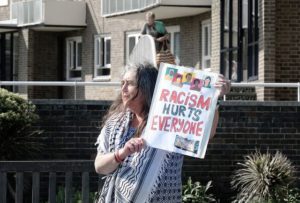
Photo Alisdare Hickson https://flic.kr/p/HDAcMK A lone Dover resident bravely leaves her home to confront a right wing anti-immigrant march

Scottish comedian Billy Connolly at one time waxed indignant about how political correctness was intruding into comedy.

“How dare they,” he fumed, on somebody’s talk-show. “Funny is funny.”

No Billy, not really. Not if you’re the butt of somebody’s bad taste joke, be it about religion, gays, people with disabilities, migrants from non-Christian countries or our indigenous people, who had the misfortune to be colonised in 1788 and not officially recognised in the Census until 1967.

What, you don’t think people make jokes about Aborigines? Try Kevin Bloody Wilson’s “Living next door to Alan”. I’m told this spoof song about a family of Aborigines moving in next door to Alan Bond, which in totality may be more about mocking big business than anything else, is a favourite amongst indigenous peoples in WA. But you can’t generalise like that, and herein lies the central problem with racism and xenophobia.

One cannot know the private thoughts of the racist who never verbalises or the indigenous person who feels persecuted but is too afraid/shy/humble to speak out.

In New Zealand, the Race Relations Commissioner, Dame Susan Devoy, launched the nation’s first anti-racism campaign. Her open letter asked Kiwis to tell their stories about ‘casual racism’ – to go beyond the 400 written complaints received last year.

‘That’s Us’ is the first campaign that asks people to start sharing their own stories about racism, intolerance and hatred.

In her letter Dame Devoy says the overwhelming majority of people never complain or go public when a car drives past and the people in it scream a racist obscenity.

She cites other casual or ‘quiet’ racist encounters “that never feel casual or quiet when you and your family are the ones being humiliated.”

Dame Devoy told The Guardian that overt racism is not as widespread as it is in, say, Australia, but she felt that New Zealanders need to reassert their position as a world leader in race relations.

“We just need to look around the world right now to see what happens when racial intolerance and racism is normalised. We think New Zealanders are better than that and we hope you do too.”

But returning to Billy Connolly’s assertion that ‘funny is funny’.

When I was growing up in New Zealand the most popular entertainment group was a Māori group, the Howard Morrison Quartet, closely rivalled by a Māori/Pakeha comedy duo, Lou and Simon.

The latter were known for parodying popular songs, e.g. West Side Story “I like to be in a Maori car” using gentle, self-deprecating humour.

The Howard Morrison Quartet had a hit in 1960 with ‘My old man’s an All-Black’ based on the Lonnie Donegan tune about a dustman. The song was a protest about the decision to exclude Maori rugby players from the 1960 tour of South Africa.

It contained comic asides such as:

“Fi fi fo fum, there’s no Horis in that scrum.”

Crikey, you wouldn’t get away with that today. The urban dictionary and others define ‘Hori’ as a racial slur, but it was in common use in the 1960s. I recall Dad cuffing my ear (as that generation of Dads were prone to do), saying: “Don’t call Māoris Horis – it’s disrespectful.”

I may have asked, risking another ear-cuff ‘Why do some Māoris call themselves Horis, then?’ and he replied that if a negro (before they were known as African American) called himself a Nigger, that was OK, but it was not OK for us to use the N word, its origins steeped in racial hatred, slavery and oppression.

Wikipedia defines ‘Hori’ as a derogatory, racist slur, but the term (like Nigger in the US) has to some extent been “reclaimed” within the community it was originally intended to insult. Like those epithets used by rappers and hip-hoppers – ‘Wazzup, Nigger?’ Hori is used today as a term of endearment amongst Māori or as a signifier of ‘keeping it real’.

Whatever age I was in 1960, that discussion led me to read To Kill a Mockingbird, Uncle Tom’s Cabin, Black like Me, Go tell it on the Mountain and at least five of the 15,000 books written by or about Abraham Lincoln.

Meanwhile in the UK, present day, five 15-year-old boys and one 16-year-old boy have been arrested on suspicion of murdering a Polish man in Harlow, Essex. A subsequent assault on a Polish man in Harlow is being investigated as a hate crime, as is the murder a week earlier.

There was a noticeable rise in hate crimes after the June 23 Brexit referendum, with more than 3,000 allegations of harassment and threats filed with UK police.

Nothing on this scale to report in Australia, but the seeds have been sown and Pauline Hanson’s anti-Muslim rhetoric just shovelled a whole lot of fertiliser on that particular garden.

Adding potash, if you will, is a new Essentials Media poll showing 49% of Australians support a ban on Muslim immigration. Economist George Megalogenis dug out some historical evidence that 58% of Australians were opposed to taking part in a worldwide plan in 1947 to resettle Jewish refugees from Europe. Just because a survey saying half the people apparently don’t want something to happen doesn’t necessarily mean it won’t.

The 1946 Census revealed that 35,000 Jews lived in Australia. Historian and author W.D Rubinstein said at least 17,600 Jewish survivors reached Australia between 1945 and 1954 – the largest single increase in Jewish numbers in the country’s history.  In 2011 there were 112,000 Jewish people in Australia, the vast majority residing in Melbourne or Sydney,

So then to the Australian Greens who this week urged me (via a ‘personal’ email from Richard De Natale), to support the party’s walk-out during Senator Hanson’s anti-Muslim speech.

I thought the Greens could have served us better if they had stayed. Despite the parliamentary tradition that it is forbidden to heckle or interject during a Senator’s maiden speech, the Greens could have done this (one by one), until all had been ejected.

What headlines would have ensued then? Nevertheless, they walked and this is what De Natale had to say:

“After we walked out on Senator Hanson’s racist speech, my office was flooded with hundreds of calls of thanks. Then in just a few short days over 11,000 of us signed a pledge to stand united against racism. This is an opportunity to bring our communities and voices together with a message of unity that cuts through the noise of parliament. It’s hugely ambitious but I think we could reach 50,000 by the end of this year.”

That seems a small target when the Race Relations Commissioner of a nearby neighbour has pointed out that overt racism is thriving in Australia, even if the NZ Commissioner admitted:

“We’ve always had a problem with racial intolerance in New Zealand – Māori New Zealanders know it is not new.”

Dame Devoy’s Australian counterpart, Tim Soutphommasane, waded into the debate this week.

The Race Discrimination Commissioner argued in a speech at the ANU that racism at its core is about an abuse of power. He appealed to Australians not to be complacent about racial intolerance being some kind of “initiation rite” for new arrivals.

“While we may never eradicate racism and bigotry, it isn’t good enough to say its targets must grin and bear it, or that there’s nothing we can do. Doing so amounts to normalising racism, to suggesting that it should be tolerated.”


Fred Smith in concert

fred-smith-dark-and-mysterious-credit-geoff-dunn
Fred Smith image by Geoff Dunn

Australian diplomat, singer-songwriter and newly-minted author Fred Smith was our house concert guest on Sunday October 16. Fred’s gig sold out again. He was here in 2015 with Liz Frencham playing to a full house (we had people sitting on the veranda too).

Fred has recently published a book, ‘Dust of Uruzgan,’ through Allen & Unwin and is now on a solo tour to promote the book and sing songs from his many albums. The most recent album, Home, was recorded after Fred completed his two-year stint as a diplomat in Afghanistan. Fred has recorded six other albums based on his experiences as a diplomat in the Solomon Islands, Bougainville and other exotic locations. He has also recorded an album of songs with the Spooky Men’s Chorale and a CD called Texas based on a residency in the US.


Newstart or job-share?

dad-needs-job
https://flic.kr/p/5YepYQ Image by Dane Nielsen

There are times when I’m grateful my conventional working life is behind me and I can wait (patiently) for the next humble pension payment. My needs are small – I can sit on the front veranda with a cup of coffee made on our machine for about 15 cents, enjoy my banana toasty, share the crumbs with the birds and do the crossword. Some may call me a leaner, but I’ve done my share of lifting, mate.

Meanwhile, out there in the thrust and parry world of staying in work, where HR is a growth industry, workers are lobbying for their next short-term contract, working out how long their redundancy payment will last or (forgive me for thinking this), shafting a colleague so they can get a better-paid job. Some, who make life plans based on aforementioned contracts, find said agreements withdrawn without notice for budgetary reasons. Yep, the veranda is better.

For one thing, the pension is linked to wage increases, which is more than you can say for Newstart (Australia’s unemployment benefit), which is indexed to the CPI. The September indexation will be calculated at 0.18%, which, on the single/childless fortnightly rate, is less than $1.

Surveys have repeatedly told the government of the day that half the 700,000 Australians who rely on Newstart are living below the poverty line. A 2015 study found that on any given day there were fewer than 10 rental properties in Australia that were affordable for people on the allowance.

Australian Council of Social Services chief executive office Cassandra Goldie told New Matilda the Newstart payment ($527.60 per fortnight for singles without children), had not seen a real increase since the Keating years (1991-1996). The major parties seem disinclined to increase the allowance, even when prompted by the Business Council of Australia. In 2013 the Greens lobbied for a $50 per week increase but failed to find sufficient parliamentary support.

This is a shameful state of affairs, the iniquities of which were plainly stated by Asylum Seeker Resource Centre founder Kon Karapanagiotidis. He tweeted on a Q&A TV debate about welfare that what a politician could claim for one night for staying in Canberra for work was equivalent to an entire week on Newstart. The Conversation fact-checked this statement and found it to be fundamentally true.

It might not seem like much, but after September 20 (next Tuesday), Newstart recipients will lose the twice-yearly $105.80 “income support bonus” added by Labor as part of its “Spreading the Benefits of Boom” package. In 2013, the Coalition announced the bonus would be scrapped from a range of benefits as Labor had funded it through the minerals resource rent tax (which the Coalition has since abolished). The Palmer United Party agreed to the bonus being scrapped on the condition it stayed until after the (July 2016) election. So rather than increasing this egregiously low payment, the Coalition is (let’s use a Tele headline word here), slashing it an amount which for a single person on Newstart provided a choice between a bacon and egg burger, a subsidised prescription, a pot of beer or an escapist video to watch after the Saturday ritual of circling jobs in the newspaper that by Monday will have already gone.

The ABC reported yesterday that Australia’s unemployment rate had dropped from 5.7% to 5.6%, but the rate of part-time work remains at an all-time high.

Since December 2015 there are now 105,300 more persons working part-time, compared with a 21,500 decrease in those working full-time.

In this country, part-time employment is defined as people in employment who usually work less than 30 hours.

The Australian (owned by an expatriate billionaire well-known for expecting senior employees to work long hours for a fixed salary), wrote that part-time work was ‘good for the over-40s’.

Economist Jim Stanford of the Australian Institute’s Centre for Future Work told the ABC in July the proportion of Australians working part-time has now reached a record 31.9%.

“Australia’s part-time employment rate has surged 4 percentage points since the GFC (2007) and is now the third highest in the OECD,” he said.

There are a few questions we should be asking about part-time work, chiefly: can you live on part-time income? If you are working part-time, is it by choice, or is that all you could find? Inter alia, did you know if you are on Newstart, and have found a part-time job as dish pig at a local café, you can earn up to $104 per fortnight before the allowance is affected? Break out the wine cask.

Let’s just imagine life on Newstart (equivalent to a night’s claimable accommodation for a working politician, remember?)

You are a 40-something male that has been “let go” – the latest in a succession of jobs that did not work out. You’ve spent your payout and your second wife has booted you out. You spend all day in the public library job-hunting, playing Solitaire and scribbling calculations on how you can live on $263.80 a week. A mate has rented you his caravan down the end of the paddock for $140 a week. Bargain. That leaves $123.80 for food and petrol (did I mention the caravan is 16 kms from town?)

Meanwhile, the rego is due, there was a letter in the mail with a photograph of you doing 122 kms in a 110 kms zone and then there is the dentist, who reckons you need two crowns and two root canal treatments.

You buy a packet of Panadol max and wash a couple down with the last lukewarm stubbie in the 20-year-old caravan fridge. Life’s great, isn’t it?

Australian society seems sharply divided between those who’d feel sorry for this fictional fellow’s plight and donate money to Lifeline and the hard-liners who’d say he’s a leaner who brought it all on himself (and how come he can afford beer?)

We need, if I may use a corporate weasel-word, a new paradigm. A UK think tank, the New Economics Foundation, proposed a utopian scenario for Europe that envisaged a society where those who can work are engaged for 20 hours a week. Anna Coote of NEF said there would be more jobs to go around, energy-hungry consumption would be curbed and workers could spend more time with their families. The model already exists in Germany and the Netherlands, the latter topping the OECD chart for part-time work. Coote mused about the rationale around jobs and growth and whether aiming to boost (insert country of choice) GDP growth rate should be a government’s first priority.

“There’s a great disequilibrium between people who have got too much paid work and those who have got too little or none.”

The Guardian’s Heather Stewart cited Keynesian economist Robert Skidelsky, who co-wrote a book with his son Edward: “How Much Is Enough?’ Skidelsky said the ‘civilised’ solution to technological change and fewer jobs is work-sharing and a legislated maximum working week.

There’s much need for a quantum shift/new paradigm, with youth unemployment at 13.2% in the UK and between 25% and 50% in seven Eurozone.countries.

It would not take much imagination to export these Eurozone ideas to Oceania (where youth unemployment is running at 13.5%).

Unhappily, Canberra’s politicians seem entirely lacking in imagination and worse, bereft of social conscience.

All 225 Federal politicians and Senators should think about this social issue on September 20, particularly if they are claiming overnight accommodation. Do claimable expenses run to the mini bar?


Skip the small change

small-change
Small change (got rained on)

A week ago a patient teller at our local bank dealt with one of my occasional visits to deposit a bag of small change. Yes, I raided the piggy-bank again, and in case you don’t believe me, there it is (left), handed out free by Macquarie Goodman at the grand opening of the Metroplex on Gateway industrial estate at Murarrie in 1998.

Once I had a Bundaberg rum bottle filled to the lip with one cent coins. The label was signed by WA blues musician Matt Taylor, after Taylor’s band Chain performed at a venue managed by me and a team of volunteers. Matt signed “To (as yet-un-named son) – you ain’t even born yet.”

Later, when we were moving house, the rum bottle was accidently kicked over, smashing on the terracotta tiles, spilling 789 one cent coins across the floor. By this time the Reserve Bank had scrapped one cent coins and was working on ridding the country of two cent coins as well. The Royal Australian Mint removed one and two cent coins from circulation in 1991-1992. The Reserve Bank decided in 1990 that 1c and 2c coins had to go as inflation had rendered them worthless. Or to be more precise, the cost of minting them far outweighed their face value.

The Royal Australian Mint, however, has produced mint sets of one and two-cent coins for collectors in 1991, 2006 and 2010. I was surprised to read that one can still present one and two cent coins as legal tender and they can be banked. They can also be sold as collectables.

Trivia alert: Some of the small change was melted down to make the bronze medals presented to athletes at the 2000 Sydney Olympics.

Other countries abandoned their one and two cent coins around the same time, citing inflation and the increasing cost of bronze (an alloy of copper with minor amounts of tin and zinc). Ireland ditched its small coins last year, in line with six other Eurozone countries

The end result of axing 1c and 2c coins is a process called ‘rounding’ which means if something is priced at $1.98, you pay $2. If it costs $1.93, you pay $1.95. Who knows what the rounders will do when they scrap the five cent coin – and trust me – it is not far away.

One of the main arguments for doing away with five cent coins is the increasing use of pay wave for small transactions.

What can you buy with five cents anyway? The Northern Star newspaper based out of Lismore asked its readers just that. The answers included ‘lollies at some shops’, ‘20 five cent coins from the tooth fairy’, ‘lemons or limes at the fruit stall’ and my personal favourite – ‘the best things ever to scratch a scratchie’.

In 2014, a Senate Estimates Committee hearing was told the five cent coin cost 6c to manufacture (it’s now closer to 7c). The cost is partly due to the combination of copper and nickel, but also the labour involved in handling and distribution. Yet the 5c coin, with an echidna on one side and Queen Elizabeth on the other, it is still with us, weighing down pockets and purses, wearing holes in the lining of jackets and trousers, disappearing down the sides of sofas and car seats.

One way you can find creative uses for those pesky five cent coins is to donate them to charity. Agencies have been hoarding 1c and 2c coins for years, using the money collected for people in third-world countries. For the past 25 years they have been focusing on 5c coins.

The Sydney Morning Herald reported last December that Australian charity Y-GAP, Y-Generation Against Poverty organised a fundraising campaign which collected 10.9 million individual 5 cent coins.

Then there’s those foreign coins one inevitably brings home from abroad. My cache of foreign shrapnel includes $5.90 in New Zealand coins, a Kiwi $5 note and a one euro coin. If you’ve noticed, some airlines encourage you to deposit foreign coins in an envelope and leave it in the seat pocket of the aircraft as you disembark. Several charities collect these coins and use the proceeds for impoverished children. UNICEF, assisted by the Commonwealth Bank and BankWest, has amassed more than $260,000 in small change since 2009. Small amounts of First World cash go a long way in Africa or India. One UK penny will provide a child with clean drinking water for a day; two Canadian dollars (Loonies) can provide a malnourished child with enough therapeutic super food for one day; in India, 220 rupees (about $4) can buy someone a mosquito net.

The subject of money was being raised at one end of a long table in the local pub on Sunday where members of our community choir had adjourned after a performance. I was at one end of the table and two of the women at the other end were talking about the design of the new $5 note. I set my hearing aids to ‘noisy room’ but still their lips moved and no words came out.

“I’m sure it will make an excellent FOMM,” I shouted, “Once I figure out what you are talking about.”

It transpired they were adding to the dissent and disappointment over the design of the new $5 note. The anti-royalists jumped on to social media posting hastily photo-shopped memes. There are many versions of the $5 polymer note where the Queen’s image has been variously replaced with Tony Abbott eating an onion, Tony Abbott wearing cyclist’s sunnies, Dame Edna looking dashing, Kathy Freeman looking like an Olympic legend and a few odd ones like Pluck-a-Duck, Shane Warne, Delta Goodrem and a jar of Vegemite.

Why did we need a new $5 note at all, you might ask? This one has enhanced security, we’re told.

We have an international track record for that, did you know? Australia was the first country to produce polymer banknotes (in 1988), largely as a response to an increase in counterfeiting. Prior to the launch of polymer notes (created by the CSIRO, the Reserve Bank and Melbourne University), a group of enterprising lads from Melbourne made pretty good copies of the (paper) $10 note. The forgeries were so good some were still in circulation when polymer notes were first introduced.

The new $5 note has a clear plastic strip down the middle, apparently un-forgeable. It also has tactile features to help the vision impaired differentiate between a fifty and a five. The new note is the first of five denominations to be rolled out by Reserve Bank of Australia (at a total cost of $29 million) over the next few years.

Curious, I went to the bank yesterday, ready to trade 100 five cent coins for one of the new notes. Alas, our local teller said she had not spied one in our town and the local supermarket told me the same story. Apparently there’s still 34 million $5 notes in circulation. You will be relieved to know that I have extracted the only necessary fact from this Reserve Bank of Australia technical article about the life-cycle of banknotes: the median life of a $5 note is 2-3 years.

Good luck finding a new one, then.


Simple as ABC Part 2

ABC-South-Bank
ABC HQ South Bank Brisbane

If journalists tend to have a universal blind-spot, it is their inability or disinclination to follow up on a story. When it comes to writing about budget cuts at the ABC, I plead guilty to said offence.

It is almost two years since I wrote about the Federal Government’s edict to the national broadcaster to trim $254 million – 20% of its then $1.22 billion operating budget – over five years. The media in general was having lots to say about this in November 2014. Petitioners were petitioning, GetUp was getting up; the ABCFriends group was lobbying and raising funds. They should have seen it coming.

A Senate Estimates hearing in February 2014 asked ABC managing director Mark Scott a hypothetical: if, given funding cuts, could he guarantee he would not have to cut services to regional Australia.

Scott said inter alia that nothing would be spared from that kind of review, and he could give no guarantee that any services would be spared, including rural services.

“But I am not expecting that, because a clear commitment was given to maintain the ABC’s funding.

The above was gleaned by what is known in the trade as fact-checking, also a reminder that the ABC’s renowned fact-checking unit was one of the casualties of the internal review that followed. We turn to the ABC itself to report on this story, because that is what bloggers do – they research and cite the work of others. Not that we’d suggest the axing was an ideological ploy, but it was Kevin Rudd’s government who provided $60 million over three years to fund ‘‘enhanced newsgathering services”. In the May 2016 budget, this funding was cut to $41.4 million over the next three years.

If you have faith in my calculations, this means the ABC has to trim $2.039 million a year from its ‘enhanced newsgathering’ budget over the next three years. This is when managers start eyeing their underlings, looking for value for money, identifying functions they could live without.

The end result is redundancies – that is, abolishing positions or roles and making people who occupy them eligible for a payout.

ABC redundancy payments totalled $9.33 million in the year to June 2015 (annual report, notes to the accounts P.172)

In 30 or so years working in the Australian media, inevitably I know people who work for (or used to work for) the ABC. Not so many decades ago it was a job for life and I know a few who have survived under successive managerial identities (the latter known by some as ‘carpet strollers’). But the Liberal government’s insistence that Mark Scott cut that very large number from his operating budget has, over the last two years, seen redundancies, early retirements, centralisation of news and the scrapping of high-profile units like The Drum and the ABC Fact Checking Unit and the closure of ABC Shops.

If you did not know what the unit did, it included checking the accuracy of politicians’ public comments, tracking election promises, along with other historical and statistical investigations. Labour-intensive work, naturally. But despite being shortlisted for a Walkley Award in 2014, the ABC Fact Check team was chopped.

As ABC news director Gaven Morris said in May, Unfortunately, having a standalone unit is no longer viable in the current climate.”

As it happened, The Conversation, an online news and commentary portal operated and funded by Australian universities and its readers, started its own fact-checking unit.

There has been a paucity of follow-up stories on the closure of the ABC Fact Checking Unit since the story broke in mid-May. The Australian had a stab at globalising the story, citing Duke University’s censuses of international fact-checking units. More than 100 sites are operating in 37 countries, Duke said. The Australian implied we are falling behind.

My photographer/author mate Giulio Saggin was one of the casualties of the ABC cutbacks, with his position as ABC online photo editor made redundant, along with two other positions at the Brisbane headquarters. He’d held the job since 2007. Fortunately, Giulio is versatile and has been free-lancing long enough to cope with its feast or famine cycles. The redundancy coincided with the launch of his third book – a manual, if you like, for free-lance photo-journalists.

What might worry ABC fans more is speculation that ABC Classic FM may be in danger of more cuts and structural changes.

Former Senator Margaret Reynolds has already started an ABCFriends campaign.

One of the key issues with the ABC is the perception, rightly or wrongly, that it caters to intellectual snobs. This attitude can be encapsulated in two observations I made in my 2014 piece.

“Hopefully they will axe Upper Middle Bogan and It’s a Date” I wrote, intellectual snobbery exposed for all to see. So I was wrong. It’s a date is into season two this year and season three of Upper Middle Bogan starts in October. ABC management appears to appealing more to the mainstream, putting up with shots across the bow from those who find such shows cringe worthy.

In 2014-2015, the top ABC episodes by peak viewing were headed by the Asian Cup Australia v Korea (2.137 million people watched a game of soccer), followed by Sydney’s New Year Fireworks (at midnight), 2.075 million.

Of the top 20 TV shows commanding an audience of 1.32 million or more, only three could be described as news and current affairs. Q&A, despite a huge social media profile, did not make that list.

So people prefer New Tricks, Miss Fisher’s Murder Mysteries or Dr Who? Well, TV is escapism at best, so why the hell not?

Whatever else ABC management tinkers with next, they ought not to rock the boat too hard with Radio National or Local ABC Radio, lifeline to people in the bush and those with vision impairment.

I attended the funeral of an old mate last year; he’d struggled with various levels of blindness for the previous 20 years or so. His son told me his Dad had a radio of one kind or another in every room in the house, even the laundry. They were all tuned to radio national.

Vision Australia estimates there are 357,000 people who are either blind or have low vision. For many of these people, radio is literally the only way they can keep in touch with what’s going on in the world.

I don’t actively listen to radio in the house, but I’m always tuned in when driving. I’ve made about 20 trips to Brisbane and back these past two months and it has become apparent what I am missing by not having RN on at home. This apparently makes me one of the 17 million Australians the ABC reaches across all platforms.

The ABC’s new managing director, Michelle Guthrie, a corporate lawyer with experience working for News Ltd and Google, has an ambitious target: she wants to increase the ABC’s reach from 71% to 100%. Just how she will do that remains to be seen, but as Margaret Simons writes in The Monthly, one of the early pointers is an internal memo that states Guthrie wants 80% of the budget spent on content and only 20% on administration.

Carpet strollers beware.


Singing the feral cat blues

Feral cat fredy mercay
Feral cat and Phascogale credit Fredy Mercay

Cat-lovers look away now. Land management and wildlife conservation groups have been increasingly concerned about the escalating feral cat population, particularly in northern Australia, where wild cats have few predators and vast swathes of unpopulated territory to scour for food.

The Commonwealth Scientific and Industrial Research Organisation (CSIRO) estimates there are 15 million feral cats in Australia, with each killing an average five animals a night.

These figures are conservative and already two years out of date. Consider this: an average cat has one to eight kittens per litter and up to three litters per year. A single pair of cats and their kittens can produce as many as 420,000 kittens in just seven years.

Whatever the numbers, they are truly, as Grand Designs host Kevin McLeod might say – “vast”.  So far the control of feral cats has fallen to commercial hunters and rangers (using humane traps and rifles), trapping and monitoring and baiting programs. The Federal Government has in recent years been trialling a new feral cat bait ironically dubbed Curiosity, specially formulated to cull feral cats and minimise the incidental deaths of other natives species. It is hoped the new poison will replace Eradicat (1080-based bait).

Yes, yes, I know – this is reminding you of a Little River Band song, (‘Curiosity killed the cat.’) I dimly recall interviewing John Farnham for a student newspaper and asking if he was going to perform the song that night. Farnham, who was lead singer with LRB from 1982 to 1986, admitted he had not yet learned the song. That’s a fair digression from the original subject, although now you’ve got the bloody tune stuck in your head, right?

Curiosity ® was the subject of a 2013 trial at Roxby Downs in South Australia, to trap feral cats in a trial area and monitor their survival using radio transmitting collars before and after baiting. Native wildlife species were monitored to determine whether or not the baits led to a decline in population size at the site. Here are the results.

In 2014 Environment Minister Greg Hunt appointed Gregory Andrews as Australia’s first Threatened Species Commissioner. The Commissioner’s role is to develop priority actions to prevent extinctions and halt the decline of Australia’s most threatened species. The Commissioner will oversee the next stage of Curiosity, which Mr Hunt said was showing promise as ‘an effective and humane approach to the problem.’

Curiosity comprises a meat-based sausage containing a small hard plastic pellet filled with toxin. Feral cats do not chew their food so will reliably swallow portions of the sausage including the pellet. Most native animals nibble and chew their food so will reject the pellet.

“The Curiosity bait for feral cats uses a new toxin called para-aminopropiophenone, or PAPP, which is considered best-practice world-wide and is analogous to putting the animal into a sleep from which they do not wake up,” Mr Hunt said.

Feral cats, which are notoriously difficult to trap and appear to be less interested in baits than live prey, have forced 20 species into extinction and are putting 124 others under threat.

In July RMIT University began a research project into the extent of feral cat control across Australia and to estimate the number of cats removed from the environment each year.

Research director Richard Faulkner told FOMM the aim of the survey is to see how (as a nation) we are measuring up against the Threatened Species commissioner’s strategy/target – a cull of two million by 2020. Mr Faulkner was surprised by the strong participation rate.

“When we launched the survey six weeks ago we were not sure how it would go. We anticipated that 500 participants would be good – we are now at 3,400 and counting!”   

The national survey aims to gather responses from rural and remote regions of Australia as well as suburban areas.

In 2014, Greg Hunt, confronted with damning evidence from the CSIRO, called for an eradication program including development of a biological control. The CSIRO study found that mammal extinctions were 40% higher than previously estimated and feral cats ranked higher than climate change as the primary cause.

While advocating measures including “island arks” and biological controls, Hunt warned that the latter could be worse than the problem if not properly controlled.

The ‘island ark’ concept – where pests are removed from a fenced reserve or island which is then re-stocked with endangered species – has worked well in New Zealand. Predators including cats, possums, rodents and mustelids (ferrets, stoats and weasels), were removed from Tiritiri Matangi and Kapiti Island, both now havens for native birds (and bird watchers).

Meanwhile the vast northern Australian landscape has become a happy hunting ground for feral cats. Arnhem Land covers 97,000 square kilometres and has a human population of 16,000 or so. If you discount the probably rare moments when a feral cat goes down to a river to drink and becomes croc food, cats are free to roam and multiply.

Some of the newer baiting proposals include ecologist John Read’s “grooming trap” which sprays toxic gel on the cat (which licks it off when grooming).

There is also a project dubbed ‘Toxic Trojans’ using live prey to attract and kill cats.

There are arguments against biological controls, baiting and trap-alter-and-release programs and you will find most of them outlined here by animal rights group PETA.

Some of Australia’s feral cats are domestic moggies gone astray, but they are not the dingo-sized beasts seen in Arnhem Land and the western deserts. Many of Australia’s feral cats are believed to be descendants of those brought by Dutch explorers as early as the 1600s.

“Most of the cats we’re talking about are really wild animals that don’t engage with humans,” Richard Faulkner says.

Australian Wildlife Conservancy (AWC) manages more feral cat and fox-free areas on mainland Australia than any other organisation. The largest areas are Scotia in western NSW (a feral predator-free area of 8,000 hectares) and Mt Gibson in WA (7800ha). Larger still, Newhaven (65,000ha in the Northern Territory), is under construction.

My contribution to this subject was a dark song written after a few weeks travelling in the NT outback where we saw a feral cat cross the Stuart Highway in the middle of the day. His was an arrogant, purposeful trot, as if this cat knew its scant risks of being killed were limited to sparse road traffic and wedge-tailed eagles (the latter probably more at risk of being run over as they scavenge road-kill).

Sometimes at night, when I’m taking the wheelie bin up to the road (trying to beat my PB), I hear a tinkling bell. This would probably be the neighbourhood cat, alerting night critters to its whereabouts by a bell attached to its collar. Good move that, and it makes puss easier to find when the owners want to lock her away for the night.

“So keep your cats locked up at night while you’re sleeping,

Make sure they wear a bell,

Out in the desert they’re quietly creeping, just how many it’s hard to tell;

In Arnhem Land we sit around the campfire, singing the Feral Cat Blues,

While descendants of our long-lost cats make the cover of the NT News,

The cover of the NT News.”

Listen: https://soundcloud.com/thegoodwills/feral-cat-blues

Risks of Olympic proportions

pole -vaulter-william-pacheco
https://flic.kr/p/GPBj4 William Pacheco/creative commons

So we’re watching the re-run of the World’s Fastest Man beating the World’s Second Fastest Man in the 100 metre Olympic dash. My heart goes out to the also-rans. Trayvon Bromell of the US, despite coming last in a field of eight, covered the 100m final in 10.05 seconds. Goodness me, I thought. It takes me one minute and 21 seconds to drag the wheelie bin 97m from the car port to the roadside (admittedly uphill), huffing like an old grampus (old Scots saying thought to mean ‘like a fat fish out of water’).

Make no mistake, people, you need to be in peak condition if you want to complete at the Olympic level. She Who Swears at the Remotes was channel surfing, realising that the various iterations of Channel 7 are showing different Olympic events at the same time. Flick flick, she went. Some Australian guy, apparently swimming in the open sea, had opened up a one minute lead on the rest of the pack. It was heartening to see all the support vessels hovering nearby in case of cramp, loss of will to keep going, cossie-loss, shark attack, remnant arctic ice or other. Flick, flick.

Oh, there’s blokes spearing through the water in kayaks, or maybe they are canoes? Foresooth, here are two women spearing through the water in a kayak/canoe.

“Look at their shoulder muscles,” I marvelled, adjusting the heat pack on my compromised AC joint.

Now we’re on to pole vaulting, a sport we take a mild interest in because we know someone who competed in this event at Commonwealth Games level.

“Crikey, there’s so many ways of killing yourself associated with this sport,” She observed. I googled “pole vault accidents”.

Some YouTube contributors delight in posting clips of athletes failing or hurting themselves, including an incident at the Rio Olympics where a Japanese competitor’s penis dislodged the crossbar. This is akin to funniest home videos, a program with which I am not amused. Pole vaulters have died competing in this sport, or have ended up in wheelchairs. So the supposedly funny/shocking videos are insensitive to say the least.

According to Chris Hord, assistant pole vault coach at the University of North Florida, pole vaulting is the deadliest track and field event.

The sport is inherently dangerous because you run at full speed, almost 100-metre sprint with a 15- to 17-foot fibreglass pole in your hand, then you’re bending it, trying to get upside down to clear a bar in the air.”

Sunshine Coast physiotherapist and former Commonwealth Games pole vault competitor Andrew Stewart agrees.

“The worst part is if you accidently land on the tip of the pole, it will bend and throw you anywhere.”

Stewart competed from 1970 to 1984, culminating with a 5th in the 1984 Commonwealth Games event in Brisbane. His own experiences of pole vaulting as a dangerous sport included breaking a leg and spraining both ankles, in the days when landing pads were much smaller.

This 2012 study by the American Journal of Sports Medicine makes for sobering reading.

A few weeks back our choir director Kim Kirkman was encouraging the tenors to reach a high B by pretending we were throwing the discus. That took me back to compulsory school sports days where we were taught to throw javelins or discus by over-zealous sports teachers whose mission in life was apparently to distract boys (and maybe girls too) from thinking too much about the onset of puberty. Now that I think on it, perhaps all that javelin and discus tossing is to blame for my problematic shoulder joint, which responds to steroid injections and physiotherapy but the pain returns when I fall back into bad habits (like not doing the archery exercise, hunching over the keyboard like a man possessed).

But getting back to the men’s 100 metre sprint and other such events, the victors feeling obliged to do a victory lap wearing their nation’s flag like a cape. Mr Bolt, a man much-used to the attention of the media, struck a few poses, the images carried around the globe in an instant. Our journalists salivated over the Jamaican champ’s promise to return to Australia (he was last here in 2012).

Media sports coverage, such as it is

Just so you know, journalists work with some limitations when it comes to reporting on the Olympics. To actually attend as a media correspondent you need accreditation. The accrediting body, the International Olympic Committee (IOC), has a fair bit of muscle.

For example, they banned the use of animated GIFs during the Olympics. GIFs are short animated videos on loop which often pop up on social media. They are more often visual gags designed to shock or amuse, but oft-times capture immortal moments of triumph.

As Business Insider reported, it appears the Olympic ban is not being observed in certain segments of the social media with many GIFs to be found on tumblr and twitter.

A GIF which appeared, if I’m correct, before the IOC ban was announced, depicted a beggar lad alone in Rio’s slums overlooking a blazingly lit Olympic stadium and fireworks display. It briefly touched a nerve before being subsumed by the weight of status updates on Facebook.

The other media curiosity revealed at the Rio Olympics was the Washington Post’s use of robotic reporting technology. The Poynter Institute reported that Heliograf, using data and language templates, churns out medal tallies, event schedules and even results, the automated news briefs forming part of the Post’s Olympic blog.

FOMM reader Ms Hand alerted us to this under-reported technology breakthrough. We’re not surprised. Speech-to-text technology has existed for quite some time, of benefit to vision-impaired writers, scribes with temporary or permanent RSI or lawyers who can no longer afford secretaries to transcribe their daily dictation.

For all you know I could be talking aloud and one of those smart programmes is writing down what I say. Isn’t that right, Siri?

As a former newspaper scribe, I have mixed feelings about machines taking over what was once the detail work of junior journalists. Attending to sports results, racing form, TV guides and the like was the cadet journalist’s way to learning about deadlines, accuracy, punctuation and the consequences of making mistakes.

Meanwhile, back at the pole-vaulting pit, it takes skilful human beings to track down the vitally important Olympic stories like the Japanese pole vaulter who failed to qualify because his penis touched the bar. News Ltd scribe Dan Felson’s breathless, euphemism-laden piece (‘let down by his trouser-friend’) went global. Read it if you must.

Despite its ever-present risks of injury or injured pride, pole vaulting continues to attract devotees.

Sydney man Albert Gay, 73, set an Australian record this year at the Australian Masters Athletics event. The Macarthur Chronicle reported that Gay ‘leapt into the record books’ for his age group with a 3m attempt (the Olympic world record is 6.03 metres, set this week by Brazilian Thiago Braz Da Silva).

Gay said he took up athletics and pole vaulting when he retired, at 62.

“It tests your bravery,” he said. “You’ve got to be a little bit of an idiot to do it.”

SWSR adds: “I prefer to confine myself to channel surfing from the comfort of the recliner, where the only danger to be faced is the possibility of the Staffie unexpectedly launching himself into my lap.”


No interest at all

piggy-bank-1239661
Johanna Ljungblom/FreeImages.com

Though the headline might put you off, we must ask: why are interest rates dropping, who does it affect and where will it all end?

Few people would be unaware that the Reserve Bank of Australia (RBA) dropped the official cash rate to 1.50% on August 2, the lowest rate since records have been kept.

The supposed reason is to stimulate the economy (that is, to encourage spending and borrowing). It is theoretically OK to do this when inflation is low or falling as it is now. Conversely, as inflation rises, so do interest rates (RBA considers that this will restrain borrowing and spending).

An official cash rate of 1.50% is a huge problem for self-funded retirees such as yours truly and She Who Supports Ethical Investment. Four years ago we invested in a bank term deposit paying 5%, with interest paid annually. The annual payment dropped into our bank account this week. But where do we turn when this tiny golden goose gets killed off next year?

On current speculation, cash rates could drop to 1.25% by the second quarter of 2017. Given that inflation is currently 1%, that is a pretty skinny return.

The theory is we (self-funded retirees and younger people trying to save), will turn to the share market, where one can not only get better yields, but also the prospect of capital gains (and a tax break via dividend imputation). That means the company paying the dividend has already paid tax on it, so the franking credits (tax component) is refunded to the investor. But as we all know, the share market is volatile; you can lose money, companies can reduce or suspend dividends; gadzooks, companies can go broke and your modest $12,000 investment drifts away like steam from a kettle.

We’re told inflation has dropped from 1.7% in January to 1% in June, yet each week we seem to spend more at the supermarket and the petrol pump. House insurance premiums are rising, ditto rego, electricity and water rates. What’s really going on?

The low interest scenario, not by any means restricted to Australia, is set to continue for the foreseeable future.

Pre the GFC (2008), self-managed retirees could obtain interest rates of 6% to 7% on term deposits so their SMSFs were earning a fair, tax-protected return, sufficient to pay pensions and preserve capital (thus avoiding the inevitable dip into the public purse).

In this low interest rate environment, the biggest risk is that naïve investors will be lured into higher-rate schemes which are either unsecured and risky or just outright scams. The best known of scams is the Ponzi scheme, where a promoter offers you 12% on your investment, making interest payments with new deposits and eventually fleeing to some country with no extradition treaty.

Caveat emptor, mate.

Nevertheless, an official interest rate of 1.5% looks generous compared to the UK, US and Japan, the latter entering negative interest* territory in February. In post-Brexit UK, the Bank of England cut the cash rate this month to 0.25%, its first rate cut in seven years. The rationale for doing so was to support growth and return inflation to a sustainable target of 2%. UK inflation was 0.3% in May, so we can see what they mean.

Steve Worthington, adjunct Professor at Swinburne University of Technology revealed an odd cultural reaction to negative interest rates in an article written for The Conversation.

One month after the Bank of Japan’s decision to unleash negative interest rates, applications to join the loyalty programmes of Japanese department stores such as Mitsukoshi, Daimaru and Takashimaya (which offer discounts on goods of 5% to 8%), were 100-200% higher than in the same month of 2015.

Such consumer behaviour undermines the intentions of the central banks. Prof.Worthington proffers that if the weapon of negative interest rates does not work as expected on currency values or domestic consumption and investment, what else is there left to deploy to prevent deflation and a further slowdown in economic activity?

Prof. Worthington says negative interest rates are intended to boost domestic demand by forcing banks to lend money out and encourage consumers to both borrow and spend.

But they cannot bank on the unpredictable behaviour of individuals and organisations. Prof Worthington referred to the unexpected result this week after New Zealand’s central bank cuts its cash rate to a new low of 2%.

“Rather than that lowering the value of the NZ dollar, it has actually sent their dollar higher – economics theory meets reality and is found wanting!”

Many Euro Zone countries are already in negative interest mode, Japan has just joined the club and the US (0.5%) and UK (0.25%) is as close to zero as you can get. There are even a few economists in Australia who believe we could be at zero interest within a couple of years.

A collaborative essay in the Wall Street Journal examined the trend to negative rates, uncovering some evidence the policy was backfiring. The authors wrote:  “some economists now believe negative rates can have an unintended psychological effect by communicating fear over the growth outlook and the central bank’s ability to manage it.”

If the primary motive of low or zero interest rates is to encourage citizens to borrow or spend, it appears to be a lost cause. The OECD index of household savings shows savings are high and likely to go higher in countries such as Germany, where the percentage of disposable income which is being devoted to saving rose to 9.7%, and is forecast to rise to 10.4% this year.  The OECD also forecasts the rate to rise in Japan.

While Australians now are saving just under 10% of their disposable income, in the noughties we were saving virtually nothing and gearing ourselves into unsustainable debt.

A Federal Treasury paper, The rise in household saving and its implications for the Australian economy, theorises that had household savings remained at  2004-05 levels, consumption would have been 11% higher than its current level – about 6% of GDP.

“The primary effect of the turnaround in household saving has therefore been to reduce the extent to which interest rates and the exchange rate have needed to rise to maintain macroeconomic balance.”

The paper noted that subdued household spending will also present challenges to the retail and residential construction sectors.

So what does the average punter do – buy a safe (apparently ‘trending’ in Japan), stash the cash under the mattress, buy gold bullion, collectables or vintage wines?

You can still find a few banks with term deposit rates around 3%, though the rate does not vary much between six months and five years.

Self-funded retirees who need a certain level of return to maintain their lifestyles have only a few options: take riskier investment strategies (hybrids, debentures, unlisted property trusts), dig in to capital; apply to Centrelink for a part-pension or (shudder) start job-hunting. (Either that, or forget about that trip overseas…Ed).

*instead of receiving a return on deposits, depositors must pay regularly to keep their money with the bank.


Showing mercy on old ships

africa-mercy
Africa Mercy, courtesy of www.mercyships.org.au

If you’ve ever taken a long journey on a ship, chances are you reminisce about the romance of it all; sitting in deckchairs with your dearly beloved, watching flying fish pass over the bow. The sweet memories bypass the sad realities of sharing an 8-berth cabin with other young travellers, determined to ignore the claustrophobic realisation that your cabin is below the water line.

Ships do a reliable job ferrying people and cargo from one port to another. According to statista.com, the number of passengers carried by the cruise industry is expected to exceed 25 million in 2019. The numbers are also huge around container trade, which accounts for about 60% of all world seaborne trade. The quantity of goods carried by containers has risen from around 100 million metric tons in 1980 to about 1.5 billion metric tons in 2013. If those numbers dazzle you, just stare at your flat-screen TV or your other household goods for a while and multiply it by every other similar household in Australia and you quickly realise the extent of trade by sea.

But there comes a time when the rigours of salt water and the impact of waves pounding at the hull takes its toll and ships must be retired.

While you may have seen documentaries about third-world ship recyclers, pulling beached ships apart by hand, there are occasions when older ships are used for worker accommodation, emergency housing or as hospital ships.

Mercy Ships is an organisation which provides much-needed medical care for people in developing countries. The idea was born in 1964 when founder Don Stephens, then 19, survived the devastation wreaked by tropical hurricane Cleo in the Bahamas. In the aftermath of the storm, Don was struck by local people talking about the need for a hospital ship to treat their injured and provide urgently needed medicines. Though it took many years, in 1978 he and fellow fundraisers paid $US1 million for the Victoria, a former cruise liner. Work began to convert her to a hospital ship and in 1982, the vessel, refitted with three operating theatres and a 40-bed ward, sailed as the Anastasis – the first Mercy Ship.

The Anastasis was home to Queensland nurse Helen Walker from late 2004 to February 2005. Specialising in ophthalmic nursing, she spent three months volunteering in Benin, West Africa. She and a colleague from Jamaica assessed 5,000 people who had gathered outside the city stadium many days before, after hearing the Anastasis was soon to dock at Cotonou.

The main mission was to perform cataract operations, routine amongst Australia’s 65+ age group, but life-changing for poor people in Africa.

“Those who showed evidence of advanced cataracts were allowed inside for further assessment by the British or American ophthalmologist, who also volunteered his time to help the poorest of the poor,” Helen said.

Helen, who now works as a remote area nurse in far north Queensland, tells a story which she says typifies the resilience of the Benin people.

Pascale, an elderly gentleman dressed in his best suit and waistcoat, stopped to mop his sweaty brow as he was gently escorted from dockside to the eye examination room aboard the Anastasis.

“He had said to the taxi driver in the north of Benin, ‘take me to the big white ship’.

“How this man, with only ‘perception of light’ sight, had made it to dockside is beyond me.

“We did our eye checks, found him a bed and he had his cataract surgery next day.

“The following morning, when the eye pad was removed and the eye chart held 6 metres away, Pascale was able to read half way down the chart!

“I watched for the usual lively signs of happiness that the Africans show, but Pascale had only the faintest smile on his lips. He just knew that we would fix his sight.”

The Anastasis was one of four Mercy Ships, three of which have been retired after serving in 150 ports throughout developing nations.

Mercy Ships relies on donations and volunteer staff to carry out its works. In Australia, the head office is in Caloundra, Sunshine Coast. The most recent field mission starts this month in Cotonou, Benin, where the flagship Africa Mercy will be based until June next year.

Africa Mercy is a former Danish rail ferry acquired in 1999 and commissioned in 2007 as the world’s largest non-governmental hospital ship.

The eight-deck Africa Mercy’s lower decks are a modern hospital with five operating theatres, an intensive care unit, an ophthalmic unit and a recovery ward with beds for 82 patients. The ship also has accommodation on its upper decks for 484 crew members including families, couples and individuals.

The ship’s medical equipment includes a CT scanner and X-ray laboratories. Physicians can consult with pathologists in the US via satellite communication.

In 2016, the medical team will provide up to 7,000 surgeries a year, including patients suffering from maxillofacial deformities such as cleft lip/palate. The team will also be providing reconstructive plastic surgery for patients suffering from severe burns, congenital abnormalities, and soft tissue tumours.

From February to May next year the team will be providing surgeries and treatments to female patients suffering from obstetric fistula, uterine prolapse and other gynaecological conditions.

Ships used to garrison troops and workers

Your average land-lubber may not know this, but ex-passenger ships and ferries have long been used as barracks for navy personnel, construction and oil rig workers and as emergency housing.

Barracks ships were used to garrison UK troops in the Falkland Islands after Argentinian occupation forces were ousted in 1982. Rangatira and another former ferry, Odysseus, housed workers building an oil platform in Scotland circa 1977–78. Rangatira housed workers who built the Sullom Voe Terminal in the Shetland Islands in 1978–81.

I fondly remember taking a journey from Sydney to Singapore aboard the Chandris Line’s backpacker special, the Patris.

After Darwin was almost destroyed by Tracy on Christmas Day in 1974, the Patris anchored in Darwin Harbour for nine months to provide emergency accommodation. Many people of my vintage journeyed on the Patris in the 1970s, as it was often the first leg of the great Overland Trail from Singapore to London via Pakistan, Afghanistan and other countries now seen as no-go zones.

According to MuseumVictoria, after leaving Darwin in November 1975, the Patris was converted to a car ferry cruising between Greece and Italy. In 1987, after a long period of idleness, she was towed to Karachi, Pakistan and left in the hands of shipbreakers.

Surely a humanitarian cause like Mercy Ships is a nobler end for vessels nearing the end of their service lives? But as care2.com observes, the vast majority of old ships are sold to breaking yards on the tidal beaches of South Asia.

European-based ship recyclers offer ship owners between 150 and 225 euros per ton of steel. South Asian shipbreakers can offer up to 450 euros per ton.

You can read more (above) about this dirty, dangerous work and the workplace health and safety risks taken by workers in places like Karachi (Pakistan) Alang (India) or Chittagong (Bangladesh).

Or you could go to www.mercyships.org and read more about a truly enlightened use of recycled ships.


Homeless for a week

Homeless-GS
Photo ABC/Giulio Saggin

The first time I thought of Homelessness Week 2016 (August 1-7) was when a young family member posted something on Facebook, aiming to raise funds for a St Vincent de Paul homeless charity, Fred’s Place. Alice took part in a community sleep out on Thursday night, raising funds to keep Fred’s Place operating.

Vinnies operates a few such sites across Australia. This one in Tweed Heads offers a home and support for people experiencing homelessness or who are at risk of homelessness.

Fred’s Place is a fully renovated home with three bathrooms, a large laundry, internet and telephone, television, staffed kitchen, inside and outside areas to socialise, storage and mailing facilities. There’s also a dedicated room for Centrelink, Medicare, Counselling, Legal Assistance and Housing NSW, all available on a weekly or fortnightly basis.

You might read elsewhere about chief executives sleeping rough for a night to get the smell of homelessness in their nostrils and raise money for charities. They’ll be up bright and early next day for eggs benedict and lattes at their favourite café, but who’s quibbling about that? All of these once-a-year sacrifices by those fortunate to have a job and a roof over their heads helps highlight homelessness as a serious issue.

New data from the Australian Institute of Health and Welfare shows that almost 256,000 people received assistance from homelessness services in 2015. So yes, it is serious.

High rents and tight vacancy rates are forcing many people to settle for less than ideal accommodation, be it share houses, hostels, motels, serviced apartments, or, down the other end of the scale, living in their cars, in campgrounds, under freeway overpasses, in tunnels or huddled in doorways.

As I wrote in the Hinterland Times last year, the Sunshine Coast is not immune from homelessness. In upmarket Noosa, where the median house rent is $650 a week and a three-bedroom unit rents for $510, 60 people, including 22 children, ended up at Noosa’s Johns Landing Camp Ground.

I began to wonder what happens to these people on the fringes, heading off to work each day,  in a region where there is a paucity of emergency or affordable housing.

Habitat for Humanity, an organisation founded by Millard Fuller and supported by former US President Jimmy Carter in the 1970s, builds houses for families who want to improve their circumstances. More accurately, the people who will ultimately live in these houses help build them. Those wanting to own a Habitat home have to be employed, scratch up a deposit and have the capacity to repay a no-interest loan. They must contribute 500 hours of ‘sweat equity’, helping volunteers and pro bono tradespeople. Habitat for Humanity has built, rehabilitated and repaired over 800,000 homes, providing four million people with improved living conditions.

The first time I visited Winnipeg, it was a refuelling stop on a flight from London to Los Angeles.  We sat on the tarmac and looked out the window where men in bright orange parkas circled the aircraft, fogging it with hand-held hoses to stop ice forming on the wings. Subsequent visits to Winnipeg, at one time home to the elder brother of She Who Was Born In Canada, Eh, were thankfully in the summer.

Those who have never been there probably know of winter on the Manitoba prairies via SBS weather, cheerfully reporting Winnipeg to be 40-below in January (average daily max -13.9). We were on a tour of the city with my brother-in-law when I spotted a homeless person asleep on a park bench.

“Jon, what happens to these people in the winter?” I asked. He then explained Habitat for Humanity, which at the time was very active in Winnipeg. When you live in a town where the rivers ice over and you have to plug your car in to stop the engine block freezing, you need a house – with central heating.

Habitat is a concept which would appeal to people who disapprove of social security, as Habitat for Humanity is a ‘hand-up’, rather than a handout. In Canada, Habitat’s funding is greatly enhanced through a chain of thrift shops called ReStore. Jon Toogood says he and several colleagues founded ReStore in Winnipeg in the 1980s and the concept has since spread world-wide. ReStores sell donated household goods and recycled building materials. Jon tells me the two stores he co-founded grossed $1.2 million last year.

Habitat for Humanity has not caught on in Australia to the extent it has in New Zealand where there is a national head office, 10 affiliates and 13 ReStores. There are two chapters in Queensland (Gympie and Ipswich). NSW has five chapters, Victoria has three and its operations include two ReStores.

Spokeswoman Jen Farmer said Habitat Queensland was currently researching to see if a ReStore could be viable here. Ipswich coordinator Ken Fischer said the local chapter was set up in 2005. Its first project was to renovate a house moved from Victoria to a quarter acre block. Mr Fischer said three prefab houses were donated to Habitat in 2011 to replace Ipswich homes destroyed in the flood. The homes were located on the same land, but raised on 2.5m stumps.

Mr Fischer said the Ipswich chapter had recently begun to work with social services groups to train homeless people to become trades assistants and work on Habitat projects. Long-term, they plan to look at how Habitat can provide housing for homeless people.

Not that it matters now, but I remember my brush with homelessness. I had paid for a one-way air ticket to New Zealand and had £11 to survive in London for a week.

Even in 1977, £11 didn’t go far. A contact told me about a hostel in Charing Cross where I could stay for a week, all found, for £9. I had to pay up front and, relieved to have somewhere to stay, it took a while to realise this was one of those homeless shelters where they feed you dinner and breakfast and put you on the streets between 9am and 5pm. I was assigned a bed in a large dormitory full of smelly, farting men whose tubercular coughs and nightmare screams kept me awake half the night. Some of those screams might have been my own.

In the bed next to mine was a 30-something Irishman who’d come to London to work on building sites but no such work eventuated. Like me, his capital had dwindled and he was now hard pressed to make himself look presentable and stay upbeat to look for work. We found a homely workers’ café in a Soho back lane where lunch – soup, bread rolls and a bottomless cup of tea – cost 50p. As I recall, my Irish friend and I shared a tureen of soup, snagging extra bread rolls from the counter while no-one was looking.

Appropriately, Mel Brooks’ comedy High Anxiety was one of the movie choices on the flight back to sunny, green New Zealand. I scored a job as a storeman packer two days later and rented a room in a share house with like-minded people. I sometimes wonder about the Paddy with the soft voice and shy manner and how his life turned out.

More reading:

http://bobwords.com.au/everyone-should-have-a-home/

http://bobwords.com.au/goodwill-housing/

http://bobwords.com.au/little-bit-compassion/