The People’s Bank and Privatisation

privatisation-peoples-bank
Bank of Bob

My first reaction to the news that the Commonwealth Bank had made a $9.67 billion profit was a typical champagne socialist rant.

What social justice reforms could we achieve with that kind of money? I fumed (something non-smokers rarely do). For perspective, CommBank’s profit is more than double the $4 billion allocated to the Federal Media, Arts and Sporting industries in the March budget.

It’s also twice the amount the Federal Government allocated to affordable housing in the same Budget. What I’m implying by these comparisons will matter not a jot to most of CommBank’s 800,000 shareholders. They are the ones who benefit most from the bank’s 4% dividend and its unrelenting capital growth.

If you’d accumulated 10,000 shares in the 1990s you’d be a millionaire now on that shareholding alone.

Almost all fund managers and investment advisers will tell you everyone should have at least one and preferably two major banks in their portfolios. Generous franked dividends, seemingly endless capital growth and ‘government-guaranteed-too-big-to-fail status’: reasons enough for most. All of the banks indulge in risky derivatives and hedge fund trading and support organisations that ethical investors avoid (mining, oil and gas, alcohol, tobacco, arms, gambling to name a few). But there’s no law against it.

Let’s climb into the DeLorean then and return not to the future but the past – 1991, an era that gave us “the recession we had to have and which ushered in a cavalcade of high-profile privatisations. Great Scott, Marty!

The Hawke/Keating Labor governments decided to offer government-owned institutions to the private investment market. CommBank, Telstra, the Commonwealth Serum Laboratory (CSL) and what we now know as Australia Post were among the biggest. At the time, the Commonwealth Bank was listed on the Australian share market and those who got in on the public float bought shares at an issue price of $5.40.

Last time I looked, CBA shares were trading at $100 and they have been as high as $110 in the past 12 months. The most recent dividend was $2.10, a yield of 4%, fully franked, which means investors get a tax rebate.

CommBank’s website offers a large slice of the institution’s history, from establishment in 1912 to present day. It’s a big number to get your head around, but what was once the People’s Bank has a market capitalisation of $172.64 billion. It employs 52,000 people.

Like all four of major banks (and some smaller ones) CommBank has not escaped scandal and opprobrium.

The Hayne Royal Commission into the banking sector in 2017 found widespread failures of governance and compliance in banks and other financial institutions. These lapses led to failures to detect and address misconduct, failures to report misconduct to the regulators in a timely manner, or even failing to report it at all.

Last year CommBank exited the discredited financial advice business, a sector which attracted a lot of the criticism within the banking inquiry.

The Australian Financial Review’s ‘wealth editor’ Alek Vicovich reported in October 2021 that CBA was closing down the last of its financial advice operations. CBA had previously operated its own financial planning subsidiary, Commonwealth Financial Planning, which employed full-time advisory and call centre staff. Other banks operated under the ‘dealer group’ model, which meant licensing self-employed companies to give advice. .

During the financial scandal-plagued 1980s, CommBank, like many others, lent money to entrepreneurs it should have been keeping a better eye on. As is always the case, large losses from bad loans are ‘written down’ and disappear forever from the balance sheet. Investigative financial journalist Michael West has written reams on the banking sector if you want to go down that particular rabbit hole.

The curious thing about a bank is that in its raw form it is simply a vault where customers keep their money. In the pre-privatisation era, the bank paid its customers interest on the money it safeguarded for them. Not a generous amount, mind you, but enough for generations to learn the value of thrift and establish savings habits. Then came privatisation. The bank still paid interest (as it also charged interest to customers who borrowed money to buy a house or build a business). Along the way (the Reserve Bank started keeping track of it in 1997), banks started charging a fee for service. In 2021 the total fees charged to household customers by all banks exceeded $1 billion.

As the RBA says, privatisation in Australia started in earnest with the sale of the first tranche of the Commonwealth Bank in 1991.

“The factor supporting its privatisation was the newly introduced capital adequacy guidelines for the banking industry. These meant that expansion by the bank would require increases in its equity base, which in turn would probably involve continuing calls on the Commonwealth budget.

Public Trading Enterprises (PTEs), have been sold at both the State and Federal levels of Government in Australia. Sales since 1990 of former Commonwealth assets totalled about $30 billion (including the first stage of the Telstra privatisation). State Government sell-offs raised a similar amount.

It’s a bit bewildering when you consider that this rampant capitalism was ushered in by a Federal Labor government and was oft-repeated at a State level, by Labor and Tory-led governments alike.

The market success of the Commonwealth Bank was replicated and then outdone by the public sale of the Commonwealth Serum Laboratory. In 2020, economist and prolific blogger Professor John Quiggin aired the latest instalment of what he calls “The strange case of CSL – paying for what we used to own”.

Prof Quiggin makes the point that the Federal Government was about to shell out more than $1 billion to a company it used to own. The deal with a CSL subsidiary, Seqeris, involved building a new vaccine manufacturing plant in Melbourne to produce vaccines for influenza and Q Fever, as well as anti-venenes for snake and spider bites. (It would have been kind of handy to have a government entity researching a vaccine for Covid, wouldn’t it? Ed.)

When the Keating Government privatised Commonwealth Serum Laboratories in 1994, the share price of $2.30 was a ‘spectacular bargain’, Prof Quiggin wrote. Investors got their money back 500 times over. That beat even the Commonwealth Bank float, where investors got about 50 times their money back.

The reason the price was so low was, in part, that CSL was not a household name. Prof Quiggin and Independent Australia colleague Clive Hamilton investigated this float, concluding it was “one of the worst privatisations entered into by the government.

Socialist rhetoric aside (not that it’s a bad thing), those who bought CSL shares at $2.30 and acquired more as the price improved are now sitting on a pharmaceutical gold mine. The shares are currently worth $295 and earlier this year almost cracked $320. CSL pays a paltry dividend (0.90% yield) but I doubt it would bother anyone who bought 2000 CSL shares at $2.30 (now worth about $220,000).

There you have it, dear reader, a brief time travel experience back to the heady days of privatisations, done so governments could reduce debt and avoid future financial liability.

I clearly recall banking sixpence a week (half my pocket money), clutching my passbook as if it was a passport to the future. Maybe you had one too.

Disclaimer: The author is a customer of on-line broker Commsec, a CommBank subsidiary, from which a lot of the research was derived.



Not everyone has Internet access

internet-access
Image: (L-R) $29 music player, Smart Phone, , Kindle E-reader (top) old school electronic diary, memory 48KB.

I visited my local library last week for the first time in months and noticed that public internet access (computers, desks and chairs), had been removed. Desks, tables and chairs had also been removed from the reading room, where one could sit for hours browsing newspapers and magazines or working on jigsaw puzzles.

“That’s not very fair on people who don’t have a computer or access to WIFI,” said She Who Believes in Equality.

A survey published in March this year, citing Australian Bureau of Statistics data, showed that 2.5 million Australians are not online. Reasons given by respondents included affordability issues, location (poor signal or no signal), or that they lacked the 21st century skill called ‘digital literacy’.

The Centre for Social Inclusion (CSI) produces the National Digital inclusion Index, based on data from Roy Morgan Research.

Since data was first collected in 2014, Australia’s overall digital inclusion score has risen by 7.9 points, from 54.0 to 61.9. Improvements have been evident across all three categories: Access, Affordability and Digital Ability. CSI notes in its 2019 report that those with the lowest ADII score are in the lowest socio-economic demographic (income under $35,000), with a score of 43.3 points. The Northern Territory is excluded from the research (sample too small), but indigenous Australians living elsewhere scored 55.1.

The digital divide is an obvious social strata marker, with a 30.5 point difference between the lowest income demographic (43.3) and the highest (73.8).

The 2019 survey shows that all segments of the digital access market improved on their 2018 score. Scores are allocated to particular geographic regions and socio-demographic groups, over a six-year period from 2014 to 2019. People aged 65 and over are the least digitally included age group, with a score of 48 (13.9 points below the national average).

I know a few elders who, for one reason or another, refuse to engage with the digital world, clinging on to old analogue TV sets and VCRs, eschewing mobile phones and in some cases, not even having an answering machine. The NBN is relentlessly catching up with this cohort. Moreover, financial institutions are forcing these older customers to abandon time-honoured way of paying bills (by cheque and in person).

As an aside, when I first tried to source the CSI report, I was ironically greeted with the message, “bandwidth exceeded, try later”.

We’re all getting a lot of messages like that with the weight of people using Facebook, Twitter and their affiliates 24/7, not to mention streaming movies, TV series and engaging in bandwidth-using virtual performances and community catch ups.

Last time I wrote about this subject, 90,000 Australians were still using dial-up modems to surf the Internet. That annoying yet welcoming modem squeal is heard no longer, at least not by Telstra customers. Telstra retired its dial-up service In December 2015, citing a sharp drop off in the numbers of people still using dial-up in favour of a variety of connectivity options.

When I last worked for the now mostly digital regional news services, when we went to public meetings in rural areas, we’d take a portable modem. The mid-1980s version was a device you clamped to the handset of a (dial up) phone and then transmitted your news report from the laptop. News organisations spent a fortune equipping field reporters with clunky laptops which weighed at least 10kg and cost thousands. When the technology inevitably did not work, reporters simply called a ‘copy-taker’ at HQ and dictated the story.

Copy-takers are long gone, and the rest of the old school cohort who had not already taken a redundancy package will most likely be swept out the door in the latest media shakeout.

But getting back to the 2.5 million Australians who told survey takers they do not have access to the Internet.

A group of 30 community organisations has called for urgent efforts to help Australians not connected to the internet. The group told the Sydney Morning Herald that the pre-existing problem was heightened during the pandemic, hindering access to government services; for example, children trying to undertake online education and people needing access to telehealth services.

The group asked Communications Minister Paul Fletcher to consider ‘targeted low-cost broadband’ connections for eligible households, a relief package of basic telecommunications equipment and a telephone service for people with low digital literacy.

Of those Australians who do have Internet access, more than four million use mobile only to ‘gain access to the internet’ (note how I refuse to verb a noun). This means they have a mobile phone or mobile broadband device with a data allowance, but no fixed connection. This cohort rated a low ADII score of 43.7, some 18.2 points below the national average (61.9). Mobile data costs substantially more per gigabyte than fixed broadband, which means mobile-only users are unlikely to be binge-watching Narcos, House of Cards or Killing Eve.

Mobile-only use is linked with socio-economic factors, with up to a third of people in low-income households, those with low levels of education and the unemployed more likely to be using mobile-only.

Now here’s what at first sight seems to be an anomaly. You would know the oft-quoted homeless numbers in Australia – around 116,000 at the last Census. However, as the survey found, homeless people find phones essential for survival and safety, job prospects and for moving out of homelessness.

Consumer advocate The Australian Communications Consumer Action Network (ACCAN), cited a Sydney University study that found 92% of Australians who identify as homeless (95% in Sydney and Melbourne), own a mobile phone. The homeless favour smart phones (77% of those surveyed had a pre-paid plan for a smart phone). They typically use free WIFI and public access (libraries) to keep costs down.

You might well ask, “How can a homeless person afford a smart phone?”

Well, I bought one last week for $29! It is destined to replace an unreliable IPod as a portable music player. But it also has all of the apps anyone needing a survival tool could ever use. And you can use it to call someone or send a text!

Apps take up most of the memory in this bargain phone. But even so, a minimum $10 a month would make this a handy ‘Where am I sleeping tonight?’ tool.

The annual Deloitte Australia Mobile Use Survey’s key finding is that mobile penetration in Australia has maxed out at 91% (about 20 million users), and accordingly, sales are slowing. The main reason for this is that Australians are holding on to their phones longer (three years on average).

If you are at all interested in how mobile technology is developing, this report (you need to sign up to download it), is illuminating.

For example, did you know that mobile is starting to lose ground to voice-assisted speakers (a 51% increase since 2018), as the preferred user method of ‘gaining access to’ home services and entertainment?

(“OK, Google, play ‘Bohemian Rhapsody’ by Queen” – but you have to train the thing to recognise your accent…Ed)

As an observation on the recent move by News Ltd to shut down many print titles and move most of the survivors online, mobile remains our preferred device to consume news. Having said that, Australians are less interested in tuning in at all, with only 39% reading the news weekly, compared to 48% last year.

And, as if we did not already know, 27% of Australia’s 17.9 million smart phone owners use their device at least once a week to watch a TV series or movies, up from just 5% in 2015!  I relate to this statistic, as I covertly watch Killing Eve on my smart phone, as She Who Believes in Equality chooses not to watch.

Bandwidth exceeded – try later.

FOMM back pages: https://bobwords.com.au/friday-on-my-mind/ Hold the phones 2014


Junk Drawer Quest For Missing Key

junk-drawer-quest
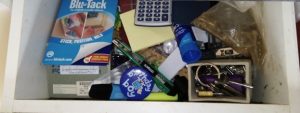
Photo: The junk drawer (after), by Bob Wilson

The small stuff autumn clean-up starts with a simple search of the junk drawer for a missing filing cabinet key. I recently shifted my office downstairs and in the shifting, all the things which were in places known to recent memory have been displaced. But it gives me a good chance to clear out what we call ‘the drawer of drawers’ – a small, deep drawer in which we throw stuff which has no particular home.

The first item in the junk drawer is an electronic button in a plastic pouch. I don’t remember what it is until squeezing it. A tune immediately begins to play, ‘Love Me Tender’, the A and B parts, faintly, reedily and slightly flat. Ah yes, that would be the satin sleep shorts from Valentine’s Day 1990-something. I surmise the idea was that one’s lover slides their hand inside the waistband (into which the button is sewn). You get the picture?

“Do you want to keep this?” I ask She Who Must Always Be Consulted.

“Aw sweet – I remember that…chuck it!”

The next items in the junk drawer are various jeweller’s screwdrivers, Allen keys and plugs you put in hardboard walls when you want to hang a picture. Then there are plastic bags full of assorted screws, nails and other wall attachments.

There are many batteries of various sizes. I set them aside to later test with the battery tester which must be in some other drawer.

Did I mention Blu-Tack? There is quite a bit of that, given our habit of posting music promo flyers all over town. I’m consolidating it into one packet clearly labelled Blu-Tack. You can see how insidiously a brand name worms its way into the language.

There are small padlocks (3) and padlock keys (7), none of which fit any padlock I can find thus far. There are 17 other keys which do not appear to have a match anywhere in the house. The old Camry key goes back quite a few vehicles. There are six plastic dimmer switch caps which became redundant last time the electrician was here.

“Do we really need to keep those?” I ask SWMABC (derisive snort).

At the bottom of the (empty) junk drawer, a tiny cockroach scrambles its way to liberty. I get the vacuum out and hoover up the cockroach grit in the bottom of the drawer. The remaining contents sit on the kitchen table awaiting re-distribution or disposal.

There’s a birthday candle, (5), which causes puzzlement until I realise there was also once a 6, which probably got thrown out after my landmark birthday. There’s a GetUp Action for Australia sticker which I just now stuck on my choir folder. There’s a Maleny Music Festival 2015 volunteer’s badge, a reminder to sign up for this year’s festival starting Friday 31st of August (and score points for being a volunteer promoter).

There’s a ball of green twine (with a strip of Blu-Tack attached), an eraser, a Niagara Falls keyring and a recipe label for Palm Street Choko Chutney. There are also quite a few small butterfly spring clips.

“Most of this shit belongs in the office,” I yell down the hall.

“There’s too much shit in the office drawers already,” comes the rejoinder. “And don’t say shit in your column.”

Motivated, I take some Bank of Queensland coin bags and separate pins, nails, screws and ‘other fasteners’ then stow them in the shed.

Will get around to that one day too, I mutter, soto voce.

So then I get stuck into the office desk drawer. There’s two paper knives (never use them), several magnifying glasses (useful), two boxes of rubber bands and lots of address labels I can’t use anymore because, as I wrote in this blog last April, I stopped paying for a private mail box.

Having drawn a blank in both drawers, I rummage through the three-drawer plastic storage container on my desk, one of which is full of USB drives, each helpfully labelled with a key tag. Oh, yes, and one of these tags is attached to the missing filing cabinet key! ‘Incroyable’ as the French would so foppishly say.

The drawer or box full of USB drives is the scourge of 21st century hoarders. Someone gives you one – “Oh you have to watch (bootlegged series)” and of course it is never returned. I still have my first USB drive, 256MB capacity (it cost $125). But if I tell you that you’ll think I’m a hoarder.

There’s a rarely-used Telstra internet dongle in this drawer, which gives me an angry hot flush when I think about Telstra’s plummeting share price, at $3.10 the lowest point since October 2011.

On Sunday I got onto Telstra’s ‘customer’ chat room to ask why it was that Telstra’s NRL app is charging data to my phone when it is supposed to be free. Incredibly, the customer service consultant told me her remit was for billing inquiries only so she’d have to transfer me to someone else. You know the story. I ended up on the ‘Crowd forum’, which is Telstra’s way of getting customers to solve their own irritating issues. A retired Telstra avatar suggested that perhaps I had not fully completed the installation process which links the NRL.com Live Pass to my mobile phone (very common, if you have the same issue – I could have told you that. Ed).

I know from reader research that 67% of you have no interest at all in rugby league, but I just want to say this one thing.

I remember when a TV reporter asked former Broncos captain Corey Parker what the Brisbane Broncos had to do to beat the Storm.

“Score more points,” was Corey’s laconic reply. He’s now a commentator with Fox Sports.

Miraculously, it seems, I feel freer and less anxious since (a) getting those unrelated issues off my chest and (b) completing the junk drawer declutter exercise.

But as happens with hoarders, the Love Me Tender button now sits on the office window sill, along with a strip of black and white negatives of uncertain provenance, a wooden frog with a fishing pole, a rabbit with one leg, a dumb-looking frog, a groovy ceramic frog with a dobro, a small concrete rabbit, a small pottery elephant, a pink piggybank, a faded postcard from Montreal, a weather station that needs a new battery and a lovely photo of SWMABC looking sweet and harmless. (Just goes to prove photos don’t always tell the truth. Ed)

junk-drawer-missing
The winning post

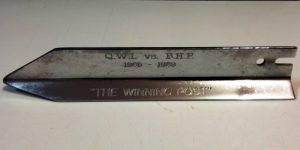
There is one more item on the window sill – a chrome-plated star picket section, ‘The Winning Post’ (pictured left). It was a souvenir from the late George Stratigos, one of the few people in the world to ever sue BHP and win. I wrote (several) news stories in the 1980s about how it took Queensland Wire Industries six years to win a Trade Practices case over BHP’s refusal to sell Y-bar to QWI, which would allow it to make star pickets, thereby competing with a BHP subsidiary. After the High Court ruling, George had a batch of ‘Winning Posts’ cast and gave them to away to remind people how sometimes the little guy can win.

Call me sentimental, but I’m hanging on to the Winning Post, tarnished as it is by age and neglect. Like life itself, even.

FOMM back pages:

and another