Global Insights On Neglected Political Issues

neglected-political-issues
Image: war-time voting at Perth Town Hall, State Library of WA https://flic.kr/p/eUK9Pa (It’s a long shot but the State Library of WA is keen to identify the people in this war-time photo)

There have been issues aplenty for people to mull over ahead of tomorrow’s Federal election, not all of them as obvious as climate change, refugees or the Murray Darling.

Chair of Australia21, Paul Barratt, named those issues as his top three in a contribution to John Menadue’s Pearls and Irritations newsletter. But he also added 10 neglected political issues. They include inequality, reversing the cuts to research and development, early childhood education and a world-class NBN. Barrett, a former Departmental secretary of Defence and Primary Industries and Energy, would be aware of the global statistics on internet speed. Increasing the latter is, after all, the main aim of a world-class NBN.

A report in the Canberra Times last month showed that Australia dropped three places to 62nd for fixed broadband. The latest Ookla Speedtest Global Index showed that Australia is far behind many comparable economies and a few developing nations. The download speed of 35.11 Mbps recorded for March is only 60% of the global average of 57.91 Mbps.

However, a spokesman for Communications Minister Mitch Fifield told the Canberra Times Ookla didn’t measure the speeds of which the NBN is capable.

“It measures the speed packages that households purchase – which is the main determinant of speeds received.” The spokesman said around half of the 5.1 million people connected to the NBN had chosen 25 Mbps or lower, eschewing the faster options.

Australians not yet connected to the NBN network are limited to an average speed of 8 Mbps with an ADSL connection (by way of explanation if I have not replied to your emails).

Barrett points out that faster internet is not just about downloading films or online gaming; it is about the needs of industry in the city and the bush as well as social benefits like remote delivery of medical services.

Coal and climate change

Whether you believe that climate change is the only real issue in this election or not, Australia is demonstrably dragging the chain in terms of mitigation. This is without a doubt the No 1 neglected political issue.

Australia is performing worse than most other advanced countries in achieving Sustainable Development Goals (SDGs). The global SDG Index ranked Australia 37th in the world (down from 26th last year and behind most other wealthy countries including New Zealand, Canada, the United States and the United Kingdom.

Efforts to sway the country away from its love-affair with fossil fuels have struggled against the incumbent government’s determination that ‘coal is good for humanity’. There’s no doubt about the growing demand for coal to generate electricity in China and India and there’s no shortage of players, including Gina Rinehart and Clive Palmer, poised to open up new mines in the Galilee Basin. It’s not hard to figure out why. Australia exported $US47 billion worth of coal – 36.9% of global trade in 2018. Demand for thermal coal to fuel power stations is highest in China, the US and India. New coal-fired power stations planned by those three nations total 334,773MW of capacity – an increase of about 23%. Research portal carbonbrief.org exposes the folly of this, saying that CO2 emissions from existing plants alone are enough to ‘breach the carbon budget’ limiting global warming to1.5 or 2C.

The good news, if you are a climate change believer, is that 14 countries (including the UK and Canada), have signed up to phase out coal power generation by 2030.The Stop Adani campaign had its genesis in 2007 when environmental campaigner Tim Flannery alerted people to the likelihood of the Galilee Basin in central west Queensland being exploited. The arguments against development of the 27 billion-tonne thermal coal resource include the low quality of Galilee Basin coal, a required expansion of an export port too close to the Great Barrier Reef for comfort and the environmental record of the applicant (Adani).

As the above infographic explains in detail, there are concerns about the amount of water required to operate (a) the mine and (b) the port. The Indian coal and power company has posted a rebuttal of claims that it will take 12 gigalitres of water from the Great Artesian Basin.

Refugees and border paranoia

The United Nations Association of Australia set out its position on refugees and asylum seekers in April last year, saying that current policies and measures need to be reviewed.

“Australia’s current policy only shifts the problem to other countries.”

“Australia’s reputation as a welcoming host country and as a responsible global citizen is diminished by our current treatment of asylum seekers and refugees arriving spontaneously, as evidenced by arguments from within the Australian community and from the UNHCR. There are alternatives.”

The UNAA states the obvious – processing arrivals offshore is not cost-effective. Between 2012 and 2016, the cost to Australia was an estimated $9.6 billion. Though costs have reduced as arrivals have decreased, the estimated cost of offshore processing for 2017-18 was $714 million.

(Offshore processing costs blew out by 52% during 2018-19. The latest Budget records that estimated actual spending in 2018-19 on offshore processing will be $1.158 billion – Ed)

Despite the weight of international criticism, Australia has persisted with the practice of detaining refugees offshore and turning boats around.

It is important to know that the Labor Party has largely promised to maintain the status quo, although it would look at New Zealand’s offer to resettle refugees from Manus and Nauru,

Australian expat musician James Fagan, who has been living in the UK for 20 years, has often had to wear criticism of Australia’s refugee policies.

But he is being asked less often, since the Brexit campaign revealed what he called the “dark underbelly of xenophobia and racism in the UK”.

“Five or 10 years ago, when Tampa and all that stuff was in the news, I used to get a lot of questions in the UK.  The one that sticks in my mind was the Armenian delicatessen owner who asked me about how I felt about my homeland’s treatment of refugees. He had Armenian friends and relatives in Australia and had been following the Tampa situation closely. He asked me if I was embarrassed. I said yes!

“But I’ve stopped being asked the question and the sad truth of it is that the longer a country persists in a particular course of action, the less it becomes newsworthy.”

Which brings us to No 10 in Paul Barratt’s list of neglected political issues – the need for empathy and compassion in government.

It should be a matter of conscious public policy that empathy and compassion underpin everything we do in the public sphere,” he writes.

“Recent Royal Commissions have demonstrated how strongly human motivations drive behaviour. Humans have a powerful competitive and acquiring motivation, which tends to turn off other motivational systems that link to caring and supporting others.

“So developing a compassionate mindset is important because it has shown that this mind-set organises our motives, emotions and actions in ways that are conducive for our own and other people’s wellbeing.”

“Recognising the needs and aspirations of every human being necessarily implies refraining from demonising any social group – refugees, the unemployed, the poor, the homeless, etc.”

Mr Speaker, I commend the Mindful Futures Network to the House (and the Senate).


(The above quote could well have come from the late ex-Prime Minister Bob Hawke. Valé to a great Australian politician who was respected by both sides of politics. SWETB) (SheWhoEditsThisBlog)

More reading – what Labor and the Greens were saying about a coalition before the 2016 election. https://bobwords.com.au/greens-coalition-bridge-far/

Three (Political) Billboards Outside Caboolture, Queensland

political-billboards-Queensland
Billboards outside Caboolture, Queensland and all the way to Canberra

A week before Easter, I was driving back from Bribie Island when my travelling companion pointed out the first of three political billboards. The first read: “Don’t Vote Labor”. A little further down the road: “If Shorten wins, you lose.”

The third billboard featured the face of a minor party leader known for her dubious skill in empathising with those in the community who have a morbid fear of ethnic minorities.

“I’ve got the guts to say what you’re thinking,” the political billboard states.

As much-quoted advertising guru Todd Sampson said on Twitter: How do you say racism without being racist? It’s surprisingly clever…

That’s not an endorsement, I’m sure, just an adman’s view of what works.

My passenger said: “Don’t they have to say who authorised those billboards?” I didn’t see anything.”

That’s the problem with advertising on billboards – the message has to be extremely pithy and in letters big enough to be read from a car passing by. The driver has only a few seconds to take in the message; no chance to read and absorb the small print which, as required, must state the name, affiliation and domicile of the person authorising the advertising.

These political billboards were sighted in the seat of Longman, which was wrested from the LNP with a 4.73% swing by Labor member Susan Lamb in 2016. After the dual-citizen fracas, Lamb resigned from the seat but won it back again at a by-election in July 2018.

Longman includes the satellite suburbs of Caboolture and Morayfield and the retirement communities of Bribie Island. High pre-poll support for One Nation had highlighted Longman as the electorate to watch, but on the day, Labor held the seat against the LNP with a two-party preferred swing of 3.7%.

One Nation was third on the ballot with some 14,000 votes. Perhaps it was the inclusion of six minor parties and an independent alongside the four main contenders that did the damage, but the LNP lost support.

As The Conversation observed at the time, the Coalition’s by-election primary vote plunged 9.4% in Longman, compared with the 2016 election. The 3.7% swing against the LNP’s Trevor Ruthenberg vindicated election analysts’ warnings about the reliability of single-seat polling.

“While senior Coalition MPs have since put this down to an ‘average’ anti-government swing at by-elections, few in the party would have expected such a kicking in a historically conservative seat,” wrote Chris Salisbury, Research Associate at the University of Queensland.

As Salisbury warned, by-election results should not be extrapolated to likely voting patterns at a general election. But those three billboards outside Caboolture, might, I suggest, be a warning to the local sheriff to watch her back (cultural reference to a 2017 movie by Martin McDonagh, starring Frances McDormand).

As we set off the following week on a circuitous back roads journey to Canberra, I inevitably began noticing billboards, As a rule, billboards positioned outside rural towns advertise food, accommodation, fuel and agricultural products. Sometimes you will see a religious message and on occasions a hand-made billboard damning fracking or coal mining. But a month out from a Federal election, it was no surprise to see political billboards as parties ramping up their profiles.

One of the most common billboards we spotted on the road proclaimed “Unsee This”, which turned out to be a house ad for a billboard company with space to rent.

As you’d imagine, advertising your wares on the side of the highway is an expensive business. Most billboard companies offer a 28-day minimum ‘lease’.

A campaign source told me it cost about $10,000 a month for a billboard and $16,000 for a mail-out to the electorate. So all up a major candidate is up for $60k to $100k for a Federal campaign

United Australia Party leader Clive Palmer estimated he has spent $50 million on various forms of election advertising, including ubiquitous billboards featuring the man himself with upstretched arms. The original pitch was “Make Australia great”, but UAP has swung away from that slogan to wordy headlines about fast trains and zonal taxing.

One of my musician friends who drove through New England on her way home from Canberra spotted a Barnaby Joyce billboard in a field. She seemed surprised, maybe assuming that after the former deputy leader’s fall from grace in 2018, he might have quit politics for good.

But no, Barnaby Joyce is once against contesting the seat of New England for the National Party, seemingly unbeatable in an electorate where he holds a 16% majority. As one of the best-known politicians for the wrong reasons, Barnaby doesn’t really need to pay to have his face recognised in the electorate.

Inverell farmer Glenn Morris, while not running for New England or putting his face on a billboard, nonetheless attracted a lot of media attention. He put climate change firmly on the agenda with a five-day horseback ride over the Anzac Day weekend. Morris and his horse Hombre rode from Glenn Innes to Uralla, wearing a drizabone raincoat with the words “Climate Action” on the back, urging voters to consider the environment in the upcoming election.

“This is an urgent message. We need climate action, we need our leaders to step up and we also need our community to demand more from our leaders,” Morris told the Northern Daily Leader

“I’ve watched too many elections come and go while I’ve been researching climate change, with no emphasis at all on the environment.”

That much is certainly true, with The Guardian saying that the partisan climate debate, characterised by hyperbole and misinformation, had paralysed Australian politics for a decade.

Labor is promising stronger policy which the Coalition has merrily dubbed “Carbon Tax 2.0”, claiming it will impose a massive regulatory burden on Australia.

As you may have read, among a long list of measures, Labor wants to set a higher emissions reduction target (45% by 2030, compared with the LNP’s 26%), reintroduce the Coalition’s abandoned National Energy Guarantee, launch a carbon credit scheme for heavy polluters, and implement strict vehicle emission standards.

As The Guardian rightly points, out, this is policy which may not even happen, despite Labor’s best intentions.The Coalition is not showing any sign of having a substantial conversion on climate change. Labor will likely need the Greens to get various changes legislated and the Greens will want a higher level of ambition than is evident in this policy.”

As is apparent from its strong advocacy against new coal mines, The Greens will want Labor to exit coal sooner than later.

So even though many lobby groups are wont to call this the ‘climate change election’ it is entirely possible the long-running ideological deadlock will continue, with little or no change.

Sweden’s teenage climate activist Greta Thunberg says she wants adults to behave as if their house is on fire.

Unfortunately, the ‘adults’ in Canberra appear to have taken the batteries out of their smoke alarms so they can char their T-bone steaks with impunity.

For those who just joined us here at Friday on My Mind, yesterday was our fifth birthday! Give me a week to cogitate about that and next week we will have a completely subjective review of five years’ of FOMM. For now, enjoy the first episode, and, if you got up early on Wednesday to Dance up the Sun, good for you.


Electoral roll closes tomorrow

Election countdown special No 1

electoral-rolls-close-tomorrow
Image: war-time voting at Perth Town Hall, State Library of WA https://flic.kr/p/eUK9Pa

This pre-election series will include timely public interest notifications and random observations about polling (the electoral roll closes tomorrow),  leadership and grassroots campaigns. Readers are urged to share this with their young adult children, nephews and nieces and Joe at the bottle-oh.

Most urgently, if you are not already on the electoral roll for the 2019 federal election, you need to do it by 8pm tomorrow (April 18).  If you are an Australian citizen aged 18 years or older you are required to vote in the federal election. To enrol, follow this link to complete the online form.

If you are confused about who to vote for, the ABC’s Vote Compass interactive tool will give you a fair idea. I completed mine last week and was aghast to find that 6/10 was the best I could do for a preferred leader (out of four possible choices, I scored two of them 1/10!)

This is perhaps not surprising when you learn that the figureheads of the main parties (LNP and Labor), can’t scratch up 50% as preferred leader.

An IPSO poll released last week put Scott Morrison (46%) ahead of Bill Shorten (34%) as preferred Prime Minister. Let’s not get despondent about the apparent lack of confidence in political leadership. Polls like these can be decidedly inaccurate.

For example, Paul Keating went into 1992 with a personal approval rating of just 25%, ebbing to 17% just before he won the 1993 election. Other PMs who failed to garner support as preferred leaders include Julia Gillard (23%), Tony Abbott (24%) and Malcolm Turnbull (34%). Those numbers were when all four leaders were at their lowest point of public support.

If you would like to take the temperature of the over-60 cohort, a survey by the website www.startsat60.com asked readers to rank Australian PMs between 1968 and 2018.

John Winston Howard won in a hand-canter with 58.3%; despite saying he’d never say sorry, despite the children overboard mistruths, despite following George Bush Jnr and Tony Blair into an unwinnable and unjustifiable war. Still, he did ban guns after the Port Arthur massacre. Bob Hawke ranked second in the over-60 survey with 17%, just behind Gough Whitlam (15.2%).

The other nine leaders all scored less than 5%, with Malcom Fraser and Scott Morrison attracting no votes at all. Tony Abbott and Kevin Rudd polled equally poorly with 0.6%.

I offer no conclusions on political surveys except to say that even when conducted by professional polling companies, they ought to be treated with caution.

Ten days in Aotearoa

Aotearoa-Te-Urewera
Aotearoa – Te Urewera, looking towards East Cape. Image by Brucieb, https://commons.wikimedia.org/w/index.php?curid=2260517

As the doors swished open at Brisbane International Airport and I walked out into 35 degrees and a dusty, smoky atmosphere, I very briefly wished I hadn’t left Aotearoa behind. How I love the mellifluous way that Maori word trips off the tongue – Ao-tea-ro-a.

The Maori language uses vowels more than we do in English and it also uses them in combinations. The language has fewer consonants, preferring the use of Wh to replace the letter F, for example. The Maori alphabet has 15 letters including two digraphs (Ng and Wh) and five vowels, each of which has a short and Continue reading “Ten days in Aotearoa”

Six Prime Ministers and a potato class action

Prime-Ministers
Prime Ministers- ScoMo feeds the fire (meme by twitter.com@GeorgeBludger)

As the dry winter fades away, ushering in a hot and bushfire-prone spring and summer, here’s some sober reflections on ‘Single-use Prime Ministers’.

I borrowed the single-use mention from a clever meme doing the rounds on social media, where, I might say in defence of the humble Kipfler, Sebago and Desiree, potatoes continue to be openly defamed. It might not be long before we see headlines where Tryhard & Associates, no win-no fee, mount a class action on behalf of Mr and Mrs Sebago and 15 other tuber families.

As we now see from former Home Affairs Minister Peter Dutton’s attempted coup, while it worked in principle, the betrayal left Mr Dutton out on a limb, with a centre-right politician seizing the leadership.

At the outset, Australia’s new Prime Minister, Scott Morrison, decided the people needed to know that “we’re on your side”.

“That’s what matters. We are on your side. And we are on your side because we share beliefs and values in common, as you go about everything you do each day.”

Keep playing that one, Scott. Stay away from the line that brings down Westminster democracies; when a leader (be it Whitlam, Hawke, Keating, Howard, Rudd, Gillard, Abbott or Turnbull), have all been caught referring to ‘my government’.

I had a couple of messages from FOMM stalwarts last week in aggregate saying “Get a grip, Bob. The nation’s imploding and you’re talking about stamp collecting?”

I defend last week’s meandering missive as making the case that Australian governments have been lurching hard-right for a very long time now, arguably since John Howard’s 1988 stance on multiculturalism and refusing to make a treaty with the Aborigines. Hence my writing about the stamp-collecting Philip Ruddock, a hard-line Immigration minister in control of our border policies from 1996-2003.

Now here’s the thing – party factions, backroom machinations and political knifings are not what does in a sitting PM – it is narcissism.

As economist and author George Megalogenis wrote in an opinion piece for the New York Times: “The prime minister is not even mentioned in the Australian Constitution, yet the office has evolved into a paradoxical position of supreme authority and permanent vulnerability.”

Megalogenis also wrote: “They have borrowed the worst of United States presidential politics, with its obsessive focus on the leader, and grafted it onto a Westminster system of parliamentary government that was designed for collaboration and compromise.”

Australia has had six Prime Ministers since 2008, the number arguably including a bit of double counting when first Julia Gillard toppled Kevin Rudd, then Rudd came back and promptly lost the next election in a landslide. Then there was Tony Abbott, Malcolm Turnbull and now Scott Morrison. This era was characterised by frantic passing of new legislation in the incumbent’s first year. Fairfax Media research tallied new acts of Parliament passed in the first year for Prime Ministers Kevin Rudd (133), Julia Gillard (132), Tony Abbott (116) and Malcolm Turnbull (104). These are mediocre numbers compared to Paul Keating (212) and Gough Whitlam (161). Surprisingly (well, I was surprised), John Howard’s first year numbers (86), are only marginally better than Ben Chifley (74).

What appears to have brought undone Prime Ministers of the past 10 years is the polarisation caused by climate change policy. It seems nigh on impossible to achieve political consensus on this most serious of issues, even if over 97% of climate scientists active in that field of research say it is a reality, aggravated and accelerated by human activities. (There are, of course, nay-sayers. Just Google ‘what percentage of scientists believe in global warming, if you have a few hours to spare.)

All six of our Prime Ministers thus far have failed or been thwarted in terms of seriously countering climate change. Some even challenging the notion that fossil fuels have had their day. I refer of course to (a) Tony Abbott’s infamous ‘coal is good for humanity’ quote, and incumbent PM Scott Morrison’s stunt, brandishing a lump of coal in Parliament.

But let’s go back 117 years, to an era when coal really did rule – when steam trains, for example, burned through eighty pounds of coal for every mile travelled (a useful factoid from Michael Portillo’s fascinating series, Great British Railway Journeys).

Australia’s leadership changed seven times in the first ten years of Federation (and 11 times between 1901 and 1922). Again, leadership changes involved ambitious men having a second (and even a third) attempt. Andrew Fisher (1909-1909, 1910-1913 and 1914-1915) proved the most persistent, governing during the early years of WWI. Fisher, I’d like to point out, introduced Australia’s first postage stamp. On January 2, 1913, the Fisher-led government issued the Commonwealth penny stamp.

It featured a controversial design – a kangaroo on a white map of Australia. Although later stamps reintroduced the King’s head, the kangaroo design remained in use for some forty years. An example of this rare stamp sold at auction in 2012 for $142,563.

But we were talking about men (and women- Ed.) and their egos and how the Prime Ministership has evolved as the Office of Omniscience. Towards the last days of Kevin Rudd’s Prime Ministership, there were reports of policy on the run, along with statements made with no consultation, and there have been similar reports about other short-term Prime Ministers. To be fair, in the first year of the Whitlam administration, the late Gough Whitlam rammed through a colossal amount of social reform legislation in a fortnight with the help of a two-man Cabinet (the duumvirate) – just Gough and his deputy, Lance Barnard.

Megalogenis observed that post-Rudd, the Labor party has made it harder to remove future Prime Ministers. Changes to internal rules now require the party leader be elected by a combined vote of the parliamentary party and grass-roots members. From this side of the fence, it is hard to see the Liberals coming up with a similar safeguard.

In no time at all, it seems, Australians will be thrust into another Federal election, with a new Prime Minister who will not have had enough time to show his mettle. On the other side, we have Labor leader Bill Shorten, and deputy leader Tanya Plibersek. Mr Shorten’s tactics thus far, apart from keeping his head down and letting the Liberal Party stew in its own juices, has been to divide and conquer, emphasising the class gulf between the left and right.

Tucked away behind the cannot-be-seen hedge, Labor’s Anthony Albanese, passed over for the Opposition leadership in 2013, declared his colours in June, in the Whitlam Oration.

Mr Albanese called upon his party to emulate the Hawke and Keating approach and “collaborate with unions, the business sector and civil society to achieve positive outcomes in the national interest”.

The Labor frontbencher also delivered a warning about the need to find common ground with voters outside the union movement.

“This is not 1950, when most Australians were members of trade unions,” Mr Albanese said. “Indeed many people from working class backgrounds are not members of unions because they were beneficiaries of Gough Whitlam’s education reforms. We cannot afford to ignore this demographic.”

Sigh, it makes my brain burn, like the feeling I got when I saw that clever meme (above) with Scott Morrison feeding a lump of coal into a (red and orange) map of Australia.

Good for humanity my arse.

Simple as ABC – a public radio/TV licence


ABC-Budget-Cuts
Chart: ABC annual report 2016-2017

At first glance, Treasurer Scott Morrison’s plan to slash $83.7 million from the ABC operating budget seems mean-spirited. At second glance, when he tells reporters ‘everyone has to live within their means’, it still seems mean-spirited.

The Budget proposal comes at a critical time for the ABC, which has been dealing with cumulative cuts of $254 million since 2014.

The Federal Treasurer, having painted the picture large, sent a hospital pass to Finance Minister Mathias Cormann to handle the outrage. Mr Cormann defended the decision to freeze indexation for three years (which amounts to $83.7 million), saying that all taxpayer-funded organisations have to find efficiencies.

The national broadcaster has been tightening its belt so much there is no room left for another notch. Managing director Michelle Guthrie sent an email to all staff saying as much, which she amplified in a press release. Ms Guthrie said the impact of the decision could not be absorbed by efficiency measures alone, as the ABC had already achieved significant productivity gains in response to past budget cuts.

She referred to Budget measures starting in 2014 with a 20% cut to the operating budget. The ABC was told to slash $254 million from its operating budget within five years. The broadcaster began to make cuts which were expected to save $207 million in 2015.

Jobs were lost, through natural attrition or redundancy, and the ABC also started reviewing its property portfolio and transmission network. As I have written previously, there was a general hubbub of protestation about this, circa November 2014.

“Petitioners were petitioning, GetUp was getting up, the ABC Friends group was lobbying and raising funds. They should have seen it coming,” I wrote.

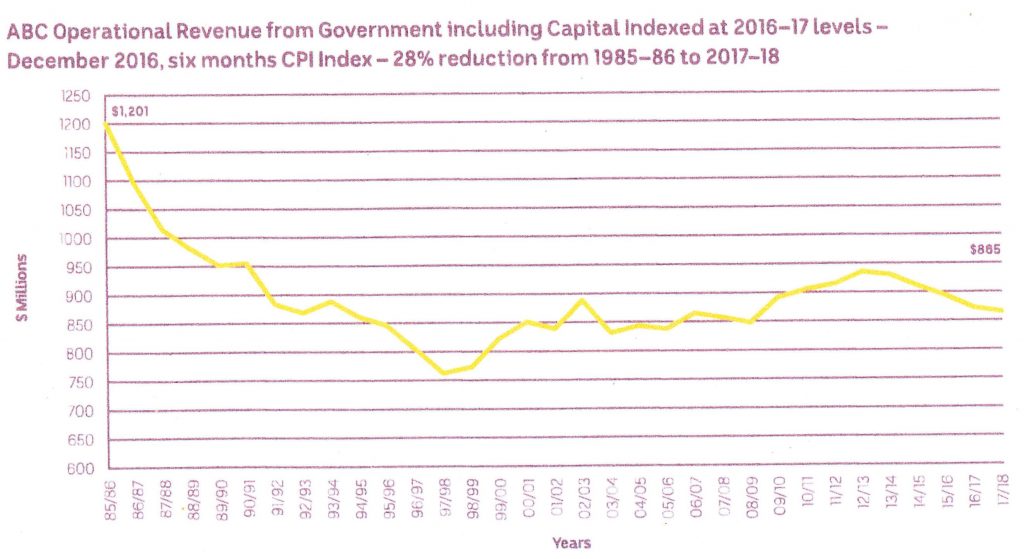
A graph in the ABC’s latest annual report (above) shows how its operational budget has waxed and waned, dropping 28% from 1985-1986 to 2017-2018. As the graph indicates, the ABC has weathered some very lean years, particularly 1997-1998, under John Howard and Peter Costello.

The ABC annual report says 2017–18 was the third year to reflect previously announced Government-funding reductions. As part of the ABC/SBS Additional Efficiency Savings measure, there was a year on year increase of $7.7 million in the cut to the ABC’s base funding, bringing the total decrease in base funding to $55.2 million per annum.

This week Ms Guthrie said the ABC was continuing to implement various savings initiatives to address funding cuts, comprising efficiency savings in support functions and transmission (to cover the previously budgeted reduction of $12.5 million required in 2018–19).

Back to the drawing board, then.

Ms Guthrie said the decision came at a critical time for the ABC, as it starts triennial funding negotiations with the Government.

“The ABC is now more important than ever, given the impact of overseas players in the local media industry and the critical role the ABC plays as Australia’s most trusted source of news, analysis and investigative journalism.”

There is also a risk that the Enhanced Newsgathering initiative will not be renewed (at a cost of $43 million). The ABC acknowledges a decision on this funding is yet to be made by the Government. Considering the hullabaloo that followed economic reporter Emma Alberici’s analysis of the government’s plan to cut corporate tax rates, these financial constraints must be seen as ideological and punitive.

Opposition leader Bill Shorten said the ABC was “one of the pet hates of the Liberal Party”, and it’s hard to disagree.

“Because the ABC occasionally asks questions of the government they’re going to wind back $83 million,” he told the ABC.

But Finance Minister Mathias Cormann says the ABC will still receive $3.2 billion over those three years.

“This is effectively equivalent to the efficiency dividend that applies to nearly all other government taxpayer-funded organisations,” he added.

One of the early victims of successive budget cuts was the ABC Fact Check Unit, which was closed down in May 2016. ABC news director Gaven Morris said at the time “Unfortunately, having a standalone unit is no longer viable in the current climate.”

In March 2017, however, the unit was revived as a joint venture between RMIT University and the ABC. The unit’s brief, as it was before, is to ‘test and adjudicate on the accuracy of claims made by politicians, public figures, advocacy groups and institutions engaged in public debate’.

Which governments taxed us the most?

You may have seen an infographic on social media which the Fact Check Unit verified. It shows which governments taxed us the most, spanning the years between Whitlam and Turnbull. Tax as a percentage of GDP peaked in the Howard years at 23.5%. The Whitlam years averaged 19.4%. The Abbott/Turnbull years thus far average 21.7%. Interestingly, the turbulent years of Rudd/Gillard/Rudd averaged 20.9%.

So isn’t it satisfying to publish information like that and know it has been fact-checked and found to be factual? In this era where fake news and what I’d call ‘sponsored news’ leaves us with a skewed perspective, it is refreshing to see the ABC has found a new way to maintain standards.

There were some moments in the Federal Budget one could choose to laud; tax cuts, better reverse mortgage opportunities for pensioners and more funding for the homeless, albeit dependent on State contributions. But there was no respite for people on NewStart and no real plan to address housing affordability.

And, as the Climate Council pointed out, there was nothing at all in the Budget to address climate change – the words were not even mentioned.

For perspective, take a moment to think about the Federal Treasurer’s $50 million plan to redevelop the Meeting Place Precinct in Botany Bay (including a $3 million statue of Captain James Cook). Yes, it’s in Mr Morrison’s electorate, but surely that’s a side issue, Leigh?

If I may revisit an idea from Simple as ABC in 2014, the budgetary travails of the ABC and the ideology motivating it could simply be avoided. All it would take is an annual public radio/TV licence; $35 per household per year would (now) raise about $300 million. If the government of the day would guarantee indexed funding of $1 billion a year, the ABC could plan, rebuild and restore quality for the long-term.

Let’s be reminded that we all paid a radio licence from 1920 and continued doing so until colour TV was introduced in the early 1970s. Not every household in Australia would be happy about paying this licence fee. Some would see it as subsidising those dangerous lefties and bleeding hearts at the ABC and SBS.

But something radical needs to happen, to arrest the decline in quality (e.g. ABC online), restore transmission to remote areas (try getting an ABC station on your car radio when travelling in country areas-Ed.) and ensure money can be found for important investigations.

Every week since 1961 the award-winning Four Corners has continued to unearth important stories. Investigative journalism is an expensive business which requires reliable funding and a relatively free hand.

If we want more important stories like the live sheep export scandal, the solution is simple as ABC: We need to consistently fund the national broadcaster and guarantee its editorial independence.

Further reading: Mr Denmore thinks the media should boycott the Budget Lockup:

http://bobwords.com.au/simple-abc/

http://bobwords.com.au/simple-abc-part-2/