Three (Political) Billboards Outside Caboolture, Queensland

political-billboards-Queensland
Billboards outside Caboolture, Queensland and all the way to Canberra

A week before Easter, I was driving back from Bribie Island when my travelling companion pointed out the first of three political billboards. The first read: “Don’t Vote Labor”. A little further down the road: “If Shorten wins, you lose.”

The third billboard featured the face of a minor party leader known for her dubious skill in empathising with those in the community who have a morbid fear of ethnic minorities.

“I’ve got the guts to say what you’re thinking,” the political billboard states.

As much-quoted advertising guru Todd Sampson said on Twitter: How do you say racism without being racist? It’s surprisingly clever…

That’s not an endorsement, I’m sure, just an adman’s view of what works.

My passenger said: “Don’t they have to say who authorised those billboards?” I didn’t see anything.”

That’s the problem with advertising on billboards – the message has to be extremely pithy and in letters big enough to be read from a car passing by. The driver has only a few seconds to take in the message; no chance to read and absorb the small print which, as required, must state the name, affiliation and domicile of the person authorising the advertising.

These political billboards were sighted in the seat of Longman, which was wrested from the LNP with a 4.73% swing by Labor member Susan Lamb in 2016. After the dual-citizen fracas, Lamb resigned from the seat but won it back again at a by-election in July 2018.

Longman includes the satellite suburbs of Caboolture and Morayfield and the retirement communities of Bribie Island. High pre-poll support for One Nation had highlighted Longman as the electorate to watch, but on the day, Labor held the seat against the LNP with a two-party preferred swing of 3.7%.

One Nation was third on the ballot with some 14,000 votes. Perhaps it was the inclusion of six minor parties and an independent alongside the four main contenders that did the damage, but the LNP lost support.

As The Conversation observed at the time, the Coalition’s by-election primary vote plunged 9.4% in Longman, compared with the 2016 election. The 3.7% swing against the LNP’s Trevor Ruthenberg vindicated election analysts’ warnings about the reliability of single-seat polling.

“While senior Coalition MPs have since put this down to an ‘average’ anti-government swing at by-elections, few in the party would have expected such a kicking in a historically conservative seat,” wrote Chris Salisbury, Research Associate at the University of Queensland.

As Salisbury warned, by-election results should not be extrapolated to likely voting patterns at a general election. But those three billboards outside Caboolture, might, I suggest, be a warning to the local sheriff to watch her back (cultural reference to a 2017 movie by Martin McDonagh, starring Frances McDormand).

As we set off the following week on a circuitous back roads journey to Canberra, I inevitably began noticing billboards, As a rule, billboards positioned outside rural towns advertise food, accommodation, fuel and agricultural products. Sometimes you will see a religious message and on occasions a hand-made billboard damning fracking or coal mining. But a month out from a Federal election, it was no surprise to see political billboards as parties ramping up their profiles.

One of the most common billboards we spotted on the road proclaimed “Unsee This”, which turned out to be a house ad for a billboard company with space to rent.

As you’d imagine, advertising your wares on the side of the highway is an expensive business. Most billboard companies offer a 28-day minimum ‘lease’.

A campaign source told me it cost about $10,000 a month for a billboard and $16,000 for a mail-out to the electorate. So all up a major candidate is up for $60k to $100k for a Federal campaign

United Australia Party leader Clive Palmer estimated he has spent $50 million on various forms of election advertising, including ubiquitous billboards featuring the man himself with upstretched arms. The original pitch was “Make Australia great”, but UAP has swung away from that slogan to wordy headlines about fast trains and zonal taxing.

One of my musician friends who drove through New England on her way home from Canberra spotted a Barnaby Joyce billboard in a field. She seemed surprised, maybe assuming that after the former deputy leader’s fall from grace in 2018, he might have quit politics for good.

But no, Barnaby Joyce is once against contesting the seat of New England for the National Party, seemingly unbeatable in an electorate where he holds a 16% majority. As one of the best-known politicians for the wrong reasons, Barnaby doesn’t really need to pay to have his face recognised in the electorate.

Inverell farmer Glenn Morris, while not running for New England or putting his face on a billboard, nonetheless attracted a lot of media attention. He put climate change firmly on the agenda with a five-day horseback ride over the Anzac Day weekend. Morris and his horse Hombre rode from Glenn Innes to Uralla, wearing a drizabone raincoat with the words “Climate Action” on the back, urging voters to consider the environment in the upcoming election.

“This is an urgent message. We need climate action, we need our leaders to step up and we also need our community to demand more from our leaders,” Morris told the Northern Daily Leader

“I’ve watched too many elections come and go while I’ve been researching climate change, with no emphasis at all on the environment.”

That much is certainly true, with The Guardian saying that the partisan climate debate, characterised by hyperbole and misinformation, had paralysed Australian politics for a decade.

Labor is promising stronger policy which the Coalition has merrily dubbed “Carbon Tax 2.0”, claiming it will impose a massive regulatory burden on Australia.

As you may have read, among a long list of measures, Labor wants to set a higher emissions reduction target (45% by 2030, compared with the LNP’s 26%), reintroduce the Coalition’s abandoned National Energy Guarantee, launch a carbon credit scheme for heavy polluters, and implement strict vehicle emission standards.

As The Guardian rightly points, out, this is policy which may not even happen, despite Labor’s best intentions.The Coalition is not showing any sign of having a substantial conversion on climate change. Labor will likely need the Greens to get various changes legislated and the Greens will want a higher level of ambition than is evident in this policy.”

As is apparent from its strong advocacy against new coal mines, The Greens will want Labor to exit coal sooner than later.

So even though many lobby groups are wont to call this the ‘climate change election’ it is entirely possible the long-running ideological deadlock will continue, with little or no change.

Sweden’s teenage climate activist Greta Thunberg says she wants adults to behave as if their house is on fire.

Unfortunately, the ‘adults’ in Canberra appear to have taken the batteries out of their smoke alarms so they can char their T-bone steaks with impunity.

For those who just joined us here at Friday on My Mind, yesterday was our fifth birthday! Give me a week to cogitate about that and next week we will have a completely subjective review of five years’ of FOMM. For now, enjoy the first episode, and, if you got up early on Wednesday to Dance up the Sun, good for you.
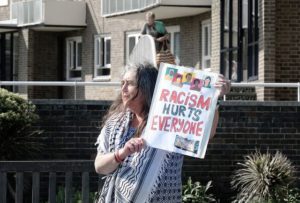


Racism hurts everyone

racism-hurts-everyone
Photo Alisdare Hickson https://flic.kr/p/HDAcMK A lone Dover resident bravely leaves her home to confront a right wing anti-immigrant march

Scottish comedian Billy Connolly at one time waxed indignant about how political correctness was intruding into comedy.

“How dare they,” he fumed, on somebody’s talk-show. “Funny is funny.”

No Billy, not really. Not if you’re the butt of somebody’s bad taste joke, be it about religion, gays, people with disabilities, migrants from non-Christian countries or our indigenous people, who had the misfortune to be colonised in 1788 and not officially recognised in the Census until 1967.

What, you don’t think people make jokes about Aborigines? Try Kevin Bloody Wilson’s “Living next door to Alan”. I’m told this spoof song about a family of Aborigines moving in next door to Alan Bond, which in totality may be more about mocking big business than anything else, is a favourite amongst indigenous peoples in WA. But you can’t generalise like that, and herein lies the central problem with racism and xenophobia.

One cannot know the private thoughts of the racist who never verbalises or the indigenous person who feels persecuted but is too afraid/shy/humble to speak out.

In New Zealand, the Race Relations Commissioner, Dame Susan Devoy, launched the nation’s first anti-racism campaign. Her open letter asked Kiwis to tell their stories about ‘casual racism’ – to go beyond the 400 written complaints received last year.

‘That’s Us’ is the first campaign that asks people to start sharing their own stories about racism, intolerance and hatred.

In her letter Dame Devoy says the overwhelming majority of people never complain or go public when a car drives past and the people in it scream a racist obscenity.

She cites other casual or ‘quiet’ racist encounters “that never feel casual or quiet when you and your family are the ones being humiliated.”

Dame Devoy told The Guardian that overt racism is not as widespread as it is in, say, Australia, but she felt that New Zealanders need to reassert their position as a world leader in race relations.

“We just need to look around the world right now to see what happens when racial intolerance and racism is normalised. We think New Zealanders are better than that and we hope you do too.”

But returning to Billy Connolly’s assertion that ‘funny is funny’.

When I was growing up in New Zealand the most popular entertainment group was a Māori group, the Howard Morrison Quartet, closely rivalled by a Māori/Pakeha comedy duo, Lou and Simon.

The latter were known for parodying popular songs, e.g. West Side Story “I like to be in a Maori car” using gentle, self-deprecating humour.

The Howard Morrison Quartet had a hit in 1960 with ‘My old man’s an All-Black’ based on the Lonnie Donegan tune about a dustman. The song was a protest about the decision to exclude Maori rugby players from the 1960 tour of South Africa.

It contained comic asides such as:

“Fi fi fo fum, there’s no Horis in that scrum.”

Crikey, you wouldn’t get away with that today. The urban dictionary and others define ‘Hori’ as a racial slur, but it was in common use in the 1960s. I recall Dad cuffing my ear (as that generation of Dads were prone to do), saying: “Don’t call Māoris Horis – it’s disrespectful.”

I may have asked, risking another ear-cuff ‘Why do some Māoris call themselves Horis, then?’ and he replied that if a negro (before they were known as African American) called himself a Nigger, that was OK, but it was not OK for us to use the N word, its origins steeped in racial hatred, slavery and oppression.

Wikipedia defines ‘Hori’ as a derogatory, racist slur, but the term (like Nigger in the US) has to some extent been “reclaimed” within the community it was originally intended to insult. Like those epithets used by rappers and hip-hoppers – ‘Wazzup, Nigger?’ Hori is used today as a term of endearment amongst Māori or as a signifier of ‘keeping it real’.

Whatever age I was in 1960, that discussion led me to read To Kill a Mockingbird, Uncle Tom’s Cabin, Black like Me, Go tell it on the Mountain and at least five of the 15,000 books written by or about Abraham Lincoln.

Meanwhile in the UK, present day, five 15-year-old boys and one 16-year-old boy have been arrested on suspicion of murdering a Polish man in Harlow, Essex. A subsequent assault on a Polish man in Harlow is being investigated as a hate crime, as is the murder a week earlier.

There was a noticeable rise in hate crimes after the June 23 Brexit referendum, with more than 3,000 allegations of harassment and threats filed with UK police.

Nothing on this scale to report in Australia, but the seeds have been sown and Pauline Hanson’s anti-Muslim rhetoric just shovelled a whole lot of fertiliser on that particular garden.

Adding potash, if you will, is a new Essentials Media poll showing 49% of Australians support a ban on Muslim immigration. Economist George Megalogenis dug out some historical evidence that 58% of Australians were opposed to taking part in a worldwide plan in 1947 to resettle Jewish refugees from Europe. Just because a survey saying half the people apparently don’t want something to happen doesn’t necessarily mean it won’t.

The 1946 Census revealed that 35,000 Jews lived in Australia. Historian and author W.D Rubinstein said at least 17,600 Jewish survivors reached Australia between 1945 and 1954 – the largest single increase in Jewish numbers in the country’s history.  In 2011 there were 112,000 Jewish people in Australia, the vast majority residing in Melbourne or Sydney,

So then to the Australian Greens who this week urged me (via a ‘personal’ email from Richard De Natale), to support the party’s walk-out during Senator Hanson’s anti-Muslim speech.

I thought the Greens could have served us better if they had stayed. Despite the parliamentary tradition that it is forbidden to heckle or interject during a Senator’s maiden speech, the Greens could have done this (one by one), until all had been ejected.

What headlines would have ensued then? Nevertheless, they walked and this is what De Natale had to say:

“After we walked out on Senator Hanson’s racist speech, my office was flooded with hundreds of calls of thanks. Then in just a few short days over 11,000 of us signed a pledge to stand united against racism. This is an opportunity to bring our communities and voices together with a message of unity that cuts through the noise of parliament. It’s hugely ambitious but I think we could reach 50,000 by the end of this year.”

That seems a small target when the Race Relations Commissioner of a nearby neighbour has pointed out that overt racism is thriving in Australia, even if the NZ Commissioner admitted:

“We’ve always had a problem with racial intolerance in New Zealand – Māori New Zealanders know it is not new.”

Dame Devoy’s Australian counterpart, Tim Soutphommasane, waded into the debate this week.

The Race Discrimination Commissioner argued in a speech at the ANU that racism at its core is about an abuse of power. He appealed to Australians not to be complacent about racial intolerance being some kind of “initiation rite” for new arrivals.

“While we may never eradicate racism and bigotry, it isn’t good enough to say its targets must grin and bear it, or that there’s nothing we can do. Doing so amounts to normalising racism, to suggesting that it should be tolerated.”