War mongers and interjections from ex PMs

war-mongers-ex-PMs
Bushmaster on patrol in Iraq 2008, Australian War Museum CC

Why is the media so enthralled with the utterances of ex-Prime Ministers, namely Paul Keating, John Howard or Kevin Rudd? Keating has been critical in recent months of the current government (his lot, I remind you) about defence issues.

Keating first lashed out at the Albanese Government in March over the nuclear submarine announcement. He described the $368 billion arrangement to buy nuclear submarines through the AUKUS defence pact as “the worst international decision by a Labor government since Billy Hughes tried to introduce conscription.” Strong words.

Keating used the National Press Club in Canberra to criticise Labor for its “incompetence” in backing the decision to sign up to AUKUS while in opposition. At the same time, Keating attacked policy decisions by defence minister Richard Marles and Foreign Affairs minister Penny Wong as “seriously unwise”, accusing them of allowing defence interests to trump diplomacy.

As it turned out, he was baying into an empty chamber, as veteran sleuth Brian Toohey discovered. The US (a key member of the AUKUS triumvirate) has said it cannot now sell three to five used Virginia class nuclear submarines to Australia, as Toohey related in the public policy journal, Pearls and Irritations.

Toohey wrote that the chief of US Naval operations Admiral Michael Gilday was recently reported from Washington as saying the US shipyards are only producing subs at a rate of about 1.2 a year. A minimum of two a year is needed to fill the US Navy’s own requirements. Until then, Gilday said, “We’re not going to be in a position to sell any to the Australians.”

“If Albanese were genuinely a good friend of America,” Toohey wrote, he would say ‘we don’t want to deprive you of any nuclear submarines, so we’ll buy readily available conventional subs that serve our needs’.

Toohey added, “Instead of grabbing this chance to get out of an impossible commitment, he behaves as if everything is still on track.”

The veteran journalist and author (he’s 79) broke numerous stories about national security and politics in his heyday, regularly receiving leaks that enraged and embarrassed politicians.

\The submarine deal is not the most recent example of ex-PM Keating getting stuck into his own party.

As The Guardian’s Paul Karp reported this week, Keating labelled the head of NATO, Jens Stoltenberg, a “supreme fool” for wanting to increase NATO’s ties with Asia. Keating’s comments coincided with Prime Minister Anthony Albanese’s travels to Germany and the NATO leaders’ summit in Lithuania. (NATO stands for the North Atlantic Treaty Organization.)

This state visit produced announcements about Australia’s material support for Ukraine via the donation of 30 Australian-made Bushmasters. Known in military parlance as Protected Mobility Vehicle or Infantry Mobility Vehicle, the Bushmaster is an Australian-built four-wheel drive armoured vehicle. ($2.45 million each).

Mr Albanese also confirmed on Monday that the German Army would buy 100 Australian-built Rheinmetall Boxer armoured vehicles. In case you did not know, this is something the Queensland government should be crowing about as the Boxers will be manufactured at Rheinmetall’s plant in Ipswich, near Brisbane. (The German company owns 64% of this joint venture – just thought you should know that.)

The Prime Minister’s announcements this week are yet another sign he and his executive team are well capable of making big decisions and acting upon them, despite criticism from the left and right. From my perspective, the Labor government seems to be a good deal more ‘hawkish’ than some of its predecessors. Then again, the top echelons of government in Canberra are no doubt privy to daily security briefings which could be prompting the escalating defence strategies.

Not the least there is China’s increasing economic and diplomatic push into the Asia Pacific, namely the Solomon Islands, Sri Lanka and Papua New Guinea.

Keating has been a strident critic of the Albanese government’s apparent strategy to prepare for possible aggression from China. He would prefer, I suppose, closed-door diplomacy.

Paul Keating, I’ll remind you, was infamous in his political career for an ability to deliver invective-laden tirades that inevitably drew headlines.

But who cares what Paul Keating thinks about anything? He had his day at the Despatch Box.

There’s a reason the likes of Rudd, Howard and Keating are ex-Prime Ministers. The people – that’s you and me and Freddie next door, not to mention their own party – got sick of them and voted them out. Brilliant, motivated and influential as they once were, they are not the least bit relevant now.

In tackling this topic, about which I know little, I relied on some expert research from the policy wonks who write for Pearls and Irritations (recommended), the Australian Strategic Policy Institute, and a defence blog which recently took a similar position on interjections by former PMs.

As Stephen Kuper wrote in DefenceConnect,

“Our world has changed significantly since the 1990s — gone are the heady days of elated optimism in the aftermath of the collapse of Lenin and Stalin’s “evil empire”,[ in its place] the global information super highway, a truly global economy responsible for lifting hundreds of millions, if not billions out of abject poverty, yet it seems, someone has forgotten to tell former prime minister Paul Keating.”

It is worth noting (from another source) that Australia’s Defence spending under the Keating government (1991-1996), was slightly above or below 2% of GDP, which is the financial benchmark for ensuring the country can be independently protected from aggression.

Defence spending was between 3% and 4% of GDP during the Vietnam war and has peaked above 2% at various times, including the 1980s when the world was in a relatively benign state.

Marcus Hellyer of the Australian Strategic Policy Institute wrote a two-part report in 2019 about the reasoning behind (and the flaws) of working on 2% of GDP. As he observed, GDP rises and falls, and any number of global crises can interfere with this way of calculating defence budgets. For example, former PM Kevin Rudd’s stimulus-spending during the Global Financial Crisis put a serious kink in the defence spending supply hose.

“As official predictions for GDP growth change, the Defence Department’s future funding changes,” Hellyer wrote. He argued that defence spending based on 2% of GDP was likely to fall short of the fixed-funding line presented in a 2016 defence white paper.

“If a future government sticks to 2% of GDP rather than the white paper line, the Defence Department would take a substantial funding cut.”

The strategic risk arises with what defence calls its ‘future force’, much of which will not be delivered until 2030. It is probably already unaffordable under the white paper’s funding model.

Australian Budget papers reveal a funding shortfall with the 2023-2024 defence budget ($54.9 billion), projected to be $5 billion short.

If I may editorialise now, that’s a serious problem for any Australian politician trying to wear big boots to a global foreign policy conference. While Albanese, Marles and Wong have been shoring up alliances with the US, UK, Japan and now, it seems, Germany, most strategic analysts agree that Australian needs to become more self-reliant (with the added financial burden that implies).

I was digging around looking for a quote about peace to finish this uneasy essay on a positive note and found one from an unlikely source.

Peace is not absence of conflict; it is the ability to handle conflict by peaceful means.” – Ronald Reagan.

Yep, he said it.

Asylum seekers and the seven-year itch

asylum-seekers-seven-years
Asylum seekers and refugee rally – photo by John Englart flickr.com

If Home Affairs minister Peter Dutton ever had a lapse in judgement, it would be thinking that asylum seekers and their supporters have given up. Over a seven-year span, Mr Dutton and his predecessors have exposed asylum seekers to a punitive system (which is outside the UN Convention on Refugees).

As you may hear this weekend, Sunday marks seven years of detention for those who were sent to centres on Manus Island and Nauru. At the time, former Prime Minister Kevin Rudd announced that people arriving by boat to seek asylum would be processed offshore and never be allowed to resettle in Australia. #7yearstoolong

Four administrations later (Gillard, Abbott, Turnbull and Morrison), the unconscionable treatment of people seeking refuge from persecution, torture and ethnic cleansing in their homelands has barely changed.

The now-famous author Behrooz Bouchani chronicled his torturous life on Manus Island in the award-winning book, ‘No friend but the Mountain’. in 2019, Australians became more aware of the effects of despair and mental health issues suffered by asylum seekers in our offshore detention centres. There was a seemingly effective campaign to Get the Kids Off Nauru. All the while, the Australian government continued to be responsible for those much-criticised centres (outsourcing the task to private security firms). Along the way, the government re-opened, closed and then re-opened again the Christmas Island detention centre, Christmas Island being an Australian protectorate.

During the past seven years, the numbers of people who have started or joined an existing asylum seeker support group have grown, to include such organisations as Rural Australians for Refugees.

This national movement started with a campaign by the good folk of Biloela, who took in a Sri Lankan family. You’d know about this saga, where authorities came in the early hours and removed the couple and their two children, taking them into detention. Over time, the family of four ended up being the only detainees in the Christmas Island Detention Centre, at a reported cost to the taxpayer of $27 million a year.

Closer to home, a Kangaroo Point motel has become the focus of the protest movement which wants to see an end to our egregious treatment of people whose only possible mistake was to pay a people smuggler to bring them to Australia – irregular, but not illegal.

Asylum seeker supporters fought long and hard to challenge the government to bring unwell detainees from offshore detention centres. This resulted in a new Act which forced the government’s hand. Even though people needing medical attention were brought to Australia, it seems that few of those brought here under the Medevac Bill have been released from detention. A lot of those people ended up at a motel in the Brisbane inner city suburb of Kangaroo Point.

As Hannah Ryan wrote in The Guardian last month , the Australian government engaged private guards and assigned them to the Kangaroo Point Central Hotel & Apartments, describing it as an “alternative place of detention”. Here, 120 people who had been detained on Manus Island or Nauru and were sent to Australia for medical treatment, are being kept indefinitely. They are not allowed to leave, as Ryan says “not even to visit the KFC across the road.

Since COVID-19 raised its head in March, they are not allowed visitors either. Over the year or so this has been going on, some detainees took to holding up placards from the motel balconies, when allowed out for fresh air. Support networks got wind of this and a series of rallies began, not without some risks. At a rally on June 29, 40 protesters were arrested for staging a sit-in after the two-hour permit had expired.

Public protests aside, Home Affairs minister Peter Dutton is pressing on with a draft Act designed to crack down on drug dealing and the development of terrorist cells. The draft Act would make it illegal for people in detention to have a mobile phone.

Just think about that for a minute, while realising how crucial your mobile phone has been to you through the COVID-19 lockdown.

Australia’s Human Rights Commissioner Edward Santow made a submission to a Parliamentary committee, saying that the bill should not proceed. Writing in the Canberra Times, Santow said:

The Commission recommends that risks be considered on a case-by-case basis. If a particular person in detention has used their phone to commit illegal activity or endanger the security of Australia, this would be a reason to prohibit them from having a phone. But it would not justify a ban that applies to other people who haven’t been shown to be a risk.” 

The government said when introducing this Bill that it did not plan to introduce a blanket ban on mobile phones, rather to address risks to health, safety, and security.

Those protesting on Sunday have made it clear what they want – an end to indefinite detention. As stated in Green Left Weekly (where you will find a list of rallies and gatherings and their locations): “Free the refugees and bring those still on Manus Island and Nauru to Australia now.”

The COVID-19 pandemic and its consequences have pushed this issue onto the media back-burner. The recent closure of some media outlets and the migration of others to online only has further diluted the message.

So emerged the hashtag #7yearstoolong on social media as volunteer groups try to raise awareness of institutionalised inaction.

While the government continues to take a hard line stance, a survey last year showed that attitudes towards refugees are hardening. Part of a global study on attitudes, it shows that 44% of Australians think borders should be closed, up 5% on the 2017 survey.

Globally, 54% of people doubted whether refugees coming into their country were really genuine and not arriving just for economic reasons. Australians’ doubts about people’s motives rated lower, at 49%. About 42% of Australians agree that refugees successfully integrate (a drop of three points since 2017).

Refugee Council of Australia statistics show that at March 31, 2020, there were 1,373 people held in onshore detention centres. Apart from any other consideration, it is costing Australia an estimated $137.34 million a year to keep refugees in domestic detention, based on figures provided by the Kaldor Centre.

And, did you know that 64,000 foreigners have overstayed their Australian work or tourist visas, with up to 12,000 believed to have been here for 20 years or more?

All of the above, I contend, should be seen in the context of Prime Minister Scott Morrison’s plan to allow Hong Kong Chinese safe haven in Australia. (Ed: “Probably because they would be well off financially”

Oh, that’s right, we are still in thrall of the ultimate strong leader (John Howard), who said in 2001 his government had an irrevocable view on border protection: “we will decide who comes to this country and the circumstances in which they come.

Every leader from Kevin Rudd onwards has toed the same Sovereign Borders line. If you are expecting anything different from the Leader of the Opposition, should he ever win an election, do not hold your breath.

Further reading: This Australian Government policy paper sets out the facts and dispels myths about asylum seekers and refugees.

We are travelling in remote western Queensland, so expect one from the archives next Friday.

*Tom Hanks’ companion in Castaway was a volleyball, not a football as I wrote last week (and the Hug Patrol photo was from 2012, not 2019).


About Nauru your petitioner humbly prays

Nauru-refugee-children
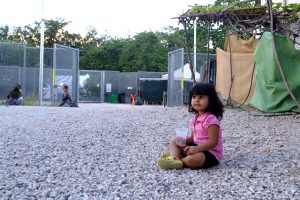
Refugee child ‘Roze’ on Nauru, provided by World Vision Australia

I could count on the toes of my feet the number of petitions I have signed in this life, but I could not refuse the Kids off Nauru campaign. More than 100 human rights groups, churches, charities and organisations, including World Vision, Amnesty International and the Australian Lawyers Alliance are behind Kids off Nauru.

The e-petition to Prime Minister Scott Morrison and Opposition Leader Bill Shorten leaves no room for negotiation. Children in detention on Nauru, about 40 of who were born on the island, have witnessed lip stitching, self-immolation and other suicide attempts. Many have developed traumatic withdrawal syndrome, characterised by resigning from all activities that support a normal life. The Australian Medical Association has called for immediate action to assure the health and wellbeing of those on Nauru.

As one of the NGOs involved in the campaign, Plan International says, “This can’t continue, not on our watch”.

“We’ve seen report after report of children who are in such despair, for whom life in detention is so miserable, that they have withdrawn socially, stopped eating and even attempted suicide,” Plan International said. “In August a 12-year-old girl tried to set herself on fire.”

The petitioners want all 120* children and their families off Nauru by November 20, 2018. The date is not random – it is Universal Children’s Day.

You all know this shameful story, where the Australian Government re-invented an offshore processing solution for people who’d mostly arrived without permission by boat, seeking refuge in the big open country they had heard was egalitarian and tolerant.

Nauru, a small island north-east of PNG and the Solomon Islands, was once known for extracting and selling phosphate for fertiliser. The resource is exhausted, so the Nauruan government could hardly refuse the lucrative offer from the Australian Government.

It’s difficult to get an accurate count* of children on Nauru, quoted variously as between 106 and 126. Meanwhile the official number from the Australian Government is 22. But wait, the fine print refers only to children in the Nauru Regional Processing Centre (Australia’s responsibility). Other refugee children are accommodated in centres run by the Nauruan Government. The latter is not at all transparent about the welfare of refugee children and their parents. A New Zealand TV reporter was detained briefly when reporting from the Pacific Forum because she went ‘off reservation’ to talk to refugees “without going through proper channels”.

I’d go and see for myself but they want $8,000 for a journalist visa.

Anglican Bishop Phillip Huggins wrote to then Home Affairs Minister Peter Dutton seeking clarification of numbers published on the department’s website.

The (eventual) reply from Mr Dutton and Huggins’s interpretation of the answers is worth reading to get a perspective.

Bishop Huggins concluded that the harsh reality is that there were (in August 2018), 120 refugee children in Nauru (some have been resettled in the last month). Some are being assessed for resettlement in America; some may eventually be resettled in New Zealand.

Let’s ask the obvious question: New Zealand PM Jacinda Ardern and her coalition partner Winston Peters have offered to take up to 150 refugees from Nauru. Former Australian PM Malcolm Turnbull rejected the offer to resettle the Nauru refugees, making the woolly argument that this would only make New Zealand attractive to people smugglers. It may surprise readers to know that the New Zealand offer to resettle refugees goes back to the administration of former PM John Key (2008-2016).

The transfer of asylum seekers to offshore processing centres in the Pacific was first introduced by the Howard (Coalition) Government in 2001.Here’s an edited summary of what followed.

Seven months after Kevin Rudd was sworn in as Prime Minister in 2008, the last remaining asylum seekers on Nauru were transferred to Australia, ending the Howard Government’s controversial ‘Pacific Solution’.

In July 2010, then Prime Minister, Julia Gillard revealed that the Government had begun having discussions about establishing a regional processing centre for the purpose of receiving and processing irregular entrants to the region. Importantly, only 25 asylum seekers had travelled by boat to Australia to seek asylum in the 2007–08 financial year. By the time Gillard made her announcement in July 2010, more than 5,000 people had come by boat to Australia to seek asylum.

Gillard acknowledged that the number of asylum seekers arriving by boat to Australia was ‘very, very minor’ but she identified a number of reasons why the processing of asylum seekers in other countries was considered necessary, including:

  • to remove the financial incentive for the people smugglers to send boats to Australia;
  • to ensure that those arriving by boat do not get an unfair advantage over others;
  • to prevent people embarking on a voyage across dangerous seas with the ever present risk of death;
  • to prevent overcrowding in detention facilities in Australia.

Though it took another two years to secure arrangements, people began to be transferred to Nauru and PNG in the last quarter of 2012.

Two months before the 2013 federal election amidst growing support for the Opposition’s tougher border protection policies, newly appointed Prime Minister Kevin Rudd announced that Australia had entered into a Regional Resettlement Arrangement with PNG. Under the arrangement, all (not just some) asylum seekers who arrived by boat would be transferred to PNG for processing and settlement in PNG and in any other participating regional State. Mr Rudd subsequently made a similar arrangement with Nauru.

Mr Rudd now says this was meant to be a temporary arrangement.

So he we are with a humanitarian crisis on our back door and as per usual, those clinging to slender majorities do not want to make brave, decent decisions which might cost them their seat at the next election.

Petitions are a form of protest known to exert moral authority; that is, they have no legal force. But the sheer weight of numbers can force social change. One example was the millions of signatures on a petition calling for the release of Nelson Mandela.

Before e-petitions and ‘clicktivism’ became the norm, government clerks charged with the receipt and storage of paper petitions had a job for life.

The Australian government receives on average 120 petitions a year, a large proportion of which are e-petitions. Activist group, change.org, (https://www.change.org), the biggest generator of e-petitions, has 50 million subscribers world-wide.

Nigel Gladstone, writing in the Sydney Morning Herald, says 32,728 Australian petitions were started on the change.org website since 2014. More than 3.5 million people signed their name to support campaigns such as reduced parking fees at NSW hospitals and marriage equality.

Professor of Political Sociology at the University of Sydney, Ariadne Vromen and Professor Darren Halpin of ANU collected data from change.org to study online petitions over a four-year period.

“This form of political engagement is both mainstream and important,” Professor Vromen told the SMH. “In Australia Get-up were really the pioneers of using online petitions and that was a bit of a shock to the system, but politicians quickly became cynical.

“Change.org is different because citizens can start their own thing, so it is different to an advocacy group starting something.”

So will the advocacy groups behind Kids off Nauru succeed in their mission to force the government to act by November 20? Let’s revisit this in a couple of months’ time.

#kidsoffnauru

More reading:


Our Australian day of shame

Convict Road
Devine’s Hill convict road sculpture photo by Laurel Wilson

We were on the road somewhere outside Sydney when a hotted-up Mazda zoomed up next to us at the lights, twin cams throbbing. From each rear window protruded an Australian flag, fluttering like when you accidently shut your frock in the door. We sat there, waiting for the green, making cynical old fart, iconoclastic noises about faux patriotism, Bogans and drivers who just cannot sit behind a caravan.

Meanwhile, Australia Day has come and gone; Shane Howard got a gong and used the occasion to highlight the iniquities and injustices of this colonised land. As an accidental Australian (twice emigrated) I hesitate to write anything acerbic about this country, my adopted home. I did not go to school here, so even though I studied Australian history at university and watch Better Homes and Gardens, there are gaps in my education through which you could drive a Holden Ute laden with slabs of beer. But I seize every opportunity to learn more, to lift the rug and look under it for First Nation stories. As chance would have it, we stumbled across two relics of our colonial past while on a circuitous road trip to the Illawarra Folk Festival and back via Tamworth. The first was the remains of a convict-built, 43-kilometre road near Wisemans Crossing in New South Wales.

Working on the chain, gang

The Great North Road was built by convict labour between 1826 and 1834 to provide a freight route from Sydney to the Hunter Valley. From Wisemans Crossing (free ferry service, thanks to the NSW government), you can drive up the road a piece, park and walk your way up Devine’s Hill. It was a hot day, but we persevered, marvelling at the 19th century engineering ingenuity and the harsh life lived by convicts. As we read about the convicts who were sentenced to serve time on ‘Iron Gangs’ to build roads, our aching calf muscles seemed a mere trifle. British convicts who had committed offences in Australia would often be sentenced to work in chain gangs, their legs in shackles. Once they had served their sentences, the shackles were removed and they were transferred to a Road Party.

Easier to work without shackles, but the work was still hard yacker, chiselling 250kg blocks out of the sandstone hills and building buttresses and retaining walls.

The chain gangs used hammer and chisels to make blocks or they bored holes in the sandstone using jumper bars and sledgehammers. The engineers then placed explosives in the holes and sliced large blocks from the hills above. There are tributes to the convicts along the 1.8 km Devine’s Hill walk which tell of the harsh terms of crime and punishment in those times, often being incarcerated for lengthy periods for what we would see as trivial offences.

Stumbling across the First Fleet

Later, we were heading for Nundle, a small town 60 kms from Tamworth, around which something of a fringe country music festival has developed. On the way, we stopped at Wallabadah, which hosts Australia’s only memorial to the First Fleet, which arrived in Port Jackson on January 26, 1788.

The personal mission of stonemason Ray Collins, the First Fleet Memorial is a small park festooned with stone tablets, listing the names of every person who travelled on the 11 ships sailing from Britain. Collins, whose interest in the project was driven by discovering his own convict heritage, has since included a tribute to the second fleet.

First Fleet Memorial
First Fleet Memorial at Wallabadah photo by Bob Wilson

This is more of a pilgrimage site than a tourist attraction. Most travellers find it by accident, stopping at the public facilities which adjoin the memorial. It was strangely moving though, walking around the gardens reading the names of this country’s first European ancestors, who thought Australia was unpopulated (Terra Nullius).

Terra Incognito might have been a more apt term, meaning unknown lands which had not yet been explored. The original inhabitants were there, though seldom seen. Early explorers made ship’s log entries about seeing plumes of smoke, from fires deliberately lit by Aborigines as a means of caring for and regenerating an arid land.

What we were not taught

As most Australians are now aware, even if they were not taught the history at school, the original inhabitants pre-dated the first fleet by at least 40,000 years. Australia Day as we celebrate it now, with thong-throwing competitions, colonial re-enactments and cockroach racing, is grossly insulting to the First Nations people, the Aborigines. I could go on, but you all know the stories of land-grabbing, exploitation, the spread of (European) diseases, genocide and our often misguided removal of children from their families.

There was the grand gesture, the Stolen Generation apology in 2008 by former PM Kevin Rudd. Apology aside, nothing can make that right. All we Anglo-Saxon Australians can do is to make symbolic gestures, like outspoken songwriter Paddy McHugh did at The Dag (a sheep station converted into a wedding reception and conference centre and alt-country music venue).

He began his set by acknowledging the original owners of the land and then, the current owner. We could all do this when the occasion arises, but so few of us do.

Meanwhile on Tuesday

On Australia Day we went on a vintage train excursion from Warwick to Nobby, along with 90 other people, many of them sporting Australia Day paraphernalia and greeting friends with “Happy Australia Day”. Excuse me, but this country’s blood-soaked history is nothing to be happy about. As indigenous journalist Stan Grant said, in a stirring speech which has been seen around the world, Aborigines were “marooned on the tides of history to the fringes of Australian society”.

Still, is there really any harm in tourists using a public holiday to spend some money keeping the smoky smell of our colonial days alive? The Nobby craft shop, run by local volunteers, did solid trade, as did Rudd’s Pub, named not for a twice-ex Prime Minister, but the author Steele Rudd, of the Dad and Dave stories about sheep shearing and dances down the hall on a Saturday night, damper and billy tea.

It is a long way removed from Carnarvon Gorge and its ancient painted rock walls. Songwriter Garry Koehler’s song The Gallery was inspired, he tells me, by the painted hands, which to him appeared to be reaching out; imploring, “Help – can you fix this mess?” Koehler told his audience in Tamworth last week that the rock carvings at Carnarvon date back 30,000 years.

“And we’ve been here only 200 years and stuffed it up.”

Well, 228 years if you want to be picky, but there has not been much to write home about for Australia’s aborigines since 1988. Indigenous musicians and kindred spirits had plenty to say though, notably Kev Carmody and Archie Roach, Yothu Yindi, also Shane Howard and Neil Murray, to name a few.

You’ll have your own views on Australia Day, as do my 298 Facebook ‘friends’, and some of them have far more strident things to say.

She Who Is Finally Mentioned favours calling January 26 “Survival Day”. It’s less negative than Invasion Day and many of this country’s 669,900 Aboriginal and Torres Strait Islander people already call it just that.

They have survived, despite everything.