Bare bones budget for jobseekers

bare-bones-budget
The bottom line (red) shows the unemployment benefit – flat-lining since 1993 apart from the Covid stimulus and the token Budget increase. Chart from ACOSS in 2023 dollars

Just as well the Commonwealth Government Budget wasn’t tabled last week – that would have been too much of a mixed message.

A nation’s budget is all about redistribution of wealth, a concept worth keeping in mind at a time when £100 million of British taxpayers’ money was spent on an unnecessary coronation pageant.

As has been repeatedly pointed out, Prince Charles became King by default on September 8, 2022, on the death of his mother, Queen Elizabeth II. There was no pressing reason to stage a mediaeval pageant, however splendidly well done.

This week, the media’s attention swung back to the King’s southern hemisphere colony, as Treasurer Jim Chalmer presented his budget.

So much had been flagged already that one does have to question is there a critical reason for the media embargo till 7.30pm on Tuesday.

As I started writing this on Tuesday morning, much of the Budget’s headline measures had already been revealed. This included a $15 billion spend on cost-of-living relief; $1.5 billion of it in electricity bill relief for 5.5 million households and 1 million small businesses. I should point out that this is from an ABC article published on Tuesday morning. The ABC’s business reporters Ian Verrender and Gareth Hutchens were all over it.

One of the other measures flagged earlier aimed to change the dispensing rules at pharmacies. Australians will be able to buy two months’ worth of medicines on a single prescription, with the change affecting more than 300 common medicines. This overrides the current rule that only 30 days’ supply of medicine can be applied to one prescription.

The ABC and other media outlets also seemed confident, ahead of the Budget, that Chalmers would produce a surplus and indeed he did. You can’t please everyone, though. Greens leader Adam Bandt said the government had prioritised delivering a ($4.5 billion) surplus over supporting people in poverty.

“Labor’s second budget is a betrayal of people who were promised that no one would be left behind,” he said in a tweet on social media.

Other leaked or pre-announced budget measures included cheaper child care and a (long overdue) pay rise for aged care workers. Welfare recipients received higher payments, but nowhere near the level asked for by lobbyists.

The Budget is a document which sets out how taxes paid by Australian businesses and individuals will be spent. It is a massive number, equating to 29% of GDP. In 2021-2022, $683 billion was raised in taxes across all levels of government. This was 15.2% higher than the previous year. A table prepared by the Australian Bureau of Statistics shows an upward trajectory for taxation revenue. The slight blip in 2019-2020 was due to disruption to employment by the onset of Covid-19 and its attendant lockdowns. Total tax revenue includes all Commonwealth, State and Territory taxes, GST, those indirect taxes that still exist and excises imposed on alcohol, tobacco and fuel.

The cost-of-living package is one thing, but the government has been under enormous pressure to raise the level of unemployment benefit. The Australian Council of Social Service (ACOSS) last month presented a detailed brief to Treasurer Jim Chalmers. A former Commonwealth Treasury head, Ken Henry, appeared on television as the ACOSS brief’s anointed spokesman. In a call to raise the level of NewStart and Youth Allowance, ACOSS said some 750,000 people in communities across Australia live on unemployment and student payments that do not cover the cost of housing, food, transport and healthcare.

The single rate of Newstart is (or was) less than $40 per day and living on Newstart and Youth Allowance presents the biggest risk to living in poverty. ACOSS wanted the rate raised to within 90% of the aged pension, so were almost certain to be disappointed.

In an open letter to the Prime Minister, ACOSS said 80% of people receiving JobSeeker payments have been receiving the benefit for more than 12 months. The same research found that seven in ten people on income support were eating less or reporting difficulty getting medicine or care. In December 2022, Anglicare found that there were 15 Jobseekers competing for each entry-level role.

“The longer people remain on income support, the harder it is to transition back into paid work,” the letter said.

ACOSS chief executive officer, Dr Cassandra Goldie, said post-Budget that while the $20 per week pay rise was welcome, it did not go far enough.

“The (increase) to JobSeeker and related payments is well below the Economic Inclusion Advisory Committee’s findings. The committee said that it needs to rise by at least $128 a week to ensure people can cover the basics.”

ACOSS and others are right to complain. Australia has the lowest rate of unemployment payment in the OECD. One in four people on Newstart have only a partial capacity to work because of illness or disability.

The ABC’s business reporter Gareth Hutchens wrote an intriguing analysis in May 2021 about the ‘full employment’ policies of governments prior to the 1970s. Then followed a policy aimed at creating a permanent pool of unemployed as a means of promoting economic growth and making Australia more globally competitive. Along with rising unemployment came a political ploy to blame the victim. The term ‘dole bludger’ emerged, first used by Liberal MP Bert Kelly, a pioneer of “New Right” political ideas. But the phrase was also promoted by Clyde Cameron, minister for labour in Gough Whitlam’s Labor government (1972-1975).

As unemployment soared in the mid-1970s, being without a job was recast as the fault of workers for being ‘too lazy’. There was much debate about the need for ‘overly generous’ income support. (Anyone who has ever been on it would dispute its  ‘overgenerosity’. Ed)

Policymakers from the early 1980s started using an unemployment rate of 5% as a deliberate policy tool.

“How could everyone be expected to find a job,” Hutchens wrote. “There haven’t been enough jobs to go around, by design.”

Now, almost 50 years later, the long-term unemployed are still being victimised over a deliberate policy to keep them out of work.

If I may hark back to a FOMM from 2018 when we speculated about what one could do were one made King for a Day:

King Bob decreed: “I’d single out the dysfunctional tax and welfare systems and propose the following reforms:

Introduction of a universal basic income for all adults: $25k a year, indexed, no strings attached. Adults are free to earn money over and above the $25k but will be taxed on a sliding scale to the maximum rate for anyone earning more than, say, $100k.

In my Kingdom, all forms of social welfare would be replaced by a new regime, overseen by the Office of Financial and Social Opportunity and Incentivisation (NOOFASOI). The office would oversee payment of the UBI and iron out the inevitable wrinkles in a new and untested system.”

In the real world, countries as diverse as Finland, France, Ireland, Norway, the US, Canada, New Zealand, Holland, Iceland, India and Brazil are either talking about a UBI or trialling it in one form or another. In 2016, the Parliament of Australia published this comprehensive yet concise policy paper by Don Henry, for those who want to find out more.

While I leave you to make of that what you will, I’ll be delving into the 997-page Budget, seeing what’s in it for me. As we all do.
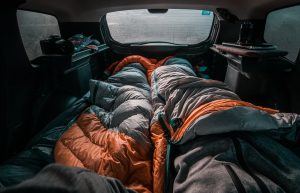
Homeless people sleeping in their cars

homeless-sleeping-cars
Image: Lucas Favre, www.unsplash.com

Today’s headline about homeless people could well be an urban myth; that is, a story people tell each other, swearing that it’s true. The housing crisis in Australia – a combination of unaffordable housing and scarce rental properties – is forcing people to live in their cars. I’ve done a bit of fact checking on this, but hang around while I relate this story from Tasmania.

We’d stopped at Scottsdale, a high country town in Tasmania’s north-east. We’d chosen the town’s free camp, which provided toilets and showers (the latter powered by three one-dollar coins). We were settling in for the evening when it became obvious that the older woman next to us was preparing to spend the night alone in her small Japanese car. The overnight forecast was a minimum of 7 degrees. She’d hung towels in the side windows and fixed a screen over the windshield. She seemed to be withdrawn, so we respected her unspoken need for privacy. But as far as I could tell (being next door and all), she went to bed as soon as it got dark. I decided my penance for not engaging in conversation was to make her a coffee in the morning. But when I arose (at 7.30am), she had gone.

It’s not illegal to sleep in your car in Tasmania – I looked it up. In theory if you are homeless, you could free camp your way around Tassie and nobody would hassle you. Some free camps allow you to stay for up to a month. But it does get cold from April to November, and rough campers would have to travel to town to find a public shower.

In Queensland, it’s illegal to sleep in your car unless you are parked in somebody’s driveway (with their permission). In which case you’d probably be inside, on the couch with the dog. There are similarly tough rules in the Northern Territory.

As blogger Tim Beau Bennett discovered, many local governments have specific by-laws vetoing this practice, so it would pay to check.

The biggest problem with assessing the level of homelessness in Australia is that the most reliable data (the Census) only comes out every five years. It could well be Spring before we see the first results of the 2021 Census. We therefore rely on data that is six years out of date (116,471 in 2016). But what’s been going on in the interim?

Recent reports show that up to 44,000 women of all ages are vulnerable to homelessness, with domestic violence being a key risk. Homelessness Australia (the National peak body for homelessness in Australia) released an analysis of housing data from the Australian Institute of Health and Welfare that showed that 1,600 women over 50 sought help from homelessness services in 2016. These women were either ‘couch surfing’ – that is, staying temporarily with friends or family members, or sleeping in their cars. The numbers had increased 75% and 81% respectively between 2012 and 2016.

Homelessness Australia launched a campaign in March this year calling for $7.6 billion to be allocated to long-term housing for women over the next four years.

The research identified a shortfall of 16,810 homes, the building of which would provide economic benefits of $15.3 billion and create 47,000 jobs across the economy.

The 2019-2020 research report Nowhere to Go, prepared by Equity Economics, showed that 9,120 women are becoming homeless every year. Women who had experienced family and domestic violence were the biggest client group seeking assistance. In 2019-20, 119,200 clients, or 41% of all such clients, sought assistance while experiencing domestic and family violence. More than half (55.8%) required accommodation. Alarmingly, the data also revealed that 7,690 women go back to abusive relationships, out of necessity.

It is perhaps illuminating to discover that Homelessness Australia was funded by the Federal Government until December 2014. Since then, it has been staffed by volunteers and has no paid staff.

As we mark the eighth birthday of Friday on My Mind, those of you who have hung in for a long time would know I often write about this topic. Australia has had a steadily increasing homelessness problem since 2011. The elevation of housing from a place to live and grow a family to a wealth-generating asset is the key issue.

An Australian Housing and Urban Research Institute (AHURI) investigation from November last year found that up to two million renters aged 15 or over are at risk of homelessness. AHURI’s brief to researchers was to identify those at risk of homelessness in smaller regional centres.

The resulting paper shows just how close so many people are to becoming homeless, primarily because of rental increases and ever-tightening rental vacancies.

All it would take is one life crisis –  a relationship breakup, a serious illness or losing work due to economic circumstances, the authors concluded. Many people found out at the peak of the COVID-19 pandemic how circumstances can quickly change.

The survey was commissioned by AHURI from researchers from Swinburne University of Technology, University of Tasmania and Launch Housing. The task was to estimate rates of people at risk of homelessness for small areas (with a population ranging from 3,000 to 25,000).

Those interviewed were considered at-risk of homelessness if residing in rental housing and experiencing at least two of the following:

low-income;

vulnerability to discrimination;

low social resources and supports;

needing support to access or maintain a living situation;

a tight housing market.

The AHURI study is an important one at this fragile stage of the electoral cycle. It bridges the gap between what we officially know about the homeless and the ‘hidden homeless’ – those who are couch surfing, sleeping in their cars, house-sitting or doing the slow lap of Australia.

Even if you have a job, the next challenge is to find a rental property. This week our local paper, The Daily Journal, carried a report that the Southern Downs region has the lowest rental vacancy rate in Queensland (0.1%). The figure, a 10-year low, comes from a Real Estate Institute of Queensland survey of 50 local government areas.

While rentals in the Southern Downs are cheap compared to metropolitan cities (advertised weekly rentals start at $210 for a one-bedroom unit, to a three bedroom house in Warwick ($600). I am assured on at least an anecdotal level that the scenario is being replicated all over Australia.

The Federal Government’s main response to this shameful crisis was the National Housing and Homelessness Agreement (NHHA). The scheme started on July 1, 2018 and provides around $1.6 billion each year to States and Territories.

The NHHA included $129 million a year for homelessness services. States and Territories must match the sum applied for when claiming this money.

The NHHA identifies ‘priority cohorts’, which is public service jargon for people most in need of a roof over their heads. (Dehumanising language is but one of the many issues when considering homelessness. They are not ‘cohorts’ – they are people. Harumph. Ed)

  • women and children affected by family and domestic violence,
  • children and young people,
  • Indigenous Australians,
  • people experiencing repeated homelessness,
  • people exiting from care or institutions into homelessness and
  • older people.

Yes, it’s a depressing topic, but better solutions and attitudes could be developed, starting by not demonising those who either can’t find work or can’t work. Then we need to stop stigmatising those who for whatever reason have nowhere else to go.

In Nomadland, Francis McDormand’s character Fern is asked: “My Mum says you’re homeless. Is that true? Fern: “No, I’m not homeless. I’m just houseless. Not the same thing, right?”

I’ll leave you with a ‘three chords and the truth’ country song, Somebody’s Daughter by Tenille Townes.


Not everyone has Internet access

internet-access
Image: (L-R) $29 music player, Smart Phone, , Kindle E-reader (top) old school electronic diary, memory 48KB.

I visited my local library last week for the first time in months and noticed that public internet access (computers, desks and chairs), had been removed. Desks, tables and chairs had also been removed from the reading room, where one could sit for hours browsing newspapers and magazines or working on jigsaw puzzles.

“That’s not very fair on people who don’t have a computer or access to WIFI,” said She Who Believes in Equality.

A survey published in March this year, citing Australian Bureau of Statistics data, showed that 2.5 million Australians are not online. Reasons given by respondents included affordability issues, location (poor signal or no signal), or that they lacked the 21st century skill called ‘digital literacy’.

The Centre for Social Inclusion (CSI) produces the National Digital inclusion Index, based on data from Roy Morgan Research.

Since data was first collected in 2014, Australia’s overall digital inclusion score has risen by 7.9 points, from 54.0 to 61.9. Improvements have been evident across all three categories: Access, Affordability and Digital Ability. CSI notes in its 2019 report that those with the lowest ADII score are in the lowest socio-economic demographic (income under $35,000), with a score of 43.3 points. The Northern Territory is excluded from the research (sample too small), but indigenous Australians living elsewhere scored 55.1.

The digital divide is an obvious social strata marker, with a 30.5 point difference between the lowest income demographic (43.3) and the highest (73.8).

The 2019 survey shows that all segments of the digital access market improved on their 2018 score. Scores are allocated to particular geographic regions and socio-demographic groups, over a six-year period from 2014 to 2019. People aged 65 and over are the least digitally included age group, with a score of 48 (13.9 points below the national average).

I know a few elders who, for one reason or another, refuse to engage with the digital world, clinging on to old analogue TV sets and VCRs, eschewing mobile phones and in some cases, not even having an answering machine. The NBN is relentlessly catching up with this cohort. Moreover, financial institutions are forcing these older customers to abandon time-honoured way of paying bills (by cheque and in person).

As an aside, when I first tried to source the CSI report, I was ironically greeted with the message, “bandwidth exceeded, try later”.

We’re all getting a lot of messages like that with the weight of people using Facebook, Twitter and their affiliates 24/7, not to mention streaming movies, TV series and engaging in bandwidth-using virtual performances and community catch ups.

Last time I wrote about this subject, 90,000 Australians were still using dial-up modems to surf the Internet. That annoying yet welcoming modem squeal is heard no longer, at least not by Telstra customers. Telstra retired its dial-up service In December 2015, citing a sharp drop off in the numbers of people still using dial-up in favour of a variety of connectivity options.

When I last worked for the now mostly digital regional news services, when we went to public meetings in rural areas, we’d take a portable modem. The mid-1980s version was a device you clamped to the handset of a (dial up) phone and then transmitted your news report from the laptop. News organisations spent a fortune equipping field reporters with clunky laptops which weighed at least 10kg and cost thousands. When the technology inevitably did not work, reporters simply called a ‘copy-taker’ at HQ and dictated the story.

Copy-takers are long gone, and the rest of the old school cohort who had not already taken a redundancy package will most likely be swept out the door in the latest media shakeout.

But getting back to the 2.5 million Australians who told survey takers they do not have access to the Internet.

A group of 30 community organisations has called for urgent efforts to help Australians not connected to the internet. The group told the Sydney Morning Herald that the pre-existing problem was heightened during the pandemic, hindering access to government services; for example, children trying to undertake online education and people needing access to telehealth services.

The group asked Communications Minister Paul Fletcher to consider ‘targeted low-cost broadband’ connections for eligible households, a relief package of basic telecommunications equipment and a telephone service for people with low digital literacy.

Of those Australians who do have Internet access, more than four million use mobile only to ‘gain access to the internet’ (note how I refuse to verb a noun). This means they have a mobile phone or mobile broadband device with a data allowance, but no fixed connection. This cohort rated a low ADII score of 43.7, some 18.2 points below the national average (61.9). Mobile data costs substantially more per gigabyte than fixed broadband, which means mobile-only users are unlikely to be binge-watching Narcos, House of Cards or Killing Eve.

Mobile-only use is linked with socio-economic factors, with up to a third of people in low-income households, those with low levels of education and the unemployed more likely to be using mobile-only.

Now here’s what at first sight seems to be an anomaly. You would know the oft-quoted homeless numbers in Australia – around 116,000 at the last Census. However, as the survey found, homeless people find phones essential for survival and safety, job prospects and for moving out of homelessness.

Consumer advocate The Australian Communications Consumer Action Network (ACCAN), cited a Sydney University study that found 92% of Australians who identify as homeless (95% in Sydney and Melbourne), own a mobile phone. The homeless favour smart phones (77% of those surveyed had a pre-paid plan for a smart phone). They typically use free WIFI and public access (libraries) to keep costs down.

You might well ask, “How can a homeless person afford a smart phone?”

Well, I bought one last week for $29! It is destined to replace an unreliable IPod as a portable music player. But it also has all of the apps anyone needing a survival tool could ever use. And you can use it to call someone or send a text!

Apps take up most of the memory in this bargain phone. But even so, a minimum $10 a month would make this a handy ‘Where am I sleeping tonight?’ tool.

The annual Deloitte Australia Mobile Use Survey’s key finding is that mobile penetration in Australia has maxed out at 91% (about 20 million users), and accordingly, sales are slowing. The main reason for this is that Australians are holding on to their phones longer (three years on average).

If you are at all interested in how mobile technology is developing, this report (you need to sign up to download it), is illuminating.

For example, did you know that mobile is starting to lose ground to voice-assisted speakers (a 51% increase since 2018), as the preferred user method of ‘gaining access to’ home services and entertainment?

(“OK, Google, play ‘Bohemian Rhapsody’ by Queen” – but you have to train the thing to recognise your accent…Ed)

As an observation on the recent move by News Ltd to shut down many print titles and move most of the survivors online, mobile remains our preferred device to consume news. Having said that, Australians are less interested in tuning in at all, with only 39% reading the news weekly, compared to 48% last year.

And, as if we did not already know, 27% of Australia’s 17.9 million smart phone owners use their device at least once a week to watch a TV series or movies, up from just 5% in 2015!  I relate to this statistic, as I covertly watch Killing Eve on my smart phone, as She Who Believes in Equality chooses not to watch.

Bandwidth exceeded – try later.

FOMM back pages: https://bobwords.com.au/friday-on-my-mind/ Hold the phones 2014


Homeless for a week

Homeless-GS
Photo ABC/Giulio Saggin

The first time I thought of Homelessness Week 2016 (August 1-7) was when a young family member posted something on Facebook, aiming to raise funds for a St Vincent de Paul homeless charity, Fred’s Place. Alice took part in a community sleep out on Thursday night, raising funds to keep Fred’s Place operating.

Vinnies operates a few such sites across Australia. This one in Tweed Heads offers a home and support for people experiencing homelessness or who are at risk of homelessness.

Fred’s Place is a fully renovated home with three bathrooms, a large laundry, internet and telephone, television, staffed kitchen, inside and outside areas to socialise, storage and mailing facilities. There’s also a dedicated room for Centrelink, Medicare, Counselling, Legal Assistance and Housing NSW, all available on a weekly or fortnightly basis.

You might read elsewhere about chief executives sleeping rough for a night to get the smell of homelessness in their nostrils and raise money for charities. They’ll be up bright and early next day for eggs benedict and lattes at their favourite café, but who’s quibbling about that? All of these once-a-year sacrifices by those fortunate to have a job and a roof over their heads helps highlight homelessness as a serious issue.

New data from the Australian Institute of Health and Welfare shows that almost 256,000 people received assistance from homelessness services in 2015. So yes, it is serious.

High rents and tight vacancy rates are forcing many people to settle for less than ideal accommodation, be it share houses, hostels, motels, serviced apartments, or, down the other end of the scale, living in their cars, in campgrounds, under freeway overpasses, in tunnels or huddled in doorways.

As I wrote in the Hinterland Times last year, the Sunshine Coast is not immune from homelessness. In upmarket Noosa, where the median house rent is $650 a week and a three-bedroom unit rents for $510, 60 people, including 22 children, ended up at Noosa’s Johns Landing Camp Ground.

I began to wonder what happens to these people on the fringes, heading off to work each day,  in a region where there is a paucity of emergency or affordable housing.

Habitat for Humanity, an organisation founded by Millard Fuller and supported by former US President Jimmy Carter in the 1970s, builds houses for families who want to improve their circumstances. More accurately, the people who will ultimately live in these houses help build them. Those wanting to own a Habitat home have to be employed, scratch up a deposit and have the capacity to repay a no-interest loan. They must contribute 500 hours of ‘sweat equity’, helping volunteers and pro bono tradespeople. Habitat for Humanity has built, rehabilitated and repaired over 800,000 homes, providing four million people with improved living conditions.

The first time I visited Winnipeg, it was a refuelling stop on a flight from London to Los Angeles.  We sat on the tarmac and looked out the window where men in bright orange parkas circled the aircraft, fogging it with hand-held hoses to stop ice forming on the wings. Subsequent visits to Winnipeg, at one time home to the elder brother of She Who Was Born In Canada, Eh, were thankfully in the summer.

Those who have never been there probably know of winter on the Manitoba prairies via SBS weather, cheerfully reporting Winnipeg to be 40-below in January (average daily max -13.9). We were on a tour of the city with my brother-in-law when I spotted a homeless person asleep on a park bench.

“Jon, what happens to these people in the winter?” I asked. He then explained Habitat for Humanity, which at the time was very active in Winnipeg. When you live in a town where the rivers ice over and you have to plug your car in to stop the engine block freezing, you need a house – with central heating.

Habitat is a concept which would appeal to people who disapprove of social security, as Habitat for Humanity is a ‘hand-up’, rather than a handout. In Canada, Habitat’s funding is greatly enhanced through a chain of thrift shops called ReStore. Jon Toogood says he and several colleagues founded ReStore in Winnipeg in the 1980s and the concept has since spread world-wide. ReStores sell donated household goods and recycled building materials. Jon tells me the two stores he co-founded grossed $1.2 million last year.

Habitat for Humanity has not caught on in Australia to the extent it has in New Zealand where there is a national head office, 10 affiliates and 13 ReStores. There are two chapters in Queensland (Gympie and Ipswich). NSW has five chapters, Victoria has three and its operations include two ReStores.

Spokeswoman Jen Farmer said Habitat Queensland was currently researching to see if a ReStore could be viable here. Ipswich coordinator Ken Fischer said the local chapter was set up in 2005. Its first project was to renovate a house moved from Victoria to a quarter acre block. Mr Fischer said three prefab houses were donated to Habitat in 2011 to replace Ipswich homes destroyed in the flood. The homes were located on the same land, but raised on 2.5m stumps.

Mr Fischer said the Ipswich chapter had recently begun to work with social services groups to train homeless people to become trades assistants and work on Habitat projects. Long-term, they plan to look at how Habitat can provide housing for homeless people.

Not that it matters now, but I remember my brush with homelessness. I had paid for a one-way air ticket to New Zealand and had £11 to survive in London for a week.

Even in 1977, £11 didn’t go far. A contact told me about a hostel in Charing Cross where I could stay for a week, all found, for £9. I had to pay up front and, relieved to have somewhere to stay, it took a while to realise this was one of those homeless shelters where they feed you dinner and breakfast and put you on the streets between 9am and 5pm. I was assigned a bed in a large dormitory full of smelly, farting men whose tubercular coughs and nightmare screams kept me awake half the night. Some of those screams might have been my own.

In the bed next to mine was a 30-something Irishman who’d come to London to work on building sites but no such work eventuated. Like me, his capital had dwindled and he was now hard pressed to make himself look presentable and stay upbeat to look for work. We found a homely workers’ café in a Soho back lane where lunch – soup, bread rolls and a bottomless cup of tea – cost 50p. As I recall, my Irish friend and I shared a tureen of soup, snagging extra bread rolls from the counter while no-one was looking.

Appropriately, Mel Brooks’ comedy High Anxiety was one of the movie choices on the flight back to sunny, green New Zealand. I scored a job as a storeman packer two days later and rented a room in a share house with like-minded people. I sometimes wonder about the Paddy with the soft voice and shy manner and how his life turned out.

More reading:

http://bobwords.com.au/everyone-should-have-a-home/

http://bobwords.com.au/goodwill-housing/

http://bobwords.com.au/little-bit-compassion/