People without lists are listless Part II

lists-listless-ocd
Bob’s latest shopping list – fuel, ah, fuel

This week let’s turn to the universal topic of lists and list-making.I instinctively feel that readers are ripe for a light-hearted look at something that’s not about Russia, the threat of nuclear war, the price of fuel or a new Covid strain.

I take issue with the medical journal articles that define excessive list-making as an indication of obsessive-compulsive disorder (OCD). The fact that I re-wrote these two paragraphs 10 times is no real indication.

List-making is a solid aid to achieving goals and being efficient. Crossing items off the daily list is not a case of clinging to a way of remembering things. I just find it useful. What is not useful is when you are leaving the house (with list in pocket) and your partner calls out “get some gluten free bikkies that don’t have soy in them”. Never going to happen. It wasn’t on my list in the first place so doesn’t qualify.

Since the last time I wrote about list-keeping (2018), I have tried keeping separate lists relevant to the five or six key interests in my life, but that system became completely shambolic after a while.

So as per past habits of managing a busy life, I rely on a paper diary, an electronic task list and a small red notebook in which I list everything I’m meant to do that day.

If you too keep lists as a way of getting things done, having you noticed how the distasteful or low-priority tasks slip to the bottom or even off the page? Give dog bath usually gets skipped for a few days (added the un-completed tasks to the next day’s list).

As the subject of lists is up for review, I’d have to say they are essential when planning a lengthy caravan trip.

Fair dinkum, you’ve no idea. First you need the 10-point leaving and arriving check lists (ours is in 20-point text and laminated), so you don’t drive off with the stabilisers down or the power cable still connected to the box. Stuff like that.

Then you need a laundry list, a pantry list, two personal clothing and effects lists, a gadget list, and an ‘essentials’ check list which includes checking tyre pressures, making sure the gas cylinder is full and that there are matches and toilet paper in the van (not much use left at home on the kitchen bench). It also helps if you take the ‘dongle’ that allows you to do electronic banking along the way.

Most of you are familiar with the term ‘bucket list’ which was invented by the tourism industry to encourage people to try skydiving, bungee jumping or going over Niagara Falls in a barrel.

It took no time at all to find a list of bucket list songs swirling around on the bottom of that virtual music bucket, Spotify. Here you will find examples by songwriters including Charles Beckerson and Owen Moore. I’d never heard of them and I’m sure they have never heard of me.

Sunshine Coast songwriter Karen Law’s ‘Bucket List’ starts with motivational line – “I want to write one good song before I die”.  

(Already achieved several times, in my opinion.Ed)

Writer Sasha Cagen took list-making to the wider world, first with a blog and then with a book, To-Do List: From Buying Milk to Finding a Soul Mate, What Our Lists Reveal About Us. As Cagen explained to NPR’s Diversions radio programme, it started in 2000 when she started publishing a magazine called To-Do List.

“The idea was to use the to-do list as a metaphor for all the things that we have to do to feel like we’re grownups.”

She asked readers to send in their to-do lists and in no time had about 5,000 to-do lists of all kinds, such as things to do before I die things to do before I get pregnant. She then decided to share them in a book.

Cagen was interviewed in 2007, the same year Morgan Freeman and Jack Nicholson starred in the dreary Bucket List, a film by Rob Reiner. The story involves two terminally ill men (from opposite sides of the track), with six months to live. They decide to explore life and make a bucket list.

Popular culture aside, the website ocdtypes.com has some pertinent things to say about the tendency for people with OCD to keep excessive lists to remind them of their daily routines.

“Research has shown that people with OCD do not have memory problems, so the lists are actually unnecessary. List-making would be considered a compulsion because the list reassures the person with OCD and helps them to feel temporarily better.”
I suppose this depends on your definition of ‘excessive’; for example ‘brush teeth, floss, polish shoes, iron shirt, put ironing board and iron back in cupboard, transfer lunch box from fridge to briefcase, kiss wife, leave’ is a wee bit over the top. You could in theory do all of this without having a list (although you left the ironing board sitting in the laundry).

A lot of lists are about people competing to reach the top of the list. Most domestic lists, by comparison, are about the efficient running of a household and equitable division of labour.

Other people’s lists (like a list of parks and reserves the local Council may or may not sell), can have a detrimental impact on our lives.

English writer and poet A.S Byatt once said ‘lists are a form of power’. More pointedly, Ahmed Yassin said: “there are many resistance movements in the world, like the IRA for instance. But it is only Islamic resistance movements that are put on the terrorist list”.

Despotic leaders have their hit lists and dispatch assassins with poisonous umbrellas and marker pens to cross their enemies off the list.

There is a top 10 endangered world heritage sites list – unsurprisingly most of them are in countries that have been split asunder by civil war. Australia managed to get on this list, however, by not taking care of the Great Barrier Reef. It’s not as if we didn’t know.

The entertainment industry absolutely loves lists, and if you are ranked number one, they will create a whole industry around you (until someone else becomes Number One). The same goes for pop music, professional sport and politics.

The world is enslaved to lists if you think about it; grand literary contests like the Booker Prize go from long lists to short lists, ditto the Academy Awards and song writing competitions. Panels appointed to review job applications or ministerial candidates also use the list system.

The traditional ‘bucket’ list usually contains travel adventures, dare devil pursuits and sometimes unattainable goals. Here’s a verse from my song, Another Year with You. How many of these things have you crossed off your list, eh?

My friends are doing marathons or they’re jumping out of planes,

The rich ones flew to the Kimberley; the poor ones caught the train;

Some heard Pavarotti sing that famous aria in the park

Swam naked with the dolphins, went croc-spotting after the dark;

Climbed Uluru at sunrise, dived for pearls at Broome,

Asked women far too young for them to come back to their room.


FOMM Back Pages


Gorgeous gorges revisited

isla-gorgeous-gorge
Isla Gorge photo BW).

This week I promised you one from the archives. The topic of gorges nicely coincides with a visit to Isla Gorge, located in sandstone country between Taroom and Theodore. More about that next week, when we have reliable WiFi. 

July 13, 2018: Although I clearly remember rubbishing the concept of a “bucket list”, it appears we may have had one all along, namely a list of famous Australian gorges.

This week’s visit to much-lauded Cobbold Gorge, south-east of Georgetown in Savannah country, turns out to be the 10th gorge we have visited from a debatable list of 14 “must-do” destinations. Despite its remoteness, privately-owned Cobbold Gorge attracted 11,500 visitors last year and judging by our two days staying in the bush caravan park, they’re on track for another good year.

Most Australian gorges of any merit are enshrined within national parks, with Cobbold Gorge the exception, through an agreement with the Queensland Government where a tourism venture is allowed to exist within a pastoral lease. The Terry family own the 330,000ha Robin Hood station, with 4,720ha set aside as a nature reserve. The family run 4,000 head of Brahman cattle on the property, which they have owned since 1964. They are the second European owners, after the Clark family who owned it since 1900 and the Ewamian, the traditional owners.

Robin Hood station, even today, is accessible only by a partially sealed road from Georgetown to Forsayth and then 41 kms of dirt road. The land in this region is cut off in the wet season (December to March). It’s not difficult to imagine the hard life out here before electricity, before a proper road was formed from an existing bullock track.

Like most gorges, Cobbold was formed millions of years by water scouring out a channel through a basalt cap then down into the sandstone and gravel escarpment. This is a narrow gorge, 2m wide in some places, which gives rise to the theory that it is relatively young.

Last week, we spent a couple of days at Porcupine Gorge, a National Park between Hughenden and The Lynd. Porcupine Gorge is sometimes referred to as Australia’s ‘mini Grand Canyon’ as its canyon walls are wide apart, eroded over millions of years by Porcupine Creek, a tributary of the Flinders River. We took the walk down into the gorge, a mere 1.2 kilometres, except for the 1,800-step uphill return walk. It cost about $25 to stay here two nights – stunning location but a bit short on facilities (hybrid dunnies). You have to come prepared, carrying your own water, food and power source.

By contrast, Cobbold Gorge tours have to be booked and paid for ahead of time and there is no alternative to a guided tour. Now that I’ve seen the infrastructure the Terry family have built there and taken the tour, I have no argument at all with the $92 fee (and $41 a night for a powered site). The facilities (the village also has motel units) and amenities are first-class.

Most of the information here was gleaned from a bit of note-taking and chatting to the guide, Graham, after the tour. The owners invested a lot of money to set up this eco-tour without any security of tenure. It was only recently that the Queensland government came to an agreement that the family would be compensated if at some future point the gorge becomes a National Park. As it stands, the nature reserve, a tract of old growth bush, can also be used for grazing and water can be taken from the Robinson River. No felling is allowed though, so the bush is allowed to regenerate.

We put this landmark on our list when last in the Savannah country circa 2007. We’d bumped into old newspaper contacts at Undara Lava Tubes. They told us they’d just come from Cobbold Gorge and said it was a special place and a must-do experience. It seems this natural gorge became a tourist attraction largely by word of mouth. The first white people to see the gorge were the Terry family’s teenage children who apparently drove a truck far enough in to carry a dinghy to the gorge and go exploring. It wasn’t long before friends and family started asking if they could visit and that led to the establishment of the tourism enterprise in 1994 (200 people visited in the first year).

The tour involves a short journey by four wheel drive bus, a walk up the sandstone escarpment to see the gorge from above then a ride on a flat bottomed boat (powered by whisper-quiet electric motor).

The walls rise up to 30m and at times the gorge is so narrow you can almost touch both sides. Spiders sit patiently waiting by their intricately spun webs. There’s a Jurassic vibe about this gorge, silent and still except for a freshwater crocodile which retreated beneath a rock ledge as we approached.

Last year, Etheridge Shire Council proposed making an application to have 49,000ha of the shire listed by UNESCO as a Geopark. The ABC reported that local graziers were worried what impact this could have on pastoral activities. The proposal caused deep divisions in the shire, but the plan was not progressed.

One could see why Etheridge Shire would want the region to become ever-more attractive to international eco-tourists. The famous Undara Lava Tubes are also within Etheridge Shire, which encompasses an area two-thirds the size of Tasmania. For all its size, the shire has only 1,500 ratepayers and has to rely on grants from State and Federal governments.

Our previous visits to well-known gorges like Carnarvon (Qld), Nitmiluk (Katherine Gorge, NT), Wattarka (Kings Canyon, NT) and Karajini and Widjana (both in WA), have mostly involved independent exploration. Hiking in outback gorge country is not without its risks. You can get lost, run out of water, have a fall or be bitten by a venomous snake.

No wonder Cobbold Gorge asks hikers to sign in and out when exploring the bush tracks. They also have a ‘no-selfie’ rule when standing atop the escarpment! It makes you think how the early explorers got by on horseback carrying water in canvas dilly bags, living off damper and bully beef, perpetually in a quest for the next waterhole.

I expect this won’t be the last gorge we visit on our six-week adventure. There’s Barron and Mossman further north and Cania Gorge on the way back home.

When you visit one of Australia’s remote National Parks, with or without gorges, it is hard not to soak up the timeless influence of the First Nations people. Cobbold Gorge was named after the famous Australian pastoralist Francis Cobbold. The Ewamian tribe were the original inhabitants of this land and there is a section on the gorge tour where guides tell visitors the Ewamian have asked them not to interpret the site or allow people to enter and take photographs.

A few months back, Aboriginal journalist Jack Latimore wrote an opinion piece in the Guardian Weekly, noting that two mountains in central Queensland were to revert to their Aboriginal names.

Jack thinks all Australian landmarks and monuments should revert to their first nation names, but he doesn’t stop there. Boring names like Brisbane, Sydney, Melbourne and Adelaide (all named after British Lords and Sirs), should also be given their native monikers. How about Mianjin instead of Brisbane?

Further reading: (attention Col|)

Cape York or bust

cape-york-tourism
Cape York or bust

No 5 in an outback series

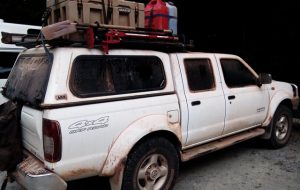
On the last day of Queensland’s school holidays, a steady line of dusty 4WD’s returning from Cape York are queuing up for the Daintree River ferry crossing. Many of these road-beaten vehicles are rentals from Cairns. You can tell the real deal 4WD by the snorkel (a vertical exhaust above the cabin – designed for crossing creek and rivers without killing the engine).

Kids or even adults have written epitaphs on the dusty windows including “Cape York or bust” “Been there done that” and “still driving”.

(And my very favourite one-“Capey McCapeface”.Ed)

The bitumen road peters out just past Cape Tribulation in the Daintree rainforest. Intrepid travellers with appropriate vehicles can take the scenic Bloomfield track to Cooktown then loop back along a sealed road to Lakeland, where the 582 kms journey to Weipa begins. After Weipa, the route becomes a 4WD dirt road with a few sealed sections, all up 908.4 kms, a 28 hour drive to the northernmost tip of Australia. Last time a survey was done, between 60,000 and 70,000 people had made the arduous trek every year. Those are small numbers compared to the volume of tourists visiting Uluru or Kakadu National Park, but in the context of a wild, undeveloped frontier, it’s a lot of traffic.

Some take organised 4WD tours, some fly/drive; others take a boat to Cape York and come back by road. If you do decide to drive from Lakeland, you have an estimated 15 and a half hour journey to Weipa (averaging 37 kmh). By contrast, the bitumen road from Cairns to Lakeland is a three hour drive (250 kms).

You might know that our outback travelling is constrained by the limitations of a six-cylinder rear-wheel drive vehicle and a 30 year old caravan. It’s a high-set van, but as recent journeys on unsealed roads have shown, the suspension is not built for corrugations. We call the 271 kms short cut from Hughenden to The Lynd, which has sealed sections and some rough stretches, ‘The Road that Broke the Wardrobe Door’.

So our adventures north of Cairns were limited to a day trip from Newell Beach to Cape Tribulation and back, via a cruise on the Daintree River, two hikes in the rainforest and the extreme disappointment that arose from listening to the Broncos getting thrashed by the Warriors (well may you scoff and say, ‘what’s that about being in the moment’?).

Daintree-Cape-York
Daintree River croc – Cape York or Bust

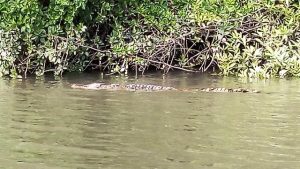
Despite the high tide, we saw three crocodiles on the (highly recommended) one-hour Solar Whisper cruise, including a 3m croc known as Scooter who decided to swim along the mangrove-lined bank a few metres from the boat. John the skipper pointed out a few birds including an Azure Kingfisher, a Papuan Frogmouth, a Rufous Night Heron and Radjah Shelducks. (There are photos on my camera, but the downloading process is rather primitive. Ed)

As for Cape York or bust, I can only repeat what authorities will tell you: take extra fuel, water, tyres, vehicle spares, a jack or two and a shovel. Always give way to wildlife. Note to those who are tempted: there is no mobile reception in much of the Cape region and satellite phones do not always work.

Nevertheless, Cape York or bust is a major bucket list item for the intrepid traveller; some ride trail bikes, others mountain bikes and more than a few walk the track, carrying their food and shelter on their backs.

Tourism is just one part of the Cape York story, a tussle between pro-development lobbyists (remember the Spaceport?), the mining industry, pastoralists, the traditional owners and increasing awareness that this pristine wilderness has to be protected for all time.

Even on the relatively tame Mossman to Daintree road there are decisions for the risk-averse. We don’t often take guided tours, but when it comes to croc-spotting (that’s Scooter on the left) on the Daintree River, go with an expert. I told our skipper about Paddy McHugh’s chilling song, Dan O’Halloran. He’d not heard of it, but I said he should look it up but maybe not share with his passengers. Not to spoil a good story song, I’ll just give you the chorus line: “Nobody knows what happened to Dan O’Halloran except me, and it makes me shiver”.

As we drove back along the narrow, winding but sealed road from Cape Tribulation, I wondered if (in the future) I had a Cape York or bust trip in me, and, when I did, would it be a sealed highway by then.

Successive governments have made efforts to upgrade the road from Lakeland to Weipa, which in 2014 still had 380 kms of dirt road, impassable after rain.

The Federal and State governments co-funded work to seal sections of road between Lakeland and Weipa, on the Cape’s west coast. Weipa is the site of a major mining operation and a deep water port. So there are commercial imperatives involved with sealing that road.

But it is a slow process, at about 30 kms per year on average between 2014 and 2018. The slow pace of the project was used as an election issue in 2017.

The numbers of tourists visiting the region fluctuate according to economic conditions and extreme weather events. Studies have concluded that the majority of Cape York adventurers are self-contained, so their contribution to the local economy is negligible.

As the Federal Government’s Wild Rivers report observed, Cape York is large and underdeveloped and only accessible for eight or nine months of the year. The region comprises 15% of Queensland in area, but accounts for only 0.3% of the State’s population. Cape York’s residents are amongst the most disadvantaged in Queensland. More than half (54%) of Cape York people aged 15 years and over have a gross weekly income of less than $400 per week.

While sealing Cape York’s main road and also minor roads to Aboriginal communities might be a good thing for locals (less wear and tear on their vehicles and all-weather access), one ought not to make the trek too easy. Cape York has been nominated as a UNESCO World Heritage site (near neighbours, the Great Barrier Reef and the Queensland Wet Tropics, are already listed). But as the University of Melbourne’s Jo Caust recently wrote in The Conversation, some World Heritage listed sites are being loved to death and authorities need to exert some control over visitor numbers.

When you read about the impact of mass tourism on Cambodia’s Angkor Wat and Vietnam’s Hoi An, a coastal town that escaped the ravages of war, perhaps it’s a good thing that mass tourism is unlikely in Queensland’s rugged and remote top end.