
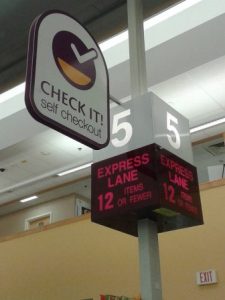
Self-service gets our enterprise for a bargain

self-service-checkouts-fuel
Self-service checkout, photo by eltpics https://flic.kr/p/p57BLf

You may call me a peevish old man, but these self-service supermarket checkouts give me the pip. I only encounter them when venturing out of the village, as our service-oriented IGA does not as yet have automated check-outs.

Not so a certain Brisbane supermarket which, around 5pm, seems to have nobody staffing its numerous checkouts and only one person ‘helping’ people scan their own groceries. I usually ignore the self-service corner and will wait an inordinate time to be served by a human being. Last time I was in the 12 items or less line at the same supermarket, the poor woman was switching back and forth between checkout customers and those at the cigarette counter.

Management textbooks would tell you this is successful multi-tasking and making efficient use of a staff member over what is probably a meal break. Decency would say put two people on at this location.

American Facebook page Union Thugs has a bit of a campaign going against self-service, observing that the machines (a) they kill jobs (b) they do not contribute to payroll tax and (c) they are really not that convenient.

The latter was certainly true when I returned from shopping in the city a few weeks back to find I’d charged myself twice for the same item. So back I went, burning more fossil fuel, to queue up at the lightly staffed counter where one person was multi-tasking between selling cigarettes and dealing with complaints like mine.

IGA Maleny director Rob Outridge knows the downsides of self-service checkouts but can see a time when he may be forced to introduce them. Supermarkets operate on skinny margins and the biggest fixed cost is wages, which keep on rising. So while Maleny IGA still exclusively hires people to serve at the checkouts, there may be a time when competition and the bottom line force his hand.

“The problem is your labour costs keep going up and there is no increase in productivity.”

I suspect Rob Outridge knew I was going to take a Bolshevik approach to the subject of automation doing people out of jobs. Nevertheless, he handed me his card and in that pleasant, management-by-walking-around way of his said: “Just let me know if you have any other questions.”

It’s not just that a machine replaces a worker. You (the customer) are doing the checkout job yourself – for nothing. Of course it does not stop there; we do the job of a retail employee at the ATM, the fuel pump, at toll points and just about anything someone would help you with offline is now done (by you) online.

The online world has transformed the way businesses interact with customers. In the online world there are myriad stories of businesses getting our enterprise for a bargain, as they con us into signing up for electronic bus and train cards, gadgets on your windshield which go ‘ping’ when you pass through the toll gates and so on. Last time I parked under the Brisbane Convention and Exhibition and Centre, I had to go to a machine and pay for the parking then pop it in the slot at the boom gate. There were no attendants to be seen.

It hardly seems like nine years since the toll booths closed on the Gateway Bridge and Logan Motorway. There was something refreshing about that brief interaction when you paused at the collection point and tossed your coins into the tub. When the electronic toll system Go Via was introduced in 2009, 100 toll collectors were made redundant, with 22 moving into management jobs within Go Via. Former toll collector Sharmaine Phelan told the Brisbane Times she had a tear in her eye on the last day.

“Over the years I have been here I’ve met some lovely people, some that I’ve kept in touch with who have come through the toll.”

Tolls were collected manually on the Gateway Bridge for 23 years. As a motorist, you always had to be sure to have a pile of coins ready in the console, but that was all you needed. Today, you need a beeping gadget on your windshield and an online account that has to be kept topped up or you will get a letter in the post demanding payment. Along the way, a system of debt-collecting was invented to deal with people who either didn’t have a bleeping thing on their windshield or kept forgetting to top up their account. If they are people who also ignore mail and such, then eventually the Department of Transport gets involved and pings you for non-payment of tolls.

How is that an improvement on making Sharmaine Phelan’s day, then?

Fuel stations have been exploiting their customers in this fashion for decades. Self-service fuel stations began to spread in the US and Australia in the 1970s, although at a faster rate in America. Mind you, there is still one state (New Jersey) that refuses to allow customers to pump their own gas.

Australia caught on to automated fuel service in the 1970s and the reach has been pervasive. Even in the remote outback you have to pump your own fuel and, between the hours of 9pm and 5am, you often have to go in and pay for it first. One of the downsides of self-service fuel (from the fuel retail owner’s perspective), is the minority of motorists who fill up and just drive away.

Imagine my surprise earlier this year when driving into Longreach (at night) in an urgent search for a fuel station. The only place open was not actually open but had a bowser where you could use your credit card to (a) enter how much fuel you wanted and (b) press the Pay Now button.

You might remember the rockabilly song Harold’s Super Service made popular by Merle Haggard in 1970. I suspect the writer (Bobby Wayne) was perhaps taking a dig at the about to be modernised industry with his song, in which the owner of an old Model A drives in to Harold’s Super Service and insists on getting his money’s worth.

“Gimme 50 cents worth of regular (pronounced ‘reglar’)
Check my oil too if you don’t mind.
Put some air in my tires won’t you mister,
Clean my windows too if you have time”

The National Advanced Convenience and Fuel Retailing magazine (NACS) explains how automation gained the upper hand in the US. In 1969, self-service gasoline accounted for only 16% of sales in the US. By 1982, 72% of gas sold in the US was self-service and it had climbed to 90% by 2011.

I was amazed to find, amidst the proliferating supermarket-owned and franchise outlets, that there are still a handful of petrol stations in Australia offering old-fashioned driveway service. You’ll have to read Mandy Turner’s article to find out where they are, though.

Maybe it’s just that I’m approaching a certain age, but I secretly yearn for that era when the petrol station attendant filled your tank, checked your oil and washed the windscreen at the same time – just like the song.

Harold’s Super Service, Merle Haggard and band (listener warning – it’s an earworm).

https://youtu.be/t2lIMLgB_Sg

FOMM  back pages

The value of inner city car parks

car-parks-value
Image of car parks Palma de Mallorca by Timmy L (flickr) https://flic.kr/p/TR4DFC

As you’d know, one little statistic can send me off on an investigation – like the number tucked away in a Guardian Weekly report that, globally, cars are in car parks 95% of the time.

The statistic emerged in a report about a pilot scheme in Amsterdam to reward residents with a free green space in front of their houses if they give up their parking permits. The car parks pilot scheme being trialled in six streets in an Amsterdam suburb is yet another Dutch idea designed to encourage people to give up cars and switch to carpooling, public transport or bicycles.

Residents’ cars will be stored for free in public car parks and in return something ‘green and pleasant’ can occupy the designated car space. The Guardian reports a fair degree of friction over this idea. Two early adopters (who have been heckled), have already put flower-filled tow carts in front of their houses (a cosy outdoor spot to sit in the sun and have a morning coffee and a plate of warm poffertjes).

This is not the first time Amsterdam’s Stadsbestuurders have tried to rend asunder the city’s love affair with the car. Amsterdam is widely known as the bicycle capital of the world because it is relatively compact and the narrow streets and canal bridges make driving more difficult than in other cities. When I spent time in Amsterdam (wishing I could forget what I can’t remember), the city was then trialling Sundays as a no-car day. I looked that up yesterday and find that it is 45 years since Car Free Sunday was introduced. As this blog explains, something changed in the Dutch mindset when the measure was introduced in 1973 (to dampen oil consumption amid the 1970s Oil Shock).  Since then cycling with or without clogs has clearly become a lifestyle/clean environment movement.

The Netherlands leads other European cities, with 27% of all trips attributed to cyclists, a figure that has been stable for a decade. How could it be anything less when Amsterdammers own 22.5 million bicycles (1.3 per resident). Evidently Mum, Dad and the kids are in on the trend. Denmark is a close second in Europe’s bicycle stakes (0.8 per resident).

Australians are fairly keen on bicycles too, with 3.6 million using one every week, The Australian Cyclists Party says the average Australian household has 1.5 bicycles in working order, although if you wanted to be pendantic, you couldn’t ride half a bike very far. You could of course turn it into a unicycle, learn to juggle, sing and play the ukulele at the same time and apply for a gig at the Woodford Music Festival.

Digressions aside, Australians are as deeply committed to the combustion engine as the global leader (America). The latest Australian Bureau of Statistics motor vehicle census showed there were 18.8 million registered vehicles in Australia as of January 31, 2017, a 2% increase on 2016. The 2016 Australian Census showed there were 2.95 million one-vehicle households, 3.02 million households with two vehicles and another 1.50 million households with three or more. The same Census revealed that only 1.1% of Australians rode their bikes to work. The sole occupant car dominated work trips – from 65.6% in Sydney to 79.9% in Adelaide.

The notion that cars are parked 95% of the time is a figure largely calculated on public car parks which are utilised 85% to 95% of the time. Just dwell on that next time you are doing laps in one of Brisbane’s large shopping malls, waiting for a spot.

Last Saturday we went to a Queensland Ballet double bill (Carmen and The Firebird) which, I must say, we enjoyed more than the reviewer in The Australian did, apparently. There were three curtain calls.

Afterwards, we walked back to the multi-level car park where I realised (despite my disdain for automation), that I had no option but to pre-pay as there were no humans in the parking booths. The machine hungrily gobbled my $20 and dispensed the ticket. You should all know the routine by now – drive to boom gate 1, insert ticket and the boom (should) automatically rise to let you drive out.

Them were the good old days, mate

Not that I want to return to days of yore, but when we first started going to the ballet in 1988, you could quite often score a free car park somewhere in South Brisbane or West End. We’d leave home early and sometimes snag a space in Fish Lane. Ah, those were the days. Now we usually park in the Brisbane Entertainment and Convention Centre car park as it has 1,500 spaces, so is the place least likely to be full around South Brisbane’s entertainment and dining precinct. If I recall, when this complex first opened in 1996, parking 2-4 hours cost $8. That’s inflation for you.

A Colliers International white paper in 2015 predicted city parking would become more expensive in Australia, as no new multi-storey car parks were being approved. Some, in fact, have been demolished to make way for new apartment buildings. The other factor in parking becoming more expensive is that many cities now impose a congestion levy on property owners.

New technology is set to disrupt the parking business model though; one example being Divvy Parking, a digital start-up which hooks up motorists with under-utilised car parks within commercial office buildings. In late 2016, New South Wales car insurance company NRMA took a 40% stake in Divvy Parking.  An NRMA study found that 30% of urban traffic congestion was caused by people driving around looking for a car park. And, according to NRMA, a third of parking spots within centrally-located commercial buildings are under-used. NRMA Group chief executive Rohan Lund told the Australian Financial Review that smart technology would be as crucial to solving Australia’s mobility issues as bricks and mortar infrastructure.

All over the world, cities are introducing measures to thwart or discourage drivers from bringing their vehicles to the inner city. These range from London’s Congestion Charge to Madrid’s blanket ban on non-resident vehicles. Only locals, taxis, buses and zero-emission delivery vehicles are allowed within Madrid. This is not the first time the padres de la ciudad have tried to beat congestion and pollution within Madrid’s city centre. In 2005, a pedestrian-only zone was introduced in a densely-populated inner city neighbourhood.

Interestingly, there are no Australian cities named in Business Insider’s recent article on 13 cities planning to ban cars to one degree or another. Most of the cities are in Europe (Oslo, Berlin, Paris, Hamburg, Copenhagen) but also China, Mexico and South America. Many of the plans are based on making it easier to walk and cycle. Several cities are planning to build bicycle-only super-highways.

Ah well, next time I go to the ballet maybe I’ll take my half a bicycle and wobble on down to the train station. (She Who Broke a Bone Falling on the Stone Steps) “Don’t forget your helmet, dear.” More reading: