The return of capital punishment

capital-punishment-returns
The condemned man enjoyed a full moon. Image by prettysleepy2, www.pixabay.com

In February, my attention was caught by a bizarre story about the Sri Lankan government advertising for two public executioners of “strong moral character”.

I let it go at the time, as the topic seemed too morbid for FOMM readers. But that was before Donald Trump’s government last month re-introduced capital punishment in the US for Federal offences.

People in Trump’s government have been lobbying to reintroduce capital punishment, last used in 2003. The main target is drug traffickers, as the US battles to staunch its opioid crisis. Trump has also tweeted that the death sentence should apply to ‘mass shooters’. After this week’s racially-motivated shootings in the US, Trump is sticking to this line, resisting calls for firearm controls saying ‘hatred pulls the trigger, not the gun’.

The capital punishment debate should pique the curiosity of Australians born after 1967, because that was when the last person was executed in this country. Ronald Ryan had the dubious honour of being the last man to step up to the scaffold in February 1967. One of my former lecturers, the late Keith Willey, was the only journalist to attend the execution of Ryan in Pentridge Gaol.

Ryan, who had been founded guilty of killing a gaol warden, said to the hangman before the trapdoor opened: “God bless you – whatever you do, do it quickly.”

Actor Lewis Fitz-Gerald directed a 1993 documentary-drama based on the Ryan execution. Fitz-Gerald also played the part of his late uncle (Keith Willey).  The Last Man Hanged also starred Colin Friels as Ryan.

Keith Willey wrote at least eight books, including “You might as well laugh, mate’, published posthumously in 1984. Willey’s Walkley-award studded journalism career included covering wars in Israel, South Vietnam and Cambodia and racial massacres in Cyprus and Kuala Lumpur.

Ryan’s execution happened at a time of growing public dissent about capital punishment. There were demonstrations, vigils and petitions. The Federal government abolished capital punishment (including the ACT and NT) in 1973. Queensland had already abolished it (in 1922), NSW in 1939 and Tasmania in 1968. Other states lagged behind including Victoria (1975), South Australia (1976) and Western Australia (1984).

As you know, I delight in uncovering apparently little-known facts, this one being the derivation of ‘capital punishment’, which is from the Latin ‘caput’ literally taken to mean decapitation.

There are a few fundamental flaws with capital punishment, the main one being that it has been shown on many occasions that innocent men (and women) were executed by mistake.

Many books have been written on this subject and more than 50 mainstream movies made, including The Green Mile, Dead Man Walking, Monster’s Ball and 12 Angry Men. People have marched in the streets over this issue, just as they are doing now in Sri Lanka and Thailand.

Nonetheless, we find ourselves in an era where conservative/right wing governments prevail. For governments of this ilk, capital punishment appeals as a deterrent. It is also a symbol of the strong hand of populist government, getting tough on crime, when the real issues are racism, poverty and the control of wealth in the hands of a few.

I’ll get off my soapbox now, as there seems no need for it in a supposedly enlightened first world country that is highly unlikely to ever re-introduce capital punishment. Federal, Territory and State governments have enough on their plates with high rates of suicide and deaths in custody. There are also emotive cases where governments are called on to defend Australian citizens convicted of crimes in countries that do have the death penalty.

Diplomatic interventions and other legal challenges failed to save convicted drug traffickers Andrew Chan and Myuran Sukumaran. These two members of the now-infamous ‘Bali Nine’ were both executed by firing squad in April 2015. In the 1980s, convicted drug traffickers Kevin Barlow and Brian Chambers were executed in Malaysia.

There have been others and there are certain to me more, given the human potential for risk-taking.

Amnesty International says there were at least 690 executions, in 20 countries, in 2018, a decrease of 31% compared to 2017 (at least 993). This figure represents the lowest number of executions that Amnesty International has recorded in the past decade. There are 106 countries where use of the death penalty is not allowed by law, including Australia, New Zealand, Canada, the UK and South Africa. However 56 countries, most in Asia and the Middle East, still retain the death penalty. Amnesty says that just four countries accounted for 84% of the executions (Iraq, Iran, Pakistan and Saudi Arabia). This does not include China which keeps its statistics secret. Amnesty estimates China executes thousands every year.

Twenty-nine of America’s 50 states hand down and carry out death sentences, even though authorities have admitted that 10 people who died were ‘probably’ innocent. More worryingly, 140 people who were on death row were subsequently exonerated.

Now here is something all Australians need to know (whether you agree or disagree). Twenty Australian political parties were asked before the 2019 election about their political stance on the death penalty – yes or no. Three parties – One Nation, United Australia Party and Shooters, Fishers and Farmers – answered yes. The three major parties answered no and 11 parties did not respond to the survey.  

The death penalty is a subject that is always up for debate,. From an ethical and moral standpoint it is indefensible. It can also be argued that by using capital punishment as a deterrent (which it isn’t), the countries who use it are clinging to concepts dreamt up in much less enlightened times.

Some of you may have seen the ABC’s Australian Story interview with former state executioner for Virginia, Jerry Givens. Givens says he is on a mission to highlight the decline in capital punishment in the US (executions fell from 98 in 1999 to a low of 20 in 2016 (25 in 2018).

This is long and far from cheery, but it is intriguing to read about capital punishment from the perspective of the ultimate insider. Givens legally executed 62 people from 1982 until forced to resign in 1999 over criminal charges which saw him serve a stint in prison.

State executioners are almost always sworn to secrecy so their place in society is rarely known about or discussed. Givens said even his wife did not know until it came to light in reports of his own brush with the law.

All up, 15,760 people have been executed in the US since 1700, with lethal injection now preferred over past methods including electrocution, hanging, gassing, firing squad and burning. It does make you think about the men and women involved in carrying out their official duties.

“So, Grandad, what did you really do at the Correctional Centre?”

Australia’s record looks comparatively benign, although executions were commonplace in the early days of settlement.

An Institute of Criminology report states that in 19th century Australia, as many as 80 persons were hanged each year. The crimes included murder, manslaughter, burglary, sheep stealing, forgery and sexual assault.  Since Federation (1901), only 114 persons have been legally executed in Australia.

Maybe so, but that’s too many to have on our collective conscience.
 

Stamp of approval a one-horse race

stamp-winx-race
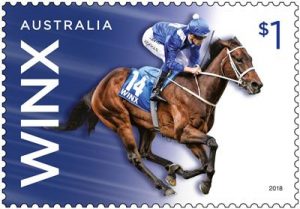
Australia Post celebrates Winx’s record-breaking 26th consecutive win with a commemorative stamp

You’d have to say Australia Post had a bit riding on the champion mare Winx winning her 26th consecutive race at Warwick Farm last Saturday. Let’s say at the outset that this is about stamp collecting, not horse racing (surveys show the latter subject turns FOMM readers off – or politics – that was a three horse race…Ed.)

Whether you like horse racing or not, the existence of Winx the super horse must have filtered through, as it is many a moon since any horse won this many races on the trot, which is racing parlance for an unbroken winning streak.

Celebrating the mare’s place in equine history, Australia Post released a commemorative stamp, pictured here by courtesy of AP and ‘with perforations’ as requested. Journalists received the press release from Australia Post about a minute after the race was run and won.

We plan ahead for important activities, achievements, and national events in the calendar, and had extra resources on standby to assist in producing the special stamps,” an Australia Post spokesperson said, in response to our obvious question.

So all ended well. If you are a stamp collector or philatelist as it is known in the trade, you will already have ordered your first day covers, special 26-stamp packs, a set of maxi cards and a medallion cover.

Horse stamps are not that unusual – examples include Black Caviar in 2013 and a set of four stamps issued in 1978. They featured Phar Lap, Bernborough, Peter Pan and Tulloch. The collection is notable for fine art work by Brisbane artist Brian Clinton.

Like Dusty Springfield, I was wishin’ and hopin’ and thinkin’ and prayin’ that either Malcom Turnbull or his nemesis were philatelists so I could make this politically relevant. But it seems only one (former) Federal politician, Philip Ruddock, collects stamps. This seemingly innocuous hobby at times embroiled the then Immigration Minister in controversy.

Ruddock, now Mayor of Hornsby Shire, was a member of Amnesty International. Critics found his membership of the organisation was at odds with his government’s hard-line immigration policies. In 2000, Amnesty asked Mr Ruddock not to wear his lapel badge when performing ministerial duties and not to refer to his membership when promoting policies opposed by Amnesty. AM 18/3/2000

In a profile for The Good Weekend in 2002, writer Richard Guilliatt was given a look at Ruddock’s collection, which spans three generations. Guilliatt, perhaps innocently, suggested that the high dramas of the job had spurred the stamp collecting hobby on.

“…every month letters pour into Ruddock’s Parliament House office in Canberra, imploring him to liberate the men, women and children detained behind razor wire in Australia’s desert camps for Third World asylum seekers,” he wrote. “Those letters come affixed with all manner of exotic stamps, which Ruddock gets his secretary to tear off so he can take them home to his house in the leafy northern hills of Sydney, to be packed away for sorting.

“That’s one of the good things about getting a lot of letters from Amnesty International,” Ruddock told Guilliatt.

If few politicians collect stamps, at least a dozen former Prime Ministers featured on Australian stamps in the 1950s and 1960s. It’s important to note that all received the honour after their deaths.

“Until the introduction of the Australia Post Australian Legends Awards in 1997, the only living person allowed on a stamp was the reigning monarch”, the spokeperson told FOMM.

Nevertheless, the PM’s head on a postage stamp seems clearly out of fashion now, in this era when one is never quite sure if the PM will last his or her term. But there have been enough sporting celebrities, athletes, actors, singers, writers and decorated soldiers to compensate.

In an aside for crime fiction aficionadas, the most infamous stamp collector award must surely go to Lawrence Block’s fictional hit man, Keller. John Keller is the protagonist in Block’s crime series which began with Hit Man in 1998. Keller collects pre-1940 stamps and uses down-time between ‘jobs’ to visit stamp shops and exhibitions. It’s a kind of cover for his apparent lack of legitimate income, not unlike Block’s gentleman burglar and antique bookstore owner, Bernie Rhodenbarr.

Many famous people are listed in various publications and websites as stamp collectors. The collection does not have to be distinguished to command a price. Former Beatle John Lennon’s collection of 550 stamps from his childhood was bought by the Smithsonian Institute’s National Postal Museum in 2005 for about $A74, 000.

Which brings me to the best-selling commemorative stamp of all time – the Elvis stamp released in 1993, Perhaps the delay since the rock singer’s death in 1977 was due to persistent ‘sightings’ of the late Mr Presley. Even today you will find folk who will tell you he is still alive and living under an alias, like someone in witness protection. Elvis would be 83 if still alive today.

The US Postal Service printed 500 million commemorative stamps – three times the usual print run. It was the most highly publicised stamp issue in the USPS history. The people were asked to choose between two designs (1.2 million votes), the majority preferring the stylised image of the young rocker, microphone in hand.

Stamps can be highly controversial items. For instance, the first secular Christmas stamp in the US, with its pair of white candles and a wreath with a red bow, was released in 1962.

Critics said it crossed the line between church and state. The public was also unenthused about a 1963 design – an illuminated Christmas tree in front of the White House.

Public takes dim view of Surfing Santa

The most controversial Australian stamp was also a Christmas release.  The 1977 stamp featured a humorous depiction by Adelaide artist Roger Roberts of Santa Claus riding a surfboard. Some members of the public were affronted, saying the postal service was not taking Christmas seriously. Until 1975, all Christmas stamps featured religious themes, often based on the traditional nativity story. There was no such fuss about the mix of secular and Christian stamps released in 1976.

If you thought the popularity of email would adversely affect stamp collecting, the market is as robust and profitable as ever. As an extreme example, the One-Cent Magenta from British Guiana, issued in 1856 and thought to be unique, sold at a New York auction in 2014 for a record $9.5 million.

In 2007, the Australian collection of Arthur Gray was sold through Shreves auction house in New York for more than $7 million. Among the spectacular results was the $265,000 paid for a block of four 1919 £1 brown and blue Kangaroos.

So did you collect stamps as a child? Did you, as I discovered, learn at some point in your cash-strapped adulthood that the collection was worthless?

We had a family friend who spent most of her younger years travelling to exotic climes and would write, with bundles of stamps included ‘for wee Bobby’.

I gave away stamp collecting and its fussy handling (gloves and tweezers and corners to mount the stamps rather than pasting them in the album), around about the time I realised girls were interesting.

I still have those two old albums tucked away somewhere – among Father’s Letters, I’m thinking.

Somewhat related reading:

Blogging and human rights

blogging-human-rights
Protest in Iran photo by Christopher Rose https://flic.kr/p/7CJsu7

In case you were curious, the word blog in Farsi looks like this – وبلاگ. Iranians who didn’t like the way things were going in their country started وبلاگ’ing (blogging) like crazy after the 2000 crackdown on Iranian media. Iranians who interact with the internet are by definition risk-takers.

As recently as late 2016, five Iranians were sentenced to prison terms for writing and posting images on fashion blogs. The content was decreed to ‘encourage prostitution’.

The Independent quoted lawyer Mahmoud Taravat via state news agency Ilna that the eight women and four men he represented received jail time of between five months to six years. He was planning to appeal the sentences handed down by a Shiraz court on charges including ‘encouraging prostitution’ and ‘promoting corruption’.

The immediacy of blogging appeals to those who live under oppressive regimes. They use the online diary to inform the world of the injustices in their country as and when they happen. I cited Iran (Persia) as just one example of a country where expressing strong opinions contrary to the agenda of the ruling government is extremely risky business.

The founder of Iran’s blogging movement, Hossein Derakhshan, an Iranian-Canadian blogger, spent six years in prison (the original sentence was 19 and a half years), before being pardoned by Iran’s supreme leader, Ali Khamenei. Derakhshan also helped promote podcasting in Iran and appears to have been the catalyst that spawned some 64,000 Persian language blogs (2004 survey). Clearly there is/was a level of dissent among people who think the right to free speech is worth the risk of incarceration or worse.

Blogging can be a lot of things in Australia, but risky it rarely is, so long as you are mindful of the laws regarding defamation and contempt of court. Not so for bloggers or citizen journalists of oppressed countries who try to get the facts out.

It is no coincidence that most of the countries guilty of supressing free speech are among the 22 countries named by Amnesty International as having committed war crimes. They include Yemen, Saudi Arabia, Syria, Sudan and, closer to home, Myanmar, where persecution and discrimination persists against the Rohingya. Amnesty’s national director Claire Mallinson told ABC’s The World Today that not only are people being persecuted where they live, 36 countries (including Australia) sent people back into danger after attempts to find refuge.

Amnesty’s Human Rights report for 2015-2016 does not spare Australia from criticism, particularly our treatment of children in custody, with Aboriginal children 24 times more likely to be separated from their families and communities. We are also complacent when it comes to tackling world leaders and politicians accused of creating division and fear.

Still, at least if you live in Australia you can openly criticise something the government is doing (or not doing), apropos this week’s Q&A and the Centrelink debt debate.

According to literary types who seem to have warmed to my turn of phrase, FOMM is not a blog as such, but an example of ‘creative nonfiction’ which I am told is not only a genre, but also something taught at universities.

I never knew that.

Bloggers in comfortable democracies like ours use blogs to write about cats, dogs, goldfish, cake recipes, fashion, yoga, raising babies, travel adventures and produce how-to manuals about anything you care to name.

The definition of a blog is ‘a regularly updated public website or web page, typically run by an individual or small group, written in an informal or conversational style.’

Scottish comedian and slam poem Elvis McGonagall, who you met last week, satirises the blog format with this entry.

Monday:

Woke up. Had a thought. Dismissed it. Had another. Dismissed that. Stared at the cows. The cows stared back. Scratched arse. Shouted at telly. Threw heavy object at telly. Had a wee drink. Had another. Went to bed.

Tuesday to Sunday – repeat as above

The definitive blog is an online daily diary, kept by people while travelling, carrying out some stated mission like preparing for an art exhibition, producing an independent album, dieting or training for a triathlon. Most of these literary exercises are abandoned at journey’s end, or on completion of the mission. A fine example of this is folksinger John Thompson’s marathon effort to post an Australian folk song each day for a year. He did this from Australia Day 2011 to January 26, 2012.

Some of the tunes have ended up on albums by Cloudstreet, Thompson’s musical collaboration with Nicole Murray and Emma Nixon.

The social worth of a blog, though, is when an oppressed human being writes a real time account of what atrocity or infringement of human rights is happening in their third-world village, right now.

There are millions of blogs circulating on the worldwide web, many of which are concerned with marketing, selling, promoting and luring readers into subscribing to the bloggers’ products and/or clicking on sponsors’ links. It is nigh-on impossible to find a list of blogs independently assessed on quality, although some have tried.

The Australian Writers Centre held a competition in 2014 to find Australia’s best blogs, dividing entries into genres like Personal & Parenting, Lifestyle/Hobby, Food, Travel, Business, Commentary and Words/Writing. The competition attracted hundreds of entries which were whittled down to 31 finalists.

The AWC told FOMM it has since switched its focus to fiction competitions but has not dismissed the popularity of blogging. Even so, continuity is an ever-present issue.

The 2014 winner, Christina Sung, combined travel and cooking, two topics which spawn thousands of blogs worldwide, into The Hungry Australian. But as happens with blogs, the author has somewhat moved on since then. As Christina last posted in September 2016: ‘Hello, dear readers! Apologies for my lengthy absence but I’ve been working on a few writing projects lately.’

Likewise, the author of The Kooriwoman, the Commentary winner for a blog about life as an urban Aboriginal in Australia, has not posted since January 2016.

It is not uncommon for finely-written blogs like those mentioned to have a hiatus or disappear without notice, for a myriad of reasons linked to other demands and distractions in the authors’ lives.

The few lists of Australian blogs you can find tend to rank them on popularity (numbers of followers or clickers). The top 10 blogs in this list are all about food or travel.

Hands-down winner Not Quite Nigella is a daily blog curated by Lorraine Elliott who according to blogmetrics has 28,523 monthly visitors. It’s not hard to see why – the blog is constantly updated with recipes, restaurant reviews, travel adventures and the like, featuring mouth-watering photos and a chatty prose style.

So there are those like Lorraine who make a living from blogging and those who start with a skyrocket burst of enthusiasm and fall to ground like the burnt-out stick.

Whatever your absorbing passion in life happens to be – cross-dressing, wood-carving, wine-making, writing haikus, collecting Toby jugs, quilt-making, proofreading or growing (medicinal) marijuana, you can bet someone out there has created a blog.

Just yesterday for no reason other than a bit of light relief after months of heatwave conditions, I searched for ‘grumpy spouse blog’ and got 22 hits. Have a look at this one – it’s choice.