Elephant captured on Nullarbor Plain

elephant-nullarbor-plain
Photo by Mario Micklisch https://flic.kr/p/peLSQA

An African elephant dubbed ‘Ferd’ by social media followers has been cornered in an industrial shed near a roadhouse on the Nullarbor Plain. Ferd escaped from the Perth Zoo three months ago and has been spotted variously in WA and the Northern Territory. Facebook posts claimed sightings on Groote Eylandt.

Shed owner Tony is making a bit of cash on the side charging travellers $10 to pose for an elephant selfie. The Grey Nomad website www.welikefreestuff.dot described this as “exploitation” and lamented the lack of a seniors’ discount.

“It’s weird,” said Tony. “Everybody takes selfies to post on Facebook but nobody actually wants to talk about the elephant in the room.”

At which point you can see this  story about Ferd the elephant is not unlike the proliferating fake news stories on social media which commonly use a  headline and intro like this to suck you in. The more insidious fake news items, however, are portrayed as legitimate news stories and are often picked up and shared.

Satire is not fake news and vice versa

Some of the fake news websites which churn out stories cast themselves as satirists, but it is a loose label, apt to blow off in the wind. A yarn about an elephant wandering the Australian desert is probably satire.

It is satire when someone suggests the Pope is marrying (famous female pop singer) and running for the White House. Fake news is a story about the Pope endorsing Donald Trump (quickly debunked by hoax tracking website www.snopes.com.

WTOE 5 News, which broke the story, claimed that news outlets around the world were reporting on the Pope’s unprecedented endorsement. But Snopes found that no reputable news publications confirmed it, because WTOE 5 News, masquerading as a local television news outlet, does not publish factual stories.

But social media is not so discriminating. As Harvard University’s Nieman Journalism Lab pointed out, this fake yarn, which appeared in July, was shared almost 1 million times, versus 36,000 shares for the story debunking it.

One such story prior to the US election suggested the Amish had committed their vote to Donald Trump. Only 10% of Amish vote at all.

Another story suggested Barack Obama was abolishing the oath of allegiance in US schools. Sounds believable but simply not true.

Before people caught on to the idea of making money by spreading fake news on social media, the so-called supermarket tabloids cornered the market.

Here you will see obviously misleading headlines like “Diana is still alive” or “Hillary Gay Crisis” or “Aliens settle in San Francisco”.

By contrast, fake news stories circulated on social media prior to the election were entirely plausible – until you read to the end or read the website’s disclaimer.

But who has the time to (a) read the whole article before (b) sharing it or (c) checking out the veracity via factcheck.com or snopes.com?

Fake news here to stay

David Glance, writing in The Conversation, says fake news is driven by advertising and is here to stay. Glance, Director of Centre for Software Practice, University of Western Australia, says a great deal of the recent fake news targeted at Trump supporters appears to have originated in the Macedonian town of Veles. Websites with legitimate-sounding names fed pro-Trump fake news, which in turn generated large revenues from traffic generated through Facebook shares.

Glance says it may be tempting to think that news from reputable media organisations is more reliable, but they too are still influenced by partisan opinion and the pressures to advertise and generate traffic and sales.

“Ultimately, there is no protection from fake news other than to adopt a sceptical view of all news and take the truth of it on balance of likelihood and confirmation from multiple reputable sources.”

Facebook and parent company Google say they are going to crack down on fake news sites. The New York Times reported last week that Google would ban websites that peddle fake news from using its online advertising service. Facebook updated its policy, which already says it will not display ads on sites that show misleading or illegal content, to include fake news sites.

Paul Who?

So who are the people who spend their days (and nights) churning out fake news? Some publications have identified Paul Horner, described by Wikipedia as an internet news satirist and writer. Horner confesses to being as described and highlights a few of the stories he has written that have been picked up and shared by internet news sites. The Amish was his, so too Obama banning the oath of allegiance and Horner has recently told the Washington Post that he helped get Donald Trump elected.

Horner’s various websites pose as legitimate websites, but if you jump to the disclaimer, the author leaves himself an out by clearly stating that “…all news articles contained within are fiction, and presumably fake news.”

As David Glance observed, mainstream media is not immune to fakery, or at least allowing embellished news to be published. The blame is placed upon gutted newsrooms, where veterans with 20 years’ or more experience are replaced by school leavers and interns. The Guardian quoted an (un-named) journalist who described the pressure to perform online:

“So much news that is reported online happens online. There is no need to get out and doorstep someone. You just sit at your desk and do it and, because it is so immediate, you are going to take that risk. Editors will say, ‘The BBC got that six seconds before we did.’”

Some editors defend the bull at a gate approach as online news can be instantly updated (or taken down), when errors become obvious. FOMM can confirm this strategy as we have occasionally corrected minor errors on our website (it’s Hillary with two l’s, Bob).

Fake news is nothing new. As David Glance says, quoting French philosopher Michel de Montaigne (re the turmoil and divisions of 16th century France):

“Is it not better to remain in suspense than to entangle yourself in the many errors that the human fancy has produced? Is it not better to suspend your convictions than to get mixed up in these seditious and quarrelsome divisions?”

Fake news stories only a problem if you read them

Facebook has been blamed by some commentators for helping The Donald get elected, but it’s a specious argument. Filmmaker Michael Moore said people in America’s forgotten ‘rust belt’ made their minds up about Trump years ago.

Moore was interviewed in July by www.cnn.com (a real news website), where he talked about the reasons why Trump would win.

If he’s able to pull it off, it will be because on that day, a lot of angry white guys, a lot of guys who have a justifiable right to be angry — guys and women– who have suffered during the last decade,” Moore said.

The Pew Institute says 13% of Americans (about 41 million, 41% of whom are over 65); do not have internet access because: the internet is too difficult to use (34%), they have no interest in going online (32%), or internet access is too expensive (19%).

Moore’s angry white men were never going to be swayed by fake stories about the Pope or the Amish, if indeed they read them in the first place.


Surfing the gender vote

surfing-the-gender-vote
Photo “The Watch” by Eric Neitzel https://flic.kr/p/kQRQLp

So we’re walking along the beach, me feeling over-dressed in board shorts, t-shirt, socks and joggers (to protect a bruised toe). We passed a group of more appropriately beach-clad women and girls (though one wore a wet suit), taking surfing lessons from a sun-worn guy in his 30s. Not that I ever surfed, but it seems to me that in the 1960s, surfing was something boys did while the girls sat on the beach, admiring their boyfriends and guarding personal items.

Later, She Who Always Wears Sunscreen came out of the change rooms wearing shorts and a bra.

“Seems I left my t-shirt on the beach,” she mused. “And I don’t feel like going back to get it.”

It says a bit about feminism in 2016 that a woman can feel OK about going around in public in a bra, however temporarily.

It covers considerably more of me than some of the women I’ve seen on the beach,” she rightly observed.

Despite statistics that suggest women make up only 15% of the surfing cohort, the sport is rising in popularity among the under-20s. There’s lots of research about this, though you need to get behind click bait articles like “Top 20 Hottest Girl Surfers” to find there has always been a determined posse of women who wanted to surf waves – since the 1920s even.

Yet Cori Schumacher, writing in The Guardian, contends that despite female pro surfers pushing the standards ever higher, they still have to compete with a double standard that demands they define their femininity within ‘a male sexual economy’.

Schumacher explained this double standard goes further than female surfers feeling pressure to surf in a bathing suit. Body image issues aside, prize money for professional surfers is skewed heavily in favour of men.

In 1976, the first year pro women surfers were paid, 20% of prize money was allocated to women. In 2011, when Schumacher wrote this, 22% of the total prize purse went to female surfers.

The ‘babes in bikinis’ gender caricature aside, there are plenty of strong female role models listed in Surfer Today.

In politics, as in surfing, one not ought to confuse a woman’s right to compete with an assumption that being female equals feminist ideals and/or leftie politics.

There have been more than enough female world leaders to suggest that they are just as likely to lean to the right as the left of politics.

It is now known that 42% of women voted for Donald Trump in last week’s shock election result. The New York Times noted that 70% of those participating in an exit poll said they thought Trump’s behaviour toward women was ‘a problem’, yet 30% of people who said that voted for him anyway.

One can hardly rely upon US election statistics to define social trends when 46% of Americans did not vote at all.

The Atlantic tried to set the record straight about gender voting in the US, maintaining that 54% of women voted for Hillary Clinton and 42% for Donald Trump (it also means 4% voted for someone else, but let’s not muddy the waters).

Exit-poll data indicated that 94% of black women and 68% of Hispanic women voted for Clinton, The Atlantic reported a few days ago.

The article cited Kelly Dittmar from the Center for American Women and Politics at Rutgers University: “If only women voted in this election (and no one else), Clinton would have won.”

That kind of wishful thinking aside, the more relevant number is that roughly 100 million eligible people (approximately 48% of whom are women), did not vote. Many journalists opined that those who did not vote were lazy or apathetic.

Yet the Pew Institute’s research on non-voters said only 2% cited ‘laziness’ as an excuse, the same proportion of those who said they could not vote because they were in jail or on parole.

The five main reasons for not voting were:

  • No time or just haven’t done it (voted) 19%;
  • Recently moved 17%;
  • Don’t care about politics 14%;
  • No confidence in government 12%;
  • Not a US citizen 7%.

We have seen many successful women come and go in the ruthless sphere of international politics. Recent female Prime Ministers include Helen Clark and Jenny Shipley (New Zealand), Julia Gillard (Australia) and Portia Simpson-Miller (Jamaica). Incumbent government heads include Theresa May (UK), Angela Merkel (Germany) and Burma’s Aung San Suu Kyi.

Forbes Magazine recently published a list of the world’s most powerful women, currently headed by Germany’s Chancellor Angela Merkel and Federal Reserve chair Janet Yellen. After November 8, 2016, Hillary Clinton may be off the list altogether.

One might also expect First Lady Michelle Obama to drop off this list too, although she has plenty of support to have a crack at the top job.

The list included 11 heads of state, one 90-year-old monarch, two first ladies and two top-seed diplomats.

A FOMM reader greeted me at the markets one day, suggesting as a future topic the humble bicycle’s role in gender relations, circa 1890. Simply put, the bicycle allowed Victoria-era women freedom of movement; moreover, the practicalities of riding a bike dressed in hoop skirt and girdle led to less cumbersome garments and, ahem, greater freedom of movement. David Hendrick remarked upon this in a paper for the University of Virginia, noting that the advent of the bicycle gave Victorian women autonomy and a way of leaving the house without relying on men for travel. He agreed with women’s rights advocate Susan B Anthony that the bicycle had “done more to emancipate women that anything else in the world”.

This was a good 30 years before the first Wahine took a long board out beyond the breakers, but perhaps you’ll see my point.

Cori Schumacher, an openly gay, world-ranked surfer, says she grew up surfing in California in the 1980s and 1990s, but very few women surfed in the earliest days of her youth.

Surfing was then described as a ‘male-dominated’ activity, but even with the growing population of female surfers, there has not been a corresponding increase in representation or equal pay.

Schumacher said “…rather than surfing being merely male-dominated, it is also a farm for masculinity and androcentrism.”

No doubt someone is running a book right now on the prospect of an androcentric Trump presidency appointing any women (apart from the third first lady, if you get my meaning), to a position of influence.

The odds of a prominent Muslim woman being appointed, even as a White House advisor, are longer still. Interestingly (facts gleaned from my kind of surfing), show that two of the Muslim women described in this article were appointed as White House advisors.

As if that were not enough, FOMM’s online surfing also uncovered three new words: androcentrism (placing the male human being at the centre of one’s world view), Wahine (female surfer) and Awk! (old school cry of alarm or excitement – e.g., spotted an excellent wave).


Refugees travelling light

refugees-travelling-light
Sri Lankan refugees – photo climatalk.com flickr

As I was packing a bag for a few days away at the beach, news items I had just read about refugees began to trouble me. Most of the articles were about people being shunted out of Calais, not knowing where they were going next.

We’ve all read about ‘The Jungle’, a ramshackle refugee camp at Calais, located close to the cross-channel tunnel which carries commerce between France and England. Since 1999, the camp has developed in an ad hoc way, attracting refugees and migrants from Eastern Europe, Asia and Africa. People in this camp attempted irregular entry to the UK via the Port of Calais or the Eurotunnel, stowing away on lorries, ferries, cars, or trains travelling to the UK. The French began evacuations in late October 2016, with 170 buses carrying people to French towns and villages. Predictably, this has galvanised people from the near and far right to form Not in Our Village groups.

There has been much consternation about the fate of 1,600 or so unaccompanied minors (mostly teenagers), who have been rehoused temporarily in converted shipping containers. News reports about this aspect of the evacuation are quite bleak.

Many volunteer groups have formed in the second half of 2016 to fill the void left by a lack of state support from Britain and France.  Grassroots campaign Calais Action updated the state of play in the Jungle on its Facebook page.

About 1,600 minors remained, with more than 100 sleeping rough in the burned and demolished camp, fed only by groups of volunteers. Calais Action said 1,626 minors were transferred on November 2 to reception and accommodation centres across France.

The thousands of people crammed into the camp at Calais had been given almost no notice they would be moved and few seemed to know where they were bound.

This is not something we first-world Australians tend to think about, although our 105,000 homeless people might disagree. The latter, their accumulated belongings in storage, maybe, the vital stuff in carry bags, or trolleys; they are a bit like refugees in that they are often on the move, rarely able to plan ahead.

So yes, it makes you think, when packing for a beach holiday. She Who Signed up for Airbnb managed to snaffle a beach-front villa for a few days of R&R. By definition, R&R means take almost nothing from your regular life. A few changes of clothes, a smart casual set on a hanger in case we go out, a pair of shoes, a pair of sandals, togs and a hat. And the tote bag with one’s toiletries and medications. Best not forget that.

Discretionary items might include books, DVDs, e-reader, laptop, iPod and a scrabble set.

I’m eyeing my 12-string guitar, sitting in its case with shiny new strings.

“They’ll need bedding in,” I say, taking up a degree of space in the back of the wagon, “the strings, that is.”

We have to take our own linen,” She said. “There’s still the eskies and boxes of groceries.”

Brits who took up the sponsored immigration option in the 1950s and 1960s will know that luggage was restricted to one sea trunk per person. You can get quite a lot of stuff in an old sea trunk, but inevitably bigger items like bicycles, billy carts and pianos got left behind.

It is far worse than that for so many refugees. The lucky (and smart) ones have a mobile phone and charger, a portable and powerful ally for people on the move. But for the rest, it’s a daily ritual of washing and drying their scant supply of clothes and bartering with others – a cigarette for a Band-Aid.

You may be surprised to learn the subject of what refugees take with them on the road has been well documented. Quite a few of the people depicted in this Mercy Corps article fled with just the clothes on their back. If they had personal items like jewellery, watches or beads, they were often gifts from family left behind.

These vignettes include a photo of Muhanad, 7, whose family had lived in Jordan for two years. The seven-year-old is holding a robot toy, a birthday gift from his grandfather ‘who is now in heaven’.

The International Rescue Committee (IRC) interviewed 30 refugees in its 2015 feature “What’s in my Bag”.

In 2015, nearly 100,000 men, women and children from war-torn countries in the Middle East, North Africa and South Asia fled their homes and travelled by rubber dinghies across the Aegean Sea to Lesbos, Greece.

“Refugees travel light, for their trek is as dangerous as it is arduous. They are detained, shot at, hungry. Smugglers routinely exploit them, promising safety for a price, only to squeeze them like sardines into tiny boats. Most have no option but to shed whatever meagre belongings they may have salvaged from their journeys.”

Aboessa, 20, a mother from Syria, left home with a packing list almost wholly dedicated to her baby, including a hat, an assortment of medication, a bottle of sterile water, and a jar of baby food.

Iqbal, 17, from Afghanistan, at the time stranded in Lesbos, brought a tube of face whitener cream.

“I want my skin to be white and hair to be spiked — I don’t want them to know I’m a refugee.”

The contents of Iqbal’s kit: one pair of pants, one shirt, one pair each of shoes and socks, shampoo and hair gel, toothbrush and toothpaste, comb, nail clipper and bandages. He also had 130 Turkish lira, US $100, a smart phone and back-up cell phone and SIM cards for Afghanistan, Iran and Turkey.

So just for the sport, I’m drawing up an emergency list of stuff I’d need if I had to flee without notice: medications, glasses, hat, one change of clothes and a jacket, wife, one pair of shoes and a diatonic harmonica on which to play Aussie campfire faithfuls like ‘The Road to Gundagai’. Of course I’d take a smart phone and charger, and a small laptop with which to read online and write and broadcast the news.

February 24, 2019: “Conditions are bleak here in Moree, where we have been herded across the border. Since the Make America Great Again Act of 2018, Queensland and the NT have been annexed as the 57th and 58th States respectively, quarantined as key US defence and resources protectorates. Marines and ‘volunteers’ have built a wall, to keep us out and essential workers in. A source tells me a nuclear power plant, fed from new mines in western Queensland and the NT, is being built at Port Douglas. The Great Barrier Reef is being dredged to provide new export shipping channels. Anyone ethnically or culturally suspect or over 50 and not employed in essential industries has been deported.

So thousands of us are squatting here in the dusty showgrounds, Muslims, grey nomads and a few hippies, squabbling over water and shade. The dump point has overflowed, it is 38 degrees and a storm is brewing. No-one knows when we will be moved on. I’ve run out of Lexapro and the chemist is boarded up. More later. Battery dying.”


Penny Davies and Roger Ilott Nov 20

penny-and-roger
Penny Davies and Roger Ilott

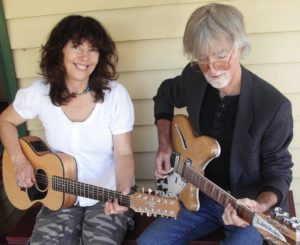
Penny Davies and Roger Ilott made their second appearance at the Goodwills’ house concert series on November 20.

The Granite Belt-based folk duo last performed at Bob & Laurel Wilson’s home in February, 2014, fresh from appearances at Woodford Folk Festival. Penny and Roger are stalwarts of the Australian folk scene and have performed at most major festivals and many smaller ones. They are known for their long association with folklorist Bill Scott. This collaboration produced classic Australian folk songs such as Hey Rain! and Where the Cane Fires Burn. They have released more than 20 albums of Australian contemporary folk music since 1983. Their lengthy association with the ABC radio programme Australia all Over brought them critical acclaim and a loyal following. Songs aired on Australia all Over include Hey Rain, Where the Cane Fires Burn, Beside a Railway Line, Ridin’ on the Fruit Train and The Monkeys Sing Soprano. Three of their songs were included on Macca’s Top 100 album in 2012.

The Goodwills (Bob & Laurel Wilson) performed an opening set, including songs from their latest album, The Last Waterhole, followed by afternoon tea then a set from Penny & Roger.

Goodwills house concerts are sponsored by the Queensland Folk Federation


Trump, Clinton and the third candidate

trump-this-small
Aussie tourist poses outside Trump World Tower, Manhattan. Photo by Laurel Wilson

Who, except Donald Trump or Hillary Clinton, would want to be leader of a nation today? The manic, 24/7 pressure of life in the top job makes old men (and women) out of youthful candidates in no time. At home, we saw the pressure tell in quick succession on Rudd, Gillard, Abbott and now Malcolm Turnbull, who no longer resembles the debonair bon vivant who aspired to high political station. In the US, Barack Obama’s eight years in the job is etched into his face.

Yet the aspirant leaders keep coming. Hillary wants the top job, even though she saw what it did to her husband, not to mention Monica Lewinsky, these days engaged in anti-bullying campaigns.

Donald Trump wants to make America great again (though no-one has yet proven when the US was ever great). Former Australian PM Tony Abbott was cited (from afar), telling high-ranking people overseas he planned to make a leadership comeback. Whether he did or didn’t say this, on his return, Abbott and Turnbull clashed jousting sticks in the House, prompting gasps and gossip amongst Canberra lobbyists.

Who’d be a world leader? US presidents get asked to make awful decisions, to wit Harry Truman’s decision to drop atomic bombs on two Japanese cities in 1945, killing between 130,000 and 226,000 people. Harry didn’t drop the bombs, but it was his head that nodded when the generals asked him if they should.

Even Australian Prime Ministers are asked to make unpalatable decisions which may come back to haunt future generations. Bob Menzies bowed to pressure from Great Britain, who wanted to test atomic bombs in Australia’s western desert. After all, they could hardly do it in Manchester or Liverpool. People would have complained.

Some impressions of this seldom-scrutinised period in our history are captured in Collisions, an 18-minute multimedia film by Lynette Wallworth. The Monthly’s Quentin Sprague reviewed the ‘immersive’ film which premiered in Adelaide and is playing as a ‘virtual reality experience’ at Melbourne’s Australian Centre for the Moving Image until mid-January. Nyarra Nyarri Morgan, a young man in the 1950s when he witnessed the mushroom cloud above the desert, recalls its impact: “the surrounding waterholes boiled and kangaroos fell to the ground under a drifting blanket of ash.”  Later, when people became sick after eating the fallen kangaroos, they mused: “What god would do such a thing.”

Harry Truman recalls approving the bombing of Hiroshima and Nagasaki. In a biography written by his daughter, Margaret Truman, Harry’s decision to over-rule the general who believed the Japanese would surrender under the onslaught of conventional bombs, was aimed at saving Japanese and American lives. Almost 80,000 died after the firebombing of Tokyo, part of a planned programme of incendiary bombing.

“It was not an easy decision to make,” Truman said. “I did not like the weapon. But I had no qualms if in the long run millions of lives could be saved.”

After a successful testing in New Mexico, Truman approved the bombing of four targets – Hiroshima, Kokura, Niigata and Nagasaki

Given the history, you do wonder about people like Donald Trump, a self-described multi-billionaire who has no material need, apparently, to live in the White House. There are bigger and better mansions and easier jobs than making America great again, or even for the first time.

Why would he want to be the one with the power to pick up the red telephone? There is no guarantee either that Hillary Clinton wouldn’t pick up the red phone.

The media is making much of the Clinton-v-Trump clash, mostly ignoring a third candidate, Libertarian Gary Johnson and his running mate Bill Weld. Johnson and Weld say they have a master plan to sneak the presidency from under the noses of Trump and Clinton.

The Washington Times reported on Monday the pair say they can change history and win the election through a combination of quirky political circumstances, voting variables and polling inaccuracies. Polling data shows Johnson and Weld have greater support in 20 states than the margin between the Republican and the Democrat, neither of whom will find it easy to snare the necessary 270 votes. One or two states could determine the outcome.

Former Republican adviser Bill Whalen agrees there is a scenario where neither Hilary Clinton nor Donald Trump wins the presidency. He told ABC Radio’s Eleanor Hall on Wednesday much hinged on the outcome in Utah, where candidate Evan McMullen has snared enough votes to win that state. It could be that the House of Representatives will decide who is best suited to the Oval Office: Trump could be deemed ‘unsuitable’ and Clinton’s election risky, as it could spark a constitutional crisis if a Federal investigation finds against her. Enter stage left, Evan McMullen, an inscrutable former CIA operative who has a theoretical chance at the White House.

Here is yet another reason to cite The Simpsons. “Citizen Kang(season 8), still rules as the best piss-take of the two-party political system. Homer is abducted by aliens Kang and Kodos who demand he takes them to his leader. When Homer explains about the (1996) election, the aliens kidnap presidential candidates Bob Dole and Bill Clinton, placing them in suspended animation and assuming their forms through “bio-duplication.” The one-eyed aliens plan to ensure one of them will become the next leader succeeds, despite their alienating habits of walking hand in hand, drooling green slime and talking in robotic voices (“Klin-ton”). Kang is subsequently elected, enslaving humanity into building a giant ray gun, to be aimed at an un-specified planet:

Meanwhile, the global media obsession with Trump vs Clinton, which promises to continue until January, provides perfect cover for our conniving government, which seems intent on homogenising the arts and making sure people who tried to get to Australia by boat go (somewhere else), and never return. Comedian Lucy Valentine suggested they should make this law retrospective to 1788.

Of lesser significance, maybe, but mean-spirited nevertheless, Education Minister Simon Birmingham announced cuts to student loan funding for 57 creative arts diploma courses including circus, screen acting, stained glass, art therapy and jewellery. Additionally, the government capped loans for creative diplomas to $10,000 compared to $15,000 for agriculture and engineering.

Birmingham said the changes were made to focus on courses which would ‘benefit Australia economically in the 21st century’.

“Currently there are far too many courses that are being subsidised that are used simply to boost enrolments, or provide “lifestyle” choices, but don’t lead to work.”

Predictably, this decision brought forth a torrent of commentary on social media, ranging from reasoned debate to outright vitriol.

This issue, however, has slipped behind the international smokescreen which is the US presidential election campaign; a litany of (alleged) lies and counter-lies, insults and counter insults, accusations of defamation and one lawyer’s letter, published in the New York Times, which is very much worth reading.

If Donald Trump does not win the election, he has promised to sue everyone who has accused him of behaviour unbecoming of a US presidential candidate. It will be a long list.

He should probably just go back to building high-rise towers, hotels and golf courses and making money. He claims to be pretty good at that.

Say it’s your birthday

bob-wilson-snr-birthday
Bob-Wilson-Snr

You might wonder about this birthday photograph of my Dad, who died in 1991. Point being, he was born 100 years ago in early October 1916. This is the way we want to remember him, a studio portrait from a happy time in his life. He made multiple copies and distributed them to whanau (extended family- for the non-Kiwis amongst you). This was the photo which inspired me to write “Like our Fathers,” a song about how we end up looking like our Dads and often thinking like them too.

October always gets me thinking about birthdays, not only my own, but a steady run of Libran/Scorpio birthdays. Some of these friends are celebrating milestone birthdays this year, though they’d pass for 39 even under bright lights. A couple of my Scorpio friends call this ‘birthday month’ and take liberties on all 31 days (and nights). Just in case.

So yes, it was 100 years ago a few weeks back when Dad reached that landmark, which brought to mind a Loudon Wainwright III song Older than my old man now”. Loudon had just turned 64, whereas his old man died at 63, the event spawning not just one song but a whole album of tunes about ageing, regret, and perhaps a little survivor guilt:  “I am older than my old man now; I guess that means I kicked his ass.”

Loudon (who was 17 when his Dad died)  starts the song with a reflective spoken narrative – “If I remain still, If I am alone and silent long enough to hear the sound of my own blood, breathing or digesting above the rustling of leaves or the world of refrigerators, my father is likely to turn up. He just arrives, unbidden, in the long-running film of my thoughts.”

LWIII, as he prefers to be known, touches on birthdays and mortality in quite a few songs, including “Five Years Old”, “Happy Birthday Elvis” and “The Birthday Present”, where he celebrates “that halfway point, where life really begins”.

She Who Breaks Into Song When Least Expected has been known to sing this at special birthdays; its wry observations about loose teeth and sagging skin (‘proof that we have been around’) ticking all the boxes for a 50th or even a 60th celebration.

There are any number of pop songs and cultural references about birthdays, including more than 30 episodes of The Simpsons. Our resident Simpsonophile reckons the standout is Series 3 episode 1 “Stark Raving Dad”, when Homer is checked into a mental asylum and meets a fat white dude, Leon Kompowsky, who thinks he’s Michael Jackson. Jackson, a fan of the animated series, lent his voice to the character although for contractual reasons it was credited as John Jay Smith and a Jackson impersonator Kipp Lennon was hired to sing the ditty Jackson composed to celebrate the birthday of Bart’s sister Lisa. The otherwise forgettable song Happy Birthday Lisa appeared on the album Songs in the Key of Springfield attributed to a W.A.Mozart.

The Simpsons creative team had an idea to bring the Kompowsky character back in a similar scenario involving Prince but it never eventuated. After the death of the Artist formerly Known As, an Australian website published excerpts from the proposed script, which Prince had rejected.

But what about Literature?

Although I was fairly sure I’d read all that iconoclastic Japanese author Haruki Murakami had to offer, I found a slim volume of short stories in the local library. The 13 stories in Murakami’s anthology “Birthday Stories” include one of his own and a short introduction to each story by the inestimable author, (at one point the 4-1 favourite for this year’s Nobel Prize for Literature).

The anthology includes “The Bath,” an earlier version of Raymond Carver’s much-studied “A Small Good Thing”. The latter story, about a boy who gets knocked over by a car on his eighth birthday was made into a short film starring Lily Tomlin, Tom Waits, Andie MacDowell and Jack Lemmon among others.

If you’ve not seen Robert Altman’s “Shortcuts”, based on Carver stories, I won’t spoil the plot, except to say Lyall Lovett’s performance as the cranky baker trying to get paid for an expensive birthday cake is up there among the great moments of on-screen menace (Jack Nicholson in The Shining notwithstanding).

Murakami’s “Birthday Girl” tells of a waitress forced to work on the night of her 20th birthday. She is fortuitously assigned the job of taking a meal to the reclusive restaurant owner in his hotel room. On hearing it is her 20th birthday, the owner grants her a wish. But in the best ‘show but not tell’ traditions, Murakami does not reveal what the girl wishes for, hence the endless conjecture by Murakists on websites and forums dedicated to the writer. The original anthology was published in Japan only. The English translation includes Murakami’s personal thoughts on birthdays in which he reveals he has visited Jack London’s farm because they share a birthday and he greatly admires his writing style, as he also admired Raymond Carver.

If you are a Murakist, this exploration of his thoughts on prizes, Nobel or not, may be of interest.

All of which is more culturally enlightening than that godawful song people insist upon singing at birthday functions. I was dining alone at a Chinese restaurant in Lismore, as you do. The only other occupants had booked a long table, the women mostly at one end, the men mostly at the other and the kids in the middle. I figured it was a child’s birthday when the waiter brought out a cupcake with a sparkler. The table broke into Happy Birthday to You. Unhappily one end of the table started singing half a line before the other end got stared. The ladies selected a key close to D while the men started in E flat. It sounded as you might imagine. Not to be discouraged, the guests carried on into a rousing round of ‘Freeza,” though how an eight year old can be a jolly good fellow is something they clearly did not talk about beforehand.

Then the kids started throwing noodles at each other.

Just so you know, the official Happy Birthday to You song has been released from the clutches of a music publisher and assigned to the public domain. One of the plaintiffs in the copyright court case was going to be charged $US1,500 for using the song in a short documentary (about the origins of the song).

First written by sisters Parry and Mildred Hill in 1893, HBTY is often claimed to be the world’s most popular song. It’s not high art, but universally popular, that’s for sure. G or A are the best keys.

I have a good few years ahead of me to be older than my old man now, but I take it as an encouraging sign that the Department of Human Services, in its services to humanity, issued me with a new pension card that expires in 2018. Lordie, so I must have passed some actuarial high water mark when men in their late 60s pop their clogs. “He’s good to seventy” someone has decreed.

As comedian and actor George Burns (1896-1996), once said of ageing: “You know you’re getting old when you stop to tie your shoelaces and wonder what else you could do while you’re down there.”

www.wikiquotes.org

Caring for carers

old-man-walker-carers
Old man with walker – dreamstime.com

He wakes from the slender sleep of the hyper-vigilant to hear the front door close. He slips out of bed, quickly dresses and walks outside, down the garden path and through the front gate. There’s Mother, dressed in a smart suit, best walking shoes, hat and handbag. A suitcase sits beside her on the footpath. It’s 3am and a crescent moon slips between clouds as if to say ‘she’s over here’.

“Mum, what’s going on?”

“Bob’s coming to pick me up. We’re going on holidays.”

Some people would recommend you remind Mum that Bob’s been dead since 1989 and she needs to come back to bed.

The hyper-vigilant son puts his arm around his mother’s shoulder.

Change of plans, Mum. Maybe tomorrow.”

He picks up the suitcase, expertly manoeuvres Mum through the gate and coaxes her inside with promises of chocolate muffins and a glass of warm milk.

After he’s helped Mum get undressed and back into bed, he stops by his son’s bedroom. The doona has slipped off the bed where the six-foot son with a mental age of eight sleeps the sleep of the just. He covers him up, gently closes the door, sighs deeply and goes back to bed.

His wife, gently snoring, arm flung over her eyes, sleeps the sleep of the day shift. He’ll sleep in and she’ll be in the kitchen, making sure Mum doesn’t set fire to the house, leave the taps running or wander off outside, looking for Bob.

An extreme case maybe; fictional, probably. But a fair picture of a night in the life of what’s known as a ‘co-resident primary carer’.

Carers Australia trots out a huge figure – $60.3 billion – to describe the replacement value of what carers, their partners and significant others contribute to the welfare of the nation. There are 2.7 million people in this country who care for people who, to one degree another, struggle to take care of themselves. Carers include the parents of adult children, children of aged parents, partners of disabled people and a range of carers who do not fit any of those categories.

You may wonder where this subject came from, and unless you are one, you probably got through the week without knowing it was dedicated to Carers. The Story Bridge was lit up for the occasion and various organisations held conferences, functions, picnics, and other social events where carers could meet and mingle.

The parents, partners or significant others who look after a disabled adult at home are saving the welfare system a small fortune. True, they may be getting a Carers’ Pension, Allowance or Supplement, but it is chicken feed compared to the cost of, say, institutionalising a wholly dependent person with a disability. So $1.2 billion a week is what the government would have to find if the 2.7 million volunteer carers threw up their hands and said ‘Stuff this – I want a life.

Sure, there may well be people who have made sacrifices to care for someone and at some stage withdraw their support. But clearly most people who have accepted the role do so with absolute commitment.

It is estimated that carers provided 1.9 billion hours of unpaid care in 2015. Carers Australia says the estimated replacement value of unpaid care equates to 3.8% of Gross Domestic Product, quoting a 2012 Deloitte Access Economics study and an Australian Bureau of Statistics report.

Of the 2.7 million carers, 770,000 are primary carers who provide the most informal assistance to another individual.

In 2012, 38.8% of primary carers reported spending 40 hours or more per week caring, while 19.5% spent between 20 and 40 hours.

Of the 1.9 million described as ‘co-resident carers’, 45.5% were the partners of the person they cared for. Another 20% cared for a parent, 23.4% cared for a child and 4.2% cared for a sibling.

If there’s a word that describes the combined experiences of carers, it is frustration. It can be infuriating when friends and even relatives just don’t get it. They know you are caring for a parent with dementia, they know your 26-year-old son has a mental age of eight and by all reports will not improve any time soon. But they don’t empathise, don’t offer to help and may even choose to express survival of the fittest notions.

“She ought to be in a home, your Mum. You’ll wear yourselves out – it will wreck your marriage.”

While there may be more than a speck of truth in this unsolicited advice, it does not help. We all have misconceptions about people with disabilities and it takes an assertive person to dispel the myths.

A woman who cares for her wheelchair-bound husband after he survived a serious stroke submitted an item to a regular feature in The Australian called “This Life”. Ruth wrote this succinct summary, published in May 2015, about a little-understood condition.

When my husband says ‘Captain swimming underwater’ I struggle to guess what he is saying so earnestly. After many failed attempts, I ask if he needs to go to the loo. “Yes’ he says in desperation.  ‘I’ve asked you five times’. Aphasia – the scrambling and breakdown of language due to a brain injury – was a new word to me three years ago when he suffered and survived a big stroke. I did not know this could happen to someone. I did not know that he would never again use my name, or anyone else’s, for that matter. I have learned that his intelligence is intact, that he knows everybody who is familiar to him and even the cricket score but he can rarely convey the simplest of phrases. His favourite daily expression is ‘It’s maddening’. It is indeed.

Carers are a mixed bunch – they include someone like Ruth, thrust late-life into the role of ‘co-resident primary carer’, a dizzying world of juggling hospital stays, rehabilitation, respite and daily chores for two people.

Others have been caring for a wholly dependent disabled child since birth. The most frequent cry for help as these carers age is “Who will look after him when I’m gone?”

Caring for someone who needs care is not always this constant or confronting. It may amount to reminding mentally ill adult children to take their medication, have a shower, and tidy their room. But it is a 24/7 commitment when anything can happen.

Professor Robert Bland of the Australian Catholic University says the caregiving role is a useful but limited description of the family response to illness. He reminds carers that the caregiving role can overwhelm other roles such as parent, spouse or sibling.  “Family members need to learn new ways of coping with the crisis, to find a balance between the demands of caregiving and meeting their own needs.”

He told a mental health carers’ conference organised by Arafmi and Aftercare that families do other things associated with protection, identity and resources.

“They provide a predictable and safe living situation for people who would otherwise be dependent on hospital, hostel, or the streets.  They keep order and routine, lend money when needed, and offer encouragement.  They persist, they remember, they open the door when you knock – unlike many mental health services that give up, close down, move on.  Families are open all hours and they’re there on the weekend.”

Yes, even at 3am, when a crescent moon slips between clouds as if to say ‘she’s over here’.

More reading


Bipolar disorder and gout

empty-chair-bipolar
Empty chair at Baroon Pocket Dam – Photo by Bob Wilson

This may seem an odd way to approach an essay about bipolar disorder, but I had forgotten that lithium was at one time prescribed for gout. Not that I’ve ever had gout, but a couple of relatives who do have it tell me it is not something you would wish upon your worst enemy – or even Donald Trump. Gout is a painful inflammation of joints caused by an excess of uric acid which forms needle sharp crystals in the joints, hence the pain.

The conventional solution is medication and avoiding rich, fatty foods. Traditional medications are allopurinol and colcochine although some GPs and naturopaths recommend low doses of lithium combined with vitamin C to make uric acid soluble and easier to expel from the body.

The point being, very few people would stigmatise gout-sufferers for taking medication to ward off the acute pain that comes from an attack. Yet lithium is the drug of choice dispensed by psychiatrists when diagnosing someone with bipolar disorder. The latter is very much a stigmatised condition. However, as we will see, some famous people are working to ‘normalise’ it through documentaries and speaking tours.

Author Edward Shorter traced the history of lithium in an article published by PubMed Canada and archived by the US National Library of Medicine:

A London internist, Alfred Baring Garrod, recommended lithium treatment for gout after discovering uric acid in patients’ blood. This was in 1847, 12 years before Garrod wrote The Nature and Treatment of Gout and Rheumatic Gout.

Lithium, a naturally occurring mineral, was used to treat mania in the 19th century, particularly in Denmark, but did not emerge as a mainstream treatment until 1949, when Australian doctor John Cade was credited with re-introducing lithium to psychiatry.

Despite the development of pharmaceutical alternatives (valproate, lamotrigine, carbamazepine), it is still regarded as the ‘gold standard’ for mood stabilisation and treatment of major depression.

The gout sufferer, meanwhile, simply has to cut down drinking beer and avoid purine-rich foods (such as red meats, offal, some seafood and Vegemite). His or her sanity is unquestioned. If asked (say at a barbecue with friends and neighbours), they will freely talk about their swollen joints; knobbly elbows and inflamed big toes may even be shown.

No such empathy for the approximately 727,300 Australians (about 3% of the population), with some form of manic depression/bipolar disorder.

In 1980 the third edition of the Diagnostic and Statistical Manual of Mental Disorders (DSM), changed the classification system to bipolar disorder, a more clinical and less emotionally loaded term than the stigmatised ‘mania’ or ‘manic’.

Stigmas die hard. There are hard-to-shake myths, worst-case scenarios magnified in the press and on current affairs TV, which focus on the tragic cases that fell through the cracks in the system. We form fixed ideas about the mentally ill, shying away from people we see as ‘odd’.

I started exploring the subject (it’s Mental Health Week after all), after watching Stephen Fry’s Not So Secret Life of a Manic Depressive 10 Years On. Fry, originally diagnosed with the less disruptive form of bipolar (cyclothymia), made a controversial documentary series a decade ago where he interviewed well-known bipolar sufferers including actor Richard Dreyfuss. The psychiatric profession was generally dismayed with Fry’s (then) stance against taking medication.

In this update, Fry is diagnosed with bipolar 1 (the more serious type in which sufferers may have psychotic episodes) and he starts taking medication, although confessing to self-medicating (as many sufferers do); in his case with alcohol, diazepam or sleeping pills. In the hour-long ABC documentary, a range of people with bipolar disorder are interviewed and the nature of their disorder is laid bare. There’s a young woman who became a paraplegic after jumping from a balcony (in her manic state she thought she could fly). There’s a chef whose wildly swinging moods are endangering his job and his home life who finally decides to stick with lithium.

Although bipolar disorder afflicts only 3% of the population, the odds are that only 50% of these people will be able to hold down a job.

People who plainly don’t understand mental illness may react badly on seeing an apparently healthy 20-something man wandering around in the middle of a working day. Because he is taking medication to quell the various strands of his illness, he is not talking to himself, acting oddly or accosting people. But he is still (invisibly) unwell.

“He’s got two arms and two legs hasn’t he? Tell him to get off his arse and find a job,” some might say.

Ah yes, so he’s a ‘leaner’ not a ‘lifter,’ a polarising notion recycled in 2014 by former Treasurer Joe Hockey (borrowed from the lexicon of Liberal Prime Minister Robert Menzies).

As Fry’s documentary shows, some bipolar sufferers have ‘normal’ friends who support them through the worst of their illness and stick around during the well times.

Others not so fortunate retreat into their own heads while their friends may drift away. Fortunately, there are support groups which can help people struggling with the feeling they are on their own.

It is easy enough to find long lists of famous people who have ‘come out’ and declared themselves bipolar and one would hope this helps to push stigmas and myths into the corner.

Surrealist painter Edvard Munch (who painted “The Scream”), is on this list, so too Beach Boy singer-songwriter Brian Wilson. The late Spike Milligan owned up to it, as did former NRL star Andrew Johns and a long list of composers, writers, comedians, actors and celebrities.

Margaret Trudeau, mother of Canadian Prime Minister Justin Trudeau travels the world speaking out against the stigmas and myths surrounding this admittedly confronting disorder. If you are my vintage, you may remember reading about Margaret in the popular press, hanging out at nightclubs with famous rock stars and generally not living as one might expect of the first lady of Canada (then married to Prime Minister Pierre Trudeau). In hindsight, those florid 1970s reports of Margaret jiving at Club 54 with Mick Jagger and the Stones typify a person in the throes of a typical bipolar manic phase: disinhibition, impulsive behaviour, risk-taking, spending sprees and so on.

In a lengthy interview with Will Pavia in the Sydney Morning Herald, Trudeau, now 68, at one point began to talk about her passion for bringing mental health issues into the spotlight. From February to June she travels, campaigning about brain diseases, depression and her experiences of living without the medication she now takes. Trudeau says she is helping to break the last great taboo – “The thing people are most afraid of talking about”.

At which point Pavia observes: “She is certainly not afraid to talk about it. She talks at a rate of knots…if this is Trudeau on mood stabilisers, what must she have been like, for all those years, when the mania struck?”

Great question, Will, one which reminds me of an older chap I know who was diagnosed with bipolar in the 1960s.

“I took the lithium and after a few months I felt great so I said, Doc, I don’t need to take this anymore. At which point he looked at me and said: “Don’t be a f***’ng idiot!”

(What I wrote last year):                    

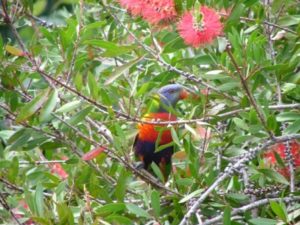
rainbow-lorikeet-02And on an entirely different note, Bird Week starts on Monday 17th October- you’re invited to spend 20 minutes one day next week to count (and name, if possible) the birds in your backyard- check it out at this website. To get you started, this is a Rainbow Lorikeet – common, now that the Bottlebrush is flowering. (Ed.)


Not good with crowds

hong-kong-low-res
Photo by Laurel Wilson: Chilling out in Kowloon Park, Hong Kong.

It was the sight of the  crowds – 83,625 screaming footie fans at Sydney’s ANZ stadium that set me thinking, looking at that roaring sea of blue – it’s the last place on earth I’d want to be. Players interviewed after the Cronulla Sharks beat the Melbourne Storm 14-12 said they could not hear the referee’s calls, could not hear players calling to them and had tinnitus for hours afterwards.

I’m not good with crowds or noise. So I should have known better than to pick a four-day stopover in Hong Kong last time we travelled overseas. On the third day I went in search of a quiet place with as few people as possible around me. Luckily, our hotel was close to Kowloon Park, a 13 hectare green space with public gardens and aviaries, surrounded by some of Hong Kong’s most striking 19th century British buildings.

I found a spot under a tree, its leaves dripping with humidity and lay down for a spell. On a lawn near me 30 or so older Asian people spread themselves out for a spot of Tai-Chi. You could still hear and feel the city hum and strum, but the impact was muted by the tranquillity of this well-tended spot; well-tended because there is almost full employment in this island nation, now governed by mainland China. People have all kinds of jobs and walking around with a pole spiking trash and wind-blown leaves and putting them in a garbage bag is just one of them.

Those who have visited the former British protectorate (returned to Chinese rule in 1997), will know what it is like for an Aussie to visit Hong Kong, where 6,400 people share every square kilometre.

Some of the land has been reclaimed from the ocean; to build a new airport, but also to build yet more apartments in this vertical city.

Hong Kong apartments on average comprise 14.86sqm of living space. Compare that with your standard Aussie ‘McMansion’ with its five or six bedrooms, three or four bathrooms and two or three-car garage (around 241.54sqm).

So if being one of over 83,000 people doing the Mexican Wave in a tiered stadium gives you the jim-jams, don’t have a holiday in Hong Kong, Singapore, London or Manhattan.

One thing world travel does to a man brought up in the sparsely populated and wide open spaces of Australasia is to appreciate how quiet things are when you come back from New York, London or Tokyo. As my pal Ed said, on returning from a three-month stay in Mexico City: “The air here is so sweet and fresh – hey, do you know a place that does good burritos?”

So where do you go if the weight of people is getting to you?

The least populated country on earth is Greenland, though that may change as arctic ice keeps melting and exposing more living space. Greenland’s ice-free population density is 0.03 persons per square kilometre, which is about one person to every 3,350 hectares, if you really needed to know.

As it happens, Australia also ranks among the least densely populated places on earth, but as in many such examples, this is misleading. As we know, the majority of Australia’s population live in a narrow coastal belt between Cairns and Melbourne. Some also live in Tasmania.

All sorts of anomalies and oddities arise when you start looking at the world’s most densely populated countries in terms of people per square kilometre of land area. The World Bank’s list (as of 2015) ranges from Greenland 0.03, Australia 3, New Zealand 17, China 146 and Japan 348, to Bangladesh 1,247 and Hong Kong 6,958.

Small island nations like Malta (1,348) and the Maldives (1,264) suffer from a lack of physical space rather than too many people. The most crowded of all is China’s 25.9sq/km gambling mecca, Macau, with 19,393 people to the square kilometre.

Those who have spent a splendid week or two roaming around the sparsely populated South Island can attest to the southern half of New Zealand’s population density of 7 (not counting sheep). Stewart Island (0.4 persons per sq. /km) is also nice at this time of year.

Seriously, though, the world’s population distribution is seriously out of whack. The herd mentality takes over when humans move about.

The Chinese government spent billions creating vast new urban cities in the interior where they planned to resettle people, taking the pressure off Beijing, Shanghai and Shenzhen.

Officials created the “Dubai of northern China” in Ordos, northern Mongolia in 2010 (Ordos is 700 kms from Beijing). The city has a capacity to house 300,000 people yet only 20,000 to 30,000 people have moved there, hardly a satisfactory return on a $161 billion investment. The answer according to this blog is that the government has failed to persuade people to move there.

Amid many such examples, China’s population remains concentrated in three key cities the population per square kilometre being: Beijing (11,500), Shanghai (13,400) and Shenzhen (17,150). Capital city population densities in Australasia look well contained by comparison: Sydney (2,100 per square kilometre), Auckland (2,000), Melbourne (1,500), Adelaide (1,350) and Brisbane (950). The above figures are a few years old but they still paint a vivid picture.

Our most under-populated state is South Australia, with 74% of its 1.67 million people (including 8 FOMM readers), living in Adelaide. SA’s population density is just 1.62 people per square kilometre.

South Australia is dry, flat and exposed to the elements. The state is surrounded by the 100km-long Bunda Cliffs (the Great Australian Bight), the Nullarbor Plain and the Simpson Desert.

If you really want to get away from it all, becoming a Jackaroo or Jillaroo (ranch hand), on one of SA’s vast cattle stations (up to 24,000sq/km) is the way to go. The climate is unforgiving in the interior, however, so much so that many residents of outback mining town Coober Pedy live underground.

No doubt their air-conditioning packed it in when last week’s storm event (SA Energy Minister Tom Koutsantonis equated it to a category five hurricane), took out 22 electricity transmission towers. The ensuing seven-hour state-wide power outage (some lost power for up to three days), should hardly have been a surprise. Some politicians used the crisis to give renewable energy a good kicking although exactly why has not been satisfactorily explained.

Australia does not have a national electricity grid as such and much of its transmission business has been privatised so there is a user-pays mentality.

After the SA crisis, Federal Environment Minister Greg Hunt called for a “more integrated system of providing consumer and investment security”. In an Australian Financial Review column Mr Hunt said: “This means that the states will have to consider new or upgraded interconnectors between Tasmania and the mainland, and South Australia and the eastern states.”

As always, the squeakiest wheel gets the most oil. The New South Wales government has invested $30 billion in energy infrastructure to ensure its 7.54 million residents can keep their porch lights on. Meanwhile, the SA Government, knowing the Port Augusta coal-fired station had just been decommissioned, made an ironic decision in the July State Budget.

Tucked away in the $209 million provided for infrastructure was this lone item for energy: $500,000 towards a feasibility study to explore options for greater energy inter-connection with Eastern states to allow for more base load power. A necessary part of the equation, but not much help when the transmission towers (and the lines between them), are out of action. Any electricity experts out there with a theory?


Bread and circuses

broncos-vs-raiders
Photo by JunkByJo https://flic.kr/p/5ai8X8 (How quickly faces change in the NRL: Broncos vs Raiders 2008 (l-r) Carmichael Hunt (AFL), Michael Ennis (Sharks), Darren Lockyer (commentator), Denan Kemp (Australian Sevens), Dane Gagai (Newcastle), Nick Kenny (retired)

Not for nothing did the Roman Empire invent the phrase ‘bread and circuses.’ This unbeatable public policy formula was coined by a Roman scribe in an attempt to arrest the decline of heroism among Romans. It means a government soothing its anxious tax payers by providing food and grand spectacles, in this context, the footie grand final.

In Roman times the serfs gathered in vast public arenas, encouraged to give the thumbs down to beaten gladiators. Today we have the less life-threatening ‘Mexican Wave’ and the lone dickhead yelling something incomprehensible during a minute’s silence to honour a fallen comrade.

At a base level, keeping the people dull-witted by swamping them with heroic spectacles (the Olympics, the Ashes, the Melbourne Cup, the World Cup, the State of Origin, the Tour De France, Wimbledon, the Australian Open, the FA Cup, the Grand Prix…) can and does work.

Some might say it stops us analysing what is wrong with the world and how best to fix it. It might even be where a lot of the money that could be used to fix what’s wrong with the world is spent.

There’s nothing like Grand Final weekend to focus the mind on just how much money is spent organising, promoting and playing professional sports. We’ll talk about the Australian Football League (AFL) final in a bit, but for purely parochial purposes, let’s look at the National Rugby League (NRL) grand final.

There’s a reason 4.4 million people tuned in to Channel Nine last year for the 80-minute plus overtime contest between the Cowboys and the Broncos (the Cowboys won 17-16 in the ‘golden point’ overtime period, remember?). It comes down to the cost of actually attending the game. Tickets at Sydney’s Olympic Park this year range from $45 to $375. If you drive there, a standard parking fee of $25 applies. So even if Mum Dad and the two kids drive to the game and snag the cheapest tickets, it’s still a $300 day out by the time you factor in petrol, pies and burgers, chips, beer and whatever memorabilia is sold to you on the way in (and out).

Bu that is small beer compared to the Victorian Government’s decision to declare a new public holiday for the AFL Grand Final. An economic impact study by PricewaterhouseCoopers (PwC) estimated the costs of the two new public holidays (the other adds Easter Sunday to Good Friday as a gazetted public holiday), at between $717 million and $898 million. But as The Age reported, the Grand Final Eve holiday accounts for up to $852 million of the costs. PwC estimates the new public holidays will result in increased public holiday wage payments of between $252 million and $286 million.

Notwithstanding, this weekend offers a veritable feast of footie, especially if you follow both codes (AFL and NRL), and you can watch the games live on TV for nothing. Last year’s AFL final between the West Coast Eagles and Hawthorn drew 3.9 million viewers for the Saturday afternoon game. At $180 to $399 for a reserved seat at the Melbourne Cricket Ground you can understand why.

Well, there’s no such thing as a free lunch. Footie finals means enduring saturation level advertising. At $130k minimum for a 30-second TV ad, advertisers nevertheless throw buckets of cash at the time slot to ensure its viewers know that their brand of car, beer, burger, mobile phone, betting app or hipster beard styling product is the best.

The stars of the show get well looked after. The 34 Melbourne Storm and Cronulla Sharks players (including four interchange players from each team), collectively earned about $7 million this year. That includes $4.27 million to most valued players in both teams; the highest paid (Storm captain Cameron Smith, $1.1 million), has a 72.3% success rate for kicking goals – more on this later.

I cite these more than adequate wages ($205,882 p.a. on average), not to irritate musician friends who customarily play four-hour gigs for about $100 per band member. No, footie players at this elite level deserve to be well paid for keeping themselves in top notch physical and psychological health and for learning how to stick to the script in after-match interviews:

Just happy to get the two points, mate’ or ‘we stuck to the game plan and saw out the 80 minutes’ or ‘Thanks to (sponsor) and (sponsor) and can I just say g’day to my Auntie in Cairns.’

So did you know that 53 NRL players earn more than $400,000 a year and a handful of those earn more than $1 million? Give them a break. It’s a short-lived career – 15 years at best. For those who invest and take the time to plan an after-footie career, it’s a good financial start.

Former Bronco turned sports commentator Gordon Tallis once famously said (amid a heated discussion about whether someone was offside or was that a forward pass) – “Guys, it’s just a game of footie.”

As is our custom, we will have friends over for pies and vegies and a good old fashioned yell at the television set. People in our village are sharply divided into (a) footie fans (the kind that own season tickets and belong to tipping clubs); (b) secret footie fans (those who would like to stay friends with (c) people who think there is something acutely wrong with our otherwise satisfactory level of mindfulness.

Mind you, I have seen hippies come out of the chemist shop clutching Lotto tickets, so nobody’s perfect.

She Who Yells at the Television says footie is great escapism and better, there’s a beginning, middle and end.

One’s level of interest in the Grand Final (if one has an interest at all), is predicated on whether the team you follow made it into the match.

This year our interest is academic – the highly accomplished wrestling team (the Melbourne Storm) versus the western Sydney outsiders, the Cronulla Sharks. As the late Jack Gibson once said: “Waiting for Cronulla to win a premiership is like leaving the porch lamp on for Harold Holt.” (Thanks to Roger the dentist for reminding me of this gem SWYATT)

Last year 82,000 people came to Olympic Park to watch the grand final and this year will be no different. A sold-out stadium is good business for those all-essential broadcast media deals. The NRL annual report detailed the five-year deal signed on 27 November 2015.

The Australian Rugby League Commission, Nine Network, News Corp Australia, Fox Sports and Telstra signed agreements to provide free to air television, pay television and mobile coverage of Rugby League for five years from 2018. The deal is worth $1.8 billion to the NRL, which makes gate takings of $57 million in 2015 look relatively modest.

I was going to write about (live) betting on footie but She Who Edits says no, it is stupid, immoral and leaves players open to temptation.

But, did you know you can get odds of 151-1 on no try being scored in Sunday’s match? Imagine!

The Rugby League Project records show that in 1986, the Parramatta Eels beat the Canterbury Bulldogs 4-2 in the only try-less Grand Final to date. Michael Cronin (Eels) kicked two penalties from four attempts, Terry Lamb (Dogs) kicked one from two.

Take the two, Cameron, take the two!