When Aussie families lived in kerosene tin huts

kerosene-tin-hut
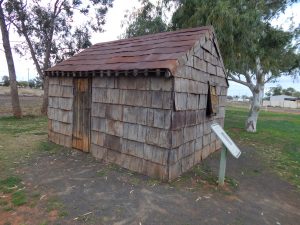
Kerosene tin hut at Morven historical village. Photo by BW

This week we are leaving president-elect Joe Biden to struggle with his Disunited States, to reflect on a time in Australia’s history when homeless people were forced to build kerosene tin huts. This Depression-era story may also give us pause for contemplation as the year-long corona virus pandemic sends many nations into deep recession. No-one wants to use the D-word but also no-one can predict how long countries will have to deal with Covid lock-down periods.

As you may already know, if you also subscribe to our Goodwills Music page, we wrote a song about it. I had the idea couple of years ago when visiting Morven, in south-west Queensland. The show piece of the historical village there is a Depression-era kerosene tin hut. It was built by the late Bob Johnson, whose widow Ethel runs the village.

A sharp-witted reader wanted to know if I was ‘trumpeting’ the new song in last week’s piece about Nellie the Elephant and the price of democracy. I prefer to think of it as drollery (listing it as one of the news stories you may have missed because of the mass media preoccupation with the US election).

Sometimes I have an idea for a song and it loses momentum because I can’t match the lyric to a tune (or maybe I’d rather watch Grey’s Anatomy). Kerosene Tin Hut sat in the drawer for a year or so until She Who Now Also Writes Songs helped me stitch the lyrics together.

As you may gather, we were brought up by parents who lived through the Great Depression (and WWII). They were frugal, good at recycling before it was a thing and were fond of sayings like never a borrower or a lender be. Goods could be bought on lay-by, but never on ‘tick’.

That generation was good at saving to buy a particular item deemed necessary for a family – like a fridge, or a washing machine (once the copper and the mangle went to historical villages). I remember once complaining about not having a wardrobe in my bedroom. Dad brought home three wooden butter boxes from the bakery. He stacked them one on top of the other and Mum made a curtain to hang on the front. This is where I stashed my Famous Five collection (I’d grown out of them), and recently collected Mad magazines.

People who battled through the Great Depression (1929-1939), became adept at “making a muckle out of a mickle” as Mum and Dad would say.

Not much has been written about that period in Australia when shanty towns were developed on common land, usually on the outskirts of towns and cities. This happened as unemployed families were either evicted from rented dwellings or worse, lost the homes they were struggling to buy. Small communities formed on Crown land, where the inhabitants did not have to pay rent or rates. They erected corrugated tin huts or, more commonly, kerosene tin huts.

Maleny reader Mike Foale remembers the kerosene tin era, but for different reasons. He contacted me after I’d sent the new song around to a mailing list.

Like others, he asked the obvious question – where did the kerosene tins come from? Kerosene was widely used in the 1920s for cooking, lighting and refrigeration, but also provided cheap fuel for tractors.

Mike recalled from his days growing up on a farm in the Mallee that the early tractors of the 1920s to the 1950s ran on kerosene, as did other stationary engines used on farms.

“Kero was imported in four gallon (20 litre) square-top tins, with a box around the tin for travel security.

On our farm, the boxes were converted into shelf units. Dad had to sell the early tractor off (a Caterpillar) for lack of maintenance services in the Mallee. So I grew up in the 1940s with draft horses doing the farm work, but the shed was full of empty kero tins.

Kerosene tins were popular in Tin Town because they could be cut into square tiles with tin snips then stapled together over a bush timber framework.

Western Plains Cultural Centre local activities officer Simone Taylor has researched the ‘Tin Town’ which existed in Dubbo, NSW. The town formed in the late 1920s during the onset of the Great Depression and disappeared 20 years later. Ms Taylor told the ABC in 2018 there was a a lot of stigma attached to ‘Tin Town’.

“The shanty’s residents were pitied by the people of Dubbo. I think the people in Tin Town were getting on the best they could, but in newspaper reports it’s clear the town was seen as a social issue to solve.

Tin Town survivors recall the hardships – there was no electricity and only a single community tap to access water. Council collected rubbish and sewage every week for a small fee.

In Dubbo, as in other locations where Tin Towns evolved, kerosene tin huts were erected on Crown land. They did not appear on official maps, so historians rely upon people’s memories and references in old newspaper articles.

Australian National University historian Joan Beaumont told the ABC that Australia was one of the countries worst hit by the 1920s crash. Communities that relied on wool and wheat exports suffered the most as global demand fell away. While the evidence suggests that Tin Towns housed families and pensioners, Professor Beaumont said single men without strong family connections were more likely to live in tin shanties.

Why is this relevant today, you might ask, when our wealthy are uber-wealthy, well-educated professionals are doing well (in two-income households) and the middle classes are, well, in the middle?

The massive disruption to the orthodox economy caused by Covid-19 has forced even conservative governments to use Keynesian economics to manage the crisis. The theory evolved by John Maynard Keynes advocates increased government expenditure and lower taxes to stimulate demand. This, rather than monetary economics (controlling the supply of money), is more likely to help avert a global depression.

There is a domino effect when people who depend on a wage to pay rent or service a mortgage, not to mention car loans, credit cards and ‘60 months nothing to pay’ consumer lures, lose their source of income.

The job goes, the search for work is fruitless, the bailiff comes calling. Suddenly, you are living in your car (the 21st century version of the tin hut). Those of us with a proper roof over our heads ought to count our blessings – count twice when rain falls.

As this recent Sydney Morning Herald article informs, the early help offered to get homeless people off the street in 2020 is being wound back. While the official homelessness figure is north of 116,000, the Australian Homelessness Monitor found that 290,000 people sought homelessness services in the year before the pandemic.

Homelessness numbers fell between April and June this year as a result of Federal government assistance, a moratorium on evictions and a targeted campaign to get rough sleepers indoors. But the future is looking somewhat bleak as supports come to an end.

Telling people to stay home during a Covid spike is all well and good if you have a home in the first place. The alternative may well be descensus in cuniculi cavum (descent into the cave of the rabbit), or in 2020 vernacular, down the rabbit hole.


Kerosene Tin Hut – a new song from The Goodwills

In the depression years, poverty and homelessness drove people to build shelters on common land, often on the outskirts of towns. Inventive Aussies cut kerosene tins into tiles and stapled them together over a sapling framework. The huts would often be lined with animal skins and/or hessian soaked in lime. Over the villages would develop, its residents sharing a tap and a community garden. There is a replica hut in the historical village at Morven between Roma and Charleville. If you are driving through, check it out

To listen to the song and download it, visit our Bandcamp site:

Since posting the song to Bandcamp we have also released a DIY video of us performing the song inside the kerosene tin hut. You can find it on our video page or here.


Our Obsession With U.S. Politics

US-politics-obsession
Image by Rolf Dobberstein, www.pixabay.com

For reasons attributed to the way my mind works, the 1950s children’s song ‘Nellie the Elephant has been in my head for months now.

If the complete domination of the airwaves by the US election is getting you down, just sing this happy refrain:

Nellie the elephant packed her trunk and said goodbye to the circus, off she went with a trumpety trump – trump, trump, trump.”

Yes, once heard never able to be un-heard.The song (Ralph Butler/Peter Hart) was first released in October 1956 by Mandy Miller and an orchestra conducted by Phil Cardew. (There’s also a 1984 cover by punk band Toy Dolls).

On Wednesday, every TV channel had live (and ongoing) coverage of the US election vote count, interspersed with snippets of local news. The blanket coverage continued yesterday and today. At one point we switched off and went out to sow grass seed and count birds.

This short discourse on our obsession with the US election begins with the obvious observation: “Why the hell should we care?” Surely we have enough problems of our own to solve without being mired in America’s divisive political miasma.

Media coverage of the US election this week (and what seems for a long time now), quickly relegated the triumphant third term return of Queensland Labor Premier Annastacia Pałaszczuk to a lesser position. It also relegated our own (small) battles with Covid-19 from top of the news, where it should be.

Covid and the obsession with events in Trumpistan lessened the usual impact of two major Australian sporting events. On Tuesday we had the Melbourne Cup, run without the usual crowd (100,000+); no outlandish hats, frivolity or drunken behaviour. Masked strappers led the horses in to the parade ring, while anyone within coo-ee of a television camera conspicuously wore a mask. This is Victoria, after all. The 2020 Cup was run and won, the day marred by the death of the top weight horse Anthony Van Dyck, which broke a fetlock and had to be euthanased. The other scandal from Cup Day, which added fuel to the ‘Nup to the Cup’ animal rights movement was jockey Kerrin McEvoy’s $50,000 fine for over-use of the whip on second-placed Tiger Moth.

Meanwhile in Adelaide, rugby league players lined up for the first of three State of Origin matches. The matches would normally have been held in May and June but this year, Covid restrictions forced a re-organisation of the classic inter-State contest.

The games are to be staged over three consecutive weeks; next Wednesday in Sydney then the following Wednesday, November 18, 2020, when Brisbane will host the third game and possible decider, depending on whether NSW wins next week.

There were other news stories this week which were not about the US election or Covid-19. Here’s a few you may have missed.

  • Reserve Bank cuts interest rates to 0.10%;
  • China suspends Australian wine imports;
  • Australia Post CEO resigns;
  • Girl, 3, found alive under rubble after Turkey’s earthquake;
  • Parrot saves owner from house fire – “Anton, Anton, wake up”;
  • Diego Maradona is to have brain surgery;
  • Queensland wins State of Origin 1, beating NSW 18-14;
  • The Goodwills release new single after lengthy hiatus.

President Trump’s appointment of Amy Coney Barrett to the US Supreme Court is a good example of the extent to which we have become immersed in American politics. The US Supreme Court became topical when Justice Ruth Bader Ginsburg died after a long illness. President Trump, as is his constitutional right, (although going against convention – no surprises there. Ed) recently appointed Justice Barrett, a favourite of conservatives, to replace Justice Ginsberg. Appointments to the US Supreme Court are rare, as Justices are appointed for life.

This issue dominated traditional media and social media alike for weeks, the focus being on the likelihood of Trump appointing a conservative judge before the election (which he did).

Meanwhile in Australia

Prime Minister Scott Morrison last week announced the appointment of two new Justices to our equivalent forum (the High Court of Australia). Federal Court Judges Jacqueline Gleeson and Simon Steward will replace outgoing Justices Virginia Bell and Geoffrey Nettle. The latter are due to retire at 70. The compulsory retirement age was brought in after a referendum in 1977.

Unlike the politically charged US Supreme Court, Australia’s High Court judges are appointed by the Governor-General in Council (which means he suggests potential candidates to the Attorney- General and then the PM, who makes the appointments).

Mr Morrison thanked the outgoing justices for their work.

Every justice appointed to the High Court carries a significant burden to uphold the laws of our land,” he said. “I congratulate Justices Steward and Gleeson and I wish them all the best.”

As this ABC report observed, our High Court process stands in stark contrast to that of the United States, where Supreme Court appointments are fought tooth and nail in a politically charged atmosphere.

An article in ‘The Conversation’ argued that Australians in general know very little about the workings of the High Court. The Canberra-based court and its panel of seven Justices is the last resort for civil cases which have been through at least one other legal forum.

The High Court’s independence is no better demonstrated by the recently decided case, Hocking v The Director of the National Archives. An academic, Professor Jennifer Hocking had sought access to the correspondence between former Governor-General Sir John Kerr and the Queen during Australia’s constitutional crisis in 1975.

The High Court held that Kerr’s papers were public record and not, as had been previously ruled, his personal correspondence.

The National Archives of Australia spent close to $1 million defending its position, an amount which could double after the High Court ruled that it pay Professor Hocking’s costs.

Even though a Pew Centre research report said 71% of Australians closely follow US news, it serves us better to be informed about domestic news. Start by following the High Court’s upcoming deliberations on Palmer vs State of WA over the ‘hard border’ closure.

The High Court of Australia is completely transparent (cases and judgements are available online). But as senior lecturer in law Joe McIntyre said in The Conversation article: “Whereas appointments to the US Supreme Court are a highly visible festival of political intrigue and showmanship, the process in Australia is a secretive affair occurring strictly behind closed doors.

As I post this week’s FOMM, US news channels are proclaiming Democrat candidate Joe Biden a narrow winner of the 2020 US election. Whether or not this is confirmed in the days and weeks to come, if you are one of the people who think Trump has to go, keep your spirits up (perhaps for another four years) by humming this ear-worm of a tune:

Nellie the elephant packed her trunk and said goodbye to the circus, off she went with a trumpety trump – trump, trump trump.”

(Wikipedia says the rhythm and tempo of this song is often used to teach people cardiopulmonary resuscitation (CPR) (100 compressions per minute). 

When Campbell Newman lost his seat

Campbell-Newman-Pre-Polling
Up to 60% of Queensland’s eligible voters will vote early or register a postal vote in the State election.

Queensland heads to the polls tomorrow, four years and nine months after the historic defeat of Campbell Newman and the LNP Coalition. I thought it would be interesting and educational to revisit those restive times, when Campbell Newman became only the second sitting Premier since Federation to lose his seat.

Mr Newman’s seat of Ashgrove was taken by Kate Jones, who ironically is quitting politics in 2020 to pursue other interests. The Tourism Minister’s last hoorah this week was to attack Clive Palmer on national television, saying his claim about a Labor death tax is “bullshit”.

Even with Campbell Newman losing his seat in January 2015, it was a close-run thing. Incoming Premier Annastacia Palaszczuk formed government with the help of one independent, Peter Wellington. The Labor Party increased its majority by four seats in the November 2017 election, despite Mr Wellington deciding to quite politics. So tomorrow’s poll is a contest between two women – Annastacia Palaszczuk, who is attempting to win a third successive term, and Deb Frecklington, in her eighth year in politics, hoping for a promotion from her highest position in the Campbell Newman government (assistant Finance Minister). Whoever wins, we are stuck with them for four years, courtesy of Queensland’s second referendum on fixed terms, which was got a Yes vote in 2016 (after a No in 1991).

In researching this topic, I uncovered a FOMM written in early February 2015, a year which also saw Prime Minister Tony Abbott ousted by Malcolm Turnbull before the former completed his term.

My blog on the Friday after the 2015 Queensland election called for more compassion, in politics and in daily life. It was also an attempt to soothe the “bruised egos and wallets of those who backed the wrong team.

Flashback:2015

We talked about compassion over the festive season, and how we could all try a bit harder. A few wise people wrote to me at the time and suggested that first you have to give yourself a break. But that week I felt an unlikely pang of compassion for Tony Abbott, under siege from his own party and the media. Just imagine how he might have felt going into the Press Club on the Monday after Queensland voters turned on the LNP.

The PM has a thick hide, obviously, but I imagine he might have had to do some meditation or yoga before he fronted the media pack. While it seems clear that the LNP’s narrow defeat in Queensland, with Premier Campbell Newman losing his seat, was all about that government’s arrogance and can-do-ism, inevitably Tony Abbott got the blame.

In typical style, the PM did not refer to the Queensland election in his prepared comments for the Press Club, although some of his detractors rode that particular elephant into the room. You could hear the knives being sharpened from up here in the mountains. A backbencher got a run on Radio National this week saying he had texted the PM to say he no longer had his support. Whether the inexplicable decision to bestow a knighthood on Prince Philip was the last straw or whether they’ve been keeping a list, we’ll never know. Whatever, I felt a bit sorry for the man. Being PM is an impossible 24/7 job that creates the kind of stress you and I would not want to know about.

“What did Tony Abbott ever do for us?” I hear you say. True, the Abbott government seems to care less about people who struggle financially; the ones to whom a $7 co-payment is a big deal. This (Federal) government scores low on Compassion, as did the former LNP (Queensland Government), which apparently thought it could do what it liked and no-one would take it personally, or be able to do anything about it.

The C-word I’d most like to introduce into contemporary politics is an old-fashioned one – Civility. ‘After you’, and ‘if it’s not too much trouble’, and ‘how has your day been?’. It costs nothing be civil with one another, but from my observations of political life here or in Canberra over the past 20 years or so, there is too much of the ‘us and them’ and ‘let’s get ‘em’. If you’re an Opposition Labor MP you have to vote along party lines, which means you disagree with everything the incumbent government has to say and ditto for the LNP when Labor is in power.

On that basis, the Queensland Parliament will be a shackled institution. The former Premier of Queensland would have us believe that hung parliaments are bad. But just why are they bad? Why not call it Consensus government? Imagine a Queensland parliament with 30 Labor members, 20 Libs, 10 Nats, 10 Greens, 14 independents and five ratbag parties to give us a bit of a giggle and keep the bastards honest. Select the most intelligent and fair-minded member as Speaker and we would indeed live in interesting times, when pollies would have to talk to one another to come up with policies they can all agree upon.

Meanwhile back in 2020

The other election preoccupying not only Australians, but the world in general, is the November 3 US presidential election. Sixty million Americans (about 40% of the expected turnout), have already voted – which may be portentious. Reactions to the polarising President, Donald Trump, have been extreme. Musician Bruce Springsteen, for example, says that if Trump wins, he is moving to Australia.

Bruce has any number of options to work his way through Australia’s migration red tape. As a business migrant he can just headquarter his music business here and tick all the boxes, especially the one that asks how much money he is bringing with him. He could also apply for an ‘exceptional talent’ visa. Above all. he has a very Australian name.

The numbers of American-born people living in Australia has almost doubled since 2001, when the Census identified 60,000. By the 2011 Census, this number had increased to 90,000. Five years later in 2016 it topped 106,000. On the annual growth rate, the numbers of US-born in Australia should now be around 120,000, the sixth-largest American population in the world.

As happens everywhere, people end up living somewhere they went to visit and then met someone (and stayed). But affairs of the heart and family ties is just one part of the puzzle. A 2015 investigation by the Sydney Morning Herald concluded there were economic factors at play. Australia, to a large degree, survived the Global Financial Crisis (GFC), which was an attraction for Americans looking to prosper somewhere else in the world that speaks English.

Post-covid and post-Trump, there is every reason to think Australia may again become the magnet for disenfranchised Americans that it was during the Cuban missile crisis (1962), the Vietnam war (1955-1975) and after 9/11 and the GFC.

The Trump factor is fairly obvious, as the ABC’s Lee Sales discovered when interviewing former US Secretary of State Richard Armitage (2001-2005), about next week’s election.

When the life-long Republican was asked what would happen if Donald Trump wins, he simply said: “Got any more room in Australia?”

FOMM back pages: Citizen Kang for President


Covid Election Wins Could Be Catching

  1. covid-election

Walking the covid election tightrope: Marc Hatot, www.pixabay.com

Election days in New Zealand and the Australian Capital Territory (ACT) were carried out last weekend in the Pacific region’s usual civilised fashion. Voters had to run the gauntlet of volunteers handing out how to vote cards, but safe to say no-one carried assault rifles or acted in a menacing way.

Both elections resulted in clear Labor victories, which ought to be a portent for Australia’s Government. Not that Scott Morrison’s Liberal Coalition will be panicking, as the next Federal election will not be held until 2022 – barring ‘incidents and accidents’ as Paul Simon observed in Call Me Al.

Speaking of, did you know that impossible bass riff in the aforesaid song was achieved by playing a conventional bass run backwards? A digression, sure, but pretty important news for bass players, yes?

As I was saying, the next Australian Federal election is at least 18 months away and probably more. That is one of the problems of four-year terms. If you inherit poor, indecisive leadership (Aus), or worse, leadership that seems quite nutty and dangerous (the US), you will have to live with it for what amounts to 17.5% of your conventional life span.

We may not be able to vote in the US election, but many of us are making our feelings known via social media – in short, we’re worried about the future of the world.

We are worried what the higher echelons of the Republican Party might do if Trump loses, calls foul and refuses to leave the White House.

Despite being deemed ‘vigilante groups with no standing in law’, self-styled militia groups have warned they will turn up at polling booths on November 3. I tried to imagine what would happen if two or three armed people wearing para-military gear turned up at a polling booth in, say, Sunnybank (a Brisbane suburb). Safe to say someone would call triple-zero and armed police would arrive in numbers, arresting said people on suspicion. The charge would most like be ‘going armed in public so to cause fear’.

There’s no doubt this will be the most watched election in history, so in view of the complexity of the US system, here’s an interactive guide produced by the BBC.

Next weekend, Queenslanders will go to the polls, to decide whether to support the Labor Government for another four years, or choose the Liberal National Coalition. We are sending in a postal vote as we will be away from home on the day. Incumbent leader, Premier Annastacia Palaszczuk of the Labor Party, has some hurdles to overcome. Three good ministers have, for one reason or another, decided to resign. Then there are those who opposed the government’s decision to allow the Adani coal mine to go ahead. Opposition leader Deb Frecklington has promised a massive four-lane upgrade of the State’s major highway from Cairns to Gympie (1,513 kms). Colourful independent politician Clive Palmer, who may or may not help the Coalition get elected, mounted an attack campaign just two weeks out, claiming that Labor was planning a ‘death tax’. Labor refuted the claim, made in TV ads and social media posts by Palmer’s United Australia Party.

It might be an over-simplification, but I see 2020 elections being decided almost solely on how well or poorly the incumbent political party managed COVID-19. There can be no doubt that Premiers, Presidents and Prime Ministers are being marked on their response to COVID-19. We could (and should) speculate about what percentage of the close relatives of America’s 216,000 COVID-19 victims, for example, would vote for Donald Trump. Not to mention the close relatives of the 7.89 million Americans who caught the virus.

In New Zealand, PM Jacinda Ardern took a hard line and went straight to a strict lock-down that lasted months. By doing so, the country limited the incidence of the virus to 1,883 cases and 25 deaths.

The ACT also continued to hold the line. On October 16 it said there were no new cases of COVID-19 in the Territory. Official figures show that of the 113 cases since the pandemic began in March, 110 have recovered. There are no COVID-19 patients in Canberra hospitals. The ACT has recorded three deaths.

What is astonishing is that the Territory has tested what amounts to 24% of its 2020 population of 418,800. The number of negative tests recorded in the ACT is now 100,630.

And, despite motions of no confidence and a seemingly relentless campaign of disparagement and criticism of Victorian Premier Dan Andrews, that election too is not until November 26, 2022. Andrews has most recently taken to comparing COVID-19 case results in Victoria with the UK, in March and now. The contrast implies that Victoria dodged a bullet, with additional daily cases mainly reduced to single figures.

By contrast, a Pew Centre research report in August found that 39% of Americans know someone who had been hospitalized or died of the virus.

No-one can under-estimate the scale of work involved in testing people in the US (population 331 million). The Centre for Disease Control (CDC) reported that since March 1, 61.12 million specimens have been tested for SARS-CoV-2 by public health laboratories and clinical and commercial laboratories in the US. As of October 16, the weekly result was: 2.61 million specimens tested for diagnostic purposes and 141,317 (5.4%) were positive. In short, 18.5% of the population has been tested.

Compare this data with Queensland’s Covid results (1,184 cases and 6 deaths since March). Sure, it makes the mitigation measures look like over-kill, but look where we are today – 4 cases between October 4 and 19.

As for next week’s Queensland election, Premier Palaszczuk has refused to be swayed to open the border between Queensland and New South Wales prematurely. It’s been an unpopular decision in some quarters and will cost her votes. But the statistics support the border closure (on March 17): 1.19 million tests have been carried out in Queensland since January 2020, with 0.1% returning a positive result.

That’s equivalent to 36% of Queensland’s population being tested. This figure may be unreliable insofar as some of the tests may have been done on people from outside the state. But even so.

So be thankful we do not live in the US or the UK, where the virus has run amok, as it apparently does in densely populated countries. In an understatement, Prime Minister Boris Johnson recently conceded the UK’s Covid figures are worse than when the country went into lockdown in March. The cumulative tally is 789,000 cases and 44,198 deaths. But the second wave (or is it a third?), took daily new cases from 7,143 on September 29 to 26,687 on October 21. Ironically, given criticism of Johnson’s handling of the crisis, he will not have to face an election until May 3, 2024.

As Paul Simon (or is it Chevy Chase?) sings in this video: “I don’t find this stuff amusing anymore.”

Call me Al: https://youtu.be/uq-gYOrU8bA

FOMM back pages

Mental Health Challenges Aplenty in 2020

mental-health-depression
Nibbler feeling blue after a visit to the vet

Over the past six years, I have written at least 20 blogs about mental health and my particular affliction, anxiety/depression. The Black Dog Institute says one in seven Australians will experience depression in their lifetime. It carries the third-highest burden of disease (in terms of cost to the community), in the country.

So if it has never affected you, be aware. The Black Dog can sneak up on you, as we can see:

  • One in five (20%) Australians aged 16-85 experience a mental illness in any year;
  • The most common mental illnesses are depression, anxiety and substance use disorder(or all three at once);
  • Of the 20% of Australians with a mental illness in any one year, 11.5% have one disorder and 8.5% have two or more disorders.
  • 54% of people with a mental illness do not seek treatment.

And those were the statistics before the pandemic came along in March and set anxiety and depression loose.

To its credit, the Australian Government stepped up in August to offer people an extension on the subsidised specialists’ scheme.

Under Medicare, a GP can refer you to a psychologist or other mental health specialist under a plan which will pay $124 per session for a maximum of 10 sessions a year. This means if your counsellor charges $165 (the going rate for a clinical psychologist), you will be $41 out of pocket, or $410 over the course of treatment.

The Federal Government extended the scheme by an additional 10 sessions for people whose plan had run out, and whose lives were directly affected by COVID-19 lock-downs.

The extended scheme, which cost $7.3 million, will run out in March 2021.

The front line treatment of a mental illness like anxiety and depression is medication, counselling and cognitive behaviour therapy. The latter means trying to change your reactions to things that trigger your moods. Increasingly, GPs and specialists will try other methods before they resort to medication. It depends if your mood disorder is bio-chemical or triggered by trauma or personal circumstances.

I recently read the biography of now-retired rugby league great Darius Boyd, who spent the latter half of his career in therapy and then became a mental heath ambassador. For much of this season, social media trolls posted nasty things about Darius, whose form fell off (as it can do with players past their peak), as also happened to his team, the once-mighty Brisbane Broncos. Darius now spends a lot of his time as a mental health ambassador, important work when you consider that 72% of men do not seek help for mental health problems.

Men are also at greatest risk of suicide but least likely to seek help. The Black Dog institute says that in 2011, men accounted for 76% of deaths from suicide. Other groups at proportionately higher risk include indigenous Australians, the LGBTI community and people in rural and remote areas.

You may know that this is Mental Health Week, which includes community activities to bring these still-stigmatised illnesses into the daylight. There’s the One Foot Forward initiative, where people volunteer to walk a certain number of kilometres through October and raise money through sponsorship for the cause.

An Australian survey of 5070 people found that 78% said their mental health had worsened during COVID-019. One in four were worried they would be infected and one in two worried that families or friends would be infected. Psychological distress levels were higher, with raised levels of depression (62%), anxiety (50%), and stress (64%).

A World Health Organisation report in May warned that significant investment in mental health support was needed owing to COVID-19. Those at particular risk of COVID-related psychological distress include children, women minding children and/or working from home, older people, those with existing mental health disorders and front-line health-care workers.

Depression, or what Winston Churchill famously dubbed the Black Dog, comes and goes, whether you take medication or not. The severity might be dampened down, but you still don’t want to get out of bed or finish reading the second or third book you started.

I find walking, bird-watching and playing guitar the best diversions and, surprisingly given my tendency to introversion, I rarely knock back opportunities to socialise, even when I’m feeling off the boil. It’s not quite ‘snap out of it’ – unhelpful advice too often doled out by people who don’t understand mental health – but it is something.

If you could capture the molecule that for no reason decides to tell your brain “ wake up, you are no longer depressed”, I’d bottle it and give it away free to fellow sufferers.

Periods of respite come along; I felt momentarily cheered when a young friend told me she was with child for the second time. I was cheered further when seeing my fledgling rose garden start to bloom. Cheerfulness came with two snail mail letters, one from a friend in her mid-80s, who wrote a long letter for my birthday, which she never forgets. She befriended our family in Scotland (I was five) before we emigrated. Mary posted the letter in New Zealand on September 22 and it turned up on the 14th October – just one example of how COVID-19 has broken down communications with family and friends.

I know people who have new grandchildren they are yet to meet, and people who would have liked to be at particular funerals and could not go. Then there were the people who could not visit a loved one who was dying of the virus because of restrictions on hospital visits.

So yes, snap out of it indeed.

But then I accidentally tuned in to ‘Dr’ Trump, self-diagnosing himself as ‘immune’, followed by the Gladys and Daryl fiasco, which tipped me back into the pit. I’m also aware that the passing of my peers – loved ones, friends, acquaintances and fellow musicians – remind me that I’m nearer the end than the beginning.

So I was sad to hear that Irish songwriter Kieran Halpin had died aged 65, and offer this brief tribute. Kieran, who graced our lounge room on several occasions, was a dedicated FOMM reader. He sometimes emailed to say how much he enjoyed particular outback travel pieces. A long while ago, Kieran and family spent a year touring Australia in a motor home, guitar in back. He loved the wide open spaces and the starry nights of the outback and drew inspiration there. An inventive and prolific writer, he had the happy knack of writing songs that other singers wanted to cover. Kieran’s songs like Nothing to Show for it All, Angel of Paradise and All the Answers were covered by artists including Delores Keane, Vin Garbutt, Niamh Parsons, The Battlefield Band and Dutch singer Ilse De Lange. As is often the case, the songs were better known that the man who wrote them.

When I call you in the morning tell you everything’s alright

I can’t see into the future I don’t see the danger in the night

Cos when I hear the siren wailing

I see the flashing of the light

I know that there is trouble there is a battle yet to fight

I may not have all the answers no

I wouldn’t have it any other way

http://kieranhalpin.com/

FOMM Back Pages:

Australia’s most over-analysed Budget

over-analysed-budget
Image: Wilfried Wende – Pixabay.com

We’d been out to dinner on Budget night, so turning on the TV later, I caught the last comment from Lee Sales: “That completes our first hour of this special Budget coverage.”

Budget analysis is a challenging topic for extended television viewing. The ABC borrowed David Speers from Insiders (wearing a blue suit and maroon socks), who took over to talk to a bank of television sets, splitting this up with breath-taking interludes (“Crossing now to Canberra for insights from…”).

It continued on Wednesday morning, while having my first coffee of the day with ABC Breakfast. Good television needs live action images and variety. I was bemused by the vox pops segment when a reporter went into the streets of Parramatta to interview everyday people. It was surely accidental than in the background a homeless person strayed into view, trundling a supermarket trolley, laden with the detritus of life on the streets. As Ralph McTell once famously sang:

She’s no time for talking, she just keeps right on walking
Carrying her home, in two carrier bags…”

Such was the need for live footage, we had to endure repeated scenes of Prime Minister Scott Morrison and Treasurer Josh Frydenberg walking across a forecourt, huge umbrellas clashing in the wind as they sheltered from the rain. Around them, photographers, reporters and camera operators were likely making memos on their phones to claim laundry expenses. The pair stopped briefly and touched elbows (photo op) before going inside, leaving the media pack to pat dry their hair with tissues and soggy hankies.

Also in the live footage were scenes of Budget papers rolling off a printing press and being stacked in boxes.

Given that anybody with an internet connection can download the entire set of Budget papers at no cost, the printing of thousands of hard copies does seem like over-kill.

I asked a Treasury official: “How many copies were printed and what is the total cost?”

OFFICIAL


Hi Bob


Thanks for your enquiry.


We do not yet have final costs.


Media Unit -The Treasury


Now you see why journalists spend much of their time cultivating contacts who can find out stuff not yet made official.

Clearly I do not have such contacts (any more) but point you instead to this story, about the Canadian Government’s printing contract in 2017.

Despite a widespread move to the paperless bureaucracy, Finance Canada had committed more than $500,000 to print Budget documents. Opposition members were not impressed.

In 2015, I discovered a Choice Magazine survey of consumers’ household budget worries. At the time, rising electricity costs was the main preoccupation and it is still in the top three. The policy thrust by the Morrison government in 2020 is to push liquefied natural gas (LNG) as an energy alternative.

Although the solar panels on our roof cost around $7,000 to install, our power bills for the calender year so far total $33 and we are now in credit.

Those who made an investment in solar panels in 2015 would be enjoying similarly small power bills, more attractive feed-in tariffs and, five years on, closer to breaking-even on the capital cost of installation. Just saying.

The annual Choice householder survey update in June found that private insurance had replaced energy costs as the number one worry. Some 81% were concerned about the costs of health insurance – up from 75% 12 months ago.

Even in May 2019, long before COVID-19 disrupted the economy, Choice said 65% of people were “barely squeaking by” in terms of household finances.

The June 2020 survey found that private health insurance, fuel and electricity are the main worrying items for households, one in four of which are struggling to make ends meet.

A report from APRA shows a continuing trend for young people (20-49) to ditch private hospital cover because of premium costs.

A one-page item in Tuesday’s Budget will mean a lot to young people, families and people with disabilities. The Government has increased the age at which dependent children can be covered under a family PHI policy. From 1 April 2021, the Government will increase the maximum age of dependants for private health insurance policies from 24 to 31 and remove the age limit for dependants with a disability.

The aim is to encourage young people to continue with PHI when they reach the age of 31 (the age at which premiums for Lifetime Health Cover starts, if the customer has not had private health insurance prior to that date).

Locked up with Laurie, Kerry, Laura and the rest

Labor PM and Treasurer Paul Keating is credited with introducing both the budget ‘lockup’ and Budget night’s televised speech in 1984. I have worked on several Budget lockups over the years. Journalists from all over the country congregate in a (large) locked room within Parliament House.

At 2pm, Treasury officials distribute Budget documents to scribes, who then have time to analyse the key points and prepare stories for the next day’s edition (and post-Budget analysis for TV and radio). Scribes keep on filing updates until their publication deadlines and then adjourn to the bar or a late-night restaurant.

The real Budget stories often surface weeks after the documents have been made public. Business scribes in particular enjoy input from sources in the accounting profession: “Cracker yarn there, Bobby, Budget Paper 4 page 97, 7.1”.

As members of Australia’s rapidly ageing over-70s cohort, we were mild amused to find we are yet again to be stimulated by ScoMo. We were already the recipients of two payments of $750 (each) and now are to receive $250 in December and again in March 2021.

Crivens”, as my Dad would say (informal Scottish dialect for an expression of surprise).

This money has already been earmarked for the little luxuries one struggles to find within the constraints of a fixed income budget. In my case that may well be a year’s supply of guitar strings, a new set of harmonicas and an ocarina (don’t ask). It may be wiser to put both payments towards a return flight to NZ to visit whanua, when allowed to do so.

As usual, individuals will scrutinise only the parts of the Budget that directly affect them: welfare payments, tax cuts, low-income tax offsets, Job Maker etc.

But if, as the Choice survey highlighted, 65% of households are ‘barely squeaking by’, I can’t see the government’s wage subsidy plan will do much to alleviate those concerns. The Job Maker scheme offers employers $200 a week for every under-30 worker they employ (minimum 20 hours a week). It will also pay $100 a week for employees aged 30-35. The government says this will create 450,00 jobs, whereas Labor says 968,000 unemployed people over 35 will miss out completely.

It remains to be seen if this wage subsidy scheme will be rorted by employers, as has happened with such initiatives over the years. The usual outcome of such incentives is that employers sack people hired under the subsidy scheme once it lapses. (Not to mention the possibility that over 35s will find themselves out of a job that has then been offered to a worker who attracts a subsidy. Ed)

But hey, I’ve already received $1500 and now promised $500 more from ScoMo for doing sweet bugger all. So I should shut up now, eh?


FOMM Back Pages:


More reading


Native forests recover from bushfires

native-forests-bushfires
Blackdown Tableland National Park, September 2020

We were at least one kilometre into a bush walk at Blackdown Tableland National Park in central Queensland before realising it was recovering from a bushfire. Such is the extent of regrowth since September 2018, it is only when you see trees that have been completely hollowed out by fire that you become aware.

She Who Bush Walks pointed out what she called ‘epicormic growth’ which is what occurs when buds buried beneath the bark of a burned tree burst into life.

You might recall hearing about this particular fire, two years ago to the day, when eleven tourists became trapped at the park’s feature attraction, Rainbow Falls. A fire and rescue worker was winched down from a helicopter to take charge of the eight adults and three children and lead them to safety.

At the time, fire was also raging 300kms away in Carnarvon Gorge National Park, which from all reports has also bounced back from the ravages of fire.

When fire burns out a patch of bush, it is not the ecological disaster it may at first seem. Fire burns plant material above the ground surface, which clears the way for new growth once the ground has cooled and there is follow-up rain.

According to educational material prepared by the Tropical Savannas Cooperative Research Centre & Bushfire CRC, regrowth primarily comes from above-ground re-sprouting.

 While many trees are killed by total defoliation following a fire, some can re-sprout from epicormic buds, which are buds positioned beneath the bark. Eucalyptus trees are known for their ability to vegetatively regenerate branches along their trunks from buds.

Below-ground roots and underground stems can also survive because soil is a good insulator. Plants survive fires by re-sprouting from basal stems, roots and horizontal rhizomes”.

native-forests-bushfires
Epicormic growth after bushfire

We explored several tracks in the park although after about 8 kms we did not have the energy to climb down to the rockpools (and back up again), fed by Rainbow Falls. The latter is popular with central Queensland residents and holiday makers, who can either camp in the park or travel from campgrounds and accommodation at nearby Dingo or Bluff. (above, epicormic growth).

The park ecology has certainly thrived since recent rainfall. Wildflowers were proliferating along the trails and it was great to see vigorous new growth climbing up the sides of burned trees.

We encountered a group of Aboriginal families, descended from the original inhabitants, exploring the culture trail with a couple of Rangers. A bluff at Blackdown Tableland is the site of a sandstone overhang, under which rock stencils are preserved

The traditional owners, the Gunghalin people, manage the 47,950ha Blackdown Tableland in a co-operative venture with the Queensland Parks and Wildlife Service. As part of this agreement, 70ha has been set aside as a conservation site for cultural purposes.

We chatted to an older woman on the cultural trail who explained why she was going ‘Cooee’ every now and then: “I’m letting the ancestors know I’m here,” she said.

Despite the progressive nature of this management agreement, I could not help but feel a twinge of white settler guilt when reading the history of the park.

Blackdown Tableland National Park was settled as a grazing homestead and perpetual lease property in 1869. Settler William Yaldwin named the tableland after the family home, Blackdown House, in Sussex, England. In more recent times, Blackdown Tableland was gazetted as a State forest and timber extraction site because of its store of valuable hardwood timbers. QPWS says most of the pastoral artefacts are being allowed to decay naturally into the landscape. Wildfires have caused damage to the cattle yards and fences at Mimosa Creek campground.

This week’s FOMM coincides with the first anniversary of the catastrophic ‘Black Summer’ bushfire season across six States and Territories.

The 2019-2020 bushfire season began as early as August in some states and at its worst in February had burned out 17 million hectares.

The statistics are confronting, so I apologise in advance to those directly affected for bringing this up again.

Across six months fire caused:

  • 33 deaths (including nine firefighters);
  • the loss of 3,094 homes;
  • 5,000 people to become homeless;
  • the loss of one billion native mammals, birds and reptiles;
  • More than 85% of the World Heritage Listed Blue Mountains reserve in NSW to be affected;
  • Fire damage in 153 parks and reserves, 55 of them suffering comprehensive damage;

The Bureau of Meteorology concluded that the fires were the largest by geographic area in modern times. About half of the fires were started by lighting strikes. The rest were said to be of ‘human origin’, the majority accidentally started.

In late September 2019, we left our home of 17 years in the Sunshine Coast hinterland for a new adventure on the Southern Downs. Our temporary home was a 1950s farm cottage at Yangan, 18 kms from Warwick, while waiting for settlement on the house we were buying in town.

Because of serial fires burning in the high country around Cunningham’s Gap and the surrounding areas, the whole valley was often blanketed in dense bushfire smoke. At night you could see the flames licking the tops of the hills. As the weather warmed through October and November we often had to keep the house closed up. Some days the smoke was so bad we could not go outdoors. The towns of Warwick and Stanthorpe were also affected by smoke.

The reprieve came in January with a solid day of rain, followed by heavier falls that topped up our new rainwater tank and partially replenished the town dams. We’re still on water restrictions though, despite a cumulative total of about 450mm for calender 2020.

A year on, after the public in general donated more than $500 million, many people left homeless by the Black Summer bushfires are still living in caravans and tents or sharing homes with friends and relatives.

Despite some decent winter rain, many parts of Australia are still in drought, with dozens of towns on water restrictions. Television news footage of wildfires in California’s Napa Valley this week will be provoking anxiety among survivors of last year’s bushfires.

The Bureau of Meteorology, meanwhile, is confidently forecasting La Nina weather conditions in 2020-2021, which means rain and more rain and an early wet season for the tropical north.

People in the bush, where droughts and bushfires are part of everyday life, tend to be stoic. But on our western journey, it became evident that 2020 has left its mark. COVID-19 restrictions have robbed the outback of its annual influx of tourists and much-needed revenue.

Let’s hope that workers, small businesses, farmers and bushfire victims in rural Australia are not forgotten in next week’s Federal Budget.

More Reading


Cigarette Butts Still Polluting Our Highways

cigarette-butts-highways
Emu and family, on patrol but not picking up cigarette butts! Photo by Laurel Wilson

While resting in our caravan at Winton on a sultry outback day, the stench of tobacco smoke came wafting through the open window.

Going outside to investigate, I found neighbours on either side, sitting outside their vans, puffing away.

I have found, over long periods suffering from respiratory problems, that I am incredibly allergic to cigarette smoke. For years now when anyone rummages in their bag and asks do I mind, I say, yes, I do mind. Outside would be great.

It’s our one inviolate house rule, so much so an old mate in Toowoomba still recalls the night (in the dead of winter) where he was told to go outside to smoke at one of our parties. The hard-arse attitude led to a ditty called ‘If you smoke in my kitchen I’ll fart in our bedroom.’ Not high art, but the kids loved it.

I had intended this week to write about Australian road travellers and our less than perfect track record at cleaning up after ourselves.

Somewhere outside Longreach there is a roadside rest stop, very tidy and well serviced, except for items of trash left on the ground. There were seven wheelie bins there and two small bins in the toilets. So why did I pick up two stubbies and an empty packet of Berocca (a vitamin C supplement) within a metre of the bins?

It might not sound like much, but do the sums; 365 days a year and soon this pristine rest stop will look like the ones where no bins are provided. You’ve probably stopped at one of those, to change drivers or have a quick pee against a tree. These rest stops are usually littered with empty bottles, cans, milk cartons, streamers of toilet paper and, scattered like mucky confetti, hundreds of cigarette butts.

According to Clean up Australia, we discard 7 billion cigarette butts a year. It is the number one litter problem in Australia. The seriousness of the problem becomes obvious when you learn that a third of smokers dispose of their butts outdoors.

The only way to rid rest areas, parks, beaches and other public places of discarded butts is to fastidiously pick them up. Volunteers form ‘emu patrols’ to pick up cigarette butts by hand (gloves and rubbish bags), and then dispose of them in the approved manner.

The term ‘Emu Patrol’ was invented by school teachers who encouraged children to tidy their playgrounds by advancing in a line, bending down and picking up trash. The actions mimic the emu’s feeding habits, frequently bending down to feed on leaves, grass, fruit, native plants and insects.

The upside is that over the last two decades, millions have given up smoking tobacco. The most recent data estimates that 14% of Australian adults smoke tobacco products. The figure is a good deal higher for the 15-18 cohort (54%), well known for lighting up behind the bike sheds.

The figure is also 14% in the US and 13% in New Zealand, where MP Winston Peters has announced a pre-election policy to reduce excise on tobacco products. That old-school tactic reminds me of Budget night in the 1960s which was only ever about two things – will beer and fags cost more?

If you look at statistics on tobacco smoking in 1980, the proportion of Australian adult smokers was 35% (men 46%, women 30%). Forty years on, the numbers have more than halved.

This gradual reduction can be linked to the connection made between smoking and cancer. A vigorous health campaign began which would, over the years, persuade more smokers to quit and hopefully result in their children being less likely to start.

In recent years, the odds have been stacked against tobacco producers, with high excise, restrictions on advertising and compulsory warnings on packaging. The game changer was when smoking was banned in workplaces, pubs, clubs and restaurants.

It’s all a long way from the end of WWII (1945) when 72% of Australian men (and 30% of women) smoked tobacco.

Many took up smoking while serving in the armed forces, which routinely gave troops a tobacco ration. Like many children of fathers who fought in WWII, we had to endure a post-war life of living in a smoky fug. People smoked anywhere and everywhere in that era; no-one gave a thought to passive smoking or health risks.

To my shame, I took up the habit in late teens until giving it away in my late 20s, due to persistent lung infections. Smoking is bad for the health of individuals, but carelessly disposing of butts puts everyone in harm’s way. We already know that cigarette butts are one of the four main causes of grass and bush fires. There are other issues with discarding cigarette butts in the great outdoors.

National Geographic covered this topic in great detail last year. Problem number one is that cigarette filters are made from cellulose acetate, a form of plastic. They can take up to 10 years to break down completely.

Clean Ocean Action executive director Cindy Zipf told NG that cigarette butts are the number one target during beach clean ups. The real problem occurs when butts find their way into rivers and oceans. The tars and heavy metals in cigarette butts leach in to waterways and have a deleterious effects on marine life.

Australia’s problems seem minor, when National Geographic reports that 4.6 trillion cigarettes are smoked and discarded around the world every year.

As The Beatles once famously said in the lyrics of ‘I’m So Tired’ – “We curse Sir Water Raleigh, he was such a stupid git.”

Raleigh introduced tobacco to the UK in 1586. The use of tobacco, most often smoked in pipes, worked its way up to high society and royalty and so became the habit of the masses.

Contrast that with the relentless Quit campaigns of the last 30 years, which, according to the statistics, seem to have worked. And the litter problem is improving. The Keep Australia Beautiful National Litter Index (NLI) measures what litter occurs where and in what volume. In 2017/18, the NLI counted an overall litter reduction of 10.3 per cent fewer ‘items’ than in the same period in 2016/17. The most significant included a 16.8% reduction in take away food and beverage packaging, a 14% reduction in CDS beverage containers and a 6.4% reduction in cigarette litter.

It might not seem like much, but it shows a positive response to increasing attempts to educate smokers.

Some conscientious smokers I know carry a coke can or similar in the car and cram their butts into it (having left a small amount of liquid at the bottom to extinguish the embers). It’s a crude plan but better than other methods, such as grinding the butt into the soil and worse yet, tossing the still-smouldering butt out of the car window, where it could start a conflagration.

Tom Novotny, an epidemiologist at San Diego University, one of the first to start researching the effects of tobacco waste on the environment, is pessimistic:

“It’s the last remaining acceptable form of littering,” Novotny told National Geographic writer, Tik Root.

“People are more likely to pick up their dog poop than cigarette butts.”

FOMM back pages:

Deadline Stress On The Road To Winton

Deadline-stress-winton
Tambo Dam, which has nothing to do with this week’s FOMM, which I drafted a week before setting off on a road trip to Winton).

An old friend emailed me to say that when he saw a book review in the Sydney Morning Herald, he immediately assumed it was (a) my memoirs or (b) The Best of FOMM.

As he found out when reading the review, Friday on My Mind is a book by music writer Jeff Apter about the life of George Young. The late founder of the Easybeats wrote ‘Friday on My Mind’, a major hit around the world in 1966, with his songwriting partner Harry Vanda.

Friday on My Mind (the song), after which this weekly missive takes its name, is everything a pop hit should be. It starts with an irresistible ‘hook’ – the rapid-fire guitar intro that immediately cements the tune in your brain. It’s a circular song, starting with Monday morning (feels so bad), then names every week day through to Friday and back again.

This alone distinguishes FOMM from other songs about days of the week, which usually focus only on the day in question.

I was researching songs which name days of the week, finding yet again that if you have what seems to be an original idea, it has usually been done. Songs about a day of the week, or which mention a day of the week, for example.

Since the uncertainty and mass anxiety of COVID-19 set in around mid-March, I have been writing new songs. I’m not just writing, but using digital recording technology to flesh out the works in progress. Thus far, I have a seven songs which are at the point where I’d be happy to perform them in public, if I had a public to whom I could perform.

I had started toying with a song about deadline stress and how it always relates to a day of the week (if you have a weekly deadline). This new song is more likely to be about blogging and why millions of people around the world think other people will be interested in what’s on their minds. Some develop huge audiences and make some money, (like Nomadic Matt, which now has 1.5m followers).

Bloggers usually start with an ambitious bang and many vanish without trace within a year or two. The stayers stay by setting themselves deadlines.

A few years ago, I was writing about extreme weather in February; here and in the Northern hemisphere. This gave me a chance to reference the only song I know about February, a poignant Dar Williams tune. Along the way, I discovered a list compiled by Chuck Smeeton, who started the Cavan Project, with the aim of writing and posting a new original song once a month.

Apart from having an interest in lists, Chuck’s aim was to entertain people with an interest in music, but also to freshen up his songwriting by setting himself a deadline. Now, after writing a new song every month since 2012, he is packing it in. Sigh. I know how he feels after six and some years of writing 1,200 words a week.

Brisbane folk singer and performer John Thompson would also know how that feels. In 2011 he set himself quite a task – to research and record an Australian folk song every day for a year.

He achieved this goal, along the way uncovering old Australian folk music that might otherwise have sat undisturbed inside somebody’s piano stool. John wrote a few songs of his own on this ambitious journey, but in the main covered each song in his inimitable style. John finished the project, as befits his deft sense of humour, with Aeroplane Jelly, an advertising jingle which has blended into the culture, just like an old folk song.

I was chatting online to Brett Debritz, who was a sub editor at Brisbane’s the Daily Sun when it was a morning paper and later when it switched to afternoons. I asked if he could recall how many editions we produced. After conferring with a colleague, he said it was at least three, Monday to Friday at 7.30am, 10.30am and 2.30pm. We broke some good business stories in that final edition, which beat our rival The Courier-Mail simply by publishing before they did. Imagine that kind of deadline stress on a daily basis, next time you’re fretting about the article you’re writing for your monthly community newsletter.

I’ve never written songs to a deadline (which probably explains why my output has been so sporadic). I know songwriters who keep writing by exposing their new work to a collective. Some of these groups set challenges (a new song each day/week/month), and often written to a topic specified by the convenor. Some songwriters write songs together. I have always been a bit crap at collaborating (but I get 100% of the royalties).

Nevertheless, I support the notion of a group of creative people meeting to discuss what they do in the privacy of their own home studios.

So, I had this song idea which roughly started “Thursday I’ve got Friday on My Mind’. While true, this was never going to sit well with the publishers of the original song. Plan B, then. The idea was to somehow describe the creative tension which never goes away when promising people something new on a particular day of the week.

If you have a thing about lists, check out Chuck Smeeton’s months of the year and days of the week songs lists (including 16 Songs about August). Among other list blogs are ‘20 musicians who own wineries’ and my favourite, ‘28 songs in unusual time signatures’.

The latter, of course, includes (Dave Brubeck’s Take Five and Jethro Tull’s Living in the Past, both in 5/4), Money (Pink Floyd, 7/4), Happiness is a Warm Gun (The Beatles, various time measures) and Peter Gabriel’s Solsbury Hill (7/8).

In the spirit of ‘it’s been done, but never done my way’, here’s a playlist I put together on Spotify; two songs for every day of the week. Most of them are sourced from the music of my youth (1964-1974), but there are examples from the new crop of songwriters (who latch on to the topic as though it was a new thing).

The standout track in my opinion is banjo player Ian Simpson’s ‘Friday on My Mind’, drawn from a mixed collection of instrumentals by Simpson and guitarist John Kane.

As I so often think, when arriving at this point in my Friday essay (1,150 words), as the lyric of work-in-progress goes, “Will anyone see this post and does it really matter, only to my readers, near and far and widely scattered.”

Jimmy Webb would tell you that is not a true rhyme, to which I could say…By the time I get to Winton…

FOMM back pages

We’re on the road for a few weeks. This is something we prepared earlier.