This is an old song born in the trendy days of wine bars (late 1970s). I had completely forgotten that Laurel and I performed this song as a duo. This live recording dates from late 1979 at the Quart Pot Folk Club, Toowoomba. The original cassette was transferred to MP3 with no edits.
Author: Bob Wilson
musician, journalist, webmaster
Much ado about Djokovic

Some journalism traditions die hard and fortunately, the one that persists in quality publications is to separate news from opinion. The labels “Opinion” or “Comment” ought to accompany any writing which draws on facts but allows the writer to comment and interpret. (Ed: Like FOMM).
Outspoken Australian journalist and commentator Van Badham was introduced this way in the New York Times on Sunday.
“Opinion – guest essay by Van Badham.”
The headline (which tradition decrees is always written by someone else), said: Novak Djokovic got the boot. Australians are thrilled.
The headline set the tone, in part by using Aussie parlance and then with the partially substantiated claim “Australians are thrilled”.
This was drawn from a poll cited by Badham that 83% of 60,000 respondents were in favour of Djokovic being booted. (FOMM opinion – But wait, that means 10,200 were not in favour…Oh right, it’s an opinion piece).
The labelling of opinion pieces is an industry practice that cuts both ways. It gives readers a first-up warning that what they are about to read is just that – somebody’s opinion. At the same time, the disclaimer allows Badham freedom to use the acrimony around Novak Djokovic’s visa cancellation to highlight the government’s (mis)handling of Covid-19.
“There’s a familiar pattern of government miscommunication and ineptitude unfolding around Djokovic that sadly reminds us of our brief and squandered advantage over the virus,” Badham wrote.
Not to be outdone, The Age also latched on to the term ‘the boot’ which is Aussie for being fired, kicked out of a pub or sent to sleep it off in the spare room. Writer Peter Schmigel ‘put in the boot’, which is Aussie for kicking a man when he’s down.
In a rare departure from form, Sky News said the Novak Djokovic saga had “damaged the government’s reputation”. Sky News host Rita Panahi said Djokovic had essentially been deported for “thought crimes”. In her Behind the News programme (a review of headlines on the topic), Panahi said the government “cynically made this decision with an eye on the polls”. What was that about my enemy’s enemy?
These obvious comment pieces reminded me that a reader suggested I write about ‘proper’ journalism. How do you separate well-researched, balanced news reporting from the bias of commentators of the right and the left, he asked? OK, done that.
The Djokovic story was hard to ignore. The media swarmed on it like wild bees drawn to a hole in a weatherboard house. January is usually a fallow field for the skeleton crews left in newsrooms, Many people are on holidays, including those who feed stories to the media on a daily basis. Suddenly, though, there was drama on the central court – a rare Sunday sitting of the full bench of the Federal Court involving the world’s Number 1 tennis player. Ask people who have been waiting two years for a court hearing what they think about that.
Journalists rostered to work on Sundays rarely have such a prize on their shift. As usual, radio and television news had the best of it.
There is rarely anything left for the Monday papers, except for targeted news released by organisations fond of exploiting the vacant space.
For example, the Queensland Government’s spin doctors tabled new research that demonstrated the disproportionate risk of remaining unvaccinated.
Independent news portal ‘InQueensland’ summed it up in one, 33-word lead paragraph.
“An unvaccinated person who contracts Covid-19 is 24 times more likely to end up fighting for their life in intensive care than someone who has had all three jabs, Queensland Health data shows.”
This introductory paragraph tells the reader in one sentence what the story is about. No need to read any more. Just retire to the water cooler and tell others. You can see the deft hand of old-school journos behind this opening para, wordy though it may be.
Health Minister Yvette D’Ath used this data to urge older Queenslanders to get their booster shot.
(Ed: we had ours on Wednesday).
The Australian Consumer and Competition Commission (ACCC) and other such organisations often release statements to the media on a Sunday for publication on Monday. It’s the slowest news day, so journalists hungry for a fresh angle can never resist. As the story usually relies on an official statement, it is difficult (on a Sunday evening) to track down someone to represent the other side.
John McCarthy, writing in On-line news publication ‘InQueensland’, reported on Monday that the ACCC had received 1800 complaints of retailers over-charging for rapid antigen tests. McCarthy cited a Chamber of Commerce and Industry survey, which showed that the lack of test kits as well as staff shortages were critical factors in the crippling of the supply chain..
This type of story will be ‘broken’ in the Monday newspapers and pounced upon by news-hungry radio and TV producers. Those breaking the story will have little opportunity to follow up, which becomes the role of radio news. While the ‘claims’ referred to are yet to be proven, they highlight the issue of price gouging over RAT’s (rapid antigen tests that can be done at home- for those unfamiliar with this Aussie acronym) and put a number on instances of (alleged) profiteering. I heard ACCC chairman Rod Sims expanding on this story later in the day on ABC news radio.
Sims said the level of pricing was “clearly outrageous”, citing media reports of as much as $500 for two tests (we paid $56 including postage for our pack of five kits, which is top of the wholesale price range).
The ACCC said there was an increase in the amount of RAT selling through service stations and convenience stores. They had become the source of many of the complaints it was receiving.
By publishing these claims, ‘InQueensland’ did radio and TV journalists a favour by pointing them to a couple of outlets (named in the report).
We sometimes describe this kind of story as “bees in a bottle” – give the jar a good shake and see what sort of noise they make.
It’s no wonder the more experienced journalists turn to commentary or analysis. The basic practice of news reporting can be quite tedious. It involves spending hours on the phone ‘doing the rounds’ and waiting, waiting for people to ring you back. In my day, the editor would probably not run your story if you did not have the other side. All too often now, the 24/7 news cycle forces media outlets to publish now and update later.
When reading news, it’s not a bad idea to separate hard news (two men died in a head on collision), from news like the ACCC report, that could become harder news once it progresses to prosecutions and hefty fines.
As for the label ‘Opinion’ or ‘Comment’, if it’s not there, write to the publisher and say that it ought to be.
In the case of writer Peter Schmigel’s ‘open letter’ rant about Novak Djokovic, the ‘Opinion’ label also allows news editors to deal with blow-back. “Don’t shoot the messenger,” they will tell irate tennis fans. They have reason to be irate – Schmigel (writing in Melbourne’s No 1 newspaper), agrees with the blokes down the pub – Novak’s a ‘boofhead’.
“The forms, mate, the forms. It would have been nice if you could have just filled in the forms right. You didn’t. Double fault. Maybe you should fire somebody – whether it’s the lawyers, the coaches, the agents, the masseurs, or your Dad, who tried to start World War Three on behalf of your backhand.
Or, maybe, just maybe, take some responsibility.”
(I particularly liked it when someone described Djokovic’s statement (that his staff member had filled in the paperwork incorrectly) as ‘the dog ate my homework’ excuse. Ed)
FROMM back pages
The Last Waterhole on TradandNow
The question Bob gets asked most about this song is – “Is there a book called The Theory of Control”? The title track from our most recent studio album was included on the compilation CD, Pick of the Crop 8, produced by the national folk music publication, TradandNow.
Featuring the exquisite fiddle playing of Silas Palmer.
Buying masks for a masked ball

I was cruising the supermarket aisles in search of Rapid Antigen Tests and P2 masks when a young woman opposite did that eye flash thing (above her mask). I was astonished – this last happened, what, in 1996? It’s quite a feat to demonstrate interest in the opposite sex with eye movement alone. Usually the mouth is used too, with either a shy smile or a naughty smirk.
The woman in question moved past, to her partner who had been behind me all the while. They moved on to the nappy aisle.
Time to take my temperature again, although this week I’m decidedly better. Before we get into a discussion about masks and how strange it is to see almost everyone wearing one, a small correction. Last week in my fevered state, I added an extra digit to the Covid cases numbers for Tasmania. It was 3,665.
As the majority of us are wearing face masks for the foreseeable future, what are the best masks and how should one go about preserving their integrity? When, dare I ask, is some entrepreneur going to launch a 2022 version of the 18th century masked ball? These lavish social events were popular in Europe (Venice) and later in the UK (where the decadence got dialled down to a cup of tea and a biscuit level). You could drink standing up, too.
You’d have to adapt the costumes, though. In those days the preferred mask left the mouth uncovered (all the better for conversation and naughty smirking). One of the more common masks employed at these events was a sequinned eye mask mounted on a stick, so the damsel could hide behind it (if flirting), or maybe avoid the attentions of a rancid squire.
This could be a good time to observe that for nearly all masked comic book superheroes, the mouth is always visible. Most superheroes wear eye masks (with no visible pupils.) This, and the skin-tight costume (first popularised by Lee Falk’s The Phantom in 1936), are the popular hallmarks of superheroes.
Batman and Robin supposedly wear masks to hide their true identity, so even observant people will never see wealthy philanthropist Bruce Wayne in the street and go “Omigosh – it’s Batman.”
Back in the real world, circa January 14, 2022, you can walk past someone you know quite well, not recognising them behind the ubiquitous face mask.
“Crikey! Is that you, Barry?”
“Mhww fwhff gruff.”
The challenges facing two or more people trying to have a conversation while wearing a face mask has resulted in the Chinunder, a word I made up, which is what it implies.
Many women, it seems, prefer the little black face mask. Men in general and as usual, have no sense of fashion or flair. Some make their own masks (I did see someone with a hanky tied across his nose and mouth, like a baddie about to hold up the stagecoach).
While medicos will tell you a plain surgical mask is preferable to a bandanna or a mask with an exhaust vent, it (was) OK to make your own. You just need two or three layers of cloth, an adjustable bridge (for those who wear glasses), and elastic to hold the mask close to your face. A timely ABC report this week, however, has experts saying the cloth mask is worse than useless and instead we should wear N95/P2 masks.
This is despite the N95 masks I bought from a hardware store (for $4 per packet), clearly states ‘not for medical use’.
More information on cloth masks is available through the Infection Control Expert Group
Whatever. If you wear hearing aids, take great care when removing your mask as there is a 50/50 chance one of your hearing aids will go ‘ping’ into the nearest hedge or shrubbery.
If you don’t make your own, what kind of mask should you buy? The benefit of N95/P2 masks is they can be bought at hardware stores or chemists and can be re-used.
But even the simple job of shopping around for an appropriate mask carries risks. Chanteuse, an avid FOMMer, commented on an ABC interview with an epidemiologist, who was asked what you should put in your ‘someone in our house has COVID’ prep kit.
The answer included disinfectant, gloves etc plus two RATs per inhabitant, a thermometer and a pulse oximeter.
“I reckon you’d get COVID in the hours and hours you’d spend traipsing from shop to shop trying to get your hands on the last three,” Chanteuse said. Traipsing, now there’s a word.
Corona virus, as we know, can spread through droplets and particles released into the air by speaking, singing, coughing or sneezing.
A survey by the Melbourne Institute found that nearly 90% of Australians support the use of masks in public places to reduce the spread of COVID-19. Approval was also high (93%) for the 14-day quarantine period for people diagnosed with Covid.
According to a team of academics from Bangor University writing in The Conversation, mandated mask-wearing is not just something prompted by Covid-19. During the Spanish Flu in 1918, the Blitz in Britain in 1941, and the smog outbreaks in the UK from the 1930s to the 1960s, mask wearing was promoted as a patriotic act.
“However, the media’s scope in the first half of the 20th century was mainly limited to government-approved posters and newsprint in the 1910s. By contrast, today’s media landscape – especially social media – allows for individual and personalised voices to be heard to an extent unthinkable in earlier decades.”
Now, of course, we have Freedom rallies, people campaigning against lock-downs and mandates, scribbling slogans on footpaths… It’s nothing new – see Anti Mask League of San Francisco 1918.
If you see someone in public who is not wearing a mask, resist the temptation to try and change their mind. Avoid them like the plague, if you will, on the assumption that they are also un-vaccinated.
Which leads me to speculate about those masked superheroes who do such amazing things (while doubtless spreading viruses everywhere). Comic artists of the day must have decided that a black eye mask conveyed the necessary gravitas. Lips are drawn to look kissable.
Comics were banned from our house when I was a child – Blyton good, Phan-tom bad. I could never figure out why this ban was in force since our daily newspaper (which was in the house), commonly ran three or four comic strips including Andy Capp, Dagwood, The Phantom and Mandrake the Magician.
Despite the household ban, I was a big fan of Phantom, Ghost Who Walks, Man Who Never Dies. He’s still going in 2022. But The Phantom does not have superpowers – it’s a multi-generational story which has fed the myth of immortality. As the story goes, phantom babies are born in the Skull Cave in Bangall* and raised by wolves (and their mother, Diana Palmer). Devil and Hero stand by, not the least perturbed by the change in the pecking order.
“Diana! Not another girl!”
Successive Phantoms always seem to be gym fit and fearless, which means they have avoided jungle diseases like dengue, yellow fever and African trypanosomiasis (sleeping sickness). Perhaps Mr and Mrs Phan-tom take the kids to the clinic in town for vaccinations?
As they say of the 21st Phantom (disguised as Mr Walker, wearing a hat, sunglasses and heavy overcoat (on a humid night in darkest Africa):
“The Phantom can be at many places at once” (old jungle saying).
*Fictitious African country.
And a joke for the ladies: Masks are like bras- they’re uncomfortable, you take them off as soon as you get home and if you see someone without one, you notice it. Ed
A garden of viruses

Dear reader, please wear a mask and don rubber gloves before reading this none-too-subtle discourse about viruses and how little medical science knows about the common garden variety.
Since I tested negative to Coronavirus, after sitting in the car for two hours on December 28, alas, I still feel like shit. Excuse the language but there is no more apt description. Those lacking in empathy might dismiss it with “Oh it’s just a cold – build a bridge and get over it.”
Not that simple, sorry. There are more than 200 different cold viruses, and despite medical science’s skills in almost every other department, we don’t have a cure for any of them. The common cold virus lasts six to 10 days and the best advice is to stay in bed, or at least stay home until you feel better. There are many remedies which arguably speed the healing process and they include plenty of sleep, plenty of fluids, exercise (which seems counter-intuitive), and other more desperate measures like eating a raw onion and listening to jazz for 30 minutes.
I felt great on Christmas Eve, cooked pizzas for the family, tried to find something intelligent to watch on TV and failed. Went to bed early.
Christmas Day I woke with that post nasal drip thing – you know the one? Within hours my nose was running and I was going ‘ah-choo f***’, spreading germs around the house. I participated in Christmas lunch, feeling gradually worse as time went by. Boxing Day was bad.
“Perhaps you’d better go and get tested,” advised my sister-in-law, the nurse.
I did so on my return home, knowing I’d have a shorter wait than people were experiencing in Brisbane, where we spent Christmas.
While this was going on, reports were dribbling in that our Christmas lunch guest were succumbing to ‘#ahchoof***’. I got a negative test result within 24 hours so that was a relief. Or was it really?
I still felt like shit and Christmas lunch guests, including SWAGACF, were feeling equally miserable.
Cousin Alice rang to say she’s sorry she missed Christmas lunch (in isolation awaiting a Covid test), which proved to be negative. My brother-in-law started referring to me as ‘the East Coast distributor’.
As many people found out, there was something ‘going round’ at Christmas.
I chatted online to a friend who was dreading catching whatever was going through his tribe of grandchildren. Later he texted:
“I’ve got the wog – about to get a RAT test. Result in a bit. Timer on. And…Negative.”
“You were on the spot by proxy at this historic event.”
I spent much of the past week in and out of bed, binge-watching Succession and marvelling at the acumen of Shakespearean actor Brian Cox as the amoral, ruthless media baron. I also spent time wondering how I got this thing. Didn’t I wear a mask when going anywhere? Didn’t I wash my hands assiduously?
The best advice to avoid the common cold is just that – wash your hands after any contact with anyone or anything. Avoid contact with people who have the common cold. Ah, the tricky one. How do we know they have the common cold? They could be asymptomatic, as I was on Christmas Eve.
Through almost two years of dealing with a potentially deadly pandemic, it’s fair to say that the media, and medical science to a lesser degree, has been less focused on other viruses.
Having said that, researchers did note the sharp drop-off in influenza numbers in 2021. This phenomenon may well have been due to the general population taking Covid precautions.
In the August edition of the Australian general practitioners magazine, ‘newsGP’, it was noted that a year had passed with not one single death due to influenza.
Professor Ian Barr was frank when asked if he ever imagined the current situation; just 435 notified cases (to August 2021) and no hospital admissions.
Barr, who is Deputy Director of the World Health Organisation Collaborating Centre for Reference and Research on Influenza at the Doherty Institute, said: “No. It’s amazing. Never.”
Professor Barr says the absence of influenza is a positive, although he also points to a number of other respiratory illnesses beyond the rising number of COVID-19 cases.
“I think fighting one virus at a time is quite enough for the general public. I don’t think we should get too complacent. There are other viruses circulating and depending on which State you’re in, those viruses are circulating at different levels.”
For context, in Australia there were 21,005 notifications of laboratory-confirmed influenza by August 2020 and 35 deaths. In 2019 there had been 214,377 and 486 deaths. (One explanation I read for this situation is that many deaths from influenza happen in Aged Care homes – the increasing emphasis on hygiene resulting from the Covid epidemic has had the effect of reducing the number of influenza deaths.Ed)
On January 6, 2022, Australia had 330,289 active Covid cases including 32,312 in Queensland. Before Christmas we had bugger-all.
I’m spending a lot of sick-bed time consulting Dr Google. If you want to minimise the chances of getting Covid, head to Tasmania. The Apple Isle and the Northern Territory have the lowest cases numbers in Australia, although at this time of year the climate is more attractive in Tassie than in the NT.
There were only 785 cases in Tasmania on Monday, increasing to 3,653 yesterday but well below the 268,787 cases in NSW and Victoria, the States you drive through to get to Tassie.
As an island State, though, one can fly directly to Tasmania, with only one border check. In WA, closed borders explains its low tally of 74 cases. The prosecution rests.
It fell to me then, viruses aside, to go on an emergency shopping expedition. I rationalised it thus: past the contagious stage, wearing a mask, washing my hands. What could go wrong?
On my last quick trip to buy juice, tissues and toilet paper, I witnessed an exchange between two customers (who apparently knew each other well enough to drop their masks under their chins).
“It’s all a bit much, eh?”
“Yeh, this flu’ll get us all eventually.”
One old bloke tendered a limp-looking ten dollar note. The (masked) checkout person picked it up in the manner of someone removing a gecko from a windowpane.
Then I went home and Dr Googled some more, finding along the way a study done in Germany which says listening to music can help heal the common cold.
Dance music, soft rock and jazz were genres most favoured to increase the levels of antibodies in the bodies of those listening to such music. (The jazz will drive me out of the room, thus achieving the aim of isolation. Ed.)
Research by the Max Planck Institute in Germany concluded that certain types of music boost the immune system and help to decrease the level of the stress hormone cortisol. Enthused by this research from 2008, latched on to by radio DJs and pop culture writers, I put together an appropriate playlist.
Our music advisor Franky’s Dad listened to the playlist and replied:
“This playlist gives an insight into the way a virus can addle the brain.”
“I see that you’ve been guided by the theme of illness & medicine,
“It’s a bewildering mix of genres though!”
FD (who also has the wog) contributed If I Could Talk I’d Tell You. Anyway, we agree – avoid listening to your favourites when unwell.
This eclectic playlist of 25 tracks – not all about feeling poorly – includes a pithy little ditty from our album, The Last Waterhole. I recommend Don’t Crash the Ambulance, not for the image it conjures, but as a piece of political history, with George W Snr advising the next president: “Watch and learn, Junior. Watch and learn.”
Christmas in Afghanistan

A few days before Christmas, the US announced it was easing aid sanctions against the Taliban, rag-tag rulers of Afghanistan. The hard-line Muslims insurgents over-ran the capital, Kabul, in August. Thousands of citizens were evacuated from Kabul Airport, with tens of thousands left behind. Since then, Afghans have been forced into starvation by a combination of famine and US aid sanctions.
The US has been trying to use aid sanctions as a lever to force the Taliban not to suppress women’s rights, including access to education. The sanctions have now been eased to allow an exemption for aid providers.
The US Treasury has broadened the definition of permitted humanitarian assistance to include education. This includes salary payments to teachers and to permit a broader use of US funds received by aid organisations working inside Afghanistan.
Before the decision to ease aid sanctions, aid groups said, the US was at risk of driving ordinary Afghans towards starvation.
David Miliband, president of the International Rescue Committee, said the humanitarian exception to sanctions on the Taliban will help organisations like the IRC to scale up and deliver lifesaving services without fearing legal repercussions.
“This couldn’t come soon enough as nine million people in Afghanistan are marching toward famine and Afghan families are bracing for an extremely tough winter.”
Miliband said foreign development aid to Afghanistan previously propped up 75% of all government spending.
“(The suspension of foreign aid) has wiped out the government’s ability to pay public servants and deliver desperately needed public services, including basic healthcare, to millions of Afghans.”
Christmas in Afghanistan might be a cute headline, but it was no fun for anyone, least of all the estimated 10,000 to 20,000 Christians living in this landlocked emirate. Many reporters and diplomats were among those flown out of Kabul on domestic and military flights, so insightful news out of the country has been scarce. What we do know is that Afghans who helped the UN and coalition forces as guides and translators when they were based in Afghanistan, are now in hiding in fear of their lives and desperate to flee the country.
Surely this is when western governments should step up and fast-track intakes of refugees under Humanitarian visas.
At the outset, Prime Minister Scott Morrison said Australia would provide 3,000 humanitarian places for Afghans in 2021-2022. The places will come from the existing annual intake of 13,750, rather than a special allocation, but Afghans will be prioritised.
The move falls far short of commitments made by Canada and Britain. Both countries pledged to take in up to 20,000 Afghan refugees over the next few years. Canada later doubled its commitment to 40,000 places.
Mr Morrison said Australia has “no clear plans” to operate a program of a similar scale.
“Australia is not going into that territory. What we’re focused on is right here and right now,” he said.
By October, there were 32,000 applications for Humanitarian visas to Australia, representing about 150,000 Afghans. Not one has been approved, a Senate Select Committee was told. Parliament has been dissolved for the year, as we know, and MPs, Senators and their families have gone fishing.
Some work was done before the office closed for Christmas. There were meetings between Afghan leaders in Australia and the relevant Ministers to provide an update on a $27 million assistance package announced on October 14. Most of the funds will be directed to help support groups to sponsor Afghan refugees and bring them to Australia. The package includes $8 million in grant funding to support community-led organisations to deliver grass roots and personalised support to the new arrivals. It also includes $6.4 million to increase legal assistance and support subclass 449 visa holders (for those who are forced to flee and for whom there are grave concerns for their safety) to transition onto permanent visa pathways. In an update posted on December 9, the Department of Home Affairs said further information on how to access each element of the package will be provided “as soon as it becomes available”.
It’s hard to imagine how hard life is in Kabul, population 4.45 million, particularly for women (who now need a chaperone to go anywhere), the Hazara people and anyone who helped the UN and coalition forces as interpreters or guides. It’s all very well to say why don’t we just fly them out, but they have to get to the airport first, and as can be seen by televised scenes of chaos on the ground, that is no easy task. Australia managed to evacuate 3,500 Australian and Afghan people with Australian visas, 2,500 of them women and children.
The ABC interviewed Afghans who now live in Australia, but at the cost of being separated from their families. Those Afghans are now worried that those left behind after the Taliban invasion will be forgotten. The ABC interviewed ‘Abdul’, who fled Afghanistan in 2011 after the Taliban targeted him for being a journalist.
Two years and three countries later, he boarded a boat from Indonesia and arrived on Christmas Island after a five-day voyage.
He has not seen his wife and five children in a decade — they are still in Afghanistan.
“Australia is a beautiful country. Nice people, lots of opportunities but when you don’t have your family with you … that’s jail for you,” he said.
Abdul is on a temporary protection visa (TPV) which grants temporary residency in Australia. But TPV holders are unable to sponsor family members applying for Australian visas.
Refugee support groups have been lobbying the government for years to grant people like Abdul permanent visas so they can hopefully reunite with their families. But the government’s hard line against resettling people who arrived by boat has left 30,000 people like Abdul stranded in Australia, some for more than 10 years, without permanent residency.
The argument about permanent vs temporary visas dates from Tony Abbott’s stop the boats campaign in 2013, which fed off John Howard’s defining statement in 2001 that no-one who arrived by boat would be permanently settled here. Temporary protection visas give rights to work and some welfare services but prevent permanent residency, family reunions and overseas travel. The Lowy Institute’s long-running series of polls on refugee issues shows that the TPV question sharply divides Australians (48% for, 49% against and 3% on the fence).
After all that is said, the government’s response (3,000 places from an existing quota), is neither admirable nor sustainable. Australia already has a strong connection to Afghanistan with 46,799 Afghans living here according to the 2016 Census. That was a 69% increase on the 2011 Census, so we could assume this figure has jumped to around 60,000 in 2021.
As chair of the Southern Downs Refugee and Migrant Network (SDRAMN), I’d encourage you write to your local MP, Immigration Minister Alex Hawke, the Prime Minister and the Leader of the Opposition. Tell them that compassionate Australians want to see the Humanitarian intake from Afghanistan raised from 3,000 to 20,000.
Tell them to decide if the government will pay to fly people out of Kabul to Australia (at the moment that question is undetermined).
Above all, encourage the government to prioritise reuniting families divided by civil war and terror.
While you are writing to politicians, remind them about the 30,000 asylum seekers/refugees who have still not been granted permanent residency. Why ‘stick to a principle’ that is causing so much suffering and has no deterrent effect?
That’s a lot to get in one letter, but if you visit Rural Australians for Refugees, you will find some helpful templates.
Happy New Year one and all.
FOMM back pages
Christmas carols vs Festive songs
It falls to me on Christmas Eve to go light and fluffy and delve into the best festive music, although this year I’ll be focusing more on ancient songs of celebration.
As the ABC’s Kath Feeney asked in a special report last Wednesday, is there a difference between a Christmas carol and a Christmas hymn, and is a Christmassy song by a pop singer the same thing?
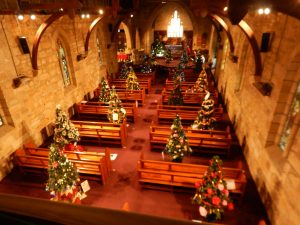
Christmas tree festival at St Mark’s Anglican Church, Warwick, Queensland.
Interesting topic and a chance for Feeney to roll out one of the few Australian carols – ‘Carol of the Birds’, sometimes known as ‘Orana’.
“Out on the plains the brolgas are dancing, lifting their feet like war horses prancing…”
There are other Australian carols – ‘Three Drovers’, ‘The North Wind’, ‘The Silver Stars (are in the Sky)’ and ‘Our Christmas Song’.
You may note I sketched around dross like ‘Deck the Shed with bits of Wattle’. We aim for quality here. Some of the Christmas songs mentioned here are not, strictly speaking, carols. The best-known Australian carols were written by John Wheeler and William G James, which fits well with my personal theory that some of the best songs ever were written by two people (music/lyrics).
‘Three Drovers’ is not as well-known as ‘Orana’ or ‘The Silver Stars’, but it piqued Paul Kelly’s interest enough to include it on his newly released ‘Christmas Train’ album. As a PK fan of long standing (right back to the Dots), this one left me a little flat.
It represents an eclectic collection of songs with a Christmas theme and another opportunity for Paul to include his big hit. I agree with one of my correspondents who said Kelly had written the best song about Christmas (and the best prison song) with ‘How to Make Gravy’.
Kelly sings ‘Silent Night’ – a traditional carol that has been sung by some of the greats – in a sleepy fashion, adding nothing new, except a verse in German, which so many choirs do.
I’m approaching this topic from the perspective of being part of a community choir which performs carols and tries to stay away from the hackneyed. Yes, we do wish you a Merry Christmas, but that’s because we all like figgy pudding.
The reasoning behind finding Australian carols is that so many of the popular ones originate from Europe and speak of snow and stars in the east, not to mention holly, ivy, reindeer and other things found mostly in the northern hemisphere.
The oldest Australian Christmas song I could find (well actually someone else found it), is ‘Our Christmas Song’, written by Ernesto Spagnoletti and published in 1863.
We welcome thee, old Christmas,
to this happy land of ours,
we welcome thee with sunshine,
we’ll strew thy path with flowers.
Our beauteous birds shall greet thee,
glad welcome they shall sing,
and wildflowers’ fragrance meet thee,
borne on the Zephyr’s wing.
Spagnoletti goes on to say that while we have no holly, no fire nor fireside cheer, we do have the bush and the “Sunny smile of heaven beaming in our summer sky”.
If you are interested in the subject, this website provides a list of 28 Australian Christmas songs and poems and a link to others.
https://tww.id.au/christmas/carol-1.html
Andrew Scholl, a regular guest on Kath Feeney’s show, called out ‘Carol of the Birds’, saying “It’s not a carol because it doesn’t mention Christ.”
The required definition of a carol is to both mention Christmas and the birth of Jesus, Scholl says. Another guest, Father Daniel Hobbs, says carols and hymns are interchangeable, although the latter are an act of worship.
A caller said a carol was meant to be sung by a group so is, therefore, a communal activity. As for the distinction between a carol and a Christmas song, another caller rang in to say that her family is religious “but we still sing Jingle Bells”.
This was an obvious retort to Feeney playing about 20 seconds of Michael Buble’s version of ‘Jingle Bells’. Father Hobbs said the song was written in 1857 and is a song about the seasons. He added it was the first Christmas song to be broadcast to earth from space. I suppose parish priests need to know things like that.
Recently our choir, East Street Singers, performed ‘Pachelbel’s Canon/The First Noel’. People who have not heard this before commonly express joy and surprise at hearing this famous piece by German composer Johann Pachelbel melding with another familiar piece. ‘The First Nowell’ (also known as ‘The First Noel’, is a traditional English Christmas carol with Cornish origins. Like many old English songs it is listed as a folk song, along with the likes of I Saw Three Ships.
This version of ‘Pachelbel’s Canon/The First Noel’ includes a group of bell ringers chiming in as per the score.
The next carol played on Feeney’s programme was ‘Carol of the Bells’, as performed by the Irish Chamber Orchestra. This is a version which can be found on Facebook.
https://www.facebook.com/watch/?v=1441016189401291
Then she played ‘Once in Royal David’s City’ which took me back to the Christmas morning Santa left a harmonica in my stocking. I’d turned eight a few months prior and although it is sinful to boast, I mastered that particular song by lunchtime. Mum, the piano player, explained the notion of sharps and flats when I got frustrated not finding every note for every song. Later I bought a chromatic harmonica which has a valve in the side that allows the player to sound sharp and flat notes; Rhapsody in Blue, not a problem.
https://www.abc.net.au/radio/brisbane/programs/afternoons/afternoons/13668658
But I digress. You might not agree with my critique of Kelly’s ‘Christmas Train’, 22 tracks performed by PK and a host of guest artists. At its best,it is a sincere ‘make work’ project for professional musicians who have struggled to earn a living since March 2020. I got momentarily excited when I saw ‘The Kelly Family” billed on this album, briefly thinking it was Alan and Kirsten Kelly (The Barleyshakes) and their kids performing under that name. Instead it was Paul Kelly and some of his musical whanau (which means ‘extended family’, for the non-Kiwis amongst us. Ed- and Merry Christmas). He also roped in his long-time backing vocalist Linda Bull to sing ‘Christmas Baby Please Come Home’ with a Phil Spector-inspired wall of sound arrangement a la Martha and the Vandellas. Linda’s got just the voice for it, but it will always sound like ‘Love You Like a Heat Wave’ to me.
There are some nice moments in this though – not the least Marlon Williams’ version of ‘O Holy Night’ in Maori and Kate Miller-Heidke exercising her operatic voice on the ‘Coventry Carol’. Also, the little known ‘Intonement Hodie’ by Alice Keath is beautiful in Latin and the English translation is helpful.
I’m also pleased Paul saw fit to include ‘Three Drovers’, as it is often overlooked in the lexicon of Australiana. Maybe I should have another good listen over the next couple of days and give The Grinch the boot – what do you say!
Wishing all FOMM readers a happy Christmas and a hopefully healthy New Year in which we can maybe all find a better way forward.
FOMM BACK PAGES https://bobwords.com.au/fomm-alt-christmas-playlist/ from 2017
Affordable housing – a key election issue

Wherever you go in Australia to visit friends and family, the conversation very soon turns to the scarcity and high cost of rental housing. The topic will then quickly shift to the ever-rising cost of houses and why parents worry about their adult kids taking on seven-figure mortgages. As residential property analyst Michael Matusik recently said, it comes down to the Bank of Mum and Dad.
Few cities or towns have escaped the 20% rise in residential real estate prices (for the year to September) or the inevitable rental hikes that followed. Stories that circulate about landlords taking advantage and tenants deciding they’d be better off sleeping in their cars are not uncommon. Check in with any emergency housing agency and they will tell you things are as tough as they have ever been.
AMP Capital chief economist Shane Oliver says that while housing affordability has always been an issue in Australia, it has moved from a periodic cyclical concern to a chronic problem.
“The 20% rise in prices over the last year has put the spotlight on the issue again. With the surge in house prices since the 1990s has come a surge in debt which brings with it the risk of financial instability should something go wrong in the ability of borrowers to service that debt.”
Oliver said the gains have been driven by record low mortgage rates, buyer incentives, a tight jobs market, a desire for more home space as a result of the pandemic and working from home, numerous government home buyer incentives, the “fear of missing out” and lower than normal listings. This has pushed average prices to record highs and real house prices to 23% above their long-term trend.
Oliver says the average capital city dwelling price rose 200% over the past 20 years, compared to an 82% rise in wages. The disparity has become more telling in the last 10 years with dwelling prices increasing by 58% and wages rising by only 26%.
The popular wisdom, if your parents taught you such things, was to spend no more than a quarter of your gross household income on housing. Over the decades, this figure has risen to 33% and in the major cities has peaked at 50%.
As we are now in pre-election mode, it’s appropriate to mention the Affordable Housing Party, a single-issue party which is on a membership drive to avert the risk of de-registration. Led by Andrew Potts, the party had its first tilt at Federal politics in 2017, fielding a candidate in the Bennelong By-Election.
The party’s policies include phasing out negative gearing, ending the capital gains discount on investment properties, stopping foreign investment in Australian property, taxing investment properties which are left empty and cracking down on full-time AirBnB operators.
Radical? Yes, but the problem needs some radical thinking before we end up with 200,000 people couch surfing and sleeping in their cars.
The AHP’s research on the housing sector focuses on negative gearing, which means the cost of owning an asset exceeds profits, resulting in investors claiming this loss to reduce other taxable income.
As the research suggests, one ought not to expect the Federal Government (or any government), to shut the scheme down. As of April 2017, Federal MPs and Senators owned a total of 289 investment properties.
This could be a good time to bust a few myths about negative gearing, Tax Office statistics from 2017 show that 64% of the 2.2 million people who own investment housing have an annual income of less than $80,000. This seems to scuttle the argument that only the wealthy benefit from investment housing. Less than 10% of Australia’s 2.2 million property investors earn more than $180,000 a year. Likewise, 71% of investors own only one home, with 19% owning two and 10% owning three or more houses.
Labor Leader Anthony Albanese upset some of the affordable housing campaigners in July when he abandoned pledges to impose restrictions on negative gearing. The opposition went to the 2016 and 2019 elections promising to halve the 50% deduction on capital gains and limit negative gearing to new properties only.
National Shelter chief executive Adrian Pisarski said by ditching its commitment to reforming negative gearing, Labor had “abandoned” would-be home-owners and low-income households wanting to buy homes.
“It took 15 years of campaigning by many to get the ALP to find a spine on CGT and negative gearing and commit to helping reduce house price inflation,” Mr Pisarski told the SMH at the time. “This is a sad day for affordable housing.”
In May Mr Albanese launched the Opposition’s $10 billion Housing Australia Future Fund. The fund would build social and affordable housing and create thousands of jobs now and in the long term, he said.
Annual investment returns from the Housing Australia Future Fund will be transferred to the National Housing Finance and Investment Corporation (NHFIC) to pay for social and affordable housing projects.
Over the first five years, the investment returns would allow the building of 20,000 social housing properties, 4,000 of which would be allocated for women and children fleeing domestic and family violence and older women facing homelessness.
Residential property analyst Michael Matusik has a few ideas to fix housing affordability. He says part of the problem is the focus on new builds rather than the existing market.
Matusik-style reforms would include removing negative gearing (a policy set when interest rates were sky high) and charging stamp duties at a flat $2,000 per transaction.
Matusik suggests a 20% tax on all property transactions – including owner stock if sold within, say, three years. This would stop ‘flipping’ (buying a house, renovating it and selling again within a short period of time) which is a major driver of prices. The government should limit foreign buyers to new dwellings and they must also have a 50% Australian business partner who pays 20% tax. These new rules would also include measures to stop developers land-banking.
“If they don’t start building the project within five years, they lose development approval. After 10 years, if there is no action the site is sold underneath them. In short, you cannot buy a home (new or existing) unless you have an Australian passport and pay 20% tax. No Passport no buy.”
As for new housing, Matusik says all housing related incentives should be removed because they distort the housing/building cycle. He also suggests that greenfield developments be required to provide minimum levels of community infrastructure set as targets. No doubt he will extrapolate on these ideas in a future Matusik Missive.
More radical ideas from Gwyn Hooper, writing for a Byron Bay newspaper (the median house price in Byron is $2.8 million (units $1m):
Under Hooper’s affordable development plan, the Federal and State governments would provide finance and free land. Local Government’s role would be to manage the buildings and tenants and waive its usual development fees.
“The tenants would have a secure tenancy, pay an affordable rent (based on income), and would importantly be able to live and bring up their families without financial stress – an issue that can cause family breakdowns that only compound these issues.”
As these examples suggest, this issue needs to be de-politicised and brought out into the sunlight with an ‘open to new ideas’ sign attached.
Written in the comfort of my freehold home, ameliorating some of my baby boomer guilt, I think.
Last week: People who lived in the UK for more than six months between 1980 and 1996 are prohibited from donating blood because of Mad Cow disease.
More reading
B Positive – not just a blood group

That cute but corny aphorism came to mind as my friend Mr Shiraz misinterpreted my recent trip to Brisbane as a blood donor emergency. He wanted to know why we were braving extreme weather and I texted (flippantly) “Appointment with Dracula.”
What I meant was we had tickets to Dracula, a production by Queensland Ballet. Dracula aside (one of that company’s best IMHO), you may have noticed there is a bit of a blood donor drive happening in Australia.
The Australian Red Cross (Lifeblood) and individual State health departments are assisting in the drive to replenish blood stocks, as demand reaches a 10-year high. As a recent Facebook post by Queensland Health noted, the shortage is of the greatest importance when it comes to rare blood groups. The post encouraged people with A negative blood to “roll up their sleeves and give generously”.
Such exhortations make my skin crawl, bringing back memories of a daily blood test over a lengthy stay in hospital. My blood group is not that rare, and, despite my life being saved by a blood transfusion in 1969, I have never donated my blood to anyone. Dad, on the other hand, had such rare blood he was on a list to donate in an emergency.
It didn’t happen often, but he would at times get a call (typically at 2.30am): “Mr Wilson, we’re sending a taxi…”
Lifeblood, the donor agency of Red Cross, is on a mission to replenish its blood supplies. It appears that through the pandemic, blood donor numbers had dropped off.
As lockdowns lift in Victoria, New South Wales and ACT, elective surgeries will start again and meanwhile we are just weeks away from holidaymakers taking to the roads, with the inevitable spate of accidents.
The impact of Covid-19 has been felt among blood agencies around the world. A study published by the US Library of Medicine noted the rise of concerns, confusion, and misleading rumours with regards to blood donation during the pandemic period.
“Additionally, due to the government’s interventions such as home sheltering, mass lockdown, and curtailment strategies towards public gatherings amid the COVID-19 outbreak, the arrangement of the voluntary blood donation drives has been debarred. Likewise, there has been a general reluctance of the public to come to the blood centres to donate blood.”
Lifeblood Executive Director of Donor Services Cath Stone said half of all blood donation appointments in Australia were not being attended, while hospital demand was at its highest point in a decade.
“Our donors have shown us incredible support over the last two years; however, as life moves to COVID-normal, it’s important that people continue to donate to help ensure hospitals can continue to treat patients.”
Lifeblood’s reserves of O Negative blood are being challenged, with the number of O Negative donors falling during the pandemic, despite increased hospital demand. O Negative is a universal blood type and can be given to anyone in an emergency.
“Only 9% of Australians have O Negative blood, but it makes up 16% of orders from hospitals because it saves lives in emergencies.”
While Australians are being persuaded to donate, here’s the status of blood supplies around the world.
It is comforting to learn that 97.5% of the global population is covered by organised collecting. Almost 120 million units of blood are donated every year, but as the World Health Organisation data shows, donation rates differ wildly. Some high-income countries see seven times more donations than in low-income countries.
If you have ever been involved in a motor vehicle accident, a brawl or a workplace mishap, you will know that sometimes victims lose too much blood. Transfusions are needed for health conditions including anaemia, complications during pregnancy and childbirth, severe trauma (accidents) and surgical procedures and transplants. Transfusions are also used regularly for patients with conditions such as sickle cell disease.
The WHO and Lifeblood are vigilant about screening donations for HIV and Hepatitis A B and C, to name a few diseases.
A survey in 2018 found that 72 % of countries had a national blood policy. Overall, 64% of reporting countries, or 110 out of 171, have specific legislation covering the safety and quality of blood transfusion. National blood policies are most prevalent in high and moderate-income countries.
There are great variations between countries in terms of age distribution of transfused patients. For example, in high-income countries, the over-60 transfused patient group accounts for up to 75% of all transfusions. In low-income countries, up to 54% of transfusions are for children under the age of 5 years.
In high income countries, transfusion is most often used for supportive care in cardiovascular surgery, transplant surgery, massive trauma, and cancer therapy. In low and middle income countries, it is used more often to manage pregnancy-related complications and severe childhood anaemia.
The WHO has been campaigning to persuade countries which allow blood donors to be paid to switch to a voluntary system. In countries including the US, Austria, Germany and some Canadian provinces, individuals can earn about $50 a time for donating blood. The collecting and warehousing of plasma has become a multi-million dollar business. The main commercial advantage is that plasma can be frozen and kept for up to a year.
Blood is usually separated into three major components: Red blood, plasma and platelets. Red blood has a life span of 42 days and is used for emergency transfusions. Plasma is the colourless liquid separated from blood. It is most often used to treat burn victims and those with bleeding disorders. The main function of platelets is to stick to the blood linings and prevent bleeding. Platelets have a shelf life of five days and are most often used for organ transplants and surgeries.
Musician Mal Webb has been a blood donor for “at least two decades”.
“I recently switched to donating platelets, which means I can do it more often.”
Sometimes even when you want to donate blood, the tight regulations around blood quality can rule you out, as a friend who used to give blood found out.
“Unfortunately, they changed the rules some years ago so if you had been in England for any length of time you might have Mad Cow disease and so couldn’t donate.
“I was disappointed as I felt good giving blood, knowing I was helping other people.”*
There are examples of physicians experimenting with blood transfusion on animals as far back as 1668. The current system can be traced back to the early 19th century, In 1918, British obstetrician Dr. James Blundell performed the first successful transfusion of human blood to treat postpartum haemorrhage.
Lifeblood and State health departments face an uphill battle trying to convince Aussies to give blood. Although one in three Australians will need a blood donation in their lifetime, only one in 30 give blood every year. It seems it was always thus, though. An article in the Sydney Morning Herald in September 1949 spoke of a ‘blood donor crisis’. The article quoted a NSW Red Cross spokesman.
“Our most urgent need is to make members of the public realise that their blood is worth bottling,” the spokesman said, hijacking a WWI term more often used as the ultimate compliment on a job well done.
If you haven’t donated blood for a while or had never even considered it, here’s a handy link: https://www.lifeblood.com.au/blood
Tell them FOMM sent you.
*People who lived in the UK for more than six months between 1980 and 1996 are ineligible to give blood due to Mad Cow disease.
More reading:
By hydrofoil to Hydra

In introducing today’s FOMM about Hydra by She Whose Pen-Name used to be Mrs W, I need to explain how often, when travelling in Southern Europe, I was mis-identified as a local. Perhaps it was the Celtic complexion, infused with Spanish blood. Or the faux fisherman’s cap. Either way, I’d get something like this:
Greek cafe owner: “Welcome! Where are you from?”
BW: “Australia” (café guy looks at colleague and chortles)
“No, no, where are you really from?”
Confused, I say “Melbourne.”
“Ah, Mel-born – I have a cousin there – Stavros – perhaps you know him?”
HYDROFOIL TO HYDRA
By Laurel Wilson
April 2004: Shirley Valentine and I have one thing in common- we both had always wanted to travel to Greece; but I was travelling with my husband, rather than trying to get away from him. My fellow traveller claimed that he could ‘speak some Greek’, having sailed to Europe in the ‘70’s aboard a Greek liner. He certainly looked the part, with his jaunty Greek fisherman’s cap, but it soon fell to me to translate the signs and attempt to get us on the right bus.
After three fascinating days in Athens, we were armed with essential traveller’s knowledge- we knew to say ‘kalamere’ instead of ‘calamari’ if we wanted to say ‘good morning’, we had worked out the main differences between our alphabet and the Greek one, and we could recognise the toilet signs.
We were on a pretty tight budget, but also craved a bit of adventure, so we chose not to travel on organised tours. One of our do-it-yourself adventures found us taking a local train to the port of Piraeus, near Athens, en route to the island of Hydra (pronounce Eedra, as we soon discovered) one of the Saronic islands off the southern coast of the Peloponnese Peninsula. The only thing I knew about ‘Hydra’ was some vague legend about a woman with snakes for hair, perhaps not an auspicious beginning.
(BW: Leonard Cohen lived there in the early 1960s with other writers and poets).
Getting to Piraeus was quite simple, but finding the ferry terminal was another thing altogether. We eventually succeeded, just in time to see our intended ferry connection sail away. Having some time to wait for the next one, we looked for somewhere to enjoy afternoon tea. We found a likely-looking café, but were told that they didn’t serve cakes or sweets. “We’re a restaurant,” the proprietor said, as if that explained everything. So being wise tourists, we had what was on offer. However, what we thought was a snack turned out to be a gargantuan meal of capsicums and tomatoes stuffed with rice, a Greek salad, mountains of bread and a cup of the thick mud-like ‘Greek’ coffee (it used to be called Turkish coffee, but national pride got in the way).
The trip to Hydra was on a very large and speedy catamaran. According to the company website, it is one of six in the Hellas ‘Flying Dolphin’ fleet. (There is a local connection too – Flying Cat No.2, was reportedly built on Queensland’s Gold Coast in 1998). It was a fast, smooth and comfortable ride of about 1½ hours, compared to twice that for the conventional ferry.
The first sighting of Hydra was memorable - seemingly impenetrable sheer cliffs, then suddenly a lovely snug little harbour lined with small fishing boats, backed by a charming small town which featured impressive stone mansions along with tiny cottages, steep narrow streets and a jumble of small shops and cafes. Although there was quite a deal of construction in evidence, the overall appearance was harmonious, thanks to the heritage laws which require newer constructions to conform to the traditional character and colours of the island’s established buildings.
Several teams of donkeys, mules and ponies accompanied by their minders waited patiently for passengers or goods to carry. Motorised transport is forbidden on Hydra, a welcome change from the noisy and chaotic traffic of Athens. Tourists often try the donkey-rides, using a type of side-saddle, but I didn’t want the poor things to suffer, so chose to walk instead. (BW: As I recall, they carried our bags).
The island is quite dry and rocky, resulting in limited scope for gardens and some suggest this is the reason for the brightly coloured shutters, doorways and window sills to be found on the island’s buildings. As we walked past one of the many closed bars, we could see and smell the fresh coat of bright green paint being applied to the shutters.
We felt no need to test our fitness by climbing to the highest point of the island, but did stroll along the wide track which curved around the headlands on either side of the village. On our first walk, we passed the prominent statue of local hero Admiral Andreas Miaoulis, who acquitted himself very well in the 19th century Greek War of Independence. Later that evening, we strolled around the Western headland to view the sunset, quite indistinct owing to the still visible smog from Athens.
If we had been a bit more energetic, we could have walked to some of the monasteries and convents dotted around the 52sq km island, or visited the ancient village of Episkopi, with its evidence of Mycenaean civilisation. Diving, sailing and yacht cruising are also available for the more active tourist, as well as swimming, though the beaches are rather pebbly, with not much sand in evidence. The local historical museum, housed in a traditional Hydriot mansion on the eastern side of the harbour, was closed while we were there, though the Byzantine Museum, situated in a building with a distinctive marble bell tower, was open to visitors.
We arrived in March, earlier than the bulk of tourists, which meant that many businesses were closed and undergoing maintenance, but we didn’t feel deprived, as there were plenty of restaurants and cafes open. Most of the businesses that were not yet open seemed to be large bars with open-air dining. During the tourist season, these promise (or threaten, depending on your point of view) loud music, with dance parties lasting all night.
It seems the cruising season had already begun, as a couple of ships arrived while we were there, disgorging very prosperous looking tourists. Souvenir shoppers were catered for with lace, jewellery and craft shops which opened during the hours that a cruise ship was in port and then closed again, figuring rightly that it wasn’t worthwhile to remain open for the few longer-stay tourists such as ourselves.
At that time of year, accommodation was readily available and very reasonably priced. Our self-contained one bedroom unit, situated just behind the village centre, cost only €35 (approx AUD$ 60) per night. It was quite a modern unit, one of several in a converted split-level home behind a walled and gated courtyard.
(BW: This is 2004, remember!)
We weren’t looking for the kind of party lifestyle that some seek on the Greek Islands, but instead were treated to a quiet and peaceful three days in a beautiful setting. Peaceful except for the feud that broke out one morning while we were having brunch. An old fellow wandered into the café and approached another chap sitting at a table near us. After much shouting and gesticulating, he retreated, to the jeers and smirks of several of those in the café. Half an hour later, he came back for a re-match. Discretion overcame my first impulse to ask the locals what it was all about, but everyone seemed to find it as entertaining as we did, even those involved, I suspect.
Later we took a moonlit walk along the harbour, relishing the peace and quiet. Only one bar was still open with faint sounds of laughter and music following us like mist.
“Fancy a nightcap, Mr W?”
“Nai parakalo, yassou – whatever!”