
Homeless people sleeping in their cars

homeless-sleeping-cars
Image: Lucas Favre, www.unsplash.com

Today’s headline about homeless people could well be an urban myth; that is, a story people tell each other, swearing that it’s true. The housing crisis in Australia – a combination of unaffordable housing and scarce rental properties – is forcing people to live in their cars. I’ve done a bit of fact checking on this, but hang around while I relate this story from Tasmania.

We’d stopped at Scottsdale, a high country town in Tasmania’s north-east. We’d chosen the town’s free camp, which provided toilets and showers (the latter powered by three one-dollar coins). We were settling in for the evening when it became obvious that the older woman next to us was preparing to spend the night alone in her small Japanese car. The overnight forecast was a minimum of 7 degrees. She’d hung towels in the side windows and fixed a screen over the windshield. She seemed to be withdrawn, so we respected her unspoken need for privacy. But as far as I could tell (being next door and all), she went to bed as soon as it got dark. I decided my penance for not engaging in conversation was to make her a coffee in the morning. But when I arose (at 7.30am), she had gone.

It’s not illegal to sleep in your car in Tasmania – I looked it up. In theory if you are homeless, you could free camp your way around Tassie and nobody would hassle you. Some free camps allow you to stay for up to a month. But it does get cold from April to November, and rough campers would have to travel to town to find a public shower.

In Queensland, it’s illegal to sleep in your car unless you are parked in somebody’s driveway (with their permission). In which case you’d probably be inside, on the couch with the dog. There are similarly tough rules in the Northern Territory.

As blogger Tim Beau Bennett discovered, many local governments have specific by-laws vetoing this practice, so it would pay to check.

The biggest problem with assessing the level of homelessness in Australia is that the most reliable data (the Census) only comes out every five years. It could well be Spring before we see the first results of the 2021 Census. We therefore rely on data that is six years out of date (116,471 in 2016). But what’s been going on in the interim?

Recent reports show that up to 44,000 women of all ages are vulnerable to homelessness, with domestic violence being a key risk. Homelessness Australia (the National peak body for homelessness in Australia) released an analysis of housing data from the Australian Institute of Health and Welfare that showed that 1,600 women over 50 sought help from homelessness services in 2016. These women were either ‘couch surfing’ – that is, staying temporarily with friends or family members, or sleeping in their cars. The numbers had increased 75% and 81% respectively between 2012 and 2016.

Homelessness Australia launched a campaign in March this year calling for $7.6 billion to be allocated to long-term housing for women over the next four years.

The research identified a shortfall of 16,810 homes, the building of which would provide economic benefits of $15.3 billion and create 47,000 jobs across the economy.

The 2019-2020 research report Nowhere to Go, prepared by Equity Economics, showed that 9,120 women are becoming homeless every year. Women who had experienced family and domestic violence were the biggest client group seeking assistance. In 2019-20, 119,200 clients, or 41% of all such clients, sought assistance while experiencing domestic and family violence. More than half (55.8%) required accommodation. Alarmingly, the data also revealed that 7,690 women go back to abusive relationships, out of necessity.

It is perhaps illuminating to discover that Homelessness Australia was funded by the Federal Government until December 2014. Since then, it has been staffed by volunteers and has no paid staff.

As we mark the eighth birthday of Friday on My Mind, those of you who have hung in for a long time would know I often write about this topic. Australia has had a steadily increasing homelessness problem since 2011. The elevation of housing from a place to live and grow a family to a wealth-generating asset is the key issue.

An Australian Housing and Urban Research Institute (AHURI) investigation from November last year found that up to two million renters aged 15 or over are at risk of homelessness. AHURI’s brief to researchers was to identify those at risk of homelessness in smaller regional centres.

The resulting paper shows just how close so many people are to becoming homeless, primarily because of rental increases and ever-tightening rental vacancies.

All it would take is one life crisis –  a relationship breakup, a serious illness or losing work due to economic circumstances, the authors concluded. Many people found out at the peak of the COVID-19 pandemic how circumstances can quickly change.

The survey was commissioned by AHURI from researchers from Swinburne University of Technology, University of Tasmania and Launch Housing. The task was to estimate rates of people at risk of homelessness for small areas (with a population ranging from 3,000 to 25,000).

Those interviewed were considered at-risk of homelessness if residing in rental housing and experiencing at least two of the following:

low-income;

vulnerability to discrimination;

low social resources and supports;

needing support to access or maintain a living situation;

a tight housing market.

The AHURI study is an important one at this fragile stage of the electoral cycle. It bridges the gap between what we officially know about the homeless and the ‘hidden homeless’ – those who are couch surfing, sleeping in their cars, house-sitting or doing the slow lap of Australia.

Even if you have a job, the next challenge is to find a rental property. This week our local paper, The Daily Journal, carried a report that the Southern Downs region has the lowest rental vacancy rate in Queensland (0.1%). The figure, a 10-year low, comes from a Real Estate Institute of Queensland survey of 50 local government areas.

While rentals in the Southern Downs are cheap compared to metropolitan cities (advertised weekly rentals start at $210 for a one-bedroom unit, to a three bedroom house in Warwick ($600). I am assured on at least an anecdotal level that the scenario is being replicated all over Australia.

The Federal Government’s main response to this shameful crisis was the National Housing and Homelessness Agreement (NHHA). The scheme started on July 1, 2018 and provides around $1.6 billion each year to States and Territories.

The NHHA included $129 million a year for homelessness services. States and Territories must match the sum applied for when claiming this money.

The NHHA identifies ‘priority cohorts’, which is public service jargon for people most in need of a roof over their heads. (Dehumanising language is but one of the many issues when considering homelessness. They are not ‘cohorts’ – they are people. Harumph. Ed)

  • women and children affected by family and domestic violence,
  • children and young people,
  • Indigenous Australians,
  • people experiencing repeated homelessness,
  • people exiting from care or institutions into homelessness and
  • older people.

Yes, it’s a depressing topic, but better solutions and attitudes could be developed, starting by not demonising those who either can’t find work or can’t work. Then we need to stop stigmatising those who for whatever reason have nowhere else to go.

In Nomadland, Francis McDormand’s character Fern is asked: “My Mum says you’re homeless. Is that true? Fern: “No, I’m not homeless. I’m just houseless. Not the same thing, right?”

I’ll leave you with a ‘three chords and the truth’ country song, Somebody’s Daughter by Tenille Townes.


JobSeeker and the $50 ‘bonus’

jobseeker-unemployment
Contrary to popular opinion, almost half the people in this study relied on NewStart (now JobSeeker) for less than a year. Graphic courtesy of Wes Mountain and The Conversation.

You know how it goes. You’ve finished ferrying 16 items down the checkout conveyor and the assistant says: $142.99 – cash or card?

“How do the poor people get by?” I ask of no-one in particular.

Later, I went to the butcher ($47) and the organic fruit and vegetable shop ($56), all up $245.

She Who Pays the Bills said: “But we only needed a few things”.

Now if we were on unemployment benefit, such profligacy would leave us with just $375 to cover the next 13 days (rent, bills, fuel and more groceries).

It is timely to write about the cost of living, and how the reality appears quite different to the official inflation rate (1.2% in December). The Federal Government’s superficially successful $100 billion wage subsidy programme (JobKeeper), ends on Monday. Businesses that claimed JobKeeper passed on the subsidy to people they employed, regardless of how turnover and profit was tracking through the year that the programme was in place.

The last day of March also signals an end to the scaled-down Covid-19 supplement paid through JobSeeker. In the first few months of its origins, JobSeeker initially doubled the benefits paid to unemployed people.

JobSeeker, which replaced NewStart and associated benefits from March 21, 2020, introduced three levels of supplements paid through the first year of the Corona virus. From April 27 2020 to September 25, recipients were paid $550 extra a fortnight. This was then reduced to $250 extra per fortnight until December 31, 2020. The final supplement of $150 a fortnight was paid from January 1 until it ends next week.

Welfare groups had long lobbied the government to raise the unemployment payment beyond the poverty level.

The government made much of its decision to raise the rate paid to those on JobSeeker by $50 a fortnight ($3.57 per day).

As of next week, welfare recipients will have to learn to live without the additional $150 a fortnight – reverting to $620 a fortnight, excluding other payments like rental assistance*.

Economist Ross Garnaut’s latest book proposes that successive Federal governments, in cahoots with the Reserve Bank, have deliberately kept unemployment high since the mid-1980s. He writes that governments  have ‘allowed’’ hundreds of thousands to languish in unemployment as a means of pursuing a policy to suppress wage growth and inflation.

Garnaut says this deliberate policy has ‘immiserated’ people.

He told ABC business reporter Gareth Hutchens that Australia should use its many resources to push the unemployment rate down to 3.5% by 2025. You may not remember, but unemployment was at this level or lower for decades between 1950 and 1975. This was an era when many Australians had permanent jobs in factories that made things.

Garnaut says the government and Reserve Bank have to stop guessing the level of ‘full employment’ (at which point the RBA starts lifting interest rates, as a means of combating inflation).

He says the budget deficits needed to sustain full employment should be funded directly or indirectly by the Reserve Bank. It is complex, but if you are interested, read more here.

The Conversation’s in-depth study of unemployment benefits busts a few myths. Research by a team drawn from the Brotherhood of St Lawrence, RMIT and ANU studied benefit payments between 2001 and 2016.

The premise of the report is that Australians receiving unemployment payments are often portrayed as “a relatively small group of people with personal or behavioural problems that stop them from getting a job.”

The research was conducted to challenge long-held perceptions of ‘us and them’.

One of the most startling conclusions clarifies myths about the long-term unemployed. The research found that nearly half of the Newstart population of 4.4 million (47%) received the payment for less than a year. Over two-thirds (68%), received it for less than two years. The study uncovered a concerning trend in the number of welfare payments suspended for not reporting income correctly or not meeting job-seeking targets.

Our study found rates of suspension increased dramatically over the study period, from 2% in 2001 to 11% to 2016.

Successive governments have increasingly sought to enforce this, leading to more uncertainty around the payment.

So, while the unemployed go forward living on a minimum $44 a day, how will things go with the end of JobKeeper, the flawed business subsidy scheme which kept 3.5 million people off the dole queue?

As business editor Ian Verrender noted in an analysis for the ABC, JobKeeper turned into a profit mill for businesses that boomed during the lockdown. Billions of taxpayers’ dollars were paid to wealthy businesses, without the mutual obligations associated with welfare. The only reason we know about this at all is the corporate regulator’s belated decision to force listed companies to disclose their taxpayer handouts in the December half corporate results.

Verrender, an investigative scribe, laments the lack of a public register of JobKeeper recipients – “despite the scheme being among the most ambitious (of its kind) in the world”.

But it is not just the blue chip public companies that scored a windfall; tens of thousands of private partnerships, sole traders, charities and small to medium-sized businesses also prospered.

Many of the heads of Australia’s biggest businesses feature in the timely release of the Top 250 Rich List by the Weekend Australian. I say timely because it suits my purposes to mock the rich. What else can you do when the 250 individuals named in this list are collectively worth  (in monetary terms- Ed.) $470 billion. As former journalist union chief Christopher Warren wrote in Crikey – that is equivalent to 25% of Australia’s GDP. Even the lower echelons on this list have a net worth of $450 million or more – $449 million more than the collective net worth of your average self-funded retiree couple..

Wish, the glossy magazine lift-out supported by full-page ads by Mercedes Benz, Cartier, Giorgio Armani and the like, is a supreme example of what The Australian calls ‘aspirational’ journalism.

For those on JobSeeker who aspire to getting best value from that extra $50 per fortnight, here’s a slow cooker recipe for lamb forequarters (large chops that are too tough for the barbeque). You can probably score a kilo for $15 or so. Buy 1.5 kilos each of onion, carrots, potatoes and the cheapest green vegetable (about $10 all up). Add a can of red kidney beans ($1.67) to flesh it out and cook the lot in a slow cooker while you are out applying for one of the 15 jobs a month needed to justify your welfare payment.

If you chucked in the right combo of herbs and garlic and made a gravy worthy of ‘Sir’ Paul (Kelly), the lamb will just fall off the bone and you’ll be eating this for days.

Buy an $8 bottle of red while you still can (he said, one eye on the coming of the cashless welfare card). Invite someone over (‘a loaf of bread would be great, thanks’).

Enjoy every casserole.

More reading

*Welfare payments quoted here are for single people, no dependants. Families obviously receive more.

Older Australians an economic burden

economic-time-bomb
Older Australians an economic time bomb

Treasurer Josh Frydenberg’s much-reported speech, where he referred to my cohort (the over-65s) as ‘an economic time bomb’, should not be seen as random.

The speech to the conservative think tank, the Committee for the Economic Development of Australia (CEDA), was deeply calculated. Frydenberg’s thesis is that older Australians should work longer and take up re-training to help facilitate a return to the work force, thus easing the country’s social security burden.

Frydenberg was immediately attacked by Seniors’ advocates who pointed out (for starters) that 25% of people on the government’s inadequate unemployment payment (NewStart) are aged 55 and over.

It came in a week when the ABC television debuted its much-hyped show, Australia Talks. The latter is based on a huge survey of 54,000 people, who were asked to prioritise their chief concerns.

The list of worries was headed by household debt, the cost of living and drug and alcohol abuse. Ninety percent of respondents answered they were ‘somewhat’ or very much’ concerned about the top three issues, with water (89%) and ageing population (87%) not far behind.


The Treasurer was interviewed the following day by 2GB radio shock jock Steve Price, who didn’t let him off too lightly:

Price: What do you say to our listeners – people like truckies, labourers and builders, all tradies, saying ‘look, we just can’t work past retirement age because physically our bodies are worn out’?

Frydenberg: Well, that is totally understandable and nobody is asking them to do that. What I am saying

Price: Well, we are pushing up the age of the pension.

Frydenberg: But what I am saying is that when it comes to that age that you referred to (67), that was legislated by the Labor Party back in 2009 and we haven’t said that we would change the retirement age, so we’ve been very clear about that.

Price: But it goes up to 67, right?

Frydenberg: It does. And again, the Labor Party legislated that in 2009.

Price: But you’re going to leave that there?

The Labor Government did introduce measures in 2009 to increase the pension age to 67 through gradual increases during the period July 2017 to July 2023. But the Abbott government’s 2014–15 Budget proposed to increase the pension age by six months every two years from 1 July 2025 until it reached 70.

Despite Prime Minister Scott Morrison shutting down speculation last year that the government was considering lifting the retirement age to 70, it was a Coalition policy and could resurface at any time.

Ian Henschke from National Seniors Australia said it was unfair to stigmatise older Australians.

“We should blame previous treasurers from 1980 who have stood by and watched this happen.

“Let’s deal with the facts, for example, that older Australians want to work more and longer but they are not getting the work they need.”

“When they do retrain, we know they are experiencing discrimination.”


Statistics support the government’s rhetoric that older people are indeed either staying in the workforce longer or making a comeback. The workforce participation for over-65s stands at 14.6%, up from 6% 20 years ago. It’s not hard to find the reason for that: a basket of goods from the supermarket costing $200 in 1999 will set you back $331 today.

There is lots of sage advice around for people nearing retirement age about how much money they will need to fund a comfortable retirement. There is less information around for those in advanced stages of not working anymore and trying to make their money last.

Moreover, factors well out of everyone’s control continue to move the goalposts, forcing retirees to come up with new and inventive game plans. Specifically I’m talking about the unsustainable investment returns available to retirees, who typically are advised to invest in no-risk strategies.

The Association of Superannuation Funds of Australia (ASFA) advises that the ideal superannuation target for a single person on retirement is $545,000 (implying that a couple needs $1.09 million).

So how are we all doing then?

While half-watching the cheerfully superficial Australia Talks, I heard a butcher’s assistant confide that she had $45,000 in her super fund. She didn’t look old enough for this to be a worry yet, but let’s face it; you’d have to sell a shitload of sausages to reach that mythical half a million dollars.

Superannuation was supposed to be the panacea for older Australians not wanting to be a burden on the national pension scheme. But ASFA statistics tell a sobering story. While there are 16.1 million Australians with at least one superannuation account, one in three women and one in four men, across all ages, have no superannuation. So 25% of women and 13% of men are retiring with no superannuation, relying partially or substantially on the Age Pension for their retirement income.

Fair enough, the Age Pension is supposed to be a safety net for Australians who find themselves at 65+ and broke. But why doesn’t Josh Frydenberg shut down the loophole that allows a couple to earn about $75,000 per annum and/or have assets well over $2 million, and still be eligible for some benefits.

In case you had wondered, Australia is a long way down the list of countries which pays its retired citizens something close to a living wage. The Organization for Economic Co-operation and Development (OECD), analysed data from 35 member countries and a number of other nations. Pensioners in the Netherlands, Turkey and Croatia receive more than 100% of a working wage when they retire (the right-hand end of the graph).

At the other end of the scale, pensioners in the United Kingdom receive just 29% of a working wage (compared with the OECD average of 63%


Pensions paid as a percentage of a working wage

economic-time-bomb
Age pensions a global economic time bomb

Image: OECD countries ranked by pensions as a percentage of a working wage. Australia is 12th from the left, paying 43%. Source OECD.

The OECD’s 2017 report Pensions in Australia noted that public spending on pensions is low and will remain low (currently 4% of GDP and projected to be 4% in 2050) as opposed to 9% and 10% for the OECD.  From this we can deduce the government’s future reliance on superannuation, including the government’s compulsory scheme and privately-funded superannuation accounts.

The old age income poverty rate in Australia is high, at 26%, compared to 13% across the OECD. This is partly related to the high prevalence of people taking superannuation funds as lump sums rather than annuities at retirement. These people, as any current affairs programme worth its spots will tell you, squander their money on travel, then risk falling into poverty if they outlive their assets. No doubt they will then sign on for our Age Pension (which costs the county $50 billion a year).

What, may I ask, is wrong with someone who has paid taxes for 45 years retiring on a combination of savings (super) and a part-pension from the government? Frankly, I’d have thought that paying $1 million+ in income tax through my working life would have been enough.

Nobody considered me a burden then, did they?

Further reading: https://bobwords.com.au/taking-an-interest-in-recessionary-economics/

.


People without lists are listless

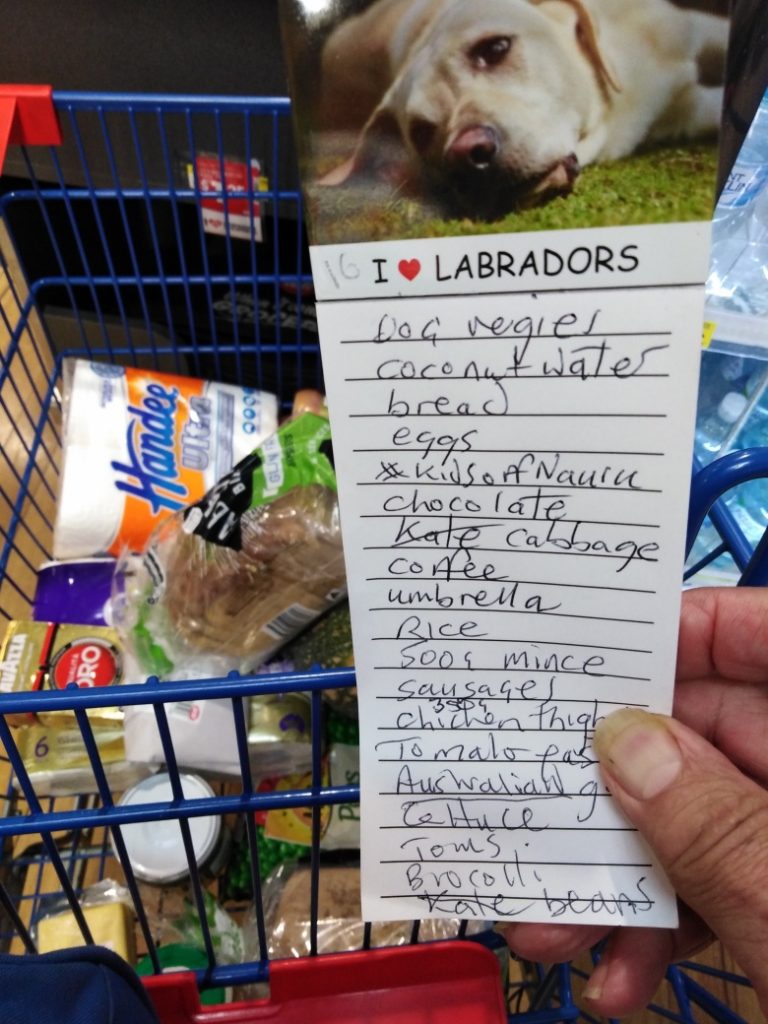
Bob’s list: “Sorry dear, there was no kale (or cabbage).”

Someone (possibly one of my lecturers), once said: ‘People without lists are listless’ – perhaps an observation on my then lack of motivation.

Decades later, I went in search of the origins of this quote and came up empty, although there are many other pithy quotes about the universal ‘to-do’ list.

Author Mary Roach, who has many opinions about lists, says that by making a list of things to be done, she loses “that vague, nagging sense that there are an overwhelming number of things to be done, all of which are on the brink of being forgotten”.

Alan Cohen, author of 24 popular inspirational books says “The only thing more important than your to-do list is your to-be list. The only thing more important than your to-be list is to be”.

I’ve been enslaved to The List since realising, as I tackled university at the ripe old age of 30, that if I wasn’t organised, it would not happen.

I‘d read a few time management books, back in the days when I aspired to be a supermarket manager, but later, embarking upon a three-year Arts degree, I made up my own system. This included hand-written term calendars posted on big sheets of butchers’ paper on the study wall. I had a diary with all lectures, tutorials and assignment deadlines colour-coded and a daily to-do list. The chief instrument of production was a huge old Olympia typewriter I bought from a Toowoomba police office sale. I decorated a large pin board with cartoons and illustrations which had something to say about productivity.

My thoughts on list-making were sharpened on a week-long trek to Gympie’s Heart of Gold film festival, followed by a spot of whale-watching. We have three one-page spreadsheets on which we tick off items every time we pack the caravan for a trip.

For reasons not easily explained, we departed from this time-honoured system and subsequently left home without a dozen items, including bath towels, phone charger, camera charger, SD card (from the camera), video camera (whale-watching, right?), a bottle of olive oil, my favourite pillow, oatmeal soap and a water bottle. Replacing the last two items was a cinch and we bought two towels from a discount department store (wash before using, the label hopefully said). The moral is, if you keep lists, actually look at them.

The three most common types of lists are (1) shopping (2) domestic chores and (3) motivational.

Motivational types will tell you it is not the items on your to-do list that matter, it is the prioritisation. People in general, but mild-mannered, non-assertive people most of all, consistently leave the most urgent and stress-inducing items for last. (Crikey, Mavis, we must talk to Jimmy (16) about his marijuana breath).

Since computers, tablets and smart phones became commonplace in homes and workplaces, the list story has taken precedence. The majority are ‘click bait’, which means whoever invented the list is getting paid for every click that takes you to an ad-festooned page. The worst of these show only one item per page, forcing you to click through if you really want to read about the 10 most successful bandy-legged men.

Some lists are, well, just way over the top. Like the one Franky’s Dad found, a list of the top 34,000 albums of all time. No, M, you don’t have time for this!

Journalist and bloggers have found that the quickest way to write a compulsive article is to turn your topic into a 10-point list. If you write a couple of paragraphs about each item you’ll quickly get to your deadline.

Lists pop up on social media all the time – ten ways to tame a wombat, 25 things you never knew about armpit hair, the top 17 crazy tattoos and so on.

Trivia aside, the shabby state of leadership and lack of sensible policy in this country suggests we all make a short list of important issues about which we feel outraged.

If you come up with more than three major items involving bad policy, prevarication, procrastination or short-term-ism, we need a change of government.

1/ #KidsoffNauru: This has become such a crisis doctors are signing an open letter to the PM; a coalition of humanitarian organisations have given the Federal Government a deadline to get 80 kids (and their parents) off Nauru. About a third of the child refugees left on Nauru are showing signs of Traumatic Withdrawal Syndrome. It is no longer OK to say it is a matter for the Nauruan government and its contractors. Whether these children are brought to Australia by November 20 or not, this has been an appalling outcome of the Federal Government’s refugee policy and should be judged so at the ballot box.

2/ Climate Change: A panel of 91 scientists has definitively told countries what they need to do by mid-century to avert the worst effects of global warming. Our Federal Government’s response to the Intergovernmental Panel on Climate Change report (which recommends phasing out coal power by 2050), was predictable. Deputy PM Michael McCormack (who may one day rue uttering these words), claimed that renewable energy could not replace baseload coal power. He said Australia should “absolutely” continue to use and exploit its coal reserves, despite the IPCC’s dire warnings the world has just 12 years to avoid climate change catastrophe. The Guardian quoted Mr McCormack as also saying that the government would not change policy “just because somebody might suggest that some sort of report is the way we need to follow and everything that we should do”.

3/ Homelessness and the cost of housing: You might dimly recall Bob Hawke’s rash promise in 1987 that no Australian child would live in poverty by 1990. Three decades later the goal is as unattainable now as it was then. Even when you take into account that Hawke mis-spoke (the script said no Australian child need live in poverty), it was an empty promise. Nine prime ministers later, close to 731,000 Australian children are living in poverty.

The official homeless figure at the 2016 Census was 116,000, with about 7% (about 8,000 people) said to be ‘sleeping rough’, defined as on the street, on a park bench, under bridges and overpasses, in their cars or in makeshift shelters. These statistics damn all sides of politics, worsening through a period in which there has been no meaningful increase in unemployment benefits or disability pensions.

Meanwhile, property investors continue to borrow money and claim expenses (notably interest payments) against rental income. In 2014-2015, 1.27 million property investors (12% of taxpayers), reduced their personal income tax through negative gearing. No government has yet had the guts to scrap negative gearing or change it in any way.

Economist Greg Jericho analysed a huge Tax Office data dump to glean a few insights – most importantly, 27% of taxpayers claiming on rental properties are in the $80k to $180k tax bracket (and another 8% earn more than that). Furthermore, just over 3% of taxpayers own six or more rental properties. The proportion that own more than one house has been on the increase in recent years.

It’s all too easy to raise other concerns, such as: Adani, Great Barrier Reef, Fracking, the threat to job security for gay teachers and even the Opera House furore (smokescreen that it is).

(Wow, that sure puts my forgetting the towels into perspective. Ed)


Australia’s hardship index

hardship-poverty-potato
“The Potato Index” Photo by Pat Joyce https://flic.kr/p/asBkcN

There’s an Aussie saying – ‘they’re doing it tough’, which can mean any variation on the theme of hardship, be it financial, emotional, physical or all three at once.

When the word ‘hardship’ is employed, it typically means financial struggle: in other words, privation, destitution, poverty, austerity, penury, impecuniousness and so on.

If you search the word ‘hardship’ online you will find a range of links purporting to explain (if you are doing it tough), how to apply for an early release of superannuation.

Continue reading “Australia’s hardship index”

Newstart or job-share?

dad-needs-job
https://flic.kr/p/5YepYQ Image by Dane Nielsen

There are times when I’m grateful my conventional working life is behind me and I can wait (patiently) for the next humble pension payment. My needs are small – I can sit on the front veranda with a cup of coffee made on our machine for about 15 cents, enjoy my banana toasty, share the crumbs with the birds and do the crossword. Some may call me a leaner, but I’ve done my share of lifting, mate.

Meanwhile, out there in the thrust and parry world of staying in work, where HR is a growth industry, workers are lobbying for their next short-term contract, working out how long their redundancy payment will last or (forgive me for thinking this), shafting a colleague so they can get a better-paid job. Some, who make life plans based on aforementioned contracts, find said agreements withdrawn without notice for budgetary reasons. Yep, the veranda is better.

For one thing, the pension is linked to wage increases, which is more than you can say for Newstart (Australia’s unemployment benefit), which is indexed to the CPI. The September indexation will be calculated at 0.18%, which, on the single/childless fortnightly rate, is less than $1.

Surveys have repeatedly told the government of the day that half the 700,000 Australians who rely on Newstart are living below the poverty line. A 2015 study found that on any given day there were fewer than 10 rental properties in Australia that were affordable for people on the allowance.

Australian Council of Social Services chief executive office Cassandra Goldie told New Matilda the Newstart payment ($527.60 per fortnight for singles without children), had not seen a real increase since the Keating years (1991-1996). The major parties seem disinclined to increase the allowance, even when prompted by the Business Council of Australia. In 2013 the Greens lobbied for a $50 per week increase but failed to find sufficient parliamentary support.

This is a shameful state of affairs, the iniquities of which were plainly stated by Asylum Seeker Resource Centre founder Kon Karapanagiotidis. He tweeted on a Q&A TV debate about welfare that what a politician could claim for one night for staying in Canberra for work was equivalent to an entire week on Newstart. The Conversation fact-checked this statement and found it to be fundamentally true.

It might not seem like much, but after September 20 (next Tuesday), Newstart recipients will lose the twice-yearly $105.80 “income support bonus” added by Labor as part of its “Spreading the Benefits of Boom” package. In 2013, the Coalition announced the bonus would be scrapped from a range of benefits as Labor had funded it through the minerals resource rent tax (which the Coalition has since abolished). The Palmer United Party agreed to the bonus being scrapped on the condition it stayed until after the (July 2016) election. So rather than increasing this egregiously low payment, the Coalition is (let’s use a Tele headline word here), slashing it an amount which for a single person on Newstart provided a choice between a bacon and egg burger, a subsidised prescription, a pot of beer or an escapist video to watch after the Saturday ritual of circling jobs in the newspaper that by Monday will have already gone.

The ABC reported yesterday that Australia’s unemployment rate had dropped from 5.7% to 5.6%, but the rate of part-time work remains at an all-time high.

Since December 2015 there are now 105,300 more persons working part-time, compared with a 21,500 decrease in those working full-time.

In this country, part-time employment is defined as people in employment who usually work less than 30 hours.

The Australian (owned by an expatriate billionaire well-known for expecting senior employees to work long hours for a fixed salary), wrote that part-time work was ‘good for the over-40s’.

Economist Jim Stanford of the Australian Institute’s Centre for Future Work told the ABC in July the proportion of Australians working part-time has now reached a record 31.9%.

“Australia’s part-time employment rate has surged 4 percentage points since the GFC (2007) and is now the third highest in the OECD,” he said.

There are a few questions we should be asking about part-time work, chiefly: can you live on part-time income? If you are working part-time, is it by choice, or is that all you could find? Inter alia, did you know if you are on Newstart, and have found a part-time job as dish pig at a local café, you can earn up to $104 per fortnight before the allowance is affected? Break out the wine cask.

Let’s just imagine life on Newstart (equivalent to a night’s claimable accommodation for a working politician, remember?)

You are a 40-something male that has been “let go” – the latest in a succession of jobs that did not work out. You’ve spent your payout and your second wife has booted you out. You spend all day in the public library job-hunting, playing Solitaire and scribbling calculations on how you can live on $263.80 a week. A mate has rented you his caravan down the end of the paddock for $140 a week. Bargain. That leaves $123.80 for food and petrol (did I mention the caravan is 16 kms from town?)

Meanwhile, the rego is due, there was a letter in the mail with a photograph of you doing 122 kms in a 110 kms zone and then there is the dentist, who reckons you need two crowns and two root canal treatments.

You buy a packet of Panadol max and wash a couple down with the last lukewarm stubbie in the 20-year-old caravan fridge. Life’s great, isn’t it?

Australian society seems sharply divided between those who’d feel sorry for this fictional fellow’s plight and donate money to Lifeline and the hard-liners who’d say he’s a leaner who brought it all on himself (and how come he can afford beer?)

We need, if I may use a corporate weasel-word, a new paradigm. A UK think tank, the New Economics Foundation, proposed a utopian scenario for Europe that envisaged a society where those who can work are engaged for 20 hours a week. Anna Coote of NEF said there would be more jobs to go around, energy-hungry consumption would be curbed and workers could spend more time with their families. The model already exists in Germany and the Netherlands, the latter topping the OECD chart for part-time work. Coote mused about the rationale around jobs and growth and whether aiming to boost (insert country of choice) GDP growth rate should be a government’s first priority.

“There’s a great disequilibrium between people who have got too much paid work and those who have got too little or none.”

The Guardian’s Heather Stewart cited Keynesian economist Robert Skidelsky, who co-wrote a book with his son Edward: “How Much Is Enough?’ Skidelsky said the ‘civilised’ solution to technological change and fewer jobs is work-sharing and a legislated maximum working week.

There’s much need for a quantum shift/new paradigm, with youth unemployment at 13.2% in the UK and between 25% and 50% in seven Eurozone.countries.

It would not take much imagination to export these Eurozone ideas to Oceania (where youth unemployment is running at 13.5%).

Unhappily, Canberra’s politicians seem entirely lacking in imagination and worse, bereft of social conscience.

All 225 Federal politicians and Senators should think about this social issue on September 20, particularly if they are claiming overnight accommodation. Do claimable expenses run to the mini bar?