Angst in the time of Covid

polio-cholera-covid
Image: A young girl is given oral polio vaccine – Wikimedia CC

Amid reports of doubters who (still) believe Covid is fake news, this week we examine the history of public protest and vaccine hesitancy in times of contagion.

Those 3,000 or so people who mingled on Sydney’s streets a while back, protesting against the Covid lockdown, protesting about vaccines – it’s nothing new.

In the early 19th century, Joe Public was getting riled up by the spread of cholera and the seemingly poor response by doctors and authorities. There was similar dissent shown when the UK government sought to make the smallpox vaccine compulsory in 1854. There was an ‘anti-mask’ movement during the Spanish Flu and much stigmatisation of polio victims in the first half of the 20th century.

While the threat of cholera has been eradicated in countries with good drinking water and sanitation, there’s still a lot of it about in parts of Africa and Asia.

Cholera is a severe diarrhoeal disease which, if left untreated, can kill within hours. It is commonly transmitted via food or untreated water, particularly in countries with poor sanitation. Even now if you are travelling to Asia or Africa, your GP will advise getting vaccinated.

And here, dear reader, is where the great divide starts; the inevitable chasm between the majority who accept the science and medical advice and those who don’t. There are those who think the Covid vaccine is a plot to de-populate the planet or a conspiracy to control our minds by implanting microchips. Mine has already succumbed, as you can tell.

The first cholera epidemic (1831) emerged in Russia then somehow moved to Scotland, causing considerable angst and consternation. Just absorb this snippet from Wikipedia and put it in the context of Sydney’s Covid lockdown (and protests).

A major riot took place in Aberdeen on 26 December 1831, when a dog dug up a dead body in the city. Some 20,000 Aberdonians (two-thirds of the city’s population, although this number has been criticised as an exaggeration), protested against the medical establishment, who they believed were using the epidemic as a body-snatching scheme similar to the Burke and Hare murders of 1828”.

In the summer of 1832, a series of cholera riots occurred in various towns and cities throughout Britain, frequently directed against the authorities, doctors, or both. Of the 72 cholera riots in the British Isles that year, 14 made reference to body-snatchers (“Burkers”).

Burkers were people who believed that medical authorities were acting in co-ordination with the State to purposefully kill and reduce the population (weeding out the poor and weak). Sounds outlandish now, eh?

Despite oral vaccinations being in widespread use, the World Health Organisation (WHO) recorded 499,447 cases of cholera and 2.990 deaths in 2018, spread across 34 countries. About 75% of cholera cases were attributed to Yemen. As the WHO observes, cholera is most likely to re-emerge and spread in countries affected by war and civil unrest and/or where infrastructure has been damaged by natural disasters.

If you roll back 102 years to the Spanish Flu pandemic, it is not hard to uncover instances of public unrest. They ranged from people stigmatising those who had the virus to complaining about having to wear a mask in public.

Historian Humphrey McQueen says mask wearing was strenuously enforced in New South Wales.

The demand for masks was so extensive that to prevent profiteering, the Commonwealth Government declared butter muslin and gauze to be `necessary commodities’ within proclaimed areas.

Opponents of mask wearing saw them as breeding grounds for infection or as sapping the community’s ‘vital force’. A ‘Bovril’ advertisement alleged that anti-influenza masks were ‘like using barbed wire fences to shut out flies’.

McQueen said there was widespread support for inoculation throughout the country. By the end of 1919, 25% of people in in New South Wales had received two inoculations against Spanish Flu.

“Melbourne’s socialites reputedly arranged `inoculation parties’ where the guests got the needle in turn to slow music and a prize was awarded to the shapeliest arm.

Vaccine hesitancy is no surprise to David Isaacs, Professor of Paediatric Infectious Diseases, University of Sydney.

Writing in The Conversation, he explored the topic from smallpox through to the Covid vaccine.

In 1853, concerned by pockets of poor uptake of smallpox vaccine, the British parliament introduced the Vaccination Act, making infant smallpox vaccination compulsory.

Mandatory vaccination fomented opposition, something we should remember if considering making a modern vaccine mandatory.”
Protests quickly emerged, with more than 80,000 vaccine dissenters marching through Leicester carrying banners, a child’s coffin and an effigy of Jenner.

Eventually, the success of Jenner’s smallpox vaccine silenced the anti-smallpox vaccination movement.

I sometimes look at the smallpox scar on my arm (1955) and wonder why people were so scared of something that could spare you from a disease more contagious than Covid-19, with a 30% mortality rate.

In the first half of the 20th century, the ‘silent killer’, polio (infantile paralysis) swept quickly through the US and other countries.
The US was desperate for a polio vaccine and it got one, but not without an early setback. Virologists Albert Sabin and Jonas Salk, competed to develop the first polio vaccine.
Salk’s vaccine, made from killed polio viruses, was ready for a large clinical trial in 1954.

Five companies applied to mass produce the Salk vaccine, four major pharmaceutical firms and one Californian family firm called Cutter Laboratories. The trial results proved the vaccine worked, so vaccination began in 1955.

But within two weeks, children who received the Cutter vaccine (but not the vaccines made by the four other companies), started to develop paralysis. Of the 200,000 children given the Cutter vaccine, 40,000 developed polio, 200 were paralysed and 10 died.

The polio vaccination program stalled due to the ‘Cutter Incident’, but the fear of catching polio was so great the public was soon reassured the other vaccines had not caused polio, Prof Isaacs wrote.

I don’t remember being told this story as a child in the 1950s, lining up in a New Zealand schoolyard for the polio needle. New Zealand was as badly affected as Australia, with five polio epidemics from 1914 to 1954, resulting in many deaths and people my age being left with a lingering legacy.

Polio Australia says there are 400,000 Australian survivors of the childhood polio epidemic. At its peak between 1944 and 1954, the virus killed 1000. The highly contagious virus, spread via faeces and nasal mucous, resulted in poor people and those living in overcrowded situations being stigmatised. Then as now, outbreaks were dealt with by closing schools, borders and public facilities like swimming pools. Victims were quarantined and newspapers published a daily tally of polio cases and deaths.

Prof Isaacs compares these stories with the public concern which arose in 2020 about the Covid vaccines, primarily because of the risk of blood clots. He concludes with the ‘greater good’ argument.

In Australia, a concentration on individual risk at a single point in time ignores the benefits to the community of widespread vaccine uptake.

“History tells us the public can tolerate risk of harm from vaccines when the severity of the disease warrants the risk.

I don’t know about you, but my second AZ shot is due tomorrow. I’ll run the risk.

More reading:

The Cutter incident
 

Polio – an ever-present risk

polio-risk-covid
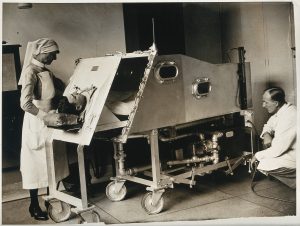
An iron lung, St. Bartholomew’s Hospital, London: a patient inside a Drinker respirator, attended to by a nurse and a doctor. Photograph, ca. 1930. Credit: Wellcome Collection. Attribution 4.0 International (CC BY 4.0)

Polio is my counter-cyclical topic to kick of a new year that everyone hopes will see the Covid-19 global pandemic kicked in the arse. That’s Australian lingo for vanquished, eradicated, snuffed out. Despite hopes that the Covid-19 respiratory virus will be globally defeated through a programme of vaccinations, it is unlikely to cover everyone who needs it, this year or even next. So let’s be informed by history.

My generation will recall the arrival of the polio immunisation team at their local primary school in the 1950s. ‘The Jab’ was administered to all children as part of a mandatory scheme to eradicate poliomyelitis (polio) from New Zealand (where I grew up). NZ, like Australia, had virus outbreaks in the 1930s, 40s and 50s.

Polio is a viral disease that affects the spinal cord and nervous system, primarily in children and adolescents. Globally, the disease has been 99% eradicated, after an immunisation programme started in 1955. Yet, as health authorities warn, even though the disease has not been seen in the US since 1988, it would take just one live case to be imported to re-start the viral cycle.

I warmed to this as a FOMM topic after reading a few chapters of Alan Alda’s charming biography ‘Never have your dog stuffed’. Alda, who contracted polio as a child in the 1940s recalled, “The country was in the throes of an epidemic. People were afraid to go to public swimming pools or theatres for fear of contagion.”

His parents utilised a controversial treatment advocated by Australian nurse, Sister Elizabeth Kenny. The treatment involved application of heat packs and manual stretching of limbs. Though controversial at the time, the Kenny methods were absorbed into what we now know as rehabilitation medicine.

Despite Alda’s graphic description of the painful application of heat packs, he credits the Kenny treatment with not developing paralysis or the characteristic withered leg common in polio victims.

Even though his doctor had declared him no longer contagious, young Alda had few visitors. He related how one child came to visit for a short while, sitting across the room on a wooden chair.

“Over the next couple of weeks, I thought about this, how kind he was to visit me. I also noticed he didn’t come back.”

Serious polio cases were often subjected to lengthy periods in an ‘iron lung’. An iron lung was a bed inside a metal box with a cushioned opening where the patient’s head protruded. The machine helped patients breathe mechanically until such time as the virus subsided and they could breathe on their own.

Survivors who were left with a withered leg were fitted with a caliper to help them walk. Serious cases ended up in a wheelchair.

It is estimated that about 30% of those affected by paralytic polio could be vulnerable to Post-Polio Syndrome in later life. Occurring about 30 years after the initial infection, PPS causes progressively worsening muscle weakness in limbs affected by the disease.

To demonstrate that polio (like Covid-19) can affect anyone, many famous people were affected by the disease:

Actor and humorist Michael Flanders (of the duo Flanders and Swan) spent much of his life in a wheelchair after contracting polio in 1942. As you can tell by this splendid parody of Mozart’s horn concerto, Flanders did not let polio dominate his life, short as it was (he died in 1975 aged 53). Given the dire nature of this topic, I recommend this performance of “Ill Wind” as light relief.  

My favourite songwriter, Joni Mitchell, developed polio and spent much of her childhood at home, where she discovered a talent for art and music. Joni developed her distinctive range of open tunings on guitar and dulcimer to compensate for an arm weakened by the disease. Polio might also explain her friendship with another Canadian songwriter, Neil Young, also a victim.

Australian songwriter Joy Mckean has worn a caliper since developing polio in childhood. In the documentary Slim and I, she tells the story of how she came to write Lights on the Hill, one of her husband Slim Dusty’s enduring songs. As Joy tells it, in the days when she and Slim criss-crossed the continent, the dip switch of most cars was located on the floor, to the left of the brake pedal. As her left leg was paralyzed, Joy had developed a method of moving her right leg across to dip the lights and back to the accelerator. It puts lines like these sharply into context:

These rough old hands are a-glued to the wheel
My eyes full of sand from the way they feel
And the lights comin’ over the hill are a-blindin’ me

Many other well-known Australians were struck down with polio as children, including the late media tycoon Kerry Packer, radio presenter John Laws and former Deputy PM Kim Beazley.

Packer was at boarding school in 1945, aged six, when, as he recalls, “one morning I got out of bed and just fell flat on my face.

I had polio and rheumatic fever and was sent straight down to Sydney. They put me in hospital there for about nine months in an iron lung.”

Although there has not been a locally acquired case in Australia since 1972, the country has a polio response plan in place. The ever-present risk of the disease being imported could trigger the plan. Although wild poliovirus-associated paralytic poliomyelitis has not been reported in Australia since 1977, an imported case was reported in a man who had traveled from Pakistan to Australia in 2007.

British new wave rocker Ian Drury was a polio survivor. The disease left him with a withered leg and arm and other disabilities. That did not stop him forming a band (The Blockheads) and penning pithy songs like Sex’n Drugs’n Rock’n Roll, Hit me with Your Rhythm Stick and Reasons to be Cheerful.

Drury, a disabled man with a poor opinion of the International Year of Disabled Persons, wrote Spasticus Autisticus in 1981. The  lyrics are directed at the campaign, which he saw as patronising and counter-productive.

So place your hard-earned peanuts in my tin
    And thank the Creator you’re not in the state I’m in
    So long have I been languished on the shelf
    I must give all proceedings to myself.”

This could be loosely adapted to a post-Covid scenario; someone lamenting how Covid has left them with weird after effects, or how the world’s way of dealing with the pandemic has dealt them a bitter economic blow.

It’s not hard to imagine Australian health authorities developing a long-term Covid response plan, as they did with polio.

As we know, all it takes is one case, imported from somewhere else, and the contagion starts all over again.

Happy New Year, then!

Lyric extracts from www.lyrics.com

Note from the Editor- don’t blame me – I said:  “Why don’t you write something fluffy for the start of the year?”


Lockdown vs Covid easing

Lockdown-covid-easing
How soon we forget. Musician Silas Palmer checking off the first of 112 days of lockdown in Victoria (see music video link further down

So let me see if I can understand this – almost 50,000 people crammed, yes, crammed) into Suncorp Stadium/Lang Park amid a global pandemic. It was the largest sports crowd in the world since Covid restrictions were applied in March. Biosecurity protocols involved in buying tickets and entering the venue, was proof enough for the Queensland Government, given that anyone attending could be contacted after the event.

Yes, amazing what governments, big business, broadcasters and multinational betting agencies can achieve.

Last time I went to Brisbane’s footie stadium with that many people, it was everything that social distancing is not. Ladies, as few of you will have ever seen a urinal, we stand shoulder to shoulder at the trough. If it is busy, there will be a row of blokes behind us, waiting for a gap to appear. Many, faced with a tedious wait for the wash basins, often dispense with the formality.

Just one example.

As of 4pm on Tuesday, rules were relaxed for pubs and restaurants in Queensland and ‘normal’ crowds welcomed back for entertainment venues, including theatres.

As of the 17th, we can now have 50 people in our homes (though why would you, I thought).

The State government allows itself an ‘out’ by being able to declare a restricted Local Government Area, should the need arise.

In this case, only 10 people are allowed in your home, and that includes people who already live there.

Queenslanders can travel anywhere within the State for any reason, with no limit on distance. You can stay overnight within the State for as many nights as you like.

It’s not a level playing field, though. Queensland Health says that special visitor rules apply for aged care facilities, hospitals and disability accommodation providers.

At the same time these changes were pending, an outbreak of Coronavirus cases in South Australia demonstrated once again that Covid-19 is the gift that no-one wants, yet it nevertheless keeps on giving. Queensland too was finding new cases, most associated with quarantine from people returning from overseas.

But regardless of mixed messages, Queensland Health advice is still that you must practise physical distancing as much as possible and wash your hands regularly with soap and water. Use (60%+) alcohol-based sanitiser, avoid hugs, kisses and handshakes and keep 1.5 metres away from other people. Or as we say here – a kangaroo apart.

While Queenslanders are getting all enthusiastic about the ‘return to normal’, the Covid cluster that emerged in South Australia is a timely warning that this virus is not going away. SA is dealing with its untimely cluster by re-introducing some restrictions, the oddest of which is that you are not allowed to stand and drink in a pub.

“Mate, don’t stand at the bar coughing over everyone. Come over here to my table and cough on us instead.”

SA was to go into a six-day severe lockdown to hopefully stamp out the growing cluster of cases (34 and counting). However, today the ABC news advised that the lockdown would end on Saturday night, three days early.

I realise that my somewhat cautious approach to full slather mingling may upset people who think Covid restrictions are too much-too long. I chatted to a few people who have either been through the quarantine ritual or are Aussie ex-pats looking on from a distance.

Morocco-based Suzanna Clarke, who operates an accommodation business in Morocco and France, can’t believe what she is seeing on social media. A Brisbane friend posted photos of musicians mingling at a ‘session’ (where folkies gather at an ale house to play diddly tunes and sing songs).

No social distancing, no masks needed! Consider yourselves extremely lucky,” Suzanna wrote. There is no way I would be attending a similar event on this side of the planet.”

Morocco (pop 36 million), has recorded 307,000 cases and 5,031 deaths. Suzanna says it is hard to know what’s currently going on.

“It’s also very hard to get a PCR test – even if you can afford it. So the numbers are likely to be much higher. The government doesn’t want to go into lockdown again because people will starve. Literally. Unemployment benefits are only available for a few. My business here has been shut since March. My business in France was starting to pick up, and they went back into lockdown.

So every booking I had was cancelled. We still have wages to pay, so we’re trying to get by on what we have, and raiding our savings. We are, of course, are among the lucky ones.”

Musician friends Silas Palmer and Sarah Busuttil recently posted a series of videos on Facebook depicting 14 days of life at the Howard Springs quarantine facility in Darwin. They flew from Melbourne to the Northern Territory, en route to Queensland and northern NSW to visit a gravely ill family member.

Since this week’s missive is somewhat dire, I thought I’d share this cheerful video the duo made during Victoria’s 112-day lockdown.

(Collins’ Dictionary word of the year, by the way!).

 Meanwhile, the world’s share markets have, as usual, over-reacted to news that Big Pharma has a vaccine ready to go. Global share markets rose 10% in a week.

FOMM reader Mr Shiraz, a strict follower of Covid prevention protocols, had this to say on Facebook:

I have been thinking about the excitement elicited by Covid vaccine announcements (Ed: described in share market reports as ‘vaccine optimism’).

It has taken us more than three decades to get polio 99% eradicated. To imagine a Covid planetary vaccination program being anywhere near good enough for “normal” life to resume in five years is silly.”

A recent article in the UK’s pre-eminent medical journal, The Lancet, advised that we get used to social distancing, hand sanitisation and wearing masks because it will be with us for “several years”.

Science magazine Nature concurred, citing a team of researchers  in virus hotspots at Anhembi Morumbi University, São Paulo, Brazil. They ran more than 250,000 mathematical models of social-distancing strategies.

The team concluded that if 50–65% of people are cautious in public, then stepping down social-distancing measures every 80 days could help to prevent further infection peaks over the next two years. Bear in mind that this research was published in August, which in the context of a fast-moving pandemic is probably a bit old.

Current international statistics are extremely worrying:

  • US 11.6m cases, 250,000 deaths;
  • India: 8.91m cases, 131,000 deaths;
  • Brazil: 5.91m cases 171,000 deaths;
  • France: 2.71m cases, 46,698 deaths;
  • Russia: 1.99m cases, 34,387 deaths’

Australia looks comparatively healthy when you consider there have been 27,777 cases and 901 deaths since January.

However, there have been 93 recent cases, including 21 reported in the last 24 hours. Drilling down into Queensland’s stats, we have had 1,190 cases, 6 deaths and 12 active cases, including 3 in the last 24 hours.

Well excuse me. Much as I loved watching Queensland snatch the Origin series away from New South Wales, I won’t be going to any major sporting events, this year or next.

As Mr Shiraz says: “Let’s adopt a new normal expectation.