Covid- it’s everywhere

covid-masks-pandemic
Washing line 2022 Willfried Wende – www.pixabay

On a quick shopping trip this week, it seemed that every second person was wearing a Covid mask, even though there is no legal obligation to do so. Friends, relatives, neighbours and friends of friends are either in isolation because of a positive RAT test or actually have Covid-19. There’s been a nasty flu getting around South-East Queensland at the same time. The only way to tell one from the other is to take a Rapid Antigen Test.

The statistics are a bit scary. The only saving grace is that the Omicron variants are said to be ‘milder’ than the Delta strain which was rampant in 2020.

As of this morning, Queensland reported 45, 824 active cases, including 6,366 new cases in the previous 24 hours. There were 907 hospitalisations and 14 patients in Intensive Care Units. There have been 73 deaths (people who died with Covid) this week alone.

There are many unanswered questions about this third wave of the Omicron variant. Like, how come we haven’t had it? Knock on wood. Or why do some people get “long Covid’’ where symptoms persist for months?

If you look at the historical charts, you have to wonder why governments decided to take their collective feet off the pedals of the crowd control machine.

On December 16, 2021, Queensland had 17 cases (a weekly average of 9). Then we opened the borders, relaxed the mask mandate and other rules like contact tracing which had thus far kept the virus out of Queensland.

By January 17, 2022, new cases had spiked to 31,056. While numbers have since fallen away, the State reported 32, 355 new cases (between July 11 and 15), with hospitalisation rates between 800 and 900.

Cumulatively, Queensland has now recorded 1.63 million cases (equates to 32% of the population) and 1,388 deaths. So much for Omicron being more infectious but less serious than Delta.

Queensland’s chief health officer John Gerrard has been quoted that catching Covid is “inevitable”. Ironically former chief health officer Jeanette Young, now Governor of Queensland, was also taken down by the virus.

Did you know that the entire Queensland Maroons rugby league team held a fan day in Warwick last week? The visit started with a sold-out dinner on Tuesday night with guest speakers including Maroons coach Billy Slater. Next day there was a street parade, breakfast in the park, coaching clinics for children and then the Maroons had a training session at the local footie oval. A few days later, two members of the team, Cameron Munster and Murray Taulagi tested positive for Covid and were unable to play in the decider on Wednesday.

I did notice that team members wore masks as they mingled with the thousands of fans who turned out to meet and greet.

Which brings me back to people wearing masks – in the street, in cafes, shopping centres and pharmacies. The latter used to insist on customers wearing a mask, but without the muscle of a state-mandated instruction, they can only make polite suggestions.

Remember the days of close contacts and contact tracing? The border closures, closed-down cafes and bars? Apart from hospitals, organisations with a Covid policy and employers, it seems you don’t have to prove you are double vaccinated. Hardly anyone checks to see the green tick on your phone. I was only asked to do so twice on a three-week trip to Tasmania in April. We did find you had to wear masks on public transport in Victoria and Tasmania (as you do in Queensland, although many do not wear masks).

An approved style of mask is your first line of defence to avoid being infected by Covid-laced aerial droplets. Second line is to stay home as much as possible.

The people I feel for are those who cannot avoid being in close quarters with other people (aged care homes, prisons, detention centres etc). It is now well known that residents in aged care are vulnerable; not only because of their living circumstances, but also because most are 75 and over and in the high-risk category.

Nationally there have been 2,881 deaths in aged care homes since the pandemic began in early 2020 and 2,580 residential aged care facilities have had an outbreak during that time. It’s probably misleading to include those two facts in the same sentence because the mind goes: ‘Hey, that’s an average of one death for each facility.’  
The Guardian reported yesterday that 100 aged care residents are dying with Covid each week, with more than 700 current outbreaks. The industry fears that two-thirds of aged care homes across Australia may be grappling with outbreaks over the next six weeks.

Amid reports of a Covid outbreak on a cruise ship anchored in the Brisbane River, I went looking for places in the world where the virus had been contained. Unhappily, the virus has caught up with some of the 10 or so island countries which, until the end of 2021, had managed to stay safe. They included Nauru, which went from zero cases in late 2021 to 40% of the population being infected. Nauru, as you may or may not know, is ‘home’ to 129 asylum seekers, most of whom have been on the island since 2012.

The World Health Organisation confirms that there are currently 121 new cases in Nauru and a cumulative 6,237 cases (and one death) since January 2022.

Citing global numbers, the WHO says that as of July 11 there have been 552.5 million confirmed cases of COVID-19 and 6.34 million deaths. As of 2 July 2022, a total of 12.03 billion vaccine doses had been administered. As for the United States, 87 million cases have been recorded since early 2020 and 1.02 million deaths. Donald Trump, we’re looking at you.

Compare that with Australia – 10,515 deaths since the first cases were seen in February 2020.

This takes me back to an early report from Seattle, the US city that gave the world the TV soap opera ‘Grey’s Anatomy’. A community choir had met for a rehearsal in the early days of Covid when nobody knew what we were dealing with.

As Live Science recalls, 52 people were unknowingly infected with Corona virus at a choir practice in Mount Vernon, Washington. The event led to the deaths of two people.

The practice happened on March 10, roughly two weeks before Washington Governor Jay Inslee issued a ‘stay home stay healthy’ executive order, barring social gatherings and non-essential travel.

That story shocked Australian choral singers. Most community choir directors I knew decided to cancel rehearsals for the foreseeable future. We mucked around on Zoom for a while and had a few tentative practices outside, but it just wasn’t the same. Eventually in 2021, as case numbers began to fall, choirs and orchestras started rehearsing again under controlled circumstances.

Experts told us that singing in a closed room was a sure-fire way to catch the virus – 20 or 30 people spraying droplets everywhere. Nobody said anything about 52,000 people in a footie stadium shouting and screaming for 80 minutes. Yes, it was an open-air event, but even so, those patrons walked in and out of the venue, used the public toilets and struggled back and forth along packed aisles, spilling beer and spreading potentially lethal aerial droplets around. Because Queensland won the State of Origin series, there was lots of hugging, kissing and selfie-posing. Then they all got on trains and buses, noisily singing the team song on the way home.

Don’t get me started. (Yes, but ‘we’ won – wasn’t it sweet? Ed)

FOMM Back Pages
Spreading the word about U3A

U3A-birdwatching-education
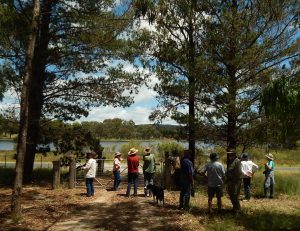
(Photo by Bob Wilson): U3A Warwick birdwatchers checking out the shallow end of Storm King Dam while on a recent excursion.

One of the positives in retirement is that it allows one to volunteer with valuable community organisations like U3A. It’s not that uncommon to meet people who have never heard of the University of the Third Age (U3A), an international organisation with broad aims of helping educate and entertain its 450,000 members, who are now in their ‘Third Age’ of life.

U3A originated in France in 1973 as an extramural university activity. This was significantly modified in the UK where it was recognized that most people of retirement age have something to contribute. The UK model, which Australia has adopted, emphasises sharing without formal educational links, that is, ‘study’ without the pressure of homework or exams. Membership is open to people who are winding down to retirement or are already retired.

Australia’s first U3A began in Melbourne in 1984 and has grown to 250 U3As with about 100,000 members. These metropolitan, regional and rural chapters develop programmes of teaching and learning over a wide range of subject areas, dependant upon the membership’s own expertise, knowledge and skills.

For example, in our local Warwick U3A, the retired principal of Scots PGC College, Neil Bonnell, tutors two courses – China Today and the Bible as History. Mr Bonnell, a much-travelled senior educator, taught at well-regarded schools in England, Uganda and Australia, finishing his career with a year in China. Last year he started writing his memoirs, which have been published in the Warwick U3A Emag and quarterly newsletters. The final chapters can be found here.

In 2003 Neil began tutoring and giving bridge lessons for U3A Warwick. He is a founding member of Warwick Bridge Club and past-president and a long-serving committee member of U3A.

I started attending Neil’s up to the minute and insightful class “China Today” this year. The advantage of being a member of a U3A course or class is that you can sit back and soak up someone else’s great knowledge and experience for a very modest annual subscription. All tutor and committee roles are voluntary. Local U3A chapters are supported by State and Territory Networks; organisations which help local committees with more complex issues (like developing a Covid policy).

Queensland U3A Network president Gail Bonser reflected on the struggle to keep U3As going through the pandemic and restrictions which saw some classes postponed or cancelled.

“Managing a U3A during the COVID epidemic has been taxing for many. Quite a few U3As have experienced a reduction in numbers and with it a reduction in their income.  All were closed for several months during 2020 and because of their special circumstances, some did not reopen during the remainder of that year.

“During the shutdown, the Network formed a communication group which enabled U3A Presidents or their representatives to keep in touch and to share ideas, experiences and management techniques.  Once Level 3 restrictions were introduced, it became possible for U3As to recommence classes and activities and members of the group exchanged documents such as COVID Safe Plans.”

Ms Bonser said associations were hoping for a COVID free start to 2022 but the Omicron spike intervened.  Most U3As cancelled their January Enrolment Days, made alternative arrangements and/or delayed the resumption of classes to early February.
“Thankfully it seems that U3A members have largely avoided the worst effects of the disease. That may have been one of the few positives.”

I joined the Warwick committee at the time we were looking for someone to edit the quarterly newsletter. The former editor had been producing a monthly Emag as well as quarterly newsletters. I took the job on the proviso I’d phase out the monthly magazine. Since then, my role has been extended to include updating our website and posting new content as appropriate.

Our chapter hosts outdoor activities including Tai Chi, bush walking and birdwatching. There are language classes, card groups, art and craft classes, meditation, music appreciation and this year, two new dance classes – Line Dancing and Scottish Country Dance. A new gardening group was formed in 2022 and retired teacher Stephen Jackson is next term resuming his popular opera class. Some courses are so popular there is a waiting list (wood crafting, for example).

Two of the four groups I joined require getting out of bed early – bush walking and birdwatching. Both activities depend on what the weather is doing at the time. Last year, our bush walking group’s expeditions included a day at Girraween National Park and a visit to Cunningham’s Gap nature reserve. The birdwatching group also travel afield and in February visited a private property at Storm King dam near Stanthorpe.

I was recently talking to a younger friend in Brisbane (late 40s) and mentioned U3A. He had not heard of the organisation but after I gave him an overview, he said it sounded like something his Mum would enjoy.

U3A members are from all different backgrounds, but it is not uncommon to meet people who have had a university education and a professional career. Perhaps that is why we have not one but two book clubs. One is a formal book club (everyone reads the same book and then the group critiques it). A new course started this year involves re-reading old Australian classics, starting with Peter Carey’s True History of the Kelly Gang.

Our U3A has about 125 members and is currently running 27 courses, so there is a lot of choice. There is also provision for members to take part in other activities through U3A Online.

As for volunteering in general, I recommend it for older people (70+) as a way of keeping your brain sharp and sharing your life experience with others. I started volunteering in 2021 as an occasional tour guide at Glengallan Homestead, a grand country home from the 1870s that was rescued from ruin. Then I joined a local refugee support group and along the way stepped up my involvement with U3A. In a way, volunteering is like one of the main aims of the organisation – to encourage people to try something new.

As someone remarked after I accepted the position of chair of the Southern Downs Refugee and Migrant Network – “You’ll grow into the role, Bob.”

The only problem with U3A (if like me you have a 40-year-old brain), is that you only ever meet people your own age (early 70s) or older. While that firmly cements me in the demographic to which I belong, it can also be a gratifying experience. Those of us who lost our parents relatively early in life can always benefit from the wise counsel of an older friend.

The message today (for readers under 50) is to subtly suggest to your parents (or grandparents) that they check out U3A. A year of absorbing activities and new friends for the price of a pub lunch. As for my peers, you don’t have to just sit there and watch daytime TV or play Solitaire on your computer. Go for a regular walk, join a seniors’ gym class, interact with grandchildren and look into U3A. Do as I say, not as I do (says he, flexing his ab). As they say, physical and intellectual activity can enrich and prolong life in one’s later years – just ask me!

FOMM back pages

Lockdown vs Covid easing

Lockdown-covid-easing
How soon we forget. Musician Silas Palmer checking off the first of 112 days of lockdown in Victoria (see music video link further down

So let me see if I can understand this – almost 50,000 people crammed, yes, crammed) into Suncorp Stadium/Lang Park amid a global pandemic. It was the largest sports crowd in the world since Covid restrictions were applied in March. Biosecurity protocols involved in buying tickets and entering the venue, was proof enough for the Queensland Government, given that anyone attending could be contacted after the event.

Yes, amazing what governments, big business, broadcasters and multinational betting agencies can achieve.

Last time I went to Brisbane’s footie stadium with that many people, it was everything that social distancing is not. Ladies, as few of you will have ever seen a urinal, we stand shoulder to shoulder at the trough. If it is busy, there will be a row of blokes behind us, waiting for a gap to appear. Many, faced with a tedious wait for the wash basins, often dispense with the formality.

Just one example.

As of 4pm on Tuesday, rules were relaxed for pubs and restaurants in Queensland and ‘normal’ crowds welcomed back for entertainment venues, including theatres.

As of the 17th, we can now have 50 people in our homes (though why would you, I thought).

The State government allows itself an ‘out’ by being able to declare a restricted Local Government Area, should the need arise.

In this case, only 10 people are allowed in your home, and that includes people who already live there.

Queenslanders can travel anywhere within the State for any reason, with no limit on distance. You can stay overnight within the State for as many nights as you like.

It’s not a level playing field, though. Queensland Health says that special visitor rules apply for aged care facilities, hospitals and disability accommodation providers.

At the same time these changes were pending, an outbreak of Coronavirus cases in South Australia demonstrated once again that Covid-19 is the gift that no-one wants, yet it nevertheless keeps on giving. Queensland too was finding new cases, most associated with quarantine from people returning from overseas.

But regardless of mixed messages, Queensland Health advice is still that you must practise physical distancing as much as possible and wash your hands regularly with soap and water. Use (60%+) alcohol-based sanitiser, avoid hugs, kisses and handshakes and keep 1.5 metres away from other people. Or as we say here – a kangaroo apart.

While Queenslanders are getting all enthusiastic about the ‘return to normal’, the Covid cluster that emerged in South Australia is a timely warning that this virus is not going away. SA is dealing with its untimely cluster by re-introducing some restrictions, the oddest of which is that you are not allowed to stand and drink in a pub.

“Mate, don’t stand at the bar coughing over everyone. Come over here to my table and cough on us instead.”

SA was to go into a six-day severe lockdown to hopefully stamp out the growing cluster of cases (34 and counting). However, today the ABC news advised that the lockdown would end on Saturday night, three days early.

I realise that my somewhat cautious approach to full slather mingling may upset people who think Covid restrictions are too much-too long. I chatted to a few people who have either been through the quarantine ritual or are Aussie ex-pats looking on from a distance.

Morocco-based Suzanna Clarke, who operates an accommodation business in Morocco and France, can’t believe what she is seeing on social media. A Brisbane friend posted photos of musicians mingling at a ‘session’ (where folkies gather at an ale house to play diddly tunes and sing songs).

No social distancing, no masks needed! Consider yourselves extremely lucky,” Suzanna wrote. There is no way I would be attending a similar event on this side of the planet.”

Morocco (pop 36 million), has recorded 307,000 cases and 5,031 deaths. Suzanna says it is hard to know what’s currently going on.

“It’s also very hard to get a PCR test – even if you can afford it. So the numbers are likely to be much higher. The government doesn’t want to go into lockdown again because people will starve. Literally. Unemployment benefits are only available for a few. My business here has been shut since March. My business in France was starting to pick up, and they went back into lockdown.

So every booking I had was cancelled. We still have wages to pay, so we’re trying to get by on what we have, and raiding our savings. We are, of course, are among the lucky ones.”

Musician friends Silas Palmer and Sarah Busuttil recently posted a series of videos on Facebook depicting 14 days of life at the Howard Springs quarantine facility in Darwin. They flew from Melbourne to the Northern Territory, en route to Queensland and northern NSW to visit a gravely ill family member.

Since this week’s missive is somewhat dire, I thought I’d share this cheerful video the duo made during Victoria’s 112-day lockdown.

(Collins’ Dictionary word of the year, by the way!).

 Meanwhile, the world’s share markets have, as usual, over-reacted to news that Big Pharma has a vaccine ready to go. Global share markets rose 10% in a week.

FOMM reader Mr Shiraz, a strict follower of Covid prevention protocols, had this to say on Facebook:

I have been thinking about the excitement elicited by Covid vaccine announcements (Ed: described in share market reports as ‘vaccine optimism’).

It has taken us more than three decades to get polio 99% eradicated. To imagine a Covid planetary vaccination program being anywhere near good enough for “normal” life to resume in five years is silly.”

A recent article in the UK’s pre-eminent medical journal, The Lancet, advised that we get used to social distancing, hand sanitisation and wearing masks because it will be with us for “several years”.

Science magazine Nature concurred, citing a team of researchers  in virus hotspots at Anhembi Morumbi University, São Paulo, Brazil. They ran more than 250,000 mathematical models of social-distancing strategies.

The team concluded that if 50–65% of people are cautious in public, then stepping down social-distancing measures every 80 days could help to prevent further infection peaks over the next two years. Bear in mind that this research was published in August, which in the context of a fast-moving pandemic is probably a bit old.

Current international statistics are extremely worrying:

  • US 11.6m cases, 250,000 deaths;
  • India: 8.91m cases, 131,000 deaths;
  • Brazil: 5.91m cases 171,000 deaths;
  • France: 2.71m cases, 46,698 deaths;
  • Russia: 1.99m cases, 34,387 deaths’

Australia looks comparatively healthy when you consider there have been 27,777 cases and 901 deaths since January.

However, there have been 93 recent cases, including 21 reported in the last 24 hours. Drilling down into Queensland’s stats, we have had 1,190 cases, 6 deaths and 12 active cases, including 3 in the last 24 hours.

Well excuse me. Much as I loved watching Queensland snatch the Origin series away from New South Wales, I won’t be going to any major sporting events, this year or next.

As Mr Shiraz says: “Let’s adopt a new normal expectation.

Don’t fence me in – a COVID-19 adventure

covid-19-travel-adventure
The author looking for an elusive bird at Sawn Rocks, 25kms from Narrabri. Photo by Laurel Wilson.

In downtown Dubbo, NSW, the checkout operator at one of the major supermarkets described the day as ‘crazy’. Shopping late (6pm) we managed to buy enough food to tide us over, mindful of Scotty from Marketing’s exhortation to stop hoarding, because ‘it’s UnAustralian’. But the PM was at least three weeks late with that edict, which fell on deaf shoulders (in Dubbo at least). There were plenty of empty shelves and shortages. No rice, mince, long life milk, potatoes, pumpkins or toilet rolls. I cracked a lame joke with a customer about SFM’s demand that we stop hoarding.

“Didn’t work here,” was the terse response. (Possibly because people resent being spoken to like naughty schoolkids.Ed.) The only things on our list that we could not buy were spuds and long life milk – the mainstay of campers everywhere. What is that about? In normal times supermarkets can’t give it away!

But these are not normal times, not at all.

As of 8pm on Thursday, there were 565 diagnosed cases of coronavirus in Australia. Yes, it is spreading fast. But lazy reporting, combined with deliberate sensationalism in the news media does not help with perspective.

Example: “The number of COVID-19 cases in NSW (265), has escalated dramatically,”  the comment not balanced with the observation, ‘Australia’s most populous state’ (7.54 million).

Scotty and his War Cabinet came up with the idea of advising the cancellation of all non-essential events attracting crowds of more than 500 people. Just why they decided on that arbitrary number is one mystery. The other imponderable is why the COVID Crisis Team decided to foreshadow the plan on March 11 but postpone it until after the weekend of March 13-15, which just happened to be the start of the rugby league season.

As we all now know, future rounds of NRL matches will be held in empty stadiums, to attempt to limit the spread of the virus; to flatten the curve, as they say.

Regardless of what happens to the infection rate now, 80,000 people attended eight rugby league games last weekend, not to mention the thousands who attended the Hillsong Conference in Sydney. As of last Monday, you can’t go and watch a live footie game anywhere.  I have no argument with that, but must roll out the old cliché about  closing the stable door. Too late, Scotty, that horse has bolted. The War Cabinet may yet regret the decision to let 80,000 people co-mingle, three days ahead of a ban on mass gatherings, which they now tell us could last for six months.

As I said last week, we are on the road and anything could happen. The three music festivals and a garden show we had planned to attend have been cancelled. Nevertheless, we motored on down the New England and Newell highways, giving our new-ish caravan its first serious road-test.

People we know who are taking the coronavirus more seriously than we are (so far) seemed alarmed that we were not self-immolating or whatever they call it. We are not alone. I counted 185 vehicles between Moree and Narrabri (some 100kms). A third of them were trucks – essential services, no doubt. In a way, we travellers are all self-isolating, sealed in our air conditioned cabs except for times when we have to refuel (paying by EFTPOS, using the same keypad upon which hundreds of customers have already left their microbe-laden fingerprints).

We’ve been staying in local showgrounds, a process which usually involved leaving cash in an honesty box. Vans are parked a long way from each other so there’s not much interaction unless you go looking for it. As I have remarked to people who know me well – I have no trouble with social distancing.

It’s a bit hard to find a news story which is not touching on the coronavirus pandemic, even in a small way, so we switched off and went birdwatching. Lake Narrabri is a good spot to see water birds of all varieties, which we did, thanks to the unprecedented discipline of getting out of bed at 7am!

If we were not ambling around country New South Wales (centre of the coronavirus universe, remember), we’d not have seen the amazing Sawn Rocks (photo above). The basalt formation lies at the bottom of a small gorge in remnant rainforest. The spectacular geology is known in the trade as ‘organ piping’.

Later we drove to Gulargambone, (kudos for those who can pronounce it correctly) stopping off for a good soak in the Pilliga Bore Baths. There were three other people in the pool and we all negotiated our corners without anyone having to say anything. I noticed that they close the baths for cleaning on Friday mornings.

Matters of personal hygiene loom large when assailed by a fast-spreading virus for which there is no vaccine. Dubbo’s biggest supermarket was right out of all items related to hand sanitation. My plan is to buy a small spray bottle from a $2 shop and mix up a mild solution of antiseptic and water. I was bemused to see sideline officials at the Tigers vs Dragons game, disinfecting footballs every time one of them went off-field. Dip, rinse and dry. Then gloved-up ball kids ran the ball back to where it was needed. Did that really happen?

The cancellation of the three music festivals at Katoomba, Yackandandah and Horsham was not a financial loss for us, apart from deciding not to upgrade our non-refundable cheap air fares to Sydney and back.

We were just going to these festivals as punters, maybe picking up a walk-up gig along the way. But I feel for my musician friends trying to earn a living in a notoriously fickle business.

As one muso friend said: “We’re watching our careers evaporate and transition to an online model that can’t possibly be sustained.”

Sick of all the negativity and doom-saying across all media, I went on a hunt for the places which had the smallest exposure to COVID-19. Gibraltar, a British protectorate located between Spain and Morocco, has only three reported cases after banning all cruise ships quite some time ago. The Vatican (meaning the Holy See), had one reported case, and the ACT has three, including high-profile politician Peter Dutton. Or you could head for the Northern Territory where no cases of COVID-19 have been reported. But you’d have to be sure you were not carrying the virus, and apparently that is the one thing none of us know.

I’m not at all sure how the Vatican City, a walled enclave within greater Rome, has managed to keep coronavirus out. Italy now has 25,000 cases and the death toll has reached 1,809. Normally a haven for tourists in the lead-up to Holy Week, this report says tourists have vanished across Italy. That must be a weird feeling for the citizens of Venice, who each year host 20 million tourists.

Closer to home, the Byron Bay Blues Festival and Canberra’s National Folk Festival at Easter have both been cancelled, with a host of smaller events following suit. Sydney’s Royal Easter Show and Melbourne’s annual flower show have also been axed. This is likely to be a financial disaster for the catering businesses who earn a living from such events.

Meanwhile we will continue on our uncharted road adventure, spending a bit of money in local towns, as my editor person says “until someone in authority orders us to stop.”

Tales of quarantine and homelessness

quarantine-homelessness
Image: Nurses wearing surgical masks during the 1918 Spanish Flu’ pandemic which killed 15,000 Australians and millions worldwide. State Library of Queensland CC

Had it not been for the coronavirus outbreak (the WHO calls it COVID-19), few Australians would have known of Manigurr-ma, a purpose-built accommodation village 30kms from Darwin.

Manigurr-ma, or Howards Springs as it is zoned by Australia Post, was built in 2012 at a cost of $600 million as part of the Ichthys LNG gas project. Developed by infrastructure company Aecom for the multinational INPEX consortium, the village can house up to 3,500 people in 875 accommodation units, each with four rooms. There is a 1,750-place dining hall, a commercial kitchen which can produce 10,000 meals per day, a licensed tavern, a cinema, medical centre and laundry.

For the next fortnight or so, the village will be home to 266 Australians evacuated from the coronavirus epicentre, the Chinese city of Wuhan. Despite assurances that the risk to the general public is minimal, Howard Springs residents are making their opinions known.

After the LNG plant at Howard Springs became fully operational in 2018, the village was closed, after housing 3,500 construction workers at its peak. In May last year, Ichthys LNG Pty Ltd transferred Manigurr-ma to the Northern Territory government at a ‘peppercorn’ rental. A spokesperson for the NT Government told FOMM a ‘have your say’ campaign was carried out last year.

“Proposals were received from a range of parties, including public feedback for the future use of the Village and its assets. 

‘‘The various submissions will be considered in the final decision by the Government about how the site and its assets will be used”

FOMM notes that the proposal required submissions to be “commercially viable”.

Given that a shortage of housing is a key issue for Darwin’s homeless population, I hope someone threw that particular hat in the ring.

Quarantine, from the Italian Quarante (meaning ‘forty’), has been around since Old Testament days. The word referred to a rule introduced in Venice that all ships suspected of harbouring people with infectious diseases stood offshore for 40 days.

Several small islands off Venice known as Lazarettos were established in the 1600s when plague was rampant. Some of these off-limits islands were later converted to mental hospitals or convents. But as far as the general populace were concerned, they were, and still are, ghost towns.

Most countries had a place where people with leprosy or plague were banished. China had a well-established policy from 600 AD to detain plague-ridden sailors and foreign visitors, preferably at sea.

North Brother Island in New York’s East River was used for decades as the site of an infectious diseases hospital. A reporter from the New York Post who was recently taken on a guided tour of the now-closed station wrote that the island’s remote location was deemed perfect in the 1880s for a hospital to treat contagious smallpox and typhoid patients.

“Mary Mallon, who earned the name Typhoid Mary by passing the disease to 51 people while working as a cook in Brooklyn and Long Island, was its most infamous tenant. She displayed no symptoms herself, but was quarantined until her death in 1938.”

Sydney’s Quarantine Station at North Head (Manly) took in immigrants who had fallen ill (as well as some residents). As the authors of a book published in 2016 found, some recovered and were released. Some never made it out.

‘Stories from the Sandstone’, published in 2016 by the University of Sydney’s Peter Hobbins, Anne Clarke and Ursula Frederick, chronicled the history of Sydney’s Quarantine Station. The title of the book comes from archaeological discoveries of inscriptions carved into sandstone by some of the 16,000 people kept at North Head between 1830 until its closure in 1984.

In the mid-1880s, infectious illnesses like smallpox, tuberculosis and scarlet fever were common and there was even a recorded case of bubonic plague in 1900. As Dr Hobbins says in the book, as a result of extensive immunisation programmes, effective antibiotics and improvements in the public health system, infectious diseases do not decimate the population as they did in the 1800s or even during the Spanish ‘Flu pandemic of 1918-1919.

The most visible (and possibly the largest), quarantine station in the world in 2020 is the cruise ship Diamond Princess, moored off Japan with its 2,666 guests and 1,045 crew ‘couped (sic) up’ as an ABC report had it, until time dilutes the fear of contagion. Princess Cruises this week confirmed reports of 39 new coronavirus cases aboard the ship, berthed at Yokohama.

“We are following guidance from the Japan Ministry of Health on plans for disembarkation protocols to provide medical care for these new cases,”  the website update states.

The Diamond Princess had been due to leave the Japanese port of Yokohama on February 4, but cancelled the cruise on advice from Japanese health authorities.

The cruise ship’s situation fits the definition of ‘quarantine’ – preventing the movement of those who may have been exposed to a communicable disease, but do not have a confirmed medical diagnosis.

The key difference between Coronavirus (now known as COVID-19) and SARS (Severe Acute Respiratory Syndrome) is that people with Coronavirus are infectious before exhibiting symptoms. This may explain the comparatively higher numbers of people contracting the disease and the overly-cautious approach to quarantine here and abroad.

A Medical Journal of Australia report compiled after the SARS epidemic had abated in 2004 demonstrated the effectiveness of Australia’s border screening. Of the 1.84 million arrivals into Australia during the study period, 794 people were referred for screening to the Australian Quarantine and Inspection Service. Of these, four travellers met the World Health Organisation (WHO) definition for SARS. None of these people were confirmed to have SARS.

The media loves contagion stories about as much as it drools over earthquakes, volcanic eruptions, tsunamis and croc and shark attacks. Are they beating it up? Time will tell. Whatever you read on social media, as of February 13, 2020, 15 Australians had been confirmed as being infected with coronavirus. Five have since recovered.

As usual, the trail of research leading into the history of quarantine stations lured me away from the point I wanted to make.

When the Northern Territory has 12 times the national average incidence of homelessness, how is it there are 875 living units sitting vacant near Darwin (for at least 18 months)?

NT Shelter estimates that 16.5% of Territorians under 16 are experiencing homelessness. The system seems unable to cope, with Shelter’s findings that 48% of people get turned away due to a ‘lack of resources’.

As Australia’s Prime Minister Scott Morrison conceded, we are no closer to Closing the Gap. The policy was announced in 2008 with noble intentions to help bridge the gap between health and welfare outcomes for indigenous compared to non-indigenous Australians. There are no simple answers to the fact that 90% of the Territory’s homeless are indigenous. As a Triple J story revealed, a survey of non-indigenous people in Darwin revealed a lot of ignorance about ‘long-grassers’ – indigenous people who sleep rough.

Larrakia Nation Aboriginal Corporation’s random survey of 300 people found the majority romanticised the notion of sleeping under the stars. Only six people identified a lack of housing, failed public policy and the impact of assimilation and integration policies as reasons for homelessness.

When the last person at Manigurr-ma is cleared to leave, it would be an interesting exercise, at the very least, to trial the centre as a homeless shelter. After all, though homelessness is not contagious, it does have far-reaching effects.