Why Human Beings Need a Hug

hug-isolation-love
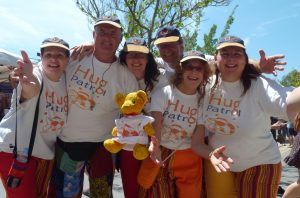
The Hug Patrol. Photo contributed by Arcadia Love

Forgive me, dear readers, for I have sinned (giving a hug in the privacy of my own home). A friend I had not seen for six months came to visit and the impulse to hug was too strong. We did the right thing to a degree, our heads facing away from each other, so the droplets would disperse in the same room, (where other people freely mingle).

You may have seen examples of people not observing the 1.5m COVID-19 physical distancing rule. Sneaks have taken phone footage in Brisbane nightclubs which show people mingling in close quarters and not sitting down to dance, as the Queensland Premier suggested.

The universal advice to maintain a physical distance of 1.5m from another person outside your immediate family makes sense. But it is hard to do and harder still to keep it up over an extended period.

The main reason is that human beings are just not designed to avoid physical contact with others.

New York Times writer Jane Brody writes that “social interaction is a critically important contributor to good health and longevity.

Referring to a long-term study by Lisa F. Berkman and S. Leonard Syme, Brody said findings drawn from 7,000 participants concluded that “people who were disconnected from others were roughly three times more likely to die during the nine-year study than people with strong social ties.

Physical contact can mean hugging, as championed by American folk songwriter Fred Small in his catchy ditty, The Hug Song. This version is by Brisbane musicians Donald McKay and Rebecca Wright, who compiled this video exclusively for FOMM. Warning: it’s an ear worm.

Late last year, we moved from a small village where, for a certain proportion of the community, hugging is the first thing you do on encountering friends, whether or not you saw them yesterday or six months ago. These are not perfunctory hugs either, but warm, tight embraces that last, well, sometimes they last longer than one party would prefer. I have it on good authority that the public hugging habit has abated in the village these past few months.

If you were a regular festival-goer in the first part of the new millennium. you might recall the Hug Patrol, initiated at Woodford in 2001 by actor/comedian Arcadia Love. Street performers roamed in small packs through the dusty byways of Woodford Festival, approaching just about anybody with open arms (asking permission first). The Hug Patrol is still turning up at festivals, carnivals, fetes, shows – anywhere where there is a crowd. Arcadia is understandably frustrated with the hug-less nature of 2020, saying that ‘virtual’ hugs are just not the same. The Patrol’s last live gig was at the Northey Street summer solstice in December 2019. The Hug Patrol’s deeds have touched people deeply, as writer Sandy McCutcheon said in a testimonial:

This extraordinary group of individuals has probably no idea of just what a positive impact they have.  I was fortunate to witness (at Woodford) the effect they had on a large group of refugee women from Afghanistan. For women whose lives are in tatters, families are scattered or dead, the rare moment of physicality was of tremendous importance.” 

Meanwhile The Conversation this week asked the most obvious question: “why are we all not wearing masks?”

There’s no doubt masks help stop the spread. A World Health Organisation study showed that face masks reduce the risk of infection with viruses such as COVID-19, by 67%, if a disposable surgical mask is used, and up to 95% if specialist N95 masks are worn.

The mask subject comes up often in community choir circles, where rehearsals are mostly still on hold and actual performances are being deferred to 2021. The theory about singers (and you’d have to ask why is it not the same for footballers who sprint 100m to score a try to be then piled upon by team members), aerosols can be spread up to 8m by singers (who don’t so far as I know, spit on the ground, or on the dressing room floor, or do that disgusting nose clearing thing ).

Plainly, a lot of people in Melbourne have not been maintaining physical distancing; nor, it would seem, have they been adhering to medical advice about social gatherings. The critical issue is, if you are feeling at all under the weather but have not been diagnosed, stay at home.

After the first month of the COVID-19 lock-down, the most common response you would get is, “I’m over it”.

Some of us spent 14 days in isolation, but in fairly comfortable circumstances, apart from not being able to leave home (except to walk the dog or buy groceries). I feel for residents in the public housing towers in North Melbourne, who up until today were not even allowed to do that. (One of the nine towers is still in very restrictive lock-down, the others have moved to ‘stage three’, like the rest of Melbourne.)

A Science Alert article on this subject (isolation and its ill-effects), said researchers based in Antarctica found that loneliness could be the most difficult part of the job.

Israeli adventurer and author Yossi Ghinsberg, who survived weeks alone in the Amazon, suffered loneliness, even creating imaginary friends to keep himself company. Which somehow reminded me of that Tom Hanks movie, where he is stranded on a desert island, alone except for a football called Wilson.

The degree to which isolation bothers you depends on your personality type (extroverts hate it). and your peer group. A report from Byron Bay about a ‘doof’ party that attracted thousands of young dance party goers, is an extreme example of how certain age groups find isolation and government-imposed health advice too inhibiting.

On the other hand, if you are a 70+ introvert with absorbing hobbies that can be performed alone in one room (Ed: who could he be talking about), the COVID-19 lock-down might not bother you at all.

So how much physical and social interaction does one have, in a typical day? If you are a checkout operator or a drive-through bottle shop attendant, quite a lot. Unemployed gamer, maybe not.

An academic study involving 7,290 participants was carried out in 2008 by researchers interested in reducing the spread of flu-like diseases. The first large-scale study of its kind, it found that respondents had on average 13.4 physical and non-physical contacts each day. The researchers recruited 7,290 people from eight European countries. They asked participants to keep a diary documenting their physical and non-physical contacts for a single day. Physical contacts included interactions such as a kiss or a handshake. Non-physical contacts, for example, might included a two-way conversation without skin-to-skin contact. The researchers concluded that the study provided a “deeper understanding of the transmission patterns of a hypothetical respiratory epidemic among a susceptible population.

If you take this study as a ‘norm’, how do these average interactions compare with 1,000 young people at a dance party or, as happened in Auckland on June 14, 43,000 people attending a rugby game?

We are not out of the woods yet, people, hugs or no hugs.

FOMM back pages

Splendid isolation in the time of COVID-19

Isolation-COVID-19
Two wallabies practising social distancing (in Wodonga, Victoria)

As we drove 1,200kms in haste from Albury NSW to the Southern Downs, trying to escape Queensland border chaos, I was grateful for readers’ insights into COVID-19 and isolation. First of all we should credit Sandy W with the witty caption for this week’s photo.

Realising I’d be spending three days driving home before resigning ourselves to self-isolation, I asked FOMM readers for their thoughts on this health crisis. I was overwhelmed with responses, so will keep some back for next week’s quarantine episode.

Two readers sent me the same meme which essentially says:

Your grandparents fought in a world war. All you’re being asked to do is sit on the couch. Don’t fuck this up.”

The meme memo was a bit too late for the hapless authorities who allowed 2,700 people to disembark from the Ruby Princess and mingle amongst the crowds in Sydney’s streets, shops and nightclubs; 130 passengers have since tested positive to COVID-19.

Yesterday we began 14 days’ voluntary home detention, mindful that we have been travelling through rural NSW in recent weeks.

King Richard of The Village said self-isolation is ‘great’.

“I’m enjoying the time to do all those jobs at home that I put aside for another day. We visit the IGA late in the evening when we need to and keep in touch with friends by phone. It’s a bit like my childhood memories of World War II and self-sufficiency.”

I asked our musician friend Silas Palmer how his gigs were going: “Six major festivals and a lot of small events, all cancelled but we’re in the same position as everybody else.”

“But we’re practicing a lot,” he added gleefully.

Katie Bee self-deprecatingly said: “So far the trickiest thing for me is that with so many things I CAN do, and so much time to do them in, my procrastination knows no bounds!

“But I’m finding myself a little more often on FB, and keeping in touch with friends by phone or email, and am gradually doing jobs that normally never enter my consciousness, after which I reward myself with some Netflix.”

Superchip from Calgary said that having been raised on a remote prairie farm in southern Alberta, isolation was not something that caused him great angst.

“I do not consider my formative years as being spent in social isolation, but I did spend a lot of time alone. I learned how to make my own fun. I learned how to just sit and try to take in my surroundings. I enjoy the company of other people, but I don’t need it on a constant basis. Given the state of the world at present, I feel I am one of the lucky ones. Getting past the pandemic will not be a mental challenge for me.” 

Anne and John are self-isolating, which means missing out of physical contact with grandchildren.

“We are missing our music session, our book clubs and exercise classes,” Ann said. “Our little granddaughter (supposed to be keeping to her school routine at home), Zoomed us this morning and tried to teach us some origami to keep us occupied…..argh!”

Barbara is coming to terms with strict tests and limits in her home, the Independent Living Unit section of an Aged Care Facility.

“The impact of the virus has radically changed our lives in the past couple of weeks, but particularly in the past couple of days.   All entrances other than the main one to our Residential Care Facility were closed last week; entrance restricted to two only visitors at a time (who have their temperature taken and are then asked to use hand sanitiser). This test has now been extended to delivery drivers visiting the facility.

Despite the constraints, she does not feel out of touch with the world.

“My IPhone is in full use. I can have uke jam sessions with friends; enjoy the light hearted Facebook posts and many, many things to keep my day full.” 

 A few of my readers appear to belong to the introvert club (we are apparently supposed to teach extroverts how to handle this).

Roger Ilott has been a professional musician and sound engineer for more than 30 years and is not fazed at all.

“As the ultimate stay-at-home, this is fulfilling a lifelong ambition of mine – I’ll never have to go out again!

“I actually always just wanted to be a session musician and did quite a bit of that in the 1970s and 1980s. Since Penny (Davies) and I started our own folk music label back in 1982, I’ve been able to do loads of session work as well as performing. I’m happy all my days sitting in the studio recording (and in cricket season, streaming the Sheffield Shield while I record!).”

After eight days in isolation, Ruth realised this was very similar to how her life has been for the past eight years, caring for her husband who had a serious stroke.

“I have come to this realisation after speaking to family and friends on the phone, some of whom are expressing angst and frustration. On listening, I realise I don’t feel like this at all. I am actually loving it. Loads of time in the garden( work and pleasure), heaps of time for photo sorting and sending, enjoyment in doing things I NEVER do, eg, cleaned all our windows inside & out the other day!”

Choir enthusiast First Soprano said that self-isolating for a couple of weeks would be easy as long as you prepared appropriately.

“Social isolation, as we know, is not a healthy situation (and unfortunately, unlike the Italians, we don’t live in high-rise flats; Italian city folk have been able to continue “socialising” from their balconies, which actually looks like lots of fun and would certainly keep spirits up), but happily in this day and age we have Skype and FaceTime so we can still easily keep in touch with family and friends.”

Jim from Albuquerque said life in the time of Corona had made a difference in his working class neighbourhood.

“Both friends and neighbours with either high or low paying jobs are on furlough or worse. Some better compensated than others in time-off but all paddling the same boat. Neighbourly relations are conducted at a safe remove but with a higher content of cordiality: Hey, howya doin’?; Feelin’ OK?; Need anything? Toilet paper?”

“Mercifully, no one is sick.”

Jon from Vancouver Island says there is always plenty to do on his little farm in what is often regarded as Canada’s Riviera.

“Spring has just arrived, which means preparing the garden for the upcoming season. Like many, I shudder when reviewing my market stocks but this brings with it a modicum of patience, realizing that fixing this up effectively is beyond me.” 

Ms Proodreader, who lives alone, said she is enjoying the interaction with virtual choirs and musicians sharing online.

“I’m mostly staying upbeat but I’m prone to little bursts of panic. I’m very much keeping away from all media….. especially social media…… as there is so much misinformation and I just need to know the basics not the analyses and the what ifs.” 

Yeh I’m with Proodie on that one. There is a lot of misguided and possibly inaccurate information being spread on social media by people who should know better. The mainstream media is completely obsessed and helplessly looking for any new angle.

As for the free papers left in the letterbox – wash your hands after reading.

Postscript: You might enjoy Erin Sulman’s Apocalypse Playlist. If you do have a listen, track 30 is Warren Zevon’s Splendid Isolation. It was recorded live in Brisbane in 1992 – you can probably hear us and Prince Richard of the Village cheering.