
Covid- it’s everywhere

covid-masks-pandemic
Washing line 2022 Willfried Wende – www.pixabay

On a quick shopping trip this week, it seemed that every second person was wearing a Covid mask, even though there is no legal obligation to do so. Friends, relatives, neighbours and friends of friends are either in isolation because of a positive RAT test or actually have Covid-19. There’s been a nasty flu getting around South-East Queensland at the same time. The only way to tell one from the other is to take a Rapid Antigen Test.

The statistics are a bit scary. The only saving grace is that the Omicron variants are said to be ‘milder’ than the Delta strain which was rampant in 2020.

As of this morning, Queensland reported 45, 824 active cases, including 6,366 new cases in the previous 24 hours. There were 907 hospitalisations and 14 patients in Intensive Care Units. There have been 73 deaths (people who died with Covid) this week alone.

There are many unanswered questions about this third wave of the Omicron variant. Like, how come we haven’t had it? Knock on wood. Or why do some people get “long Covid’’ where symptoms persist for months?

If you look at the historical charts, you have to wonder why governments decided to take their collective feet off the pedals of the crowd control machine.

On December 16, 2021, Queensland had 17 cases (a weekly average of 9). Then we opened the borders, relaxed the mask mandate and other rules like contact tracing which had thus far kept the virus out of Queensland.

By January 17, 2022, new cases had spiked to 31,056. While numbers have since fallen away, the State reported 32, 355 new cases (between July 11 and 15), with hospitalisation rates between 800 and 900.

Cumulatively, Queensland has now recorded 1.63 million cases (equates to 32% of the population) and 1,388 deaths. So much for Omicron being more infectious but less serious than Delta.

Queensland’s chief health officer John Gerrard has been quoted that catching Covid is “inevitable”. Ironically former chief health officer Jeanette Young, now Governor of Queensland, was also taken down by the virus.

Did you know that the entire Queensland Maroons rugby league team held a fan day in Warwick last week? The visit started with a sold-out dinner on Tuesday night with guest speakers including Maroons coach Billy Slater. Next day there was a street parade, breakfast in the park, coaching clinics for children and then the Maroons had a training session at the local footie oval. A few days later, two members of the team, Cameron Munster and Murray Taulagi tested positive for Covid and were unable to play in the decider on Wednesday.

I did notice that team members wore masks as they mingled with the thousands of fans who turned out to meet and greet.

Which brings me back to people wearing masks – in the street, in cafes, shopping centres and pharmacies. The latter used to insist on customers wearing a mask, but without the muscle of a state-mandated instruction, they can only make polite suggestions.

Remember the days of close contacts and contact tracing? The border closures, closed-down cafes and bars? Apart from hospitals, organisations with a Covid policy and employers, it seems you don’t have to prove you are double vaccinated. Hardly anyone checks to see the green tick on your phone. I was only asked to do so twice on a three-week trip to Tasmania in April. We did find you had to wear masks on public transport in Victoria and Tasmania (as you do in Queensland, although many do not wear masks).

An approved style of mask is your first line of defence to avoid being infected by Covid-laced aerial droplets. Second line is to stay home as much as possible.

The people I feel for are those who cannot avoid being in close quarters with other people (aged care homes, prisons, detention centres etc). It is now well known that residents in aged care are vulnerable; not only because of their living circumstances, but also because most are 75 and over and in the high-risk category.

Nationally there have been 2,881 deaths in aged care homes since the pandemic began in early 2020 and 2,580 residential aged care facilities have had an outbreak during that time. It’s probably misleading to include those two facts in the same sentence because the mind goes: ‘Hey, that’s an average of one death for each facility.’  
The Guardian reported yesterday that 100 aged care residents are dying with Covid each week, with more than 700 current outbreaks. The industry fears that two-thirds of aged care homes across Australia may be grappling with outbreaks over the next six weeks.

Amid reports of a Covid outbreak on a cruise ship anchored in the Brisbane River, I went looking for places in the world where the virus had been contained. Unhappily, the virus has caught up with some of the 10 or so island countries which, until the end of 2021, had managed to stay safe. They included Nauru, which went from zero cases in late 2021 to 40% of the population being infected. Nauru, as you may or may not know, is ‘home’ to 129 asylum seekers, most of whom have been on the island since 2012.

The World Health Organisation confirms that there are currently 121 new cases in Nauru and a cumulative 6,237 cases (and one death) since January 2022.

Citing global numbers, the WHO says that as of July 11 there have been 552.5 million confirmed cases of COVID-19 and 6.34 million deaths. As of 2 July 2022, a total of 12.03 billion vaccine doses had been administered. As for the United States, 87 million cases have been recorded since early 2020 and 1.02 million deaths. Donald Trump, we’re looking at you.

Compare that with Australia – 10,515 deaths since the first cases were seen in February 2020.

This takes me back to an early report from Seattle, the US city that gave the world the TV soap opera ‘Grey’s Anatomy’. A community choir had met for a rehearsal in the early days of Covid when nobody knew what we were dealing with.

As Live Science recalls, 52 people were unknowingly infected with Corona virus at a choir practice in Mount Vernon, Washington. The event led to the deaths of two people.

The practice happened on March 10, roughly two weeks before Washington Governor Jay Inslee issued a ‘stay home stay healthy’ executive order, barring social gatherings and non-essential travel.

That story shocked Australian choral singers. Most community choir directors I knew decided to cancel rehearsals for the foreseeable future. We mucked around on Zoom for a while and had a few tentative practices outside, but it just wasn’t the same. Eventually in 2021, as case numbers began to fall, choirs and orchestras started rehearsing again under controlled circumstances.

Experts told us that singing in a closed room was a sure-fire way to catch the virus – 20 or 30 people spraying droplets everywhere. Nobody said anything about 52,000 people in a footie stadium shouting and screaming for 80 minutes. Yes, it was an open-air event, but even so, those patrons walked in and out of the venue, used the public toilets and struggled back and forth along packed aisles, spilling beer and spreading potentially lethal aerial droplets around. Because Queensland won the State of Origin series, there was lots of hugging, kissing and selfie-posing. Then they all got on trains and buses, noisily singing the team song on the way home.

Don’t get me started. (Yes, but ‘we’ won – wasn’t it sweet? Ed)

FOMM Back Pages
Spreading the word about U3A

U3A-birdwatching-education
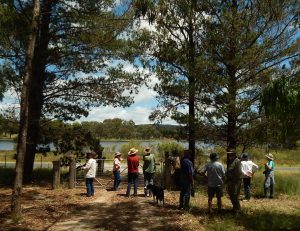
(Photo by Bob Wilson): U3A Warwick birdwatchers checking out the shallow end of Storm King Dam while on a recent excursion.

One of the positives in retirement is that it allows one to volunteer with valuable community organisations like U3A. It’s not that uncommon to meet people who have never heard of the University of the Third Age (U3A), an international organisation with broad aims of helping educate and entertain its 450,000 members, who are now in their ‘Third Age’ of life.

U3A originated in France in 1973 as an extramural university activity. This was significantly modified in the UK where it was recognized that most people of retirement age have something to contribute. The UK model, which Australia has adopted, emphasises sharing without formal educational links, that is, ‘study’ without the pressure of homework or exams. Membership is open to people who are winding down to retirement or are already retired.

Australia’s first U3A began in Melbourne in 1984 and has grown to 250 U3As with about 100,000 members. These metropolitan, regional and rural chapters develop programmes of teaching and learning over a wide range of subject areas, dependant upon the membership’s own expertise, knowledge and skills.

For example, in our local Warwick U3A, the retired principal of Scots PGC College, Neil Bonnell, tutors two courses – China Today and the Bible as History. Mr Bonnell, a much-travelled senior educator, taught at well-regarded schools in England, Uganda and Australia, finishing his career with a year in China. Last year he started writing his memoirs, which have been published in the Warwick U3A Emag and quarterly newsletters. The final chapters can be found here.

In 2003 Neil began tutoring and giving bridge lessons for U3A Warwick. He is a founding member of Warwick Bridge Club and past-president and a long-serving committee member of U3A.

I started attending Neil’s up to the minute and insightful class “China Today” this year. The advantage of being a member of a U3A course or class is that you can sit back and soak up someone else’s great knowledge and experience for a very modest annual subscription. All tutor and committee roles are voluntary. Local U3A chapters are supported by State and Territory Networks; organisations which help local committees with more complex issues (like developing a Covid policy).

Queensland U3A Network president Gail Bonser reflected on the struggle to keep U3As going through the pandemic and restrictions which saw some classes postponed or cancelled.

“Managing a U3A during the COVID epidemic has been taxing for many. Quite a few U3As have experienced a reduction in numbers and with it a reduction in their income.  All were closed for several months during 2020 and because of their special circumstances, some did not reopen during the remainder of that year.

“During the shutdown, the Network formed a communication group which enabled U3A Presidents or their representatives to keep in touch and to share ideas, experiences and management techniques.  Once Level 3 restrictions were introduced, it became possible for U3As to recommence classes and activities and members of the group exchanged documents such as COVID Safe Plans.”

Ms Bonser said associations were hoping for a COVID free start to 2022 but the Omicron spike intervened.  Most U3As cancelled their January Enrolment Days, made alternative arrangements and/or delayed the resumption of classes to early February.
“Thankfully it seems that U3A members have largely avoided the worst effects of the disease. That may have been one of the few positives.”

I joined the Warwick committee at the time we were looking for someone to edit the quarterly newsletter. The former editor had been producing a monthly Emag as well as quarterly newsletters. I took the job on the proviso I’d phase out the monthly magazine. Since then, my role has been extended to include updating our website and posting new content as appropriate.

Our chapter hosts outdoor activities including Tai Chi, bush walking and birdwatching. There are language classes, card groups, art and craft classes, meditation, music appreciation and this year, two new dance classes – Line Dancing and Scottish Country Dance. A new gardening group was formed in 2022 and retired teacher Stephen Jackson is next term resuming his popular opera class. Some courses are so popular there is a waiting list (wood crafting, for example).

Two of the four groups I joined require getting out of bed early – bush walking and birdwatching. Both activities depend on what the weather is doing at the time. Last year, our bush walking group’s expeditions included a day at Girraween National Park and a visit to Cunningham’s Gap nature reserve. The birdwatching group also travel afield and in February visited a private property at Storm King dam near Stanthorpe.

I was recently talking to a younger friend in Brisbane (late 40s) and mentioned U3A. He had not heard of the organisation but after I gave him an overview, he said it sounded like something his Mum would enjoy.

U3A members are from all different backgrounds, but it is not uncommon to meet people who have had a university education and a professional career. Perhaps that is why we have not one but two book clubs. One is a formal book club (everyone reads the same book and then the group critiques it). A new course started this year involves re-reading old Australian classics, starting with Peter Carey’s True History of the Kelly Gang.

Our U3A has about 125 members and is currently running 27 courses, so there is a lot of choice. There is also provision for members to take part in other activities through U3A Online.

As for volunteering in general, I recommend it for older people (70+) as a way of keeping your brain sharp and sharing your life experience with others. I started volunteering in 2021 as an occasional tour guide at Glengallan Homestead, a grand country home from the 1870s that was rescued from ruin. Then I joined a local refugee support group and along the way stepped up my involvement with U3A. In a way, volunteering is like one of the main aims of the organisation – to encourage people to try something new.

As someone remarked after I accepted the position of chair of the Southern Downs Refugee and Migrant Network – “You’ll grow into the role, Bob.”

The only problem with U3A (if like me you have a 40-year-old brain), is that you only ever meet people your own age (early 70s) or older. While that firmly cements me in the demographic to which I belong, it can also be a gratifying experience. Those of us who lost our parents relatively early in life can always benefit from the wise counsel of an older friend.

The message today (for readers under 50) is to subtly suggest to your parents (or grandparents) that they check out U3A. A year of absorbing activities and new friends for the price of a pub lunch. As for my peers, you don’t have to just sit there and watch daytime TV or play Solitaire on your computer. Go for a regular walk, join a seniors’ gym class, interact with grandchildren and look into U3A. Do as I say, not as I do (says he, flexing his ab). As they say, physical and intellectual activity can enrich and prolong life in one’s later years – just ask me!

FOMM back pages