
Christmas cards or emails?

christmas-cards-emails
The world over, the mail must get through – image by Brazilian photographer Alexandre Fukugava www.pixabay.com

Last week I posted a handful of Christmas cards to New Zealand. The woman in the post office frowned and said I’d missed the deadline for international post.

But it’s only New Zealand, so they will probably get there,” she added, with a slow, small country town smile.

I’m not so confident. The record time taken for mail exchanged between my sister and I was 17 days in 2020. Blimey, I could have flown over and hand-delivered it, enjoying a two-week holiday at the same time.

Those of you with family members living abroad know of the annual dilemma. Is it Christmas cards in the post and/or calendars, an animated ecard or an email with a word document of the family’s highlights through the year?

The problem with the annual epistle is that some years are just crap. Nothing good happened and you didn’t go anywhere, right?

I have more or less faithfully kept up the tradition of sending cards in the mail, not expecting one in return, since moving to Australia in the mid-1970s (stamps then cost 10c).

When we were both working, we’d shop for Australian calendars and post them to relatives in New Zealand, Canada and the UK. We stopped doing this once the cost of postage became more than the cost of the calendars.

Last month, I had a reminder email from animated ecard producer Jacquie Lawson, who offers cards for all occasions. The reminder was that my $20 subscription was about to lapse. It was a shock to find I had sent only five ecards in 12 months. I must be old school after all.

I’m not renewing, but if you decide (on December 23, after counting the unsolicited cards on the tree and mantel piece), that you should reciprocate, it’s easy to sign up and deliver an impressive ecard.

The first Christmas card was issued in 1843 by UK civil servant, inventor and entrepreneur Henry Cole, the first director of the Victoria and Albert Museum. Cole was instrumental in reforming the British postal system, helping to set up the Uniform Penny Post. This system encouraged the sending of seasonal greetings on decorated letterheads and visiting cards. Struck by the idea of creating a greeting card of his own, Henry asked his friend, artist John Callcott Horsley, to illustrate it.

Horsley’s design depicts the Cole family raising a toast in a central, hand-coloured panel surrounded by a decorative trellis and black and white scenes depicting acts of giving.

Cole commissioned a printer to transfer the design onto cards, printing a thousand copies that could be personalised with a hand-written greeting. The issue (at a shilling each), was described as a commercial failure.

Cole would have been fascinated to see how his idea blossomed into a multi-billion-dollar business. The greetings card industry is in a spot of trouble now, as digital options make sending greetings cheaper and faster.

Marketing group researchandmarkets.com released projections that showed global greetings card sales would drop 17% from $23 billion in 2020 to $20.9 billion in 2026. Reasons for the decline include the popularity of social media platforms and messaging apps such as WhatsApp.

“Despite the challenges posed by the growing social media and e-cards, there still exists a niche consumer base for physical greeting cards,” a spokesman said.

“Giving and receiving these cards continues to matter to a set of consumers, albeit a shrinking one. For this niche group of consumers, a physical greeting card on special occasions means much more than a Facebook message or an e-card.”

Last year, the Australia Post network delivered around one million fewer letters every working day than prior to the onset of the COVID-19 pandemic in early 2020.

A spokesman told FOMM the network did not differentiate between Christmas mail and regular letters so could not produce meaningful statistics. But as a guide, the annual Santa Mail program last year received more than 118,000 letters bound for the North Pole!

Australia Post is one of Australia’s most successful companies, posting revenue of $8.3 billion for 2021 and pre-tax profit of $100.7 million.

“This is a strong result, with our domestic parcels business continuing to go from strength to strength, while we retained our position as a market leader with parcel and services revenue growth of 17.7%,” acting CEO Rodney Boys said in the 2021 annual report.

Revenue was driven by a record peak period, with more than 52 million parcels delivered in December alone. The organisation is continually finding new ways to take advantage of the growth in ecommerce (more than one million households now shop on-line each month). Australia Post has developed well beyond a simple service for mail delivery. The network supports banking and bill-paying services for major institutions.

My recent application to renew my Australian passport (at the post office), for example, cost $307.00 plus $27.95 for passport photos, taken by Australia Post.

(Ed: He has some spares if you’d like an autographed one).

The Australian Passport Office delivered my new passport by registered mail ($4.45) in just under four weeks so obviously the Passport Office/Australia Post collaboration is working well.

The strong growth in ecommerce and parcel home delivery has coincided with an ongoing decline in the volume of letters, however. Revenue dropped from $2.33 billion in 2017 to $1.77 billion in 2021.

As a trustee of a self managed super fund, I can vouch that all companies which issue shares promote electronic delivery of annual reports and other correspondence. All of the institutions and government agencies with which we have dealings also push hard to convert their clients to on-line interaction.

Despite my earlier observation about the time taken for mail to arrive in New Zealand, Australia Post boasts a 94% delivered on time record for letters and parcels. If the letter/parcel you are expecting is late, it is probably someone else’s fault.

There are 7,950 postal routes in Australia, some requiring a marathon effort to traverse. We should be grateful for the 10,000 ‘Posties’ who battle rain, hail, bushfire smoke, steaming hot days and aggressive dogs.

No laughing matter that, with Australia Post confirming that more than 1,000 posties have been attacked by household dogs in the past six months. Nibbler used to bark at the postie, or more accurately at the scooter as it whizzed past. I went out one day to introduce the dog, thinking it would make him less likely to bark and run along the fence. Our local postman said it was ‘traditional’ for dogs to bark at posties.

I hope this has inspired you to get out your address book and start writing in cards (buy a box of cards from a charity and do two good deeds in one).

A study by the University of Limerick concluded that the act of sending (and receiving) Christmas cards can help alleviate depression. Moreover, if someone who always sends you a card suddenly doesn’t, this can be a red flag.

“If you do not hear from someone who regularly sends you a Christmas card, it might be worth checking in with them to spread some Christmas cheer,” said Dr Jennifer McMahon, a lecturer in psychology at UL and study co-author.

You have seven days.

Postscript: I wrote an irony-laden Christmas song which has been described as ‘a bit dark’ by someone who saw a preview. Not suitable for children.
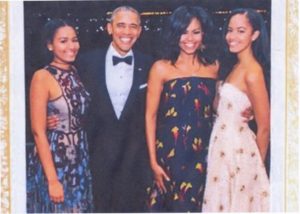
Obama’s last Christmas card

Barack-Obama-family
Image: White House

The first you know it’s getting close is when you receive the first Christmas card. Like many of you, though, we’ve been receiving fewer cards each year as friends and family switch to email and social media.

But it was so nice of Barack, Michelle and the girls to remember us! #dontleave

We are organising a ‘Secret Santa’ gift-giving ritual. This means if there are 10 people coming for Christmas dinner; each person buys one gift to an agreed value. The Secret Santa organiser assigns shopping tasks – “You can buy a gift for Auntie Val. I heard her grumbling last week that her pruning shears have had it.”

So rather than 10 people each spending about $599 (the average Christmas gift spend, according to a Commonwealth Bank survey), you each spend $50 and there’s a good chance the person receiving the Secret Santa gift will get something they actually want/need.

An international survey by ING Bank conducted in October found that 82% of Europeans received one or more gifts in 2015. One in seven (15%) were given something they didn’t appreciate, didn’t like or couldn’t use. The proportions were only slightly different in the US and Australia. Of the 15% who admitted to receiving unwanted presents, more than half kept them anyway. Others gave them to someone else (25%), sold them (14%) or tried to return them to the store (11%).

The Australian Bureau of Statistics has estimated that $798 million of the $8.8 billion spent on Christmas loot goes on unwanted gifts.

There are three basic options if you want to rein in your Christmas gift spending. The family could agree to (a) not buy gifts at all (b) organise Secret Santa or (c) donate money to organisations like World Vision or Oxfam; the latter uses the money to buy practical items for poor African villages. The gift recipient receives a certificate, which says something like, Congratulations (name), you have bought a goat for a village in Sudan. The certificate goes on to explain what a goat can mean for a poor African village. You can pin the certificate to your office noticeboard and feel virtuous for a whole year. (Or as Little Brother says, you could go to a country that doesn’t celebrate Christmas and give the whole circus a swerve.)

Some children get $200 cash and more!

The Australian and Securities Commission (ASIC) website Moneysmart, which aims to educate consumers, compiled an Infographic (see fact sheet link which shows how much money Australians spend on Christmas gifts. The average spent on gifts ranges from $401 (South Australia) to $548 (NSW). Sixty percent used savings when they went shopping, 20% used a credit card, 10% borrowed money from family and friends or used a bonus/tax refund and 10% used lay-by. Of those who used a credit card to pay for Christmas, 80% paid it off within three months.

Nine out of 10 children received some cash as Christmas presents with 20% receiving between $100 and $200 and 22% more than $200! Boys spent the cash on console games (45%), computer games (24%), and other games (22%), put the cash toward saving for a big item (31%) or banked it (43%). Girls spend the cash on clothes (40%), music (22%) and going out (20%), though 29% put the money towards saving for a big item and 45% put the cash in the bank.

Australians will spend all-up around $48.1 billion in the six weeks leading up to Christmas, with this weekend and December 23 and 24 identified as the bonanza shopping days. This massive spend includes $19 billion on food (we all have to eat) and $2.8 billion on on-line shopping. The Retailers Association of Australia and Roy Morgan Research say Victoria will show the biggest increase in spending ($11.6 billion, up 4.6% year on year followed by Queensland ($9.5 billion, up 4.2%).

And if you’re wondering on Christmas Day how Little Johnny could afford to give Dad the boxed set of Game of Thrones, ARA’s research shows that shoplifting will cost retailers $1.4 billion over the six-week period.

Of course buying gifts is only one part of it – then you have to buy wrapping paper and either wrap presents or pay a professional to do it for you. Australian Ethical and Clean up Australia provide some tips for people who feel bad about the 50,000 trees that get pulped every year to make your Christmas gifts look appropriately festive.

Australians use more than 8,000 tonnes of wrapping paper each year and, as Clean Up Australia chairman Ian Kiernan points out, foil sheets are hard to recycle. His suggestions for a sustainable Christmas include:

  • Rather than buying someone a physical gift like a CD, consider buying them a service, like a singing lesson;
  • Buy yourself a real Christmas tree – they smell fresh, last well, and are biodegradable through your green waste (they can also be planted out);
  • Cut back on gift wrapping, resize large cards to make gift tags, get creative with newspaper or magazines for wrapping presents and recycle the wrapping that you can’t use anymore.

“It’s not over till it’s over and you throw away the tree” (LWIII)

There is an unhappy trend to brand someone trying to moderate spending at Christmas as a Scrooge or a Grinch. The inference is we are spoiling the festive season by questioning excessive consumption.

And then there are Christmas cards, which come in ever-diminishing numbers, despite assurances that the market is doing better than ever.

The Greeting Cards Association of Australia says Australians spend $500 million on greetings cards and ours is the world’s third largest market per capita.

In the US, Christmas cards represent about 25% of the $6.5 billion greeting card market, where sales are steady, although profits are declining. Marketing expert Brandon Gaille expects global sales to keep declining as multiple issues confront the industry, including rising postal rates and competition from DIY cards and low-cost e-cards.

The Obama family sent out their last Christmas card this week, which created a sentimental outpouring around the hashtag #dontleave.

The cards are sent only to friends, supporters, White House staff and the media (which explains the hurriedly scanned copies on Twitter, Facebook and just about any traditional media outlet you can name).

The White House can afford to send out at least one million* cards featuring the Obama family’s last hoorah. Since 1960 the incumbent President’s political party has paid for this indulgence.

Back home, listeners told 720 ABC Perth the cost of postage is the overwhelming reason people are resorting to emails, texts and social media messages. I can vouch for this, having spent $70 at Australia Post sending a few calendars overseas and buying a dozen Christmas cards and stamps for friends who don’t do email.

Even though you get a 35c discount when buying card-only stamps, the high cost of postage is pushing more people to compose annual “e-letters” (complete with happy snaps).

But as one ABC Perth listener lamented, “You can’t really put an email on the mantlepiece, can you?”

*Ronald Reagan set the one million White House Christmas card benchmark in 1983 but was upstaged in 2009 by George W Bush Jnr (1.5 million).