
Why Human Beings Need a Hug

hug-isolation-love
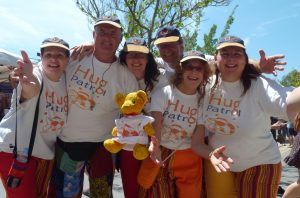
The Hug Patrol. Photo contributed by Arcadia Love

Forgive me, dear readers, for I have sinned (giving a hug in the privacy of my own home). A friend I had not seen for six months came to visit and the impulse to hug was too strong. We did the right thing to a degree, our heads facing away from each other, so the droplets would disperse in the same room, (where other people freely mingle).

You may have seen examples of people not observing the 1.5m COVID-19 physical distancing rule. Sneaks have taken phone footage in Brisbane nightclubs which show people mingling in close quarters and not sitting down to dance, as the Queensland Premier suggested.

The universal advice to maintain a physical distance of 1.5m from another person outside your immediate family makes sense. But it is hard to do and harder still to keep it up over an extended period.

The main reason is that human beings are just not designed to avoid physical contact with others.

New York Times writer Jane Brody writes that “social interaction is a critically important contributor to good health and longevity.

Referring to a long-term study by Lisa F. Berkman and S. Leonard Syme, Brody said findings drawn from 7,000 participants concluded that “people who were disconnected from others were roughly three times more likely to die during the nine-year study than people with strong social ties.

Physical contact can mean hugging, as championed by American folk songwriter Fred Small in his catchy ditty, The Hug Song. This version is by Brisbane musicians Donald McKay and Rebecca Wright, who compiled this video exclusively for FOMM. Warning: it’s an ear worm.

Late last year, we moved from a small village where, for a certain proportion of the community, hugging is the first thing you do on encountering friends, whether or not you saw them yesterday or six months ago. These are not perfunctory hugs either, but warm, tight embraces that last, well, sometimes they last longer than one party would prefer. I have it on good authority that the public hugging habit has abated in the village these past few months.

If you were a regular festival-goer in the first part of the new millennium. you might recall the Hug Patrol, initiated at Woodford in 2001 by actor/comedian Arcadia Love. Street performers roamed in small packs through the dusty byways of Woodford Festival, approaching just about anybody with open arms (asking permission first). The Hug Patrol is still turning up at festivals, carnivals, fetes, shows – anywhere where there is a crowd. Arcadia is understandably frustrated with the hug-less nature of 2020, saying that ‘virtual’ hugs are just not the same. The Patrol’s last live gig was at the Northey Street summer solstice in December 2019. The Hug Patrol’s deeds have touched people deeply, as writer Sandy McCutcheon said in a testimonial:

This extraordinary group of individuals has probably no idea of just what a positive impact they have.  I was fortunate to witness (at Woodford) the effect they had on a large group of refugee women from Afghanistan. For women whose lives are in tatters, families are scattered or dead, the rare moment of physicality was of tremendous importance.” 

Meanwhile The Conversation this week asked the most obvious question: “why are we all not wearing masks?”

There’s no doubt masks help stop the spread. A World Health Organisation study showed that face masks reduce the risk of infection with viruses such as COVID-19, by 67%, if a disposable surgical mask is used, and up to 95% if specialist N95 masks are worn.

The mask subject comes up often in community choir circles, where rehearsals are mostly still on hold and actual performances are being deferred to 2021. The theory about singers (and you’d have to ask why is it not the same for footballers who sprint 100m to score a try to be then piled upon by team members), aerosols can be spread up to 8m by singers (who don’t so far as I know, spit on the ground, or on the dressing room floor, or do that disgusting nose clearing thing ).

Plainly, a lot of people in Melbourne have not been maintaining physical distancing; nor, it would seem, have they been adhering to medical advice about social gatherings. The critical issue is, if you are feeling at all under the weather but have not been diagnosed, stay at home.

After the first month of the COVID-19 lock-down, the most common response you would get is, “I’m over it”.

Some of us spent 14 days in isolation, but in fairly comfortable circumstances, apart from not being able to leave home (except to walk the dog or buy groceries). I feel for residents in the public housing towers in North Melbourne, who up until today were not even allowed to do that. (One of the nine towers is still in very restrictive lock-down, the others have moved to ‘stage three’, like the rest of Melbourne.)

A Science Alert article on this subject (isolation and its ill-effects), said researchers based in Antarctica found that loneliness could be the most difficult part of the job.

Israeli adventurer and author Yossi Ghinsberg, who survived weeks alone in the Amazon, suffered loneliness, even creating imaginary friends to keep himself company. Which somehow reminded me of that Tom Hanks movie, where he is stranded on a desert island, alone except for a football called Wilson.

The degree to which isolation bothers you depends on your personality type (extroverts hate it). and your peer group. A report from Byron Bay about a ‘doof’ party that attracted thousands of young dance party goers, is an extreme example of how certain age groups find isolation and government-imposed health advice too inhibiting.

On the other hand, if you are a 70+ introvert with absorbing hobbies that can be performed alone in one room (Ed: who could he be talking about), the COVID-19 lock-down might not bother you at all.

So how much physical and social interaction does one have, in a typical day? If you are a checkout operator or a drive-through bottle shop attendant, quite a lot. Unemployed gamer, maybe not.

An academic study involving 7,290 participants was carried out in 2008 by researchers interested in reducing the spread of flu-like diseases. The first large-scale study of its kind, it found that respondents had on average 13.4 physical and non-physical contacts each day. The researchers recruited 7,290 people from eight European countries. They asked participants to keep a diary documenting their physical and non-physical contacts for a single day. Physical contacts included interactions such as a kiss or a handshake. Non-physical contacts, for example, might included a two-way conversation without skin-to-skin contact. The researchers concluded that the study provided a “deeper understanding of the transmission patterns of a hypothetical respiratory epidemic among a susceptible population.

If you take this study as a ‘norm’, how do these average interactions compare with 1,000 young people at a dance party or, as happened in Auckland on June 14, 43,000 people attending a rugby game?

We are not out of the woods yet, people, hugs or no hugs.

FOMM back pages

Arts Take Virtual Performance To Another Level

arts=virtual-choir
Pokarekare Ana

One evening in April, a Kiwi songwriter friend living in London posted a YouTube video by the London Humanist Choir, performing a love song in Māori. The video of New Zealand’s unofficial anthem, Pokarekare Ana, was, as we are now accustomed, a multi-screen video with choir members recording their parts remotely. I shared this with a few Kiwi friends who live elsewhere, knowing it would tug at the tendrils of homesickness, which are almost always waving in the breeze.

This video has had some 37,000 views – not bad for an arts group with 322 subscribers. The group’s social media curator coined the cute phrase, ‘Choir-antine’.

The group’s leader, Alex Jaye, started by giving the choir singers notes on how to record, mostly to minimise unwanted noise, distortion and filtering. Once he received the 20+ videos, he used EQ and compression to correct problems detected in the audio (often due to mobile phone microphones).

“Very little corrective editing (on individual videos) was used as it kills the sense of there being a choir – which does invite blemishes naturally as part of the sound.

Mr Jaye used iMovie to edit the video, utilising picture-in-picture, a technique often used in sports broadcasts.

“Overall it was around a day’s worth of work, however mostly due to video editing not being my forte, so I would say all told five to six hours’ worth of editing.”

In the same vein, a virtual video by Camden Voices does Cindi Lauper’s True Colours a lot of justice.

Like Alex Jaye, the UK choir’s director Ed Blunt started by giving singers instructions for filming the videos to a click track (metronome).

“It was a steep technological learning curve for me as I only had limited experience with video editing.”

He also converted the individual video formats into a uniform file type. The video was synchronised separately from the audio and the different grids were arranged and then exported (one at a time) to an editing programme (Premiere Pro). The audio tracks were synced and mixed in Logic.

My point, before we get too much further into this topic, is the value of such contributions to the community in general. True Colours (this version) has had 1.64 million views. If even 10% of the people who watched this sent Camden Voices $1, they would be able to top up their larder, probably bare these past months from a lack of paid performances.

True Colours:

Sunshine Coast choir director Kim Kirkman concurs with the complexities involved in editing a virtual video. He produced a Zoom video for female barbershop group Hot Ginger Chorus, performing Cindi Lauper’s Time after Time.

The audio part is the challenging part for me. I have to put 25 voices in line with each other and check that they are all correct. That takes quite a lot of time. The visual is very easy. I just do two runs through Zoom and then stitch that together over the top of the audio that I’ve done previously.”

Time after Time:

Musicians, performing artists, actors and dancers were quick to adapt the technology to the life of isolation. Anyone with a smart phone and the ability to film themselves could play. The production values on numerous videos by orchestras, jazz bands, country musicians and choirs have, for the most part, been outstanding.

The ‘Quarantunes’ series by the Nelson family (Willie and sons Lukas and Micah) is worth a look. Lukas, who wrote a lot of the music for the hit movie A Star is Born, is the one singing, in case you were wondering!

Turn off the TV and build a Garden:

Queensland Ballet is a local example of an arts company creating ‘mini-ballets’ to keep subscribers’ appetites whetted for next year’s season. On May 21, QB made the difficult announcement that it was postponing its 2020 season to 2021.

Queensland Ballet Artistic Director Li Cunxin AO said the company was planning a reintroduction of activity “in a cautious and methodical manner to optimize dancer and community safety”.

Mr Li said in a statement that the decision was also based on feedback from patrons that they may wish to wait until 2021 to enjoy ballet again.

“We have also undertaken economic modelling which has considered potential social distancing restrictions that would render any return to the stage as extremely costly and potentially detrimental financially to the company.”

If you are a ballet fan (and FOMM’s research suggests that readers are more likely to follow the arts than the NRL), you can donate money this month and a benefactor will quadruple your gift. So your humble $25 turns into $100 and so on. To keep the faith, QB is posting 60 short dance videos through the month of June.

Britain’s National Theatre has been filming live performances and streaming them every Thursday. The most recent play is Shakespeare’s Coriolanus, starring Tom Hiddleston. There was also a performance of Frankenstein starred Benedict Cumberbatch as the monster. Imagine!

This is high art delivered with a generosity of spirit while the theatre is closed to patrons until at least August 31. If you think about what tickets to live theatre cost in Australia, you could log on to PayPal and send them a few quid!

I rather liked comedian Sammy J’s Antique Roadshow piss-take recently where he evaluated the worth of a pair of tickets to a live event. As the faux antique owner says, “you mean people used to leave their houses?”

We might bear this satire in mind, given that this week the first patrons will be allowed into live rugby league games. The National Rugby League apparently pointed out that pubs and clubs were allowed to have up to 50 patrons on their premises (subject to social distancing rules). So, the NRL said, it was only fair that rugby league fans to be allowed in limited numbers, confined to the catering sections of stadiums.

It will be interesting to see if Fox Sports abandons its naff ‘virtual crowd’ audio, the sports equivalent of canned laughter in a comedy show where there is no audience.

Andrew Moore of the ABC’s sports show Grandstand left no room for ambiguity when he commented on this during a lull in play.

“When two players are down injured like this (a head clash known as ‘friendly fire’), the crowd would normally go quiet. Let’s have a listen (pushes window open). Nah, nothing! No fake crowd noise on the ABC, folks.”

Which is as good a point as any to observe that while arts communities were getting creative through the March/April covid-19 restrictions, the best Channel Nine (the home of rugby league) could come up with was re-runs of State of Origin matches from bygone eras. the transition over the next 12 months.

The best advice to choirs and singers in general is dire – there is no safe way to practice public singing while the coronavirus is active.

Dr Lucinda Halstead, one of the experts quoted in this paper, says physical distancing on a stage for a choir would not be possible:

“You would need a football stadium to space apart the Westminster choir”.

The reality is that normal transmission will not be resumed until social distancing ends (as is now the case in New Zealand).

Kia kaha (be strong).


Friday on My Mind –Ring Christmas Bells And Other Carols

Tapestry choir leader Kim Kirkman usually introduces our version of Carol of the Bells by mentioning that it featured in the soundtrack of the 1990 movie, Home Alone. This brought back memories of the parlous times in 1990 when media baron Rupert Murdoch nearly went broke. Yes, he nearly did, back when News Ltd’s total debt was a scary $7.9 billion (this was 1990, remember). What saved Murdoch was an agreement between 146 banks that refinancing was a better solution than the collateral damage from a collapsing global media empire.

The other thing that saved Murdoch was the box office success of the Christmas movie, Home Alone, starring Macaulay Culkin. Home Alone became the highest grossing Christmas movie of all time (adjusted for inflation) taking $US477 million in box office sales world-wide, against a film budget of $18 million. Murdoch’s Twentieth Century Fox was the beneficiary of the film’s success. As a recently-employed journalist, I wrote a piece stating just that (News Ltd saved by Home Alone).

The movie spawned four sequels, none of which achieved the heights of the original.

As we all now know, Rupert Murdoch’s foray into film, television and satellite TV paid off. The timely acquisition of 20th Century Fox in 1986 helped Murdoch achieve more fame and fortune via a then unknown animated show, The Simpsons. Launched modestly in December 1989, The Simpsons is still going strong, 649+ episodes later.

As one of the most popular TV shows on Fox Broadcasting, the creators of The Simpsons repeatedly got away with satirising the Fox Network. Animator David Silverman is said to have based the appearance of Homer’s boss Montgomery Burns on Fox chief Barry Dillon, using the body of a praying mantis as a model. Monty Burns is the fictional owner of Springfield’s nuclear power plant, a greedy tycoon who exploits his workers and can rarely remember their names. Hmmm, as Marge Simpson would say.

The crew of Sunshine Coast radio station Hot91 were asked to rate favourite Christmas movies for a feature in the Sunshine Coast Daily’s Weekend Magazine (also owned by Rupert Murdoch). All three DJs rated Home Alone, along with other candidates including The Grinch, Bad Santa (execrable-Ed.), National Lampoon’s Xmas Vacation, Elf, Santa Clause and Love Actually. The latter is cerebral and worth watching but I remember Home Alone as being deeply silly with some dangerous-looking stunts.

Christmas songs often get written about at this time of year, which is hardly surprising as you rarely hear them between January and November. Last year I ranked my top 12 Christmas songs (only three of which are carols).

As a member of a choir, you are expected to sing Christmas carols, which almost always lend themselves to harmonies. Our choir Tapestry racked up five performances this month, which is some kind of a record. As a serious chamber choir, we mixed it up a bit, from the ancient (Veni Veni, a Gregorian chant in Latin) to an irreverent piece about Christmas excess (The Banquet Fugue), and a short protest song (‘The Wrong Present’ aka ‘Don’t sing me Christmas Carols anymore’). We did a good job of the Little Drummer Boy and worked an uplifting key change into the last verse of Handel’s Joy to the World.

Thankfully, Kim elected to stay away from the tedious (12 Days of Christmas) and the seasonally irrelevant (White Christmas and Frosty the Snowman), although we did perform Rudolph and We Wish You a Merry Christmas for those who might have been thinking we were being a bit too precious.

This month She Who Sings O Holy Night (that was in Home Alone too), with me in tow attended quite a few Christmas parties where carol books were handed out. I got chatting to a chap who was hovering out in the kitchen (my usual retreat at parties). We discussed why people are so attached to these songs, so many of which are deeply pious, with their references to the Virgin birth, three wise men, the holy infant and home birthing in a stable.

Statistics on religiosity are unreliable; even though the 2016 Census tells us that only 52.1% of Australians identify as Christian, it is an optional question, which 9.1% chose not to answer. Otherwise, 30.1% answered ‘no religion’ and 8.2% nominated a faith other than Christian (including 2.6% or about 630,000 people, who follow Islam).

You will find other surveys which suggest that Christianity is in decline and that Australia is becoming more secular. Which begs the question why people who probably last entered a church for a wedding or funeral will happily sing along with Good King Wenceslas and Oh Come all Ye Faithful. Ah well, it is all about peace, love and goodwill so what’s not to like.

As you might suspect, however, I prefer Christmas songs that take the piss. This year’s award goes to Keir Nuttall’s classic Christmas Landfill, performed here by Keir and his partner Kate Miller-Heidke. The combination of a sweet Christmas melody and Keir’s satirical lyrics (‘fleeting joy will never decompose’) is just perfect, moreso with the help of superimposed lyrics. This video also includes KMH’s cover of Tim Minchin’s White Wine in the Sun.

I should follow this with a reassurance that I’m not dissing Christmas or the joy it clearly brings so many people. You can tell how serious I am by the inclusion of this video of Tapestry performing The Little Drummer Boy, The women had the melody, so the job for the basses and tenors was to imitate drums (hence heads buried in scores).

I should also clarify my remarks about Christmas carols and religious music in general by observing that the charismatic church Hillsong has produced Australia’s best-selling CD on a fairly regular basis. Sydney Morning Herald reviewer Bernard Zuel harshly but probably accurately described Hillsong’s 2015 Aria winning album Empires as a ‘churchy songbook sung by mostly anonymous faces scrubbed clean of any travails’. Nonetheless, the album sold 7,000 copies in its first week of release, 2,000 more than the debut solo album of former Silverchair songwriter Daniel Johns. Go figure.

Since we exposed you to Tapestry’s version of the Little Drummer Boy, let me leave you with this version by Johnny Cash and Neil Young.)

Merry Christmas from FOMM. Take care on the roads (said he who got a ticket in the mail from NZ). 

Re changes at FOMM: Next Friday you will all receive a link to a New Year blog. Thereafter, the weekly email will direct you to the website www.bobwords.com.au. Anyone can subscribe (email link at the top of the page) and of course unsubscribe at any time.

Thanks to those who have already responded to my (optional) subscriber drive for payments of a suggested $5, $10, $15 or $20 to defray the costs of running the website.

Payments can be made via PayPal or direct debit (follow this link www.thegoodwills.com/shop). The subscriber drive ends on January 31, 2019.